What Happened to the 12 Disciples?
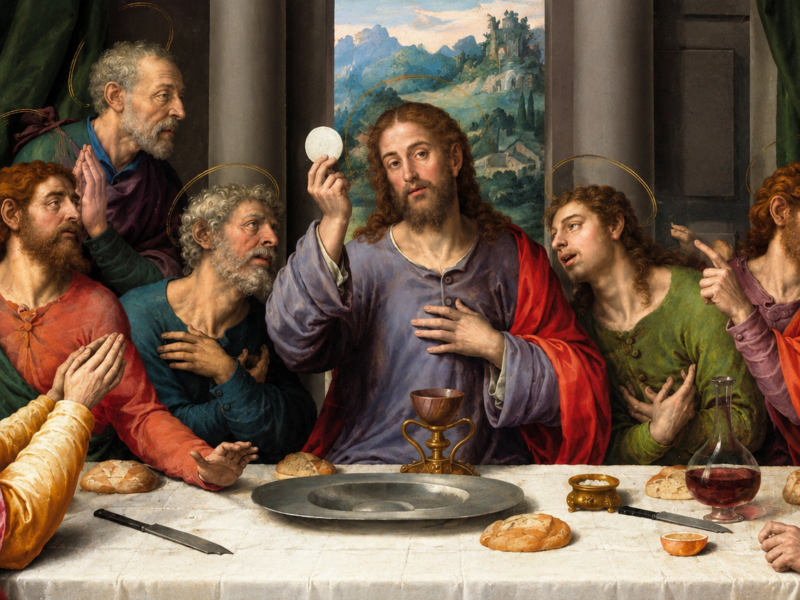
The disciples of Jesus are among the most important figures in Christianity. But what happened to them after the Bible?
It is said they traveled across the Mediterranean and beyond, founding some of the very first churches in Christian history. Then the story takes a darker turn.
According to legend, only one of them lived into old age. The other eleven met gruesome fates, and generations of artists have immortalized their final moments.
Before going through the twelve, a basic question: what exactly is a disciple?
Across the New Testament Gospels, the Bible lists twelve men who accompanied Jesus during his three-year ministry. Today we know them simply as the disciples, a word that comes from the Latin discipulus, meaning student.
But in reality, these men were not just there to learn. They lived and ate alongside their master, and many were given positions of authority. Perhaps a better way to see them is as apprentices, which is closer to the original Greek term, mathetes.
So what do we actually know about them after Jesus? Not much. With the exception of the Acts of the Apostles, the Bible says very little about what came next.
It is widely believed that the disciples traveled across the Mediterranean and beyond. In the centuries that followed, rumors began to spread about their various adventures. Curiously, nearly all of those stories end in tragedy, with one sole exception.
Let’s begin with the man traditionally placed first.
Of all the disciples, Peter is considered one of the most important, if not the most important. He may be one of the most significant figures in Christianity, and a key part of the transformation of a fringe Jewish sect into the religion we know today. He is also one of the most studied figures in history.
But who was the real St. Peter? Start with the name, because it was not originally Peter. He was known as Simon.
According to the Gospels, Simon worked as a fisherman on the Sea of Galilee alongside his brother Andrew. Jesus approached him and famously called him to become a “fisher of men.” From there, Simon emerges as a leader among the disciples and is always listed first.
Over time, he comes to recognize Jesus as the promised Jewish Messiah. Jesus then gives him the name Petros, the Greek word for rock, which is where the name Peter comes from. It leads to one of the best-known lines in the Bible: “You are Peter, and on this rock I will build my church.”
The line is often seen as establishing Peter’s authority for generations of Christians. Language buffs add that it is a bit of a pun, and probably funnier in the original Greek.
Historically, Jesus and his disciples likely spoke Aramaic, so Peter was probably called Kephas, the Aramaic word for rock. That name turns up in the writings of Paul, some of the earliest documents in the New Testament. This independent mention suggests Peter was a real historical figure, active in the early church.
Despite his leadership, Peter was not without flaws. The Gospels describe a man prone to outbursts, like the time he sliced off a soldier’s ear during the arrest of Jesus.
Later, he failed his master in his hour of need, denying three times that he knew him, an act announced by the crowing of a rooster. Yet he is among the first to witness Jesus’s return and is later forgiven and reinstated.
After Jesus’s departure, Peter emerges as the leader of the first Christian community, centered in Jerusalem. But the followers of Jesus still had enemies, and soon Peter was captured and imprisoned by King Herod Agrippa. His jail time did not last long, as an angel is said to have broken in and set him free.
From there, Peter appears to have traveled north to Antioch to establish another church. It was there that he met a new problem entirely.
According to the Acts of the Apostles, Peter encountered a Roman centurion named Cornelius, who wanted to be baptized. Under Jewish law, all members of God’s covenant had to be circumcised, a requirement dating back to Abraham. Did that apply to Cornelius, a non-Jew?
Peter set the law aside and baptized him anyway. The decision sparked controversy for some, but it also marked a quiet turning point in Christian history. Was this movement part of the wider Jewish faith, or something else entirely?
What happened later in Peter’s life is less well known. According to the next generation of Christian writers, he spent his final days in Rome.
By the first century AD, Rome was a vast metropolis of around a million people, home to soldiers, senators and emperors, as well as thousands of poor and enslaved people. It was among those masses that Christianity began to spread rapidly. A distinct Christian population grew in the city, and its increasing presence began to worry the Roman elites.
The historian Tacitus records that Christians in Rome were loathed for their “hatred of the human race,” and that sporadic violence against them was often welcomed. It came to a head in July of 64 AD, when a fire severely damaged the city.
The emperor Nero hastily blamed the Christians and ordered widespread persecution. If the rumors are to be believed, one of the victims was the apostle Peter.
Early histories say the saint had presided as the city’s first Christian bishop. Now a man in his sixties, his years of running had caught up with him. After the great fire, Nero’s soldiers captured him, and for his alleged crimes Peter was crucified upside down.
The scene is captured in one of art history’s most iconic paintings, Caravaggio’s Crucifixion of St. Peter, where men prepare the saint’s cross. The aged Peter seems composed, ready to accept his fate.
These stories have circulated since around the second century. It was around that time that a small church was established at the rumored site of his death, and it grew into a Christian center whose influence spread across the Mediterranean.
Rome’s powerful line of bishops came to be called Papa, or Pope, and could trace their line of succession back to Peter, the rock of the church. Today the great symbol of the Catholic Church is St. Peter’s Basilica in Vatican City, beneath whose marble floor the saint’s relics are rumored to lie.
Historians are more cautious about the details. The New Testament itself does not describe Peter’s death, and the upside-down crucifixion rests on later tradition. Believers counter that the Roman tradition is ancient and consistent, and that the early church guarded the memory of its leaders with care.
Either way, Peter’s life shows how a small Jewish sect grew into a network of churches across the Mediterranean, laying the foundations of a global religion. He is seen today as the greatest of the disciples and certainly Jesus’s closest follower.
That stands in contrast to the next figure on the list.
Judas Iscariot is by far the most infamous disciple. He was the man who betrayed Jesus, famously handing him over for thirty pieces of silver, and he remains one of the most controversial figures in all of Christianity. But who was Judas, and why did he do it?
Judas appears in the original list of the twelve, usually under his full name. Iscariot is a strange surname. One theory holds that it is a Greek rendering of an Aramaic phrase meaning the man from Kerioth, a town in southern Judea. If so, Judas would have been an outsider, the only disciple not from Galilee.
At first he plays a minor role, but he features in one telling incident. In John’s Gospel, Judas complains when Jesus has his feet anointed with expensive perfume, arguing that the money would be better spent on the poor. The Gospel adds that his concern was not for those in need. He wanted the money for himself.
But if Judas was so untrustworthy, why was he one of the twelve? It is a mystery in the original story. A few passages seem to suggest that Jesus already knew his fate, and that Judas had a role to play.
Jesus appears to know when Judas will betray him, most famously at the Last Supper, when he points out the traitor with the words, “What you are about to do, do quickly.” Judas then slips away to receive his payment from the chief priests and elders.
Curiously, the Bible offers two different motives. In Matthew and Mark, it is simple: greed. In Luke and John, Judas is possessed by Satan himself.
Whatever the cause, soldiers ambushed Jesus in the Garden of Gethsemane, led by Judas, who identified him with a kiss. It is a moment forever immortalized in another of Caravaggio’s haunting works.
According to Matthew’s Gospel, Judas was overcome with remorse and tried to give back the blood money. Rejected and consumed by guilt, he went to a nearby field and ended his life. That field is known as Akeldama, the Field of Blood.
For centuries, Judas has been viewed as an irredeemable figure of evil. In Dante’s Inferno he sits in the ninth circle of hell, chewed in the mouth of Satan for eternity in a great icy chasm.
That is the most common view, but not the only one. The Gospel of Judas, a late Christian text discovered in Egypt, seems to portray Judas as Jesus’s favorite disciple, told to betray him in order to fulfill a cosmic plan. Mainstream Christian tradition rejected that text as a later, Gnostic work, so the question stays open for readers: malevolent or misunderstood?
Next is Thomas, perhaps the most underrated of the twelve, especially as he may have traveled further than any other person on this list.
Thomas stayed loyal throughout Jesus’s ministry, but his leader’s death must have hit him hard. When reports came that Jesus had somehow returned, Thomas remained unconvinced. Despite the eyewitness testimony of the others, he declared that the only way he would believe was to see Jesus face to face and touch the wounds of the crucifixion.
“Doubting Thomas” has become a byword for the overly skeptical. Yet resurrection is not an everyday occurrence, even for a man who had seen Lazarus raised.
A week later, Jesus returned and proved to Thomas that he had indeed risen. Once again, Caravaggio’s painting, The Incredulity of St. Thomas, captures it best. Jesus gently guides Thomas’s hand into the wound left by the spear, and Thomas confesses his faith.
After that story in John’s Gospel, Thomas fades from the narrative. But in the years to come, stories of where he went next began to emerge. If they are to be believed, he went further than any other disciple.
In the southern Indian state of Kerala live the St. Thomas Christians, an ancient church that claims to trace its lineage back to the disciple himself. According to local legend, Thomas left the Holy Land and sailed along the spice routes of the Indian Ocean. Landing on the tropical Malabar coast, he preached to local Hindu Brahmins and even gained converts.
It did not take long for the strange visitor to attract unwanted attention. While preaching, he was set upon by a clan of warriors, and one of them ran a spear through his side, in the same place as his former master.
Locals are said to have preserved his relics, and his shrine became a site of pilgrimage. Today the remains are said to rest in St. Thomas Cathedral in Chennai, built by Portuguese explorers over the site of the original tomb. Even the spear that supposedly killed him is on display.
A trip to India may sound far-fetched. But early Christian histories do attest to the legend, the spice routes were well known in Roman times, and the St. Thomas Christians are indeed an ancient church that still thrives. Skeptics note that the earliest evidence is thin and much of it legendary. The debate is unlikely to be settled soon.
Then there is Andrew. Scotland, home of Robert Burns, Scotch whisky and the Highland Games, flies a national flag known as the Saltire. Once you know how it relates to St. Andrew, you may never look at it the same way again.
According to the synoptic Gospels, Andrew was originally a fisherman, called to follow Jesus by the Sea of Galilee. That association has stuck in Christian art, where he is often shown carrying a large net.
He is one of the most important of the twelve, and one of the few to hear Jesus’s strangest discourse, which outlines the signs of the apocalypse. On the Mount of Olives, Jesus tells Andrew and the others that corrupt prophets will one day emerge and falsely claim to be the Messiah. Violence will erupt across the earth, leading to the persecution of Christians and the apostasy of many.
Biblical historians find that discourse especially interesting. Many believe it reflects a genuine strand of Jesus’s original teaching, and perhaps the apocalyptic anxieties of the early Christian communities.
Like many on this list, Andrew’s fate is not recorded in the New Testament. Early Christian scholars filled in the gaps from the rumors they had heard.
According to early histories, Andrew left the Holy Land for a region called Scythia, loosely the steppes north of the Black Sea. Later medieval writers considered him an early apostle to the Slavs, who supposedly foretold that Kyiv would become a cradle of Orthodox Christianity.
After his travels, Andrew returned south and set up a church in the Greek city of Patras. In the year 60 AD, he was captured by guards and sentenced to crucifixion, this time on a cross shaped like an X.
After his death, his relics were sent to various churches, and it has long been rumored that some were taken to Scotland. The veracity of those claims is debated. Even so, a small monastic community developed on the coast of Fife, and that site is now the University of St. Andrews, one of the oldest universities in Europe.
At its center stand the ruins of a once great cathedral that allegedly housed the saint’s remains, destroyed during the Protestant Reformation. Because of this connection, Andrew is the patron saint of Scotland, and the Saltire honors his brutal manner of execution. The St. Andrew’s cross later became part of the Union flag of the United Kingdom. It is a shame, as the account wryly notes, that the Welsh dragon still cannot fit.
The problem with being called John is that everyone is called John. From John the Baptist to John of Patmos, the Bible is full of them.
The disciple in question is known as John the Evangelist, one of Jesus’s closest followers. Tradition links him to the Gospel of John, where he is often identified as the mysterious author known only as “the disciple whom Jesus loved.”
That Gospel was written between roughly 90 and 100 AD, so if the author was the same man, he must have been very old by then. Scholars remain divided on whether he was. In Christian art, John is easy to spot as the youngest of the group.
After the events of the Bible, John is said to have traveled across the eastern Mediterranean. According to the apocryphal Acts of John, he even performed miracles, such as raising a woman from the dead. The text was deemed heretical, yet illustrations of the story still found their way into medieval Christian art.
But there is one more reason John matters on this list. He was the only one who did not die a horrific death.
After his travels, John is believed to have settled in Ephesus, where he established a Christian school and died peacefully of natural causes in 98 AD. His relics were kept in a great basilica whose ruins can still be visited.
Ephesus became an important center of Christian learning. One of its most famous theologians, Irenaeus of Lyon, was a fierce opponent of the Gnostic Gospels. Irenaeus had been taught by a man named Polycarp, who had himself allegedly been taught by the apostle John, which gave Irenaeus a rare link back to the original ministry.
In any case, John is remembered as the last surviving member of Jesus’s original ministry, having outlived the other eleven.
Like his brother John, James the Greater shares his name with several others in the New Testament, including another disciple on this very list. This James earned the nickname “the Greater,” and he certainly earned his reputation.
According to the Gospels, James was a close disciple with a reputation as a firebrand. In one story, he and John visit a Samaritan village that is not overly welcoming. Insulted, James asks Jesus whether he should call down fire from heaven to destroy them. Naturally, Jesus declines.
Because of his eager, perhaps impulsive personality, Jesus gives James and his brother a curious nickname, Boanerges, a word with no direct meaning. Many scholars think it could be a corrupted version of an Aramaic phrase meaning “sons of thunder.”
James is also one of the few disciples whose death is recorded in the Bible. In the Acts of the Apostles, he is executed by King Herod’s soldiers, which makes him the first of the twelve to be martyred.
His life may have been short, but a great deal of legend attached to it, especially in Spain. According to medieval Spanish chroniclers, James briefly traveled west before his martyrdom and arrived in the Roman province of Hispania.
One famous story says he saw a vision of the Virgin Mary standing on a pillar, who asked him to build a church in her honor. The apparition vanished, but the pillar stayed behind and still stands in the Cathedral-Basilica of Our Lady of the Pillar in Zaragoza.
James then returned to Jerusalem and was martyred. His faithful followers brought his relics back to Spain and, as the story goes, hid them in the northwestern region of Galicia.
Today that site holds the great cathedral of Santiago de Compostela, one of the most important pilgrimage destinations in Europe. Every year thousands of visitors pray at the tomb of the apostle, as they have for centuries. Historians, however, doubt that James ever set foot in Spain, and the legend appears in sources far later than his lifetime. For many pilgrims, the centuries of devotion matter more than the proof.
As the patron saint of Spain, St. James, or Santiago, features heavily in the nation’s myths. In the medieval era he became a symbol of the Spanish people, particularly during the Reconquista, when Muslim rulers were driven from the peninsula. In one battle, he was said to have appeared miraculously on a white horse to help the Spanish Christians.
That image of James as a crusader was later used in the Spanish conquest of the Americas. Church artworks in Peru often show him as a conquistador trampling indigenous warriors beneath his horse. It is a complicated legacy, though perhaps a fitting one for an apostle nicknamed a son of thunder.
Philip is one of those disciples who is often overlooked, but his history is fascinating all the same. He is a minor figure in the Gospels, and his real moment of fame comes in the feeding of the five thousand, one of the few miracles recorded in all four.
In the story, Jesus sees a great crowd approaching and decides to test Philip, asking him where bread could be bought for so many hungry people. Those familiar with the tale know Jesus had a plan all along. Beyond that, Philip barely gets a mention.
There is one interesting theory about his name. Philip is not what you would expect from an Aramaic-speaking laborer. It is a Greek name, so many believe he was probably bilingual, which would explain why some stories cast him as an apostle to the local Greeks.
After the Gospels, Philip fades into the background. Many apocryphal sources describe his later life, such as the Acts of Philip, which explore his preaching across the Mediterranean colonies. Others credit him with authoring the Gospel of Philip, a much later Gnostic text that set out some of the core beliefs of that breakaway sect. Scholars generally reject that attribution.
Setting those books aside, many histories end Philip’s story in Hierapolis, in modern-day Turkey. In 80 AD, a local Roman governor is said to have ordered him strung up and crucified. Even then, the story goes, Philip kept preaching from the cross and won new converts in his final moments.
In the centuries that followed, Hierapolis became a pilgrimage site, and archaeologists have long searched for the saint’s remains. One breakthrough came in 2011, when a mysterious tomb was found with inscriptions linked to the disciple. Researchers also found several sixth-century bread stamps that appear to show Philip, a nod to his role in the feeding of the five thousand, with the same image of his tomb in the background.
In the Duomo of Milan stands a sculpture of St. Bartholomew. At first glance it seems pleasant enough: a tall, muscular man in a long, flowing robe. Look closer, and he is a little too muscular, and the robe is a little too skin-like.
For anyone who has not heard the story, a warning. This disciple has the worst fate of them all.
First, the name. He is often called Bartholomew, a Greek form of Bar-Tolmai, Aramaic for son of Tolmai. In the Gospel of John he is called Nathanael, so perhaps his real name was Nathanael bar Tolmai.
Whatever he was called, he does not feature prominently in the Gospels. That left early Christians plenty of room to create one of the most gruesome legends in Christian history.
According to the historian Eusebius of Caesarea, Bartholomew traveled to Armenia, where he converted the pagan king to Christianity. Not everyone in the royal family was so keen. The king’s brother, enraged, ordered Bartholomew tortured and executed.
The punishment was flaying: his skin was removed from his body. The tradition has produced some of the most horrifying Christian art ever made, much of it showing the saint carrying his own skin as if it were a loose cloak.
It inspired the Milan statue, sculpted by Marco d’Agrate in 1562. Despite its ghoulish appearance, it is considered one of the great sculptures of its era, with carved musculature and intricate anatomical detail.
His suffering, believers say, was not in vain. Christianity kept a foothold in Armenia in the years that followed, and in 301 the kingdom officially adopted it as the state religion, becoming the first Christian nation in history. That is why Bartholomew is the patron saint of the Armenian church. He is also, as the account wryly adds, the patron saint of leather workers.
When the Roman Empire annexed Judea, it extracted harsh taxes from the population and hired locals to do the dirty work. That is where we meet Levi, a tax collector who was almost universally disliked. The exception was Jesus, who curiously called him to be one of the twelve.
The scene appears in another Caravaggio painting, The Calling of St. Matthew. In a darkened room lit by a beam of light, a finely dressed man sits among fellow tax collectors, pointing at himself in confusion. Only then do you notice Jesus in the corner, partly hidden in shadow.
Despite his disreputable origins, Levi proved a loyal follower and was renamed Matthew, a name that means gift of God in Hebrew. Little else is said about him in the Bible. According to later histories, he traveled south to the African kingdom of Ethiopia, a land with strong ties to the ancient Jewish religion.
There, he preached the gospel and even converted the king’s daughter. As in the story of Bartholomew, the act enraged the king’s brother, who ordered the apostle killed while he prayed at an altar.
Today the Ethiopian Orthodox Church is considered one of the oldest Christian churches in existence, with its own biblical canon that includes the apocryphal Book of Enoch. Matthew is regarded as the apostle of that nation.
He has another claim to fame: the Gospel of Matthew, one of the most important texts in the Bible. Tradition holds that the disciple wrote it himself, collecting Jesus’s sayings into a single document.
Most biblical scholars today are more skeptical. They believe an anonymous author wrote it around 80 AD, reworking parts of the Gospel of Mark and possibly another text known as the Q source, whose material also appears in Luke. The Gospel was probably the work of second- or third-generation Christians, who had not known Jesus in person but had heard eyewitness accounts, and Matthew’s name was likely attached to it in the decades that followed.
Now a challenge for the reader: remember this next disciple. It will be hard, because he is, sadly, a little forgettable.
James, son of Alphaeus, is the second James among the twelve, and we know very little about him. He appears in the lists of the apostles and almost nowhere else. When Christian writers do mention him, it is usually to tell him apart from James the Greater, with diminutive titles such as James the Minor, James the Lesser or Little St. James.
Despite his obscurity, early Christian artists did not forget to give him a gruesome death. When the saint appears, he is often shown carrying a large club, the symbol of his martyrdom. Wait, who are we talking about again? Moving on.
When it comes to biblical names, some are a little tarnished. Such is the case with Jude, who must not be confused with Judas Iscariot. For that reason, this loyal disciple is sometimes called Thaddeus.
Jude Thaddeus does not feature prominently in the Gospels, but he may have a role elsewhere in the New Testament. Near the end of the Bible is a very short letter, the Epistle of Jude, which warns that the Christian community is under threat. Impostors have crept into the church, it says, people who claim to be moral but seek only to enrich themselves.
The author then cites biblical characters who showed their faith. Curiously, one of his sources is the Book of Enoch, an apocryphal writing banned from mainstream biblical canons. As with many on this list, there is debate over whether Jude actually wrote the letter.
After the Gospels, Jude is said to have traveled around western Asia. Many stories take him to Armenia, where he met Bartholomew, and as we have seen, it was a doomed mission. No wonder Jude is the patron saint of lost causes.
He was martyred in Armenia, but the Christian community survived. The monastery of St. Thaddeus still stands today, with an original building dating to the third century, one of the oldest churches in existence.
The final disciple is often depicted carrying a large saw. By now, you can probably guess why.
Simon the Zealot is a curious figure. The word zealot has made it into English from the Bible, but in its original context the Zealots were a radical and violent political movement. As the Roman Empire governed Judea, they rose up and fought for the freedom of the Jewish people.
Little is known about Simon, but it is striking that a man with revolutionary politics would be linked to Jesus. After all, while Jesus was viewed as the Jewish Messiah and a descendant of King David, his message is generally one of peace. Perhaps Simon came to understand that the so-called king of the Jews was more interested in a different kind of kingdom.
In the centuries that followed, Christian legend said Simon traveled to Persia to spread the faith. That is where the saw comes in. According to the apocryphal Passion of Simon and Jude, the locals sawed him in half.
Simon seems to have renounced his violent ways, but the Zealots would go on fighting their oppressors, and the region erupted into all-out conflict. During the Jewish War, the Romans destroyed Jerusalem and its sacred Temple. The event would change the fate of Christianity forever, as many fled their homeland and established churches across the Mediterranean.
Across English primary schools, a popular rhyme helps children remember the fates of Henry VIII’s six wives: divorced, beheaded, died, divorced, beheaded, survived. The twelve disciples could use a similar rhyme, though it is hard to know what rhymes with “flayed alive by Armenians.”
It is fair to say that being a disciple of Jesus carried one of the highest mortality rates going. The exception, of course, is John, the only disciple said to have been spared a brutal death. For the other eleven, it often ended badly.
Why did the disciples all seem to suffer such excruciating fates? There is a real historical reason, and it points to how these stories were told.
Throughout these legends, the artworks show the disciples in their final moments, yet their expressions are usually serene. The reason is that, since early Christianity, martyrdom was seen as a holy act.
From the very beginning, Roman elites were nervous about Christians, especially because they refused to worship at the imperial shrines. Christianity required followers to renounce all other gods, including the emperor. Christians were treated with skepticism and distrust, which soon boiled over into violence.
Nero blamed them for the fire of Rome, and in later years emperors like Diocletian ordered mass persecutions and the destruction of church buildings. Despite the threat of the lions, many Christians would not renounce their faith even when death was certain. Their martyrdoms were seen as witness to unwavering loyalty, and they echoed the courage of their spiritual leader, whose death is the central symbol of the religion.
Times have changed, and this is not something anyone should imitate. But early Christian writers appear to have treated martyrdom as a template for devotion. Before long, almost all stories of the saints were stories of martyrdom, and that included the disciples of Jesus.
Over time, tales emerged of their bravery in the face of cruelty, all in service of their faith. That is why, in these paintings, you sense serenity blended with suffering.
Historians add a note of caution here. Many of these death stories come from legends written long after the events, and not all of them can be confirmed. Believers reply that the memory of the martyrs was treasured from the earliest days, and that the traditions, taken together, point to men who really did give their lives for their faith.
The twelve disciples, give or take, laid the foundations of Christianity, the largest religion in world history. Their stories offer glimpses into the lives of the historical figures they represent, and into the world of early Christianity and the people behind the New Testament writings.
And there is more. Other texts exist, lost books allegedly written by the disciples, like the infamous Gospel of Judas, associated with the Gnostics, who represent the earliest heresy in the history of Christianity. What happens next in that story is another chapter entirely.









