What Amish Midwives Are Ordered to Burn After a Birth, I Buried Three Instead
The fire had already caught in the kindling before my hands stopped it.
I remember the smell first, sweet hay underneath everything, and something sharper laid on top of it.
Something copper and warm that I had smelled a hundred times before that night, and would smell a hundred times again.
Someone had wiped the cloths down already.
Folded them the way I had taught the younger girls to fold them, corners in tight as a letter.
The deacon set the bundle in my arms behind the Hostetler barn, and told me, the way he had told me once before, exactly what I was to do with it.
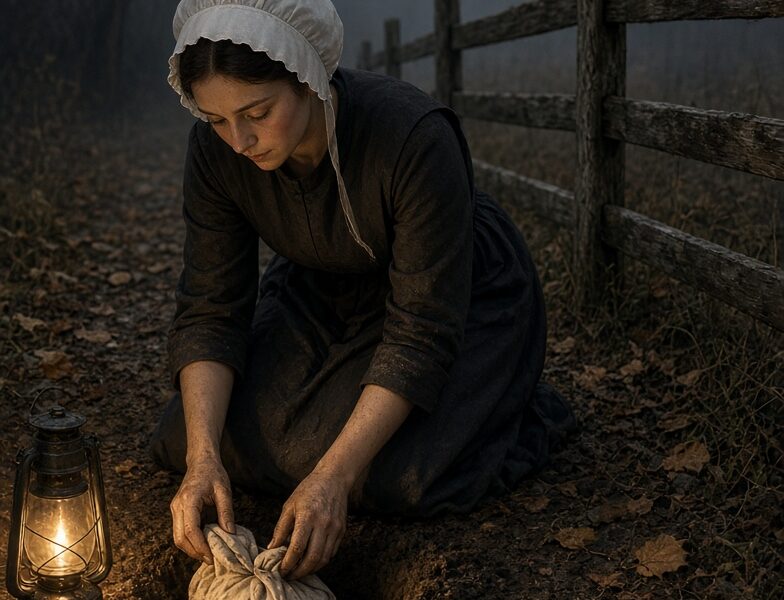
My knees were wet through from the October ground.
I was twenty-four years old.
In my apron pocket sat a small blue tin that had once held strike matches, given to me the week I was made midwife of that district, and I had used it the way I was meant to use it every time before that night.
I held the bundle over the flame long enough for the deacon to walk back toward the house, his lantern swinging low against his leg.
Then, I did not light it.
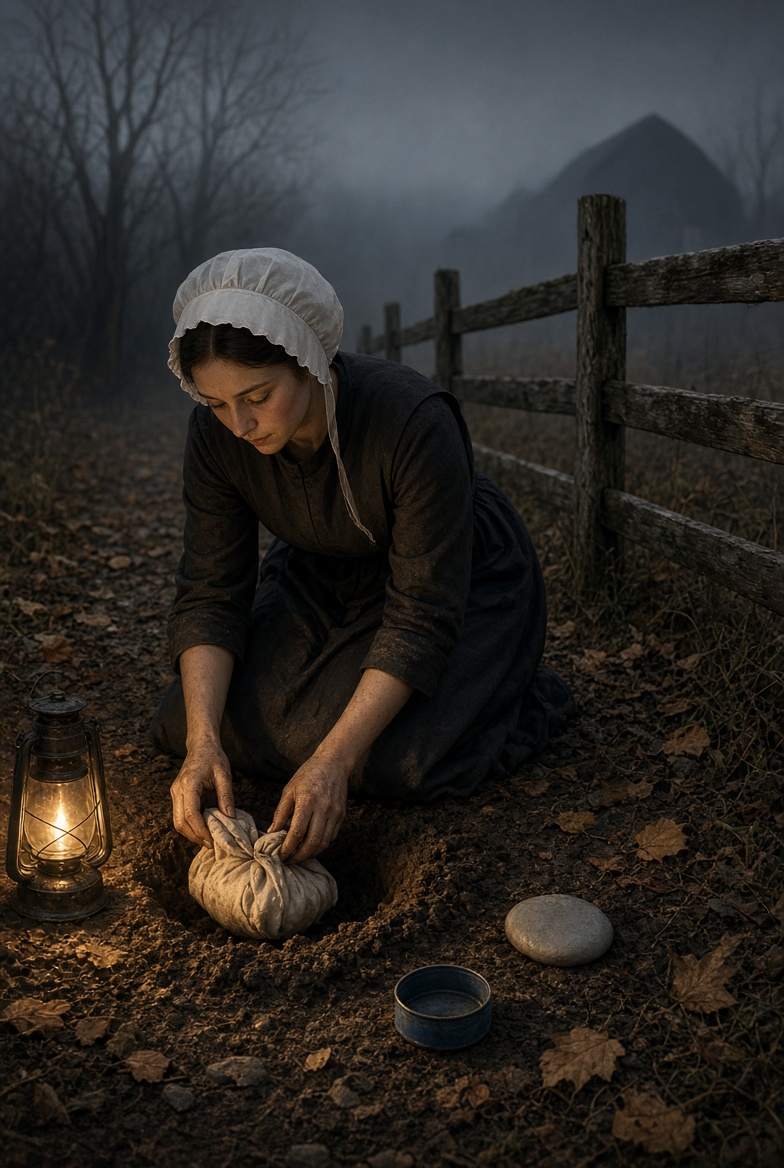
I dug instead six inches down at the fence line where the mower never reached, and I put the bundle into the ground with my own two hands.
That was the first time I disobeyed.
It would not be the last.
And by the third time I did it, what happened behind that barn would end the only life I had ever known.
My name is Rachel.
For thirty-one years, I served as a midwife inside an Old Order settlement in Holmes County, Ohio.
I delivered close to four hundred babies in that time, and I sat with families through the best nights of their lives and through the very worst ones.
This is Rachel the Amish midwife.
And this channel holds the stories from the bedside my community never allowed me to say out loud.
Births that went right.
Births that went wrong.
Faith chosen over medicine more times than I could ever count.
And children I was ordered to erase as though they had never once drawn breath.
Before I go further, if these stories are reaching you the way they were meant to reach someone, subscribe, tap the bell, and tell me in the comments where you are watching from tonight.
Now, let me tell you what send it back clean actually meant inside that district.
And why I finally stopped saying yes to it.
In that world, a birth is not only a beginning.
It is a judgement.
Read the way weather is read or a harvest.
A healthy child born easily in the right order to a married couple in good standing is received as a small proof that the family walks correctly with God.
A birth that goes wrong is read the same way.
Only backward.
A baby who does not live.
A baby born with something visibly different about its body.
A baby conceived before the wedding.
No matter how carefully that was managed and hidden.
Any of these inside certain districts is treated less as a tragedy than as evidence.
Not of the ordinary cruelty of biology, but of something unconfessed sitting inside the house itself.
Nobody says this plainly.
I never once heard a bishop stand and preach it outright.
But I heard the shape of it in a hundred small sentences over three decades.
The way you learn the shape of a room in the dark by the places you keep bruising your shins.
“What is not spoken of was never carried by this house,” the bishop said to me once, early on, when I asked why a family whose son had died within the hour was not permitted so much as a stone in the burying ground.
And when a birth was judged this way, the instruction to the midwife was always the same three words, spoken low, usually by the deacon, sometimes by the bishop himself.
“Send it back clean.”
The cloths.
The gown, if one had been sewn in hope beforehand.
The cord.
Anything that had touched the child in its one hour or its four days, burned before the next sundown.
The ashes scattered along a fence line, so that no single spot could ever be visited or named again.
No entry made in the family Bible.
No grave.
The mother was expected to rise from her bed within the week and return to her work as though a season had simply passed rather than a child.
I want you to understand that this was never explained to families as cruelty.
It was explained as mercy, a way of sparing a woman a permanent marker of her sorrow, a way of letting a household move forward instead of building its life around a stone.
I believed that explanation myself for longer than I am proud of.
It took me years of watching what actually happened afterward to understand what the instruction really cost.
I watched women go quiet in a particular way that never fully lifted.
A stillness that sat behind their eyes even at weddings.
I watched husbands stop mentioning a month that had once meant something to them.
The way you stop mentioning a name after enough silence has taught you not to.
Grief that has nowhere to stand does not disappear.
It only stops having a name.
And a thing without a name is much harder to carry, not easier.
I remember one woman, years into my work, who asked me quietly, months after her own loss, whether I thought her baby had gone somewhere good.
I told her I believed he had.
She looked at me a long moment and said, “Then why is there nowhere I am allowed to go to be near him?”
I did not have an answer for her that night.
I am not certain I have a complete one even now, though I have spent decades trying to build one out of everything I saw.
The first time I was given the order, I obeyed it exactly because I did not yet understand what I was being asked to do.
It was a girl, born still to a young couple two years married, in the spring of 1986.
I was new enough to the work that I trusted every instruction handed to me without turning it over first, the way a young nurse trusts a chart.
I burned the bundle behind their barn while the mother lay inside with her sister’s arms around her.
And I told myself, walking home in the dark afterward, that I had just done something merciful.
I did not understand then what I understand now.
It was not a mercy.
It was a policy dressed carefully enough that a good and tired young midwife could carry it out without asking who it actually served.
The second time was different, though I did not see the difference until I was already kneeling in the dirt again two years later.
Esther Miller was thirty-one, married nine years, and had lost three babies before this one.
A boy born at seven months, breathing for perhaps ninety seconds before he stopped.
His chest working the way a bird’s does after it has struck a window.
Esther’s mother-in-law stood in the doorway of the birthing room the entire time, arms folded across her apron, and said only one thing to me before I left with the bundle.
“Send it back clean, Rachel. She has had enough sorrow already without a stone to visit.”
I want to tell you I heard something wrong in that sentence right away.
I did not.
I heard something almost gentle in it.
The old woman reaching for the only language she had to try to spare her daughter-in-law a permanent marker of loss.
It was only later, walking home with my kit banging against my hip, that I understood the sentence carried two meanings folded into one.
And that the second meaning was the true instruction underneath the first.
Esther was not being spared sorrow.
Esther was being prevented from having anywhere to put it.
That night, I buried the bundle instead of burning it, thirty yards from where I had buried the first, near an old fence post leaning hard to the east, and I told no one, not even my husband, who slept through my absence the way he slept through most things that year.
I marked the spot the only way I dared.
I pressed a single flat stone into the dirt above it.
No name on it, nothing carved into it at all.
Nothing a person passing by would ever notice as a marker of anything.
Between those two burials and the third one, there were years I have not mentioned yet, and I want to be honest about them because they were not years of quiet resolve.
They were years of doing the work exactly as instructed over and over, while something in me kept a private ledger it would not let me look at directly.
I burned four more bundles in that time.
I stood over four more small fires behind four different barns, and told myself each time that this one was different, that this family’s circumstance had truly required it, that I was not the kind of woman who would let a sentimental attachment to ceremony put a grieving household through more than it could bear.
I believed that story about myself for a long time.
There was one gentler year in the middle of all of it, the summer of 1990, when nearly every birth I attended went easily, and every mother lived, and every child breathed on the first try.
And I remember standing in a kitchen holding a healthy boy while his father wept with relief rather than grief.
And thinking that this ordinary, unremarkable joy was most of what the work actually was.
I needed that year.
I think most of us need at least one season like that to keep going at all.
But by the fall of 1991, I was back at a different fence line with a different bundle.
And the ledger inside me had grown heavier than I let myself admit.
That fall, it was Katie Bontrager, twenty-two, her first child born with a condition I did not have a name for then and would not have a name for until Diane gave me one many years later.
The baby lived nine days.
Katie’s husband would not come into the room after the fourth day.
Not because he did not love his son, but because he did not know what a man was supposed to do with a grief that had already been declared by everyone around him to be something that should end quietly and quickly.
On the ninth night, I sat with Katie while the baby’s breathing slowed and she asked me a single question.
The kind of question that does not require an answer so much as a witness.
“Will anyone remember he was here?”
I told her I would.
It was the only promise I had any authority to make.
And I have kept it in the only way left to me, by telling you his name does not appear anywhere in this video, the way it never appeared anywhere else either.
I burned that bundle.
I want to be honest that I did not bury everyone that came after Lavina’s brother in the ledger of my memory.
Obedience did not end the night I dug that third hole.
It only cracked.
And it kept cracking slowly for years after.
The way ice does before it finally lets a person through.
If this story is reaching you the way I hope it is, take one moment now to like this video and subscribe.
Every person who does tells me this story matters to someone besides me.
And after all these years, that still means more than I know how to say.
The third time was Lavina Schrock.
And Lavina was the one who changed everything.
Because Lavina was the one who asked me a question I could not answer with a lie.
She was nineteen, unmarried, and had come to me in her seventh month asking me to keep her confidence as long as I possibly could.
I delivered her in secret in a cousin’s cabin three miles from the main settlement.
On a night in November with the temperature already well below freezing and the water in the basins skinning over with ice between uses.
The baby was a boy, born breech, born alive, and he lived four days before his lungs simply gave out the way they sometimes do with breech babies born a little too early.
Lavina held him the whole four days.
She did not sleep.
She ate almost nothing.
And what little I could get her to take, she took only because I put the spoon directly to her mouth the way you do with a child.
On the fourth night after he was gone, the deacon arrived.
Someone had told him.
I never learned who, and I have stopped trying to guess.
And he stood in that cold cabin and gave me the same three words he had given me twice before.
“Send it back clean.”
And Lavina, who had not spoken to him at all until that moment, said one sentence I have carried every day since.
“He does not even get a name.”
It was not a question.
It was the truest sentence I heard inside that community in thirty-one years.
And it landed in that room like something dropped from a height.
I did not answer her.
I could not.
I took the bundle, walked out into the dark alone.
And instead of a fire, I dug a third hole.
This one closer to the tree line than the first two.
Deep enough that no dog would find it before spring.
I pressed a second flat stone above it, the way I had for Esther’s.
And then, because something in me had finally come loose after two silent burials, and one spoken sentence I could not get out of my ears, I did something I had never done before.
I took the small blue tin from my apron, the same tin still holding the last of the strike matches I had never once used for their intended purpose.
And I buried it beside the stone instead of carrying it home.
It felt at the time like laying down a tool I no longer wanted to be trusted with.
I did not fully understand what that gesture would cost me until the following spring, when a boy chasing a loose calf found freshly turned earth near the fence line, and mentioned it to his father over supper, the way boys mention any strange thing they find.
There is a part of this story I cannot tell you here.
Not on this platform, not under these rules.
The algorithm has limits, and I have learned exactly where they sit after all this time.
So, I wrote the rest of it down instead, slowly, without the softening, without the cuts.
Everything the camera is not permitted to show, including what was actually said to me the night the deacon came back to that fence line with two other men and a lantern, and what Lavina’s letter said in full.
The book is called The Births They Never Recorded.
Forty-six pages of what I actually witnessed at those bedsides.
No softening, no cuts.
The link is in the first comment of this video.
That is where the part I could not say out loud lives.
By the second year after Lavina, I had started keeping a private record of my own.
In a notebook I hid inside a flower tin at the back of my kitchen cupboard.
Dates, initials only, never full names.
A private ledger of every child the community had asked me to erase.
I did not yet know why I was keeping it.
I only knew that if I did not write something down somewhere, it would be as though none of those children had existed at all.
And I found I could not bear that a second longer than I already had.
There was one more birth that spring, a healthy girl born to a young couple three farms over from my own.
And I remember holding her in the lamplight and feeling, for just a moment, an ordinary and uncomplicated happiness that had nothing to do with anything I was carrying underground.
I mention it because I do not want you to think every night of that decade was heavy.
Most of them were not.
It was the few that were that stayed.
Lavina left the district that spring before the ground had fully thawed.
I do not know everything that happened to her afterward.
I know she went to live with an aunt somewhere past Millersburg, and I know she wrote me one letter, three lines long, that I still have folded inside my Bible.
I have never been able to find out what became of her after that letter, whether she stayed inside the faith in some other district or left it entirely, whether she ever had another child, whether she ever went back to that fence line at all.
Some part of her story simply stops on my end at three sentences on a folded page, and I have made a kind of peace with not knowing the rest of it, though it is not a complete peace.
It never quite is.
The deacon found the second stone that same spring, not the third.
He never learned about Lavina’s boy at all.
That grave stayed hidden for eleven more years until I told my own daughter about it the week I finally left the community.
And by then, it did not matter to anyone what had or had not been found.
What mattered was what happened once he found the one he did find.
I was called before the ministers within the week.
I sat on a hard bench in a farmhouse kitchen while three men who had known me my entire adult life asked me to explain why I had disobeyed a direct instruction not once but twice.
The bishop asked first, not unkindly, “You understand what you have done.”
I told him I understood exactly what I had done, and that I had done it with my eyes open both times.
He asked me why.
I told them the truth plainly, the way I had learned to speak at bedsides for two decades.
I told them a stone with no name on it had never once endangered a single soul, and that I could not go on pretending a fire did what a fire cannot do.
One of the deacons leaned forward and said the same three words I had heard behind three different barns.
“We send it back clean, Rachel. That is the way it has always been done.”
I said the only thing I had left.
“Then I am the one who stopped.”
What it cost me came quickly after that, and I will list it exactly the way it happened, because the plain facts carry more weight than anything I could add to them.
My standing as district midwife ended within the month.
My name stopped being spoken at the quilting circle I had attended for nineteen years.
Three families who had once called me at two in the morning without a second thought delivered their next babies with someone else.
A letter I wrote to my own sister that winter came back four weeks later unopened, the seal still intact.
I do not tell you any of this to make myself out to be brave, because I was not only brave, I was also afraid and confused.
And there were nights I lay awake certain I had done something unforgivable rather than something necessary.
And some mornings still, I am not entirely sure which one it was.
I want to be honest about something else, too, because it matters as much as the rest of it.
That community was not only the fence line and the fire and the deacon’s three words.
It was also women who sat up with me through hard labors for no pay and no thanks at all.
And a faith that for most families, most of the time, held people together through things that would otherwise have broken them apart alone.
I do not hate what I left.
I loved it.
And it is entirely possible to leave a thing you loved because it finally asked you to do something you could no longer do and still call yourself honest.
Some years later, after I had left the community entirely and was living in a small rented house in town, I sat in a counselor’s office across from a woman named Diane trying to explain why I still dreamed about a blue tin box more often than I dreamed about almost anything else in my life.
I told her about the three stones.
I told her about Lavina’s sentence, the one that still arrives in my ears some nights exactly the way it sounded in that cold cabin.
She was quiet for a while after I finished.
And then she said something I have never forgotten.
“What you’re describing is disenfranchised grief. Grief a person isn’t permitted to name or mourn out loud because the people around them have decided it doesn’t count.”
I sat with that sentence for a long time after I left her office that day.
I had spent three decades believing the problem was simply that those children had died.
Diane helped me understand that the deeper wound was that their deaths had never been allowed to exist at all.
Not in a record, not in a conversation, not even in their own mother’s permission to grieve them out loud in front of another living soul.
Before Diane, I had seen those three burials as something I had done in spite of my faith.
A small, private failure of obedience.
Afterward, I understood them differently.
They were the only funerals those three children were ever going to get, and I had given it to them without fully knowing what I was doing at the time, as the one thing the system was built from the ground up to withhold.
If you grew up in a place, whether it looked anything like mine or nothing like it at all, where certain kinds of pain simply were not allowed to be spoken of out loud, I see you.
If you have ever stood at the edge of a loss that everyone around you had quietly agreed to pretend had not happened, and you carried it alone because carrying it alone was the only option anyone gave you, I see you.
If you have ever done one small, quiet, disobedient thing, a stone with no name on it, a letter kept instead of thrown away, a date you never let yourself forget because it was the only way you knew how to say that a life had mattered, I see you, too.
And I want you to know that thing you did counted, whether or not one other living soul ever knew about it.
I do not hate the world I came from, even now, all these years later.
It gave me my hands, my patience, and thirty-one years spent at the most sacred bedsides a person can ever sit beside.
And I carry that gift forward as much as I carry the rest.
I still keep a small blue tin on the windowsill above my kitchen sink.
An ordinary one I bought at a hardware store here in town.
Empty of matches, holding nothing at all but three smooth stones I carried out of Ohio the week I left.
I did not plan to keep it there.
I only know that some mornings I look at it while the coffee is brewing.
And it is enough some mornings simply to look.
If this is resonating with you, take one moment to subscribe and like this video.
Every person who does tells me this story reached exactly who it needed to reach.
And tell me in the comments if you ever had your own version of that fence line.
The quiet place where you kept something the world had told you not to keep.
I read every single one.
What I carried out of that community I carry here.
So that what happened in the dark does not stay there.









