What Amish Husbands Can Demand Behind Closed Doors, I Finally Refused After Baby Four
The Night Everything Changed
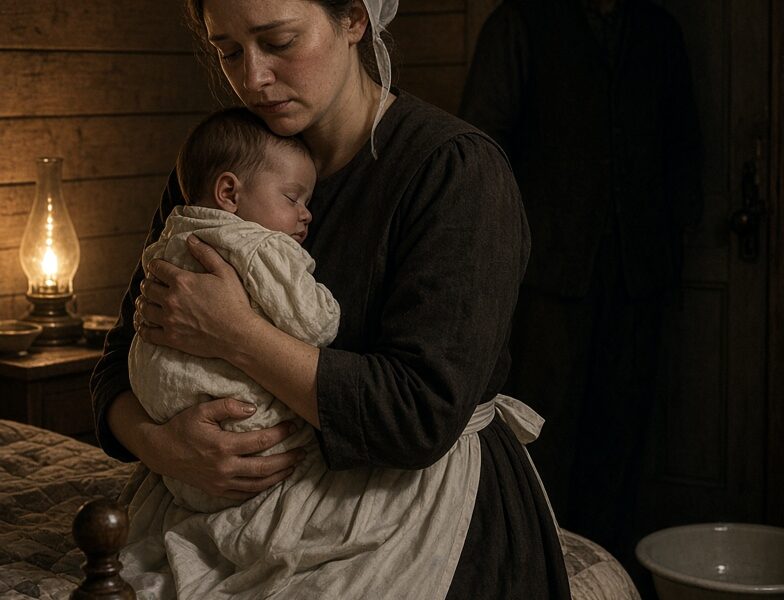
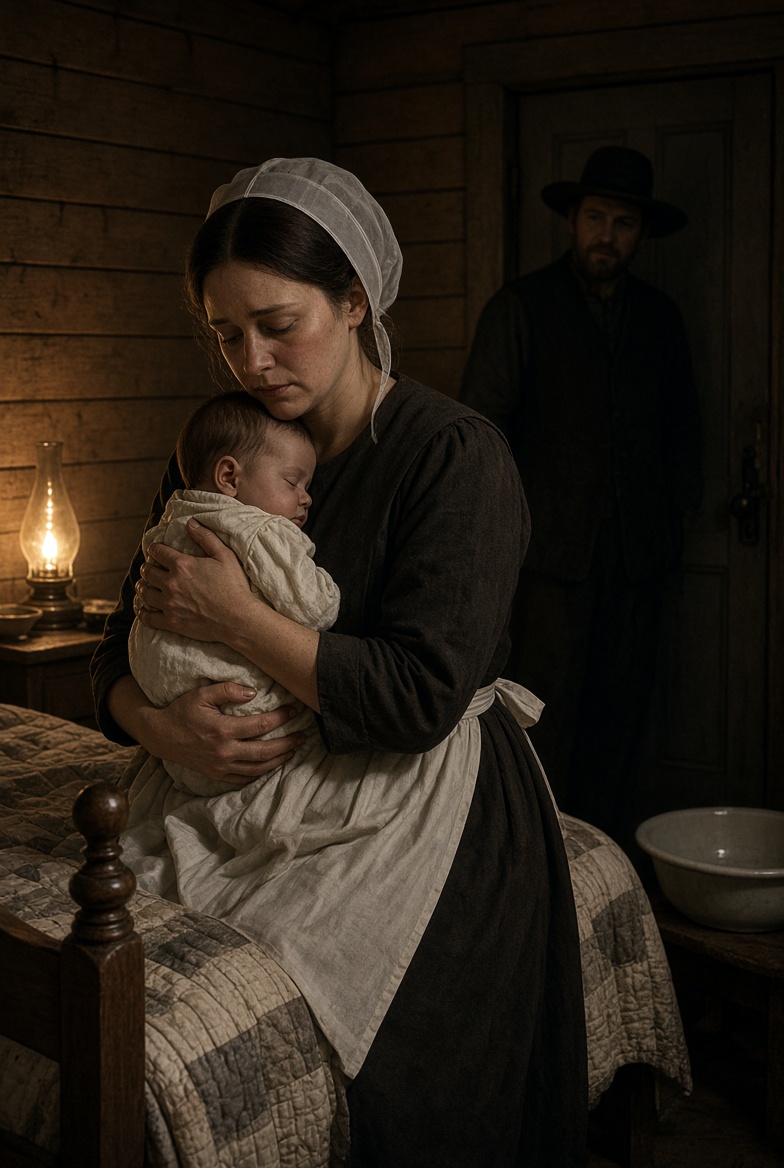
The baby had finally stopped crying when I heard the bedroom floorboard creak behind me. It was a little after ten, and the house had gone quiet in the way our house only did after everyone was asleep. I remember the smell of wood smoke in the room, the weight of the baby still warm against my chest, and the ache in my back from carrying him most of the day.
I had been up three times the night before. My hands were cracked from washing. There was flour under one fingernail that I had not managed to scrub out. And when my husband closed the door, I knew what he expected before he said a word.
That night, after four babies and years of believing a good Amish wife was supposed to accept whatever her husband asked behind closed doors, I said no.
My name is Katie. I grew up Old Order Amish, and I share these stories because there are parts of our life that outsiders rarely see, especially the parts that happen quietly inside a home where everybody is trying to be faithful and nobody wants to admit when something hurts.
If you have ever been taught that being good means never disappointing the people you love, tell me in the comments. That was a lesson I carried much longer than I should have.
What I Was Taught About Marriage
When I married, I was young enough to believe that marriage would answer questions nobody had ever allowed me to ask. We did not talk openly about intimacy in the way many people do now. There were no long conversations about expectations, boundaries, fear, or what it might feel like to become a wife overnight.
The women around me spoke in hints. A look across the kitchen table, a sentence that stopped halfway, a warning disguised as advice. My mother once told me, a few days before my wedding, “A peaceful home depends on what a woman is willing to carry.”
At the time, I thought she meant work—cooking, laundry, children, canning, gardening, church meals, mending, keeping your voice low when you were irritated, getting up before everyone else and going to bed after everyone else. I did not understand how many different meanings could fit inside the word carry.
My Husband Was Not a Villain
My husband was not a man who shouted often. That is important for me to say. People hear a story like this and sometimes imagine a villain who announces himself plainly. Mine did not.
He worked hard. He was respected. He helped neighbors raise barns. He brought in firewood before storms. He could repair almost anything with an engine or a belt. When one of our children was sick, he worried even when he tried not to show it.
That made everything harder to understand because the part of our marriage that frightened me did not look frightening from the outside. It looked ordinary. It looked like a closed bedroom door. It looked like a wife who was tired and a husband who believed marriage had already answered the question for her.
After Our First Baby
After our first baby, I was exhausted in a way I had never known was possible. The labor had been long. My body felt unfamiliar. The baby woke often, and because I was nursing, most of the nighttime care fell to me.
During the day, life did not stop because I had given birth. There were meals to make, clothes to wash, floors to sweep, vegetables to preserve, visitors to receive, a baby to feed again and again.
People were kind in practical ways. Women brought casseroles. My sister came twice to help with washing. My mother held the baby while I slept for nearly an hour one afternoon, and I remember waking with my cheek pressed into the pillow, confused because the house was so quiet.
But nobody asked me the question I needed somebody to ask: “Are you comfortable saying no?”
I do not think most of the women around me would have known how to answer it themselves. In the world I grew up in, marriage was described as a covenant, and the husband was understood to carry authority in the home. Different families lived that out differently. Some husbands were gentlemen who never used that teaching as a weapon. Some wives spoke their minds freely and were respected for it. But there were also women who learned very early that disagreement could be called rebellion, and there were husbands who learned that leadership meant they were entitled to the final word.
Behind closed doors, that belief could become something even heavier.
The First Time I Tried to Refuse
The first time I tried to refuse my husband, I did not really refuse. I apologized. That is the strange thing I remember most clearly. I said I was sorry before I said what I needed.
The baby was only a few months old. I had a headache and had barely slept. I told him I was tired. He went quiet. Not angry. Just quiet. Then he reminded me that we were married. He did not have to explain what he meant.
I had heard enough sermons about marriage, enough whispered advice from older women, enough jokes from men that stopped when women came near. A wife belonged with her husband. A wife should not create temptation. A wife should not use affection as a weapon. A wife should not make her husband feel rejected.
I had heard all of those ideas in one form or another. What I had not heard was that a wife could be exhausted and still be worthy of tenderness. What I had not heard was that marriage did not erase the meaning of the word no.
So I stopped arguing, and afterward I told myself that this was simply part of being married. That sentence became a hiding place. This is simply part of being married. I used it when I was tired. I used it when I was sick. I used it during pregnancies when everything in me wanted rest. I used it when I felt resentment rising and was ashamed of myself for feeling it.
By the Second Child
By the time our second child was born, I had become skilled at making my own discomfort seem unimportant. That skill can look a lot like peace from the outside.
I still smiled at church. I still made pies for visiting Sundays. I still stood beside my husband while people told us we had a beautiful young family. And we did have beautiful children. That is another difficult part to explain. Something painful can exist beside something precious. I loved my babies so fiercely that sometimes I felt guilty for connecting the exhaustion of motherhood with the fear I had started to feel at night.
After our third baby, I began sleeping lightly. I would hear my husband come down the hallway, and my body would tense before my mind had decided anything. Sometimes he only wanted to check the stove. Sometimes he was coming to bed. Sometimes he would lie down and fall asleep within five minutes, but I had already learned to listen for footsteps.
That is what fear does when it has nowhere to go. It turns ordinary sounds into warnings.
My Sister’s Words
One winter evening, when our third child was about a year old, I was washing jars at the kitchen sink. Snow had been falling since afternoon, and the windows had turned dark enough that I could see my own reflection in the glass. My older sister was visiting. She had married several years before me.
We were alone for a few minutes because the children were with our husbands in the other room. I do not know what made me say it. Maybe I was tired. Maybe I wanted someone to notice me. I asked her, “Do you ever feel like you are not allowed to be tired?”
She stopped drying a jar. For a long moment, she did not answer. Then she said very quietly, “Being a wife does not make you stop being a person.”
That was all. She did not ask for details. I did not give any, but the sentence stayed with me. Being a wife does not make you stop being a person. I carried those words for years before I had the courage to act like I believed them.
The Fourth Pregnancy
My fourth pregnancy was the hardest. By then, I had three small children and a household that seemed to multiply work while I slept. I was nauseated longer than I had been with the others. My ankles swelled in the summer heat. I would sit on the edge of the bed in the morning and count to ten before standing because I felt dizzy.
My husband noticed some of it. He took over evening chores more often. He carried heavy baskets. He told the older children to let me rest.
That kindness confused me, too. How could a man be considerate in one room and dismissive in another? I spent a long time thinking that if someone was good in many ways, I had no right to name the place where he was hurting me.
The Woman Who Brought Bread
When our fourth baby was born, I was twenty-eight. The baby arrived before dawn after a night that felt endless. By sunrise, I was shaking from exhaustion. For several weeks afterward, I moved through the days as if my body belonged to everybody except me. The baby needed me. The children needed me. The house needed me. My husband needed me. The church needed us to show up.
There was always another need. I began to wonder when I was allowed to have one.
About six weeks after the birth, an older woman from our community came by with bread. She was not someone I knew especially well. She had raised eight children, and I remember thinking she moved with the calm confidence of somebody who had survived many hard seasons.
She watched me lower myself slowly into a chair. “You are sore,” she said.
I laughed because I did not know what else to do. “I am fine.”
She looked at me for a moment. Then she said, “You do not have to call pain fine just because you can endure it.”
I have never forgotten that sentence. Maybe she meant only my body after childbirth. Maybe she meant more. I never asked, but after she left, I stood alone in the kitchen and cried. Not loudly, just tears falling while I cut the bread she had brought.
You do not have to call pain fine just because you can endure it.
That was the second sentence that changed something inside me. The first came from my sister. The second came from a woman who may never have known what she gave me.
The Night I Finally Refused
The night I finally refused happened a few months later. It had been a difficult day. The baby had cried through much of the afternoon. One of the older children had a fever. Supper burned because I was trying to settle the baby and forgot the pot for too long.
By nine, the kitchen was finally clean. By ten, the children were asleep. I sat in the bedroom with the baby against my chest. The lamp was turned low. My husband came in after checking the animals. He washed at the basin, changed his shirt, and closed the door.
I knew that feeling immediately. That old tightening, that calculation. How tired am I? How angry will he be? Can I make myself disappear enough to get through this without an argument?
Then I looked down at our baby. His fist was curled against my dress. He trusted me completely. And for some reason, seeing that tiny hand made me understand something I had refused to understand about myself.
I was somebody, too. I was not only a wife. I was not only a mother. I was not only the person who kept everyone else comfortable. I was a human being standing inside my own life.
My husband came closer. I told him I was exhausted. He said something like, “You are always tired now.” There was frustration in his voice. Normally, that would have been enough to make me surrender the argument before it began.
That night, I did not.
I said, “Then hear me anyway.”
He stared at me. I could hear the clock in the other room. The baby made a small sound against my chest.
My husband said, “I am your husband.”
And I said, “Yes, that is why you should care whether I am afraid of you.”
The Truth Between Us
I had never said anything like that to him, not once. His face changed. He looked hurt first, then angry, then confused. I think he had expected resistance he could dismiss as tiredness or moodiness. He had not expected me to name fear.
The room felt very small. He asked me what I meant. So I told him—not everything. I could not have told him everything that night, but I told him enough.
I said there had been many times when I had not wanted what he wanted and had believed I was not permitted to refuse. I told him that I had learned to dread the sound of him walking down the hallway. I told him I had felt guilty for being tired. Guilty for being sore. Guilty for wanting my own body to be left alone.
He said, “I never forced you.”
That sentence landed hard. Because from his point of view, maybe he believed it. I had rarely fought. I had rarely shouted. I had rarely said the word no clearly enough for him to hear it as no. I had learned that refusal was dangerous before I ever tested it. So I had softened every boundary until it sounded like a request.
I said, “You did not need to hold me down. You knew I believed I was not allowed to refuse you.”
He did not answer.
For the first time in our marriage, we sat in the same room with the truth between us and did not rush to cover it.
The Days After
He slept downstairs that night. Not because I ordered him to, but because neither of us knew how to lie beside the other after that conversation.
I barely slept. Part of me felt relief. Part of me felt terror. I wondered whether he would speak to the bishop. I wondered whether I would be accused of denying my husband. I wondered whether my mother would tell me to be more patient. I wondered whether our marriage had just broken because I had finally said one honest sentence.
The next morning, I expected anger. Instead, my husband was quiet. He ate breakfast. He helped one of the children with a boot. He left for work without saying much.
For nearly three days, we moved around each other carefully. Then, on the third evening, he asked if we could talk.
The Conversation That Mattered
We sat at the kitchen table after the children were asleep. He did not apologize immediately. I wish I could tell you he understood everything at once. He did not.
He defended himself. He reminded me of what we had both been taught. He said he had never believed he was hurting me. He said husbands had needs, too.
I listened. Then I told him something I had never been brave enough to say: “Your need does not become my duty just because you call it marriage.”
He flinched. So did I. Even hearing myself say it felt dangerous. But I did not take it back.
That conversation lasted more than two hours. There was no dramatic ending. No perfect apology. No sudden transformation. But something had changed because I had finally refused to participate in pretending.
The Months That Followed
Over the next months, our marriage became harder before it became healthier. He had to face the difference between being obeyed and being trusted. I had to learn that setting a boundary was not the same thing as being cruel.
There were days when we fell back into old patterns. There were moments when he became defensive and moments when I became so afraid of conflict that I stopped speaking.
But the word no existed in our marriage after that night. Not as a threat. Not as punishment. As a complete sentence. And slowly, he began to understand that being chosen freely meant more than being obeyed automatically.
What I Wish Someone Had Told Me
I wish someone had told me that before I married. I wish someone had told him, too. Because boys in our community were shaped by the same silence. They were taught authority without always being taught the responsibility that should come with it. They were told to lead, but not always taught how carefully a person must hold power over someone who loves them.
Some men understood that instinctively. Others did not. Silence gave the worst interpretations room to grow.
When I look back now, I do not think the most important moment was the argument itself. It was the moment before it. The baby against my chest, the low lamp, the floorboard behind me, the realization that I had spent years waiting for somebody else to give me permission to belong to myself.
No one came. I had to say it.
What I Understand Now
That changed the way I understood marriage. Love is not proven by how much discomfort you can endure without complaint. Faithfulness is not the absence of boundaries. Peace is not the same thing as silence. And being a wife does not mean becoming less human.
I still think about the words my sister gave me beside the kitchen sink. Being a wife does not make you stop being a person. I understand them differently now. At the time, I heard them as comfort. Now I hear them as a responsibility, too. If I expect another person to recognize my humanity, I have to be willing to speak when it is being ignored.
That was difficult for me because I had spent so much of my life trying to be good. I wanted to be a good daughter, a good church member, a good wife, a good mother. But I had confused goodness with disappearing. They are not the same.
For Anyone Who Needs to Hear This
If you are listening to this and something in my story feels familiar, I want to say this carefully. You do not have to prove your love by becoming silent about pain. You are allowed to name what frightens you. You are allowed to expect care from someone who says they love you.
And if a boundary is only respected when the other person agrees with it, it was never really being respected.
That is what I understand now. Not that marriage should be easy. Ours was not. Not that two people will never disappoint each other. We did. But love cannot depend on one person losing the right to say no.
A Final Thought
Before I go, I also wanted to tell you that my new book, The Ninth Day, is out now. It is the first book in The Katie Journals. And if you would like to read it, you will find the link in the description. Writing it gave me a way to explore some of the quieter choices that can shape a whole life—the kind people do not always see from the outside.
If you want to hear more stories about what Amish life looked like from inside our home, subscribe and stay with me.
And tell me in the comments: when do you think obedience stops being a virtue and starts becoming fear?
I read more of your answers than you probably realize.









