What Amish Husbands Are Told While Their Wives Are in Labor, I Was Never Supposed to Hear It
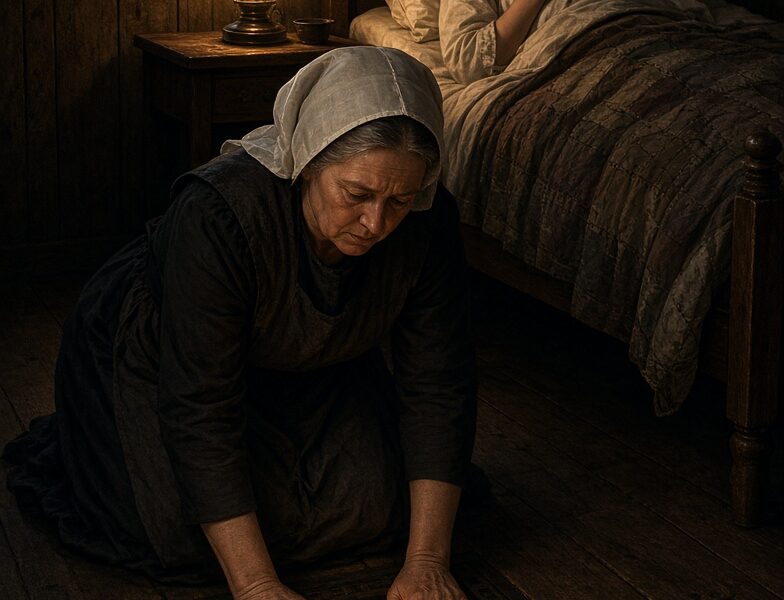
At ten minutes to two in the morning, I knelt on a bedroom floor with my palms flat on an iron grate, and it was warm, and it printed a pattern of small squares into my skin.
Behind me, a girl of twenty-one breathed through her teeth and waited for the next pain.
Through the grate came the smell of wood smoke and boiled coffee, and a man’s voice, level and low, counting.
I could hear him counting in the gaps between the words, the way you can hear someone touch their fingers one by one.
Then he said the first thing, and I stopped breathing, because I knew at once that I was hearing something no woman in that house was meant to hear.
The floorboards under my knees were cold. The lamp behind me hissed.
I held still and listened, and I counted them myself on the iron slats under my hands.
There were six, and after the sixth, he lowered his voice so far that the floor swallowed it.
I am going to tell you what a husband is told on the night his wife labors, in the order it was told to him, because I have never forgotten a word.
My name is Rachel, and this is Rachel, the Amish Midwife.
I was the district midwife for twenty-eight years in an Old Order settlement in Pennsylvania.
I caught more than a thousand children.
I finished the eighth grade and not a day more, and everything else I know about a woman’s body I learned from my aunt Saloma and from the women themselves.
Tonight is about a conversation held on the floor below a woman while she was in labor.
Before I go on, I need you to know that nobody in that kitchen was acting out of hatred.
I will say that again before the end, because it is the hardest part to believe.
There is a black cloth ledger I kept for twenty-eight years. I still have it.
Before we are finished tonight, I will tell you why it was the one thing I carried out of my house the night I left, and what I can still read in its blank lines that nobody else alive can.
In this world, the night of a birth is two nights.
Upstairs are the women, the midwife, the mother, perhaps an aunt with a basin.
Downstairs are the men, and the men have a night of their own.
It is called sitting with.
The minister or the husband’s father or both come to the house after supper and sit with the husband in the kitchen until the child is born.
It is a kindness, and nobody in my district would have called it anything else.
A frightened young man is not left alone.
But the women upstairs know something the men rarely think of.
A farmhouse is built to hold heat.
The cook stove sits in the kitchen, and above it, cut into the bedroom floor, is a square of cast iron with slots in it, so that the warmth can climb the stairs without anyone having to carry it.
Heat rises through that grate.
So does sound.
The women of my district had known that for two hundred years, and had told no one, and had never once been asked.
We were told over and over from the bench and at the quilting and across the wash line that the Lord needs no ledger from us.
It was said about records and about complaints and about the way a woman might have felt about anything at all.
The thing not written down was the thing that was safe, and the thing said aloud in a kitchen at two in the morning was the thing that was safest of all.
A midwife stands in the doorway between the two nights.
She is upstairs with the women until dawn, and she sits down at the table with the men to eat the breakfast that follows.
It made her, in the eyes of that district, a kind of ambassador, someone who moved freely between the two sides of the floor.
It made her the one person everyone assumed had been told.
It was not cruelty. It was inheritance.
It was the absolute conviction that a man on the worst night of his life needed instruction the way a drowning man needs a rope.
Not because they wanted to keep anything from their wives, not because they were afraid of them, because it had been done for them on their own worst nights by men who loved them and knew nothing else to give.
The cost was a woman on a bed with the most important conversation of her life going on directly beneath her in a low voice with the heat coming up through the floor.
In October of my seventeenth year as district midwife, I was called to the Shrock farm at seven in the evening.
Sarah Shrock was twenty-one and this was her first child.
Her husband Noah was twenty-two, with hands like shovels and a habit of apologizing to the furniture when he bumped it.
By nine, the women who had come to help, Sarah’s mother and two aunts, had gathered their shawls and gone home.
It was always so.
On the night of a first birth, I asked Sarah’s mother why she was leaving when the labor had scarcely started.
She said the house had to be quiet.
I did not ask what the quiet was for.
I had been a midwife for seventeen years, and I had never once asked.
Mennow Hostettler arrived at ten with a thermos of coffee and a Bible he did not open.
He was sixty, the minister of our district, a broad, slow man with a white beard cut square, and I had known him all my life.
He had sat at my own father’s bedside.
He took off his hat in the kitchen, and I heard the low rumble of him and Noah’s father, Reuben, and Noah, and the scrape of three chairs.
Then I went upstairs and closed the bedroom door, and forgot them, as I always had.
The Shrock bedroom lay directly over the kitchen in the oldest part of the farmhouse, where the floor was only a single layer of pine.
It was the first time Sarah hummed hymns between her pains, one after another, and I stood at the window and watched the frost come up the glass in feathers and thought that I had never in my life been so content in a cold room.
By ten to two, my hands were stiff from the cold, and Sarah was in the long middle of her labor, breathing through each pain and going quiet between.
I knelt at the grate to warm my fingers.
That was all I meant to do.
The heat came up through the iron, and with it came his voice, and I heard him say, “Noah, there are things a husband is told on this night, and the midwife is not to hear them.”
I did not move. I stayed on my knees. I did not move.
He said the first thing so evenly that I thought at first he was reading it.
A husband stays below. A man on the stairs is a man who has stopped trusting the Lord.
He said the second.
A husband does not ask the midwife what she sees. She will tell him what is fit to be told.
He said the third.
The pains are as long as they are long, and a woman’s cries are not a summons.
I pressed my hands harder into the iron.
The fourth.
If it goes hard, the household will decide what is done, and the household is Noah and his father and the minister, and the wife is not to be troubled with it.
The fifth.
Whatever the Lord does before morning, a husband does not question the hour.
And the sixth, in a lower voice.
Afterwards, we do not speak of this night. Not to her, not to each other.
I sat back on my heels with the squares of the grate still printed in my palms.
Behind me, Sarah had raised her head from the pillow.
She was watching me across the room, gray-faced, her braid stuck to her neck.
She had been watching me listen.
She said, “What are they saying?”
I said, “Nothing that matters.”
I said it the way you say the word rain.
I have wished for twenty-two years that I could unsay it.
She looked at me a moment longer.
Then the next pain took her, and she turned her face into the pillow.
At ten minutes past three, Sarah’s daughter’s head was born and the shoulders would not follow.
I knew what that was.
I had seen it eleven times in my life, and it was the one thing in all my work that I feared without shame.
The baby’s face was going the color of a plum.
Sarah was too tired to hold her own knees, and the mother, the aunts, everyone who might have held her legs, had been sent home at nine so that the kitchen would be quiet.
I could do it alone with a strong pair of arms beside me, and I had none.
I went to the top of the stairs.
I did not run. I was afraid that if I ran, I would not be able to stop.
I said, in a voice I did not recognize, “Noah Shrock, I need your hands.”
Mennow’s voice came back up the stairwell, level as a plumb line.
“Noah stays below, Rachel.”
I said, “I heard all six, Mennow.”
Nobody spoke.
It was the longest silence of my life, and I would guess it was three seconds.
Then a chair went back and boots crossed the kitchen floor, and Noah Shrock came up the stairs two at a time with his face the color of milk and the minister’s hands still on his sleeve.
He shook it off.
I do not think he knew he was doing it.
I put his hands under his wife’s knees and folded them back against her chest, and I set the flat of my fist above her pelvic bone and pressed down with everything I had.
The baby came in one long slide all at once. A girl. Slick and blue and silent.
I turned her over and rubbed her back, and for what felt like an hour and was perhaps twelve seconds, nothing happened.
Then she drew a breath and yelled.
I cut the cord and wrapped her in flannel and laid her against her mother.
Noah reached out one enormous finger as though he were afraid of breaking something, and she closed her whole fist around it.
Her fingers were the size of green bean pods.
He looked at that hand for a long time.
Noah sat down on the bed with his wife’s foot still in his hand and wept without any sound.
Sarah reached out and put her palm against the side of his face.
She said, “You came up.”
He said, “I was told not to.”
She said, “I know what they told you.”
She was not looking at him. She was looking at me.
“I heard it through the floor,” I said.
“So did I,” she said. “I thought you knew, Rachel. We all thought the midwife was told.”
I stood at the foot of that bed with a wet cloth in my hand and understood that I was not the only woman in that district who had ever knelt at a warm iron grate.
I was only the first who had ever said so out loud.
The next Sunday, I did not go to Mennow. Mennow came to me.
He stood on my porch with his hat in his hands and told me in the mildest voice imaginable that the night at the Shrock farm had been a matter of men, and that he would prefer it stayed one.
I said I would sit where I was put.
It was not a promise. It was only the truest sentence I could find that would not begin a war.
From that night on, when I attended a first birth in a house where a council would be held, I came down the stairs at ten with my knitting and sat on the milking stool beside the woodbox.
I did not speak. I did not look at the men.
I turned the heel of a gray sock and turned it again and again until the council gave up and became a conversation about corn prices.
In eleven years I sat on that stool in thirty-three kitchens.
A midwife has no right to sit in the men’s council.
But I was a guest with a bag, and a guest may sit where she is put, and the bag was in the kitchen.
It cost what such things cost.
Mennow stopped meeting my eye.
The men’s bench stopped growing quiet when I walked past, which was worse, because it meant they had stopped noticing me at all.
The black ledger was asked for on the first Sunday of every month and returned to me on the second.
A lamp burned in the minister’s window on the nights I worked, and I understood that it was meant to be seen.
I did not end it.
I want you to know that the six things did not stop. They moved.
Three husbands were told them in the barn instead, two at the sawmill, and one on a fence line in the cold, with the wind carrying every word away from anyone who might have been listening.
I had not saved a single woman from anything.
I had made it harder to hear, and I had called that progress.
It was the first time I understood that a system does not break when you sit inside it.
It only learns where you are sitting.
In the fifth winter, Sarah Shrock left a loaf of bread inside my door with a folded scrap of paper under it.
There were three words on it in pencil, in a hand that pressed so hard it had torn the paper at the last letter.
They said, “I still kneel.”
I kept that scrap in the back of the black ledger behind the last page for the rest of my time in the district, and I read it on nights when the lamp burned in the minister’s window.
I will not tell you Mennow Hostettler was a hard man.
When he was twenty-nine, his wife Annie died in childbirth with their first son, and the boy went with her. She was twenty-three.
He was given the six things that night by his father-in-law in that same kind of kitchen, because a young man in the worst hour of his life needs a rope, and it was the only rope that man had.
Mennow had carried it for thirty-one years.
He carried it to every frightened husband in our district, and he sat with them until dawn, and he brought the coffee himself.
Every October on the anniversary of her death, he sat on the far end of the bench with his hat on his knee, and no one in the district ever asked him why.
I never once saw him leave a man alone.
It did not occur to me until much later that a rope which saved him had been the thing that drowned so many others.
There was a seventh thing that night.
I know because I heard his voice go on after the sixth, so low that the iron swallowed every word.
I have never learned what it was.
I have asked myself a thousand times, and I have asked the women who knelt beside their own grates, and no one will say.
I think it is the reason Noah went white.
Six months after I left, I sat at a metal desk in the county office with a folder of forms in my lap.
I did not know how to be a person who signed things.
The fluorescent light hummed, a vending machine down the hall ticked as it cooled, and the room smelled of carpet glue and burned coffee.
There was a young clerk on the other side, no older than my youngest daughter, with a lanyard around her neck and a pink pen behind her ear, and she was filling in the boxes on my behalf because I could not find the words for half of them.
She reached a box and stopped.
She asked me who I wanted named to speak for me if I ever could not speak for myself.
I said, “My husband.”
I heard it as I said it. I had not chosen it. It had come out of me the way a hand goes to a light switch in a familiar room.
She waited. She did not correct me. She did not look at the folder.
She said, “It can be anyone you choose. It’s called a health care proxy. Nobody is born with one.”
I sat with the pen in my hand and looked at the box.
My husband was in the dotty house and would not have come to my door if the house were on fire.
I thought of Sarah Shrock and the six things and a warm iron grate.
In twenty-eight years and more than a thousand births, I had never met a woman who had chosen who would speak for her.
It had been chosen. It had been chosen the day she was married. And the man chosen had been told what to say in a kitchen on a night when he would have agreed to anything.
A woman in my district was born with a mother and a father and a church and a bench to sit on, and nobody had ever thought to say that she was also born with a voice, and that it was hers to hand to anyone she liked.
I asked her whether I could name myself.
She smiled and told me that was the default, and I said then I would like that in writing.
It was the first thing I ever wrote in my own name that was not a birth.
Before that afternoon I had thought of the grate as the place the men’s voices came through.
After it, I saw it as the place where every woman in the house had been kneeling for two hundred years, hands flat on the warm iron, listening to the sentences that concerned her, and telling herself that she had heard nothing at all.
If you have ever lain in a room while your life was being arranged in the room below, I want you to hear me now.
I see you kneeling at a grate with your palms pressed to the iron, catching your own name in a stranger’s mouth.
I see you who was told afterward that we do not speak of that night, and who has not.
I see you who knew the whole time exactly what was being said, and who kept the knowing folded small in your chest because nobody had ever asked you to open it.
You were not eavesdropping. You were keeping watch over your own life.
There is one thing I would like you to do this week.
If you can, ask the woman nearest to you who speaks for her.
Ask your mother, or your sister, or the girl at the next desk.
I have asked it forty times since I left, and not once has anyone known the answer straight away.
Every one of them has gone quiet and looked at the middle distance and then said slowly that she had never been asked.
It is the same silence I heard through the iron, and it is the beginning of something.
I do not hate the place that made me.
It gave me Mennow on my porch with his hat in his hands, mild and afraid, and I have never met anyone who needed a kinder rope.
It gave me the sound of a wood stove settling in the dark.
It taught me to knit a heel in a room full of men who had forgotten I was there.
I carry all of that, and I carry the grate.
There is a vent in the floor beside my bed in the house where I live now.
It carries heat and nothing else.
Some nights I lie with my hand hanging over the edge of the mattress and the warm air moves across my knuckles and I listen to it say nothing at all.
It does not carry a voice. It does not carry a sentence about me from one room to another.
For forty years I lived above a floor that talked, and it is the best sound I know.
The iron grate had printed small squares into my palms, the black ledger had held a scrap of paper that said I still kneel, and the vent beside my bed now carries nothing but warm air.
Where are you watching from tonight? Tell me in the comments. I read every single one.
You were always allowed to hear the sentence that was about you.









