What Amish Couples Are Never Allowed To Discuss, We Broke The Rule Once
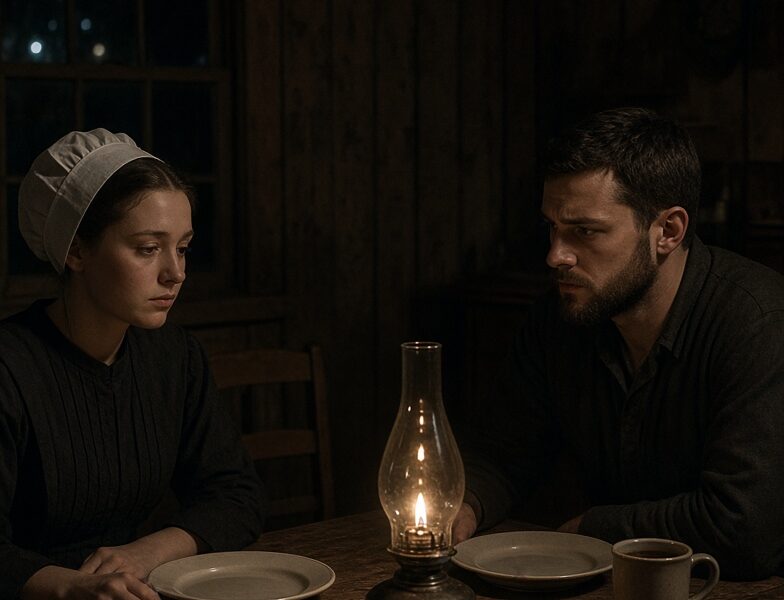
The first time my husband and I broke the rule, we were sitting at the kitchen table after the children were asleep and the house had gone the particular kind of quiet that only comes after nine o’clock in an Amish farmhouse when the lamps are turned low and there is nothing left between two people but the sound of each other breathing.
He looked at me across the table and he said something that no Amish husband is supposed to say to his wife.
And I said something back that no Amish wife is supposed to say to her husband.
And afterward, we both sat there in the silence of what we had just done.
Not quite looking at each other the way you don’t look directly at something you are not sure you were supposed to see.
I need to tell you what we said.
But first, I need to tell you why we were never supposed to say it at all.
Because the rule we broke that night was not written anywhere.
It was not in the Ordnung.
It was not in any sermon I ever heard from the bishop’s bench.
It lived in something older and quieter than rules.
It lived in the way Amish marriages are built from the ground up.
Stone by stone.
Silence by silence.
And what happens to a marriage and to a woman when one night the silence finally cracks open and something true falls out.
Before I go further, I have to be honest with you about something.
More than ninety percent of the people watching this right now have not yet subscribed.
And I understand that.
You may have found this video by accident.
You may not be sure yet whether these stories are for you.
But if you have made it this far, if something in those first few sentences made you lean in just slightly, then I think you already know they are.
My name is Martha and this is Hannah the Amish Girl.
The channel where the conversations that were never supposed to leave the kitchen finally get spoken out loud.
Please subscribe and tap the like button so these stories can keep reaching the people who need them.
And tell me in the comments, is there something you have always wanted to say to someone that you were taught you were not allowed to say?
Because this whole story begins there.
Now, the rule.
In the community where I grew up in the Old Order district of Geauga County, Ohio, there was a thing that Amish couples simply did not do.
They did not discuss their marriage.
Not with each other, not directly, not in the way I am about to describe.
I know that sounds impossible.
I know that from the outside it sounds like I am describing people who lived inside a locked room.
But I need you to understand that it was not experienced as a locked room from the inside.
It was experienced as walls.
And walls, when you have grown up inside them, do not feel like confinement.
They feel like the shape of the world.
Let me explain what I mean.
Jonas and I had been married for three years when the night at the kitchen table happened.
Three years.
In that time, we had built something together that I would not have called unhappy.
We had two children, we had a working farm, we had a rhythm.
He came in from the barn, I had supper on the table.
I washed, he dried, sometimes.
We went to church together on Sundays and sat on opposite sides of the room the way married couples sit.
And I watched the back of his head during the sermon and thought whatever quiet thoughts a young Amish wife thinks while the bishop is talking.
We were not unhappy.
But we were not, I understand now, actually talking.
What Amish couples talk about is practical.
Who is coming to visit on Sunday, whether the back field is ready to plant, what the children need for the school term, whether the roof above the summer kitchen is holding, or whether Jonas needs to ask his brother to help re-shingle it before the fall rains.
This is the language of an Amish marriage.
Useful language, necessary language, language that keeps a farm and a family moving forward through the seasons.
What Amish couples do not talk about is everything underneath that.
What they feel, what they need, what is not working, what they wish were different, what they are afraid of, what they wanted once when they were young enough to want things without knowing yet that wanting was itself something to be careful with.
I want to tell you that Jonas and I were unusual in this.
I want to tell you that other couples in our district did things differently.
But the older I get and the further I am from that life, the more I understand that we were not unusual at all.
We were Amish.
And this is how Amish marriages work.
And the reason I know this, the reason I am certain of it in a way I was not certain of it while I was still living inside it, is because of what happened the night the silence finally broke.
It started with a small thing.
It always starts with a small thing.
That is what I have learned about the conversations that change everything.
They do not begin with the thing they are actually about.
They begin sideways, the way every important thing in Amish life begins.
Tilted toward the truth, but not quite facing it.
Jonas came in late from the barn that night.
I had held supper for an hour past the usual time and then fed the children without him and put the plate on the back of the stove.
When he finally came in, he sat down and ate without looking at me.
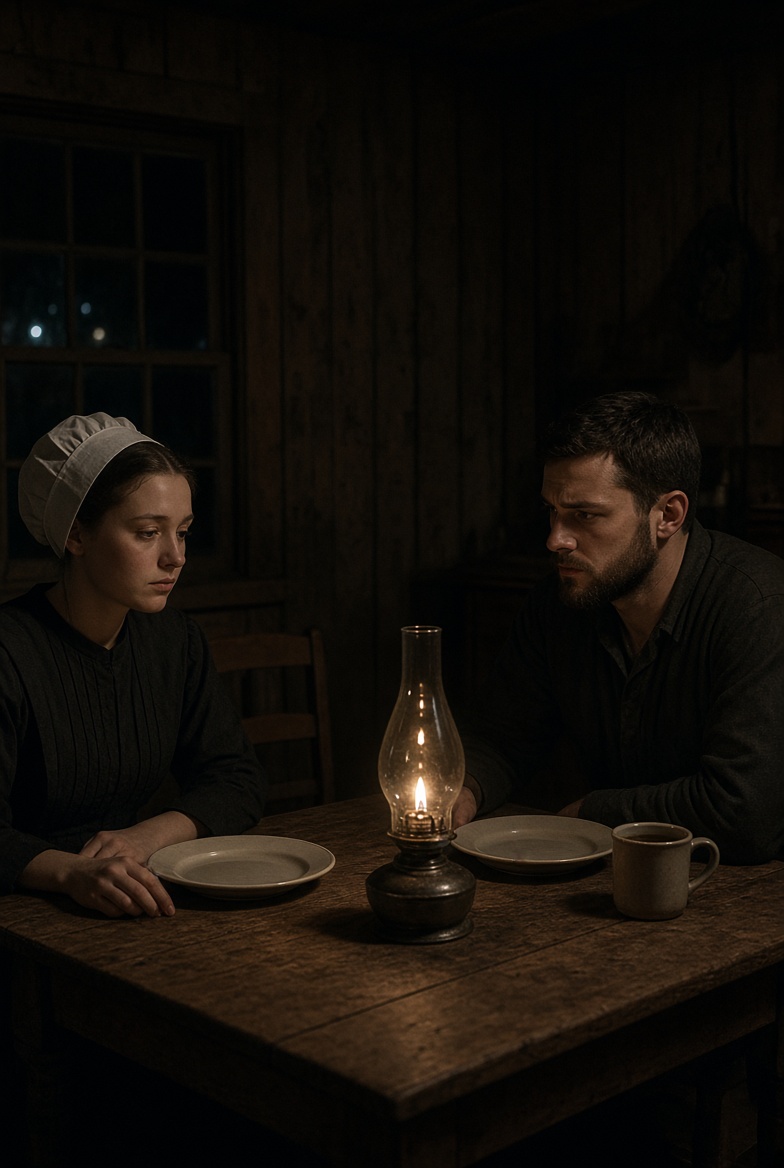
And I sat across from him with my hands around a cup of cold coffee, and the children were in bed, and the house was quiet.
And something about the particular quality of that quiet on that particular night was different from every other quiet we had sat inside together.
I cannot tell you exactly what made it different.
I have thought about it many times since, and I still cannot name it precisely.
But I think it was this.
Jonas looked tired in a way that was not about the barn.
I had seen him tired from the barn a thousand times.
This was tired from somewhere else, somewhere inside.
And when I saw that, something in me recognized it.
Because I had been tired from that same somewhere for a long time, and had told no one, including myself.
He finished eating.
He pushed his plate back.
He looked at the table between us, not at me.
And he said, “Martha, are you content?”
I want you to stay with that question for a moment.
Are you content?
Not are you happy?
Not are you well?
Content.
Because content is the word that an Amish man reaches for when he is trying to ask something he does not have the language to ask directly.
Content is the word that lives at the edge of what Amish people allow themselves to want.
You do not hope for happiness in my community.
Happiness is an English word, full of self and wanting.
But content, contentment, that is something plainer, something humbler, something a person might be permitted to have without it being a sign of pride.
And here is the thing I need you to understand about what happened next, because this is the part that mattered.
This is the crack where everything came through.
I could have answered that question the way I had been trained to answer it my entire life.
I could have said, “Yah, Jonas. I am content.”
I could have said it in the quiet, certain way that Amish wives say things they are not certain of at all.
And we could have gone up to bed, and the silence would have settled back over us like snow settling over a field, and nothing would have changed.
But I did not say that.
And I still do not fully understand why.
Maybe I was tired enough that night that my careful self let go before my honest self could stop her.
Maybe it was the way he had asked it, looking at the table instead of me, which meant he was asking it for himself as much as for me.
Maybe it was just that three years is long enough for a silence to become heavier than a person can carry alone.
I said, “I don’t know.”
Three words.
“I don’t know.”
And in the context of an Amish marriage, in the context of that question, those three words were not small.
Those three words were the rule breaking.
Because a wife who says, “I don’t know” to, “Are you content?” is a wife who is admitting that the answer might be no.
And a wife whose answer might be no is a wife who is standing at the edge of the most dangerous territory an Amish woman can stand at, which is the territory of her own interior, the landscape of what she actually feels, what she actually needs, what is actually true about her life beneath the surface of all the things she does and keeps and manages and maintains.
Jonas was quiet for a long time after I said it.
Long enough that I thought I had made a mistake.
Long enough that I started arranging a way to take it back, to soften it, to turn it into something less true.
And then he said, very quietly, still looking at the table, “I don’t know, either.”
I need to tell you what those four words cost him.
I need you to understand what it means for an Amish man, a man who has been raised since boyhood inside a theology that teaches him that his role is to know, to lead, to be certain, to provide the shape of the life that his wife and children live inside.
A man who has been told from the time he was old enough to sit through a sermon that doubt is a weakness, and uncertainty is an open door for something worse.
For Jonas to say, “I don’t know, either,” across a kitchen table at nine o’clock on a Tuesday night, was not a small thing.
It was, in the language of everything we had both been taught, a kind of failure.
And he said it anyway.
And that was when the conversation began.
The one we were never supposed to have.
We talked for two hours.
Two hours at that kitchen table in the low lamplight, with the house quiet around us and the children asleep upstairs.
And we said things to each other that Amish husbands and wives are not supposed to say.
We did not say them in the way of the outside world.
We did not have the vocabulary for that.
We did not talk about feelings in the way a therapist might encourage.
We did not use words like needs or boundaries or emotional labor.
We talked in the plain language we had, and we talked around things and toward things, and sometimes we sat in silence for several minutes before one of us found a word that was close enough to what we meant to use it.
But we talked.
Really talked.
Possibly for the first time since our wedding day.
Jonas told me he did not know how to tell me when something was hard for him.
That he had not been taught that it was allowed.
That his father had never once in his life told his mother that something was hard.
And so Jonas had grown up believing that hardness was something a man processed alone, in the barn or in prayer, or just inside himself with the door shut.
He told me that there were days when the farm felt like too much.
And he did not know how to say that to me because saying it would mean admitting that he was not handling it.
And not handling it was not something an Amish husband was supposed to be.
I listened to this and I felt something open in me that I had not known was closed.
Because I had spent three years watching Jonas come in from the barn and sit down to supper and move through our evenings and our nights with that quiet serious face.
And I had read that face as many things.
Contentment, indifference, hardness, judgement.
But I had never read it as this.
I had never read it as a man who was also drowning quietly inside a life that had given him the shape of what to be without teaching him what to do when the shape did not fit.
I told him things, too.
I told him that I was lonely in a way I did not have a word for because I was surrounded by people every day of my life.
And loneliness was not supposed to be possible when you lived inside a community that tight.
I told him that I sometimes stood at the kitchen window in the afternoon and felt something that I could only describe as a kind of flatness.
Like a field after the harvest, empty and waiting for something I could not name.
I told him that I loved our children with everything I had, and that motherhood had also taken something from me that I had not expected to lose, and could not quite identify now that it was gone.
I told him all of this in halting, careful words, watching his face while I spoke, ready to stop the moment I saw something close in him.
And his face did not close.
He listened.
He nodded slowly, once.
He said, “I have seen that in you. I did not know I was allowed to ask about it.”
We did not solve anything that night.
I want to be clear about that because I think there is a version of this story where two people have an honest conversation and it fixes everything.
And that is not what happened.
Nothing was fixed.
The farm was still the farm.
The children were still small and needed what small children need.
The community was still the community with all of its weight and its watching and its rules about what was permitted and what was not.
Jonas still did not know how to talk about hard things, and I still did not know how to ask for what I needed.
And neither of us had any framework for doing it differently because nothing in either of our upbringings had given us one, but something had shifted.
Something small and real and permanent.
We had said true things to each other.
We had sat inside the discomfort of our own honesty, and neither of us had left the table.
And in the morning, when Jonas came in for breakfast and looked at me across the kitchen, something in the way he looked at me was different.
Not dramatically different.
Not in a way anyone else would have seen or named.
But I knew it.
The way you know when a window has been opened in a room that has been shut too long.
Here is what I have thought about in the years since.
The rule that Amish couples are not supposed to break, the rule against that kind of conversation, does not exist because anyone sat down and decided that honesty between a husband and wife was dangerous.
It exists because the whole structure of Amish life depends on a certain kind of silence.
The silence that keeps everyone in their place.
The silence that keeps the wife submitting and the husband leading and the bishop preaching and the community holding its shape.
The moment two people inside that structure start telling each other the truth about what is actually happening inside them, something loosens.
And a thing that loosens is the thing that might eventually come free.
I think Jonas and I both understood this somewhere beneath the conversation on the night we broke the rule.
I think we both knew that we had stepped onto ground that was not supposed to be stepped on.
I think that is why we never quite did it again.
Not the way we had that night.
Not with that same openness.
Because the openness itself was frightening.
Because it pointed toward a kind of life that our community had no room for and no word for and no way to hold.
I left three years later.
Jonas did not leave.
I have heard through the long, quiet grapevine that runs between the Amish world and the outside that he remarried within the year.
I hope she is content.
I hope he asks her.
I hope on some quiet Tuesday night when the children are asleep and the lamp is low that he looks across the table and remembers what it felt like to say something true out loud to another person and have them stay in the room.
What I know now that I did not know then is that the conversation we were never supposed to have was also the most important thing that ever happened in our marriage.
Not because it saved it.
It didn’t.
But because it showed me for the first time what a marriage could hold if it were given enough room.
What two people could build if they were allowed to tell each other the truth.
What I deserved and what I had been given and the size of the distance between those two things.
My therapist in the years after I left called what Jonas and I had been doing for three years before that night emotional compartmentalization.
She called the silence that Amish marriages are built on a learned suppression of relational need.
She used words I had never heard before and gave me frameworks I had never been given.
And all of it was useful.
All of it helped me understand.
But the thing that helped me most was simpler than any of it.
It was remembering the look on Jonas’s face when I said, “I don’t know.”
The way something in him relaxed.
The way his shoulders, which had been carrying something I had not seen until that moment, came down half an inch.
The way a man looks when someone has finally asked him a question he has been waiting his whole life to be allowed to answer honestly.
We were both trapped.
That is the thing I want you to take from this.
Not that Amish men are cruel and Amish women are victims because it is not that simple and it was not that simple for us.
We were both trapped inside the same silence.
We had both been handed the same rule and told that following it was what love looked like.
And on one kitchen table, on one ordinary Tuesday night, we broke it together.
And for two hours, we were something other than what we had been built to be.
We were just two people telling each other the truth in the quiet of a house that was finally listening.
If this story reached something in you, if you have ever sat across from someone you love and felt the words you needed to say lodged somewhere between your chest and your mouth, going nowhere, I want to hear about it.
Tell me in the comments.
Tell me what you have never been allowed to say or what it cost you to finally say it.
Or whether there is still something sitting in that quiet place inside you, waiting.
And if you want to keep hearing the stories from behind the prayer cap, the ones that were never supposed to leave the kitchen, please subscribe to Hannah the Amish Girl.
There is so much more I still need to say.
Until next time, remember this.
The most important conversation of your life might be the one you were told you were never allowed to have.









