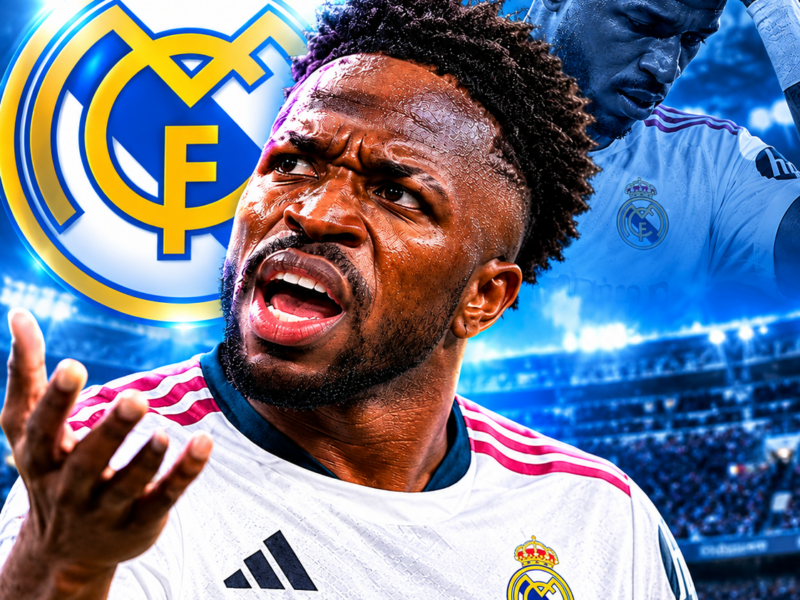
Vinicius Jr.’s Alarming Decline: Is Real Madrid’s Former World’s Best Player Already Past His Peak Before Age 30?
Something strange has been happening at the Santiago Bernabéu, and it isn’t hard to see once you know where to look.
A player who once made grown men in the stands gasp every time he touched the ball now draws a different reaction entirely.
Silence. Low expectations. A quiet dread that whatever happens next probably won’t matter much.
That player is Vinicius Junior, and the transformation from unstoppable force to hesitant shadow of himself has become one of the most uncomfortable storylines in Spanish football this season.
Real Madrid fans spent years bracing for opposing defenders to get torched every time Vinicius picked up speed near the touchline.
Now they brace for something else. A misplaced touch. A hesitant cutback that goes nowhere. A shot that sails over the bar when it looked easier to score.
This is not hysteria from a fanbase that turns on its stars too quickly. This is a pattern that has been building for two full seasons, and it just got a lot harder to ignore.
Seven matches into the new campaign under new head coach José Mourinho, Vinicius has one goal. It came from inside an empty net, the kind of finish that requires almost no skill at all.
For a player who was, by nearly every credible measure, the best footballer on the planet in 2024, that single statistic should stop people in their tracks.
A Warning Nobody Wanted to Hear
Football punditry loves nuance, loves hedging, loves the phrase “let’s wait and see.” But every so often a conversation happens where the participants stop hedging and just say the quiet part out loud.
That is essentially what unfolded recently among a trio of Real Madrid-focused football analysts working through the club’s early-season form. What started as a routine breakdown of tactics and transfers turned into something heavier: a genuine, uneasy discussion about whether Real Madrid has already seen the best of Vinicius Junior.
Not the best of this season. The best of his career.
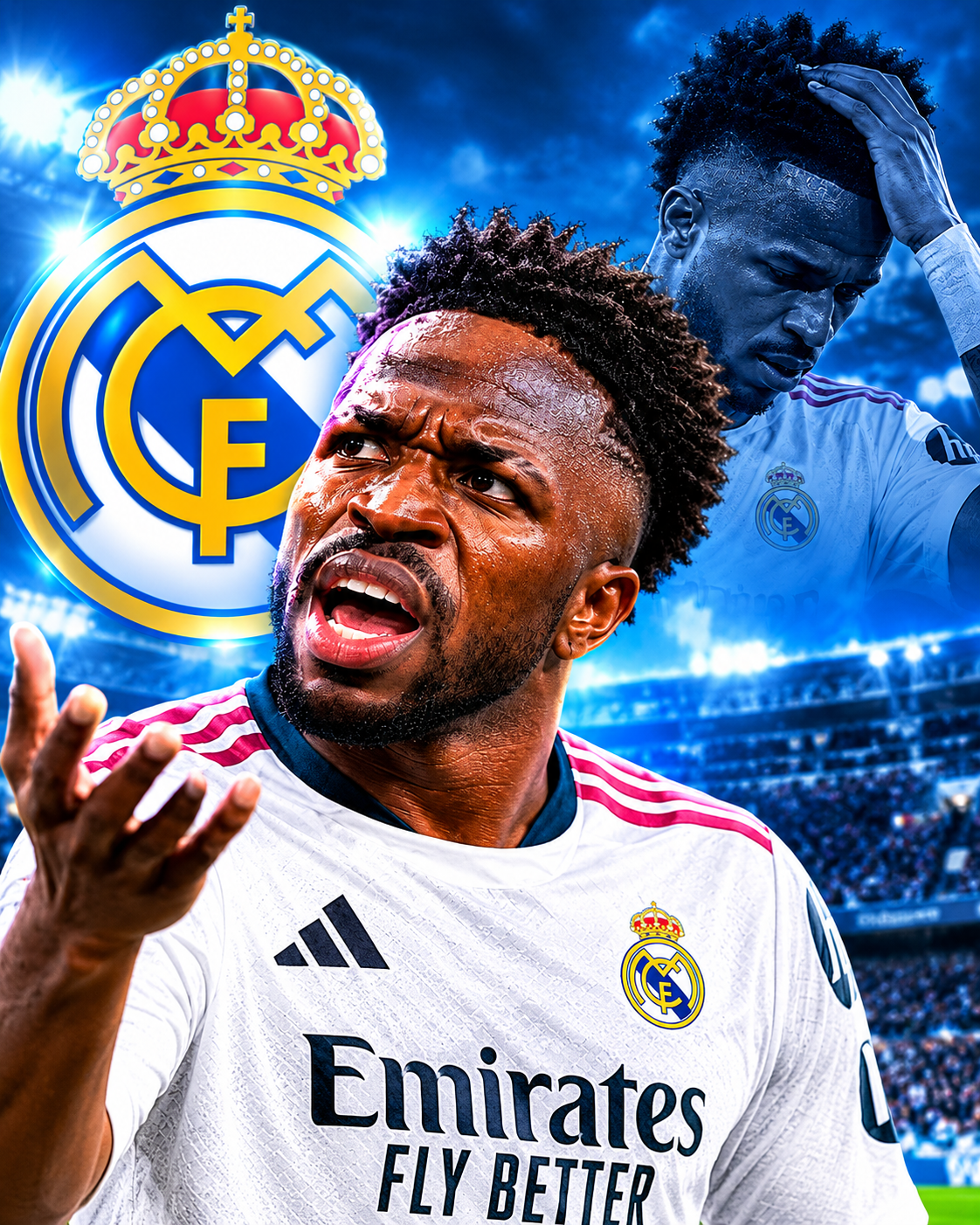
It’s a jarring question to even ask about a 26-year-old attacker who is, statistically and biologically, supposed to be entering his athletic prime rather than leaving it. Wingers built on searing pace typically start showing decline in their early thirties, not their mid-twenties. Vinicius should have years of explosive football still ahead of him.
And yet the numbers, the body language, and the eye test are all telling a version of the same uncomfortable story.
The Tornado That Used to Exist
To understand how far Vinicius has drifted from his peak form, you have to go back to the earliest version of the player Real Madrid brought over from Flamengo.
That Vinicius was raw. Wildly inconsistent in decision-making, prone to disastrous final touches, occasionally maddening to watch because the end product rarely matched the buildup. But he had one gift that made all of it forgivable: he was physically untouchable.
Defenders simply could not deal with the combination of acceleration, unpredictability, and sheer physical intensity he brought every single match. He was less a footballer in the traditional sense and more a natural disaster wearing boots. Commentators regularly described him using language reserved for extreme weather events, because that’s genuinely what it felt like trying to contain him.
Over time, something remarkable happened. Vinicius didn’t just rely on that physical gift. He built an entire footballing identity on top of it.
He developed the ability to play through congested central areas, not just wide channels. His combination play sharpened dramatically. His finishing, long considered his biggest weakness, became a real weapon rather than a liability. By the 2023-24 season, he wasn’t just a frightening athlete anymore. He was a complete forward, arguably the most dangerous attacking player in world football, full stop.
That version of Vinicius won nearly every argument in football’s endless “best player alive” debate, Ballon d’Or voting controversy notwithstanding. Whatever your opinion on that infamous snub, there was no credible argument that Vinicius wasn’t playing at an elite, world-class level throughout that stretch.
That is the standard against which this season’s performances are being measured. And by that standard, the drop-off has been brutal to watch.
What’s Actually Broken
The easy explanation would be to blame conditioning. Early-season fitness dips happen to plenty of players, especially those who play deep into international tournaments or manage heavy club schedules. That explanation, though, only covers part of what’s going wrong.
Yes, physically, Vinicius looks like a diminished version of himself. The blistering top-end speed that used to demoralize fullbacks before the match even properly started has been largely absent through the opening weeks. There have been isolated flashes, brief moments where the old explosiveness reappears for a few strides, but they’ve been fleeting rather than sustained.
But the physical decline, real as it is, might not even be the most alarming part.
What’s more troubling is the decision-making. Vinicius has always been a streaky finisher, but even in his roughest patches historically, he kept attempting the moves that made him dangerous. He kept driving at defenders. He kept trying to beat his man one-on-one, because that willingness to take risks was the entire engine of his game.
This season, that engine has stalled in a different way. He is barely attempting to dribble past defenders at all. Across recent matches, he’s been credited with roughly one dribble attempt per game, a number that would be unremarkable for a possession-based deep-lying midfielder but is almost unthinkable for a player whose entire footballing identity was built on beating people off the dribble.
That’s not simply a fitness issue. A tired player still tries to dribble and just gets caught. A player who has stopped trying altogether is dealing with something else, whether that’s a confidence problem, a tactical adjustment, a mental block, or some combination of all three.
The Teammate Making It Worse (For Vinicius, At Least)
Every struggling star eventually runs into the same uncomfortable reality: somebody younger, hungrier, and cheaper starts playing well in a similar role, and suddenly the conversation shifts from “how do we get him going again” to “why isn’t the other guy playing instead.”
For Vinicius, that pressure is arriving in the form of a breakout campaign from a teammate operating on the opposite flank. In Real Madrid’s most recent fixtures, that player has been putting on an attacking clinic that makes Vinicius’s struggles even harder to ignore by direct comparison.
In one particular match, while Vinicius managed his now-standard single dribble attempt, his teammate on the right wing completed seven successful dribbles out of nine attempts. Seven successful dribbles from a flank that the team’s overall structure doesn’t even heavily feature or funnel possession toward.
That level of individual output from a wide player operating without the tactical support that Vinicius typically enjoys on the left side is the kind of statistic that gets noticed in the locker room, gets noticed by the coaching staff, and eventually gets noticed by supporters wondering out loud why the starting spot hasn’t changed.
It’s a dangerous dynamic for Vinicius specifically because of what’s happened off the pitch this year. He no longer has the leverage that comes from an expiring contract and open market value. Real Madrid extended his deal through what amounts to a mega-contract running all the way to 2031, locking him in for years and at a salary level that most rival clubs simply cannot match.
On paper, that security should be reassuring. In practice, it creates a strange trap. If a younger, cheaper alternative keeps performing at a higher level on a fraction of the wage bill, the pressure to justify that enormous contract only intensifies. Job security through legal paperwork doesn’t automatically translate into job security on the team sheet, and locker rooms have long memories when it comes to who is actually earning their place versus who is simply protected by a signature on a contract.
The Contract Nobody Can Easily Undo
It’s worth pausing on just how significant that contract situation actually is, because it fundamentally changes the calculus around Vinicius’s future at the club in a way that didn’t exist even a year ago.
Previously, when Vinicius’s performances dipped or his form wavered, there was always an unspoken pressure valve available to Real Madrid’s front office: the deal was set to expire, giving the club natural leverage. They could afford to let a rough patch play out because the alternative, letting his value erode toward a free transfer, was itself a form of accountability. Vinicius, the thinking went, had every incentive to perform because his next contract, wherever it might be, depended on it.
That calculus has completely inverted. The new deal is so long, and the associated exit costs so prohibitive, that Real Madrid has essentially removed its own flexibility. If a club wanted to pursue a transfer for Vinicius today, they would need to guarantee both an enormous transfer fee and multiple years of an elite, top-bracket salary. The number of clubs on the planet capable of meeting both conditions simultaneously is vanishingly small, and shrinking further given the financial landscape of modern European and global football.
In blunt terms, Real Madrid is now stuck. Whatever version of Vinicius shows up this season, and next season, and the season after that, the club has committed itself to that player for the long haul. There is no easy escape hatch, no simple pressure-release mechanism. The path forward has to run through getting the best version of Vinicius back on the pitch, not around him.
That reality raises the stakes on every one of his performances in a way that simply didn’t apply before. This isn’t a player auditioning for his next contract anymore. He already has it. The question now is whether he can live up to it.
A Captain’s Role Requires a Captain’s Consistency
One argument frequently raised in Vinicius’s defense goes something like this: wait until spring, wait until the business end of the season, because that’s when he historically turns it on.
It’s true that Vinicius has, across multiple seasons, produced some of his most memorable and decisive performances in March, April, and May, when Champions League knockout football raises the stakes and his talent tends to rise to meet the moment.
But that defense, while grounded in some real precedent, is also becoming increasingly hard to accept as a full explanation, for one simple reason: Vinicius is no longer just a talented squad player who can afford to have quiet stretches. He is, by financial commitment and by role, one of the central figures the entire team is built around.
A team captain, in any meaningful sense of the word, doesn’t get to captain from March through May and disappear for the rest of the calendar. Leadership, especially the kind embedded in a contract that makes someone one of the highest earners in world football, has to show up from the opening whistle of the season through the final one.
And when you actually chart out Vinicius’s recent seasons month by month, a clear and uncomfortable pattern emerges. Two seasons ago, during the campaign that ultimately produced his Ballon d’Or snub, he started strong before visibly fading after that ceremony, seemingly affected by the disappointment in a way that bled into his on-field performances for a stretch. Last season followed an even rougher arc: a first half of the campaign so barren in front of goal that he reportedly went roughly three months without scoring, only rediscovering some rhythm in the spring before flatlining again at the most critical moment of all, Real Madrid’s decisive Champions League matchup against Bayern Munich.
Layer this season’s sluggish start on top of those two previous years, and you get a three-year trend line that looks less like a temporary blip and more like an established pattern. Vinicius shows up for a handful of months at genuinely world-class level and disappears for stretches that are just as long, if not longer.
Compare that inconsistency to what Real Madrid is currently getting from two other central attacking figures on the roster. One of them, an English midfielder who drew plenty of criticism last season for failing to meet expectations, has started this campaign in visibly improved form, taking on more responsibility, growing more vocal, and generally looking like a player who has internalized what leadership on the pitch actually requires.
The other, Real Madrid’s marquee forward signing from recent seasons, hasn’t been flawless in front of goal either, but has still produced somewhere in the range of eight or nine goals across the opening seven matches, a return that, whatever its imperfections, dwarfs Vinicius’s single goal scored from inside an empty net.
If the standard being applied to those two players is fair, and if the expectation is that stars carrying major financial and tactical responsibility need to perform from August through June rather than only during marquee spring fixtures, then that same standard has to apply to Vinicius. Anything less is special pleading dressed up as patience.
The Physical Preparation Mystery
One of the more curious threads running through Vinicius’s slow start involves his offseason preparation, and it opens up a set of questions that extend well beyond simple match fitness.
Vinicius has long been known as one of the most meticulously self-managed players in the Real Madrid squad, someone who invests in a private, parallel support structure that runs alongside whatever the club itself provides. A personal physical trainer. A personal physiotherapist. A personal nutritionist. Reportedly, an elaborate home gym setup that rivals professional training facilities.
That level of individualized investment in his own body has generally been viewed as a positive, evidence of a professional athlete taking his craft seriously and controlling every variable he can influence.
This offseason, though, something reportedly shifted. Given the compressed and unusually demanding calendar leading into this year’s World Cup, word emerged that Vinicius’s personal training team had specifically recommended he scale back his usual summer conditioning regimen, prioritizing rest over the customary grind.
In past years, footage of Vinicius working through intense summer sessions alongside teammates, running drills, hitting the gym, staying sharp during the offseason window, was a fairly regular sight. This year, by most accounts, that customary summer work simply didn’t happen, not through negligence, but reportedly by design, on the advice of the specialists managing his personal fitness program.
Setting aside for a moment whether that decision turns out to be wise in the long run, it raises an interesting and somewhat uncomfortable structural question. If a player’s day-to-day physical preparation is being directed by a private team operating in parallel to, rather than in direct coordination with, the club’s own medical and performance staff, whose priorities are actually being served? Real Madrid’s competitive interests across a grueling ten-month season, or a broader set of personal and international considerations that might not always align perfectly with the club’s calendar?
That tension isn’t unique to Vinicius. Plenty of elite athletes across multiple sports maintain personal performance teams. But it does complicate any simple attempt to explain away his sluggish start purely in terms of standard early-season rust. If the deficit is the product of a deliberate decision to under-prepare physically over the summer, that’s a materially different situation than a player who trained hard and simply hasn’t found his legs yet, and it raises real questions about how much longer that physical gap might persist before it closes.
Something Beyond the Physical
Here’s where the conversation around Vinicius gets genuinely uncomfortable, because the deeper you look, the harder it becomes to attribute everything purely to conditioning.
There have been specific moments this season, and one particular recent match against Elche stood out in this regard, where the issue on display had nothing to do with tired legs or a lack of preseason mileage. It looked like something closer to disengagement.
A shrug where there should have been urgency. A lack of the frustration, the visible fire, that used to define Vinicius even during his worst individual performances. In years past, even when he was playing poorly, you could see it bothering him. He’d argue with referees, gesture in frustration at teammates, visibly demand more of the ball because he believed he could fix it himself. That competitive irritation, uncomfortable as it sometimes was to watch, was also proof that he cared, deeply, in real time.
This season, at moments, that fire has looked banked rather than burning. And when you place that alongside two teammates navigating their own version of a slow start, the contrast becomes even more pointed.
Both the English midfielder and the World Cup-bound forward mentioned earlier arrived to preseason behind schedule in their own physical preparation, for entirely understandable scheduling reasons related to their national team and injury recovery timelines. And yet, watching them play, there’s a visible sense of urgency and competitive hunger that simply hasn’t been matching Vinicius’s body language on the same nights.
Why might that be the case? A few theories circulate, none of them provable from the outside, all of them plausible.
One is tactical frustration. It’s become fairly evident that Mourinho, in his early messaging both on the pitch and in press conferences, has been leaning publicly toward positioning the World Cup-bound forward as the focal point of the attacking setup, the player the system is most explicitly designed to feature. If Vinicius perceives even a subtle demotion in his standing within the collective attacking hierarchy, whether or not that perception fully matches reality, it wouldn’t be surprising if that fed into a broader sense of disconnection.
Another involves the increased defensive responsibilities Vinicius has been asked to shoulder under Mourinho’s tactical setup. By most accounts, he has actually been tracking back and contributing defensively more than in prior seasons, even if that defensive work still looks somewhat unstructured and instinctive rather than systematically drilled. That’s a real shift in what’s being demanded of him, and it’s entirely plausible that a player who built his reputation purely as an attacking weapon might chafe, at least initially, against being asked to invest energy in a part of the game he was never primarily valued for.
None of this rises to the level of confirmed explanation. Nobody outside Vinicius’s inner circle can say definitively what’s driving the visible dip in intensity. But the pattern is real enough, and has repeated across enough matches now, that dismissing it purely as an extension of physical fatigue starts to feel like willful avoidance of a more complicated truth.
The Cosmetic Surgery Storyline
Adding another layer of intrigue to an already complicated situation is a story that circulated widely during the offseason regarding a reported cosmetic procedure, specifically a chin augmentation, or mentoplasty, that Vinicius is said to have undergone during the summer break.
The story generated plenty of jokes online, as these things tend to, and on the surface it might seem like an irrelevant tabloid distraction with no real bearing on football performance.
But there’s a legitimate physical consideration buried underneath the punchlines. Procedures involving facial reconstruction, even relatively minor ones like chin augmentation, typically require a real recovery window, generally cited as somewhere in the neighborhood of two to three weeks of restricted physical activity to allow proper healing.
If that timeline is accurate, and if it overlapped significantly with what was already a compressed, roughly four-week offseason break, the math starts to look genuinely relevant to explaining a slow physical start. Losing half or more of an already short summer training window to mandatory recovery from an elective procedure isn’t a minor scheduling footnote. It’s a real, quantifiable disruption to preseason conditioning.
Combine that with the earlier point about his personal training team reportedly advising reduced summer workload heading into the World Cup, and you start to see a fuller picture of why Vinicius might be entering this season from a lower physical baseline than in years past, independent of any questions about motivation, mentality, or tactical fit.
It doesn’t fully explain the dribbling numbers or the visible body language issues, but it does offer a legitimate, non-conspiratorial reason why the explosive first step and sustained sprint speed that once defined him have been largely missing through the season’s opening weeks.
The Historical Precedent That Should Worry Real Madrid
Football has a long, fairly consistent history of explosive, pace-dependent attackers peaking earlier than fans generally expect, and that history is relevant context for anyone trying to project where Vinicius goes from here.
Look across the history of elite Brazilian attacking talents specifically, and a pattern starts to emerge. Players whose games were built heavily around explosive athleticism rather than positional intelligence or set-piece craft have historically tended to hit their absolute ceiling relatively early, often before turning 30, before beginning a gradual decline that, while not eliminating their effectiveness entirely, clearly separates their best years from what follows.
That’s not a universal rule, and there are obvious counterexamples of attacking players extending elite form well into their thirties through smart adaptation of their playing style. But for the specific archetype Vinicius represents, an explosive, one-on-one, downhill dribbling wide forward whose value is disproportionately tied to pure physical burst, the historical base rate for early decline is real and worth taking seriously.
Vinicius currently sits at 26 years old, meaning he technically still has several years before he’d even reach the age where that kind of decline traditionally becomes visible in comparable players. On paper, there’s no biological reason he couldn’t rediscover elite form and sustain it deep into his late twenties and beyond.
But “technically possible” and “likely, given current trajectory” are two very different things. The uncomfortable truth is that a player doesn’t need to be old to be in decline. Sometimes the decline shows up early, gets misdiagnosed as a temporary rough patch or bad luck, and only becomes undeniable in hindsight once enough seasons have accumulated to reveal the actual pattern.
The Uncomfortable Math of “Good Years Remaining”
Here’s a blunt way of framing the stakes involved. Real Madrid committed to Vinicius through a contract widely reported to run roughly six years, extending his tenure at the club deep into the next decade.
If you assume, generously, that a player of his profile can realistically sustain truly elite, world-class form for something like four out of those six contracted years, that’s already an optimistic projection given everything discussed above about his recent trajectory and the historical pattern of explosive wide players.
If the more realistic outcome ends up being two or three genuinely elite seasons scattered across that six-year window, interspersed with extended stretches of the inconsistent, streaky form that has increasingly defined his last two-plus seasons, that’s a fundamentally different value proposition than the one Real Madrid presumably had in mind when negotiating and signing off on that contract length and salary structure.
None of this is to suggest Vinicius becomes a bad player or a wasted investment. Even a diminished version of peak Vinicius remains a dangerous, valuable attacking weapon by most standards. But there’s a meaningful difference between paying elite, top-three-in-the-world wages for a player who delivers world-class performances year-round, and paying those same wages for a talented but streaky contributor who shows up in flashes.
Why the Contract Timing Raises Its Own Questions
It’s worth asking a slightly cynical but fair question about the timing and structure of Vinicius’s contract extension in the first place. Why commit to such a long-term, heavily front-loaded financial and structural commitment to a player whose underlying performance metrics had already started trending downward across the two seasons immediately preceding the signing?
One plausible answer involves risk management around the alternative scenario: letting Vinicius’s contract run down toward free agency, and either losing him for nothing or being forced into a discounted sale under pressure, mirroring situations other major clubs have faced with star players whose situations were allowed to drift unresolved for too long.
From that angle, locking in a long-term deal, even at a premium price and with the accompanying loss of future flexibility, could be viewed as a defensive move designed to protect asset value rather than a pure vote of confidence in sustained elite performance. Better to overpay for a player you control completely than risk losing him for a fraction of his value, or for nothing at all, down the line.
That’s a coherent business rationale. But it also means the club may have knowingly accepted a level of performance risk in exchange for financial and structural certainty, a trade-off that only looks smart in hindsight if Vinicius does eventually rediscover something close to his peak level on a sustained basis. If he doesn’t, the club is left holding a long-term, difficult-to-move financial commitment tied to a player delivering inconsistent returns, with very few realistic offloading options given the contract terms discussed earlier.
What a Path Back Actually Looks Like
None of this analysis is meant to suggest Vinicius’s career is somehow finished or that a rebound is impossible. Far from it. Twenty-six is still young by almost any reasonable standard for elite footballers, and players have rediscovered peak form after rougher stretches plenty of times throughout football history.
But a genuine path back to consistent elite performance likely requires several things to align simultaneously, rather than any single fix solving the problem in isolation.
Physically, he needs the delayed conditioning work, whatever combination of factors caused it, whether the cosmetic procedure recovery window, the reduced summer training load, or simple accumulated fatigue from recent seasons, to finally catch up and normalize. That process appears to already be underway to some degree, with occasional flashes of restored speed appearing intermittently across recent matches, even if not yet sustained across full ninety-minute performances.
Mentally and tactically, there needs to be some resolution, whether through direct conversation with Mourinho, adjusted tactical instructions, or simple acclimation, to whatever is currently causing the visible hesitancy and reduced aggression in his decision-making, particularly around attempting dribbles and taking on defenders.
And structurally, the emergence of a genuine internal competitor on the opposite flank might actually end up being a positive forcing function rather than purely a threat. Competitive pressure has motivated plenty of players throughout football history to rediscover urgency they’d been missing. If Vinicius responds to that pressure the way elite competitors typically do, by raising his own level rather than accepting a diminished role, that internal competition could become the catalyst for exactly the kind of rebound Real Madrid desperately needs from him.
The Metropolitano Test and the International Break Ahead
In the immediate term, Vinicius faces a notoriously difficult away fixture at the Metropolitano Stadium, a venue that has historically proven tricky for him even during his very best stretches of form, let alone during a slump like the current one.
Following that match, he departs for international duty with Brazil, adding another data point to an already complicated conditioning picture, before an eventual return to club football. That stretch, spanning a genuinely hostile away environment followed by an international break, represents a meaningful early test of whether the physical and mental issues discussed throughout this piece are beginning to resolve themselves or whether they’re settling into something more entrenched.
Real Madrid, and by extension its supporters, don’t need Vinicius to instantly return to Ballon d’Or form overnight. Nobody realistically expects that kind of immediate turnaround. What they need, at minimum, is evidence that the trajectory is bending back in the right direction. A dribble attempted and completed. A sprint that looks like the old explosiveness rather than a labored jog. A finish that suggests the confidence is returning rather than continuing to erode.
The Bigger Picture for Real Madrid’s Season
It’s worth stepping back to consider why this particular storyline matters so much beyond Vinicius’s individual narrative arc. Real Madrid’s broader ambitions this season, domestically and especially in the Champions League, are heavily dependent on their attacking trio functioning at something approaching full capacity simultaneously.
Losing Vinicius as a consistent, dangerous attacking threat doesn’t just remove one dimension of the attack. It fundamentally changes opposing defensive strategy, freeing up resources that would otherwise be dedicated to containing him and allowing rival coaching staffs to funnel additional defensive attention toward Mbappé and Bellingham instead.
In a competitive landscape where several European heavyweights currently look genuinely stronger on paper than in recent seasons, Real Madrid doesn’t have much margin for carrying a underperforming attacking piece, particularly one occupying such a central role in both the tactical setup and the wage structure. Champions League knockout football in particular punishes teams that can’t consistently generate individual moments of brilliance from their most talented players, and Vinicius, at his best, has historically been exactly the kind of player capable of manufacturing those decisive individual moments when games are tightest.
A Question Without a Clean Answer
So, has the footballing world already witnessed the best of Vinicius Junior?
The honest answer, based on everything discussed above, sits somewhere in an uncomfortable middle ground. It seems unlikely that Vinicius has permanently lost access to elite form altogether. The talent, the underlying skill set, and the physical tools, once properly conditioned, all remain fundamentally intact. Good performances, even genuinely excellent ones, almost certainly still lie ahead.
But the specific version of Vinicius that dominated world football throughout the 2023-24 stretch, the sustained, week-in-week-out world-class consistency that made him a legitimate Ballon d’Or contender and arguably the single most feared attacking player on the planet, that specific peak may indeed be behind him rather than ahead.
What’s more likely going forward, based on the trend lines established across the past two-plus seasons, is a Vinicius who oscillates between genuine brilliance and frustrating inconsistency, whose best moments remain spectacular but whose overall output across a full season becomes considerably harder to predict or rely upon.
For a player carrying the financial weight and tactical centrality that Vinicius now carries at Real Madrid, that kind of unpredictability represents a real problem, not just for his own individual legacy, but for a club that has committed enormous resources banking on something closer to sustained excellence.
Why This Story Isn’t Going Away
Whatever happens over the coming weeks at the Metropolitano and beyond, this particular storyline around Vinicius has crossed a threshold that makes it impossible to simply wave away as early-season noise or an overreaction to a small sample size.
Two consecutive seasons of documented inconsistency, now compounded by a rough start to a third season under a brand-new head coach who is actively evaluating his attacking hierarchy in real time, represents a genuine pattern rather than a statistical blip.
Add in the internal competitive pressure from a breakout teammate performing at a higher level on a fraction of the salary, the structural handcuffs created by an enormous long-term contract that essentially eliminates any easy exit options for the club, and lingering, unresolved questions about both his physical preparation and his mental engagement with the current setup, and you have all the ingredients of a storyline that will keep generating headlines regardless of how any individual match plays out.
Real Madrid needs its supposed generational left-winger to rediscover the version of himself that terrorized defenses just two seasons ago. Whether that rediscovery actually happens, on what timeline, and how sustainably, remains one of the most genuinely uncertain and consequential questions hanging over the club’s entire season.
For now, all anyone connected to Real Madrid can do is watch, wait, and hope that whatever combination of physical recovery, tactical adjustment, and internal motivation Vinicius needs finally clicks into place before the gap between who he was and who he currently is becomes permanently impossible to close.









