Vinicius Jr Benched Early as Fuming Mourinho Blasts Referee After Real Madrid’s Bitter Derby Defeat to Atletico
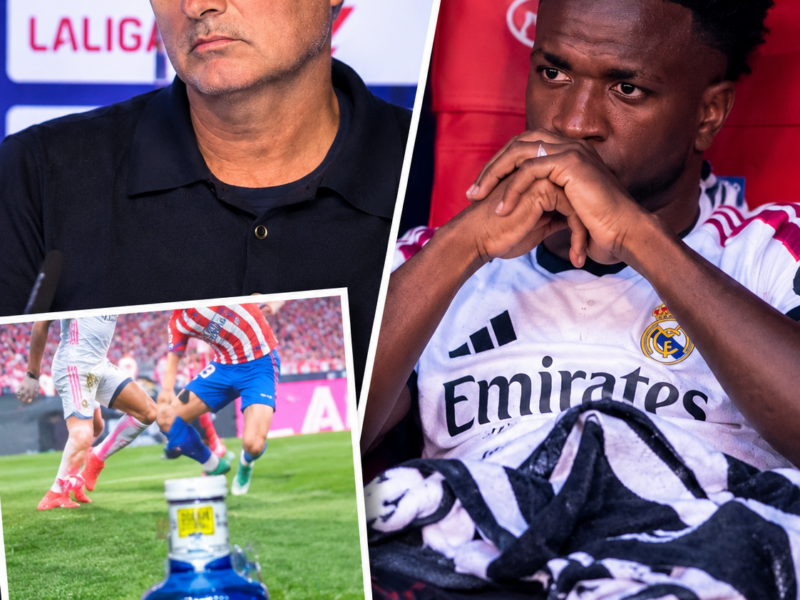
He sat there with his hands pressed close to his face, staring blankly at a pitch he was no longer allowed to stand on.
Fifty four minutes had passed. Real Madrid were already down to ten men, already trailing, and their biggest attacking weapon had just been pulled from the game.
Vinicius Junior did not argue. He did not throw his arms up in protest the way he sometimes does.
He simply walked off, sat down, and let the cameras do the rest of the talking.
That image, the Brazilian forward slumped on the bench with a stone cold expression while his team fought a losing battle in the biggest match of the season so far, ended up traveling faster around Spanish football media than almost anything that happened on the pitch itself.
But while everyone was busy dissecting Vinicius and his body language, the man who actually pulled him off had a completely different fire burning inside him.
Jose Mourinho was not thinking about his forward’s demeanor.
He was thinking about a referee, a VAR booth, and two tackles he believed should have changed the entire complexion of the match.
By the time the post match press conference rolled around, Mourinho was not just annoyed.
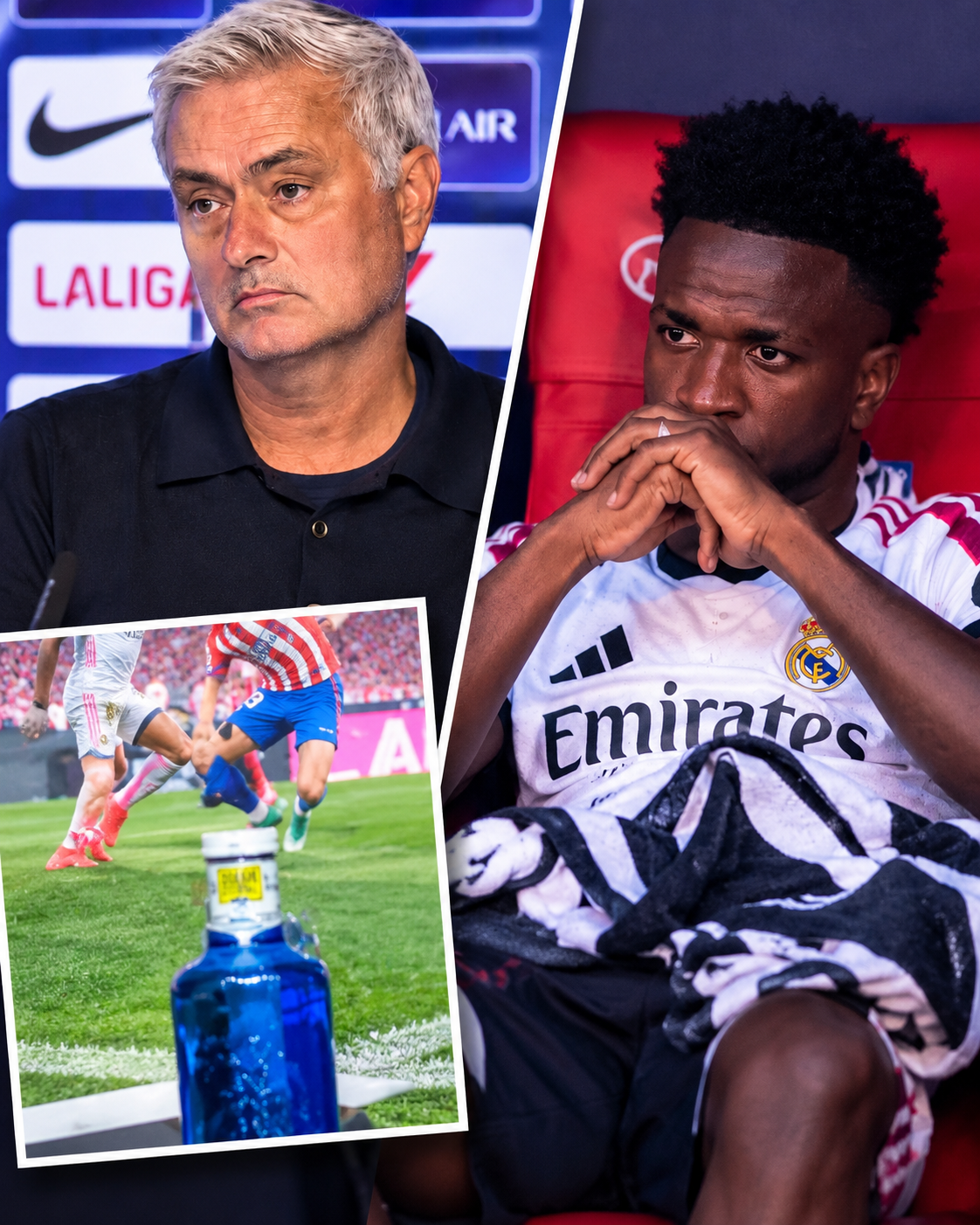
He showed up armed with printed photographs, ready to make his case in front of every camera in the room.
So what actually happened at the Metropolitano on Sunday that left Real Madrid’s manager fuming, left Vinicius facing a fresh wave of criticism, and left Los Blancos six points off the pace in the title race?
A Derby That Real Madrid Desperately Needed to Win
Real Madrid traveled to the Riyadh Air Metropolitano knowing exactly what was at stake.
Barcelona had already opened up a commanding lead at the top of LaLiga, arriving into derby weekend unbeaten and full of confidence.
A win for Real Madrid would have kept the gap manageable heading into the international break.
A loss would do the opposite, and unfortunately for Mourinho’s side, a loss is exactly what happened.
Diego Simeone’s Atletico Madrid won the match two goals to one, a result that ended Simeone’s personal losing streak against Mourinho in LaLiga and handed the home fans one of their most satisfying afternoons of the season.
The defeat dropped Real Madrid to third in the table, six points behind a red hot Barcelona side and one point below Atletico themselves.
For a club that hired Mourinho specifically to restore discipline and start winning immediately, this was exactly the kind of result nobody at Valdebebas wanted to see this early in the campaign.
A First Half Full of Warning Signs
The opening forty five minutes at the Metropolitano did not produce many clear cut chances, but it produced something arguably more consequential: the seeds of the controversy that would define the entire afternoon.
Jude Bellingham was involved in a tangle with Atletico defender Cristian Romero that immediately caught the referee’s attention.
The official initially reached for a yellow card, pointing it at Bellingham for what looked like a challenge on the Argentine defender.
Then came the VAR review.
After watching the replay, referee Miguel Angel Ortiz Arias reversed his original decision entirely, pulling the card back from Bellingham and instead booking Romero for what the review determined was a stamp.
Real Madrid’s players and coaching staff were furious in the moment, convinced that a stamp on an opponent deserved far more than a simple yellow card.
Then, before the half had even finished, a second flashpoint arrived.
Fede Valverde was on the receiving end of a heavy challenge from Atletico’s Lee Kang-in, another moment that Real Madrid’s bench felt warranted a red card rather than the caution that was ultimately shown.
Two incidents. Two moments where Real Madrid believed the referee had let Atletico off the hook.
And in Mourinho’s mind, both of those decisions would go on to define the entire match.
The Moment That Changed Everything: Huijsen’s Red Card
Whatever frustration had been building in the first half exploded into something far more consequential just after the restart.
In the fifty second minute, Dean Huijsen found himself exposed by a clever, searching pass that caught Real Madrid’s defense flat footed.
Giuliano Simeone latched onto the ball with a clear run toward goal, and Huijsen, recognizing he was the last line of defense, grabbed and pulled back the young Atletico forward inside the penalty area.
There was no other outcome available to the referee at that point.
Huijsen was shown a straight red card, reducing Real Madrid to ten men for the remainder of the match, and the penalty award that followed was never seriously in doubt.
Alejandro Grimaldo stepped up and calmly converted the resulting spot kick, sending Courtois the wrong way to put Atletico ahead.
It got worse from there, and it got worse quickly.
Just six minutes after Grimaldo’s penalty, Jonathan David doubled Atletico’s advantage, capitalizing on the space and momentum that Real Madrid’s ten man situation had opened up across the pitch.
In the span of roughly ten minutes, Real Madrid had gone from a tense, goalless derby to a match that was rapidly slipping away from them, playing a man short against a rival that smelled blood.
Why Mourinho Pulled Vinicius So Early
This is the moment where Mourinho made the decision that would dominate headlines almost as much as the result itself.
With his team down a man and now trailing by two goals, the manager needed to reshuffle his structure immediately.
Rather than simply shifting his existing personnel into a new shape, Mourinho chose to remove Vinicius Junior from the match entirely, just moments after Atletico’s second goal, and send on Yan Diomande in his place.
On the surface, the substitution made obvious tactical sense.
Down a man, a manager typically sacrifices an attacker to reinforce midfield or defensive solidity, and Vinicius, for all his talent, had not been having the kind of afternoon that made him untouchable.
By the numbers, Vinicius lost four of his seven individual duels before he was withdrawn, a modest return for a player of his caliber in a match this important.
But context matters here, and the context is exactly what turned a routine tactical substitution into a genuine talking point.
Vinicius has spent much of this season under a level of scrutiny that borders on relentless.
Every dip in form gets magnified, every quiet performance becomes evidence in an ongoing debate about whether he has plateaued, and every substitution gets read as a referendum on his standing within the squad rather than a simple tactical decision.
Being pulled in the fifty fourth minute of the biggest match of the season so far, in a match his team desperately needed him to help rescue, fed directly into that narrative.
The image of him sitting on the bench, hands near his face, saying nothing, visibly stewing, was always going to become the moment that defined the broadcast, regardless of what the underlying tactical logic actually was.
Was It Tactics, Or Something More?
The honest answer probably sits somewhere in the middle.
Mourinho absolutely needed to reorganize his ten man team, and sacrificing an attacker who was already having a mixed afternoon is a defensible, orthodox decision under those circumstances.
But it would be naive to pretend that Vinicius’s broader struggles this season played no role at all in how quickly and how decisively that particular substitution came.
A manager with more patience for a misfiring superstar might have waited longer, might have tried a different reshuffle first, or might have pulled a different attacker instead.
Mourinho did not hesitate.
And in a season where Vinicius’s every touch is already being dissected by pundits and supporters alike, that lack of hesitation was always going to be read as a signal, whether or not that was Mourinho’s actual intention.
Rudiger’s Late Consolation Could Not Save the Day
Real Madrid did not simply fold after going down two goals with ten men.
Mourinho’s substitutes pushed for a way back into the match, and in the eighty ninth minute, Antonio Rudiger rose highest to head home from a free kick, giving Los Blancos a genuine, if ultimately futile, glimmer of hope.
The goal set up a nervy, chaotic finish, with Atletico’s home crowd whistling and jeering every touch from the visitors as the clock ticked down.
But there was no time left for a second miracle.
The final whistle confirmed what had felt inevitable since Huijsen’s red card: a 2-1 defeat, Real Madrid’s first loss of the season in a fixture that mattered more than almost any other on the calendar.
Mourinho’s Explosive Press Conference
If the match itself had been contentious, what followed in the press room turned the temperature up even further.
Mourinho walked into his post match media duties carrying printed screenshots of the two first half incidents involving Bellingham and Valverde, physical evidence he intended to present directly to the assembled journalists.
He held the images up, one at a time, laying out exactly why he believed both moments should have resulted in red cards for Atletico players.
According to Mourinho, had either of those incidents been correctly punished, Atletico would have played a significant portion of the match with ten men themselves, a scenario that could have completely altered the outcome of the derby.
Mourinho did not stop at the two contested tackles.
He turned his attention directly to the man in the middle, referee Miguel Angel Ortiz Arias, questioning both his experience and the decision to appoint him to a fixture of this magnitude in the first place.
He pointed out that the referee was forty one years old with no international experience, framing the appointment itself as part of the problem rather than simply criticizing individual calls made during the ninety minutes.
Mourinho suggested that the pressure of officiating a Madrid derby, which he described using a memorable phrase referencing an old fashioned, eighties style intensity rarely seen in modern stadiums, had simply overwhelmed the young official.
He credited his players for a first half he called full of class and character, saying the only thing he could do for them afterward was offer a hug, a rare moment of warmth in an otherwise combative press conference.
When a reporter raised the six point gap to Barcelona, Mourinho’s response carried an unmistakable edge, suggesting that if his team were simply left alone to play their own game without external interference, the results would speak for themselves.
This Was Not a Spontaneous Outburst
What made this particular press conference even more significant is the context that Spanish media uncovered in the hours that followed.
According to reporting from AS, Real Madrid had actually lodged a formal objection to Ortiz Arias being appointed to officiate the derby before a ball had even been kicked, citing the referee’s previous dealings with Barcelona players as a point of concern.
That detail reframes the entire episode.
Mourinho’s fiery press conference was not simply a manager lashing out in the heat of a fresh defeat.
It appears to have been a coordinated position that Real Madrid had already decided to take before the match even started, with Mourinho serving as the public face of a wider institutional complaint about how the league’s referees were being assigned to high profile fixtures.
One Spanish outlet went as far as describing the moment as a declaration of war between Real Madrid and the country’s refereeing establishment, a framing that captures just how seriously the club appears to be taking this particular grievance.
Atletico Madrid Fires Back
Real Madrid’s complaints did not go unanswered.
Atletico Madrid used their own social media channels to hit back at what they characterized as a pattern of pressure tactics aimed at match officials.
The rojiblancos posted content mocking the situation, including messaging built around a hashtag that roughly translates to demanding an end to what they described as referee harassment.
It was a pointed, public response, and it added another layer to an already heated rivalry that shows no signs of cooling down anytime soon.
For a fixture that already carries generations of history and animosity, this latest chapter, played out as much in press conferences and social media posts as it was on the pitch, only added fuel to an already simmering fire between the two Madrid clubs.
Was Mourinho Actually Right About the Referee?
Here is where the story takes an interesting turn, because Mourinho’s complaints were not simply dismissed as the sour grapes of a losing manager.
Spain’s refereeing technical committee reviewed the match in the days that followed and reached a notable conclusion regarding one of the two contested incidents.
The committee determined that Lee Kang-in’s challenge on Valverde should indeed have resulted in a red card, effectively vindicating at least one half of Mourinho’s grievance.
However, the same committee upheld the validity of Huijsen’s dismissal, confirming that the review of his challenge on Giuliano Simeone had been correctly assessed and that the red card stood as the right call.
So Real Madrid did not get everything they wanted from this after the fact review, but they did not walk away empty handed either.
One legitimate officiating error was acknowledged, even if it arrived far too late to change anything about the final scoreline.
That kind of split verdict rarely satisfies anyone completely, and it certainly has not ended the broader debate about how LaLiga assigns its officials to the biggest fixtures on the calendar.
What This Means for Vinicius Going Forward
Setting aside the refereeing storm for a moment, the more lingering question coming out of this derby concerns Vinicius Junior’s standing within Mourinho’s system.
This was not an isolated bad performance in a vacuum.
It arrived during a stretch where the Brazilian’s overall output has drawn increasing scrutiny from pundits, former players, and sections of the club’s own fanbase.
Being withdrawn so early and so decisively in the season’s marquee fixture, regardless of the tactical justification behind the move, is the kind of moment that tends to stick in the public consciousness far longer than the underlying numbers would suggest it deserves.
The Spanish media wasted no time turning their attention squarely onto Vinicius following the final whistle, with several outlets dissecting his body language on the bench nearly as thoroughly as they dissected Huijsen’s red card or Mourinho’s printed evidence.
Whether that criticism proves to be a fleeting reaction to one difficult afternoon, or the beginning of a more sustained period of pressure on one of the club’s most important attacking players, will depend heavily on how he responds in the matches that follow.
Football has a short memory for players who bounce back quickly, and an unforgiving one for those who let a rough patch snowball into something larger.
Vinicius now finds himself needing to answer questions with his performances rather than his press conferences, starting with whatever fixture comes next on Real Madrid’s increasingly congested calendar.
Mbappe’s Quiet Frustration Added to the Gloom
Vinicius was far from the only Real Madrid attacker who struggled to make an impact at the Metropolitano.
Kylian Mbappe, who entered the match sitting agonizingly close to five hundred career goal involvements in club football, cut a visibly frustrated figure for most of the ninety minutes.
He managed just a single shot across the entire match, a remarkably quiet output for a player of his caliber in a fixture this significant.
With Real Madrid reduced to ten men for the majority of the second half, service to Mbappe naturally dried up, but his overall body language throughout suggested a player who knew the derby was slipping away and could do little about it individually.
Between Vinicius’s early withdrawal and Mbappe’s near invisible afternoon, Real Madrid’s two most expensive attacking assets both walked away from the Metropolitano with performances well below their usual standard, adding yet another layer of concern to a result that already had plenty to unpack.
A Costly Defeat With Real Standings Implications
Beyond the drama, the raw table implications of this result are significant.
Barcelona entered the international break having won every single one of their opening fixtures, building a six point cushion over Real Madrid that already feels sizable this early in the campaign.
Atletico Madrid, meanwhile, leapfrogged Real Madrid in the standings entirely, moving to within a single point of Barcelona and putting genuine pressure on both of their rivals heading into the coming weeks.
For Mourinho, who was brought back to Real Madrid specifically to close the gap on Barcelona and restore the club’s competitive edge, an early season defeat of this magnitude, compounded by a controversial red card and a public dispute with refereeing authorities, is not the start anyone at Valdebebas envisioned.
There is still an enormous amount of football left to play this season, and a six point gap in September is a very different animal than a six point gap in April.
But derbies carry psychological weight that outlasts the final scoreline, and Atletico will take genuine confidence from finally beating Mourinho in LaLiga after a run of previous frustrations against him.
A Rivalry With History Between Simeone and Vinicius
This was not the first time Diego Simeone and Vinicius Junior found themselves at the center of a heated Madrid derby storyline.
Back in January, during a tense Spanish Super Cup semifinal between the two clubs, tempers boiled over after Vinicius was substituted late in the match, sparking a heated exchange between the Brazilian and the Atletico manager.
Simeone reportedly told Vinicius in the heat of that moment that club president Florentino Perez would eventually sell him, a comment that generated significant backlash in the following days.
Simeone later apologized publicly to both Vinicius and Perez ahead of a subsequent Copa del Rey fixture, acknowledging that his behavior in that moment had been out of line.
That history adds an extra layer of subtext to this latest derby defeat.
Vinicius has now been substituted early in back to back high profile meetings between these two rivals, each time accompanied by a wave of scrutiny that extends well beyond the normal boundaries of a single substitution.
Whatever tension exists between the two camps, it is clear that Atletico Madrid occupies a unique psychological space in Vinicius’s season, one where his most difficult, most heavily scrutinized moments seem to keep finding him.
Huijsen’s Rough Afternoon Adds to a Difficult Start
Dean Huijsen’s red card deserves its own moment of scrutiny, separate from the broader referee controversy that followed.
Signed for a substantial fee to add composure and physicality to Real Madrid’s back line, Huijsen has generally impressed since his arrival, quickly establishing himself as one of Mourinho’s trusted starting center backs alongside a rotating cast of partners.
Sunday’s dismissal represents a rare, costly blemish on an otherwise promising start to his Real Madrid career.
Being caught out by a clever through ball and forced into a last man challenge inside the box is the kind of moment that happens to even the most composed defenders, but the timing could not have been worse, arriving in the biggest fixture of the season so far and directly gifting Atletico the platform they needed to seize control of the match.
Whether this proves to be an isolated lapse or the first sign of growing pains as Huijsen adjusts to the unique pressure of Real Madrid’s biggest fixtures will become clearer as the season progresses.
The Bigger Picture: A Club at War on Multiple Fronts
Zoom out far enough and this derby defeat becomes part of a larger, more complicated picture at Real Madrid this season.
Mourinho is simultaneously managing a squad with genuine depth issues in certain positions, a handful of unhappy young players agitating for more playing time, and now a public standoff with LaLiga’s refereeing hierarchy that shows no signs of cooling down.
Each of these storylines exists somewhat independently, but together they paint a picture of a club that is still very much finding its footing under its returning manager, even as results on the pitch remain, for the most part, competitive.
A single derby defeat does not define a season, and Real Madrid have more than enough talent and enough matches remaining to close the gap on Barcelona if their form stabilizes.
But this particular defeat, with its red card, its controversial officiating, and its uncomfortable questions about one of the world’s most talented forwards, is exactly the kind of result that lingers in the background of a season rather than disappearing quietly into the record books.
What Comes Next
Real Madrid now face a stretch of fixtures where they will need to answer every question this derby raised, from Vinicius’s form to the squad’s disciplinary record to Mourinho’s ongoing relationship with LaLiga’s officiating bodies.
How the club responds, both in results and in tone, will say a great deal about whether this Metropolitano defeat becomes a forgettable early season blip or the first chapter of a genuinely difficult campaign.
For now, the lasting image from this derby remains the same one that dominated broadcasts within minutes of the final whistle: Vinicius Junior, hands near his face, sitting quietly on the bench, while his manager prepared to wage a very different kind of battle in the press room just a short walk away.
How This Compares to Previous Chapters of the Rivalry
The Madrid derby has produced no shortage of controversial finishes over the years, and this latest chapter fits neatly into a long tradition of matches where the storyline extended well beyond the final scoreline.
Some of the most memorable recent meetings between these two clubs have hinged on refereeing controversy, dramatic red cards, or moments of individual brilliance that overshadowed everything else happening on the pitch.
This one had all three, wrapped into a single ninety minute window that will likely be discussed for weeks.
What separates this particular derby from many of its predecessors is the sheer volume of institutional fallout it generated in the days immediately following the final whistle, from the technical committee’s mixed verdict to Atletico’s pointed social media response to the framing of the episode as a full blown declaration of war between Real Madrid and Spanish football’s refereeing establishment.
Few single matches manage to generate that much sustained conversation across so many different fronts simultaneously, and it speaks to just how much weight both clubs, and the wider footballing public, continue to attach to this fixture every single time it comes around.
The Road Ahead for Mourinho’s Real Madrid
Every manager who takes charge of Real Madrid eventually faces a defining early test, a moment where the club’s demanding standards collide head first with the messy reality of a long, grueling season.
For Mourinho, this derby defeat may well become exactly that kind of test.
How he manages the fallout, both in terms of squad harmony and his ongoing relationship with LaLiga’s officiating bodies, will shape the next several weeks of his second spell in charge just as much as any tactical adjustment he makes on the training ground.
Real Madrid have the talent to respond decisively, and history suggests that a club of this stature rarely stays down for long after a single bad afternoon.
But the questions raised by this particular defeat, about discipline, about Vinicius’s form, and about the club’s increasingly public standoff with match officials, are not the kind that disappear overnight.
They will follow Mourinho and his players into every fixture that follows, at least until results on the pitch give everyone a reason to talk about something else.
The Calendar Offers No Time to Sulk
If there is one small mercy for Real Madrid amid all of this fallout, it is that the schedule does not allow for extended brooding.
The club’s fixture list moves quickly into a demanding stretch, and circled prominently on that calendar is the first Clasico of the season, scheduled for the weekend of October 24 and 25 at Camp Nou.
That fixture now carries even greater significance than it already would have, given that Barcelona sit six points clear and unbeaten heading into it.
A poor result in Catalonia would deepen the gap even further and pile additional pressure onto a Mourinho side already fielding difficult questions about discipline, squad harmony, and its relationship with match officials.
Conversely, a strong response between now and then, starting with the matches immediately following the international break, would go a long way toward recasting this derby defeat as a temporary setback rather than the beginning of a genuine crisis.
Real Madrid have shown throughout their history a remarkable capacity to respond to adversity precisely when the stakes are highest.
Whether this current group, with all of its individual talent and its accumulating internal tensions, can do the same will become one of the defining storylines of the season’s first real stretch of pressure.
Frequently Asked Questions About the Madrid Derby Controversy
Why was Vinicius Junior substituted so early in the Madrid derby?
Real Madrid were reduced to ten men after Dean Huijsen’s red card in the fifty second minute, and Mourinho reorganized his team by withdrawing Vinicius in the fifty fourth minute for Yan Diomande.
Vinicius had also lost four of his seven duels up to that point, giving the manager a tactical justification alongside the numerical disadvantage his team was facing.
Was Dean Huijsen’s red card the correct decision?
Spain’s refereeing technical committee reviewed the incident afterward and confirmed that the red card, shown for pulling back Giuliano Simeone inside the penalty area, was correctly given.
Was Mourinho right to complain about the referee?
Partially. The same technical committee that upheld Huijsen’s red card also found that Lee Kang-in’s challenge on Fede Valverde should have resulted in a red card, meaning Mourinho’s complaint about that specific incident was ultimately validated after the fact.
What does this defeat mean for Real Madrid’s title chances?
The loss dropped Real Madrid to third place, six points behind an unbeaten Barcelona and one point behind Atletico Madrid.
It is still early in the season, but the gap adds pressure on Mourinho’s side heading into the coming weeks of fixtures.
How did Atletico Madrid respond to Mourinho’s referee complaints?
Atletico used their social media channels to publicly mock Real Madrid’s stance, posting messaging that accused the club of using pressure tactics against match officials, further escalating tension between the two rivals.









