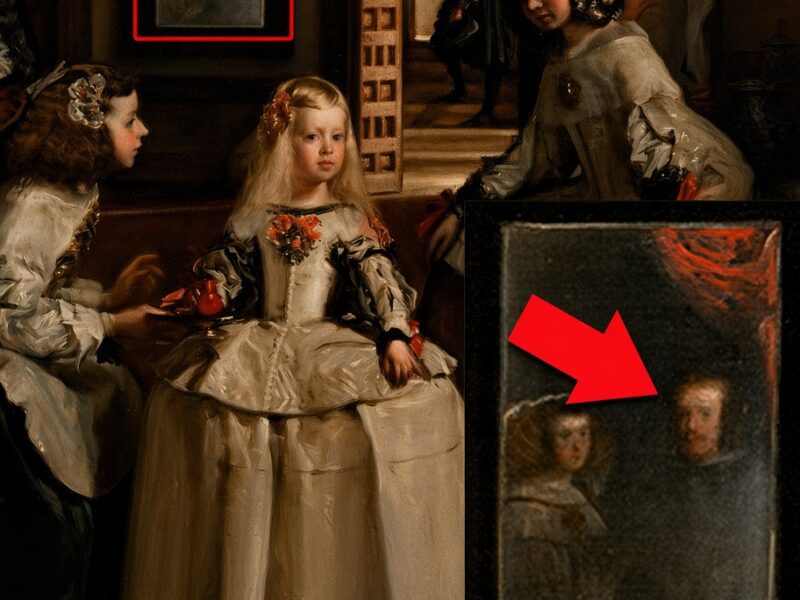
Vel\u00e1zquez’s Greatest Puzzle: Who Stands Where the King Stood?
At first glance, it looks like an ordinary court portrait. In fact, Diego Velázquez’s Las Meninas hides so many mysteries that art historians have been arguing over it for almost 400 years.
What does the mirror on the back wall actually reflect, and who are the mysterious people in it? What is the artist painting on the enormous canvas hidden from view? Why do these particular paintings hang on the wall, and what did the artist mean by them? Why do almost all the figures stare straight at the viewer?
Each detail seems small. Put together, they make this not just a painting but one of the greatest puzzles in the history of world art.
Velázquez painted it in 1656, just four years before his death. By then he had served as court painter to King Philip IV of Spain for more than thirty years.
The subject seems simple enough. We are in a room of the Royal Alcázar Palace in Madrid. At the center stands five-year-old Margarita Teresa, daughter of King Philip IV, and the artist has made her the main source of light. Her bright dress glows against the darker interior, and the eye goes straight to the little princess.
On either side are her closest ladies-in-waiting, the meninas who give the painting its name. One has knelt to offer the girl a small jug of water. The other is about to curtsy, looking toward the viewer.
Farther to the right stand two figures who immediately draw the eye, the court dwarfs Mari Barbola and Nicolasito Pertusato. Mari Barbola is portrayed with remarkable dignity. She stands perfectly upright, looking ahead with a serious expression, and on her chest is a decoration awarded for her service at court.
Nicolasito behaves quite differently. While everyone else observes strict etiquette, the boy casually nudges a huge mastiff in the middle of the room with his foot. The dog does not even react, as if long used to such pranks.
Behind them stands Marcela de Ulloa, the Infanta’s governess and bodyguard, beside a courtier whose identity remains unknown. At the back, framed by an open doorway, is the court marshal José Nieto. On the left, in front of the enormous canvas, stands Velázquez himself, pausing mid-work with a brush in one hand and a palette in the other, looking straight ahead.
The first thing that has fascinated historians for centuries is the unusual composition. In the 17th century, court portraits followed strict conventions. The monarch was almost always the central figure, and everyone else existed to underline his power and status.
Here, the king is nowhere to be seen. Or, rather, almost nowhere. On the back wall hangs a small mirror, and in it are the faces of two people: King Philip IV and his wife, Mariana of Austria. That tiny mirror is what turned Las Meninas into a legend.
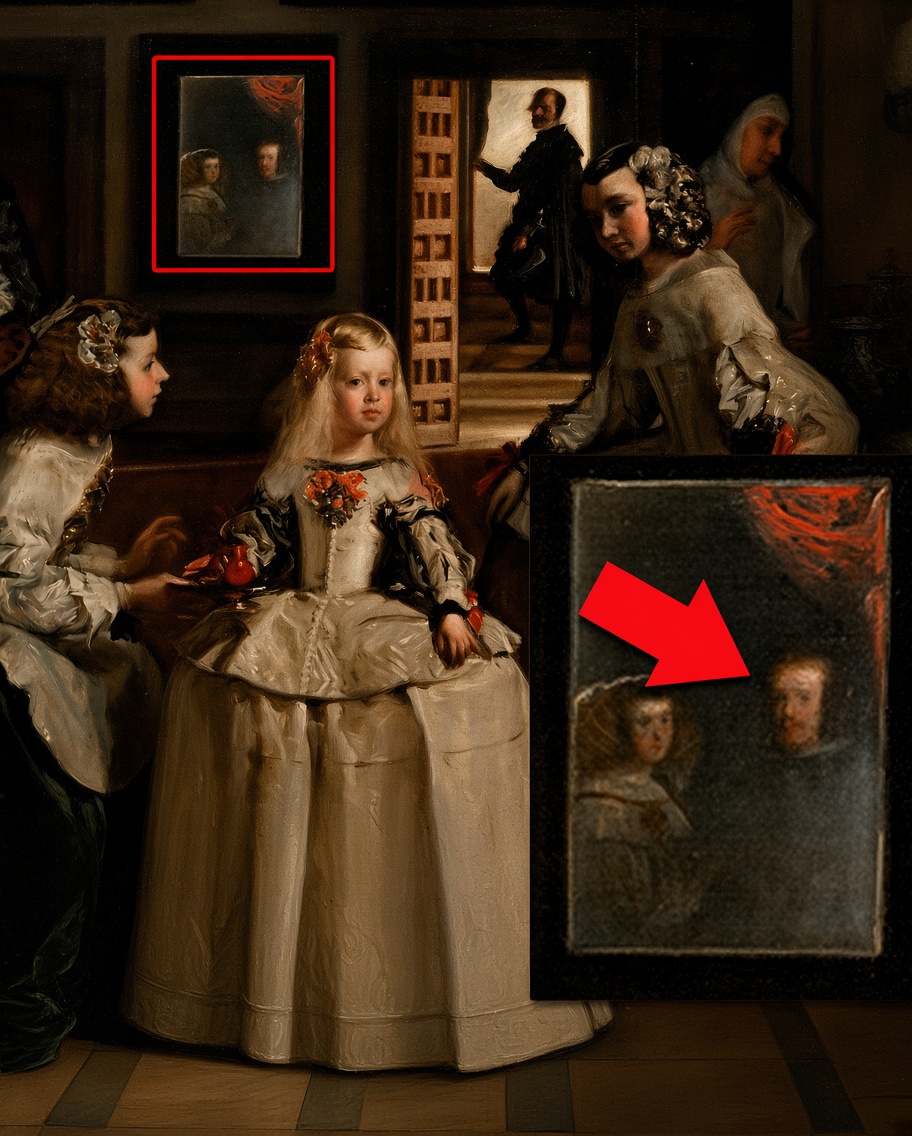
For centuries, scholars have failed to agree on what it actually shows. Today there are two main theories.
The first holds that the mirror reflects the king and queen themselves, standing outside the painting directly in front of Velázquez, watching the scene while everyone in the room looks at them. If so, the viewer occupies the monarch’s place. Step up to the painting and you stand where the King of Spain stood, seeing the scene through his eyes.
The second theory offers a completely different reading. In it, the royal couple is not in the room at all. The mirror reflects the image on the enormous canvas Velázquez is painting, an official portrait of the monarchs, whose back is all we see. The mirror then becomes part of the artistic composition rather than a window into real space.
The difference may seem slight, but the answer changes the meaning of the whole painting. In one case we take the king’s place. In the other we remain ordinary onlookers.
If the first theory is right, the rest of the scene falls into logic. The man at the back has opened the door and let the princess in. Margarita has come to see how her parents’ portrait is progressing, and her attendants have followed. The ladies-in-waiting prepare to bow, the dwarfs watch, and Velázquez studies his sitters. None of them is looking at the viewer. They are all looking at the king, and the viewer merely stands in his place.
Some researchers propose the opposite. In their view, Velázquez is not painting the king and queen at all, but five-year-old Margarita. Philip IV and Mariana have simply stepped into the studio to check on their daughter’s portrait, and it is their unexpected arrival that draws everyone’s attention.
The arguments are compelling. Throughout his life, Velázquez never painted a formal double portrait of the royal couple in a format that could have been reflected in that mirror. He did paint Margarita many times. She also sits at the very center of the composition, lit more brightly than anyone, with the other figures arranged around her.
Whichever theory you prefer, the mirror was no accident. It forces the viewer to question what they are seeing, and turns an ordinary court scene into one of the most enigmatic compositions in painting.
It is far from the only secret. Velázquez does not portray himself as a humble court painter at all. His figure is almost as tall as the adult courtiers, and he stands beside the royal family in one of the most prominent spots in the picture.
Today that seems natural. In the 17th century, an artist was considered a craftsman, and even the most famous painters belonged officially to the lower classes. For the Spanish aristocracy, painting was physical labor, and physical labor was unworthy of a nobleman.
Velázquez spent his life trying to change that. He dreamed of a knighthood, and of proving that painting was an intellectual art rather than a trade. Look at how he shows himself: taller than most, calm, nothing like a servant. Even the king stays outside the painting while Velázquez remains within it. Some researchers call this a true revolution, the first time a painter placed himself almost level with political power.
Then there is the detail that makes the story stranger. On Velázquez’s chest is the red cross of the Order of Santiago, one of the most prestigious chivalric honors in Spain. Winning it was extraordinarily hard. Candidates had to prove purity of lineage, no Jewish or Muslim ancestors, noble family origins and an impeccable reputation.
Velázquez spent years pursuing the title, and when he finished the painting in 1656 he did not yet have it. He became a knight of the Order only three years later. So why is the insignia already there?
Modern research suggests it was not. During restoration, specialists found that the red paint lies on top of a fully dried layer, which means it was added after the rest of the picture was complete.
The most famous legend says that after Velázquez was admitted to the Order in 1659, King Philip IV walked up to the canvas and painted the red cross on the artist’s chest with his own hand. It is a lovely story, with the monarch publicly honoring his favorite painter. But no surviving documents confirm it.
Another puzzle stands in the doorway. The man there is José Nieto Velázquez, the court marshal responsible for furnishing the royal apartments. Some historians think he may have been a distant relative of the artist, though there is no conclusive evidence.
More intriguing is what he is doing. Is he entering or leaving? One foot is on a higher step and the other on a lower, and the pose fits both movements equally well. He may have just opened the door and come in, or he may be about to go out. Velázquez seems to have chosen the one moment when the direction cannot be told, and the effect of frozen time grows stronger for it.
Now look at the wall. Two large paintings hang there, known today to be copies of works by Peter Paul Rubens. They seem like ordinary palace decoration, but the subjects are far from random. One shows the contest between Athena and the weaver Arachne. The other shows the musical contest between Apollo and the satyr Marsyas.
Both stories share an idea: a human challenges a higher power, and both end tragically. Arachne is turned into a spider, and Marsyas is brutally punished for his arrogance.
Why would Velázquez choose them? Perhaps they mirror his own position at court. In both myths, mortals dare to compete with the gods and pay a terrible price. Despite his enormous prestige, Velázquez remained a servant, entirely dependent on the monarch, who could raise him up or take everything away.
Perhaps this was his way of reminding the viewer of the fine line even the most talented master must never cross.
The painting is almost 370 years old, and its mysteries have never been fully solved. We still do not know what Velázquez is painting on the canvas hidden from us. We cannot say with certainty where the king and queen are standing. We still argue over whether the man in the doorway is coming or going, and even the small red cross on the artist’s chest continues to raise questions.
Perhaps that is exactly why Las Meninas still draws millions of viewers from around the world. It is not simply a portrait of the Spanish court. It breaks the traditional rules of painting and makes everyone who stands before it part of the scene.
So the question remains. In Las Meninas, who is really watching whom? Are we watching the figures in the painting, or are they watching us?









