Two Dice, One Devil and the Woman Who Is the Real Stake
Two tiny white cubes sit in the middle of the painting, two dice on a dark green cloth. A man’s soul is on the table.
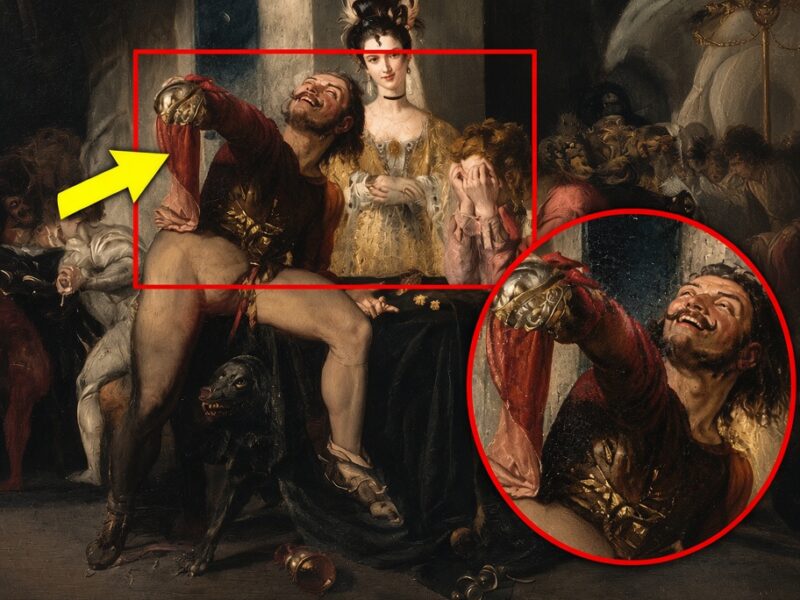
On the right is Faust, bent forward, his face pushed into both hands, fingers spread across his skull. He cannot look at the result. On the left, Mephistopheles leans back with his mouth open in a huge grin, one elbow jutting out, his other hand lying open beside the dice. His legs are spread, one knee pushed toward his opponent, while Faust has folded himself into one corner of the table.
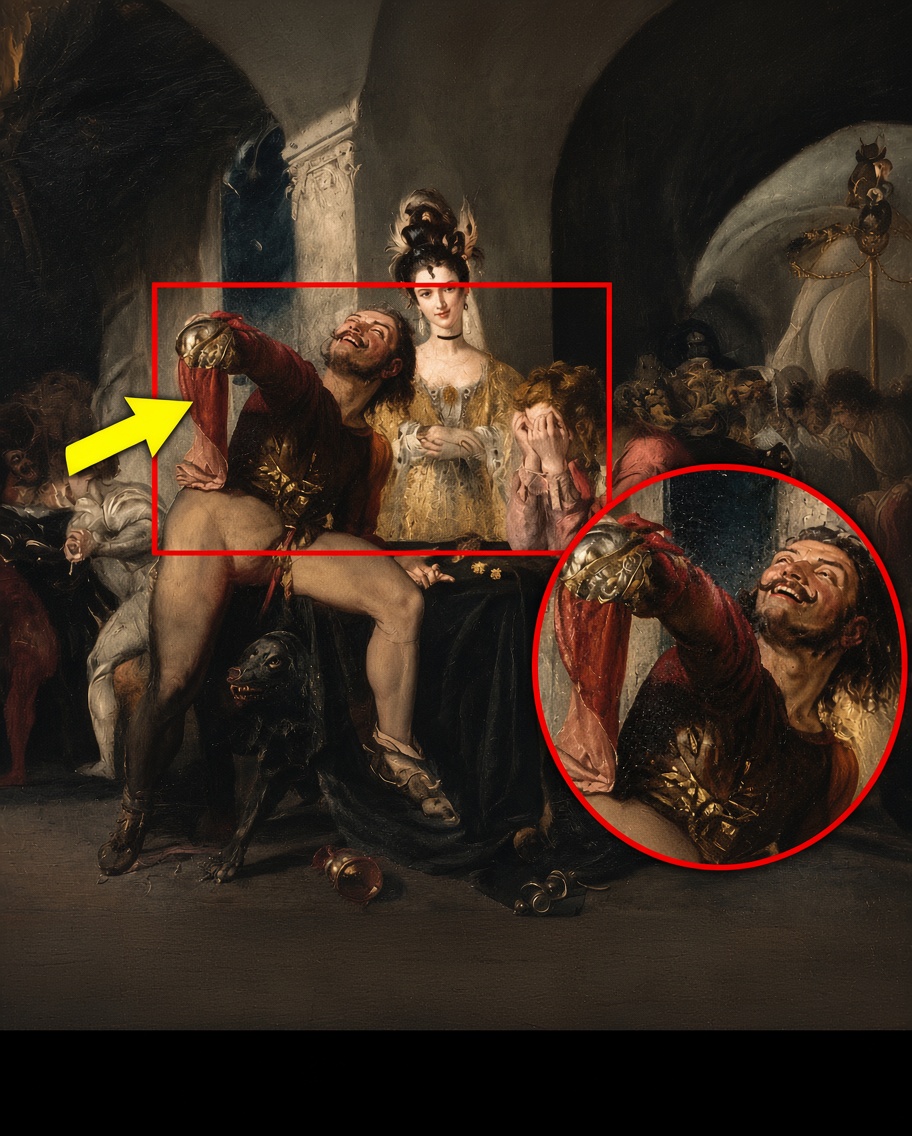
Mephistopheles takes up everything else. Look between his legs, under the chair, in the shadow, and a dark dog-like creature bares its teeth.
Then look at the woman standing between the two men. She wears a gold patterned dress and a black ribbon around her throat. Her hair rises into a tall arrangement of feathers and pearls, and her hands rest together at her waist. A man sits beside her with his face in his hands, and she looks almost amused.
Everything in the painting is in motion. Mephistopheles is laughing, Faust is collapsing, and the party behind them rolls on. She is the only thing perfectly still.
Keep your eyes on her, because the two dice, the laughing devil and the dog under the chair all point in one direction, and that direction is her. Once you see it, you understand this painting is not about the game at all.
Start with the table. The work is called The Dice, its full title Mephistopheles Plays for Faust’s Soul, and it is attributed to a London painter named Theodore von Holst, working in the 1830s or early 1840s. Hold on to that word, attributed. It matters later.
Holst was a prodigy, born in London in 1810, the son of a music teacher. He drew so well as a boy that the president of the Royal Academy, Sir Thomas Lawrence, bought his sketches. He became the favorite pupil of Henry Fuseli, the man who painted The Nightmare, with its demon crouching on a sleeping woman’s chest.
At 20, Holst drew the first illustration ever made for Mary Shelley’s Frankenstein. For the rest of his short life, he kept returning to one story, Goethe’s Faust.
But this is not how Goethe stages the bargain. In the play there are no dice. Faust makes his agreement with Mephistopheles alone in his study, and the devil asks for a signature written not in ink but in blood. One drop.
Holst threw all that away and turned a contract into a dice game. A contract has to be read, while a dice game is understood at a glance: two players, two cubes, two completely different reactions.
He also had a reason to choose dice. Holst was painting in London in the 1830s, when the gambling houses of St. James’s were swallowing the fortunes of young men in a single evening. Crockford’s had opened in 1828. His audience had seen this scene, a young man at a table with his face in his hands, and some of them had been that young man.
Now look at the room. Behind the table, the party goes on: figures drinking, leaning on each other, dissolving into the dark. In the bottom right corner, a man slumps against the wall with a bottle in his hand, staring at nothing.
In Goethe’s play, Mephistopheles takes Faust to a tavern called Auerbach’s Cellar to show him how low pleasure can go. That is where we are. And nobody in the cellar has noticed what just happened at this table.
Then the floor. A lute lies dropped on its back, a goblet has tipped over with its contents gone, and coins are scattered beside Faust’s shoe. The music has stopped, the drink is finished and the money is still lying there. Nobody has picked up the winnings, which tells you the winnings were never money.
Look at the dog again. In Goethe’s play, Mephistopheles does not arrive in smoke. He arrives as a black poodle, a stray that follows Faust home from an evening walk and curls up in his study. When the door is locked, it grows, twists and stands up as a man.
Holst has painted both. The devil as he is now, laughing at the table, and the devil as he first came in, still crouched at his feet, teeth bared, still wearing the disguise. Faust let a dog in, and now he sits with his face in his hands.
Now go back to the woman and look at her headdress. Follow the feathers to the very top, where a jewel should be. A small, dark figure sits there, a creature perched on her head like a bird on a branch.
The auction catalog does not identify her, and nobody can say for certain who she is. She may be Gretchen, the innocent girl Faust seduces and destroys in Goethe’s story. She may be no one from the play at all.
But look at what Holst did with her. He dressed her in gold and pearls and placed her directly between the two players at the center of the canvas. He gave her the calmest face in the room, and he set a demon on her head.
She is not watching the game. She is the stake. Faust did not sit down for the coins on the floor. He sat down for her, and the creature on her head is the devil’s flag, planted before the dice were even thrown.
One more look at the two men’s hands. Mephistopheles’ free hand lies open on the cloth, loose and careless, because he has not bothered to collect anything. Faust’s hands are clenched into his own face. One man is holding on. The other does not need to.
Which brings us back to that word, attributed. The painting is not signed. Scholars believe Holst painted it, since it is his subject, his theater, his Fuseli-trained faces lit from below. But no name was ever put on the canvas.
That suits Holst better than anyone could have planned. He died in 1844, aged 33. The child whose drawings were bought by the president of the Royal Academy, the first illustrator of Frankenstein, the Englishman who painted the devil more often than any painter of his generation, was buried and forgotten almost at once. His studio was sold off within months, and for a century his name barely appears in the history of British art.
Years later, Dante Gabriel Rossetti found his work and called him a forerunner of everything the Pre-Raphaelites were trying to do. By then, it was too late.
Here is a painting about a man who gambles away the one thing that makes him who he is, painted by a man who lost his own name in exactly the same silence.
Look back at those two little cubes. They barely take up any space on the canvas, yet every face around the table makes them feel enormous. Faust has not lifted his head. He is still in the moment just after the dice stopped, when you know but have not accepted.
Holst never shows us his face when he finally looks up. He did not have to. Anyone who has ever lost something they could not get back already knows what it looks like.









