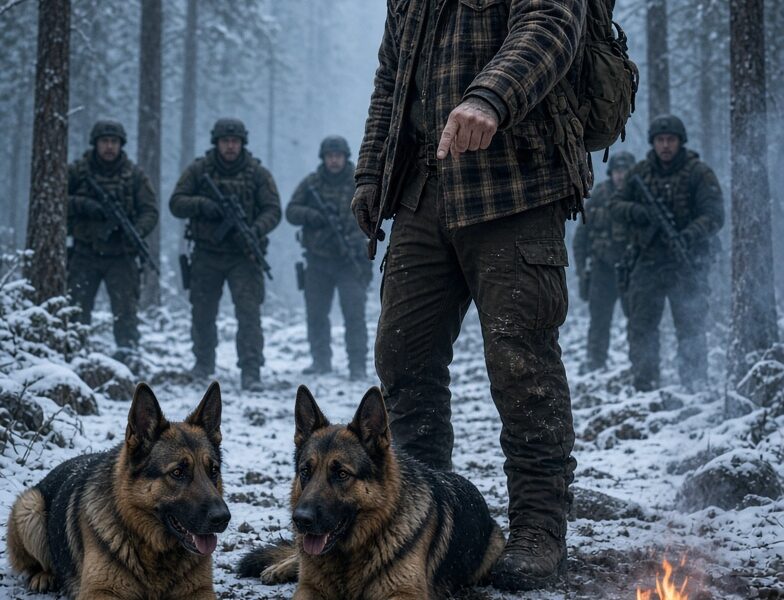
Two Charging Police Dogs Closed In for the Kill — Until the Man in the Woods Spoke One Word
Footsteps crunched against the freezing Montana dirt as two 80-pound German Shepherds snapped their leads and sprinted dead center toward a solitary figure in the woods.
Sheriff Courtland Holmes braced for a massacre.
He did not know the man in their crosshairs was a decorated Navy SEAL, and he definitely did not expect what happened next.
Frost clung to the heavy branches of the Bitterroot National Forest, casting a bone-chilling dampness over the morning.
Sheriff Holmes exhaled a plume of white breath, his hand resting instinctively on the grip of his holstered sidearm.
For 14 hours, the Ravalli County Sheriff’s Office had been playing a deadly game of cat and mouse across 5,000 acres of unforgiving terrain.
Their prey was Ray Coburn, a suspected methamphetamine manufacturer who had shot a Montana Highway Patrol trooper during a routine traffic stop the previous evening.
Coburn was armed, desperate, and intimately familiar with the sprawling wilderness.
But Holmes had an advantage Coburn could not outrun.
Ahead of the sheriff, pulling with a force that threatened to dislocate their handlers’ shoulders, were two premier K9 units, Titan and Brutus.
Both were purebred German Shepherds imported from European bloodlines and trained to track, corner, and neutralize.
Deputy Travis Lawson gripped Titan’s heavy leather leash, his boots slipping on the slick pine needles.
Beside him, Deputy Greg Mitchell struggled to keep Brutus at a steady pace.
The dogs were in a frenzied state of drive, their noses vacuuming the forest floor and pulling the tactical team deeper into the isolated ridge.
“They’ve got something solid,” Deputy Lawson whispered, his chest heaving under his tactical vest.
“Titan’s posture just changed. Tail stiff. He’s closing in.”
Sheriff Holmes signaled for the four heavily armed deputies behind him to fan out.
“Keep your spacing,” Holmes said. “Coburn’s got nothing to lose. If he pops out of a blind spot, I want overlapping fields of fire.”
“Lawson, do not let that dog off the lead until we have eyes on.”
What Sheriff Holmes did not know was that the scent pulling his two 80-pound missiles through the brush did not belong to a desperate fugitive.
Less than 300 yards away, Tyrie Barrett was kneeling beside a small smokeless fire, nursing a tin cup of black coffee.
Tyrie was a man carved from the very granite of the mountains he sought refuge in.
For 12 years, he had operated in the shadows as a chief petty officer in the United States Navy, specifically attached to SEAL Team 6.
He had survived firefights in the mountains of Afghanistan, breached compounds in the dark of night, and lost men who were closer to him than brothers.
Medically retired after a piece of shrapnel ended his career, Tyrie had retreated to the Montana wilderness to silence the ghosts of his past.
He did not own a television, rarely checked his phone, and was entirely unaware of the massive manhunt converging on his position.
Tyrie’s finely tuned instincts, honed by more than a decade of combat deployments, suddenly flared.
The forest had gone completely silent.
The usual morning chatter of jays and squirrels had vanished, replaced by a subtle rhythmic crunching of frost under boots and the heavy, ragged panting of large animals.
He calmly set his tin cup down on a flat rock.
He did not scramble for the SIG Sauer P226 strapped to his hip, nor did he panic.
Instead, he slowly stood up, brushing the dirt from his heavy flannel jacket, his eyes scanning the dense tree line.
The forest had already chosen its witness.
Down the ridge, disaster struck the sheriff’s team.
Titan crested a small embankment, his paws catching a patch of hidden black ice.
Deputy Lawson, already exhausted from the overnight hike, lost his footing.
As Lawson went down hard on his shoulder, his grip on the leather lead slipped.
Sensing the sudden release of tension, Titan launched forward like a coiled spring.
Brutus, highly competitive and triggered by his packmate’s sudden acceleration, lunged violently.
The force snapped the brass clip connecting his harness to Deputy Mitchell’s lead.
It was a one-in-a-million equipment failure, but it happened in the worst possible fraction of a second.
“Loose dogs! Loose dogs!” Mitchell screamed, scrambling to his feet and grasping at empty air.
Sheriff Holmes’s heart plummeted into his stomach.
Two highly aggressive, fully energized German Shepherds were now off leash, charging blindly toward what the team assumed was an armed fugitive.
“Push up! Push up!” Holmes roared, abandoning stealth as he drew his weapon and sprinted up the embankment.
“If Coburn shoots those dogs, we light him up through the trees.”
Holmes caught sight of the clearing.
He saw a tall, broad-shouldered man standing by a fire pit.
The man had a beard, a dark jacket, and matched the general physical description of their fugitive.
Holmes watched in horror as the two German Shepherds broke through the final layer of brush, teeth bared, closing the 30-yard gap at a dead sprint.
In Holmes’s mind, the next few seconds were already written in blood.
The suspect would either draw a weapon and kill the million-dollar K9s, or the dogs would hit the man at 30 miles an hour, their powerful jaws locking onto his limbs.
“Get down!” Holmes bellowed at the top of his lungs, his voice echoing off the canyon walls.
But the man did not move.
He did not reach for a gun.
He did not run.
Tyrie Barrett watched the two massive German Shepherds barreling toward him.
Any normal civilian would have turned and fled, triggering the dogs’ predatory pursuit drive and guaranteeing a brutal takedown.
But Tyrie was not a civilian.
During his time in naval special warfare, he had spent three years cross-trained as a multi-purpose canine handler.
He knew the psychology of a working dog better than he knew most people.
He immediately recognized the posture of the animals.
They were not moving in for a fear-based attack.
This was pure, unadulterated apprehension drive.
They were doing a job.
As Titan closed the distance to 15 feet, preparing to launch his 80-pound frame into Tyrie’s chest, Tyrie squared his shoulders.
He did not flinch.
Instead, he stepped forward, a move that fundamentally disrupts a dog’s targeting calculus.
Then, pulling from the depths of his diaphragm, Tyrie barked a command in flawless, authoritative Czech.
The language was predominantly used for imported police and military K9s.
“Lehni! Down!”
The command cracked through the freezing air like a whip.
Titan, entirely unprepared for the suspect to speak the exact language of his deep obedience training with such overwhelming alpha authority, locked his front legs.
The dog skidded across the frosted dirt, kicking up a cloud of dust and pine needles, stopping less than 3 feet from Tyrie’s boots.
Brutus, coming in hot just a second behind, heard the booming command and saw his lead dog abort the strike.
Brutus aborted too, sliding to a halt beside Titan.
Tyrie did not break eye contact.
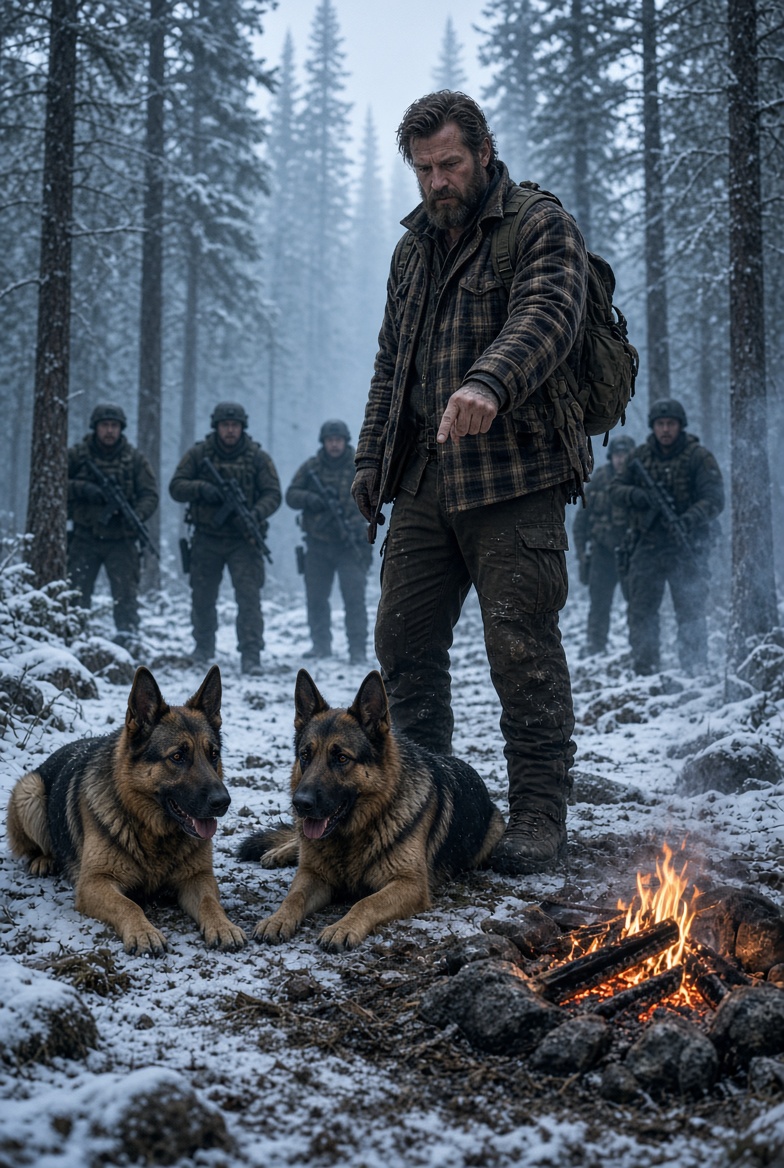
He maintained a towering, dominant posture, pointing a rigid finger directly at the ground.
“Lehni!” Tyrie commanded again, his voice dropping an octave and echoing the absolute authority of a handler correcting a subordinate pack member.
Instinct and hundreds of hours of repetition overrode the dogs’ drive to bite.
Both German Shepherds instantly dropped to their bellies, their ears pinned back, panting heavily as they looked up at the stranger, completely submissive, waiting for their next command.
A second later, Sheriff Holmes and his deputies burst into the clearing, their AR-15s and sidearms raised, laser sights dancing aggressively across Tyrie’s chest.
“Don’t move! Keep your hands where I can see them!” Holmes screamed, his finger hovering over the trigger.
“Get on the ground, Coburn. Do it now.”
Tyrie did not raise his hands, nor did he drop to the ground.
Doing so would change his silhouette and potentially reignite the dogs’ prey drive.
He kept his hands relaxed at his sides, his eyes calmly shifting from the barrels of the rifles to Sheriff Holmes’s panicked face.
“If I get on the ground, Sheriff, these dogs are going to break their down-stay,” Tyrie said, his voice terrifyingly calm compared to the adrenaline-fueled screaming of the deputies.
“I’m going to slowly reach into my left chest pocket with my left hand using two fingers. I’m pulling out a black leather wallet. You have the wrong man.”
“I said get on the ground!” Deputy Mitchell yelled, stepping forward.
Titan, sensing the aggression from the deputies toward the man who had just established himself as an alpha, let out a low, rumbling growl, confused about who the actual threat was.
“Deputy, if you take one more step, you’re going to stress your dog into a redirect,” Tyrie warned smoothly.
“He’s overstimulated. Call him to a heel. Use his name. Say, ‘Here, here,’ and give him a reward turn. He’s forgetting who his handler is right now.”
Sheriff Holmes froze.
The man in his sights was not acting like a meth head or a cop killer.
He was not acting like a suspect at all.
He was dictating the tactical flow of the clearing with the icy detachment of an instructor.
“Mitchell, hold your position,” Holmes ordered, his breathing heavy.
He kept his weapon aimed at Tyrie’s center mass.
“Who the hell are you?”
“Tyrie Barrett, chief petty officer, United States Navy, retired.”
Tyrie used his left thumb and index finger to slowly extract his wallet, tossing it lightly onto the dirt halfway between himself and the sheriff.
“Check the ID, and while you’re doing that, you need to leash your animals.”
Holmes nodded to Lawson, who cautiously stepped forward, keeping his eyes locked on Tyrie, and reclipped Titan’s leash.
Mitchell did the same with Brutus.
The dogs were remarkably calm, occasionally glancing at Tyrie for approval.
Holmes nudged the wallet with his boot, keeping one hand on his gun as he opened it.
The military ID and Montana driver’s license stared back at him.
The face was a match.
The name was not Ray Coburn.
Holmes slowly lowered his weapon, the crushing weight of the near-fatal mistake washing over him.
If this man had not known exactly how to stop those dogs, they would have mauled him.
If the deputies had perceived him fighting the dogs, they might have shot him.
They had almost killed a decorated veteran.
“Stand down, boys,” Holmes said, his voice cracking slightly as he holstered his weapon.
The deputies lowered their rifles, exchanging bewildered glances.
“Mr. Barrett,” Holmes started, removing his hat and wiping the sweat from his forehead despite the freezing temperature.
“I owe you a profound apology. We’re tracking a fugitive who shot a trooper last night. The dogs caught a scent. And we assumed you—”
“Assumed he came this way,” Tyrie interrupted, stepping forward to retrieve his wallet.
He patted Titan firmly on the head, and the dog leaned affectionately into the former SEAL’s hand.
“They didn’t track me from the highway, Sheriff. I’ve been out here for three days. My scent is cold.”
Holmes frowned, looking at his K9 handlers.
“What are you saying?”
Tyrie turned, looking past the smoldering ashes of his campfire toward the dense, rocky incline to the west.
His eyes narrowed, slipping instantly back into the operator mindset he had tried so hard to leave behind.
“I’m saying the dogs were tracking a hot scent, Sheriff. And it wasn’t me.”
Tyrie crouched, pointing to a patch of crushed frost and a broken fern a few yards past his campsite.
“Someone came through my camp about 20 minutes ago, stepped right over my fire pit while I was down at the creek fetching water. The dogs didn’t alert on me. They alerted on the trail that intersects my camp.”
Holmes felt a cold spike of adrenaline hit his heart.
Tyrie stood back up, his eyes locking onto a specific cluster of boulders roughly 400 yards up the ridge.
“He didn’t keep running, Sheriff. He realized he was leaving a trail in the frost, and when your dog started barking, he found the high ground.”
The silence in the woods suddenly felt suffocating.
“Get to cover,” Tyrie whispered fiercely. “Now.”
Before the sheriff could even process the warning, a supersonic crack ripped through the tree line, and the bark of the pine tree right next to Holmes’s head exploded into lethal wooden shrapnel.
Bark and splintered wood rained down on Sheriff Courtland Holmes as he threw his weight backward, diving behind the thick trunk of a centuries-old ponderosa pine.
The deafening echo of the rifle shot was still bouncing off the canyon walls when a second round tore through the freezing air.
This one found flesh.
Deputy Travis Lawson cried out, his leg buckling as a high-caliber bullet ripped through the meaty portion of his outer thigh.
He collapsed onto the frosted dirt, groaning in agony.
As Lawson fell, his grip slackened, and the leather leash slipped from his heavy gloves.
Titan was loose again, but this time the dog was in a frenzy of protective drive, spinning wildly to locate the source of the threat that had just injured his handler.
“Officer down! Lawson is hit!” Deputy Mitchell screamed, flattening himself against a shallow depression in the earth and dragging Brutus down with him.
Chaos erupted in the clearing.
The deputies, trained for law enforcement rather than asymmetric mountain warfare, were laying down blind, scattered suppressive fire with their AR-15s, chewing up the tree line but failing to target the elevated sniper.
Tyrie Barrett did not panic.
His mind, conditioned by years of brutal SEAL Team 6 deployments, instantly compartmentalized the fear and noise.
He processed the auditory signatures with mechanical precision.
The supersonic crack preceding the muzzle blast meant the shooter was elevated and firing from a distance.
The heavy resonant boom indicated a large hunting caliber, likely a .308 or a .30-06 bolt-action rifle, given the distinct two-second delay between the first and second shots.
“Cease fire! Cease fire!” Tyrie roared, his voice cutting through the chaotic gunfire.
“You’re shooting at shadows and giving away your positions. He’s 400 yards up the ridge, in the boulder cluster.”
Holmes, pinned behind his tree, looked over at the retired Navy SEAL.
Tyrie was low-crawling through the dirt with terrifying speed and efficiency, moving directly toward the wounded deputy.
Titan, barking furiously and pacing in front of Lawson, snapped his jaws at the empty woods.
The dog was a split second away from charging blindly up the mountain, a move that would result in his immediate death.
Tyrie slid into the dirt next to Lawson.
He did not reach for the deputy first.
He had to secure the K9.
“K noze! To me!” Tyrie barked the Czech command sharply, clapping his hands once to break the dog’s target fixation.
Titan whipped his head around.
The massive German Shepherd hesitated, torn between his instinct to guard Lawson and the overwhelming alpha presence of the man who had effortlessly dominated him moments earlier.
“Místo!” Tyrie commanded, pointing rigidly to the ground directly beside him.
Titan yielded.
The dog scrambled over to Tyrie and dropped tightly into the dirt, trembling with adrenaline but holding his position.
“You’re going to be fine, Lawson. It’s a clean through-and-through. Missed the femoral artery,” Tyrie said calmly, swiftly unbuckling the heavy leather belt from the deputy’s waist.
He fashioned a makeshift tourniquet high on Lawson’s thigh, cranking it down mercilessly until the bright red arterial flow slowed to a dark trickle.
“Sheriff, I need a rifle.”
Holmes stared at the man.
Standard protocol dictated that a civilian was never to be armed by an officer.
But standard protocol had vanished the moment a sniper pinned them in an open clearing.
Holmes unslung his patrol AR-15 and slid it aggressively across the frosty ground.
Tyrie caught the rifle by the handguard, smoothly popping the magazine to check the load, slamming it back in, and racking the charging handle.
He checked the optic—a standard red dot.
Not ideal for a 400-yard uphill engagement, but in his hands, it would have to be enough.
“He has the high ground, cover, and a scoped rifle,” Tyrie stated, crawling over to Holmes’s position while keeping low.
“If you try to retreat carrying a wounded man, he will pick you off one by one. You are sitting ducks in this bowl.”
“So what’s the play, Barrett?” Holmes asked, wiping a mix of sweat and melted frost from his eyes.
“We wait for SWAT. They’re an hour out.”
“By the time SWAT gets here, Coburn will have slipped over the ridge and vanished into the next county,” Tyrie replied, his eyes scanning the terrain.
He pointed to a steep rocky ravine that curved aggressively to the west, cutting up the mountain and wrapping around behind the boulder cluster.
“That draw offers defilade cover. I can use it to flank him, but I need you to keep his head down.”
“You want to single-handedly flank an armed sniper?” Mitchell yelled from his ditch, clutching Brutus tightly.
“Are you insane?”
“I was a tier-one operator, Deputy. This is Tuesday,” Tyrie said, his face deadpan.
He looked at Holmes.
“I need exactly 60 seconds of coordinated, sustained suppressive fire on those boulders. Don’t blow your magazines all at once. Fire in three-second bursts, alternating left and right deputies. Keep him pinned.”
Holmes looked at the cold, calculating eyes of the retired SEAL.
There was no arrogance in his gaze, only absolute certainty.
“Do it,” Holmes ordered his men over the radio.
Before the deputies could open fire, Tyrie looked down at Titan.
The dog was watching him intensely.
Tyrie knew that if he left, the dog might try to follow or break formation, potentially drawing fire.
Furthermore, having a K9 on a flank could be the decisive advantage he needed in close quarters.
Tyrie unclipped a spare carabiner from Lawson’s tactical vest, securing it to his own belt and snapping Titan’s lead into it.
“He goes with me,” Tyrie told Holmes.
“Give me cover.”
“Light him up,” Holmes screamed.
The woods erupted.
Four AR-15s unleashed a deafening barrage of 5.56-caliber rounds, chewing into the granite boulders up the ridge and sending chips of rock and pulverized snow flying into the air.
Under the deafening roar of the cover fire, Tyrie Barrett moved.
He did not run like a normal man.
He glided.
He moved with a low, predatory crouch, his footfalls impossibly silent on the treacherous terrain, dragging the 80-pound German Shepherd alongside him.
Titan, feeding off Tyrie’s hyper-focused energy, dropped into a low stalk, mirroring the SEAL’s movements perfectly.
They slipped into the ravine and vanished like ghosts into the mist.
The climb was agonizing.
The freezing air burned Tyrie’s lungs, and the loose shale threatened to send him sliding back down into the line of fire.
But 12 years of carrying 100-pound rucksacks up the mountains of the Hindu Kush had forged his legs out of iron.
He moved efficiently, keeping his silhouette below the ridge line and strictly adhering to the tactical shadows.
Titan stayed pinned to his left leg in a flawless tactical heel.
The dog’s breathing was controlled, sensing the absolute gravity of the hunt.
Below them, the deputies’ gunfire sputtered and ceased.
The 60 seconds were up.
Now the forest was plunged back into a terrifying silence, broken only by the wind howling through the pine needles.
Tyrie reached the crest of the ravine.
He was now approximately 50 yards behind and slightly above the boulder cluster where Ray Coburn had set up his sniper nest.
Tyrie dropped flat onto his stomach, crawling the last few yards through the freezing mud.
Titan belly-crawled right beside him, a silent furry missile waiting for the launch code.
Peering through the sparse winter brush, Tyrie laid eyes on the fugitive.
Ray Coburn was huddled between two massive slabs of granite.
He was hastily shoving loose .308 rounds into the internal magazine of a scratched Winchester hunting rifle, muttering curses under his breath.
He was dressed in a filthy camouflage jacket, shivering violently from a combination of the biting cold and methamphetamine withdrawal.
Coburn was entirely focused on the clearing below, completely unaware that death was resting silently 50 yards behind him.
Tyrie slowly raised the AR-15, settling the red dot directly over the center of Coburn’s back.
It would be an easy shot.
One squeeze of the trigger, and the threat would be permanently neutralized.
But Tyrie Barrett was not a murderer, and this was not a war zone.
This was American soil.
And as a civilian, he intended to let the justice system do its job.
He needed to take Coburn alive, but he could not risk a close-quarters firefight that might send stray bullets raining down on the deputies below.
He needed a distraction.
A violent, overwhelming distraction.
Tyrie lowered the rifle slightly and leaned his mouth right against Titan’s left ear.
He unclipped the carabiner from his belt, freeing the leash.
“Revier, such, fass!” Tyrie whispered, his voice a low, guttural rasp.
“Fass! Hold!”
Titan exploded from the brush.
The German Shepherd covered the 50 yards in less than three seconds, navigating the jagged rocks with the agility of a mountain lion.
Coburn heard the unnatural crunch of gravel behind him.
He spun around, awkwardly raising the long barrel of the Winchester rifle, but he was far too slow.
Before Coburn could even find the trigger, Titan launched into the air.
Eighty pounds of muscle, teeth, and kinetic energy slammed directly into Coburn’s chest.
The impact sounded like a car crash.
Coburn was thrown backward against the granite boulder, the wind violently knocked from his lungs.
The Winchester rifle clattered uselessly down the rocky slope.
Titan’s jaws clamped down with crushing force onto Coburn’s right forearm.
The fugitive let out a bloodcurdling shriek as the canine’s teeth locked in, completely neutralizing his ability to reach for the hunting knife strapped to his belt.
“Get him off! Oh God! Get him off me!” Coburn screamed, thrashing wildly in the dirt.
But Titan held on with absolute, unyielding tenacity, aggressively pulling backward to keep the suspect off balance, exactly as he had been trained to do.
Tyrie stepped out from the brush, the AR-15 leveled squarely at Coburn’s head.
“Stop fighting the dog, Ray, or I will let him take your arm entirely off,” Tyrie commanded, his voice echoing with chilling authority.
Coburn, terrified and agonizingly pinned, immediately went limp, sobbing into the dirt.
“Fuss out,” Tyrie ordered sharply.
Titan instantly released his bite, though he remained standing directly over Coburn, teeth bared, letting out a low, rumbling growl that vibrated through the suspect’s chest.
“Sheriff Holmes, this is Barrett,” Tyrie called out, picking up the deputy’s radio from his belt.
“Suspect is secured. Sniper rifle is out of play. You can move your men up.”
Ten minutes later, the clearing was a flurry of organized chaos.
Paramedics, who had been staging a mile down the logging road, were loading Deputy Lawson onto a stretcher.
His wound was stabilized, thanks entirely to Tyrie’s rapid application of the tourniquet.
Sheriff Holmes stood near the boulders, watching as Deputy Mitchell tightly handcuffed a weeping Ray Coburn and began reading him his Miranda rights.
Holmes walked over to Tyrie.
The retired SEAL was leaning against a pine tree, calmly unloading the AR-15 before handing it back to the sheriff.
Titan was sitting at Tyrie’s feet, leaning heavily against his leg, completely ignoring his actual handler across the clearing.
“I’ve been in law enforcement for 26 years,” Holmes said, shaking his head in sheer disbelief.
“I have never seen anything like what you just did today. You commanded my dogs better than my own men. You saved Lawson’s life. And you took down a barricaded shooter without firing a single bullet.”
“The dogs did the heavy lifting, Sheriff,” Tyrie replied, offering a faint, weary smile as he scratched Titan behind the ears.
“They’re good boys. They just needed clear instructions.”
“Mr. Barrett, the county is in your debt. If you ever need anything, and I mean anything, you call me,” Holmes said, extending a hand.
Tyrie took it, his grip firm and calloused.
“I just want to drink my coffee in peace, Sheriff. That’s all I’m out here for.”
As the tactical teams began their long descent down the mountain, dragging the fugitive toward justice, Tyrie Barrett turned back toward his campsite.
The woods were quiet again.
The sun was finally breaking through the heavy gray clouds, casting long golden shadows across the frosted earth.
He had come to the mountains to leave his wars behind.
But as he walked away, he knew that a warrior’s instincts never truly vanish.
They just wait patiently in the silence, ready to answer the call when the wolves come to the door.
That was the debt the morning would collect.
By the time Tyrie reached his camp, the tin cup of black coffee had gone cold on the flat rock.
He picked it up anyway, wiped the rim with his thumb, and poured the cold coffee into the dirt.
Then he sat down on a fallen log and listened to the helicopter blades fading toward the hospital in Hamilton.
He did not know Deputy Lawson’s full name yet.
He did not know whether the young man had a wife, a child, or a mortgage, or whether he liked his coffee the same way.
But he knew the sound of a tourniquet tightening just right, and he knew the sound of a dog trusting a human voice in the middle of chaos.
Those were the sounds that stayed with him.
Two hours later, Sheriff Holmes stood in the parking lot of the Ravalli County Sheriff’s Office and watched the emergency room doors at the hospital across town in his mind.
Deputy Lawson was alive.
The bullet had missed the femoral artery by less than an inch.
The ER doctor said the tourniquet had bought him time, and the surgical team said he would walk again.
Holmes repeated those words to himself like a prayer.
He also repeated the number 60.
Sixty seconds of suppressive fire.
Sixty seconds that had allowed a retired SEAL and an 80-pound German Shepherd to climb a ravine and end a sniper standoff without a single additional shot fired.
The number felt too small for what it had purchased.
That night, the sheriff’s office held a brief press conference outside the station.
Holmes kept it short.
He said a suspect was in custody, a deputy was recovering, and a civilian had assisted with the arrest.
He did not use Tyrie’s name.
He did not mention the dogs.
He did not mention the moment when two German Shepherds had charged a man who spoke their language and dropped them to the dirt with a single word.
But the story had already begun to move.
A paramedic on the scene had taken a photograph of Titan sitting beside Tyrie’s boot, the dog’s ears relaxed, the retired SEAL’s hand resting on the dog’s head.
The photograph did not show blood or weapons or fear.
It showed trust.
By morning, the photograph was on the front page of the Ravalli Republic with the headline “The Man Who Stopped the Dogs.”
The article was careful and factual, but the comments underneath were not.
Some people called Tyrie a hero.
Some people asked why a civilian had been given a rifle.
Some people asked why the sheriff’s office had almost shot a decorated veteran.
Holmes read every comment.
He did not sleep well.
The next afternoon, he drove out to the Bitterroot National Forest alone.
He parked his truck at the trailhead and hiked the same ridge he had hiked the day before, but slower this time, without a rifle or a radio.
He found Tyrie’s camp by the smell of woodsmoke.
Tyrie was sitting on the same fallen log, a fresh tin cup of black coffee in his hands.
Titan and Brutus were lying in the sun nearby, their leashes tied loosely to a pine stump.
Holmes stopped at the edge of the clearing and took off his hat.
“I brought you something,” he said.
He held up a small paper bag.
“It’s not a medal. It’s just coffee. The good kind. From the diner in town.”
Tyrie looked at the bag and then at the sheriff.
“You didn’t have to do that.”
“I know,” Holmes said.
He set the bag on the log beside Tyrie and sat down at a respectful distance.
For a while, neither man spoke.
The dogs slept.
The wind moved through the pines.
“I keep thinking about the 60 seconds,” Holmes said finally.
“The cover fire. The climb. The way you moved. I keep thinking about what would have happened if you had been five seconds slower.”
Tyrie took a sip of coffee.
“You would have had a different story to tell.”
“That’s not funny.”
“It’s not meant to be.”
Holmes looked at the ground.
“I almost shot you.”
“You didn’t.”
“I almost let my dogs tear you apart.”
“They didn’t.”
“That doesn’t make it right.”
Tyrie set the tin cup down on the flat rock.
“Sheriff, I’ve been on the other side of that equation. I’ve been the man with the rifle, the man with the dog, the man with the radio. I’ve made calls in the dark that I still replay in my head. You made a call with bad information. Then you listened. That’s more than a lot of people do.”
Holmes nodded slowly.
“The department is going to review the K9 protocols. The leash clips. The radio traffic. The way we handle civilian encounters in the forest. I want you to know that.”
“Good.”
“I also want you to know that Deputy Lawson is asking about you. He wants to meet Titan’s new best friend.”
Tyrie smiled for the first time that afternoon.
“He can meet me anytime. But he should know I’m not a dog trainer.”
“You could have fooled me.”
“I was trained by men who were harder than any dog,” Tyrie said.
“And by dogs who were smarter than most men.”
Holmes laughed, a short, surprised sound.
“That’s a hell of a line.”
“It’s true.”
The sheriff stayed for another hour.
They talked about the forest, the weather, the price of coffee, and the way the Bitterroot Valley looked in the fall.
They did not talk about the sniper.
They did not talk about the shot that had hit Lawson.
They did not talk about the moment when Tyrie had pointed a borrowed rifle at a man’s back and chosen not to pull the trigger.
That conversation could wait.
The community did not wait.
Within a week, the story of the two German Shepherds and the Navy SEAL had spread beyond Montana.
A national news outlet picked up the photograph and ran a short segment titled “A Stranger in the Woods.”
A veterans’ group in Missoula invited Tyrie to speak at a monthly meeting.
He declined.
A dog-training club in Bozeman asked if they could interview him about working-dog psychology.
He declined that too.
But he did agree to meet Deputy Lawson at the hospital.
Lawson was sitting up in bed when Tyrie walked in, his leg elevated and wrapped in bandages.
Titan was not allowed in the hospital, so Tyrie brought a photograph instead.
He set it on the bedside table.
“That’s Titan,” he said.
“He’s the one who stopped first.”
Lawson looked at the photograph and then at Tyrie.
“I heard you saved my life.”
“The tourniquet saved your life. The doctors saved your life. I just happened to be there.”
“That’s not what Sheriff Holmes says.”
“Sheriff Holmes is being generous.”
Lawson shook his head.
“He says you took control of a bad situation and made it right. He says you’re the reason I’m going home to my daughter.”
Tyrie was quiet for a moment.
“You have a daughter?”
“She’s six. Her name is Emma. She wants to be a veterinarian.”
“That’s a good job.”
“She’s already got the dog bed picked out for Titan. She thinks he’s a superhero.”
Tyrie looked at the photograph on the table.
“He’s just a dog who was trained well. But I’m glad she thinks so.”
Lawson reached out and shook Tyrie’s hand.
“Thank you.”
“You’re welcome.”
On the way out of the hospital, Tyrie passed a gift shop and stopped.
He bought a small stuffed German Shepherd and left it at the nurse’s station with a note that said “For Emma.”
He did not leave his name.
The sheriff’s office internal review took three weeks.
The findings were not dramatic, but they were specific.
The brass clip on Brutus’s harness had failed due to metal fatigue.
The leash on Titan had slipped because Deputy Lawson had been hiking for 14 hours without enough water and his grip strength had faltered.
The radio traffic had been cluttered because the team had not established a clear channel for K9 commands.
The deputies had fired without a confirmed target because they had been trained for urban encounters, not mountain snipers.
The report recommended new equipment, new training, and a new protocol for civilian encounters in the forest.
Sheriff Holmes signed it without changes.
He also added a personal note to the file.
“The actions of Mr. Tyrie Barrett on the morning of the incident were extraordinary and should be recognized. His presence prevented further loss of life and injury to K9 units. The department owes him a debt of gratitude.”
The note was not public.
But Holmes made sure a copy found its way to Tyrie’s mailbox.
Tyrie read it once, folded it, and put it inside the cover of a worn paperback book he kept in his cabin.
He did not frame it.
He did not show it to anyone.
But he kept it.
The trial of Ray Coburn began six months later.
The prosecution had a strong case.
The highway patrol trooper had survived his wound and identified Coburn in a lineup.
The Winchester rifle had Coburn’s fingerprints on the stock and the bolt.
The DNA on the camouflage jacket matched a sample from Coburn’s toothbrush.
The defense tried to argue that the evidence had been contaminated by the chaotic arrest, but the judge was not impressed.
Tyrie was called as a witness.
He wore a clean flannel shirt and a dark jacket.
He answered questions in a calm, measured voice.
He described the moment he heard the first shot, the moment he saw Lawson fall, and the moment he decided to flank the sniper.
The defense attorney asked him why he had not simply shot Coburn when he had the chance.
Tyrie looked at the jury.
“Because I’m not a judge,” he said.
“And because the law is supposed to decide who goes to prison, not a man with a rifle.”
The courtroom was silent.
The jury deliberated for four hours.
Ray Coburn was convicted of attempted murder of a law enforcement officer, aggravated assault, and possession of a firearm by a prohibited person.
He was sentenced to 40 years in the Montana State Prison.
The highway patrol trooper was in the courtroom when the verdict was read.
He shook Tyrie’s hand afterward and said nothing.
There was nothing to say.
The story did not end in the courtroom.
It ended in the forest.
Or maybe it did not end at all.
Deputy Lawson returned to light duty three months after the shooting.
He walked with a slight limp, but he could walk.
His daughter Emma brought the stuffed German Shepherd to show-and-tell at school.
She told her class that Titan was a real hero and that her dad was a real hero too.
The class clapped.
Deputy Mitchell took Brutus to a K9 recertification course in Billings.
Brutus passed with high marks.
The instructor asked Mitchell where he had learned the “down” command in Czech.
Mitchell laughed and said he had learned it from a retired Navy SEAL in the middle of a manhunt.
The instructor did not believe him.
Titan stayed with Deputy Lawson.
The dog had been assigned to a new handler after the shooting, but Lawson requested a transfer to the K9 unit and eventually became Titan’s permanent handler.
The department approved the request.
Titan slept at the foot of Lawson’s bed every night for a month.
Emma called him “the big brave dog.”
Titan seemed to like the name.
Tyrie Barrett returned to his cabin in the Bitterroot.
He fixed the loose board on his porch.
He restocked his firewood.
He bought a new tin cup because the old one had developed a crack.
He did not buy a television.
He did not start checking his phone more often.
But he did keep a radio on the kitchen counter, tuned to the local sheriff’s channel.
He told himself it was for the weather reports.
He knew it was not.
One morning in October, Sheriff Holmes drove out to the camp with two cups of coffee from the diner.
Tyrie was sitting on the fallen log, watching the frost melt on the ferns.
The dogs were not with him that day.
Holmes handed him a cup and sat down.
“I have a question,” Holmes said.
“I have an answer,” Tyrie said.
“Why did you stay? After the shooting, after the trial, after everything. You could have moved back to town. You could have taken a job with the department. You could have written a book.”
Tyrie took a sip of coffee.
“I came out here to be alone.”
“But you’re not alone.”
“No.”
“So why stay?”
Tyrie looked at the forest.
“Because the forest doesn’t ask me to be anything other than what I am. It doesn’t care about my medals. It doesn’t care about my record. It just is. And I can be here without pretending.”
Holmes nodded.
“That’s a good answer.”
“It’s the only one I have.”
They drank their coffee in silence.
The sun rose over the Bitterroot.
The frost turned to water.
The water turned to steam.
The morning was cold and clear and ordinary.
It was the kind of morning that made men believe in second chances.
The county held a small ceremony in the spring.
It was not a parade.
It was not a banquet.
It was a picnic at the fairgrounds with folding tables and paper plates and a banner that said “Thank You, First Responders.”
Sheriff Holmes presented Deputy Lawson with a commendation.
He presented Deputy Mitchell with a commendation.
He presented Titan and Brutus with new collars and a lifetime supply of dog treats.
Then he called Tyrie Barrett to the front.
Tyrie walked up slowly, his hands in his pockets.
He did not look comfortable.
Holmes handed him a framed certificate.
“For extraordinary courage and selfless service,” Holmes read aloud.
The crowd clapped.
Tyrie looked at the certificate and then at the crowd.
He did not make a speech.
He just nodded once and said, “Thank you.”
Later, a reporter from the local paper asked him how it felt to be called a hero.
Tyrie thought about it for a moment.
“A hero is someone who runs toward the thing everyone else is running from,” he said.
“I didn’t run toward anything. I just happened to be standing in the right place.”
The reporter wrote that down.
The story ran the next day with the headline “The Right Place.”
Tyrie did not read it.
He was already back in the forest, sitting on his fallen log, drinking coffee from a new tin cup.
The cup was white with a small chip on the rim.
He had bought it at the hardware store in Hamilton for $6.99.
It was not a symbol of anything.
It was just a cup.
But every time he picked it up, he remembered the morning when two German Shepherds had charged him and a sheriff had almost made the worst mistake of his career.
He remembered the sound of the command in Czech.
He remembered the weight of the borrowed rifle.
He remembered the 60 seconds.
He remembered the way Titan had leaned against his leg afterward, as if to say, “We did good.”
He remembered the way Deputy Lawson had shaken his hand at the hospital.
He remembered the way Emma had hugged the stuffed dog.
He remembered all of it.
And he knew that the forest would always be quiet, but it would never be empty.
A few weeks later, Riley Collins, owner and manager of Tampa Ruthless Hearts, watched the bodycam footage for the first time.
She had heard the story from a friend in Montana, and she had not believed it until she saw the dogs drop at the sound of the command.
She watched the clip three times.
The first time, she held her breath.
The second time, she watched Tyrie’s hands.
The third time, she watched the dogs.
What stayed with her was not the sniper or the rifle or the 60 seconds of cover fire.
It was the moment when Tyrie set his tin cup down on the flat rock before he stood up.
He had not known who was coming.
He had not known if he would survive the next five minutes.
But he had taken the time to set the cup down carefully, as if he expected to come back for it.
That was the moment that made her believe the story was real.
She shared the clip with her friends and asked them what they would have done in Tyrie’s shoes.
Most of them said they would have run.
A few said they would have frozen.
One said they would have screamed.
No one said they would have spoken Czech to a pair of charging German Shepherds.
Riley thought about that for a long time.
She thought about how calm can change the shape of a moment.
She thought about how a man who had spent 12 years in the shadows had stepped into the light just long enough to save a deputy and stop a shooter and teach a sheriff something about trust.
She thought about the tin cup.
And she thought about the way Titan had looked up at Tyrie after the arrest, waiting for the next command.
She decided that the story was not really about the dogs or the SEAL or the sheriff.
It was about the space between fear and action.
It was about what happens when someone fills that space with a steady voice.
It was about the 60 seconds.
Riley Collins did not know Tyrie Barrett personally.
She had never been to the Bitterroot National Forest.
She had never seen a German Shepherd stop at the sound of a Czech command.
But she knew a good story when she saw one.
And she knew that the best stories are the ones that make people ask, “What would I do?”
She asked that question.
She hoped other people would ask it too.
The forest did not answer.
The forest never does.
But the man with the tin cup was still out there, listening.
And the dogs were still waiting for the next command.









