Try to Spot One Crucial Detail Missing in this Painting!
Put down your tea and look closely. You are standing inside a besieged palace, and it is chaotic, loud, and doomed. Smoke from the burning city outside rolls into the dark, obscured corners of the chamber.
Right in the middle sits a massive, lavish bed draped in blindingly rich red fabric. On it, wrapped in flowing white cloth and heavy gold jewelry, lies a man with his arm propped up. He is casually watching the slaughter of his entire household.
In the left foreground, a muscular slave fights a panicked horse, driving a dagger into its chest. Just above the thrashing animal, a dark-skinned man has turned a blade on himself, plunging it into his own chest.
On the right, a man kneels behind a terrified woman, gripping her arm and holding a knife to her throat. Six women are in the scene, mostly undressed, either dying or waiting for the blade. One lies prone, already dead, sprawled across the king’s feet. It is a slaughterhouse.
This is The Death of Sardanapalus, an enormous oil painting by French artist Eugène Delacroix, which he showed to the world in 1827. It is famous, and it is horrifying. But there is a question, and it’s the very reason you clicked.
Look closely at the weapons. Look at the bodies. Can you spot what is missing? Take a guess. Once you see it, you may never look at this painting the same way again.
To understand why Delacroix left it out, we have to look at the man on the bed. So who is this spectacularly unbothered guy?
Meet Sardanapalus, the last Assyrian king of Nineveh. The year is roughly 876 BCE, and things have gone terribly wrong. His palace has been under a grinding siege by an invading army for two straight years. The walls are breached, and the enemy is at the gates.
A normal king might surrender. A brave king might go down fighting. Sardanapalus chooses a third option. He orders his officers to drag everything he owns into his bedroom and destroy it in front of him.
That means his wives, his pages, his concubines, his eunuchs, his favorite dogs, and even his horses. It is the ultimate catastrophic tantrum.
Delacroix based the scene on a play written by Lord Byron in 1821. But he didn’t paint a polite summary. He built a monstrosity of a canvas, nearly four meters high and five meters wide.
When it was unveiled at the Paris Salon in 1827, the critics despised it. One called it “the fanaticism of ugliness.” Why? Because it broke nearly every rule of traditional academic painting.
Classical paintings were orderly, with subdued colors and rigid space. Here, the perspective of the bed is awkward, throwing the scale of the background figures out of proportion. The gaze wanders endlessly without a single calm place to rest.
Critics stood before the giant canvas complaining that they couldn’t penetrate the subject. One reviewer simply asked, “Where are we?” They thought Delacroix had made a mistake. Admirers have long argued the opposite: that he knew exactly what he was doing, and the disorientation was the point.
To see why, we need to get uncomfortably close to the victims. Start in the foreground, where Delacroix uses thick, broad brushstrokes to create a deeply unsettling sense of movement.
The dark-skinned slave on the left pulls hard on the horse’s reins, fighting the animal’s panicked strength while driving a dagger into its chest. The horse rears up. It isn’t crippled by the blow. It thrashes with raw energy.
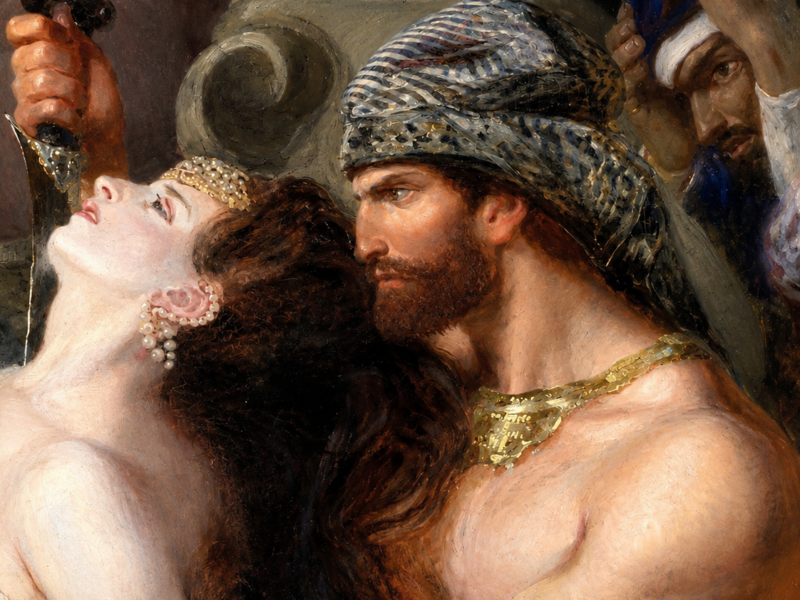
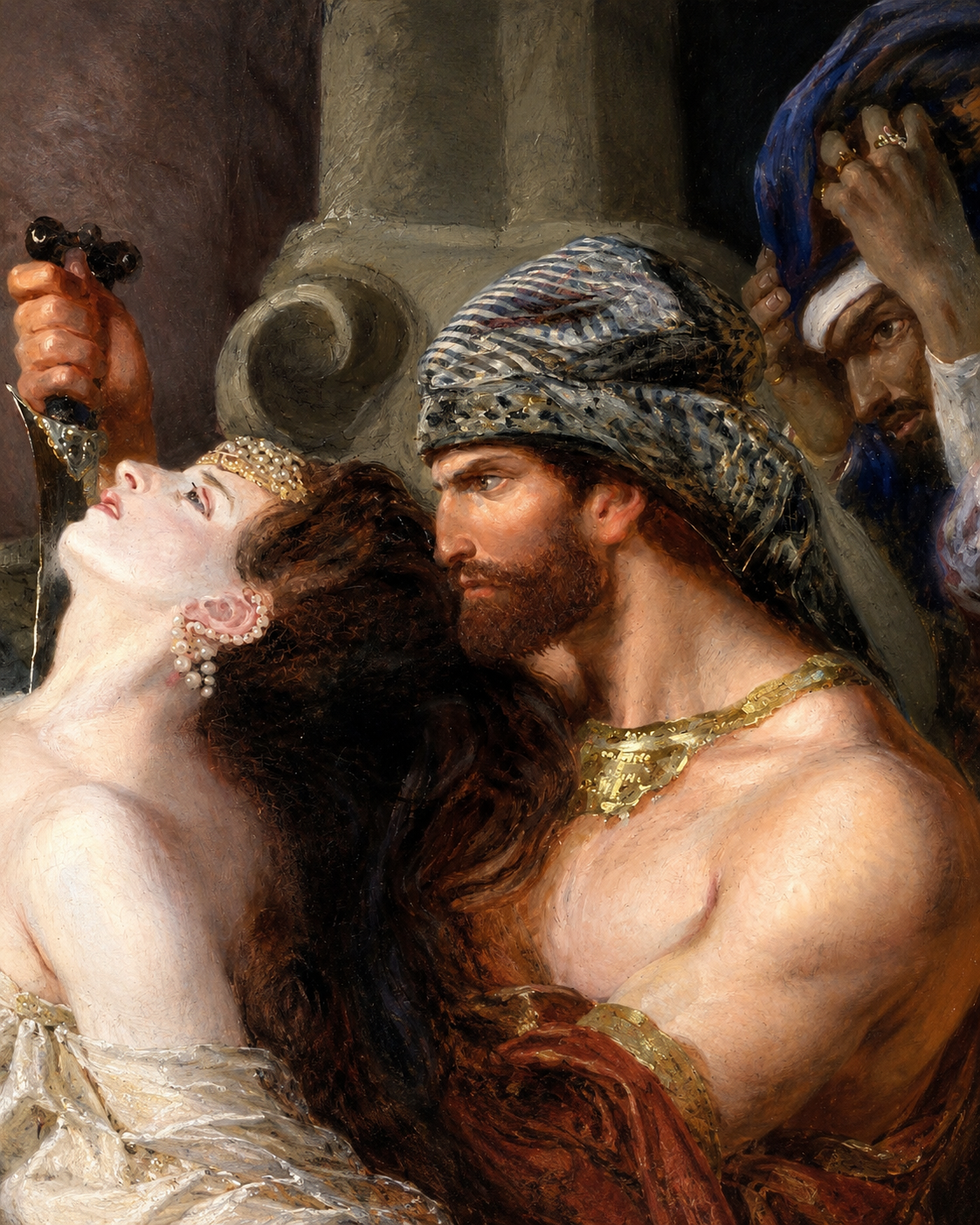
Move right, to the captive woman. The man behind her grips her arm brutally. Her head is thrown back, her mouth open, gasping for air. Her body has gone limp under the threat of the blade near her neck.
Now take in the waste surrounding them. The floor is littered with golden urns, jeweled scabbards, and priceless trinkets. Massive golden elephant heads anchor the base of the bed.
Keep moving, to the woman draped face-down across the lower half of the bed. Reviewers in the 1800s couldn’t stop looking at her. One anonymous writer fixated on the woman “viewed from the back,” dying on the tyrant’s bed. Her pale limbs strike a sharp contrast against the glaring red of the bedding.
Now look up. In the upper center, hidden in shadow, is a woman named Aïscheh. She hangs by a noose. Above all the frantic, sweaty violence, she dangles motionless.
And then the king himself. Sardanapalus leans on his elbow, surrounded by golden elephant heads and luxury, watching his empire get butchered. His face is blank, his eye disinterested as the chaos unfolds.
Historians are split on what to make of him. Some argue he’s an effeminate coward. Others say he’s a romantic hero, facing failure without a flinch. Either way, he simply watches, passively taking part in a gruesome passage from life to death.
He watches the harem women butchered and the horse stabbed. There are daggers plunging into chests, a hanging, and self-inflicted sword wounds.
Have you spotted what’s missing yet? Time’s up.
Look at the horse again. The dagger is buried in its chest. Do you see the red tassels falling from its bridle? Delacroix painted them a vivid blood red, placing them exactly where the wound is. They stand in for the hot blood that should be pouring out.
But look closely at the wound, at the blade, at the horse’s coat. There is no blood.
Look at the woman on the right. The dagger is at her throat, but she is perfectly clean. Look at the dark-skinned man in the lower left, driving a sword into his own chest. No blood.
Look at the dead woman sprawled across the foot of the king’s bed. Her pale, creamy skin is fully exposed. She is lifeless in the middle of a massacre, yet pristine. Not a smudge. Not a smear.
Scan the entire four-by-five-meter canvas of slaughter, and the answer is the same. In a scene defined by mass murder, nobody is bleeding.
Why? Did Delacroix forget? Was he squeamish? Not at all, say many art historians. They see a deliberate, chilling psychological choice. Skeptics counter that we can’t read the mind of a painter who left no explanation, and that Romantic-era conventions or taste may have played a part.
By the more popular reading, Delacroix wasn’t interested in the physical mess of death. The actual dead body wasn’t his central concern. He was obsessed with the tension of the moment just before, the terrifying limbo between life and death.
By removing the gore, he forces us to focus on gesture and action. We don’t look at bleeding wounds. We look at the bulging muscles of the killers, the limp, resigned bodies of the victims, and the panic of the horse. Delacroix favored impending death over motionless corpses.
Take Aïscheh. Hanging cuts off oxygen to the brain, setting off a slow sequence of organ failure. She may not even be completely dead yet. She is trapped in that transition.
By scrubbing away the blood, Delacroix turned a slaughter into an ambiguous nightmare. The victims are trapped in the agonizing act of dying, forever. And we are trapped in that room with them, unable to rest our eyes and unable to escape.
Just like Sardanapalus, watching it all, waiting for the end.









