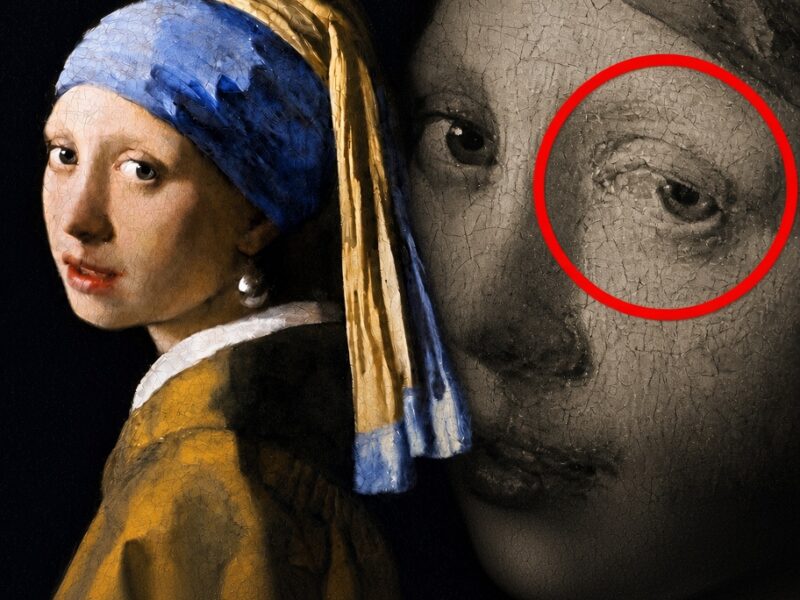
This Vermeer Painting Has Been Lying to Us for 350 Years
The Girl with a Pearl Earring is not floating in a void. She is standing in front of a green curtain. You have never seen it, because the pigment disappeared.
Here is the part that gets worse. Nobody noticed it happening. For 350 years, viewers looked at pure black behind her and called it genius.
No room, no wall, no world, just her, floating in nothing. Art teachers and textbooks repeated the same line. Vermeer wanted emptiness behind her so your eyes had nowhere else to go.
Nobody checked, not for three centuries. Then, in 2018, a team slid the painting into a scanner that reads it layer by layer. And the void started to talk.
The painting dates to around 1665 and was made in Delft. People call her the Mona Lisa of the North, but she is not really a portrait. Vermeer’s contemporaries had a name for paintings like this, a tronie, a study of a face, a type or a mood rather than a named person with a life.
So we do not know who she was, and we may never know. What we do know is what she does to you. She is twisted back over her shoulder, her lips just barely open, as if you called her name half a second ago and she is still turning to find you.
That single twist of the neck is the trick. It puts you in the room and makes you the person she is looking at. Now follow the light.
It slides across her cheek, catches the wet edge of her lip and lands on the pearl. Get close to that pearl, really close, and it is almost nothing. Two strokes of paint: one soft gray curve and one hard white dot.
Step back, and it glows as if lit from within. That is the move. Vermeer does not paint the object. He paints what light does when it hits the object, and he lets your brain do the rest.
The turban follows the same logic. That blue is ultramarine, ground from lapis lazuli and hauled across mountains from Afghanistan. Pound for pound, the pigment cost more than gold.
Vermeer used it freely, on paintings he sometimes could not even sell. That fits the man he actually was. He had eleven children and a stack of debts he never climbed out of.
He died at 43, and his widow was left drowning in those debts. Then the world did something almost unthinkable. It forgot him. For nearly 200 years, Vermeer was a footnote in Dutch art history, barely a name.
The girl sat in the dark while her maker’s name faded from the history books. But the darkness around her was not fading with him. According to the account, that darkness was a lie waiting to be caught.
To see why it matters, picture the world she was born into. Seventeenth-century Holland was the richest patch of land in Europe, a tiny republic of merchants, sailors and traders sending ships to every corner of the map. In those same decades, in Vermeer’s own city, a man named Antoni van Leeuwenhoek pointed a homemade lens at a drop of pond water.
What he found changed science. An entire universe of living things moving and swimming, invisible until that moment. He saw bacteria, blood cells and sperm cells, creatures he called animalcules because nobody had a word for them yet.
He ground his own lenses by hand, one at a time, some strong enough to magnify 270 times. For years, the Royal Society in London did not believe him. They sent people to Delft to check.
It was an age obsessed with looking, with lenses and light and seeing the world more sharply than anyone before. Vermeer was steeped in the same obsession. Some historians think he used a camera obscura, a box with a lens and a mirror, to study how light bends and falls across a human face before touching a brush to canvas.
There is also a detail that links the two men directly. After Vermeer died, buried in debt, the court in Delft appointed Van Leeuwenhoek to handle his estate and settle what he owed. It was a civic duty, not a friendship.
Still, it means the man who spent his life grinding lenses to see what was too small for the eye ended up holding the paperwork of the man who spent his life painting light too fleeting for the eye to hold. Same small city, same obsession, running in two completely different directions.
In 2018, that obsession with seeing came back around. The Mauritshuis in The Hague slid the girl into a scanner. For two weeks, in front of the public, they studied her more closely than anyone had in 350 years.
The technique is called macro X-ray fluorescence. It reads the chemical elements in every layer of paint, going back centuries, layers the eye gave up on long ago. Scientists ran it across the whole canvas, inch by inch.
When the beam crossed the flat black background, something showed up that should not have been there. Diagonal lines, folds, a repeating, structured, deliberate pattern. It was not a smudge and not decay. It was a shape sitting under the black, waiting.
Vermeer had painted her in front of a curtain, heavy fabric hanging in the upper corner of the room. And it was not black. It was green.
The account explains why we never saw it. Vermeer made that green by layering a blue pigment, indigo, under a yellow one, weld, a plant-based dye. Stacked together, they gave off a deep, rich green.
But both pigments are notoriously unstable. Weld breaks down quickly under light, and indigo is not much sturdier. Painters knew they were fragile even then. They simply had nothing better.
Over three and a half centuries, the yellow layer faded first. Then the blue underneath went dark and dull. What remains today reads as flat black.
Vermeer had no way of knowing his curtain was built from colors with a shelf life. The room she once stood in dissolved slowly, one decade at a time, until nobody alive had ever seen it. The masterpiece in the Mauritshuis today, the account argues, is not the painting Vermeer signed off on. It is a ghost of it.
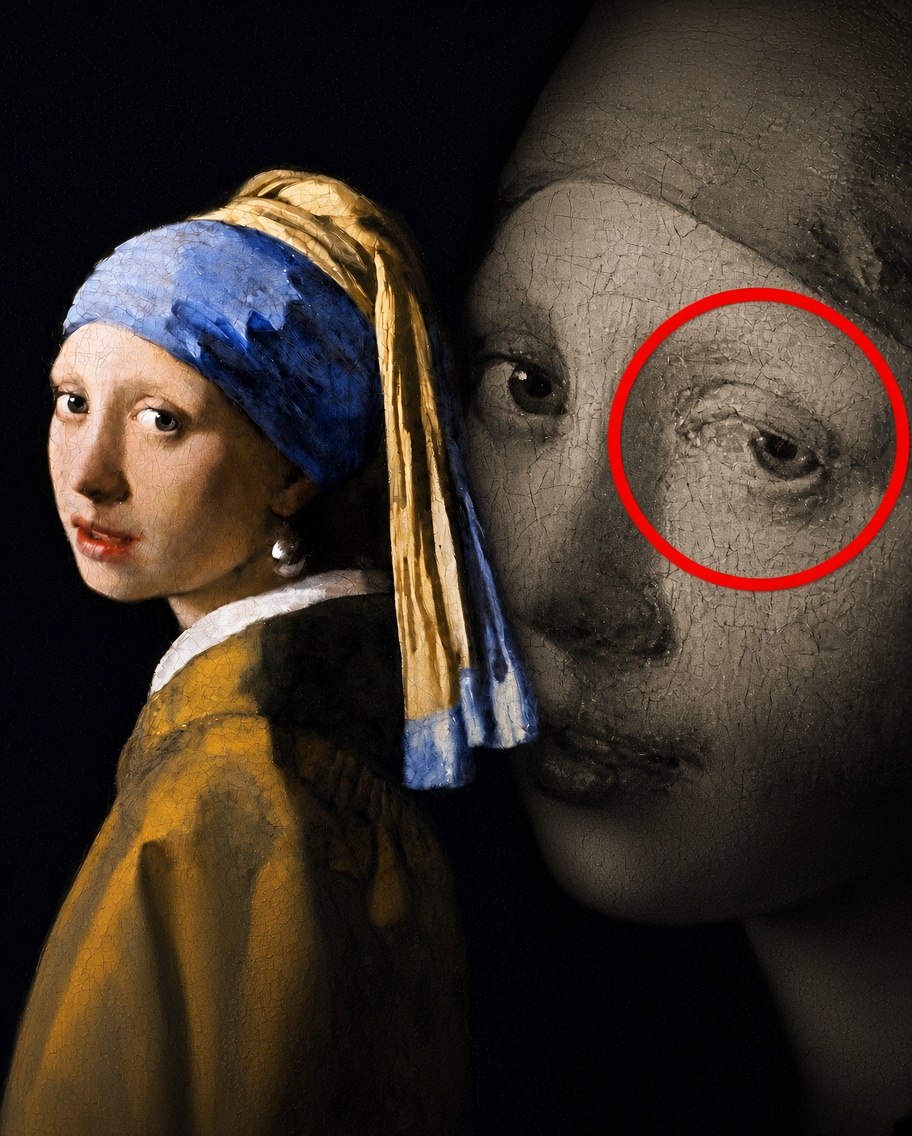
The scan was not finished. Look at her eyes again. For generations, art historians pointed to this spot as proof that she was not real.
She seemed to have no eyelashes. That absence was written into the case for a tronie, an idea or a type rather than a living person Vermeer sat down in front of. The scan, according to the account, proved them wrong.
Tiny painted hairs ring both eyes, buried under grime and yellowed varnish. Vermeer gave her lashes all along. She was never a blank idea staring out of a black hole. She was a girl painted with lashes, a curtain and a room around her.
Time took all of that away without asking. We did not just misread a painting for 350 years. We fell in love with what was left after the original disappeared.
A curtain going dark. A pair of lashes fading into nothing. Small changes, stacked slowly enough that nobody alive ever caught them happening. Somewhere in that slow fade, we stopped calling it damage and started calling it design.
Here is the part that is hard to sit with. The painting the world fell for, the one on posters, coffee mugs, a novel’s cover and a movie, is the changed one. It has been quietly altering since the day Vermeer set down his brush. Every reproduction shows the painting as it exists now, not as it looked in 1665.
Science can show the difference. Researchers can rebuild the curtain on a screen. They can restore the lashes and brighten the pearl, and show a girl who looks sharper and more alive than the one hanging in The Hague.
But no scan can say which girl is the real one. The one Vermeer’s hand made, or the one three and a half centuries of chemistry built on top of it? It is the same fight restorers face every day, on old paintings in every major museum.
Strip away the aging and hand people back the original, or leave it alone because the aging is now part of the object’s history too. This is not hypothetical. When the Sistine Chapel ceiling was cleaned from the late 1980s into the early 1990s, the colors underneath shocked people.
Bright reds and sharp blues made Michelangelo look almost like a different artist. People argued for years over whether they had uncovered the truth or destroyed something sacred. The same fight sits inside this quiet Dutch painting, waiting for someone to decide.
Whatever the Mauritshuis chooses, it is not just cleaning a painting. It is deciding which 350 years of history gets to count as real. The three and a half centuries Vermeer never lived to see, or the few hours it took him to paint her in 1665.
Vermeer died broke and mostly forgotten, but the girl did not stop existing when he did. She hung in someone’s house, then a private collector’s cabinet, and eventually a museum wall in The Hague. Through every move, she kept changing.
The curtain kept sinking into black. The lashes kept fading under old varnish. Slowly, with no one noticing in real time, she turned into a painting Vermeer never actually made.
We like to believe art sits frozen, exactly as the artist left it. It does not work that way. Paint cracks. Pigments shift chemically, even in a climate-controlled room. Varnish yellows and thickens.
The object on that wall today is not the object that left Vermeer’s studio in 1665. It is related to it, not identical. Some art historians say to leave her alone. The faded version, they argue, earned her place in history, and it is the one on the book covers and the movie poster.
Other historians say we owe Vermeer the truth of what he painted, curtain and all. Neither side is wrong, exactly. Restore her and you lose the girl the world fell for. Leave her alone and you are stuck with a painting still in the middle of disappearing.
There is no clean way out of that trap. She turned her head 350 years ago, and she is still turning it every time someone walks up to the painting. But she is not looking at the world Vermeer stood in. The curtain is gone, the room is gone, and for a while even her lashes went missing.
The girl changed, and so did everyone looking back at her. So which version is the real one? Tell us in the comments.









