This Painting Was Banned in 2018. Here’s Why
There is a terrifying silence in this image. Walk past it in a gallery, glance at it for a second, and you might mistake it for a scene of romance. It looks like a fairy tale.
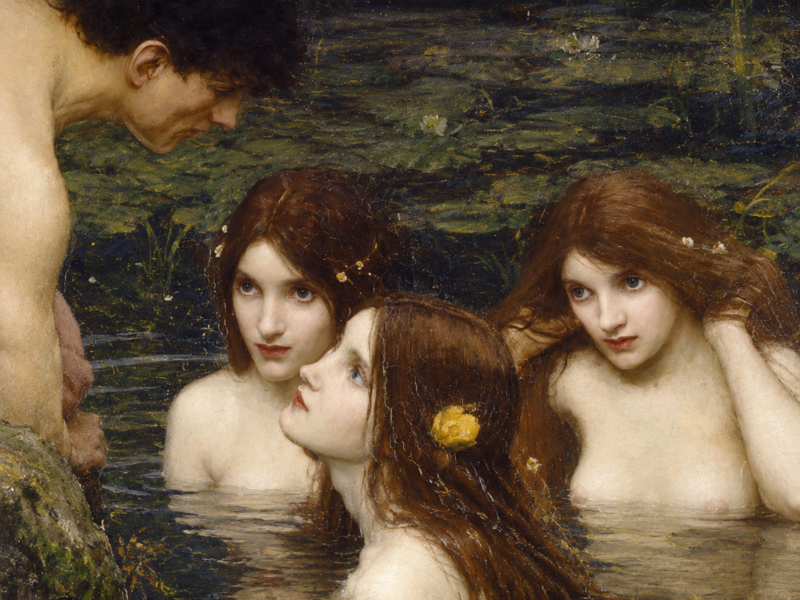
But look closer. Look at the hands. Notice the pale, wet fingers wrapping around the man’s forearm, and the hand resting on his tunic. Notice how the girl in the center pulls him, ever so gently, not toward her lips for a kiss, but downward.
We are witnessing the final second of a man’s life. In the next breath, the water will close over his head, the ripples will settle, and the surface of the pond will return to a glassy perfection, as if he had never existed at all.
This is Hylas and the Nymphs, painted by John William Waterhouse in 1896. It is one of the most mesmerizing, haunting, and controversial images in British art. It has been attacked, worshipped, and, in a way, even pulled from public view.
Why? What is it about this arrangement of figures that unsettles us so deeply? To understand the horror beneath the beautiful surface, we have to peel back the layers of myth, madness, and the Victorian obsession with the dangerous woman.
The story begins with the man. His name is Hylas. In Greek mythology, he was the companion and lover of Hercules, the greatest of all heroes. They sailed together as Argonauts on the quest for the Golden Fleece.
Hylas was renowned for his beauty, a beauty so profound that it became his curse. When the Argonauts landed on the island of Cios to rest, Hercules sent him to find fresh water.
Imagine the scene. He wanders away from the safety of the camp, away from the fires and the warriors, and enters the woods alone. The air is thick and humid. He finds a spring, a hidden sanctuary of nature, and kneels to fill his bronze pitcher.
That is the moment Waterhouse freezes in time.
The myth tells us that the Naiads, the water nymphs who presided over the spring, were so struck by Hylas’s beauty that they could not let him leave. They didn’t want to kill him, not in the traditional sense. They wanted to keep him, to possess him. In the logic of the ancient world, being possessed by a god or spirit meant vanishing from the mortal realm.
Waterhouse captures the precise instant of the trance. Hylas is no longer in control. He is off-balance, leaning precariously over the edge. One hand holds the pitcher, but it is forgotten, and the water spills uselessly back into the pond.
His other arm is braced against the earth, but it is failing. His body is tense, yet his face is slack. He is caught in the gaze of the central nymph.
And this is where the painting shifts from a mythological illustration into a psychological thriller. The brilliance of Waterhouse lies in how he depicts the monster. In traditional horror, the monster is ugly, with fangs, claws, and shadow. Here, the monster is exquisite.
The seven nymphs are painted with ethereal, almost translucent skin. They are nearly indistinguishable from the water lilies around them, and they seem to grow out of the water itself. They are bare, their alabaster skin luminous in the dark but clear water, with yellow and white flowers in their auburn hair.
One of them offers pearls as a treasure to beguile the young Hylas, enticing him away from his task. In folklore, pearls were often considered the tears of drowned men. On that reading, the offering signals that Hylas is being lured to his death, receiving the tears of his own demise.
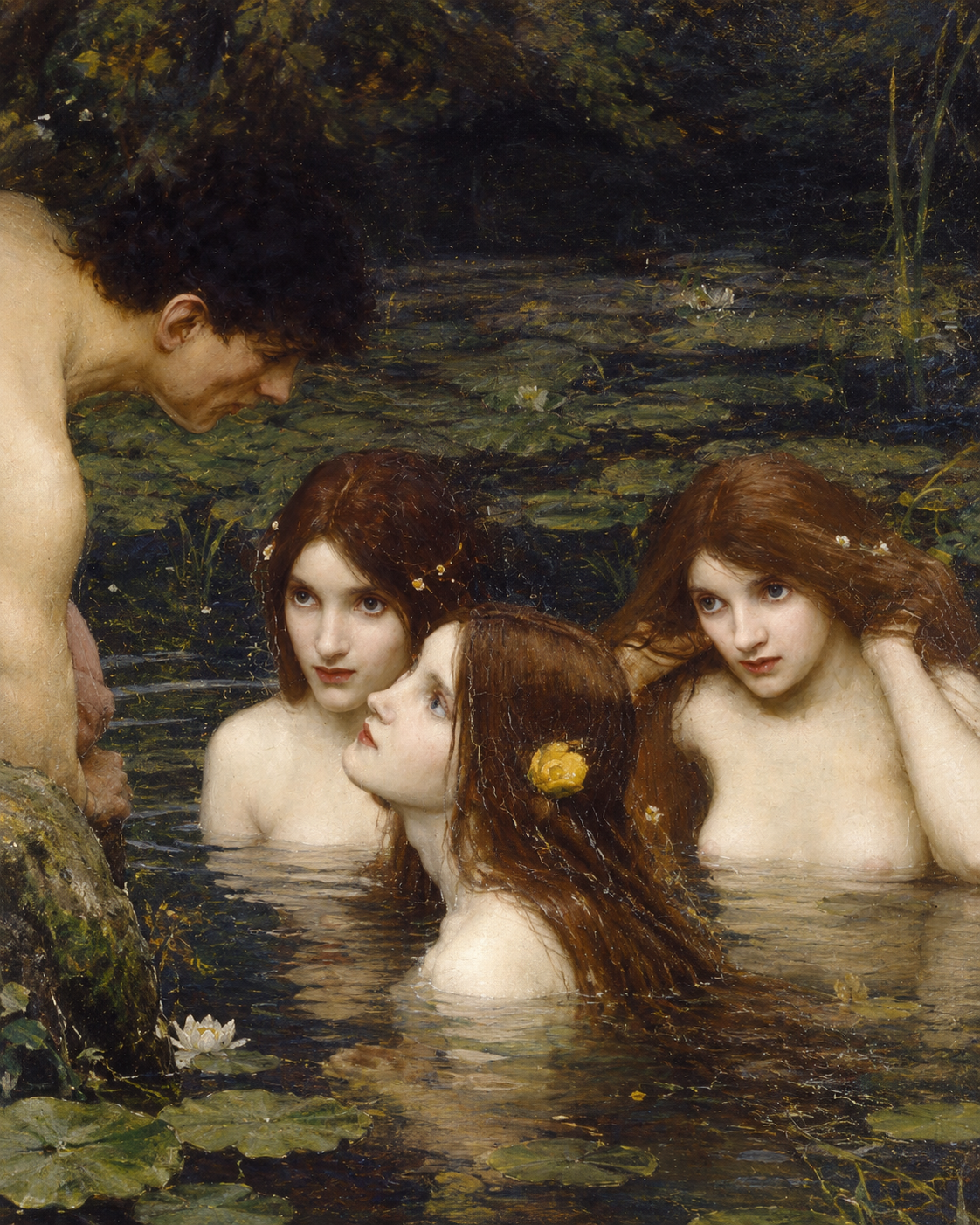
There is a disturbing uniformity to the nymphs. Have you noticed that they all look alike? Art historians have long debated the model. It is likely they are variations of a single sitter, perhaps Muriel Foster or another of Waterhouse’s muses, though the identification is far from settled.
By repeating the same face, Waterhouse creates a sense of the uncanny: a hive mind, a collective consciousness with a single, predatory goal.
Look at their eyes. Not one of them looks at the viewer. We are voyeurs, unseen, watching from the bushes. The nymphs are entirely focused on Hylas.
Their expressions are hard to read, and that is the source of the painting’s tension. Are they malicious? Not exactly. There is no anger in their faces. Are they lustful? Perhaps, but it is a cold, detached sort of lust.
They regard him with a mixture of curiosity and hunger, the way a child might look at a butterfly before tearing its wings off. There is a profound innocence in their cruelty. They do not understand that water fills human lungs. Or perhaps they simply do not care.
To them, dragging Hylas down is an act of love, an embrace. That the embrace ends in death is merely a side effect. That ambiguity, the blurred line between affection and murder, is what makes the image so hard to look away from.
We must also consider the artist. Waterhouse was painting at the very end of the Victorian era. He was a man out of time, clinging to the romantic ideals of the Pre-Raphaelites long after the art world had begun to move toward Modernism.
But while his style was romantic, his subjects grew darker. He had a fascination, bordering on obsession, with the femme fatale. Throughout his career, he painted Circe offering poisoned wine, the Sirens luring sailors to shipwreck, and La Belle Dame sans Merci leaving knights withered on a hillside. Hylas and the Nymphs is the climax of that obsession.
Why was the Victorian era so fixated on women who kill? Consider the context. It was a time of immense social change. Women were beginning to demand rights, independence, and a voice. The “New Woman” was emerging, challenging the domestic subservience of the past.
For many male artists and the society around them, the shift was frightening, and it surfaced in their art as a fear of female sexuality. The woman was no longer just a mother or wife. She was a siren, and she was nature itself: beautiful, uncontrollable, and capable of swallowing you whole.
In this painting, Hylas, the hero’s companion and a warrior in training, is stripped of his power. He is passive. He is the victim. The power dynamic is reversed, with the women as hunters and the man as prey.
Look at the colors. The painting is dominated by greens and muddy browns, earth tones. But there is a flash of red: the sash around Hylas’s waist. Red is the color of blood, of life, of the mortal world. It is the only warm color in the picture.
The water is cool, blue-green, and shadowed. That red sash is the last tether to humanity, and it is being overwhelmed by the green.
The lighting matters too. There is no bright sunlight here, only a twilight world. Waterhouse paints the nymphs’ skin with a luminosity that seems to come from within, in contrast to the tanned, rugged skin of Hylas. They are two different species, the supernatural colliding with the mundane.
Now we come to the painting’s recent history. For over a century, it hung in the Manchester Art Gallery, a beloved masterpiece. Then, in January 2018, it suddenly disappeared. Staff removed it from the wall and left a blank space.
The public reaction was instant and furious. Critics called it censorship. They accused the gallery of political correctness gone mad and of trying to erase art history because it didn’t fit modern sensibilities.
The gallery’s position was that the removal was temporary, meant to spark a conversation about how bodies, specifically female bodies, are displayed in museums. It wanted to challenge the “male gaze,” the idea that women in art exist as passive objects for male pleasure.
In a way, they proved the painting’s power. Even in its absence, Hylas and the Nymphs provoked a storm.
But some argue the controversy missed a crucial point. Although the painting certainly sexualizes the nymphs, it does not make them passive. They are the active agents, and they are the ones in control. If this is a fantasy, they say, it is a masochistic one, a fantasy of surrender.
The painting returned to the wall about a week later, but the conversation had changed. We can no longer look at it innocent of its modern context.
Now the questions are different. Is it a painting of male entitlement? Is it a demonization of female power? Or is it simply a tragedy about the fragility of youth?
Return to the narrative within the frame. What happens one second after this frozen moment? In the myth, Hercules searches for Hylas for a long time. He runs through the woods, shouting the boy’s name until his voice is hoarse.
“Hylas! Hylas!”
The poets say Hylas heard him and tried to shout back. But his voice came from underwater, distorted and faint, so to Hercules it sounded only like rustling leaves or a bubbling spring. Eventually, Hercules had to leave and continue the quest. Hylas was left behind, immortalized in the depths, forever young, forever held in the embrace of the water.
Waterhouse captures the tragedy of that silence. The painting is incredibly quiet. There is no splashing and no struggle, just the soft, hypnotic lock of eyes.
There is a detail you might have missed. Look at the water lilies again. In the Victorian language of flowers, which Waterhouse would have known fluently, the water lily represented purity of heart.
These are Nymphaea, deeply rooted in the mud yet blooming on the surface. They bridge the gap between the rot at the bottom and the beauty at the top. Among the leaves, some botanists have suggested, there may be poisonous flora in the background, hinting at the toxic nature of this paradise. If so, it is a trap, perfectly disguised.
The texture reinforces the effect. Waterhouse uses loose, fluid brushstrokes for the water and background, creating a dreamlike haze. But the faces are painted with sharp, porcelain clarity.
That contrast mimics Hylas’s own sensation. The world around him is dissolving into a blur, and the only thing that stays sharp, the only thing that matters, is the eyes of the creature pulling him down.
We all have our own version of this pool. We all have moments when we stand at the edge of a decision that cannot be undone. It might be a forbidden love, a dangerous addiction, or a risk that defies logic. We lean over the water, seeing the beauty, ignoring the danger, feeling the cold hand on our arm.
If the beauty is profound enough, is the drowning worth it? Hylas stares into the eyes of his fate, and he does not pull away.
The tragedy isn’t that he falls. The tragedy is that he lets himself fall.









