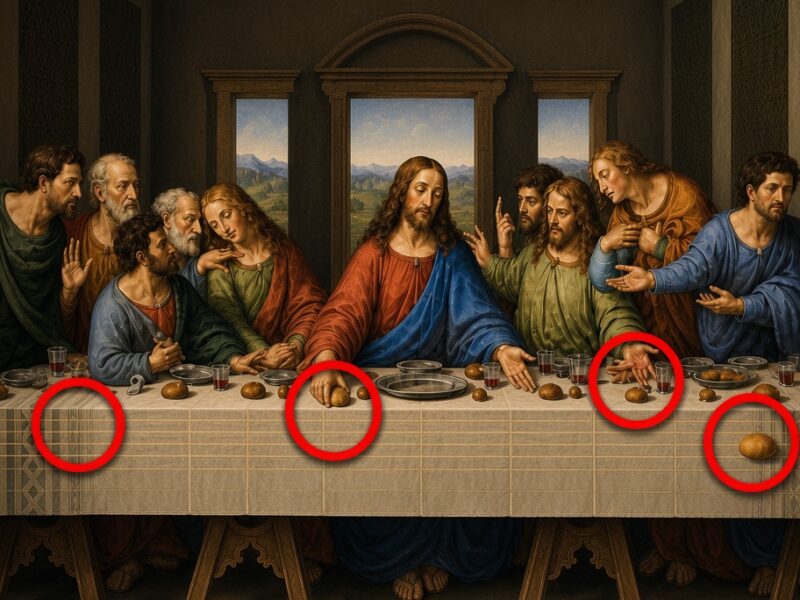
This da Vinci Painting Has Puzzled People For 500 Years
What if the most famous painting in the world has been hiding a song for 500 years, and nobody noticed until 2007? This is The Last Supper, painted by Leonardo da Vinci on the wall of a dining hall in Milan. For most of that time, everyone who looked at it believed they were seeing bread and hands.
But what if the rolls on that table, and the hands resting beside them, are not just composition? What if they are notes on a page?
In 1495, Leonardo da Vinci was 42 years old. In Renaissance Italy, that was not middle age. It was closing in on old, in an era when average life expectancy sat around 40.
By that point, Leonardo still had not produced a single large-scale public work the world would call a masterpiece. That is not an insult. It is simply where his career stood.
The clearest example is a bronze horse, a monument to the Sforza family that Leonardo spent 12 years designing. He built a full-size clay model and devised an entirely new casting method. It was set to be the biggest bronze statue anywhere in the world.
Then Milan needed cannons. The bronze was melted down for war, and the horse was never made.
So when the Dominican friars at Santa Maria delle Grazie approached Leonardo with a commission, it was not really for a painting. It was for a wall. A blank stretch of plaster in their dining hall, where the monks ate every meal in total silence.
That is a strange request to hand a man best known for unfinished sculptures and abandoned war machines. But look at what Leonardo actually did during his years in Milan. He was not just an artist on the payroll.
He ran the entertainment for the Sforza court. That meant building rotating stage sets, mechanical rigs that made performers appear to fly, and devices that faked thunderstorms and crashing waves. He was, in effect, a stage designer who also happened to paint.
Once you know that, the wall stops looking like an odd assignment. It starts to look like the only assignment that made sense. Leonardo did not treat that dining hall as a flat surface waiting for saints.
He treated it like a stage, with Christ and the twelve apostles caught mid-scene and reacting in real time. It was a play frozen at its most dramatic second.
Then came the risk. True fresco, the standard technique of the day, meant painting fast onto wet plaster before it dried. Leonardo hated fast, so he threw out the rule book.
He mixed oil and tempera on plaster that had already dried, a technique nobody had properly tested at that scale. It let him work slowly, lay down detail exactly as he wanted and blend light the way he had trained himself to see it. It also meant the paint began flaking off the wall within 20 years.
Why does any of this matter? Because the man who built this wall treated music and math as the same language. That is about to become important. It is also what makes the supposed hidden score so hard to dismiss as an accident.
Before anyone can talk about a hidden melody, it helps to see how obsessed Leonardo was with control. He built the whole room around a single point, right beside Christ’s head. Every line in the architecture, the ceiling beams, the tapestries and the edges of the table itself, collapses into that one spot.
He did not eyeball it. He hammered an actual nail into the wall and stretched string from it to mark his lines. If you visit Milan today, you can still find the nail hole, 500 years later, with the math still sitting in the plaster.
So the perspective is locked down to the centimeter. Then look at the people. Christ has just said one sentence: “One of you will betray me.”
Leonardo splits the twelve apostles into four clean groups of three. Each group reacts to the same sentence in a different key. On one end, hands fly up in shock.
Peter grips a knife, leaning in as if ready to use it. Judas rears back, his elbow catching the salt cellar and tipping it over, his face falling into shadow while everyone around him stays lit. Every gesture answers the same question, who is it, yet no two hands answer it the same way.
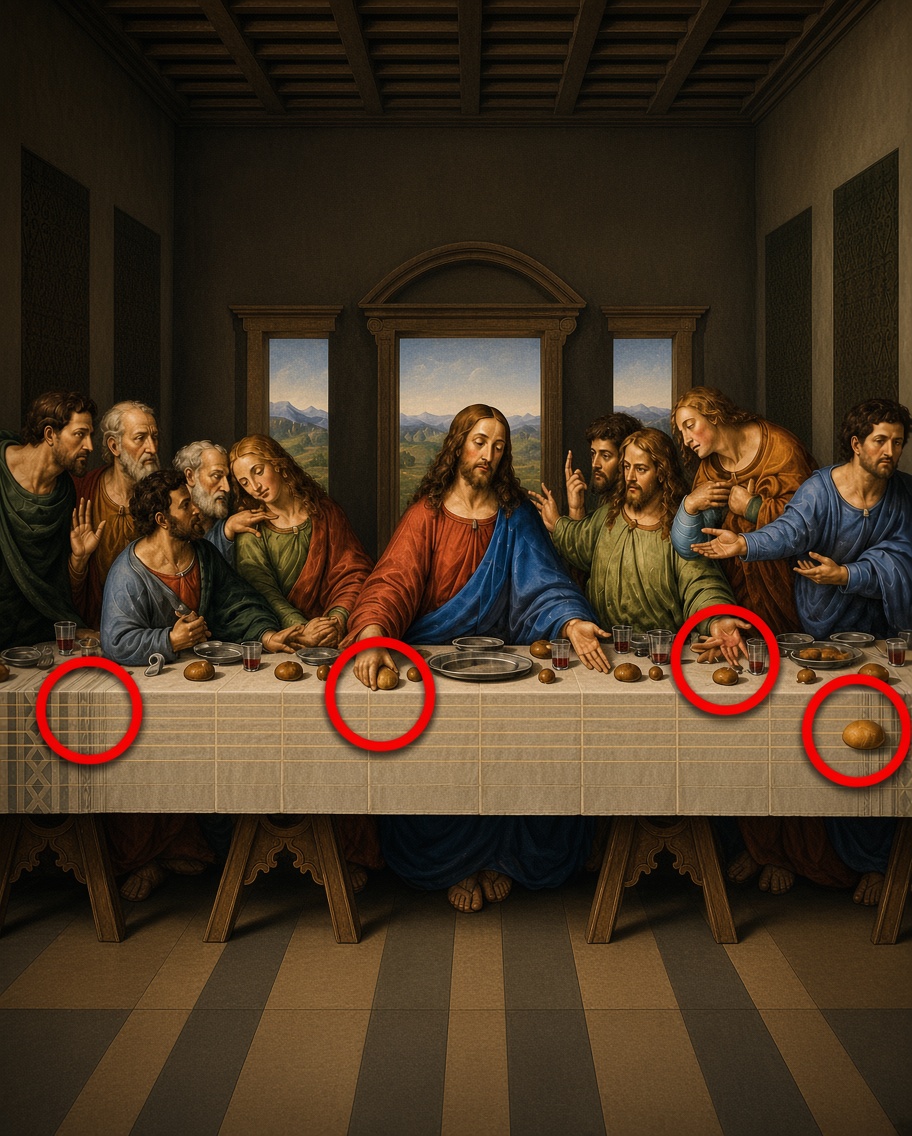
Here is what most people miss when they walk past a print of this painting in a hallway. Look at the bread rolls. They are not scattered.
They repeat down the table at almost the same distance from one another. The regularity has little to do with how bread usually gets set down at a dinner table. It is the kind of spacing you might expect from someone counting, not from someone arranging a meal.
Now try something. Picture five lines drawn across that table, and picture every roll landing close enough to one of those lines to read as a note. Not roughly close, but close enough to actually play. That does not happen by casually placing bread wherever it looks nice, supporters of the idea argue.
In November 2007, an Italian musician named Giovanni Maria Pala looked at that spacing and asked a question nobody had asked in over 400 years of studying the painting. What if it is not spacing? What if it is a staff?
He took a musical staff, the five horizontal lines used to write sheet music, and laid it across the table in the painting. The bread rolls landed on specific lines. The hands of Christ and the apostles landed on others.
Treated as notes rather than bread, each position becomes a note on the scale. Pala then reasoned that reading the sequence from right to left, a known compositional trick in Renaissance music, produces a coherent phrase. So he flipped the sequence and played it backward.
What came out, he found, was not noise. It was a musical phrase that could be played on a real instrument, roughly 40 seconds long. It sounded like a hymn, slow and somber, the kind of music you might expect at a funeral mass.
As described, it opens on a low D, then a pause, then an A that hangs unresolved. It drops to an F sharp, a note that sounds like a door closing. Then it rises again like a question that never quite finds its answer.
So there is a shape on a wall that plays like music when treated as music. That leaves the question every Leonardo scholar ends up circling back to. Is this real, or is it simply what happens when you stare at something long enough that your brain finds a song that was never there?
Skeptics deserve their turn. Art historian Alessandro Vezzosi has cautioned that the human brain is built to find shapes in noise. Stare at clouds long enough and you will find a face. Stare at static long enough and you will swear you hear a voice beneath it.
His caution is simple. When you look that hard for a pattern, you usually find one, whether or not the person who made the image ever put it there on purpose. Yet the Leonardo case is complicated, because he is not a random case.
This is a man who left behind more than 10,000 pages of notebooks. They hold sketches of swirling water, birds in flight and muscles peeled back layer by layer. They also cover the mechanics of a bell and the mathematics of an echo.
On those pages, Leonardo never treats art, math and music as three separate rooms. To him, they are the same room, seen from different angles. He did not see a painting as separate from an equation, or an equation as separate from a chord.
Music was not a hobby on the side. It was part of his job at the Sforza court. He built instruments, and he designed a silver lyre shaped like a horse’s skull that impressed the duke enough to help get him hired in Milan.
He wrote pages on the physics of sound, on how pitch works and on how proportion in music mirrors proportion in the human body. He organized live performances as part of his official court duties. The same court later paid him to stage rotating sets and mechanical storms.
So how likely is it that the same man placed bread rolls in a musical pattern by accident? If any painter in history were going to hide a working melody inside a wall of bread and hands, who would be a better candidate than the one man who already treated sound and geometry like cousins?
That does not settle it. There is no notebook page where Leonardo writes down a melody and tells himself to hide it in the table. There is no letter to a patron mentioning a hidden song.
Pala’s staff and his hymn all came from a musician overlaying lines onto a 500-year-old painting in 2007. It is an interpretation built after the fact. A convincing one to its fans, but not a documented plan anyone can point to as proof.
So here is where it leaves us. Either Leonardo built a literal soundtrack into the most famous meal in human history, encoded so well that it took four centuries for anyone to hear it. Or people for 500 years have been listening to a coincidence and calling it music because they wanted it to be there.
There is no clean way to separate the two possibilities, not yet. For 500 years, visitors have walked past that wall in Milan looking at bread and hands and calling it composition. Maybe the whole time, it was asking to be heard, not just seen.
Next time you pass a print of The Last Supper, look at the table. Not the faces, not the gestures, just the bread. Is it composition, or is it sheet music? Either way, a man who saw music in the movement of water and geometry in the shape of a chord was perhaps always going to make a table full of bread sing.
So what do you think? Did Leonardo hide a real song in that painting, or are we just hearing what we want to hear? Tell us in the comments.









