This da Vinci Artwork Has Puzzled People For 500 Years
Perhaps there is not a single work by Leonardo da Vinci that is not surrounded by mystery. His paintings, drawings, and manuscripts have been the subject of debate, research, and bold hypotheses for centuries.
But even among the master’s masterpieces, one work has spawned more secrets than any other. It is The Last Supper, Leonardo’s famous mural.
At first glance, it is simply the biblical scene of Christ’s last meal with his disciples. Yet art researchers and puzzle enthusiasts are convinced that Leonardo hid a multitude of symbols and hints in the painting, and that many of them have never received a definitive explanation.
Leonardo painted The Last Supper between 1495 and 1498 on the wall of the refectory of the Santa Maria delle Grazie convent in Milan. It was commissioned by the Duke of Milan, Ludovico Sforza.
The scene is based on one of the most dramatic episodes of the New Testament. Jesus and his apostles share their final meal before his death and resurrection, and during dinner he says that one of his disciples will betray him and hand him over to the authorities.
Most artists before Leonardo showed the participants seated calmly at the table. He chose the moment of an emotional explosion instead. Upon hearing Christ’s words, the apostles react, each in his own way. Some are outraged, some are shocked, and some try to understand what was said.
The composition itself draws special attention. The twelve apostles are divided into four groups of three, and a distinct emotional scene unfolds in each one. Some argue among themselves, others turn toward Christ, and still others express disbelief and anxiety.
On the viewer’s left are Bartholomew, James the Lesser, and Andrew. Andrew raises his hands in a gesture of surprise, as if he cannot believe what he has heard.
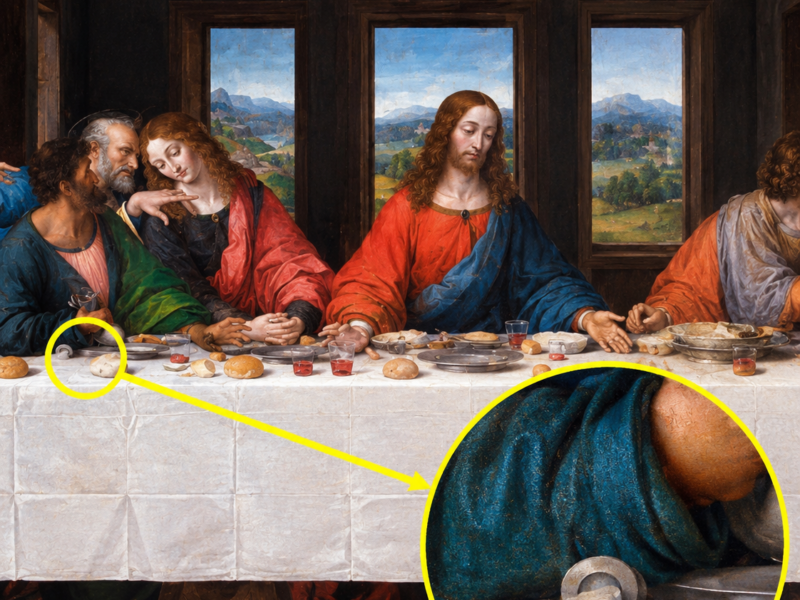
The next group includes Judas Iscariot, Peter, and John. This part of the composition holds some of the most mysterious details in the painting.
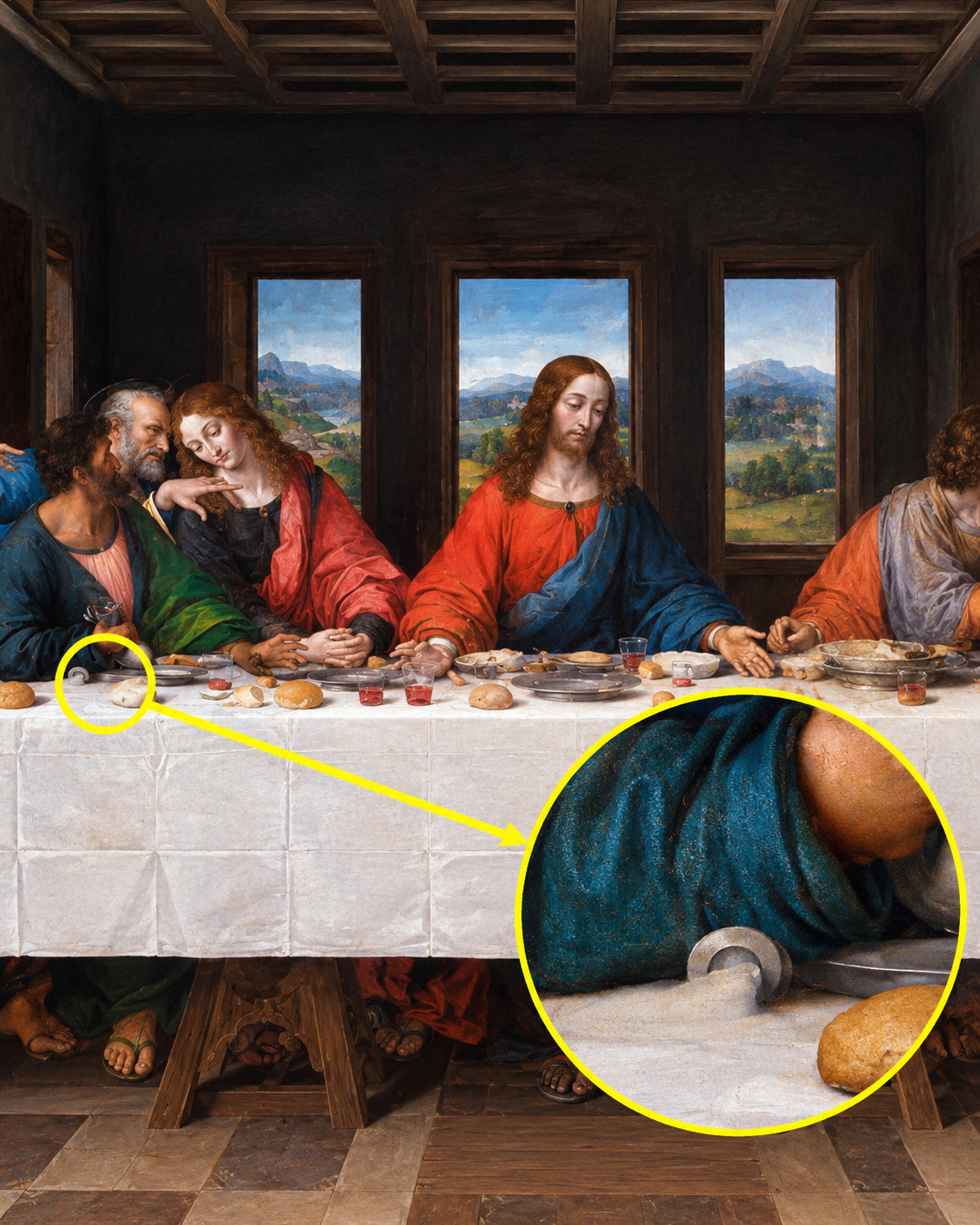
In the center sits Christ. His figure forms a stable triangle, a symbol of harmony and divine perfection. All the lines of perspective converge on his head, making Jesus the main focus of the work and drawing the eye to his calm, luminous image.
To his right are Thomas, James the Greater, and Philip. They are followed by Matthew, Jude Thaddaeus, and Simon the Zealot. Each group seems to respond to Christ’s words differently, creating a true psychological drama.
The scene begins with a single line. According to the Gospel, Christ says the betrayer is the one who dips his hand into the bowl at the same time as he does. At that moment, the disciples begin searching among themselves for the guilty one.
The tension of that search is what Leonardo made the main subject of the painting. The contrast between Christ and those around him is especially striking. The apostles are gripped by agitation, while Jesus keeps complete composure, his head slightly bowed, his gaze lowered, and his posture balanced and still.
Look closely, and Judas can be seen reaching toward the bowl along with Christ. That gesture is one of the key hints about the identity of the future betrayer.
Still, Leonardo does not show the moment of exposure directly. The betrayer has not yet been unmasked and remains, outwardly, part of the community of apostles. The viewer is invited to find the hidden signs among the many details.
There are other hints about his role. In Judas’s hand is a small pouch, which most researchers believe refers to the 30 pieces of silver, the reward for betraying Christ. The pouch looks insignificant, but it helps the viewer pick out the betrayer.
Another detail sits right next to him. On the table in front of Judas, a salt cellar is overturned and the salt is spilled across the tablecloth. In European tradition, spilled salt has long been seen as a bad omen, and some historians believe Leonardo used it deliberately to underline the coming betrayal.
Before Leonardo, it was customary to show Judas separately from the others, usually seated on the opposite side of the table with his back to the viewer. Da Vinci broke with that tradition. He placed Judas in the same row as Jesus and the other disciples, suggesting that evil can hide among one’s own, inside the familiar circle.
Behind Judas’s back is the hand of the Apostle Peter, gripping a dagger. It foreshadows the events in the Garden of Gethsemane, when the hot-tempered Peter will cut off the ear of Malchus, the high priest’s servant during the arrest of Jesus.
Interestingly, the blade is turned away from Christ, which suggests that Peter is ready to protect his teacher.
But the most famous mystery involves the figure seated right next to Jesus, closest of all. For centuries, it was believed to be the Apostle John.
Then, toward the end of the 20th century, a sensational theory emerged. Some researchers claimed the figure is not a man at all, but Mary Magdalene. The reason was the figure’s unusual appearance, with soft facial features and long hair that look significantly more feminine than the other disciples.
Proponents of the theory also argue that the space between Christ and this figure forms the letter V, an ancient symbol of the feminine principle.
Most professional art historians disagree. They point out that in Renaissance painting, the Apostle John was traditionally shown as young, beardless, and soft-featured, so the figure’s appearance is not proof of Magdalene’s presence.
They also raise a logical objection. If this is Mary Magdalene, where did Leonardo hide the Apostle John, given that there are exactly twelve people at the table with Christ?
Another puzzle lies on the table itself, in the fish. Because of the damage to the mural and its many restorations, researchers have never agreed on what Leonardo painted, an eel or a herring.
The dispute may seem trivial, but supporters of the hidden-symbol theory believe the choice of fish could carry deep meaning. According to one version, an eel would symbolize faith, spiritual guidance, and devotion to the teachings of Christ, giving the fish a positive symbolic meaning.
If it was a herring, the meaning could be the opposite. In a number of northern Italian dialects, the name of that fish was associated with people who reject religion or hold false beliefs. In that case, it could hint at doubt, disbelief, or even betrayal, which fits the plot well.
Neither version has convincing evidence behind it, and the argument about the fish continues to this day.
The gesture of Thomas raises just as many questions. He stands to the right of Christ with his index finger pointing upward, a gesture that appears in other works by da Vinci. Traditionally it is read as a reminder of the future. Some researchers, however, see a Masonic sign or a hint of hidden esoteric knowledge, though that remains a minority view.
The fate of The Last Supper turned out to be nearly as dramatic as the story it depicts. It is hard to believe today, but the famous mural began to deteriorate almost as soon as it was finished.
The reason lay with Leonardo himself. Seeking subtler color transitions, depth of light, and meticulous detail, he abandoned the traditional fresco technique, in which paint is applied to wet plaster. Instead he experimented with oil and tempera on the dry surface of the wall.
The method gave him an impressive painterly effect, but it proved extremely short-lived. Within a few years of completion, the paint began to flake. Contemporaries noted that the image gradually lost clarity and fragments crumbled off the wall.
By the middle of the 16th century, just a few decades after Leonardo’s death, the work was in far worse condition than most frescoes made centuries earlier.
The following centuries made things worse. Moisture in the damp refectory, repeated alterations to the building, the Napoleonic Wars, and even the bombing of World War II all caused serious damage.
Restorers from different eras tried to save the masterpiece, but many interventions failed. Damaged areas were repainted, sometimes with new details added, and over time it became harder to tell where Leonardo’s work ends and his later rescuers’ work begins.
The most extensive restoration began in 1978 and lasted more than 20 years. Specialists carefully removed later overpainting and old restoration layers, trying to preserve every surviving brushstroke of the master. The work was completed in 1999.
The restorers stopped the deterioration and brought the painting as close as possible to its historical appearance. The findings, however, were both impressive and sad. Less than half of Leonardo’s original painting, by the figure reported, has survived to this day. The rest was lost to time or replaced by later restoration.
Fortunately, the mural’s original look was not lost entirely. As early as the beginning of the 16th century, Leonardo’s students and followers made several very accurate copies.
The most valuable is considered to be the work of the northern Italian artist Giampietrino, painted roughly between 1515 and 1520. It was made while the original still kept most of its details, so it serves as a crucial source for studying the lost fragments.
Thanks to that copy, researchers can see elements that have nearly vanished from the wall today: the richer colors of the garments, subtle facial expressions, the tableware and draperies, and even the feet of Christ, which were lost after a doorway was cut into the lower part of the composition.
Early copies like this allow art historians to reconstruct Leonardo’s vision far more accurately than the surviving mural alone could.
The Last Supper continues to attract millions of people. It is not just a religious scene or an outstanding work of art. It is a puzzle painting in which every detail becomes a reason for new research and debate.
More than 500 years later, Leonardo still forces us to ask questions, and many mysteries of his greatest masterpiece are still waiting for a definitive explanation.









