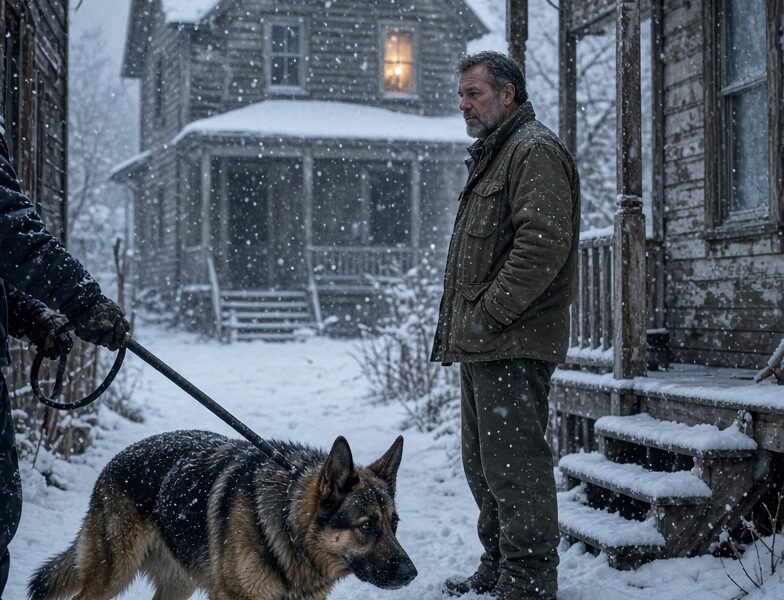
They Tried to Capture the German Shepherd in the Snow — He Was Fighting to Save the Man Who Had Fallen
A German Shepherd fought against the catch pole in a snowy alley in Red Lodge, Montana, but former Navy SEAL Travis Halden noticed something the two animal control officers had missed. The dog wasn’t trying to escape. He was trying to go back.
Every time the officers loosened their grip, the German Shepherd turned toward the same weathered house at the end of the street. His paws dug into the snow, his ears angled toward the porch, and his eyes kept returning to a door no one had opened all morning.
Then Travis spotted a small leather pouch attached to the dog’s dark green collar. Inside were a name, an emergency contact, and a brass key.
The walkway was buried beneath fresh snow. A newspaper lay untouched near the steps. Yet a faint haze of condensation clung to the inside of one window.
Something wasn’t right.
When the front door finally opened, the dog raced through the hallway and stopped at the bottom of the staircase, where seventy-nine-year-old Walter Keane had been lying injured since the previous night.
Duke had never been trained to rescue anyone. He had simply spent hours leaving, returning, and refusing to give up on the one person who needed him.
And when the officers tried to take Duke away afterward, they had no idea that the dog would soon teach three people something none of them had been willing to learn.
By four o’clock, Red Lodge had already begun surrendering its edges to winter.
Snow covered the rooftops, softened the outlines of fences, and gathered along the curbs of the older streets. Beyond town, the Beartooth Mountains stood beneath a pale gray sky, their ridges fading into the distance.
Travis preferred afternoons like this.
Snow made people efficient. They walked faster, kept their hands in their pockets, and nodded instead of stopping to ask questions.
At fifty-two, Travis Halden had become skilled at answering questions without encouraging another one.
He wore a dark sage canvas jacket over a faded olive drab shirt, heavy work boots, and the expression of a man who had learned to keep his private life private. His ash-brown hair was cut short, silver showing clearly at his temples, and his clean-shaven face rarely revealed more than he intended.
His workday had involved three furnace repairs, a frozen condensate line, and a retired couple who had offered him pie twice after he had already declined once.
The pie had been the most complicated part.
He was cutting behind the old commercial block when the barking began.
It wasn’t the frantic, high-pitched sound of a frightened little dog. This bark was deep and sharp, repeated in uneven bursts that echoed between the brick buildings.
Travis slowed.
The alley narrowed between a laundromat and a two-story building that had once housed a pharmacy. Snow had drifted against the dumpsters, and a yellow streetlamp glowed weakly above the far end.
Two men in county jackets were struggling to control a German Shepherd.
The larger officer held a catch pole. The dog braced against it, claws digging into the packed snow, his powerful shoulders angled toward the street beyond them.
Travis stopped twenty yards away and watched.
Neither officer appeared angry. Neither was striking the animal. They were simply trying to keep nearly eighty pounds of determined German Shepherd from dragging them somewhere they didn’t want to go.
The dog barked again.
The pole loosened slightly.
Immediately, the Shepherd twisted—not toward the open street behind the officers, but toward a weathered two-story house at the end of the alley.
The line tightened.
The dog planted all four feet.
Travis narrowed his eyes.
The same thing happened again.
Then a third time.
The younger officer noticed Travis watching.
“Sir, give us a little space.”
Travis remained where he was, hands resting loosely at his sides.
“I’m not interfering.”
“Good. Then we’re all having a productive afternoon.”
The German Shepherd stopped barking long enough to catch his breath.
He had a black saddle, honey-colored legs and chest, a broad head, and thick winter fur around his neck. A few pale hairs showed around his muzzle. One ear stood straight, while the other angled outward whenever he glanced toward the house.
He wasn’t feral.
His dark green collar was worn but well cared for.
Travis studied the dog’s posture. He had spent enough years around military working dog teams to recognize a determined animal, but he had never been a handler. He knew better than to mistake observation for expertise.
“What happened?” he asked.
The mustached officer shifted his grip.
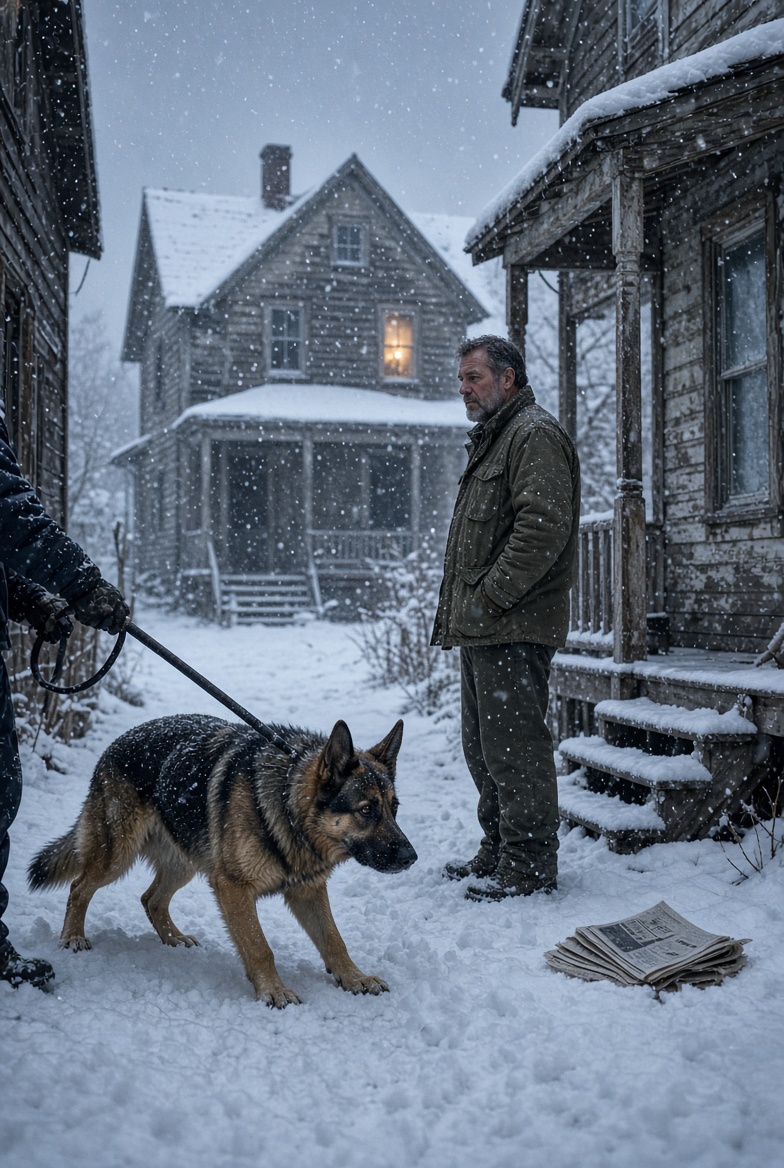
“Been loose since this morning. Three calls. First near Murphy’s Diner, then by the hardware store, then he nearly ran in front of a plow on Broadway.”
“Anybody bitten?”
“No.”
“Charged anyone?”
“No. He just doesn’t want to come with us.”
The older officer exhaled.
“That’s putting it mildly.”
The dog lunged toward the house again.
Travis watched the direction of the movement, the tension through the Shepherd’s shoulders, and the way his gaze returned to the porch even when the officers pulled him away.
“He’s not trying to get away from you,” Travis said.
The mustached officer looked over.
“What?”
“He’s trying to get back there.”
Both men glanced toward the house.
Snow covered the short walkway from the porch to the sidewalk. There were no fresh footprints, no shovel marks, and no sign that anyone had opened the front door recently.
A newspaper lay half buried near the steps.
The younger officer finally introduced himself.
“Luis Ortega. Animal control. That’s Dean Pritchard.”
“Travis.”
Luis waited, apparently expecting a last name or an explanation.
Travis offered neither.
Dean crouched carefully beside the Shepherd.
“There’s something on his collar.”
Luis shortened the pole enough to keep the dog steady without forcing his neck. Dean reached beneath the thick fur and found a small leather pouch flattened against the collar.
The Shepherd tolerated the touch but kept staring at the house.
Dean opened the flap.
Inside was an identification card.
“Duke,” he read. “Owner’s name is Walter Keane.”
Luis repeated the address printed beneath it.
They all looked toward the house.
It was the same address as the one directly in front of them.
Dean removed another card.
“Emergency contact. Maryanne Keane.”
He took out his phone and called the number.
It rang.
No answer.
He tried again.
Still nothing.
Then he tipped the pouch into his palm.
A flat brass key fell against his glove.
For the first time, Travis felt something shift in the alley.
Not danger, exactly.
Possibility.
A dog could get loose. A key could be attached to a collar for convenience. A phone could go unanswered for any number of ordinary reasons.
But ordinary things sometimes gathered in the wrong order.
Duke stared at the porch, then at Travis, then back at the porch.
Travis didn’t believe the dog was asking him anything. He believed Duke had been giving the same answer for hours, and nobody had yet asked the right question.
He looked at the front windows.
Most were dark, but the lower pane in the living room held a faint blur of condensation along the inside edge.
Heat.
The house wasn’t empty enough to be cold.
“Have you checked on the owner?” Travis asked.
Luis’s expression changed.
“No.”
Dean looked toward the untouched walkway.
Duke gave a low, impatient whine.
That small sound carried farther than the barking had.
Luis made his decision.
He removed the catch pole but kept a standard lead attached to Duke’s collar.
“All right,” he said. “Show us.”
The moment the pressure released, Duke surged forward.
Luis had to jog two steps to keep from being pulled off balance. The Shepherd reached the porch, turned, and looked back.
The three men stood in the snow.
Duke waited.
Travis felt an old part of his mind switch on.
Not fear.
Sequence.
Owner unknown inside the house. Possible medical emergency. No answer to the emergency contact. Key available.
He hated how easily that part of him still worked.
He hated even more that some part of him was relieved to have something that needed doing.
Luis climbed the steps and fitted the brass key into the lock.
The door opened.
Warm air met them, although warm was generous. The thermostat beside the hallway read sixty degrees. A radio murmured somewhere in the living room, a man’s voice discussing agricultural prices with the calm seriousness of someone unaware that three strangers and a German Shepherd had just entered his home.
“Mr. Keane?” Luis called. “It’s county animal control. Is anyone here?”
No answer.
Duke pulled hard.
This time, Luis followed without resistance.
The dog raced through the hallway, past a small kitchen and a coat rack, then stopped at the bottom of the staircase.
Travis saw the man on the floor.
“Here.”
The word left his mouth before he realized he had spoken.
Walter Keane lay on his side across the runner rug. His white hair had lost its careful part, and a charcoal cardigan was twisted beneath one shoulder. One leg rested at an awkward angle, though nothing immediately suggested an obvious fracture.
A wool throw covered part of his chest.
Duke lowered himself beside the man and pressed his body against Walter’s shoulder.
Walter’s eyes opened.
They were brown, alert enough to focus, and immediately annoyed.
“You took your time,” he whispered.
Travis almost smiled.
Luis was already calling emergency medical services over his radio. Dean moved toward the living room to clear space for the paramedics.
Travis knelt beside Walter.
“Mr. Keane, I’m Travis. Don’t try to move yet.”
Walter studied him.
“You always introduce yourself after entering people’s houses?”
“Usually, they answer the door.”
Walter considered that.
“Fair point.”
Travis checked Walter’s responsiveness without moving his injured hip. The old man’s hands were cold, and his lips looked pale, but he was conscious and speaking clearly.
“What happened?”
“Gravity became ambitious.”
“Did you fall down the stairs?”
“Only part of them. I believe in moderation.”
Travis glanced toward the landing. A cordless phone sat on a small table upstairs, beyond Walter’s reach.
Walter followed his eyes.
“Phone’s up there.”
“How long have you been down?”
Walter’s humor faded.
“Since last night.”
Duke shifted closer, pressing his nose beneath Walter’s hand.
Walter’s fingers moved slowly through the dog’s thick fur.
“I could reach that blanket,” he said. “Couldn’t stand.”
Travis looked toward the back hallway and noticed the flap of a dog door set into the laundry room entrance.
“You trained him to get help?”
Walter gave a faint snort.
“No. I trained him to expect breakfast at six-thirty and a walk at seven.”
“Then what happened?”
Walter looked at Duke.
“When it got light, I kept telling him to go.”
“Go where?”
“Anywhere with thumbs.”
Travis looked down at the dog.
Walter continued, his voice weakening.
“Eventually, I told him, ‘Go get somebody, Duke.’ He went out, came back, went out again. Kept checking on me like I’d changed my mind.”
Duke pushed his nose beneath Walter’s hand again.
“Eventually,” Walter whispered, “he stopped coming back so fast.”
Outside, the distant sound of a siren grew louder.
Walter looked at the three men, then down at his dog.
“He made a nuisance of himself.”
Travis glanced at Luis, who was doing an excellent job of looking busy with his radio.
“Pretty impressive nuisance.”
Walter’s mouth moved into the smallest smile.
“Good. Finally learned something useful.”
Duke rested his head against Walter’s shoulder.
Travis remained beside them until the paramedics arrived. He had entered the alley believing he was watching a dog refuse to be taken away.
Now he understood that Duke had been doing something simpler.
He had been refusing to leave someone behind.
And for reasons Travis did not yet want to examine, that distinction stayed with him long after the ambulance doors closed.
Walter Keane decided within ten minutes that hospitals were designed by people who had never been patients in one.
The bed moved when he didn’t ask it to. The lights were too bright in the morning and too dim when he wanted to read. Someone appeared every few hours to ask questions he felt he had already answered.
On a scale of one to ten, how badly did his hip hurt?
On a scale of one to ten, how dizzy did he feel?
Walter had lived seventy-nine years without assigning numbers to discomfort and saw no reason to begin now.
When a nurse asked how badly his hip hurt, he said, “Enough to make me dislike stairs more than I did yesterday.”
She smiled despite herself and wrote something on his chart.
The medical news was better than it might have been. Walter had bruised his right hip and strained several muscles, but there was no fracture. The hours on the floor had left him dehydrated, exhausted, and mildly hypothermic when the paramedics arrived.
Nothing required surgery.
With rest and rehabilitation, the doctor expected him to walk normally again.
That should have made the situation simple.
It didn’t.
By the second afternoon, the question was no longer what had happened to Walter. It was where he would go after leaving the hospital.
A case manager named Rachel Monroe sat beside his bed with a tablet balanced on one knee. She was in her early fifties, with dark hair beginning to gray at the roots and the careful patience of someone who understood that older men often heard the word assessment as a threat.
“Your house has a second-floor bedroom,” she said.
“It has for forty-three years.”
“And the full bathroom is upstairs.”
“Also true.”
“The downstairs bathroom is small, and the staircase railing needs to be checked.”
Walter folded his arms.
“Are we discussing my house or preparing it for a hostile takeover?”
Rachel smiled politely.
“Neither. We’re trying to make sure you can return safely.”
Travis Halden heard that part from the doorway.
He hadn’t intended to stay long. He had brought the brass key back, asked whether Walter was stable, and planned to leave before anyone discovered another reason to involve him.
Travis liked errands because errands had edges. They began, they ended, and nobody expected them to become friendships.
He stepped inside.
Walter noticed the key first.
“That’s mine.”
Travis held it up.
“Unless you’ve started collecting strangers’ house keys.”
Walter extended his hand.
Travis placed the key in his palm. The old man closed his fingers around it and examined it briefly, as though checking that nothing had changed while it was away.
Rachel glanced at the clock.
“I’ll give you two a few minutes. I’ll be back later to discuss the next steps.”
She reminded Walter that an occupational safety evaluation would be required before his discharge arrangements could be finalized, then left the room.
Walter waited until the door closed.
“Duke eat?”
The question caught Travis off guard.
He had expected something about the house, the fall, or the doctors.
“Yes.”
“How much?”
“Most of breakfast.”
Walter’s forehead tightened.
“Most?”
“He’s eating, Walter.”
“That isn’t what most means.”
Travis pulled the visitor’s chair closer and sat.
“He keeps looking at the door.”
Walter’s expression changed so slightly that another person might have missed it.
Travis didn’t.
The old man turned the brass key between his fingers.
“He hates places where I’m not.”
There was no self-pity in the sentence.
That made it heavier.
Outside the narrow hospital window, snow slid from the edge of a neighboring roof in soft sheets. Red Lodge looked almost cheerful beneath the winter sun, with bright streets and parked cars capped in white.
Walter stared at the key.
“My wife hated this town in February.”
Travis looked at him.
“Why February?”
“January snow is beautiful. December snow is festive. By February, Elaine said snow was just work with good publicity.”
Travis smiled.
Walter’s expression softened for a moment.
“She died six years ago.”
There was no dramatic pause. Walter didn’t look toward the window or reach for a photograph.
He simply continued.
Duke had been three when Elaine died. For the first few months, people had visited often. Food appeared on the porch. Neighbors called. Maryanne drove in from Spokane whenever her schedule allowed.
Then life resumed its ordinary rhythm.
Walter didn’t resent anyone for that. People had jobs, families, obligations of their own.
Mostly, Duke remained.
“He needs feeding whether you’re grieving or not,” Walter said. “Needs walking. Needs the back door opened because apparently the concept of cold becomes irrelevant when there’s a squirrel outside.”
Travis pictured Duke standing rigidly in the alley, refusing to turn away from the house.
Walter continued.
“Dogs are inconvenient that way. They keep requiring tomorrow.”
Something about the sentence caught Travis.
Not because it sounded wise, but because Walter didn’t seem to know that it was.
A knock came at the door.
Luis Ortega stepped inside, accompanied by a woman Travis hadn’t met before. She was in her early sixties, with short silver hair that seemed to have refused every attempt at discipline, pale green eyes, and dark teal veterinary scrubs beneath a charcoal fleece jacket.
“This is Dr. Celeste Ward,” Luis said. “Duke’s veterinarian.”
Walter sat straighter.
“Something wrong?”
“No,” Celeste assured him. “I came to talk about Duke’s records and make sure we have everything arranged properly.”
Walter relaxed by a degree.
Celeste explained that Duke’s vaccinations were current, his weight was healthy, and he had no history of aggression or biting. She had treated him for years and knew his habits well.
There was mild arthritis beginning in his left rear leg, nothing unusual for an older German Shepherd.
Walter frowned.
“He doesn’t have arthritis.”
Celeste looked at him over her glasses.
“He absolutely has arthritis.”
“He runs.”
“So do people with bad knees.”
Walter looked betrayed by medicine as a profession.
Luis covered a smile.
The important question was what would happen to Duke while Walter recovered.
Animal control could keep him temporarily, but the arrangement wasn’t ideal. Duke was safe, fed, and properly cared for, yet he spent most of his time near the kennel door.
“He isn’t settling,” Luis explained.
Walter looked at him.
“What does that mean?”
“It means he keeps waiting.”
Celeste’s voice softened.
“That doesn’t mean he’s suffering. He knows your scent isn’t there. He’s waiting for you.”
Walter rubbed the brass key with his thumb.
“How long can he stay?”
“A few more days without any problem,” Luis said. “Longer if necessary, but he’d do better in a home environment.”
Walter’s jaw tightened.
“My home is available.”
No one answered immediately.
The house was available, certainly. But Walter couldn’t yet climb the stairs safely, and the bathroom arrangements remained a concern.
Celeste chose her words carefully.
“The question isn’t whether Duke can go home.”
“I know what the question is.”
Walter looked toward Travis.
Travis recognized the expression. It was the look of a man who had already decided he disliked the answer and was preparing to reject every possible version of it.
The door opened again before anyone could continue.
Maryanne Keane entered carrying a navy canvas tote over one shoulder and a winter coat folded across her arm.
At forty-eight, she shared her father’s nose and eyes, but none of his interest in pretending irritation was a personality.
She stopped at the foot of his bed.
“You drove in this weather,” Walter said.
Maryanne stared at him.
“You lay on the floor all night.”
“That was yesterday.”
Travis immediately understood that this wasn’t their first version of the argument.
Maryanne set her tote down.
“Do you know what the hospital called me?”
Walter said nothing.
“They asked whether you had an emergency plan.”
“I had one.”
“No, you had a key on a dog’s collar and a daughter who couldn’t get you on the phone.”
Walter glanced at the brass key.
The emergency pouch had been Maryanne’s idea a year earlier, after he experienced a brief dizzy spell in the kitchen.
He hadn’t fallen then. He hadn’t needed an ambulance. He hadn’t even called anyone.
Maryanne learned about it three weeks later when he mentioned it accidentally.
Afterward, she had insisted on putting her contact information and a spare key inside Duke’s leather pouch.
Walter had called the idea excessive.
“Paranoid,” Maryanne corrected.
“I said cautious.”
“You said this is what happens when daughters discover the internet.”
Luis suddenly became very interested in the view outside the window.
Travis looked down to hide a smile.
Walter glanced at him.
“You don’t need to enjoy this.”
“I’m not.”
“You have the face.”
Maryanne almost laughed, but anger won.
She pulled a chair closer to the bed.
“When you leave here, come to Spokane.”
Walter’s expression closed instantly.
“No.”
“Just until you’re stronger.”
“No, I heard the first version.”
“Dad, you can’t climb those stairs right now.”
“Then I won’t climb them.”
“The bedroom is upstairs.”
“I own a sofa.”
“That isn’t a plan.”
Walter’s voice sharpened.
“It’s my house, and I’m not trying to take it from you.”
Maryanne stared at him.
“That is exactly how these things begin. First I stay with you for two weeks. Then somebody decides I shouldn’t drive. Then somebody else decides I need a place with bingo at four.”
“You think that’s what I want?”
Walter didn’t answer.
Her voice lowered.
“I’m not angry because you’re getting older.”
He looked away.
“I’m angry because you make sure I only learn something is wrong when it becomes an emergency.”
That broke the argument differently than shouting might have.
Walter stared at the blanket covering his legs.
For a moment, Travis felt he should leave. This had moved far beyond the return of a key.
He stood.
Walter noticed.
“How long will animal control keep Duke?”
Maryanne closed her eyes.
“Dad.”
“What?”
“You just spent twenty minutes discussing the dog.”
“He was there.”
“So was the floor.”
Walter ignored that.
Travis reached for his jacket.
He had no dog, no properly fenced yard, and work hours that changed according to whichever furnace decided to stop cooperating. He liked silence, predictable mornings, and waking without anything expecting him to be useful.
Every reasonable thought told him to say good night.
Instead, he heard himself ask a question that surprised everyone, including him.
“Does Duke destroy furniture?”
Walter looked up.
“No.”
“Bark at night?”
“Only when justified.”
“That answer worries me.”
Walter narrowed his eyes.
“Why?”
Travis exhaled.
“Because apparently I’ve reached a point in my life where I need to become responsible for a large German Shepherd belonging to a man I’ve known for less than two days.”
Duke needed somewhere familiar to stay while Walter recovered. Travis could provide that, at least temporarily.
“Duke can stay with me for a few days.”
Maryanne turned toward him.
Walter stared.
Even Travis felt surprised by how final the sentence sounded.
“You sure?” Walter asked.
“Until you can work out the next step.”
Walter studied him for several seconds.
Then he laughed.
It wasn’t loud. His hip clearly objected to the movement, but it was the first laugh Travis had heard from him that wasn’t being used as armor.
And for once, Travis didn’t immediately look for the nearest door.
Duke entered Travis Halden’s house without gratitude.
That was the first thing Travis respected about him.
There was no dramatic inspection of his new surroundings, no grateful collapse beside the fire, and no immediate recognition that Travis had done anything worth appreciating.
Duke walked through the front door, stopped on the entry mat, and looked around as if conducting an audit.
The cabin sat near the edge of Red Lodge, where the houses spread farther apart and plowed streets gave way to narrower roads bordered by snowbanks.
It wasn’t large. One bedroom, a small spare room Travis used for tools and paperwork, a kitchen opening into the living room, and a mudroom where work boots gathered salt stains every winter.
Travis had bought a dog bed that afternoon.
He’d chosen the largest one in the store because Duke looked like the kind of animal capable of regarding insufficient square footage as a personal insult.
He placed it near the wood stove.
Duke sniffed it, walked around it once, then lay down directly in front of Travis’s bedroom door.
Travis stood in the hallway.
“You understand that cost forty-eight dollars?”
Duke closed his eyes.
Excellent.
The first night passed quietly until three in the morning, when Travis woke to the sound of claws shifting against the floorboards.
He opened the bedroom door.
Duke lifted his head.
Nothing was wrong. No barking, no pacing, no obvious distress.
The dog simply looked past Travis into the dark room, confirmed he was still there, and lowered his head again.
Travis remained in the doorway longer than necessary.
Walter’s words returned to him.
He hates places where I’m not.
Travis shut the door halfway instead of completely.
He didn’t think about why.
At 6:58 the next morning, he walked into the kitchen and found Duke standing beside the coat hooks.
Travis poured coffee.
Duke watched him.
Travis buttered toast.
Duke watched him.
Travis sat at the table and opened the weather report on his phone.
Duke continued watching him.
“You’re going to have to develop a more persuasive argument.”
Duke sat, his right ear angled outward slightly.
Travis drank half his coffee.
At exactly seven, Duke looked at the door, then back at him.
Travis stared.
“Oh, no.”
Duke didn’t move.
Walter had mentioned the morning walks, but Travis had assumed that meant sometime after breakfast, before lunch—a concept rather than an appointment.
Apparently, Duke disagreed.
Travis finished his coffee, pulled on his canvas jacket, and reached for the leash Luis had left with him.
Duke immediately stood.
“There it is.”
Outside, the snow had stopped during the night. Red Lodge sat beneath a clear, pale sky, every roof and fence line sharply defined.
Their breath drifted white in front of them.
Duke walked with purpose for the first two blocks.
Then a squirrel crossed a fence.
The disciplined German Shepherd disappeared.
Duke lunged so suddenly that Travis had to take a quick step sideways.
“Absolutely not.”
Duke stared up the tree.
The squirrel stared down with the confidence of an animal protected by altitude.
Travis shortened the leash.
“You nearly led three grown men to a medical emergency yesterday. Try to preserve some dignity.”
Duke sneezed snow from his nose.
By the third morning, Travis had stopped pretending seven o’clock was accidental.
He woke at 6:45. Coffee, boots, jacket, leash.
He noticed the change only after he found himself waiting for Duke instead of the other way around.
That realization irritated him enough that he deliberately sat down for another minute.
Duke stood beside the door.
Travis checked his old field watch.
It was four minutes fast, as always.
“Your schedule isn’t legally binding.”
Duke continued staring.
Travis stood.
“Apparently, neither is mine.”
The adjustment spread into other parts of the day.
Travis began moving electrical cords farther from the floor, even though Duke had shown no interest in chewing them. He put a water bowl in the mudroom because Duke drank as if preparing for a drought.
He learned that the dog disliked the metallic scraping noise made by snowplow blades. Whenever one passed, Duke became rigid and turned toward the sound until it faded.
He also learned that Duke ate fresh snow with enthusiasm and judgment far below his age.
On the fourth morning, Duke swallowed enough to cough.
Travis stopped.
“You live in Montana?”
Duke coughed again.
“This cannot be new information.”
A woman shoveling her porch nearby looked over.
Travis realized he was arguing with a dog in public.
He kept walking.
The gloves began disappearing on the second day, only one at a time.
Travis would leave a pair on the bench by the door, return from the kitchen, and discover the left glove gone.
The first appeared beneath the dining table.
The second time, it was the right glove.
The third time, Duke carried one directly into the living room, placed it beside his front paws, and went to sleep.
He never chewed them.
He simply took them.
Travis eventually stopped retrieving the glove immediately.
That disturbed him more than the theft.
On Friday afternoon, Luis Ortega knocked on the door with a twenty-pound bag of Duke’s regular food over one shoulder.
Duke reached the entrance before Travis.
Luis crouched.
“There’s the criminal.”
Duke sniffed him, then looked at the bag.
“Nice to know forgiveness can be purchased.”
Travis took the food.
Luis stepped inside and noticed the unused dog bed.
“He won’t sleep on it?”
“He considers it decorative.”
Luis looked toward the hallway.
“Where does he sleep?”
“Outside my bedroom.”
Luis smiled.
Travis pointed at him.
“Don’t.”
“I didn’t say anything.”
“You were about to.”
“I was about to compliment your hospitality.”
“That wasn’t your face.”
Luis laughed and unzipped his county jacket.
Duke returned to the living room and settled near Travis’s chair.
Luis watched him for a moment.
“I keep thinking about that alley.”
Travis put the dog food in the pantry.
“Why?”
“I should have noticed he kept turning toward the house.”
“You noticed eventually.”
“After you said it.”
Travis looked back at him.
Luis’s humor had disappeared.
Animal control work, Travis suspected, offered plenty of opportunities to be blamed and very few to be thanked. A person could either become defensive or learn to carry uncertainty.
Luis seemed to belong to the second group.
“I had calls about a loose eighty-pound Shepherd near traffic,” Luis said. “My job was to get him out of the road.”
“And you did.”
“I still put a pole on a dog who was trying to help.”
Travis leaned against the kitchen counter.
“You kept him from being hit by a plow.”
Luis gave him a look.
“That’s a surprisingly kind way to say I arrested the messenger.”
“Don’t get used to it.”
Luis smiled again.
It was enough.
Later that afternoon, Travis took Duke to the hospital.
The visit had been arranged as a short, supervised meeting in a rehabilitation sitting room rather than Walter’s hospital room. Dr. Celeste Ward had provided the vaccination records, and the hospital had agreed to the visit as long as Duke remained leashed.
Walter was already there.
He sat in a high-backed chair with a walker beside him, his injured leg extended slightly forward. Maryanne occupied the chair opposite.
Travis knew there had been an argument before he entered, not because anyone was shouting, but because both of them were sitting too straight.
Duke crossed the room immediately and pressed himself against Walter’s knees.
Walter buried a hand in the thick fur around his neck.
“There you are.”
For several seconds, everything else disappeared from his face.
Then Maryanne spoke.
“I called a snow service.”
Walter’s hand stopped.
“For what?”
“Your driveway.”
“I have a shovel.”
“You also have a bruised hip.”
“That’s temporary.”
“The ice isn’t.”
Walter sighed.
“I asked you last winter to let someone clear it,” Maryanne continued. “You said you could manage.”
“I can.”
“You said the same thing about the railing.”
Walter looked toward Duke.
“The railing didn’t cause the fall.”
“That isn’t the point.”
“Then why mention it?”
“Because everything is always separate with you. The driveway is separate. The stairs are separate. The dizzy spell is separate. The bathroom is separate. Nothing is ever enough to count as needing help because you divide it into pieces.”
Walter’s jaw tightened.
“When I need help, I’ll ask.”
Maryanne was quiet for a moment.
Then she said, “You never say you need it. You only let me know after it becomes something you can’t hide.”
The room changed.
Not dramatically. Walter didn’t shout. Maryanne didn’t cry.
But Walter’s hand stopped moving through Duke’s fur.
Travis looked at him and understood suddenly that Maryanne’s fear and Walter’s fear weren’t opposites.
They were facing the same future from different ends.
Maryanne was afraid that one day the phone would ring too late.
Walter was afraid that one day it would ring too early, before he had decided he needed anyone at all.
Travis knew enough about fear to recognize how often it disguised itself as principle.
He also knew enough to keep his mouth shut.
Duke rose.
He walked away from Walter, crossed the narrow space, and lay down exactly between the two chairs.
His body touched neither of them.
Walter looked down.
“He hates arguments.”
Maryanne watched Duke settle his chin on his paws.
“No,” she said.
Walter glanced at her.
“He hates when nobody listens.”
For once, Walter had no reply prepared.
The silence that followed wasn’t comfortable, but it was honest.
Travis looked toward the window.
Outside, snow had begun again, small flakes turning slowly beneath the parking lot lights.
He had spent years believing useful people were the ones who knew what to do next.
At that moment, doing nothing felt more difficult.
So he stayed.
Duke stayed, too.
And between Walter and Maryanne, for several quiet minutes, no one tried to win.
By the second week, Duke no longer treated Travis’s truck as transportation.
He treated it as an event.
The first time Travis noticed, he had just come out of the hardware store with a box of furnace filters under one arm. Duke was waiting in the passenger seat behind the secured window gap, his head turned toward the sidewalk.
The moment Travis appeared, the dog sat straighter.
Not excited. Not frantic.
Attentive.
Travis unlocked the truck.
“I was gone seven minutes.”
Duke watched him set the filters behind the seat.
“Walter would probably say that’s excessive.”
Duke’s tail struck the upholstery once.
Travis closed the door.
He didn’t think much about the moment.
Walter did.
The hospital had approved regular short visits with Duke in the rehabilitation lounge. The first meeting had been almost painfully uncomplicated.
Walter had been sitting near a window with a blanket over his knees when Travis brought Duke through the door.
Walter said his name once.
“Duke.”
The dog stopped.
For half a second, every part of him seemed to gather toward the sound.
Then he moved.
Travis had to brace the leash as Duke crossed the room in three hard strides and pressed his head against Walter’s legs.
Walter buried both hands in the thick fur around his neck.
He didn’t joke, complain, or ask how much paperwork had been required.
For nearly a minute, he simply held the dog.
Maryanne stood near the far wall and looked away.
Travis understood why.
Some kinds of love became smaller when watched too closely.
After that, the visits became regular.
Twice the first week, three times the next.
Walter was improving. His bruised hip still limited him, but he could move farther with a walker and no longer looked exhausted by every trip down the hallway.
Duke always went to Walter first.
That never changed.
What changed happened afterward.
Small things, the kind no one would have noticed unless they were already afraid of what they meant.
One afternoon, Travis shifted in his chair to stand. Duke lifted his head immediately.
Walter noticed.
Another day, Travis reached for the leash after the visit. Duke sat before being asked.
Walter noticed that, too.
A few days later, Duke heard the truck door close outside the rehabilitation entrance before Travis came in. His ears rose.
Walter’s hands stopped halfway through scratching the dog’s neck.
“You know that sound now?”
Duke looked toward the hallway.
Travis entered thirty seconds later carrying two coffees.
Walter said nothing.
That silence was different from his usual silence.
It was less defensive, more private.
Travis began to understand that Walter was counting things.
Not consciously, perhaps, but counting.
How quickly Duke looked toward Travis. How easily he settled beside Travis’s boots. How often the leash changed hands without resistance. How comfortable the dog appeared in a routine Walter hadn’t created.
The trouble was that none of those things meant what Walter feared they meant.
But fear rarely needed good evidence.
One Thursday afternoon, snow moved slowly past the tall windows of the rehabilitation lounge.
Walter sat with Duke pressed against his left leg. Maryanne had stepped downstairs to speak with the case manager, leaving Travis and Walter alone.
For several minutes, they talked about nothing important.
The weather. A heater making a strange noise in the west wing. Whether hospital coffee qualified as a beverage or a legal punishment.
Then Walter asked, “Where does he sleep?”
Travis looked at Duke.
“At my place.”
“Where?”
“Usually outside my bedroom.”
Walter’s hand remained on Duke’s back.
“He used to sleep beside my bed.”
Travis heard the sentence clearly enough.
He didn’t answer immediately. Anything comforting would sound too quick. Anything factual would sound cold.
So he said, “He still waits by the door sometimes.”
Walter gave him a sideways look.
“Sometimes.”
There it was.
Travis leaned back.
“Walter, he’s adjusting.”
“I can see that.”
The answer wasn’t angry.
That was worse.
Walter looked down at Duke. The dog had fallen half asleep, his eyes closing and opening slowly while Walter’s fingers moved through the fur behind his ear.
“You know what Elaine used to say?”
Travis waited.
“She said Duke had no loyalty, only appetite.”
Travis glanced at the dog.
“She may have had evidence.”
“She usually did.”
Walter smiled faintly, but it didn’t last.
Then he asked, “Does he wait for you when you leave the room?”
Travis felt the question settle between them.
“Sometimes.”
Walter nodded.
That was all.
A few days later, the thing Walter had been quietly measuring finally became visible.
It happened during an ordinary visit.
No argument, no medical news, no dramatic announcement.
Walter sat near the window while Duke lay with his head across the old man’s foot. Maryanne was reading something on her phone, and Travis’s coffee cup was empty.
He stood.
“I’m getting another one.”
Walter looked up.
“Try getting coffee this time.”
“No promises.”
Travis crossed the room.
Behind him, Duke lifted his head.
Travis heard claws touch the floor.
He turned.
Duke had stood.
The dog took three steps after him, then stopped.
Travis looked at Walter.
Walter was watching Duke.
Not Travis.
Duke glanced between them, then returned to Walter and settled beside his chair.
It was an ordinary choice.
A dog tracking the movement of the person who had fed him, walked him, driven him, and slept behind the same door for nearly three weeks.
Travis knew that.
Maryanne knew that.
Walter probably knew it, too.
Knowledge didn’t help.
Something in Walter’s face closed.
By the time Travis returned with coffee, the old man had started talking about the weather.
That evening, Maryanne found Travis near the elevator.
“He says Duke should stay with you.”
Travis stopped.
“What?”
“He thinks your place is better for him.”
Travis looked back toward the rehabilitation lounge.
“He doesn’t believe that.”
“I know.”
“He thinks he’s being practical.”
Maryanne folded her arms.
“He thinks being practical is the respectable way to disappear.”
The sentence was sharper than she probably intended.
She looked tired immediately afterward.
Travis understood the exhaustion behind it.
“What exactly did he say?”
“That Duke needs space, exercise, someone strong enough to walk him in winter. Someone younger.”
Travis almost objected to the word younger on principle.
Instead, he said, “He’s seventy-nine, not ninety-five.”
“Tell him.”
“I’m trying very hard not to become part of this argument.”
Maryanne gave him a long look.
“You volunteered to take his dog home.”
“That was temporary.”
“Everything is temporary until people start depending on it.”
Travis didn’t answer.
That sentence followed him into the lounge.
Walter was alone with Duke. The dog lay beneath the window.
Walter didn’t look up when Travis entered.
“I hear you’ve reorganized my life.”
Walter sighed.
“Maryanne talks too much.”
“She says the same about you.”
“I’m sure.”
Travis sat opposite him.
Walter looked toward Duke.
“You can give him more than I can now.”
“That’s not the same as him belonging with me.”
“He walks better with you.”
“He walks with whoever holds the leash.”
“He watches for your truck.”
“He also watches squirrels.”
Walter’s mouth tightened.
“Don’t reduce everything because you don’t like where the conversation is going.”
Travis leaned forward.
“All right. You think Duke doesn’t need you anymore?”
Walter’s expression barely changed, but that was answer enough.
“He needs exercise.”
“That’s not what I asked.”
“He needs stability.”
“He has it.”
“He needs somebody who can keep up with him.”
“He has you.”
Walter gave a dry laugh.
“I’m sitting in a rehabilitation ward learning how to turn without falling over. For now.”
He looked away.
Travis studied him.
The mistake became clear.
Walter wasn’t trying to give Duke away because he loved the dog less.
He was trying to leave first, to make the rejection voluntary, respectable, useful.
Travis knew that instinct better than he wanted to.
“He didn’t replace you with me,” Travis said.
Walter looked back.
“You don’t know dogs.”
“Maybe not.”
Duke lifted his head at the sound of their voices.
Travis continued.
“But I know people are very good at leaving before anyone gets the chance to leave them.”
Walter went still.
The words had come out before Travis decided whether they belonged in the room.
For several seconds, neither man spoke.
Walter studied him differently now. Not as the stranger who had found him, not as the man temporarily keeping Duke, but as someone who had said something with too much familiarity behind it.
“Who left you?” Walter asked.
Travis looked toward the window.
“That wasn’t the point.”
“It usually is when someone says something like that.”
Travis almost smiled.
“Your hip getting better has made you irritating again.”
“Good.”
Walter shifted carefully in his chair.
Duke stood, crossed the small space, and placed himself between them.
Not because the room needed rescuing.
Not because he understood what was being said.
He simply wanted to be close to both men.
Walter looked down. Duke’s shoulder touched his knee, and one paw rested near Travis’s boot.
Nothing had been settled.
Walter hadn’t withdrawn the idea of letting Duke stay permanently with Travis. Travis hadn’t explained himself.
But something had changed.
The distance between them no longer belonged to a rescuer and a man who had needed rescuing.
It belonged to two men who had accidentally recognized the same habit in each other.
And for the first time, Walter didn’t look at Duke as proof that something had been taken from him.
He looked at the dog as if he might still be deciding what it meant that love could move toward someone new without moving away from him.
The next stage of Walter’s recovery began with a tape measure.
Janice Rowan arrived at the old house carrying a tablet, a yellow tape measure, and no visible interest in being impressed by anyone.
Walter disliked her immediately.
That was probably why he listened.
At fifty-seven, Janice was compact and steady on her feet, with short salt-and-pepper hair that curled slightly at the ends and rectangular brown-framed glasses. She pushed them higher whenever someone gave her an answer that was technically correct and practically useless.
Her quilted navy vest was zipped over a muted sage sweater. The tape measure rested in one pocket.
Walter noticed it before she finished introducing herself.
“You planning to measure me?”
“Only if you turn out to be part of the doorway.”
Travis looked away to hide a smile.
Walter didn’t bother.
Janice had been assigned as the occupational therapist responsible for assessing whether Walter could safely return home after discharge. He had agreed to the visit only because the hospital had made it clear that refusing the evaluation wouldn’t make the questions disappear.
Walter stood just inside his living room with a cane in one hand and Duke pressed close to his left leg.
He had been cleared for a supervised home assessment, not a permanent return.
Maryanne had driven him. Travis had brought Duke.
Walter looked around as though returning from a long trip rather than a hospital stay of several weeks.
Everything was where it belonged.
The radio. Elaine’s lamp. The old walnut table. A folded newspaper on the chair.
For a few moments, his shoulders relaxed.
Then Janice opened the tape measure.
Walter looked at her.
“You’re here to tell me I can’t live alone.”
“No. That usually comes after the measuring.”
Janice crouched to check the threshold between the hallway and living room.
“I’m here to find out how many things have to change if you want to keep making that decision yourself.”
Walter studied her.
That answer was apparently acceptable enough to continue.
Janice began with the front door, then the stairs, then the bathroom. She didn’t move through the house like an inspector looking for violations.
She asked Walter to show her how he normally did things, where he kept his medication, how he carried laundry, which stove burner he usually used, where Duke’s food was stored, what happened if the driveway iced over, and who lived closest.
Walter’s answers grew less sarcastic as the questions became more specific.
The staircase was steep, but that wasn’t the only issue.
The lower handrail ended three steps before the landing.
The full bathroom upstairs had a tub with a high side.
The downstairs half bath was narrow enough that a walker would barely clear the sink.
Walter’s medication sat in a kitchen cabinet above shoulder height.
The driveway sloped toward the street and collected ice on the northern edge.
The nearest neighbor was a retired teacher two houses away.
“She’s eighty-three,” Walter said.
Janice looked at him.
“So your emergency backup is older than you.”
“She’s very competent.”
“I’m sure she is.”
Travis moved through the house with a different set of eyes.
Loose railing. Threshold. Bathroom. Ice exposure. Lighting.
His mind began doing what it always did when confronted with a problem.
Break it down.
Fix the pieces.
He went to his truck and returned with a measuring tape of his own.
Walter noticed.
“See? A useful person.”
Janice watched Travis measure the stair width.
“How much of this can you fix?”
“Railings, lighting, maybe widen the downstairs bathroom entrance depending on the framing. Add grab bars. Move the bedroom downstairs. Improve the exterior handrail and ice control. We could relocate the medication storage.”
Walter looked pleased.
Maryanne didn’t.
She stood near the kitchen counter with both hands wrapped around a mug she had stopped drinking from.
Janice looked from Travis to Walter.
“You can repair quite a lot.”
Walter gave Maryanne a small victorious glance.
Then Janice asked Travis a question that stopped him cold.
“Can you make him want to live in this house for another ten years?”
The tape measure stopped moving.
Walter’s expression changed.
“That isn’t the question.”
“It might be.”
“I own this house.”
“Yes.”
“I’ve lived here longer than some of the people deciding whether it’s safe.”
“Also true.”
Walter waited for the disagreement.
Janice didn’t give him one.
Instead, she said, “Safety isn’t the same as suitability.”
The room went quiet.
Travis let the tape retract into its case. The sharp metallic snap sounded louder than it should have.
Janice continued.
“If we fix the railing and move your bedroom, you still have a narrow bathroom. If we modify that, you still have the driveway. If we address the driveway, you still have winter access and the distance from emergency services.”
Walter leaned on his cane.
“You’re making a list.”
“That’s my job.”
“I can make lists, too.”
“I know.”
Her voice stayed even.
“The question is whether you want your next ten years to become a maintenance project.”
That landed harder than anything Maryanne had said.
Walter looked around the living room.
Duke wandered over to Elaine’s old chair and lay down.
For several seconds, no one spoke.
Travis understood what Janice had done.
She hadn’t taken the house away from Walter.
She had handed it back to him as a decision.
That was much more difficult.
Later, after Maryanne took Janice into the kitchen to discuss follow-up recommendations, Travis and Walter sat on the front porch.
The afternoon had cleared. Sunlight reflected so brightly from the snowbanks that Travis had to narrow his eyes.
Walter held a mug of coffee in both hands.
Duke lay between their boots.
“You really think I should leave?” Walter asked.
Travis looked at the street.
“I didn’t say that.”
“You measured the stairs.”
“That’s not a vote.”
Walter took a drink.
“You fix things for a living.”
“Mostly things that stop working in bad weather.”
“So fix the house.”
Travis almost answered immediately.
That instinct itself told him to wait.
Walter noticed.
“What?”
Travis leaned back.
“I think I like problems better when they have bolts.”
Walter gave a short laugh.
“That explains you.”
Travis looked over.
“What does that mean?”
“You show up very well when something is broken.”
“That sounds like a compliment.”
“It wasn’t entirely.”
Walter drank again.
“You ever married?”
Travis hadn’t expected the question.
“Yes.”
Walter waited.
Travis knew the technique. Old men and good interrogators shared several habits. One was allowing silence to become uncomfortable enough that someone filled it voluntarily.
“It ended,” Travis said.
“Clearly, no disaster.”
“No.”
“That disappoints me.”
“I’m sure.”
Travis watched Duke’s ears move toward a passing truck.
“My wife wanted a life with more people in it.”
Walter didn’t interrupt.
Travis continued.
“Dinner with friends. Weekends somewhere. Neighbors coming over. She liked knowing what everyone was doing.”
“And you?”
“I was working.”
“That wasn’t the question.”
Travis smiled despite himself.
“I liked being useful. If a heating line failed at two in the morning, I went. If a generator stopped during a storm, I went. If somebody needed help moving equipment, I went.”
Walter waited.
“But dinner?”
Travis looked down at his coffee.
“I was usually busy finding something useful to do.”
Walter nodded slowly.
“No cheating?”
“No.”
“No plates thrown?”
“No.”
“No dramatic airport scene?”
“Nothing that cinematic.”
“Shame.”
Travis laughed once.
“She finally told me she was tired of being married to a man everyone could call except her.”
Walter’s humor faded.
“What happened?”
“We stopped making each other unhappy.”
“That sounds very civilized.”
“It was.”
“And lonely?”
Travis didn’t answer.
Walter looked toward the snow-covered street.
“What did you call it?”
“What?”
“Living like that afterward?”
Travis thought for a moment.
“Freedom, probably.”
Walter nodded.
“I called mine independence.”
They sat in silence.
Then Walter began to laugh.
Not loudly, just enough to shake his shoulders once.
Travis looked at him.
Walter said, “We’re both very good at giving respectable names to the same bad habit.”
Travis couldn’t disagree.
Inside the house, Maryanne opened the front door.
“Dad.”
Walter looked over his shoulder.
“What?”
She didn’t tell him what to do.
That alone changed the conversation before she had even entered it.
She came onto the porch and sat on the step rather than taking the empty chair.
“If you didn’t have to prove anything to me,” she said, “what would you actually want?”
Walter frowned.
“About what?”
“Where you live.”
“I live here.”
“That’s where you are. I’m asking what you want.”
Walter looked at her.
Maryanne didn’t mention Spokane. Didn’t mention assisted living. Didn’t mention the fall.
That made the question harder.
Walter looked down at Duke.
“I want him.”
Maryanne nodded.
“Okay.”
“I want my own front door.”
“Okay.”
“I want to make my own coffee.”
Travis raised his cup.
“That standard should remain low.”
Walter ignored him.
“I want to walk when I want. I want Elaine’s things where I can see them. I don’t want to ask permission to have someone over.”
Maryanne listened.
“And I don’t want you managing my life.”
Her face tightened slightly, but she nodded.
“Okay.”
Walter looked suspicious.
“That’s it?”
“No. But it’s a start.”
She reached into her navy canvas tote and pulled out a folded printout.
“There’s a ground-floor apartment open on Birch Street.”
Walter’s entire posture changed.
“No.”
“You haven’t heard anything yet.”
“I heard apartment.”
“It allows dogs.”
“No.”
“Ground floor.”
“No.”
“Small porch.”
“Still no.”
“Three blocks from downtown.”
Walter turned to Travis.
“You see what happens when you encourage questions.”
“I didn’t.”
Maryanne put the paper on the porch railing instead of handing it to him.
“Fine. I’m not asking you to move there.”
“Good.”
“I’m asking you to look at it.”
Walter stared at the folded page.
Maryanne went back inside.
Travis didn’t touch it.
Neither did Walter for nearly a minute.
Then Walter picked it up.
He didn’t unfold it.
He simply held it.
Duke raised his head and rested his chin against Walter’s knee.
Walter looked down at him.
“This proves nothing.”
Travis nodded.
“Of course.”
Walter tucked the paper into his cardigan pocket.
That wasn’t agreement, but it was no longer refusal.
And for a man who had spent years treating every open door as the beginning of surrender, it was enough for one afternoon.
Walter hated the apartment before he had seen the bedroom.
That seemed efficient.
“This kitchen is too small.”
Maryanne stood behind him with both hands in the pockets of her coat.
“You make coffee and toast.”
“I also own a saucepan.”
“Then civilization may survive.”
Walter ignored her and moved deeper into the apartment with his cane.
Birch Street ran along the quieter side of downtown Red Lodge, close enough to the main blocks that a person could walk to the grocery store or café without needing a car on a decent winter day.
The building itself was nothing remarkable. Two stories, pale brick, dark trim, a shoveled walkway, and a narrow porch facing southwest.
The apartment was on the ground floor.
No stairs, no long icy driveway, no upstairs bathroom waiting like a test.
Walter looked at the living room walls.
“Terrible color.”
Travis stood near the door.
“What color is it?”
Walter stared at him.
“Oatmeal.”
Travis looked around.
“That seems accurate.”
Maryanne rubbed one eyebrow.
“You can paint.”
Walter moved to the front window.
“Too low.”
“For what?”
“Privacy.”
“You live alone.”
“That is when privacy is most useful.”
Travis turned away before Walter could see him smile.
The visit had taken planning.
Walter had been cleared to leave the hospital for several hours as part of discharge preparation, provided he used his cane, avoided unnecessary strain, and returned before evening medication rounds.
Janice Rowan had supported the outing because choosing between options meant little if Walter hadn’t physically experienced them.
No one called the apartment a solution.
That wording had been deliberate.
Walter distrusted solutions offered by other people.
He tolerated options slightly better.
The landlord had left the heat on, and the small rooms held the dry warmth of an empty place. There was a shallow coat closet near the door, a modest bedroom, a bathroom with a walk-in shower, and a short hall wide enough for Walter to move through without turning sideways.
He found problems in all of them.
The bedroom faced the wrong direction. The bathroom shelf was too high. The kitchen cabinet handles looked cheap. The refrigerator made a noise like an insect reconsidering its life.
Maryanne allowed the complaints to pass without answering every one.
Travis noticed that.
A month earlier, she would have defended the place.
Now she let Walter dislike it.
They moved toward the back.
The porch door opened without resistance.
Cold air entered.
Walter stepped outside and stopped.
The lower slopes of the Beartooth Mountains were visible beyond the roofs, washed blue-white in the afternoon light. Snow clung to the pines. A thin trail of chimney smoke lifted almost straight upward in the still air.
For the first time since entering the apartment, Walter didn’t criticize anything.
Maryanne noticed, too.
She said nothing.
Travis leaned against the doorframe.
From the porch, Walter could see the roof of the grocery store two blocks away. The café on the corner was even closer.
“You could walk there,” Travis said.
Walter didn’t look back.
“On a good day.”
“Yes. On a bad day, stay home.”
Walter frowned.
“That sounds dangerously reasonable.”
A few minutes later, Luis arrived with Duke.
The dog came through the front door on a standard leash, stopped, and sniffed.
Walter watched him too carefully.
Travis saw it immediately. Perhaps Maryanne did, too.
Duke explored the room without urgency. He checked the corners, sniffed beneath the kitchen table, investigated the bedroom, returned to the living room, then drank from the bowl Maryanne had placed near the wall.
Nothing happened.
No dramatic inspection. No sudden choice. No sign from fate.
Duke simply walked back to Walter and lay down across his shoes.
Walter looked at the top of the dog’s head.
“That proves nothing.”
Maryanne nodded.
“I know.”
Walter glanced at her, suspicious of the agreement.
Duke sighed.
The apartment remained what it had been ten minutes earlier.
An option.
The next day, Walter asked to return to the old house.
Not to stay.
Not yet.
He wanted clothes, books, and personal things.
At least that was how he described it.
Travis understood that Walter needed something else: a way to leave without feeling removed.
The house looked unchanged from the street. Snow still edged the porch steps. The newspaper from the day of the fall was gone, but the brass mailbox leaned at the same slight angle.
Inside, the rooms held the familiar quiet of a place temporarily unoccupied.
Walter stood in the entry hall for a long moment.
Duke moved around him, nose working.
Maryanne waited.
Travis carried two empty boxes into the living room and then stopped.
No one needed instructions.
Walter moved slowly from room to room.
He didn’t begin with valuables.
He began with the radio.
The same old tabletop set that had been playing the day Travis first entered the house.
Walter unplugged it.
“This comes with me.”
Maryanne wrote nothing down.
No list.
That seemed important.
The next thing was Elaine’s reading lamp. Brass stem, cream shade, one pull chain.
Walter touched the shade with two fingers before lifting it.
“She hated overhead lighting.”
Travis took the lamp.
Walter looked at him.
“Careful.”
“I repair furnaces.”
“That doesn’t qualify you for lamps.”
“Apparently not.”
They continued.
A box of photographs.
Four books from a shelf containing at least fifty.
A wooden chair by the front window.
Duke’s bed.
Three coffee mugs.
Maryanne looked at the mugs.
“Three?”
Walter didn’t turn.
“Halden drinks coffee.”
Travis held the box open.
“I haven’t agreed to become a regular visitor.”
Walter placed the third mug inside.
“You’ve had my dog for nearly a month. You lost the right to pretend we’re strangers.”
Travis looked at Maryanne.
She smiled.
“Don’t involve me.”
A sound came from the hallway.
Duke appeared carrying a gray wool sock in his mouth.
Walter pointed.
“No.”
Duke stopped.
The sock remained hanging from one side of his jaw.
“No.”
Duke stared.
Walter waited.
The dog didn’t move.
Travis folded his arms.
“This feels familiar.”
Walter looked at Duke again.
The dog’s ears shifted.
Walter sighed.
“One.”
Duke walked past them with the sock.
Maryanne laughed first, then Travis.
Walter tried not to.
Failed.
The laugh did something none of them had planned.
It loosened the room.
Until then, every object Walter selected had felt like evidence. Proof that he was deciding. Proof that he wasn’t being taken. Proof that leaving the house didn’t mean losing the life that had happened inside it.
Then Duke stole a sock.
And for ten seconds, the old house became ordinary again.
Walter walked into the living room.
The light was changing. Late-afternoon sun came through the western windows and stretched pale rectangles across the floorboards.
Elaine had sat in that room, read there, argued there, and laughed there.
She had died somewhere else.
For years, Walter had understood those facts without arranging them properly.
He had kept the house because it was his, because he knew every switch, because he remembered which stair creaked in winter, because leaving felt suspiciously like agreeing that one part of his life was over.
He had never said that aloud.
Perhaps he didn’t need to.
Travis stood near the doorway holding the lamp.
Walter looked around.
“I thought if I left this place…”
He stopped.
Maryanne waited.
He tried again.
“I don’t know what I thought.”
No one helped him finish.
That was the kindness.
Walter walked to the window.
Outside, Duke crossed the porch with the stolen sock and disappeared briefly into the snow.
Walter smiled.
“She’d have hated that dog.”
Maryanne looked at him.
“Mom loved Duke.”
“She complained about him constantly.”
“She complained about you constantly.”
Walter nodded.
“Exactly.”
The grief didn’t leave.
It changed shape.
That was all.
When the boxes were packed, Maryanne stood near the door.
“What are you going to do with the house?”
Walter pulled on his gloves.
“Nothing.”
“For now?”
“For now.”
He looked through the front window at the snow-covered yard.
“This place has stood here for more than sixty years.”
Maryanne waited.
“It can wait until April.”
She nodded.
No argument. No urgency.
Not every decision required an answer simply because people had finally become willing to discuss it.
The lease papers for Birch Street were waiting at the property office that afternoon.
Walter read every page twice.
He questioned the pet deposit, objected to one clause about snow removal, and asked whether repainting required written permission.
The property manager answered each question with increasingly careful patience.
Finally, Walter reached the signature line.
Maryanne stood several feet away.
Travis remained by the window.
No one handed Walter the pen.
He took his own from his cardigan pocket.
He signed his name.
The letters shook slightly from age and fatigue, but they were his.
He put the pen down.
Maryanne’s eyes shone, though she looked away before Walter could comment.
Travis studied the snow outside.
Walter closed the folder.
“Well,” he said.
Travis glanced back.
“That sounded emotional.”
“It wasn’t, of course.”
Walter tapped the folder.
“I’m renting an apartment. People do it every day.”
“Yes.”
Walter looked at him.
“And you’re carrying the lamp.”
Travis looked down at Elaine’s reading lamp, still protected beneath his arm.
“Apparently.”
Walter smiled.
That was enough.
He hadn’t saved everything.
He hadn’t abandoned everything, either.
He had simply begun choosing what still belonged in the life ahead.
By the end of February, Red Lodge was still white, but winter had changed its tone.
The snowbanks remained high along the curbs. Roofs still held thick caps of snow. The Beartooth Mountains still rose beyond town in blue-white layers.
But daylight stayed longer.
Four o’clock no longer felt like evening.
The streets had begun to shine instead of disappear.
Walter noticed that on his first morning at Birch Street.
At 6:58, he was standing in the kitchen deciding whether his coffee needed more grounds when Duke appeared beside the front door.
Walter looked at the clock, then at Duke.
“You’re early.”
Duke stared.
Walter checked again.
Seven o’clock.
“Fine.”
He pulled on his coat.
The apartment was beginning to look less temporary.
Elaine’s reading lamp stood beside the chair near the window. The old radio occupied a shelf Travis had mounted two days earlier. Duke’s bed was near the radiator, though the dog preferred the rug beside Walter’s chair.
The third coffee mug sat upside down in the cabinet.
Walter hadn’t mentioned it.
Neither had Travis.
Outside, the morning air was sharp enough to sting the inside of Walter’s nose.
Duke moved ahead on the leash, then slowed automatically when Walter’s pace changed.
That more than anything had surprised him.
Duke had always walked quickly.
Walter had simply walked quickly, too.
Now the dog had learned a different rhythm.
They were halfway down Birch Street when Travis appeared across the road carrying two paper cups.
Duke saw him first.
His ears rose, then he surged forward.
Walter let the leash slide through his glove a little before tightening it.
“Traitor.”
Duke stopped and looked back.
Travis crossed the street.
“He heard you.”
“He heard the cup.”
Travis handed Walter one of the coffees.
“Possible.”
Duke leaned briefly against Travis’s leg, then returned to Walter.
A month earlier, Walter would have watched that movement differently.
He might have counted the seconds, measured the ease of it, and wondered whether affection had shifted its weight.
Now he simply took a drink.
“Too much cream.”
“You drank it.”
“That isn’t the same as approval.”
They walked toward town.
No one needed anything repaired.
That still felt strange to Travis.
He had spent most of his adult life giving himself permission to enter people’s lives only when there was a reason.
A broken furnace. A stranded vehicle. A storm. A man on a floor.
Walter required nothing that morning except company and badly judged coffee.
Travis was learning that this counted.
Over the next two weeks, life settled without becoming neat.
Janice Rowan visited once to see how Walter was moving through the apartment. She checked the bathroom, watched him use the shower grab bar, inspected the clear path between the bedroom and kitchen, and made him demonstrate how he would get up if he dropped something.
Walter complained the entire time.
Janice looked satisfied.
“I think you’re going to be all right here.”
Walter frowned.
“You sound disappointed.”
“I’m devastated.”
She closed her tablet.
“That means I’m done.”
Walter looked surprised by how little ceremony came with that.
Janice left.
Her role ended because it was supposed to.
Dr. Celeste Ward continued to see Duke at the clinic for his normal care. She adjusted nothing dramatic, merely reminded Walter to keep an eye on stiffness in Duke’s left rear leg after long walks.
Luis Ortega occasionally passed Birch Street in the county truck.
The first time he saw Duke outside with Walter, he slowed and rolled down the window.
“Is he still causing public disturbances?”
Walter looked at Duke.
“Constantly.”
Luis nodded.
“Good. We like consistency.”
Then he drove on.
No one became family by declaration.
They simply became people Walter now knew he could call.
That was more useful.
Maryanne returned to Spokane after Walter had settled in.
Before leaving, she stood in the apartment entryway holding the navy canvas tote she carried everywhere.
“I’m calling tomorrow.”
Walter shook his head.
“No.”
Maryanne stared.
“You just moved.”
“I’m aware.”
“I want to know you’re okay.”
“You knew that yesterday.”
She folded her arms.
“Wednesday.”
“What about Wednesday?”
“That’s five days.”
“Yes.”
She opened her mouth.
Walter raised a hand.
“And Sunday if you absolutely cannot control yourself.”
Maryanne considered it.
“Wednesday and Sunday.”
“Wednesday.”
“Dad.”
“Fine. Sunday, too.”
She smiled.
The agreement held for exactly one week.
Then Walter called her first on Wednesday.
He never mentioned that detail again.
Neither did Maryanne.
The apartment remained quieter after she left.
Not empty.
Walter was beginning to understand the difference.
Travis still walked alone most days. He still preferred silence in the mornings and took long routes home that avoided the busiest blocks.
He didn’t suddenly become the kind of man who dropped into every diner booth or waved at every passing truck.
But Birch Street became a turn he sometimes made without planning.
At first, he told himself it was efficient.
Then he stopped lying to himself.
Sometimes he knocked.
Sometimes Walter answered with coffee already made.
Sometimes they spoke about Elaine. Sometimes they spoke about Travis’s work. Sometimes Duke slept between them while neither man said anything for twenty minutes.
Silence changed when it was chosen together.
One afternoon, Travis stood to leave after fixing absolutely nothing.
Walter looked offended.
“You’ve been here forty-five minutes.”
“I’m aware.”
“And nothing broke.”
“Disturbing.”
Walter reached toward the small table beside his chair.
There was a brass key on it.
Travis saw it but didn’t understand until Walter held it out.
“What’s that?”
“A key?”
“I got that far.”
Walter kept his hand extended.
Travis didn’t take it.
“For what?”
Walter shrugged.
“The apartment.”
“Why?”
“I don’t know.”
Travis looked at him.
Walter added, “That’s the idea.”
For a moment, neither man moved.
The first key Travis had carried for Walter had rested inside a leather pouch attached to Duke’s collar because Walter had refused to acknowledge that one day another person might need to enter his house.
This key was different.
No emergency had forced it into existence.
No daughter had insisted.
No hospital had suggested it.
Walter had chosen it.
Travis took the key.
It was surprisingly light.
He turned it once in his palm.
“You know this gives me access to your oatmeal-colored walls.”
Walter nodded gravely.
“That’s the risk.”
Travis slipped the key into his jacket pocket.
Near the front door, another spare hung from a small brass hook Walter had installed himself.
Duke’s collar no longer carried the leather emergency pouch. Only the dark green collar and his worn brass name tag remained.
Walter had removed the pouch the week before.
No speech. No ceremony.
He had simply put the key where keys normally belonged.
The detail stayed with Travis.
He thought about it later while walking home through light snow.
There had been a time when Walter’s safety depended on a dog carrying a key to his house.
Now the key was shared because Walter wanted it shared.
Trust looked less dramatic than rescue.
That didn’t make it smaller.
A few days later, snow began falling just after lunch.
Not a storm, only slow flakes drifting across the street.
Travis was returning from a service call when he saw Walter and Duke on the opposite sidewalk.
Walter wore his charcoal coat and flat cap. Duke moved several feet ahead.
Then he saw Travis.
The German Shepherd trotted toward him across the cleared portion of sidewalk.
Halfway there, he stopped and turned.
Walter was still approaching.
Duke waited, not anxiously, just watching.
When Walter came closer, Duke continued.
Travis crouched and scratched the thick fur behind his ear.
“No need to find anyone today.”
Walter heard him.
“Give him time.”
Travis looked up.
“What does that mean?”
Walter smiled.
“He’s training us.”
“To do what?”
Walter looked at Duke.
“People who come back.”
That answer stayed in the air between them.
They continued toward the center of town.
Three figures moving through light snow.
No ambulance, no locked house, no crisis waiting at the end of the street.
Walter still used the cane on icy days. His hips still stiffened in the morning. He still missed Elaine.
Maryanne still worried from Spokane.
Travis still preferred quiet.
Duke was still just a dog who liked routine, café smells, and walking where his people walked.
Nothing had been cured.
That wasn’t what had changed.
Walter had learned that accepting help didn’t mean surrendering ownership of his own life.
Maryanne had learned that loving her father didn’t require standing guard over every decision.
Travis had learned that a person didn’t need a broken furnace, a storm, or an emergency before he was allowed to show up.
And Duke, who had once worn a key because no one else was close enough to carry one, now walked between two men who knew where the door was.
The key stayed on the hook.
Another rested in Travis’s pocket.
For the first time in a long while, that didn’t feel like dependence.
It felt like choice.
Sometimes, when winter settled over Red Lodge and the snow returned to the rooftops, Travis thought about the first afternoon in the alley.
He remembered the catch pole, the county jackets, the untouched walkway, and the little leather pouch beneath Duke’s collar.
He remembered how easy it would have been to assume the dog was simply stubborn.
He remembered the way Duke kept turning toward the house, offering the same answer again and again until someone finally understood the question.
Travis had spent years believing the most important thing a person could do was remain capable of handling everything alone.
Walter had believed much the same thing.
Neither had been entirely wrong about independence.
They had simply confused it with never needing anyone.
Duke had never made that mistake.
When Walter fell, the dog had left the house because leaving was the only way to bring someone back.
When the officers tried to lead him away, he resisted because he wasn’t finished.
When Travis took him home, he waited outside a bedroom door because he needed to know someone was still there.
And when Walter moved to Birch Street, Duke learned a new route, a new schedule, and a new way of keeping both men within sight.
He never stopped loving Walter.
He simply made room for Travis.
There had been no grand announcement, no single moment when the three men understood exactly what they meant to one another.
There had only been a key, a dog who refused to give up, and a series of ordinary days in which people kept coming back.
When this story began, Walter believed independence meant keeping every burden in his own hands.
By the end, he had learned something quieter.
Sometimes strength is trusting the right person enough to share the key.
Sometimes courage is admitting that a familiar house can hold beautiful memories and still no longer be the safest place to spend every night.
Sometimes love means allowing a daughter to worry without treating her concern as an attempt to take control.
And sometimes a former Navy SEAL who has spent years avoiding unnecessary attachments discovers that the most important mission of his life isn’t one that requires orders, training, or a uniform.
It’s the simple decision to show up when somebody needs him.
The next winter, when snow covered the streets of Red Lodge again, Walter would still complain about the weather. Travis would still claim that he preferred walking alone. Maryanne would still call more often than her father thought necessary.
And Duke would still insist on his seven o’clock walk.
Some mornings, Walter would take him.
Other mornings, Travis would arrive with two coffees and a ridiculous excuse about having business nearby.
Duke would greet him, then look back toward Walter.
Not because he couldn’t decide whom he loved.
Because he knew they were both coming.
The brass key would remain on its hook beside the door. The spare would stay in Travis’s pocket. And the old leather pouch, no longer needed for emergencies, would rest in a drawer with the other small objects Walter had decided to keep.
It would remind him of the morning when a dog had crossed the snowy streets of Red Lodge, returned to his house again and again, and refused to let strangers mistake his loyalty for disobedience.
The lesson had never been that Duke needed to choose between the people who cared for him.
It was that there was room for more than one person to matter.
If this story meant something to you, think about the people who have stayed beside you when life became difficult, the ones who checked the door one more time, made one more call, or offered help even when you insisted you didn’t need it.
Sometimes the smallest act of loyalty changes the direction of an entire life.
Sometimes the person who saves you isn’t the one who arrives with a plan. Sometimes it’s the one who keeps coming back until somebody finally listens.
And sometimes the greatest gift isn’t being rescued.
It’s discovering that you can still choose who gets to walk through your door.
If you were in Travis’s position, would you have taken Duke home, knowing it might change your quiet life? And if you were Walter, would you have found it difficult to let another person help you without feeling that you were giving something up?
Share your thoughts, and remember that independence and connection don’t have to be opposites.
May your home be filled with peace, may your loyal companions always find their way back, and may you always have someone trustworthy on the other side of the door.









