They Told the 71-Year-Old Janitor to Get on the Floor — He Stayed Standing and Exposed the Real Crime
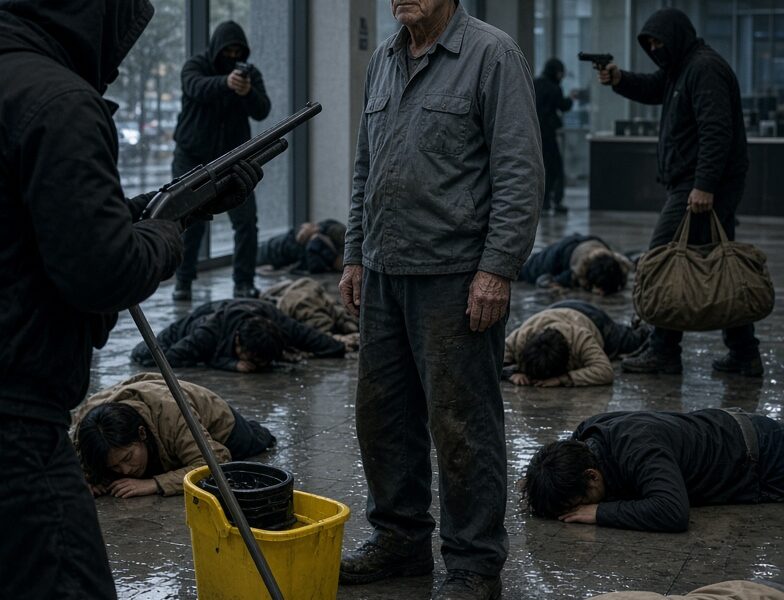
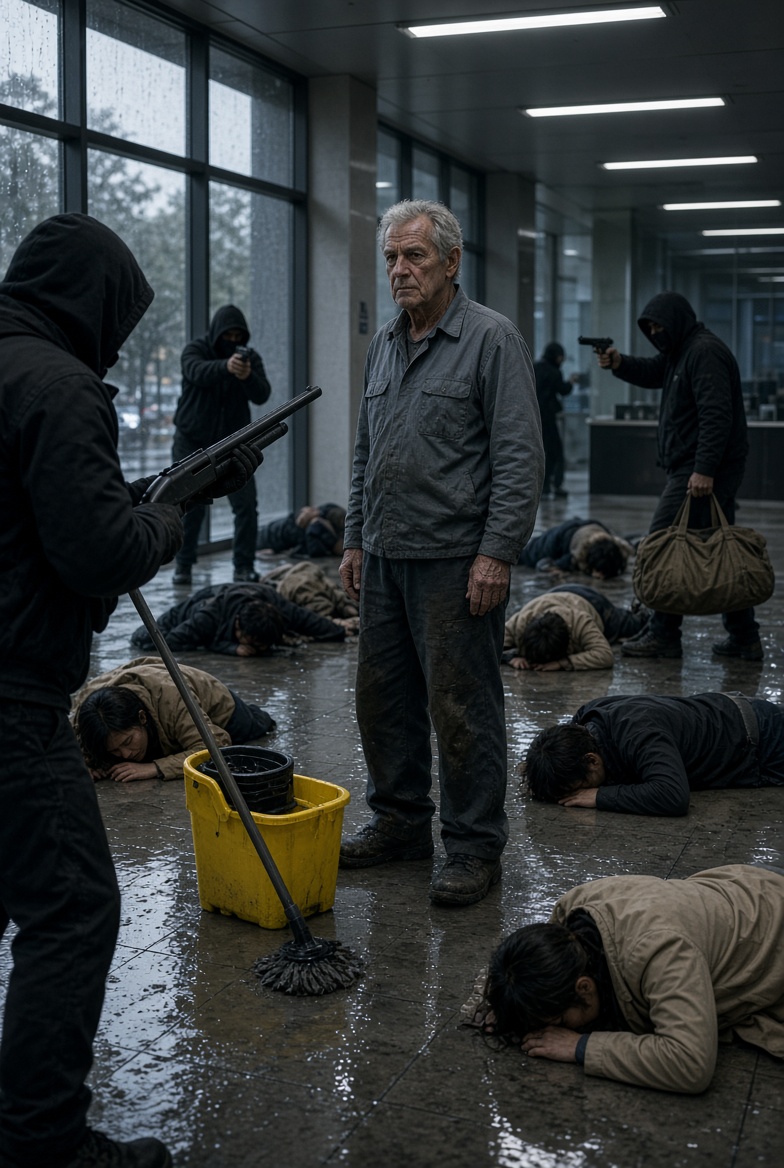
Four armed men pushed through the doors of the Asheford Savings branch at seventeen minutes past nine on a cold Friday in October, and the customers went down on the wet tile.
Every employee froze.
Only the janitor stayed standing, a seventy-one-year-old man beside a yellow bucket of dirty water.
“Move, old man,” the leader said.
Walter Keane did not move.
The first man started toward him and stopped short, and the second never got past either.
Within ten minutes, all four had been turned back at that bucket.
But the strangest part was what Walter said when the police finally came inside.
Walter Keane let himself in through the employee entrance at ten minutes past seven, shook the rain off his jacket, and hung it on the third hook from the left the way he had for nineteen years.
The branch was still dark except for the security lights, and in the quiet you could hear the radiators knocking in the walls.
He filled his bucket at the utility sink, added a capful of the lemon cleaner that Vivien insisted on because it smelled expensive, and started at the east corridor the way he always did.
Baseboards on Monday, glass on Wednesday, floors every day because people tracked in half the county.
He emptied the bins in the loan offices, wiped the conference table on the second floor, and set out the chairs in a straight line because Vivien Blackwell counted them.
At twenty to eight, he stopped, as he always did, and took out his father’s pocket watch.
It had stopped running in 1988, and he had never had it fixed.
He liked the weight of it, and the way the brass had gone soft from being carried.
His father had been a machinist on Delaney Street for thirty-one years, and he used to say that a man could tell a lot about a company by looking at the floor nobody important walked on.
Norah Bellamy came in at 8:15 with two coffees and left one on the ledge by the supply closet without saying anything about it, because the one time she had handed it to him directly, Vivien had seen.
“Rain’s supposed to turn over to sleet,” Norah said. “Did you bring a real coat?”
“I brought this one.”
“That’s not a real coat, Walter.”
“It’s been with me longer than the car.”
She laughed and went to open her window.
Walter drank the coffee standing up in the corridor, listening to the building fill.
At twenty past eight, Vivien Blackwell came through the lobby in heels that announced her from the parking garage, stopped in front of the teller line, and pointed at a thin gray streak near the threshold of the main office.
“Walter.” She did not look at him when she said it, she said it toward the room. “Do you see that?”
He saw it.
He had watched a junior loan officer set down a coffee cup too hard on that exact spot ten minutes earlier, and he had been on his way back with the mop when Vivien came in.
“You’re paid to make the floor clean,” she said.
A woman waiting to make a deposit turned her head away, embarrassed on his behalf, which was its own kind of thing to carry.
Walter rung out the mop and went over the streak twice.
He did not say whose coffee it was, because in nineteen years he had learned exactly what it cost to correct Vivien Blackwell in front of customers, and it was more than he had.
At 8:35, a black car pulled into the reserved space under the awning, and Preston Whitmore III came through the lobby without looking at anyone in it.
The chairman of Whitmore Financial Holdings visited the Ashford branch perhaps twice a year, usually for photographs.
He had a lawyer with him today instead, a tall man named Graham Sterling, who carried a briefcase the way other people carry a rifle.
Walter was on his knees at the base of the stairwell working at a scuff when the two of them stopped on the landing above him.
“The examiners will want the originals,” Sterling was saying. “Not a summary. Originals.”
“Then there won’t be originals.”
“Preston, there’s a schedule for destruction. We follow the schedule.”
“The schedule is the problem. If it moves early, it looks like it moved for a reason.”
They turned the corner, and that was all of it.
Walter went back to the scuff, because he had been invisible in that building for a long time and he had stopped minding.
Invisible men hear a great deal.
Ten minutes later, Vivien found him in the file corridor.
“Mr. Whitmore would like you to stay off the management floor today.”
“The carpet’s up there. That’s mine.”
“Then do them Monday.” She looked at him then, properly, and there was something almost like satisfaction in it. “Actually, we should talk about Monday. The contract’s being reviewed. Facilities thinks we’re overpaying for coverage we don’t need.”
“I’ve heard that before.”
“Not from me. You haven’t.”
She walked away.
Walter stood with the mop handle in both hands and let it go through him and pass the way you let a cramp pass.
Then he noticed the box.
It was sitting on a hand truck outside the records room, taped, with the gray archive label Whitmore had used before everything went digital.
The label code began with the letters PL, and the year was 2006.
There was a retention stamp in the corner that put its destruction date fourteen months out.
Boxes did not come out of that room fourteen months early.
In nineteen years, Walter had never seen one do it.
He looked at the transfer log hanging on its clipboard by the door, the way he looked at everything without appearing to.
Someone had signed for the box.
The name in the handwritten column was R. Tilly.
Ray Tilly had retired from the Ashford branch in 2019 and moved to Florida to be near his daughter.
Walter did not say anything about the box.
He finished the corridor, carried the bucket to the utility sink, poured it out, and refilled it with clean water.
At a quarter to nine, he had gone out the back to break down cardboard for the recycling pickup, and the delivery door at the end of the service hallway was propped open with a rubber wedge.
That door was never propped.
It had a magnetic contact and a thirty-second chime, and the chime had been silenced, because when Walter pushed the door to a half inch from closed and let it go, nothing happened at all.
He found Norah between customers.
“The delivery door is wedged,” he said. “And the alarm on it’s been pulled.”
“Maintenance?”
“Nobody scheduled. I’d know. I’d have had to let them in.”
She frowned, and to her credit, she went straight to Vivien’s office.
Walter heard enough of it from the corridor.
“He’s three days from losing the contract,” Vivien said, “and suddenly he’s discovering security problems. Think about that for a second, Norah.”
“He’s not like that.”
“Everyone’s like that.”
Norah came out with her jaw set and gave Walter a small shake of the head that meant she had tried.
He went and pulled the wedge himself, set the door against the frame, and heard the lock bolt seat.
It took eleven seconds.
Through the narrow window beside the door, he could see the parking lot and the street beyond.
And across the street, in the loading zone in front of the shuttered hardware store, a gray box truck was parked with its engine running.
It had been there when he arrived at 7:10.
He remembered because the exhaust had been drifting under the streetlight.
A man sat in the passenger seat, and in the time Walter watched, which was not long, the man looked at his wrist twice.
Walter was not a man who leapt to conclusions.
A truck idles for a hundred reasons.
A door gets wedged by a kid delivering water jugs.
A box gets pulled early because somebody upstairs wants to look thorough for the examiners.
But he had learned something in another life, something he had not used in a long time, which was that fraud does not look like one enormous wrong thing.
It looks like six small things that have no business being in the same week.
At 9:05, he stood in the supply closet and typed a message with his thumbs, slowly, the way he did everything with a phone.
“Caleb. Gray box truck been idling across from the branch since seven. Service door was wedged and the contact alarm’s been disabled. Probably nothing. If a car is free, maybe roll by.”
Caleb Rourke had been the chief in Asheford for six years.
He knew Walter from the Thanksgiving meal at St. Brendan’s, where Walter ran the dish line every year because it was the one place a man could be useful without anyone discussing it.
Caleb did not answer right away.
It was a Friday, and there had been a wreck out on the county road.
At 9:17, the front doors opened.
Walter was ten feet inside the mouth of the records corridor with his bucket beside his left foot, going over a stretch of tile for the second time that morning.
The first man through had a shotgun held down along his leg and a hood pulled over a ball cap.
The second had a pistol and a canvas duffel.
The third put his back against the door frame.
The fourth went straight down the teller line as though he had walked it before.
“Everybody down,” the first one said, and his voice was not a scream.
That was the frightening part.
“Floor. Hands where I can see them. Nobody’s getting shot today unless somebody decides to be a hero, and heroes are a 1970s thing.”
The lobby went down.
A man in a quilted jacket by the brochure rack lowered himself in stages, holding his knee.
A woman with a rolling cart lay down beside it and kept one hand on the handle like it might get away from her.
Walter set the mop against the wall and stayed on his feet.
The leader saw him from thirty feet away and came over.
Up close, he was thirty-eight or forty, thick through the chest, and his eyes moved constantly, checking corners, checking the camera dome, checking the clock above the teller line.
He had done this before, or something close enough to this.
“Look at that,” he said, for the benefit of the room. “Bank can’t afford a guard anymore. Now they’ve got grandpa and a mop.”
“There are people lying on a wet floor,” Walter said. “Don’t step on them. They’ll go down hard.”
The man tilted his head, then brought the shotgun up level with Walter’s chest, which was an answer, and not a complicated one.
“On the floor.”
“Tiles are slick right here. If I go down on it, I won’t get back up. And then you’ve got a seventy-one-year-old man on your hands you have to think about. You don’t want to think about me.”
They looked at each other for a second and a half.
Behind the leader, the man with the duffel was unzipping it at the end of the teller counter.
He did not take out a sack for cash.
He took out a sheet of paper, a photograph printed on ordinary office stock, and held it up for Vivien Blackwell to see.
It was a photograph of a gray archive box with a label beginning PL, sitting on a hand truck in a corridor Walter had mopped at eight that morning.
Vivien did not make a sound, but Walter watched the color go out of her face in a way that had nothing to do with the shotgun.
“The storage room behind the teller line,” the leader said. “The one with the separate lock. You’re going to open it.”
“The vault is through there,” Vivien said, and her voice had gone high and careful. “The cash is in the vault. I can open the vault.”
“Did I ask about cash?”
That was the moment the morning turned for Walter Keane.
Up until then, he had been doing arithmetic the way anybody does, trying to work out how long four armed men stay in a bank and what the odds are that everyone gets to go home.
But four men do not come through the front door in daylight in a town with a four-minute police response for a box of paper.
Not unless the paper is worth more than the money.
And they had a photograph of it, taken that morning, inside the building.
Vivien’s keys were in the drawer behind the second teller window.
The leader sent the man with the duffel to walk her down.
The route from there to the records room ran straight through the corridor where Walter was standing, four feet wide between the file cabinets and the wall, with his bucket on the floor beside his left foot.
“Hallway’s wet,” Walter said. “Give me two minutes to run the mop over it and it’ll be safe to walk.”
“Nobody cares about the floor.”
“You will when somebody comes through here in a hurry.”
The duffel man came down the corridor anyway.
Norah Bellamy had been pulled out from behind her window and was being moved toward the center of the lobby with the others, and she had the branch keys in her hand because she had grabbed them off the hook without thinking.
And when she saw the man coming at her with a pistol, she dropped them.
The ring hit the tile and skated, and she went after it.
That was instinct, not courage.
A person reaches for the thing they dropped.
Walter moved the bucket.
He did it the way a man does a thing he has done ten thousand times, a short pull on the handle with two fingers, and it slid eighteen inches across the wet tile and stopped in the mouth of the corridor with Norah on the far side of it and the duffel man on the near side.
And now the four-foot corridor had a woman, a bucket, and a mop bracket in it, and the man with the pistol could not get through without going around all three.
“Get back,” he said to Norah.
“She will,” Walter said. “Let her stand up first. If she goes down on this floor, she takes you with her.”
It bought nine seconds.
It was not heroic, and nobody in that lobby would have described it afterward as anything at all.
But nine seconds was long enough for the leader to decide he did not like his man out of sight, and he called him back, and the trip to the records room did not happen on that pass.
Then he came down the corridor himself and put a hand flat on Walter’s chest and walked him backward into a chair by the brochure rack.
“Sit. Stay. That’s the whole job.” He looked down at him. “Who do you think you are?”
“The man who has to clean up after you leave,” Walter said.
The leader laughed once, genuinely, and that was the first mistake he made, because it told Walter that this man still believed he was going to leave.
His name was Derek Voss, though nobody inside the building knew that yet.
He had spent eleven years in contract security, four of them at a cash-handling company, which was how he knew where a branch keeps its secondary lock and why a man goes to the duffel instead of the drawer.
He had been hired through two intermediaries by somebody he had never met, and the terms had been simple enough to make him suspicious if he had let himself be.
Get the box with the label starting PL. Make it look like a robbery. Take whatever cash you can carry for yourself. Payment on delivery.
The part of the briefing he was starting to resent nineteen minutes in was the line about the branch being soft.
No guard. Staff that would hand over anything to avoid trouble. Nobody in the building who would think.
Nobody had mentioned the janitor.
In the second-floor conference room, Preston Whitmore III had listened to the first shout, “Come up the stairwell,” and had done the only intelligent thing available to him, which was to lock the door and sit down.
Graham Sterling stood with his back to the wall beside the window, holding his phone against his thigh, not using it.
“You said quiet,” Preston said. “You said quiet, and after hours.”
“I said it would be handled. There are forty people down there.”
“Sixteen,” Sterling said. “And nobody is supposed to be hurt, and nobody will be, and in an hour you will be on camera saying how grateful you are to law enforcement.” He finally looked at Preston. “Sit down and be a victim. You’re good at the first part.”
It took Derek eleven minutes to work out that the branch manager could not open the secondary archive lock by herself.
It was a dual-authorization cabinet, bank side and corporate side, a control that existed because the examiners wanted it to and which that morning was the only thing standing between a man with a shotgun and a box.
“Who signs?” he said.
Vivien hesitated for perhaps four seconds, and in those four seconds she made a decision that would end her career.
“The chairman,” she said. “He’s upstairs.”
They brought Preston down at five minutes to ten with his hands behind his head, and he came into that lobby doing something Walter had seen men do in boardrooms, which was to change shape.
By the time he reached the floor, he was pale and breathing hard and asking whether anyone was injured.
Then he saw Walter sitting in the chair by the brochure rack, and he stopped being frightened long enough to be something worse.
“That’s him,” Preston said. “That’s the one. The service door. He has the keys to the back of this building and he’s the only person here who isn’t on the floor. I have been saying for a year that we needed to end that contract.”
The room turned.
Sixteen people on a wet tile floor, and all of them looked at the old man in the gray work shirt, because when a frightened room is offered somebody to blame, it takes the offer every single time.
“He’s right,” Vivien said. “He’s been in and out of that service hallway all morning.”
She knew.
That was the thing Walter would think about later, in the quiet, long after everything else had been sorted out by lawyers.
Not that she said it, but that she knew and said it anyway, because Preston Whitmore had said it first, and she was forty-three years old with a mortgage and a title and no other offers on the table.
Walter did not defend himself.
He had spent nineteen years learning that defending yourself in front of people who have already decided is a way of agreeing to the terms of the argument.
Instead, he said to Derek, in the flat voice of a man asking about the weather, “If they came for cash, how did they get a photograph of a records box that was moved out of storage at eight this morning?”
The lobby did not gasp.
Nobody in a real emergency gasps on cue.
What happened was that Derek Voss turned his head about fifteen degrees toward Preston Whitmore and did not turn it back for a while.
And the man at the front door, the youngest of the four, a thirty-two-year-old named Elliot Crane, stopped watching the parking lot and started watching the room.
“Shut your mouth,” Preston said.
“You’re the one who said I didn’t have anything worth saying,” Walter said. “Pick one.”
Outside, the first cruiser had come up Delaney Street at 9:26 and stopped two blocks short, because Caleb Rourke had read a message about a gray box truck forty minutes earlier and had been halfway to the branch on his own time when the silent alarm came through.
By ten, there were eleven units, a perimeter at both ends of the block, and a command post in the pharmacy parking lot, and nobody had any idea what was happening inside beyond what the exterior camera showed, which was a man’s back against the door frame.
Caleb had the gray truck’s plate run.
It came back to a leasing company in Scranton, and the rental agreement had been paid in cash by a man whose license would turn out three days later not to exist.
“Chief,” one of his sergeants said, “we’ve got a corporate number calling in. Whitmore Financial. They want to know whether their chairman is inside.”
“Who’s asking?”
“Their counsel. Guy named Sterling. He’s calling from a cell phone.”
Caleb looked at the building for a moment.
“He’s calling us from inside the building,” he said. “Why is a lawyer who is in a hostage situation calling to ask whether his boss is in a hostage situation?”
He did not have an answer that morning.
He wrote the question down.
Inside, at twenty past ten, the phone on the manager’s desk rang, and Derek Voss made his first demand, which was a van at the rear of the building and a clear route to the interstate, and his first threat, which was that in thirty minutes he would start putting people out the front door and the condition of the first one would be up to the police.
He did not mean it.
Walter could hear that he did not mean it, but he could also hear the thing underneath it, which was a man who had come to a building for one object, had been inside it for an hour, and was beginning to understand that no exit plan had ever actually been described to him.
That was when Walter stopped waiting.
A man who wants to walk out with a box can be stalled.
A man who has realized he is expendable will do almost anything, and standing in a corridor will not slow him down for ten seconds.
Walter had been in that building long enough to know how it would go.
Derek would get the box, and then somebody would have to answer the question of what to do about sixteen witnesses who had watched four armed men bypass a vault full of money to steal paper.
He needed Derek to ask that question himself, because people do not believe things they are told by janitors.
They believe things they work out alone.
“Your dual authorization’s going to take two signatures,” Walter said. “Hers and his. And the inner door’s been sticking since the water damage in March. There’s a trick to it. You can put your shoulder through it if you want, but you’ll be forty minutes clearing the frame.”
Vivien looked up sharply.
“That’s true,” she said, and then, hearing herself defend him, looked away.
They went down the corridor at twenty-five to eleven, Derek and Vivien with the key ring, Preston with his hands at his sides now, Elliot Crane covering the rear, and Walter Keane with a mop bucket, because he had asked to bring it and no one had thought it was worth arguing about.
Halfway down, Walter said, without turning around, “Can I ask you something?”
“No.”
“Four men, daylight, a county seat with a police station eight blocks away. For a box of paper you could burn in a barrel.” He let it sit. “You should ask whoever hired you why he didn’t just come get it himself. He’s got a key. He signs the authorization. He could have walked it out to his own car on a Tuesday night and nobody would ever have known.”
Derek said nothing.
But Elliot Crane said, behind them, in a voice that was too young for the room, “Yeah. Why didn’t he?”
“Shut up, Elliot.”
“You used my name,” Elliot said, and then stopped, because that was worse than the question.
The records room smelled like dust and toner and old paper, and the gray box was sitting where Walter had seen it at eight that morning on the hand truck, taped.
Vivien turned her key.
Preston entered a six-digit code on the panel without being asked twice.
The inner door did stick, and Walter lifted it half an inch on its hinge with the flat of his hand, and it opened.
Then he looked at the label on the box, and the morning rearranged itself.
PL 2006. Portfolio Loans, 2006.
Four digits after it, a sequence code.
The kind of thing nobody memorizes.
Walter Keane had memorized it in 2007 at a desk in a credit union on Harrow Street, in a chair with a bad caster, over a period of nine weeks.
He had been an internal auditor then, fourteen years at it.
He had found a pool of forty-one commercial loans originated with appraisals dated after the closings, and he had written it up.
His supervisor had asked him to revise the language, and then to soften it, and then simply to sign a version he had not written.
He had refused.
He had been fifty-two years old and had thought that refusing was the end of a bad week.
It had been the end of his career.
Not dramatically.
Nobody fires an auditor for refusing to sign.
They restructure the department.
They give you a title with no reports and no files, and they do not renew, and then you are a fifty-three-year-old man whose last reference will not return calls in an industry where everyone in the state knows everyone.
And you have a wife with a bad hip and eleven years left on a house.
He had taken the janitorial contract at Asheford Savings in 2007 because it had health coverage.
The forty-one loans had been sold.
Walter had watched them go in the trade press the way you watch a car you used to own drive past.
They were bundled, transferred twice, and the servicing rights had landed in 2011 with a holding company that had since been folded into Whitmore Financial Holdings.
He had never gone looking.
He wanted that understood later, and he said it under oath more than once.
He had not taken a mop in order to haunt a building.
He had taken it because it paid eleven dollars an hour and because he had a wife who needed an operation.
And in the nineteen years since, he had cleaned the floors of a company that owned the thing that had cost him everything, and he had not once gone up to the second floor at night and opened a file.
He had only kept his own copies in a plastic tub in a closet in Ardmore, because a man who has been called a liar keeps his notes.
And now here was that sequence code, four feet from his face, on a box that had been pulled fourteen months early and signed out under the name of a man who had moved to Florida.
Walter did not say any of it out loud.
What he did was look up, and Preston Whitmore was already looking at him, and Preston saw it land.
In nineteen years, Preston Whitmore had never once looked at Walter Keane.
He had walked past him in corridors, stepped over his cord, spoken over his head to Vivien about the smell of the cleaner.
If you had put him in a room and offered him money, he could not have described the janitor’s face.
He could see it now.
He could see a man reading a label and understanding it.
“Get the box,” Preston said. “Get the box and let’s be finished.”
Derek put a hand on the hand truck, and Preston moved in close to him, closer than a hostage stands to the man holding a shotgun, and said, low, near his shoulder, “Don’t let the old man talk to the police.”
Derek Voss had heard that sentence before, four days earlier, in a parking lot in Scranton, from a voice on a phone that belonged to the person paying him.
He stood very still with his hand on the hand truck and looked at the man he had been told was a hostage.
“Say that again,” he said.
Preston stepped back and did not say it again.
That was answer enough for everyone in the corridor, including Vivien Blackwell, who put her hand on the file cabinet beside her and left it there.
They came back out into the lobby at six minutes to eleven with the box on the hand truck, and the room had changed while they were gone.
The man in the quilted jacket, whose name was Harold Pike and who had come in to move money into a certificate for his grandson’s tuition, was sitting up against the brochure rack with his shoulders going and a sound coming out of him like a door in a draft.
“That’s asthma,” Walter said. “His inhaler’s in his jacket and he can’t work the cap with his hands like that. Let her help him.”
“Nobody moves.”
“She moves four feet and he doesn’t die in your bank.” Walter said. “You can decide which of those costs you more.”
Derek let Norah go to him.
It took her forty seconds.
Harold Pike got two breaths of albuterol and put his head back against the rack and closed his eyes, and the whole lobby exhaled with him.
And something in the temperature of the room came down a few degrees.
Derek noticed it too, and it did not improve his mood, because a room that is no longer terrified is a room that starts making its own decisions.
“We’re going,” he said. “Van at the back.”
“Thirty minutes was twenty minutes ago,” Elliot Crane said. He had come off the door. He was holding his pistol pointed at the floor, which he had not been doing an hour earlier. “Who’s paying us?”
“You’ll get paid.”
“That’s not what I asked.”
“You’ll get paid when the box is delivered.”
“Delivered to who, man?” Elliot’s voice cracked on it. “You said there’d be a guy. You said quiet building. No guard. People handed over. There’s a hundred cops out front and we’re standing here with a box of paper and a bank president who just told you to kill a janitor.”
“He didn’t say that.”
“He said don’t let him talk.”
Walter did not make a speech.
He had thought about what he would say if the chance came, and he had decided that one question was worth more than ten sentences, because a question makes a man search his own pockets.
“If that box is worth doing this in daylight,” he said, “ask yourselves what it’s worth to the man who’s paying for it. And then ask whether a man who’d pay that much to make paper disappear wants four people walking around who can describe him.”
The fourth man, the one who had been at the end of the teller line all morning and had not spoken once, said, “I’m done.”
He walked toward the front doors, saw what was waiting in the street through the glass, and stopped and stood there with his hands open at his sides like a man who had just remembered an appointment.
The one with the duffel set his pistol on the counter and backed away from it with his palms out.
“Twelve years,” he said to nobody. “I did twelve years. I’m not doing twelve more for a box.”
Elliot Crane went to the manager’s phone, picked it up, and said to whoever was on the other end, “We’re sending out the customers. Nobody’s hurt. Don’t come through the doors.”
He started letting people out in twos, the older ones first, and Harold Pike went out on Norah’s arm into the rain and the noise.
Derek Voss stayed where he was with the shotgun and the hand truck in a lobby that was emptying around him.
And for the first time that morning, he looked like a man standing in a building rather than running one.
Walter walked back to the mouth of the corridor and stood beside his bucket, because that was where he had been all morning and because he was seventy-one and his hip had had enough.
“You can walk past me,” he said. “I can’t stop you. I want to be honest about that. I’m an old man with a mop and you’ve got a shotgun, and if you come through this hall, I’m going to move out of your way.”
Derek did not answer.
“But the man paying you isn’t going to do your time,” Walter said. “He’s standing right there, and he’s already picked which one of us he’s going to blame, and it isn’t going to be him.”
Preston had been quiet for two full minutes.
Now he came forward with his hands up, speaking fast and low, the way he spoke to boards.
“Take it,” he said to Derek. “Take the box, and take me out the back in the van. With me in the vehicle. They won’t fire on a vehicle with me in it. I can make the rest of this go away for you. I have resources you have not begun to consider.”
Elliot Crane looked up from the phone with an expression Walter would remember a long time, the particular expression of a thirty-two-year-old man finding out what he actually is in a transaction.
“He’s not a hostage,” Elliot said. “He’s the client.”
Derek Voss turned toward the hall.
He got hold of Walter’s sleeve and pulled him two steps into the corridor, not roughly, but like a man using the last tool in the bag.
“Where’s the rest of it?”
“The rest of what?”
“You looked at that label like you’d seen it before. If there’s more, you tell me where.”
Walter let himself be held.
He did not pull back, and he did not raise his voice, and he kept his left hand open at his side where everyone could see it.
“That box is one of six,” he said. “There’s a loan file and a servicing history and an appraisal log that doesn’t match the loan file and a transfer record from 2011. This is the one with the appraisals. On its own, it isn’t proof of anything. It’s just paper.”
He let that settle.
“But if you carry it out that door, you’ll be the only man in Pennsylvania standing on a street holding stolen evidence of somebody else’s crime. He gets a press conference. You get the box.”
“You’re lying.”
“I might be. I’ve been wrong before about most things.” Walter looked past him at Preston. “Ask him whether I know what’s in it.”
“Don’t listen to him.” Preston’s voice went up and broke in a way that no one in that company had ever heard. “He’s a janitor. He mops floors. He’s a failure who couldn’t hold a job in a credit union. And he’s been pushing a bucket around my building for nineteen years. Nobody is going to believe one word out of a man like that.”
The lobby was quiet.
Rain on the glass, a radio out in the street, the compressor on the vending machine by the stairs.
“You’re right about one thing, Preston,” Walter said. “Nineteen years, and nobody in this building ever thought I was worth listening to.”
He did not say anything after that.
It would have cheapened it.
What happened next was not dramatic.
Norah Bellamy, standing by the open front door where Elliot had sent her, said clearly, “He told me the service door was wedged. At nine this morning. I reported it to Miss Blackwell, and she told me he was making it up to save his contract.”
And Vivien Blackwell, who had everything to lose and had already lost most of it between the records room and the lobby, said, “That’s correct. He reported it. I dismissed it.”
And Elliot Crane said, “I can give you the number. The guy who called me. I’ve got four calls from him on this phone.”
Derek Voss stood in a corridor with his hand on an old man’s sleeve and did the arithmetic that Walter had been waiting ninety minutes for him to do.
Three of his men had stopped.
The street was full.
The client was in the room, and the only thing he had to show for any of it was a cardboard box that had become, in the last four minutes, the single worst object in the world to be found holding.
He let go of Walter’s sleeve.
He bent down slowly with his eyes on the glass doors and laid the shotgun on the wet tile and pushed it away from himself with two fingers.
The entry team came through sixty seconds later and took all four of them down onto the floor without firing a shot, and took Preston Whitmore III down with them, because at that moment nobody knew who he was and he was the only other man standing.
The bucket was still beside Walter’s left foot.
Someone’s boot caught the rim going by, and water went out across the tile in a thin sheet, and the morning’s work was undone, and Walter Keane stood in the middle of it with his hands on top of his head because an officer had told him to, and waited for somebody to come and ask him what he knew.
It took them four hours to ask.
In the back of a borrowed office at the Asheford police station, with a cup of coffee he did not drink, Walter Keane put three things on the table.
The first was his phone, with a message sent at five minutes past nine that morning to Chief Caleb Rourke about a gray box truck and a service door with its contact alarm disabled.
The second was a page from a yellow legal pad in handwriting that slanted hard to the right, listing the time he had first seen the archive box on the hand truck, the label code on it, the retention date stamped in the corner, and the name signed in the transfer log.
Under it, he had written in parentheses the words Ray retired 2019.
The third was a photocopy of an audit memorandum dated the eleventh of June, 2007, addressed to a loan committee that no longer existed, concerning forty-one commercial loans in a portfolio designated PL.
It was signed by W. Keane, Internal Audit.
Paper-clipped to it was a second version of the same memorandum, with the finding section rewritten, which he had never signed.
“You kept this for nineteen years,” Caleb said.
“I kept it in a tub in a closet with my wife’s tax returns. I wasn’t keeping it for anything. I just couldn’t throw it out.”
Here is what the rest of that day, and the eleven months after it, made clear, and it is not what anyone in the lobby assumed while it was happening.
Walter Keane had never been an undercover anything.
He had not taken a janitorial contract to watch a company.
He had taken it because he was fifty-three years old, radioactive in his own industry, and the position had dental.
For nineteen years, he had wanted nothing more complicated than to be left alone until he could stop working, and he had let a great many things pass in front of him without objection, including small ones he was ashamed of later.
He had been a quiet man, and some of that quiet had been decency, and some of it had been fear, and he never pretended otherwise.
The robbery was not a robbery.
It had been built to look like one, which is a different thing.
Elliot Crane’s phone produced four calls from a prepaid number, and the prepaid number produced a purchase record, and the purchase record and a set of toll transponder readings between Asheford and Philadelphia produced a chain that investigators spent seven months walking backward.
It did not end at Preston Whitmore.
It ended at Graham Sterling, who had used an intermediary, who had used Derek Voss, and who had been standing in a second-floor conference room with a phone in his hand the entire morning.
The purpose was never cash.
The purpose was for a file to vanish inside a federal criminal case, where its disappearance would be somebody else’s fault, eighteen days before an examination that had specifically requested original documentation for the 2006 portfolio.
And the bucket was a bucket.
There was nothing in it.
It was not a trap, a signal, or a weapon.
No one had positioned it.
It held eleven liters of dirty water and a mop that needed replacing, and it sat where it sat because at seventeen minutes past nine on a Friday morning, a man was cleaning a corridor he had cleaned every working day for nineteen years.
What mattered was that he knew the corridor was four feet wide.
He knew which door stuck and why.
He knew the names of sixteen people on the floor, including the one with asthma, because he was the only person in that building who had ever had reason to learn all of them.
He knew that a box had moved fourteen months early and had been signed out by a man in Florida.
And when the moment came to either look away one more time or stand where he was, he did not step aside.
He did not win because he was strong.
He won because he stayed slow when everyone else in the room got fast.
They took Preston Whitmore out through the side entrance at a quarter past four that afternoon, and on the way to the car he stopped in front of Walter in the corridor by the coffee machine with an officer’s hand on his elbow and asked the only question he had left.
“How long have you been planning this?”
“I didn’t plan a robbery,” Walter said. “I just decided that this time I wasn’t going to look away.”
The four men who came through the doors that morning all pleaded.
Derek Voss got eleven years and testified about the parking lot in Scranton.
Elliot Crane got four and was the first to give up the number.
The indictments upstairs took longer, because they always do.
In August of the following year, a federal grand jury returned charges against Graham Sterling and Preston Whitmore III involving wire fraud, falsification of records in a financial institution, and conspiracy to obstruct an examination.
Walter was a witness, not a hero of the case.
The case was built out of transponder data, call records, a transfer log, four boxes that were still in the records room because nobody had been able to carry them out, and the dated handwriting of a man who had been taught in 1994 to write down what he saw on the day he saw it.
Vivien Blackwell was not charged.
She lost her position in November after an internal review found that she had suppressed a reported security breach, failed to escalate an irregular records transfer, and approved the early release of a retention-stamped box on a verbal instruction.
She sent Walter a letter the following spring.
He answered it.
He never told anyone what either of them said.
At the hearing, Whitmore’s attorney spent most of a morning on what Walter Keane was.
A custodian, a contractor, not an employee, a man terminated from the financial sector nineteen years earlier who had kept documents he had no authority to keep, who had a personal grievance, who mopped floors for a living.
Walter answered every question in the same unhurried voice he used to tell people the tile was wet.
He read his own dates aloud.
He matched them to the bank’s log.
He explained in about nine minutes how an appraisal can be dated after a closing and what it means when it is, and the courtroom that had been half asleep at ten was entirely awake at eleven.
Afterward, a journalist caught him on the steps and asked whether it was satisfying now to watch the people who had looked down on him stand in a courtroom.
“I don’t need anybody to get down on their knees to me,” Walter said. “I’d just like them to stop deciding which people are allowed to stand up straight.”
Norah Bellamy was the first one on her feet in the gallery.
It was not an ovation.
It was one woman standing up, and then a few more, and Walter was already looking for his coat.
The branch reopened under new management in the spring.
Walter was offered a position as a part-time consultant on records control and internal procedure, and he took it two days a week, because his hip did not want five.
He did not become wealthy.
He was not given the bank.
Nobody handed him back the nineteen years or the career or the eleven months his wife had spent waiting on a hip replacement while he worked nights to keep the coverage.
She had died in 2021, and no verdict was going to change the arithmetic of any of that.
He simply got to do work that matched what he knew, and to stop absorbing insults in order to keep a paycheck.
And at seventy-one, that was not a small thing.
On his last shift in the gray work shirt, he cleaned the records corridor one more time, corner to corner, because it had been left badly by whoever had been covering the hours.
Norah found him coiling the cord.
“You should keep the bucket,” she said. “Seriously. Put it on a shelf somewhere.”
Walter looked at it.
Yellow, scuffed white along one side, the handle mended once with wire.
“No,” he said. “Leave it for the next one. They’ll need it.”
He set the mop upright in the corner of the utility room the way his father had taught him to leave a tool, took his pocket watch out, and turned it over in his hand once.
Then he walked out through the lobby and into the parking lot in the rain.
Do not measure a person by the uniform they wear, the work they do, or the number at the bottom of their account.
Some people are quiet because they have nothing to say, and some are quiet because they learned long ago that the truth costs something and they are still deciding whether they can afford it.
Walter Keane spent nineteen years deciding.
When the morning came, he paid.
The bucket was the thing, and the thing was the bucket, and the bucket was eleven liters of dirty water that held a corridor four feet wide and a man who had decided, once, not to look away.
The bucket was the thing.
The bucket is always the thing.









