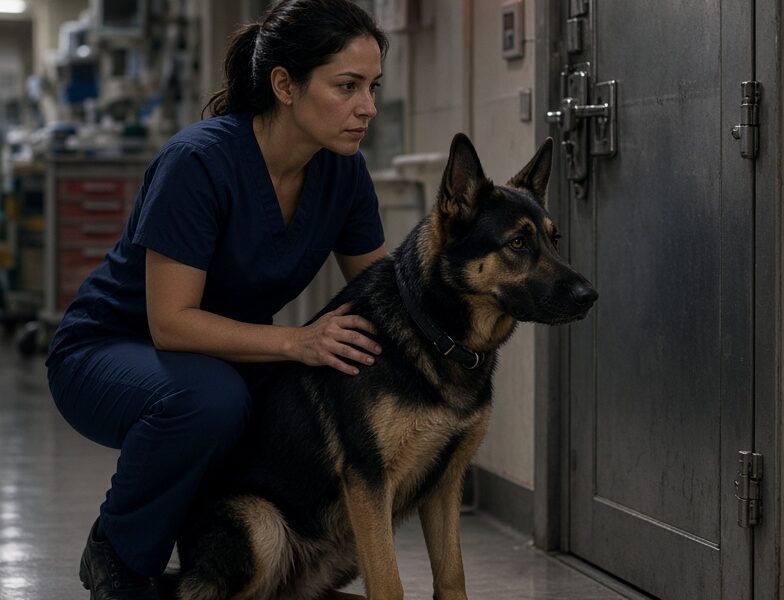
They Told Her to Ignore the Dog… Until a Faint Knock Came From Behind the Sealed Door
Tessa closed her eyes briefly.
During her Navy service, she had helped train medical support personnel to recognize emergency signals used when radio communication failed.
One of the simplest was a repeated pattern of knocks—a way to establish that someone was alive behind a wall or obstruction.
The pattern itself was not unique to the military, but combined with Atlas’s trained search behavior, the unanswered maintenance checks, and the sealed wing, it was enough to justify immediate action.
“There’s someone inside,” she said.
The security supervisor reached for his radio. “Facilities, we need an immediate check of the old diagnostic wing. Possible trapped person.”
Dr. Vay stepped toward the door. “Wait. We don’t know whether the structure is safe.”
“Then nobody enters until the safety team assesses it,” Tessa replied.
The physician stared at her. “You seem remarkably certain about all this.”
“I’m certain we need to take the possibility seriously.”
The hospital safety officer arrived with two facilities technicians.
They checked the corridor, reviewed the available maintenance information, and confirmed that the old wing’s ventilation status was uncertain.
Nobody would enter until the immediate hazards had been assessed.
Atlas continued to pull toward the darkness.
His handler held him close, speaking softly. “Show me, boy. Where?”
The dog took two steps toward the opening, stopped, and looked back.
Then he moved left toward a second door, partly hidden behind a stack of maintenance panels.
Tessa followed his gaze. “What’s behind that door?”
The maintenance worker checked the building plan on his tablet. “An old imaging preparation room. It connects to the equipment passage.”
“Is there another exit?”
“There’s a service door at the far end, but it was supposed to be secured during repairs.”
Tessa looked toward the safety officer. “Can we check that route from outside?”
The officer nodded and dispatched a technician to inspect the external access point.
Dr. Vay folded his arms. “This is becoming a major disruption over a dog barking at a wall.”
Dunn’s face tightened. “Sir, Atlas is trained to search for people. He has located missing personnel during exercises. He isn’t just barking at a wall.”
“And you are certain he’s right?”
“No, sir. I’m certain we should find out.”
That answer silenced the argument.
A few minutes later, the technician returned.
“The external service door is closed. But the electronic access log shows an entry at 7:56 this morning.”
The maintenance worker checked his records. “Nobody was scheduled to enter after yesterday’s inspection.”
“Who used the access card?” the security supervisor asked.
The technician read the name. “Jonas Pell. Electrical contractor.”
The maintenance worker shook his head. “Jonas was supposed to finish his work yesterday. He didn’t tell me he was coming back.”
Dunn looked at the door. “Could he be inside?”
“Possibly,” the worker answered.
Tessa felt her pulse quicken. “What time did the hospital last confirm that he was safe?”
Nobody had an answer.
The safety officer requested Jonas’s contact information and asked security to call him.
His phone went directly to voicemail.
The officer then coordinated with the facilities team to establish a safe approach through the service passage while they worked.
Tessa noticed Atlas had moved away from the first door.
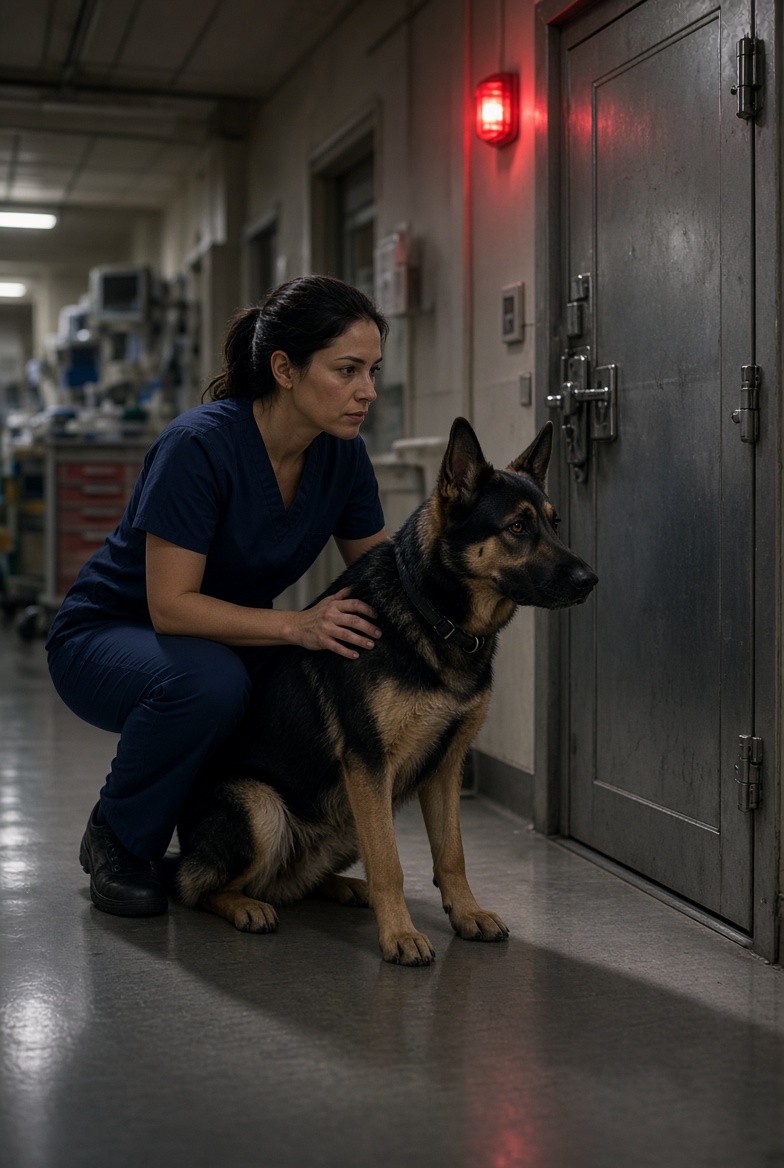
He stood near the second entrance, nose raised toward a narrow gap between the door and its frame.
He barked once.
Then he sat.
Dunn stared. “That’s his location indication.”
“What does that mean?” the security supervisor asked.
“He’s telling me the search has led him to a particular point. I can’t tell you exactly what he’s detected, but he’s showing a consistent response.”
Tessa crouched a few feet away. “Atlas, is someone there?”
The dog looked at her, then turned back toward the door.
From behind it came a faint scrape.
Something moved across the floor.
Tessa felt the room shrink around her.
“Jonas?” she called. “My name is Tessa. We’re here to help. Can you hear me?”
There was a long silence.
Then a weak voice answered.
“Help.”
The word was barely audible.
The security supervisor immediately radioed the emergency response team.
“Confirmed person inside. Possible injured contractor. We need medical support at the old diagnostic wing.”
Dr. Vay’s expression changed.
He no longer looked irritated.
He looked alarmed.
The safety officer instructed everyone to remain outside the affected area while the team assessed the safest means of reaching the contractor.
The building plans revealed a second access route that bypassed the damaged section.
But the passage was narrow and partly obstructed.
Tessa studied the diagram. “That route leads behind the preparation room, doesn’t it?”
“Yes,” the facilities technician answered.
“Could someone reach him from there without crossing the damaged electrical area?”
“We need to verify that first.”
“Please do.”
The safety team checked the alternate passage and found it suitable for a controlled rescue approach.
Medical personnel waited at the safe entrance with equipment ready.
Tessa was told to remain outside until the area was cleared.
She obeyed.
But she could hear Atlas.
Every time the team paused to assess the route, the dog gave a short bark.
When the rescuers moved closer to the preparation room, he stopped and watched.
It was almost as if he were keeping track of their progress.
Dunn stood beside Tessa. “You’ve worked with search dogs before.”
“Not as a handler.”
“That wasn’t what I asked.”
She gave a tired smile. “I worked with their medical support teams. I learned to pay attention to what the handler was telling me and what the dog was doing.”
“Was that in the Navy?”
“Yes.”
“How long?”
“Seven years.”
Dunn turned toward her. “Seven years and nobody here knows?”
“That’s not why I came to work here.”
He studied her face, then nodded. “I understand.”
Tessa looked toward the closed wing. “Do you?”
He didn’t answer immediately.
Then he said, “My first partner taught me that the hardest part of working with a dog isn’t training him to recognize a problem. It’s convincing people to take his warning seriously when they don’t understand it.”
Tessa looked at Atlas. “That sounds familiar.”
The rescue team reached the preparation room through the alternate passage.
They found Jonas Pell lying on the floor beside an overturned tool case.
He was conscious but confused, with a head injury and signs of possible exposure to an unsafe atmosphere.
The responders assessed him before moving him along the cleared route.
A medical team took over as soon as he reached the safe corridor.
Tessa joined the receiving team and helped with the initial assessment.
Jonas could barely keep his eyes open.
“How long were you in there?” she asked.
“I don’t know. What happened?”
He swallowed.
“I went back to check the control panel. The lights went out. The door wouldn’t open.”
“Did you fall?”
“I—I think so.”
The medical team continued evaluating him while another responder checked the room’s environmental conditions.
Jonas was transferred to the emergency department.
Atlas finally stopped barking.
He sat beside Dunn, breathing heavily, his gaze fixed on the passage through which the contractor had been carried.
Tessa crouched and looked at him. “Good work, Atlas.”
The dog leaned forward and briefly touched his nose to her hand.
Dunn smiled. “That’s the first time he’s done that with someone he met today.”
Tessa rose. “Maybe he’s just glad someone listened.”
For a few minutes, the hospital seemed to exhale.
The contractor had been found.
The immediate rescue was complete.
The safety team had secured the affected wing, and staff were beginning to return to their duties.
Dr. Vay approached Tessa near the nurses’ station.
“You were right about someone being inside.”
Tessa looked at him. “Atlas was right.”
The physician hesitated. “Yes. He was.”
It was not quite an apology, but it was the first time he had openly acknowledged that her concerns had been justified.
Then a respiratory therapist hurried out of the treatment area.
“Dr. Vay, we need you in bay four. Something’s wrong with a patient.”
The physician immediately turned away.
Tessa followed the therapist.
Inside bay four, a retired naval engineer named Arthur Bell was struggling to breathe.
He had arrived earlier that morning with dizziness and nausea—symptoms that had initially appeared consistent with dehydration.
Now his condition was worsening.
The attending nurse adjusted his oxygen while the respiratory therapist reviewed his observations.
“His saturation is dropping,” she said.
Dr. Vay examined the monitor. “Increase the oxygen and get the physician covering critical care.”
Tessa stood near the doorway watching.
Arthur’s symptoms had begun before Jonas was found.
The contractor had been trapped in the sealed wing for an unknown period.
The building’s ventilation system had not passed its final inspection, and Tessa remembered the faint, stale smell near the service door.
“Doctor,” she said, “has anyone reviewed Arthur’s possible environmental exposure?”
“We’re treating his immediate symptoms.”
“I understand, but he reported dizziness before he arrived. The old wing has a ventilation fault, and we still don’t know whether the affected system connects to any occupied areas.”
Dr. Vay looked at the respiratory therapist. “Call the safety officer. Have the affected ventilation routes reviewed against this bay.”
The therapist left immediately.
A few minutes later, the safety officer returned with an update.
The old diagnostic wing had been isolated, but the review of the building’s ventilation records had uncovered a discrepancy.
A temporary bypass installed during the repairs had not been documented correctly.
The team had not yet established whether it explained Arthur’s condition, but the finding required an urgent assessment of connected spaces.
The hospital began precautionary checks and moved patients from the potentially affected section while specialists evaluated the system.
Arthur was transferred to a safer treatment area where his medical team continued investigating the cause of his symptoms.
Tessa watched as the bed passed through the doors.
Then she heard a sound behind her.
Atlas was barking again.
He had been resting with Dunn near the staff entrance, but he had suddenly risen and pulled toward the emergency department.
Three sharp barks.
A pause.
Three more.
Dunn stared at him. “No. Not again.”
Atlas looked toward the treatment area, then turned toward the service corridor.
Tessa felt a cold weight settle in her chest.
The first rescue had uncovered a serious problem.
But the dog’s renewed alert suggested that they might not have found the whole danger.
And this time, the person at risk was already inside the hospital.
Dunn brought Atlas closer to the treatment area, keeping the dog away from the patients and medical equipment.
But Atlas would not settle.
He moved toward the entrance, looked at Tessa, and returned to his handler.
Then he repeated the movement.
Tessa recognized the behavior immediately.
It was the same sequence she had seen near the sealed wing.
Alert.
Return to the handler.
Look back toward the location.
Only now, the dog was not directing them toward the old diagnostic rooms.
He was looking toward the hospital’s lower service corridor.
“Petty Officer, I think he wants us to check something else.”
Dunn frowned. “The search area has already been cleared.”
“Then let’s establish why he’s repeating the alert.”
The safety officer had already restricted access to the affected wing.
Tessa asked whether the team had checked the adjacent staff room and the small equipment passage connected to the ventilation system.
The officer reviewed the inspection notes.
“The passage was checked from the entrance. The staff room wasn’t occupied at the time.”
“Was it physically inspected?”
He paused. “I’ll confirm.”
That pause was enough.
The officer contacted the facilities team and asked them to verify the inspection.
A technician returned several minutes later with an update.
A portable environmental monitor had been found inside the staff room, but its recorded readings had not been downloaded.
The team had no evidence that anyone remained in danger there, but the room needed to be checked before the area could be declared safe.
Tessa watched Atlas.
The dog was still alert, but he had stopped barking.
Dunn crouched beside him. “Is that what you’re telling us, boy?”
Atlas looked toward the corridor.
Tessa felt a strange mixture of relief and unease.
The dog could not explain what he had detected, and she would not pretend otherwise.
But his behavior had repeatedly drawn attention to places that had not been adequately checked.
The safety team conducted the additional inspection using the appropriate equipment and precautions.
No second casualty was found.
Instead, the investigation confirmed that the temporary ventilation arrangement required further isolation and testing before the affected section could reopen.
The portable monitor also contained readings that helped specialists reconstruct the timing of the system’s failure.
It was a crucial piece of evidence.
The team now had a clearer picture of how the problem had developed, although the full technical investigation would take longer.
When the safety officer returned, he addressed Tessa directly.
“Thank you for insisting that we complete the inspection. We had closed the initial search, but we hadn’t finished verifying the connected spaces.”
Tessa nodded. “Thank you for checking.”
Across the department, Arthur Bell’s condition had begun to stabilize.
His physicians continued investigating the cause of his symptoms, and no one was prepared to make a definitive diagnosis until the clinical and environmental findings could be reviewed together.
Jonas Pell was also receiving treatment.
The hospital’s immediate crisis was under control, but its investigation was only beginning.
For the first time that day, Atlas settled beside Dunn.
The handler looked exhausted.
“You know,” he said, “I was ready to believe he was having the worst training day of his life.”
Tessa smiled faintly. “Sometimes the problem isn’t the warning. It’s our assumption that we already know what it means.”
Dunn studied her. “You sound like someone who learned that the hard way.”
Tessa looked toward the window. “I did.”
He waited, but she didn’t continue.
She had spent years keeping that part of her life separate from the person she had become at Bellhaven.
Before she became Nurse Rowan, she had been Petty Officer Tessa Rowan—a Navy corpsman assigned to a medical support unit that frequently worked alongside search and rescue personnel.
Her job had been to assess injuries, stabilize patients, and help get them to definitive medical care.
She had learned to work under pressure.
But she had also learned something more difficult.
An emergency rarely announced itself in a way that made immediate sense.
Sometimes the first indication was a detail that didn’t belong.
A patient whose breathing changed before the monitor registered a problem.
A responder who repeatedly looked toward an apparently empty room.
A working dog that refused to leave a doorway.
Years earlier, during a search operation following a structural collapse, Tessa had worked with a trained dog named Bracken.
Bracken had located a missing maintenance worker beneath a partially collapsed section of a temporary facility.
The dog had returned to the same location repeatedly, despite being redirected by personnel who believed the area had already been cleared.
Tessa had watched the handler recognize the dog’s behavior and request another search.
The worker had been found alive.
That experience had stayed with her because it had taught her how easily an incomplete assessment could become a dangerous assumption.
But Bracken was not the reason she had left the Navy.
The real reason was a medical evacuation several months later.
During that operation, Tessa had been part of a team treating multiple injured personnel.
The environment was chaotic.
Communications were unreliable, and every decision had to be made with incomplete information.
She had done everything she could for the people entrusted to her care.
One of them had not survived.
For a long time afterward, Tessa replayed the operation in her mind, examining every decision and every moment when she might have acted differently.
She knew, intellectually, that she had not controlled every circumstance.
Emotionally, it took much longer to accept.
Eventually, she completed her transition into civilian nursing.
She wanted to care for people without carrying the constant expectation that every shift would become a crisis.
She never stopped caring.
She simply stopped talking about the past.
At Bellhaven, she had hoped her work would speak for itself.
Instead, she had become the quiet nurse whose observations were easy to overlook—until Atlas arrived.
Later that afternoon, Dr. Vay asked Tessa to meet him in his office.
She entered expecting another discussion about procedures.
Instead, she found the hospital’s nursing director seated beside him.
Dr. Vay stood.
“Nurse Rowan, I owe you an apology.”
Tessa remained silent.
“I dismissed your concerns this morning because I assumed you were overstepping your role. I should have assessed the information before making that judgment. Thank you.”
“Doctor, I also reviewed several of your previous safety reports. Some should have received more attention than they did.”
Tessa folded her hands. “I wasn’t trying to challenge anyone. I wanted the concerns checked.”
“I understand that now.”
The nursing director opened a folder.
“We’re reviewing the reporting process and the maintenance handover. This isn’t about rewarding one person for noticing a problem. It’s about making sure the system doesn’t depend on someone having to argue repeatedly before a concern is investigated.”
For Tessa, that was more meaningful than praise.
She had never needed everyone to admire her background.
She had needed people to take patient safety seriously.
“That would be a good change,” she said.
Dr. Vay nodded.
Then he asked, “Why didn’t you tell us about your Navy experience?”
Tessa considered her answer.
“Because I wanted to be judged on the work I did here, not on a uniform I used to wear.”
The nursing director closed the folder. “That’s fair.”
When Tessa returned to the department, she learned that Arthur Bell had been moved to a monitored bed.
Jonas Pell was awake and able to speak with his family.
Neither man was out of danger simply because the immediate crisis had passed, but both were receiving appropriate care.
Dunn was preparing to leave with Atlas after the safety team completed its checks.
Before they departed, he approached Tessa at the nurse’s station.
“Can I ask you something?”
“Of course.”
“When Atlas first started barking, what made you take him seriously when everyone else wanted him removed?”
Tessa looked down at the dog.
Atlas stood quietly beside Dunn, his ears relaxed and his gaze moving between them.
“I didn’t know exactly what he was telling us,” she said. “I recognized that he was repeating a trained search behavior. He was asking us to follow him and investigate a location. That was enough to justify checking.”
Dunn nodded. “And the knocking?”
“I recognized a familiar emergency signal. It wasn’t proof by itself, but it gave us another reason to investigate.”
“So you weren’t certain?”
“No. I was willing to be wrong after we checked. I wasn’t willing to assume nobody was there without checking.”
Dunn considered that.
Then he extended his hand.
“That’s a lesson worth remembering.”
Tessa shook it.
Atlas stepped forward and gently pressed his nose against her palm.
She crouched to stroke his head. “Good work, Atlas.”
The dog leaned against her for a moment, then returned to Dunn’s side.
As they walked toward the exit, he looked back once.
Tessa raised her hand.
She did not imagine that Atlas understood her past or knew anything about the years she had spent trying to put it behind her.
He didn’t need to.
He had given an unmistakable warning through the behavior he had been trained to use.
She had recognized it because of what she had learned long before she came to Bellhaven.
And that had been enough to help the right people find someone who needed them.
In the weeks that followed, the hospital completed additional inspections and revised its procedures for documenting maintenance work, verifying closed areas, and escalating unresolved safety concerns.
Tessa continued working her usual shifts.
She still arrived early.
She still checked her charts carefully.
She still spoke quietly.
But now, when she raised a concern, her colleagues asked questions before dismissing it.
The change wasn’t dramatic.
It was practical.
And it mattered.
One evening, a newly hired nurse approached Tessa after a difficult shift.
“I heard what happened with the military dog,” she said. “Is it true you used to work with Navy search teams?”
Tessa smiled. “Sometimes.”
“How did you stay calm when everyone else was arguing?”
Tessa thought about Atlas, the sealed door, and the three knocks that had changed the entire morning.
“I didn’t try to solve everything at once,” she replied. “I looked at what was actually happening. Listened to the people who had relevant information and made sure we didn’t dismiss something important just because we didn’t understand it yet.”
The younger nurse nodded thoughtfully.
Tessa returned to her work.
She had once believed that moving forward meant leaving her old experiences behind.
Now she understood that some lessons were worth carrying, even when the memories attached to them remained painful.
She did not need to become the loudest person in the room.
She did not need to tell everyone about her service.
And she did not need a crisis to prove that her experience mattered.
She only needed to keep doing the work.
Because the most important lesson Atlas had brought to Bellhaven wasn’t that a dog could recognize a danger before a human did.
It was that an alert deserved to be investigated, even when its meaning wasn’t immediately clear.
Sometimes the person who noticed the first clue was overlooked.
Sometimes the warning came from an animal that could not explain itself in words.
And sometimes saving a life began with a simple decision to stop, pay attention, and refuse to assume that silence meant everything was safe.
The door had started as a sealed barrier that everyone assumed was empty.
It had become a question, a warning, and a rescue.
And now it stood open, a reminder that the quietest person in the room sometimes recognizes the most important warning.
The end.
If this story touched your heart, subscribe for more stories about courage, loyalty, and the extraordinary bond between people and the animals who stand beside them.
Because Atlas never needed to speak a human language.
He only needed one person to understand that he was trying to lead them somewhere.
And when Nurse Tessa Rowan finally listened, an entire hospital learned the value of hearing what others had overlooked.
See you in the next one.









