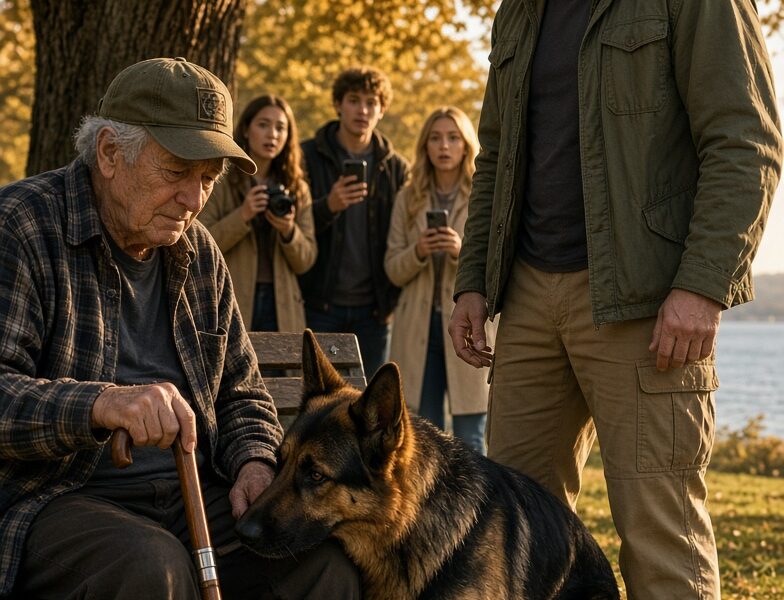
They Targeted a Quiet Vietnam Veteran for a Viral Prank… Until a Retired Marine and His German Shepherd Exposed the Truth They Never Expected
They thought an old Vietnam veteran would be the perfect target for another viral prank. Three wealthy young influencers surrounded him in a lakeside park, mocked his military service, and humiliated him in front of rolling cameras, certain that money, connections, and millions of online followers would protect them from consequences.
They never noticed the U.S. Marine watching from across the walking path, or the German Shepherd at his side that recognized the veteran’s distress before anyone else did. Within minutes, a cruel stunt became something none of the young men could control.
Within days, the video would expose a network of deception reaching into Havenport’s wealthiest families, a series of suspicious property sales, and a town that had learned to remain silent whenever powerful people demanded obedience. But the most important evidence would not come from a courtroom or a billionaire’s office. It would begin with a missing walnut cane, an old leather notebook, and a question no one in Havenport had dared to ask aloud: What if the people everyone trusted were the ones creating the lies?
A cool breeze rolled across Lake Michigan as afternoon sunlight settled over Havenport, Michigan, a lakeside town where elegant waterfront estates overlooked crystal-blue water and luxury yachts rested in private marinas.
From the outside, Havenport looked like the kind of place where nothing truly terrible could happen.
Its parks were meticulously maintained, its downtown restaurants attracted visitors from neighboring communities, and its streets were lined with historic homes that had been restored to magazine-cover perfection.
Yet beneath that postcard beauty existed another reality.
Real estate corporations financed local development. Wealthy families maintained close relationships with elected officials. Business owners understood which complaints were welcome and which could quietly destroy a career.
Most residents had learned that challenging powerful people rarely ended in their favor.
So they kept their heads down, paid their bills, and convinced themselves that whatever happened behind the gates of the town’s grandest properties was none of their concern.
Master Gunnery Sergeant Daniel Brooks had no intention of becoming part of that world.
At forty-two, Daniel still carried the unmistakable presence of a United States Marine. Standing just over six feet tall, he had broad shoulders, a powerful athletic build, closely cropped dark brown hair, and a neatly trimmed beard touched by the first signs of gray.
His steel-blue eyes remained calm and observant, unconsciously measuring distances, reading body language, and noting the exits whenever he entered an unfamiliar place.
Years of deployments across the Middle East had trained his mind to recognize danger long before most people noticed it.
During his final deployment, an explosion had permanently damaged his left leg, forcing him into retirement after more than two decades of military service.
The injury had ended his career, but it had never weakened the discipline that defined him.
Every morning began before sunrise. Every task was completed with quiet precision. Every promise he made was treated as an obligation, not a suggestion.
When retirement arrived, Daniel politely declined invitations to become a military consultant, motivational speaker, or television guest.
He had spent enough years living in conflict.
What he wanted now was silence.
That desire had brought him to a modest cedar cabin beside the marshland outside Havenport, where the sounds of wind, birds, and gentle water gradually replaced the echoes of helicopters and distant explosions that still visited him in restless dreams.
His closest companion was Shadow, a five-year-old German Shepherd whose striking black-and-amber coat concealed the scars of a life spent protecting others.
A long scar crossed Shadow’s left shoulder beneath his thick fur, a reminder of the explosion that had nearly taken both dog and handler during Daniel’s final mission.
Trained in explosive detection, tracking, and search operations, Shadow had repeatedly saved Marines by locating hidden threats before anyone else could see them.
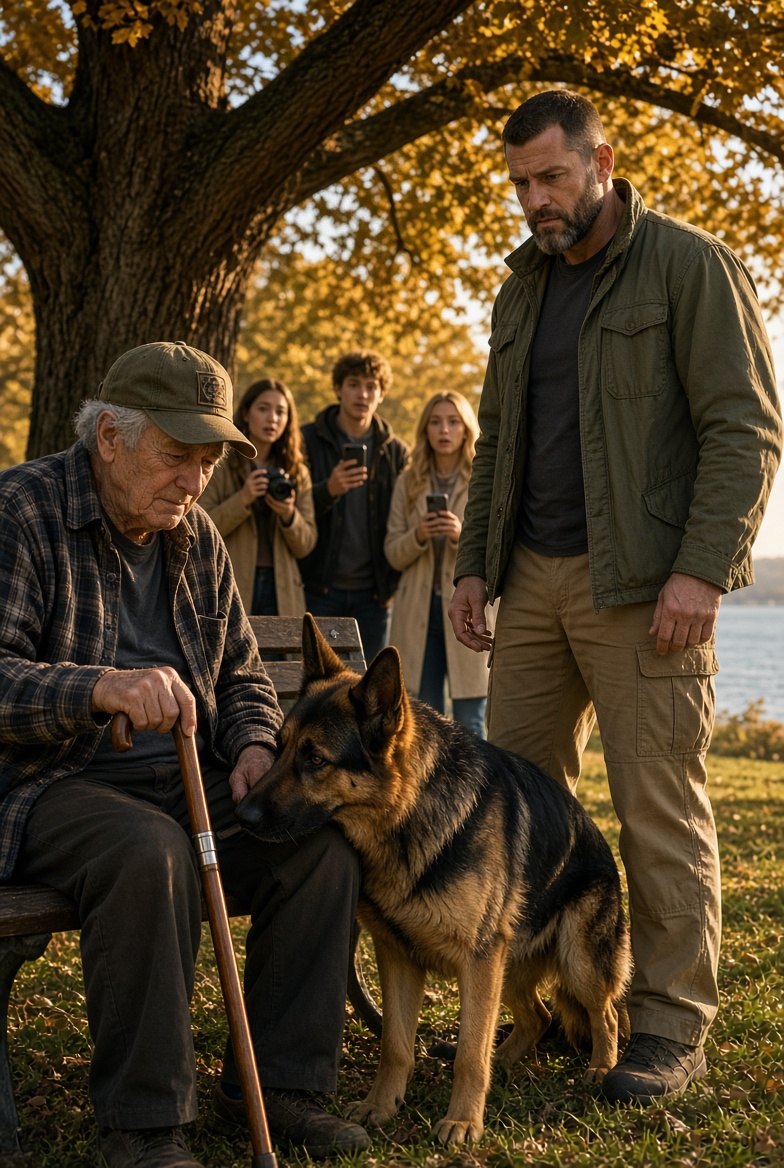
On that final deployment, he had instinctively moved toward Daniel moments before the blast, helping shield his handler from the full force of the explosion.
Since then, the bond between them had grown beyond spoken commands.
A slight movement of Daniel’s hand, a quiet glance, or a subtle change in posture was enough for Shadow to understand what was needed.
Every afternoon, they followed the same peaceful route toward Harbor Pines Park, grateful for the ordinary rhythm of a life neither of them had once believed they would have again.
Daniel had learned that peace was not always a destination.
Sometimes, it was a routine you protected one ordinary day at a time.
And every afternoon, beneath the oldest oak tree in Harbor Pines Park, another veteran was quietly doing the same.
Walter Bennett was seventy-six, with neatly combed silver hair, a weathered face, and the unmistakable bearing of a soldier who had survived more than he cared to discuss.
A gunshot wound suffered during the Vietnam War had permanently weakened his right leg, leaving him dependent on a polished walnut cane that had accompanied him for nearly fifty years.
After losing his wife, Margaret, to illness several years earlier, Walter had chosen to remain in Havenport.
Their modest home stood on a quiet residential street a short walk from the lake. It was not impressive by the standards of the town’s wealthy residents, but every corner carried a memory of the woman who had filled it with warmth.
Walter had no desire to leave.
Instead, he devoted each afternoon to a simple ritual that reminded him life was still worth appreciating.
He carried a small paper bag filled with breadcrumbs for the birds that gathered beneath the old oak tree.
Tucked beside it were two homemade dog biscuits wrapped carefully in a napkin, reserved exclusively for Shadow.
Inside the worn leather notebook resting on his lap were the handwritten names of every soldier from his platoon who had never returned from Vietnam.
Before leaving the park each day, Walter quietly read one page to himself.
He believed a person’s memory only truly disappeared when someone stopped speaking their name.
Shadow noticed Walter before Daniel did.
The German Shepherd’s ears lifted, and he glanced briefly toward his handler.
Receiving the slightest nod, Shadow walked forward with calm discipline and gently accepted one of the biscuits before sitting beside the old veteran.
Walter smiled and scratched behind the dog’s ears.
“There’s my good boy,” he murmured. “I was wondering when you’d show up.”
Daniel watched in silence.
Few people earned Shadow’s complete trust, yet Walter had done so without commands, complicated training, or extravagant rewards.
He had earned it through patience, kindness, and the quiet respect one veteran instinctively offered another.
“You’re spoiling him,” Daniel said as he approached.
Walter chuckled.
“Somebody has to. His handler looks like he hasn’t smiled since the last presidential election.”
Daniel gave a brief, genuine laugh.
“Careful, Walter. That’s almost an insult to a serving Marine.”
“Almost?” Walter raised an eyebrow. “Son, I was insulting officers before you were born.”
For a few precious minutes, the world remained exactly as Daniel wanted it to be.
Then a black luxury SUV rolled into the parking lot.
Three young men climbed out carrying cameras, smartphones, and wireless microphones.
Nineteen-year-old Evan Whitmore led the group with effortless confidence.
Tall, handsome, and dressed in expensive designer clothing, he was the only son of Charles Whitmore, a billionaire real estate developer whose company had transformed large portions of Havenport over the previous decade.
Evan loved attention.
He measured success by online views and believed almost anyone could become entertainment if the camera was pointed in the right direction.
Walking beside him, Mason Cole adjusted a professional camera mounted on a stabilizing rig.
Slim, sharp-eyed, and exceptionally talented at video editing, Mason had built a reputation for turning ordinary footage into sensational stories, often blurring the line between truth and fiction.
A few steps behind them came Tyler Grant, whose thoughtful expression contrasted with his friends’ excitement.
Tyler had begun questioning the increasingly manipulative direction of their social media channel, Truth Exposed, but he lacked the confidence to challenge Evan openly.
He had joined the project because he loved filmmaking.
He had stayed because the money was good, the equipment was expensive, and walking away from people with powerful connections had begun to feel more frightening than admitting something was wrong.
At that moment, Daniel’s phone vibrated inside his jacket.
He glanced at the screen.
Colonel Rebecca Sloan.
His former commanding officer had called twice that week, and he had ignored both attempts.
Daniel stared at the name for several seconds before locking the phone and slipping it back into his pocket.
Across the lawn, Evan lowered his sunglasses, fixed his eyes on Walter, and smiled.
“I think,” he said softly, “we’ve just found our next story.”
He had no idea that the old veteran beneath the oak tree would eventually become the one person whose testimony could help unravel his family’s carefully protected empire.
And he certainly had no idea that the smallest detail in that park would become the first piece of evidence no amount of editing could make disappear.
The following afternoon, Harbor Pines Park appeared no different from any other autumn day.
Children chased pigeons across the walking paths. Elderly couples occupied familiar benches beneath towering oaks, and the waters of Lake Michigan shimmered beneath a cloudless sky.
Nothing in the peaceful scene hinted that someone’s reputation was about to become the target of a carefully planned deception.
Walter Bennett arrived shortly after two o’clock, moving at his usual unhurried pace with his polished walnut cane supporting his weakened right leg.
His faded Army veteran cap rested neatly above his silver hair, and his worn leather notebook remained tucked beneath one arm beside the paper bag of breadcrumbs.
His routine never changed because routine gave him comfort.
Every afternoon, he greeted the same birds, sat beneath the same oak tree, and quietly honored the names of the young soldiers who had never returned from Vietnam.
He believed consistency was another form of loyalty.
Daniel Brooks and Shadow were not far away.
Daniel had stopped near the lake to watch a small sailboat drift across the water while Shadow remained at his left side, scanning the park with the quiet awareness that years of military training had made instinctive.
Although retirement had removed them from the battlefield, Daniel never completely relaxed in crowded places.
Old habits survived because they had once kept people alive.
The black SUV rolled into the parking lot precisely as Evan expected.
He stepped out first, flashing the easy smile that had convinced thousands of followers he genuinely cared about exposing injustice.
Mason followed, checking focus and audio levels.
Tyler climbed out last, carrying spare batteries and quietly observing the families scattered throughout the park.
The uneasy feeling that had followed him since the previous afternoon refused to disappear.
“You ready?” Evan asked.
Mason grinned. “Cameras rolling.”
Tyler looked toward Walter.
“Let’s just keep it respectful.”
Evan laughed without looking back.
“Respect doesn’t get a million views.”
The three young men walked toward the old veteran with practiced confidence.
Evan slowed several feet away before offering a warm smile.
“Mr. Bennett? We’re filming a short feature honoring American veterans. We’d really appreciate hearing about your service, if you don’t mind.”
Walter looked up with mild surprise.
Compliments still embarrassed him after all these years.
He studied the three young men before returning Evan’s smile.
“If it helps people remember the men who didn’t come home,” he replied, “I’d be happy to answer a few questions.”
Several yards away, Daniel noticed the interview beginning.
Nothing seemed immediately alarming.
Shadow, however, kept his eyes fixed on the strangers a little longer than usual.
Walter answered the first questions with the humility that had defined him for decades.
He spoke briefly about Vietnam, never mentioning medals or acts of courage, choosing instead to remember the young men who had never grown old.
“The real heroes,” he said, resting both hands on the top of his cane, “are the ones who never got the chance to grow old.”
Mason kept the camera steady.
Tyler listened with genuine respect, and for a brief moment, he wished the interview would remain exactly as it was.
Evan had no interest in sincerity.
He slowly changed the conversation.
“Do you think veterans deserve more respect than young people today?” he asked.
Walter smiled gently.
“I think everyone deserves respect.”
Evan tilted his head.
“So you believe this generation has become weak?”
“I didn’t say that.”
“But isn’t that what you meant?”
“No.”
Walter’s answer remained calm, but Evan continued pressing, twisting every response into something it had never been.
Tyler shifted uneasily.
“Evan, I think we’ve got enough.”
Evan ignored him.
“So if someone disagreed with you, would you say they don’t appreciate the military?”
Walter sighed.
“Young man, you’re asking questions only to hear the answers you’ve already decided on. That’s not a conversation.”
He reached for his cane and began to leave.
That was the moment Evan had been waiting for.
As Walter slowly stepped away, Evan casually nudged the cane with his foot, then bent down as if adjusting his shoe.
In one smooth movement, he slid the cane beneath a nearby park bench, where it disappeared into the shadows.
Walter took another step before realizing his support was gone.
He stopped, looked around in confusion, and instinctively reached into empty air.
His weakened leg trembled.
For one frightening second, the old veteran struggled to remain upright.
Daniel noticed the movement immediately.
Before he could react, Shadow was already moving.
The German Shepherd trotted toward Walter without barking or showing the slightest sign of aggression.
He gently pressed his shoulder against the old veteran’s leg, giving him enough support to regain his balance.
Then Shadow lowered his head, sniffed beneath the bench, and carefully pushed the hidden cane toward Walter with his nose.
Several people nearby smiled at the remarkable display of intelligence.
A mother pointed the scene out to her young daughter, while an elderly couple exchanged approving glances.
Mason lowered the camera for a brief second.
“What a shot,” he murmured.
Evan’s expression hardened.
“Keep filming.”
Daniel arrived beside Walter and picked up the cane, placing it carefully back into the old veteran’s hand.
“You all right?”
Walter nodded, though his face had lost some of its color.
“I’m fine, thanks to both of you.”
Daniel studied the ground near the bench, then looked at Evan.
He had seen the young man’s foot move.
He had also seen the way Evan’s expression changed when Shadow helped Walter instead of allowing the moment to become the humiliating spectacle he had intended.
Daniel said nothing.
He had spent too many years learning the difference between reacting to an insult and responding to a threat.
Evan stared silently at the scene, already imagining how differently it would appear once Mason finished editing.
“Cut everything before Daniel walked over,” he whispered.
Mason hesitated.
“But the dog helped him.”
“I said cut it.”
Tyler looked from Walter to Shadow, then back at Evan.
For the first time since joining Truth Exposed, he felt less like a content creator and more like an accomplice.
Walter carefully settled onto the bench.
“Young man,” he said, looking directly at Evan, “you ought to remember that a person’s age doesn’t make him a suitable target.”
Evan gave him a bright, practiced smile.
“Of course, sir. We were only trying to make a positive video.”
Daniel’s eyes remained on him.
“Then why did you hide his cane?”
The question landed with such quiet precision that Mason’s camera briefly dipped.
Evan blinked.
“I don’t know what you’re talking about.”
“You heard me.”
“Are you accusing me of something?”
“I’m asking you a question.”
Evan straightened, suddenly aware that the retired Marine was considerably larger than he was.
“We’re filming a public-interest piece. You can’t just come over here and intimidate people because you don’t like what we’re doing.”
Daniel glanced at the camera.
“Then leave the footage unedited.”
For the first time, Evan’s smile faltered.
Tyler heard the words and felt something inside him shift.
Leave the footage unedited.
It was such a simple request.
It was also the one thing Evan could never afford to do.
That evening, the edited video appeared online under a bold headline:
RETIRED MILITARY MAN INTIMIDATES TEEN VOLUNTEERS.
The opening showed Evan approaching Walter with a friendly smile.
The next clip showed Daniel standing beside the bench, his broad shoulders filling the frame.
Mason had removed the questions that provoked Walter, the moment Evan hid the cane, and the seconds when Shadow supported the old veteran.
The finished version suggested that Daniel had abruptly confronted a group of young volunteers who were simply trying to honor a veteran.
In another cut, Walter appeared confused and agitated.
A final close-up showed Shadow standing beside Daniel, accompanied by ominous music that made the trained military dog look threatening.
The title promised an outrageous confrontation.
The video delivered one.
Only none of it had happened the way viewers were being told.
Miles away, inside the top-floor office of Whitmore Development, billionaire Charles Whitmore watched the video without changing expression.
His silver-haired attorney stood quietly beside a massive window overlooking Havenport’s marina.
Charles pressed pause.
“Good,” he said.
His attorney glanced at him.
“Do you think it’s necessary to involve the boy’s channel?”
Charles turned away from the screen.
“It’s already involved.”
“I meant the veteran. He may be more difficult to manage than we expected.”
Charles’s expression remained composed.
“He’s seventy-six, lives alone, and spends his afternoons feeding birds. He isn’t the problem.”
“And the Marine?”
For the first time, Charles’s eyes narrowed.
“Find out who he is.”
Across town, Daniel watched the same video on his phone in the silence of his cabin.
He neither argued nor responded online.
He simply locked the screen, glanced at Shadow lying beside the fireplace, and wondered who truly stood to benefit from turning a peaceful afternoon into a lie.
Shadow lifted his head.
Daniel reached down and rubbed the dog’s neck.
“We’re not going to chase every fool with a camera, are we?”
The German Shepherd’s tail moved once against the floor.
“No,” Daniel answered for him. “Didn’t think so.”
But when Daniel opened his jacket to put away his phone, he saw the missed call notification from Colonel Rebecca Sloan.
This time, he did not dismiss it.
He set the phone on the table and stared at the name.
Somewhere beyond the marsh, Havenport’s carefully maintained silence was beginning to crack.
And Daniel was about to discover that the video was not the beginning of the trouble.
It was the distraction someone had been waiting to create.
By breakfast the next morning, the edited video had spread far beyond the audience of Truth Exposed.
Local community pages reposted it with dramatic captions. Neighborhood forums argued over what had happened at Harbor Pines Park, and strangers confidently judged people they had never met.
Some claimed Daniel Brooks was an unstable retired Marine who had frightened innocent teenagers.
Others insisted Walter had exaggerated the incident to gain sympathy.
The harshest accusations were directed at Shadow.
Dozens of comments demanded restrictions on military working dogs in public parks, despite the absence of any evidence that the German Shepherd had threatened anyone.
The truth had become almost impossible to recognize beneath thousands of emotional opinions.
Daniel read only a handful of comments before locking his phone.
Twenty-two years in the Marine Corps had taught him that panic rarely solved problems and that reacting too quickly often helped the person creating the chaos.
He had survived ambushes, roadside bombs, and long nights waiting for intelligence that never arrived.
Compared with those memories, anonymous voices on the internet seemed insignificant.
Even so, watching Shadow become the target of fear quietly unsettled him.
The dog had spent years detecting explosives and protecting Marines who would never know how close they had come to disaster.
Seeing people describe him as dangerous because of a dishonest video felt deeply unfair.
Shadow sensed the change without understanding the words.
As he walked beside Daniel through downtown Havenport, maintaining perfect heel as always, people who normally greeted him with smiles now stepped aside.
A father gently pulled his young daughter behind him.
Two joggers crossed to the opposite sidewalk.
Shadow briefly looked toward Daniel, searching for guidance, but continued forward after receiving the familiar, reassuring nod that meant everything was under control.
“You’re still the same dog,” Daniel murmured. “Don’t let strangers tell you otherwise.”
Across town, Walter Bennett experienced the consequences differently.
He slowly made his way toward Harbor Pines Park, his walnut cane tapping steadily against the sidewalk.
Along the route, he noticed professionally printed signs fastened to telephone poles and community bulletin boards.
SELL NOW. PREMIUM OFFERS AVAILABLE. WHITMORE DEVELOPMENT.
Walter paused.
He had seen one of those notices the previous afternoon.
Today, there were dozens.
He continued walking until he reached the modest home of Frank Holloway, an eighty-two-year-old Korean War veteran and retired carpenter whose weathered hands still carried the strength earned through decades of honest labor.
Frank usually greeted visitors with an easy laugh.
That morning, his broad shoulders seemed unusually heavy, and the smile never reached his tired blue eyes.
“They came again,” Frank admitted after inviting Walter onto the porch.
Walter lowered himself carefully into a chair.
“Who did?”
“Whitmore’s people. Different suits, same offer.”
“You told them no?”
“I did.”
Frank looked toward Harbor Pines Park.
“They smiled, Walter. They thanked me for my time. Then they reminded me that neighborhoods change when the right people decide they should.”
Walter’s fingers tightened around the handle of his cane.
“Did they threaten you?”
“Not in words you’d take to the police. They mentioned my roof. My property taxes. The cost of keeping up an old house. They said I could take a generous offer now, or wait until the neighborhood became less desirable.”
Frank gave a humorless laugh.
“Funny thing is, the neighborhood hasn’t become less desirable. They’ve just started telling everyone it has.”
Walter thought about the video.
“Did they say anything about what happened at the park?”
Frank looked up sharply.
“That video with the Marine?”
Walter nodded.
“They showed it to me yesterday. Said Havenport was changing, that people like us needed to think about whether we could safely remain here.”
Frank leaned forward.
“Then maybe it isn’t a coincidence.”
Walter looked toward the lake.
He had spent years believing that most people were simply trying to live their lives.
He had never been naïve enough to think everyone was honest, but he had always assumed that cruelty usually came from small minds and selfish motives.
Now he began to wonder whether the campaign against Daniel and Shadow had never been the true objective.
Perhaps it was only the distraction someone needed while another plan quietly unfolded in the shadows.
Frank reached for a folder resting on the porch table.
Inside were copies of letters, property assessments, and a printed offer to purchase his home.
The proposed price was $186,000.
Walter stared at the number.
“That’s low.”
“By at least forty thousand,” Frank replied. “A local agent gave me an estimate last spring.”
“Have you spoken to anyone else?”
“Three neighbors. All three got similar offers. Two of them have already signed.”
Walter looked at the papers again.
“What happens if you refuse?”
Frank shrugged, but the movement lacked his usual confidence.
“I suppose they’ll keep making my life difficult until I stop refusing.”
Walter placed the folder carefully on the table.
“Then don’t face it alone.”
Frank studied him.
“You’re seventy-six years old, Walter. You have enough trouble of your own.”
Walter’s eyes settled on the polished walnut cane beside his chair.
“I’ve been told that before.”
He thought of the names in his leather notebook, the young soldiers who had stood beside him when the future was uncertain and the road home seemed impossibly far away.
“Some promises are too important to keep only when they’re convenient.”
Neither man noticed the black sedan parked across the street.
Inside, a woman wearing a business suit watched them through the windshield before lifting her phone.
“He’s talking to Holloway,” she said.
A man’s voice answered through the speaker.
“About the offer?”
“I can’t hear them.”
“Then keep watching.”
The woman glanced toward the old house.
“And the veteran in the video?”
“That situation is being handled.”
She hesitated.
“What if the Marine starts asking questions?”
There was a brief silence.
Then the man replied, “Make sure he finds the wrong answers.”
The call ended.
The sedan remained parked for another three minutes before pulling away.
And inside Frank Holloway’s folder, beneath the property offer and the tax assessment, was a document neither veteran had yet noticed: a list of neighboring parcels marked for acquisition, with Walter Bennett’s address highlighted in yellow.
The campaign was closer to his front door than he imagined.
Meanwhile, Tyler Grant arrived at the Truth Exposed studio later than usual, hoping the extra time would settle the uneasiness that had followed him since the interview.
It did not.
The second-floor workspace overlooked Havenport’s harbor through wide glass windows, but the beautiful view felt strangely distant behind rows of computer monitors, shelves packed with hard drives, professional cameras, microphones, and lighting equipment.
The room had once represented ambition and creativity.
Now, it felt like a factory where reality was reshaped until it became whatever attracted the most attention.
Evan Whitmore was already celebrating.
Leaning comfortably against the editing desk with an expensive coffee in one hand and his phone in the other, he watched the view counter climb higher every few seconds.
“Two million before noon,” Evan announced. “Sponsors love controversy.”
Mason barely looked up from his keyboard.
His fingers moved rapidly across the editing software, selecting clips, adjusting audio, and refining the dramatic pauses that made ordinary encounters appear explosive.
“I told you,” Mason said. “People don’t share facts. They share outrage.”
Tyler forced a smile but said nothing.
He had heard the same explanation dozens of times.
At first, he had believed it was simply how social media worked. Then he had started noticing that the edits always seemed to hurt the same kinds of people: older homeowners, small business owners, local volunteers, and anyone who refused to cooperate with the interests of Havenport’s wealthiest residents.
When Evan left to answer a call from a marketing agency and Mason went downstairs to collect a package, Tyler found himself alone.
His eyes drifted toward the Harbor Pines project still open on one monitor.
Almost without thinking, he clicked into the editing history.
Several hidden sequences appeared.
His pulse quickened.
There was Walter, calmly answering every question with dignity.
There was Evan repeatedly trying to provoke him.
There was Shadow, gently supporting the elderly veteran after the cane disappeared.
There was Daniel arriving only after Walter had begun losing his balance.
Tyler watched the untouched footage twice.
Everything the internet believed had been created inside this room.
He opened another project, then another.
The pattern repeated itself.
Small pauses had been removed.
Reactions had been shifted.
Questions had been reordered.
Moments taken completely out of context had become the emotional climax of stories that had never truly happened.
In one recording, a local restaurant owner patiently explained a misunderstanding with a customer.
The published version made the owner appear openly hostile.
In another, a volunteer refused to abandon flood victims while emergency crews were still working to reach them.
The final upload transformed her decision into an accusation that she had ignored official instructions.
A retired school coach had been recorded asking a group of teenagers to stop damaging the equipment at a community center.
The finished video made it appear that he had insulted the entire group.
Tyler sat motionless.
Truth Exposed had not gradually lost its integrity.
It had been built on carefully manufactured narratives from the very beginning.
A floorboard creaked outside.
Tyler minimized the folders just as Mason returned carrying a cardboard shipping box.
“You still checking yesterday’s project?” Mason asked casually.
“Just organizing backups,” Tyler replied.
Mason shrugged.
“Don’t waste time keeping raw files forever. Once the final version goes live, nobody cares how we got there.”
Those words echoed in Tyler’s mind long after Mason returned to editing.
Late that evening, Tyler sat alone inside his bedroom, listening to rain strike the window while a small encrypted solid-state drive rested in his hands.
Months earlier, whenever an edit felt dishonest, he had quietly copied the untouched footage before it could disappear forever.
At the time, he had told himself it was simply good professional practice.
Tonight, he finally understood why he had never deleted those files.
One by one, he opened the backup folders.
Every original recording remained exactly as it had happened.
Every edited version told a different story.
Tyler slowly leaned back in his chair.
For the first time, he realized he was no longer preserving old projects.
He was preserving evidence.
Outside, thunder rolled across Havenport.
Inside the quiet room, Tyler made a decision that would change everything.
He copied every original file onto a second encrypted drive and hid it in a place where no one, not Evan, not Mason, not even his own family, would ever think to look.
Then he returned to the Harbor Pines folder.
He enlarged the original footage and studied the few seconds before Evan moved his foot.
The camera had captured more than the missing cane.
It had captured Evan glancing toward a man standing near the parking lot.
The stranger wore a dark coat and held a phone against his ear.
After Evan concealed the cane, the man gave a small nod.
Tyler froze the frame.
He had never seen the man at the studio, but something about his face felt familiar.
He searched the company’s internal folders for the man’s image, then checked several event photographs stored on the shared server.
After nearly twenty minutes, he found a match.
The man had attended a private reception hosted by Whitmore Development six months earlier.
His name was Gregory Shaw.
And according to the event notes, he worked as a property acquisitions consultant for a company registered under a different name.
Tyler leaned closer to the screen.
The same company appeared in a spreadsheet attached to several of the older video projects.
He opened the file.
The column headings were simple: target, publication date, engagement, property status, acquisition contact.
Beside the name of a restaurant owner was a date corresponding to a misleading video.
Beside the name of a retired coach was another.
And beside Walter Bennett’s name, in a row created three days before the park incident, were the words:
PHASE ONE — PUBLIC CREDIBILITY.
Tyler felt the room tilt around him.
The video had not merely been intended to humiliate an old veteran.
Someone had planned the humiliation in advance, and the property campaign had been waiting on the other side of it.
He copied the spreadsheet.
Then he copied the event photograph.
Then he made a third backup.
The more he discovered, the more he understood that deleting a few videos would never be enough.
Someone had to prove what the videos were designed to accomplish.
And he knew exactly where to take the evidence.
Night settled over Havenport, but the silence carried none of the peace Daniel Brooks had hoped to find when he retired.
A cold wind swept through the marsh outside his cabin, rustling the reeds beneath a sky hidden behind heavy clouds.
Shadow suddenly lifted his head from beside the fireplace.
The German Shepherd’s ears stood erect as he stared toward the gravel driveway, sensing a familiar but anxious presence long before a knock reached the front door.
Daniel opened it without hesitation.
Standing beneath the porch light was Tyler Grant.
The young man looked nothing like the confident content creator Daniel had seen at Harbor Pines Park.
His shoulders were tense, dark circles surrounded his tired eyes, and his hands gripped a weatherproof backpack so tightly that his knuckles had turned pale.
Tyler’s normally tidy brown hair was damp from the mist outside.
His breathing suggested he had driven across town without once slowing down to think.
Fear had replaced hesitation.
“I don’t have much time,” Tyler said quietly. “If Evan realizes I’m gone, he’ll start asking questions.”
Daniel studied him for several seconds before stepping aside.
“Come in.”
Shadow approached Tyler cautiously, sniffed his hand, and calmly returned to Daniel’s side.
The dog’s relaxed posture told Daniel something important.
Whatever Tyler carried, it was not a threat.
Inside the cabin, Tyler carefully removed the compact encrypted solid-state drive from his backpack and placed it on the wooden table.
“This isn’t just the Walter video,” he said, struggling to keep his voice steady. “It’s everything I managed to save.”
Daniel remained silent.
Tyler continued.
“I started making copies months ago. At first, I thought it was just insurance. Sometimes Mason’s edits didn’t feel right. Then it kept happening.”
He swallowed hard before opening his laptop.
One folder after another appeared across the screen.
Each project contained two versions: raw footage and published version.
Daniel watched silently as Tyler opened several examples.
In one recording, a local restaurant owner patiently explained a misunderstanding with a customer.
The final upload had rearranged the conversation to make him appear openly hostile.
Another showed a volunteer refusing to abandon flood victims until emergency crews arrived.
Clever editing transformed that decision into an accusation that she had ignored official instructions.
Then Tyler opened the Harbor Pines files.
The untouched recording revealed every missing moment.
Walter answering with patience.
Evan repeatedly trying to provoke him.
Shadow quietly supporting the elderly veteran after his cane disappeared.
Daniel arriving only after Walter had begun losing his balance.
No threats, no intimidation, no aggression.
Only careful editing that manufactured an entirely different story.
Daniel slowly closed the laptop.
“This wasn’t about views,” he said.
Tyler shook his head.
“I don’t think it ever was.”
Daniel looked toward the encrypted drive resting on the table.
“What else is on it?”
Tyler drew a slow breath.
“I haven’t opened every folder yet.”
He hesitated before adding the words that had haunted him since discovering the archive.
“But I think someone has been paying Evan and Mason to destroy specific people.”
Daniel’s expression changed almost imperceptibly.
“Who?”
Tyler turned the laptop toward him.
“Charles Whitmore’s companies keep appearing in the records. Not always under the same name. Sometimes it’s a property consultant. Sometimes it’s a marketing agency. Sometimes it’s a company that doesn’t seem to own anything at all.”
Daniel studied the spreadsheet.
“Do you have proof that Charles himself ordered anything?”
“Not yet.”
“Then we don’t make that claim until we can support it.”
Tyler nodded, looking almost relieved.
Daniel had not dismissed him, but he had not allowed fear to become certainty either.
Years of military service had taught him never to rush toward conclusions simply because they seemed obvious.
Facts came first.
Assumptions came later.
Daniel inserted the encrypted drive into his laptop and carefully opened the remaining folders.
The archive reached far beyond edited videos.
There were spreadsheets listing project names, payment dates, anonymous client numbers, and encrypted correspondence between Evan, Mason, and unidentified contacts.
Several folders contained signed property purchase agreements involving elderly homeowners living within a mile of Harbor Pines Park.
Every sale had occurred only weeks after a viral controversy targeted someone in the same neighborhood.
The pattern was too consistent to dismiss as coincidence.
Tyler looked down at the wooden floor.
“I never connected the videos to the property sales until yesterday,” he admitted. “I thought we were chasing views. I didn’t realize we were helping someone pressure people into leaving their homes.”
Daniel slowly nodded.
“This has gone beyond defamation.”
He reached for his phone.
For the first time since leaving the Marine Corps, he deliberately searched for the name he had ignored for days.
Colonel Rebecca Sloan.
The call connected almost immediately.
“Daniel,” Rebecca answered. “I was beginning to think you’d never call.”
Rebecca Sloan had commanded Marine intelligence support units during several overseas deployments.
At forty-eight, she possessed sharp gray eyes, short auburn hair, and the calm confidence earned through decades of leadership.
She had built a reputation for solving complicated problems without unnecessary attention, believing that careful preparation was more effective than emotional reactions.
“I need help,” Daniel said simply.
Rebecca listened without interrupting as Daniel summarized the evidence.
When he finished, her voice became noticeably firmer.
“Do not send those files through ordinary email. Do not upload them anywhere. Keep the originals untouched, and don’t let anyone edit or rename them.”
“I understand.”
“Are there threats?”
“Not directly. But someone seems to be coordinating the videos and the property offers.”
“Then treat the situation seriously. Don’t confront anyone on your own, and don’t attempt to investigate their offices or accounts.”
Daniel glanced at Tyler.
“Understood.”
“I’m driving to Havenport tonight,” Rebecca said. “I’ll contact attorneys experienced in digital evidence and property fraud, along with the appropriate investigators. If someone is coordinating false public campaigns to pressure homeowners, this may be much larger than your town.”
Daniel thanked her before ending the call.
Tyler looked relieved for the first time that evening.
“So someone actually believes me?”
Daniel met his eyes.
“The evidence doesn’t care who believes you. Our job is to make sure the evidence can speak for itself.”
Tyler lowered his head.
“I helped make the video.”
“Yes.”
“I knew the edits were misleading.”
“Yes.”
“And I let it happen.”
Daniel did not look away.
“Then you’ll have to tell the truth about that, too.”
Tyler’s eyes glistened, but he nodded.
For several seconds, the only sound was the rain tapping against the cabin windows.
Then Shadow rose and rested his head against Tyler’s knee.
The young man looked down at the dog.
“I don’t deserve that,” he whispered.
Daniel glanced at Shadow.
“That’s not his decision to make.”
The dog remained where he was, offering no judgment and asking for nothing in return.
Tyler slowly reached down and touched the thick fur behind Shadow’s ears.
For the first time since discovering the truth, he allowed himself to breathe.
But the most dangerous part of the night had not yet arrived.
As Daniel secured the evidence, his phone vibrated again.
This time, the message came from an unfamiliar number.
It contained only one sentence.
You should have stayed retired, Marine.
Beneath the words was a photograph of Walter Bennett’s house, taken from across the street less than an hour earlier.
Daniel stared at the screen.
Shadow’s ears rose.
Tyler went pale.
And outside, beyond the warm circle of light surrounding the cabin, a vehicle’s headlights briefly swept across the marsh before disappearing into the darkness.
The threat had become personal.
Whatever happened next, Daniel knew one thing with absolute certainty.
Walter Bennett was no longer simply an old veteran who had been humiliated in a park.
He was now a man whose home, history, and dignity stood between a powerful network and the truth.
Daniel did not sleep much that night.
He secured the cabin, checked the locks, and moved the original evidence drive into a fire-resistant document case. He made no attempt to trace the threatening message himself. Instead, he photographed the screen, recorded the time, and forwarded the information through the secure contact Rebecca had provided.
The photograph of Walter’s home bothered him more than the words.
Someone had known where Walter lived.
Someone had watched him.
And someone had taken the time to make sure Daniel understood that the old veteran was vulnerable.
At six-thirty the next morning, Rebecca arrived with a small team of professionals, including a digital forensic specialist named Aaron Mitchell and an attorney named Laura Bennett, who had spent fifteen years representing homeowners in disputes involving deceptive property transactions.
Rebecca entered the cabin, placed her coat over the back of a chair, and studied Daniel’s face.
“You look terrible.”
“I’ve been called worse.”
“I’m sure you have. That doesn’t make it less true.”
She turned toward Tyler, who sat at the kitchen table with a mug of untouched coffee between his hands.
“You’re Tyler Grant?”
“Yes, ma’am.”
“I’m Rebecca Sloan. I’m not here to promise you immunity or tell you everything will be easy. I’m here to make sure the evidence is handled correctly and that the appropriate authorities can determine what happened.”
Tyler swallowed.
“I understand.”
“Good. Then we start with the facts.”
For the next several hours, Aaron created verified forensic copies of the original recordings while preserving their metadata, file histories, and timestamps.
Laura reviewed the property records, noting each suspicious transaction without jumping to conclusions.
Rebecca organized the material into separate categories: manipulated media, communications, payment records, property transactions, and potential intimidation.
The process was slow.
It was also necessary.
A dramatic accusation could attract attention, but only reliable evidence could withstand scrutiny.
By noon, the team had identified twenty-three videos associated with suspicious property activity in Havenport.
Twenty-three.
Some had attracted millions of views.
Others had received only modest attention, but each appeared to have damaged the reputation of someone living near a property targeted by an acquisition company.
Aaron opened a spreadsheet and began comparing publication dates against the available real estate records.
“Look at this,” he said.
Rebecca leaned toward the monitor.
“What am I looking at?”
“The timing. These aren’t random overlaps. In several cases, the first purchase offer came within ten days of the video being published.”
Laura examined the records.
“How many?”
“Nine confirmed examples so far. The others need more documentation.”
Daniel stood behind them, his injured leg aching after hours at the table.
“Who owned the properties?”
“Mostly older residents,” Laura replied. “Some had lived in the same homes for forty or fifty years. Two were small business owners. One was a retired teacher.”
“And what happened after the videos?”
“Several owners received offers substantially below the estimated market value. Others reported that prospective buyers suddenly became hesitant after the controversy.”
Tyler stared at the screen.
“That’s exactly what Evan’s spreadsheet showed.”
Aaron nodded.
“Your spreadsheet is a lead. The underlying records are what we’ll need to verify independently.”
Rebecca folded her arms.
“Then that’s our next step. We find the people who were affected, establish what they experienced firsthand, and let investigators follow the money.”
Daniel looked toward the window.
Outside, the marsh grass bent beneath a steady wind.
He had spent years watching operations unfold according to plans that looked perfect on paper but changed the moment they encountered reality.
This investigation would be no different.
The evidence suggested a pattern, but a pattern was not yet a complete explanation.
They needed people willing to speak.
And in Havenport, speaking had become the one thing many residents feared most.
Their first visit was to Frank Holloway.
Walter met them on the porch, his walnut cane resting beside his chair.
When he saw Daniel, his expression softened.
“Well, I’ll be. I figured you’d be too busy fighting the entire internet to visit an old man.”
Daniel offered a faint smile.
“I decided the internet could wait.”
Walter noticed Rebecca and Laura.
“Friends of yours?”
“People who can help,” Daniel replied. “If you’re willing to tell them what you’ve seen.”
Walter studied the two women before nodding.
“Come on in. Margaret always said the kitchen table was the best place to sort out a problem.”
Inside, the house smelled faintly of coffee and cedar.
Photographs covered one wall, including a faded picture of Walter and Margaret standing beside a wooden fence on their wedding day.
A smaller photograph showed Walter with several young soldiers in Vietnam.
He touched its frame before sitting down.
“I’ve spent fifty years trying not to make my service the center of every conversation,” he said. “I don’t want this to become about me.”
Laura opened her notebook.
“It doesn’t have to. We want to understand what happened, what you observed, and whether you have information about the property offers.”
Walter nodded.
He described the encounter at the park, the missing cane, the misleading video, and the sudden change in how strangers treated him.
Then he told them about Frank’s offer.
Laura asked to see the documents.
Frank had received a formal purchase proposal for $186,000, despite an independent estimate suggesting his property might be worth approximately $228,000.
The difference was substantial.
It was not, by itself, proof of wrongdoing.
But when Laura examined the accompanying correspondence, she found language that troubled her.
The offer referenced a “declining neighborhood confidence index” and suggested that the area’s public reputation could affect future resale values.
The document did not identify the source of that index.
It also did not explain why the assessment had been revised shortly after the video controversy began.
“Did the company explain how it calculated this figure?” Laura asked.
Frank shook his head.
“They told me it was based on market conditions.”
“Did they provide a report?”
“No.”
“Did they tell you the offer would expire?”
“Forty-eight hours.”
Laura exchanged a glance with Rebecca.
“That doesn’t establish that the offer was unlawful,” she explained carefully. “But it gives us questions worth asking, especially if similar language appears in other transactions.”
Frank leaned back in his chair.
“So what do I do?”
“For now, don’t sign anything you don’t understand. Keep every letter, email, and text message. If they contact you again, document what they say.”
Frank nodded slowly.
Then he looked at Daniel.
“You think this is connected to that video?”
“I think we have enough reason to investigate,” Daniel replied. “I don’t think we have enough to accuse anyone of everything yet.”
Walter smiled faintly.
“Still a Marine. Always waiting for confirmation.”
Daniel glanced at the old veteran.
“Confirmation keeps good people from making bad decisions.”
For the first time that morning, Frank laughed.
It was a small sound, but it changed the atmosphere in the room.
They were no longer simply discussing a problem that had frightened them.
They were beginning to understand it.
Over the following three days, Laura’s office received information from seven additional residents.
One was a retired schoolteacher named Evelyn Price, who had been publicly accused of mistreating students after an edited recording removed the context of a disciplinary meeting.
Another was a restaurant owner whose business had suffered after a video portrayed him as hostile toward a customer.
A third was a volunteer coordinator who had been accused of abandoning elderly residents during a winter power outage, even though the original footage showed her coordinating emergency supplies.
Each had a different story.
Each had experienced reputational damage.
And each had received an unsolicited property offer from a company connected, directly or indirectly, to the same investment network.
Evelyn Price arrived at Laura’s office carrying a thick folder secured with an elastic band.
“I kept everything,” she explained. “My husband thought I was being foolish. He said the whole thing would blow over.”
Laura invited her to sit.
“What made you keep the records?”
Evelyn’s eyes filled with tears.
“Because people started looking at me differently. Parents who had known me for twenty years stopped returning my calls. A woman I taught with for thirty years crossed the street rather than speak to me.”
She opened the folder.
“I knew the video wasn’t honest. I thought if I waited long enough, someone would notice.”
Daniel sat quietly in the corner.
He knew that kind of waiting.
The exhausting hope that truth would eventually become obvious without anyone having to risk anything to defend it.
Evelyn continued.
“Then the property people came. They said the neighborhood was changing, that my home might become difficult to sell later. They offered me $241,000.”
Laura reviewed the paperwork.
“What did an independent assessment say?”
“Three hundred and five thousand.”
Again, the difference did not automatically prove misconduct.
But the timing, the language, and the repeated pattern were becoming harder to ignore.
Evelyn removed a final document from the folder.
“This was in the envelope they left at my door.”
It was a glossy brochure advertising a proposed waterfront redevelopment project.
The rendering showed modern condominiums, a landscaped promenade, boutique retail spaces, and a private residential marina.
At the bottom was the name Whitmore Development.
Daniel examined the illustration.
“Where was this planned?”
Evelyn pointed to a map on the back.
“Along the old residential blocks north of Harbor Pines. They want to connect the new development to the marina.”
Walter, who had accompanied them, leaned forward.
“My house is inside that boundary.”
“So is Frank’s,” Evelyn added.
Laura placed the brochure beside the purchase offer.
The pieces were beginning to fit together.
A neighborhood with long-term residents stood between a wealthy developer and a valuable stretch of waterfront property.
A series of misleading videos damaged the reputations of selected residents.
The resulting controversy appeared to provide convenient talking points for acquisition companies seeking to purchase homes at reduced prices.
But they still needed evidence linking the media campaign to the property transactions and the people directing it.
Rebecca was clear about that.
“We have a serious pattern,” she told Daniel later that afternoon. “But we need to be disciplined. We can’t assume every person who worked for Whitmore Development knew what was happening.”
“What about Charles?”
“We follow the evidence. If his companies are connected, investigators will determine who authorized what.”
Daniel nodded.
He respected the answer.
He had seen too many people confuse suspicion with certainty, especially when anger made the conclusion feel satisfying.
Yet the investigation was beginning to draw attention, and not everyone was pleased.
On the fourth morning, Evan Whitmore arrived at the Truth Exposed studio to discover that Tyler’s workstation had been cleared.
His editing presets were gone.
Several project folders had been moved.
And the encrypted drive Tyler normally kept in a locked drawer was missing.
Evan stood motionless in front of the desk.
“Mason.”
Mason looked up.
“What?”
“Where’s Tyler?”
“I thought he was with you.”
Evan’s expression hardened.
“Don’t play games.”
“I’m not.”
Evan opened the server logs.
One folder had been accessed the previous night.
Another had been copied.
A third contained a partial record of an external drive connection.
For the first time since building Truth Exposed, confidence disappeared from Evan’s face.
“He took something,” he whispered.
Mason stood.
“What did he take?”
“I don’t know.”
“Can you recover it?”
Evan turned sharply.
“Do you think I would be asking if I knew?”
Mason stared at the screen.
“We can delete the projects.”
“That won’t help if he copied the originals.”
“Then we tell everyone he stole company property.”
Evan considered the suggestion.
It was the kind of solution that had worked before: attack the credibility of the person who might expose them, make the accusation first, and trust the audience to choose a side before the facts arrived.
But this time, something was different.
Tyler knew how they worked.
He knew which files mattered.
And he knew that a story could be manipulated only as long as no one had access to the unedited version.
Evan reached for his phone.
“I’m calling my father.”
Mason watched him leave the room.
For several seconds, he remained beside the editing desk, staring at the empty space where Tyler’s drive had been.
Then he opened a private folder on his computer.
Inside were invoices, messages, and several files he had never shared with Evan.
Mason had always considered himself the practical one.
He edited footage.
He followed instructions.
He told himself that decisions about property, money, and public reputation belonged to other people.
But now he understood that the distinction had never protected him.
He had helped create the false stories.
He had removed the moments that would have shown the truth.
And if Tyler had copied the originals, Mason might soon have to explain exactly what he had done.
He opened the first invoice.
The client reference was a company called Northshore Strategic Media.
The payment amount was $12,500.
The description read: REPUTATIONAL SUPPORT — PHASE ONE.
A second invoice carried the same client reference.
A third was linked to a property acquisition scheduled for the following month.
Mason leaned back.
For the first time, he wondered whether Evan had been telling him the whole truth.
He also wondered how much of the operation his own name had become attached to.
Downstairs, a printer began running.
Mason looked toward the door.
Then he closed the folder, copied the invoices to a personal drive, and slipped it into his jacket.
He had no plan yet.
But he was no longer willing to assume that loyalty to Evan would protect him.
Across town, Charles Whitmore listened to his son’s explanation without interrupting.
His office overlooked the harbor, where the afternoon sun glimmered against the windows of the marina.
Evan paced in front of his father’s desk.
“Tyler copied the original footage. He might have the property files, too.”
Charles remained seated.
“How much?”
“I don’t know.”
“Then find out.”
“I can’t just ask him.”
Charles looked up.
“Why not?”
“Because he left. He’s not answering his phone.”
“Then perhaps you should consider why.”
Evan stopped pacing.
“He thinks we’re doing something wrong.”
Charles’s expression barely changed.
“Are you?”
Evan hesitated.
“We edited the videos.”
“That wasn’t my question.”
The room fell silent.
Charles rose and walked toward the window.
For years, he had built his reputation on the belief that every problem could be managed through a combination of money, relationships, and timing.
He had funded community projects, sponsored local events, and supported public initiatives that made Havenport appear prosperous.
His company had helped renovate the marina and restore several historic buildings.
He knew the mayor, the council members, the bankers, the attorneys, and the people who decided which development proposals moved forward.
He had never considered himself a villain.
He considered himself a man who understood how the world worked.
The redevelopment project would create jobs, attract new businesses, and increase the town’s tax base.
That was the argument he had repeated to himself for months.
But the old homes along the waterfront stood in the way of his plans, and their owners had refused to sell.
When conventional negotiations stalled, a consultant had proposed a strategy designed to make the neighborhood appear unstable.
Charles had not asked many questions about the methods.
He had wanted results.
Now, for the first time, he wondered whether the methods had become a liability he could no longer control.
“Listen carefully,” he told Evan. “Do not contact Tyler again. Do not threaten him. Do not delete anything else from the company servers.”
Evan stared at him.
“You’re telling me to do nothing?”
“I’m telling you to stop making decisions while you’re frightened.”
“What about the Marine?”
Charles turned away from the window.
“Find out whether the evidence has reached investigators. Nothing more.”
Evan looked frustrated.
“What if it has?”
Charles’s voice became colder.
“Then we find out what the evidence actually proves.”
He returned to his desk and opened a folder containing the redevelopment proposal.
The map showed the properties planned for acquisition.
Twenty-nine parcels were marked in red.
Among them were Walter Bennett’s home, Frank Holloway’s house, and the modest residence where Evelyn Price had spent most of her adult life.
Charles stared at the map.
He had told himself the project would improve Havenport.
Now the question was whether the town would ever believe that explanation again.
The next morning, the investigation moved beyond local conversations.
Rebecca’s contacts helped route the evidence to the appropriate authorities, while Laura continued collecting firsthand accounts from the affected residents.
Aaron prepared a detailed forensic report explaining how the original recordings differed from the published versions.
The report did not speculate about motives.
It documented edits, removed segments, altered sequencing, and discrepancies between the footage and the claims made in the accompanying captions.
The evidence was methodical.
That was its strength.
The authorities began reviewing the material, including the suspicious payment records and property transactions.
No public announcement was made.
No dramatic raid occurred.
Instead, investigators requested additional records, interviewed witnesses, and examined the corporate relationships behind the acquisition companies.
For Daniel, the process felt familiar.
The most important work was happening quietly, away from cameras and public applause.
Meanwhile, Havenport continued arguing about the video.
Some residents still believed Daniel had behaved aggressively.
Others had begun asking why the published footage never showed what happened to Walter’s cane.
A local journalist named Hannah Pierce contacted Laura after receiving an anonymous message suggesting that the video had been deliberately manipulated.
Hannah had covered Havenport’s city council for nearly a decade.
She knew the town’s development history, the names of the major investors, and the careful language officials used whenever a proposal became controversial.
She also knew that anonymous tips were not evidence.
When she met Daniel at a small coffee shop near the courthouse, she brought a notebook and a recorder but left both in her bag.
“I’m not asking you to give me a statement today,” she said. “I want to understand what happened.”
Daniel stirred his coffee.
“What do you know so far?”
“That the video went viral, that people are divided, and that the original footage may tell a different story.”
“Then you know as much as I can responsibly discuss.”
Hannah studied him.
“You could clear your name by giving me your side.”
“My side isn’t enough.”
“Why not?”
“Because I know what I saw. I don’t know everything that happened before or after the camera started rolling.”
Hannah paused.
It was not the answer she had expected.
Most people who believed they had been wronged wanted the public to hear their version immediately.
Daniel seemed more interested in preventing the wrong conclusion than in winning the argument.
“You’re not worried about your reputation?” she asked.
“I care about the truth. Reputation tends to follow it, eventually.”
“And if it doesn’t?”
Daniel looked out the window.
“Then at least I know I didn’t make it worse by pretending to know more than I do.”
Hannah sat quietly for a moment.
Then she asked about Walter.
Daniel described the old veteran’s daily routine, his service, his late wife, and the notebook containing the names of his fallen comrades.
He did not dramatize the story.
He did not turn Walter into a symbol.
He simply explained that a man who had spent decades honoring the dead deserved to be treated with dignity while he was still alive.
Hannah’s expression softened.
“Can I speak to him?”
“Ask him. Don’t assume he’s obligated to help you.”
She nodded.
Before leaving, she placed a business card on the table.
“If the original footage becomes available through the proper channels, I’d like to review it.”
Daniel slipped the card into his jacket.
“I’ll pass that along.”
Outside, the afternoon wind swept across the harbor.
For the first time since the video had appeared, Daniel felt that someone in Havenport was asking a question without already deciding what the answer should be.
It was a small development.
But small developments were often where the truth began to find its way through.
That evening, Walter sat beneath the old oak tree with his leather notebook resting on his lap.
Shadow lay beside him, his head positioned near the veteran’s knee.
Daniel stood a few feet away, watching the lake.
“Do you think people will ever believe what really happened?” Walter asked.
Daniel took a moment before answering.
“Some will. Some won’t.”
Walter gave a quiet sigh.
“I spent my whole life believing that if you did the right thing, people would eventually recognize it.”
“Did they?”
“Sometimes.”
Walter ran his thumb along the edge of the notebook.
“Other times, I learned that people believe what makes their lives easier.”
Daniel looked toward him.
“Then we make the truth easier to find.”
Walter smiled faintly.
“That sounds like something Margaret would have said.”
He opened the notebook to a page near the middle.
Several names were written in neat, careful handwriting, each followed by a date and a short memory.
Daniel recognized the ritual.
He had seen Walter read the names before, but he had never asked what happened when the old veteran reached the end.
“How long does it take you to read the whole thing?” Daniel asked.
“About three weeks, if I don’t get interrupted.”
“And then?”
“I start again.”
Walter looked toward the lake.
“I used to think I was doing it for them. Now I suspect I’m doing it for myself, too.”
He closed the notebook.
“Memory is a responsibility, Daniel. If you remember only the parts that make you comfortable, you’re not remembering the person. You’re remembering a story you’ve invented about him.”
Daniel considered the words.
They applied to more than the men whose names filled the notebook.
They applied to the people of Havenport, too.
A community could remember itself as generous, prosperous, and fair while ignoring the people who had been pushed aside to preserve that image.
The difference between memory and truth was often the part people preferred not to examine.
Shadow lifted his head and nudged Walter’s hand.
The old veteran laughed softly.
“All right, all right. I haven’t forgotten you.”
He reached into his paper bag and removed the last homemade biscuit.
Shadow accepted it gently.
Walter watched him chew.
“There’s one thing I want you to understand,” he said to Daniel. “I don’t want this town torn apart because of what those young men did.”
“Neither do I.”
“I want the people responsible to answer for their choices. But I don’t want their families, their employees, or their neighbors blamed for something they didn’t do.”
Daniel nodded.
“That’s why we let the evidence lead.”
Walter looked down at the leather notebook again.
“Then promise me something.”
“What?”
“When this is over, don’t let the story end with a photograph of a man in handcuffs. I want people to remember the families who almost lost their homes. The people who were too frightened to speak. The neighbors who stopped talking to one another because they believed a video instead of asking a question.”
Daniel held his gaze.
“I promise.”
Walter placed the notebook inside his jacket.
“Good. Because the truth is only useful if it changes what happens next.”
Neither man knew that, less than a mile away, Tyler Grant was sitting in his parked car outside the federal building, preparing to tell investigators everything he had done.
He had brought the original footage.
He had brought the payment records.
And he had brought the one piece of information he had been most afraid to reveal: the fact that the operation had not begun with Walter Bennett.
It had begun months earlier, with a spreadsheet and a list of people who refused to sell their homes.
Tyler had copied the list before he understood its purpose.
Now he was ready to explain how it had been used.
He stepped out of the car, closed the door, and walked toward the entrance.
His hands were shaking.
But he kept walking.
For the first time in his life, he was choosing the consequences of telling the truth over the comfort of remaining silent.
And somewhere in the growing file of evidence, the old veteran’s walnut cane had become more than a symbol of a cruel prank.
It was the first visible sign that someone had mistaken kindness for weakness.
They were about to discover how costly that mistake could become.
Clarify Frank and Walter’s scene transitionStrengthen the midpoint escalation with Tyler









