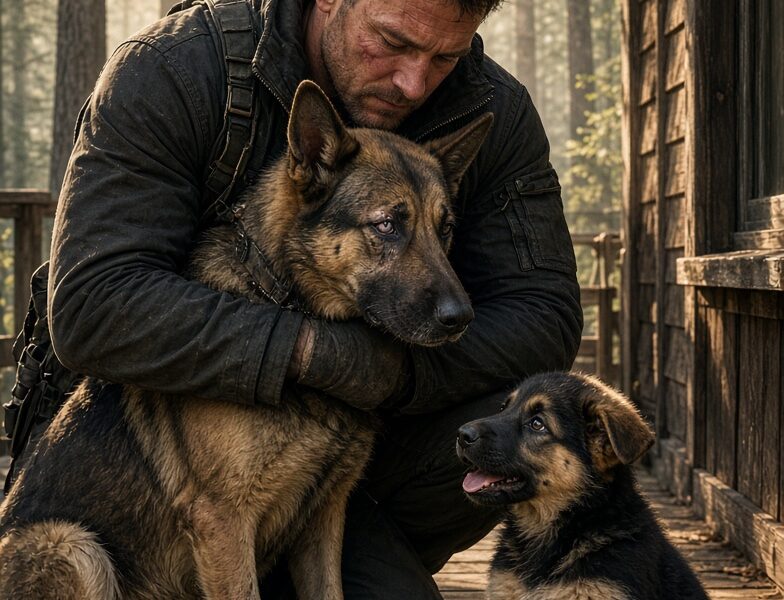
They Scheduled the Broken Military Dog to Die at Dawn… Then He Dug Up a 22-Year-Old Secret That Exposed an Entire Town
The German Shepherd was scarred, aggressive, and scheduled to be put down at dawn.
Nobody wanted a broken weapon.
But when a haunted Navy SEAL looked into the dog’s eyes, he didn’t see a monster.
He saw a mirror.
He bought the canine completely unaware the dog was about to unearth a town’s darkest secret.
Chief Petty Officer Nate Miller walked with a heavy limp, the permanent souvenir of a mortar shell in the Korengal Valley that had violently ended his twelve-year career as a Navy SEAL.
At thirty-four, Nate was a ghost of a man.
His days were empty, stretching out in a monotonous blur of physical therapy, painkillers, and the deafening silence of a civilian world he no longer understood.
He had retreated to a dilapidated, inherited cabin on the edge of Ironwood Ridge, an isolated logging town in Oregon where the pines grew so thick they choked out the sun.
He hadn’t come to the specialized military working dog rescue facility in Pennsylvania looking for a companion.
He had come because his former commanding officer had relentlessly pressured him to find a purpose, suggesting that adopting a retired military canine might bridge the gap between the brotherhood he lost and the solitude he now endured.
Dr. Harrison Reed, the exhausted facility director, led Nate down a concrete corridor filled with the echoing barks of dozens of retired service dogs.
But as they reached the final row, the noise abruptly stopped.
The last kennel was situated in a dimly lit corner, heavily reinforced with steel mesh.
“I’ll be honest with you, Miller,” Dr. Reed said, pausing with his hand on the chain-link gate. “I’m only showing him to you because of your background, but I don’t recommend him. This is Havoc.”
Nate stepped closer.
In the shadows of the cage paced a massive ninety-pound German Shepherd.
The dog’s coat was a faded, dull black and tan, marred by patches of missing fur and a torn left ear.
But it was the dog’s eyes that made Nate stop breathing for a second.
They were hyper-vigilant, wild, and utterly devoid of trust.
As Nate approached, Havoc didn’t bark.
Instead, he stopped pacing, lowered his head, and let out a low, guttural growl that vibrated through the concrete floor.
“He was an explosive detection and patrol asset. Two tours in Afghanistan, then transferred to a border task force,” Reed explained quietly, watching the dog’s stiff posture. “Six months ago, his handler was killed in an ambush during a cartel raid. Havoc took a graze to the ribs and stayed over the body for twelve hours. Wouldn’t let the medics near him. They had to sedate him with a dart just to recover the handler. Since then, he’s unpredictable, aggressive. He’s failed three rehabilitation assessments. Protocol dictates euthanasia for a dog this traumatized. His time is up tomorrow morning.”
Nate stared at the German Shepherd.
The dog stared back, unblinking, muscles coiled like a steel spring, ready to snap.
Nate recognized that look.
He had seen it in the mirror every morning for the past two years.
It wasn’t malice.
It was the raw, bleeding edge of survival.
It was the look of a soldier who was still fighting a war that everyone else had moved on from.
“Open the gate,” Nate said softly.
Reed frowned. “Miller, he bit a seasoned trainer last week. I can’t.”
“Open it, Doc.”
Nate’s voice carried the quiet, undeniable authority of a man used to giving orders in the dark.
Reluctantly, Reed unlatched the heavy door.
Nate didn’t step in immediately.
He slowly lowered himself to a crouch, groaning slightly as his ruined knee protested, and tossed his cane aside.
He didn’t offer his hand.
He didn’t speak in a high-pitched, comforting voice.
He just sat there on the cold concrete, exhaling a long, slow breath, making himself as small and non-threatening as possible.
Minutes ticked by in agonizing silence.
Havoc held his ground, the growl rumbling steadily in his throat.
But Nate didn’t flinch.
He just kept his eyes cast downward, projecting a calm, anchored energy.
Slowly, the growling hitched.
Then it stopped.
The massive Shepherd took one cautious step forward, then another.
Havoc lowered his massive, scarred head and pressed his wet nose against Nate’s combat boot.
He took a deep, lingering sniff, cataloging the scents of gunpowder, old blood, antiseptic, and the distinct metallic scent of chronic pain.
Finally, the dog looked up, his amber eyes locking onto Nate’s.
Nate slowly reached out his hand, palm up.
Havoc didn’t bite.
Instead, with a heavy, shuddering sigh, the massive canine rested his chin heavily onto Nate’s palm.
“I’ll take him,” Nate said quietly.
The first month at the Oregon cabin was a brutal test of endurance for both of them.
Havoc was heavily triggered by loud noises.
A slamming car door half a mile away would send him into a frantic patrol of the perimeter.
He suffered from night terrors, thrashing and whining in his sleep.
Nate would wake up in cold sweats from his own nightmares of the Korengal Valley, only to find the massive German Shepherd sitting rigidly by the front door, standing guard in the pitch black.
They were two broken things moving silently around each other in the gloomy, rain-soaked woods.
But slowly, a fragile bridge of trust formed.
Nate began relying on the dog’s structured routine to pull himself out of bed.
He established a strict military regimen.
0500 wake-up, perimeter walk, feeding, training drills.
He communicated with Havoc using the sharp German command words the dog had been trained on.
Fass, heel, sitz, bleib.
In return, Havoc began to soften, just slightly.
The dog would shadow Nate’s every move, his shoulder brushing against Nate’s good leg, a silent anchor in a world that felt entirely unstable.
For the first time in two years, Nate didn’t feel entirely alone.
He had a teammate again.
But as September rolled into October, and the biting Oregon autumn brought relentless storms rolling off the Pacific, Havoc’s behavior began to shift.
The dog was no longer just patrolling the property.
He was investigating it.
And his attention was becoming dangerously fixated on one specific area.
The Ironwood Ridge property bordered thousands of acres of dense, unforgiving national forest.
It was a landscape of towering Douglas firs, impenetrable blackberry brambles, and treacherous, fog-choked ravines.
It started on a Tuesday morning during their perimeter walk.
They were about two miles from the cabin, nearing the northern property line where the woods grew incredibly thick.
Suddenly, Havoc stopped dead.
His ears pinned forward, his tail went stiff, and the fur along his spine bristled into a sharp ridge.
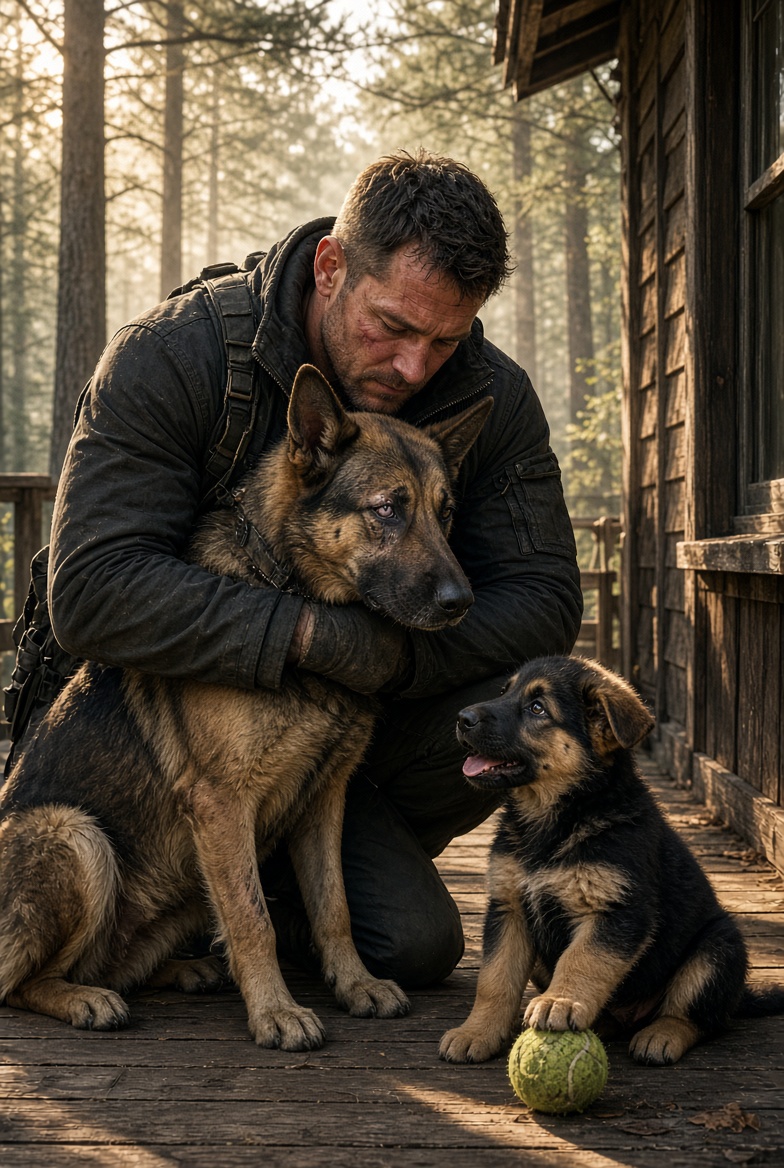
“What is it, Havoc?” Nate asked, tightening his grip on the heavy leather leash.
The dog didn’t look at him.
His nose was pointed directly upwind, drawing in long, deep, stuttering breaths.
Suddenly, Havoc lunged forward with such explosive force that he nearly tore the leash from Nate’s heavily calloused hand.
“Hey! Havoc! Heel!”
Nate barked, planting his boots and using his body weight to anchor the ninety-pound animal.
Havoc ignored the command, a massive breach of his ingrained training.
He whined frantically, pulling against the choke collar until he was gagging, his claws tearing up the wet earth as he tried to drag Nate toward a steep, heavily wooded ravine that plunged off the edge of the property line.
Nate frowned, his tactical instincts flaring.
A bear? A mountain lion?
But Havoc wasn’t reacting with the aggressive territorial display he usually reserved for wildlife.
His body language was purely operational.
He was tracking.
He was locked onto a scent.
Nate managed to drag the dog away that day, but the obsession only escalated.
Over the next week, Havoc spent hours sitting at the edge of the tree line, staring intensely into the woods.
He would pace the fence line, whining high in his throat, constantly testing the wind.
The dog was becoming agitated, reverting to the hyper-vigilant, restless state he had been in at the rescue shelter.
The breaking point came on a Friday night.
A massive Pacific storm front had slammed into the coast, dumping torrential rain over Ironwood Ridge.
The wind howled through the pines, rattling the windows of the old cabin.
Inside, the power had been knocked out hours ago.
Nate was sitting by the wood stove, reading a book by the beam of his SureFire tactical flashlight, trying to ignore the rhythmic, frantic pacing of the dog.
Havoc was losing his mind.
He was running from the back door to the window, scratching desperately at the heavy oak framing.
“Havoc, platz! Down!” Nate commanded sharply over the roar of the wind.
The dog dropped to his belly, but only for a second.
A massive crack of thunder shook the floorboards, and Havoc sprang up, letting out a sharp, demanding bark.
He ran to the door, grabbed the brass handle in his teeth, and tried to violently wrench it open.
Nate stood up, wincing as his bad knee flared with pain.
“What is out there, buddy?” he muttered, walking to the door.
He peered through the glass but could see nothing beyond the sheet of sideways rain and the black silhouette of the tree line.
Thinking the dog just desperately needed to relieve himself, Nate grabbed his Gore-Tex jacket and unlatched the deadbolt.
The second the door cracked open, Havoc hit it like a battering ram.
The heavy wood slammed into Nate’s shoulder, knocking him off balance.
By the time Nate recovered, the dog was gone.
“Havoc!” Nate roared into the storm.
Nothing.
Just the screaming wind and the punishing rain.
Panic, cold and sharp, flooded Nate’s chest.
The woods out there were a death trap in a storm like this.
Sinkholes, falling timber, sheer drops.
Cursing violently, Nate grabbed his high-lumen flashlight, his medical kit, and his holstered sidearm.
He didn’t bother with his cane.
Adrenaline, a ghost from his SEAL days, dumped into his system, masking the pain in his leg.
He plunged into the tree line, the beam of his flashlight cutting a stark white cone through the driving rain.
He tracked the fresh, deep gouges of dog claws in the mud.
They led straight north, exactly where Havoc had been trying to go all week.
“Havoc!” Nate shouted again, his voice instantly swallowed by the roar of the trees.
He pushed through a wall of thorns that tore at his face and jacket, sliding down a steep muddy embankment.
He was a mile deep into the national forest now, far off any trail.
The terrain was brutal, tangled with rotting deadfall and slick rocks.
After thirty minutes of grueling tracking, Nate heard it.
A frantic, wet tearing sound over the noise of the rain.
He crested a small ridge and angled his flashlight down into a deep, bowl-shaped hollow.
At the base of an ancient, massive cedar tree, Havoc was digging.
The dog was completely covered in mud, frantically tearing at the earth with his front paws.
Mud and rocks flew through the air as Havoc dug with a desperate, single-minded obsession.
Nate slid down into the hollow, his boots sinking into the muck.
“Havoc! Back off! Hier!”
The dog ignored him.
He was a foot deep, tearing through heavy tree roots with his teeth, his whimpers echoing in the hollow.
Nate reached the dog and grabbed the handle of his harness, hauling him backward with all his upper body strength.
“I said knock it off!” Nate yelled, pinning the struggling dog against his leg.
Havoc fought him for a second, then suddenly froze.
He didn’t look at Nate.
He looked down into the muddy hole he had just excavated.
Then the trained canine did something that made the blood freeze in Nate’s veins.
Havoc sat down perfectly straight, staring at the hole.
He didn’t bark.
He didn’t move.
It was a passive indication alert.
The exact posture a military dog takes when they have found a buried explosive or human remains.
Nate’s breath hitched.
He stepped closer to the edge of the pit, wiping the driving rain from his eyes.
He aimed the SureFire beam directly into the churning mud.
At first it just looked like dirt and severed roots.
But then the harsh white light caught a glimmer of something unnatural.
Something that didn’t belong in the earth.
Nate dropped to his knees in the mud.
He reached down into the freezing muck, his fingers brushing against something rigid.
He cleared the mud away, his heart hammering against his ribs.
It was a piece of heavy, faded yellow fabric.
A raincoat.
Nate kept digging, his hands moving faster now.
Beneath the fabric, his fingers struck something hard.
A metal box? No.
He wiped the sludge away, revealing a small, tarnished silver object attached to a rotting nylon strap.
He pulled it free.
It was a child’s backpack zipper pull shaped like a silver star.
Nate turned it over in his muddy palm.
The light illuminated three letters scratched deeply into the back of the cheap metal.
A.J.F.
Nate stared at the initials, his mind racing, trying to connect the dots.
Then an icy realization washed over him.
When Nate had inherited the cabin from his uncle a year ago, he had spent hours reading old local newspaper clippings in the town library to pass the time.
One headline had dominated the front pages of the Ironwood Ridge Gazette for years.
Twenty-two years ago, a seven-year-old girl named Abigail Jane Foster had vanished while walking home from school.
The town had been torn apart.
Suspects were interrogated.
The woods were searched for months, but not a single trace of her was ever found.
Nate slowly raised his eyes from the zipper pull to the dark, muddy hole beneath the ancient cedar.
Havoc hadn’t chased a deer.
He hadn’t found an old hunter’s cache.
Guided by a scent that had somehow seeped through two decades of soil and rain, the retired, broken military dog had just found the forgotten grave of Abigail Foster.
And based on the sheer depth of the roots covering the site, she hadn’t gotten lost and died out here from exposure.
Someone had buried her.
Nate’s military instincts immediately overrode his initial shock.
The rain continued to violently assault the forest canopy, but Nate’s mind went eerily quiet, slipping back into the cold, calculated headspace he used during combat deployments in hostile territory.
He didn’t dig any further.
He knew the incredibly fragile nature of forensic evidence, and touching anything else could compromise a decades-old crime scene.
Carefully, he placed the silver zipper pull back exactly where he found it.
He pulled a roll of bright orange paracord from his tactical medical kit and tied it securely around the trunk of the massive cedar tree, marking the exact location.
Then, grabbing Havoc’s harness, he began the grueling, treacherous hike back to the cabin.
The dog was reluctant to leave, whining softly, his amber eyes locked on the muddy pit, but a sharp, authoritative command from Nate finally broke his trance.
It took them an agonizing forty-five minutes to fight their way back through the storm.
By the time they reached the porch, both man and dog were shivering, coated in thick, freezing mud.
Nate didn’t bother changing his clothes.
He grabbed his landline phone, the only reliable connection out here on the dense ridge, and dialed the local county dispatcher.
Two hours later, the storm had finally broken, leaving behind a heavy, suffocating fog that rolled through the pines like phantom smoke.
The flashing red and blue lights of three county cruiser vehicles illuminated the dripping trees outside Nate’s cabin.
Sheriff Wade Collins, a heavily built man in his late fifties with cold, deeply set eyes, stood in Nate’s living room, dripping water onto the floorboards.
Beside him stood his ambitious right-hand man, Deputy Brian Hayes.
“You’re telling me,” Sheriff Collins started, his tone dripping with thick skepticism, “that your crazy, washout military dog managed to sniff out a twenty-two-year-old cold case in the middle of a torrential downpour under four feet of mud and ancient tree roots.”
“I’m telling you he found something that looks exactly like a child’s raincoat and a backpack zipper pull with the initials A.J.F.,” Nate replied coldly, leaning heavily on his cane. “Abigail Jane Foster. It’s a passive indication alert. Havoc is trained to find human remains. He doesn’t make mistakes.”
Deputy Hayes scoffed, crossing his arms.
“Listen, Miller. We all respect your service. But that dog of yours is a known liability. He was scheduled for the needle for a reason. There are old pioneer graves, animal bones, and illegal hunting caches all over these woods. You probably just found a poacher’s old trash dump.”
Before Nate could respond, a low, menacing rumble vibrated through the room.
Havoc, who had been commanded to hold a down-stay in the corner of the kitchen, was staring dead at Deputy Hayes.
The dog’s lips curled back, exposing his massive canines.
He wasn’t just growling.
He was tracking Hayes with a predatory intensity that Nate had only seen him use when sensing a direct, imminent threat.
“Call off your animal, Miller, before I put him down right here,” Hayes snapped, his hand instinctively dropping to the handle of his holstered service weapon.
“Havoc, aus. Leave it,” Nate commanded softly.
The dog stopped growling but didn’t break his piercing eye contact with the deputy.
Nate’s tactical mind began turning.
Havoc hadn’t reacted this way to the paramedics, the mailman, or even Sheriff Collins.
There was something specific about Deputy Hayes that triggered the dog’s defensive drive.
Collins sighed heavily, rubbing his temples.
“Fine. We will hike out there at first light when the ground is stable. But listen to me carefully, Miller. Keep your mouth shut about this. If you go spreading rumors that you found the Foster girl, and it turns out to be a dead deer wrapped in a tarp, this town will tear you apart. Her parents are still alive. Don’t you dare give them false hope.”
The deputies left.
But Nate didn’t sleep a single wink that night.
Collins’s dismissive attitude didn’t sit right with him.
It wasn’t just skepticism.
It felt orchestrated.
It felt like containment.
As dawn broke, casting long gray shadows across the ridge, Nate made a decision.
He wasn’t going to let the local department handle this alone.
He went to his uncle’s old desk and pulled out a stack of historical county maps.
He traced the coordinates of the cedar tree.
The land wasn’t part of the national forest, after all.
It sat on a forgotten, heavily overgrown strip of private property that had once belonged to the Stanton Logging Company, owned by Robert Stanton, the current mayor of Ironwood Ridge.
Twenty-two years ago, Robert Stanton’s son, Greg Stanton, had been a wild, reckless teenager notoriously known for drunk driving and getting bailed out by the local police.
And the sheriff at the time, Wade Collins’s older brother, had conveniently retired exactly one month after Abigail Foster went missing.
The pieces began clicking together in Nate’s mind with sickening clarity.
Abigail wasn’t abducted by a stranger.
She was hit by a drunk driver on the Ridge Road.
A powerful family panicked.
A corrupt sheriff covered it up, burying the evidence on private logging land that was permanently closed to the public the very next day.
Nate realized with a jolt of pure adrenaline that if Collins and Hayes went into those woods today, they weren’t going to secure a crime scene.
They were going to destroy it.
Nate didn’t wait for the local authorities.
He strapped on his tactical vest, checked the magazine of his SIG Sauer P226, and clipped Havoc into his heavy-duty combat harness.
They moved out into the dense, fog-covered woods long before the promised first-light arrival of the sheriff.
When they approached the ravine, the silence of the forest was suddenly broken by the heavy, rhythmic thud of metal striking earth.
Nate crouched low behind a thick wall of blackberry bushes, peering through the mist.
Down in the hollow, next to the giant cedar tree, stood Deputy Brian Hayes.
He wasn’t laying down crime scene tape.
He was wielding a heavy steel trenching shovel, frantically digging into the hole Havoc had opened the night before.
Next to him sat a thick, black industrial contractor bag.
He was exhuming the remains to move them.
Nate’s blood ran ice cold.
He unholstered his weapon, his thumb silently clicking off the safety.
He looked down at Havoc.
The German Shepherd was absolutely rigid, perfectly silent, waiting for the command to engage.
Nate stepped out from the tree line, raising his weapon.
“Drop the shovel, Hayes.”
His voice boomed through the hollow, echoing off the damp trees with absolute authority.
Hayes spun around, his eyes widening in panic.
But he didn’t drop the shovel.
Instead, he dropped his hand to his duty belt, drawing his firearm with surprising speed.
“You should have minded your own business, crippled boy,” Hayes yelled, raising his gun.
Nate didn’t have time to seek cover.
He relied on the one weapon he knew was faster than a bullet.
“Fass! Bite!”
Nate roared.
Havoc launched himself off the muddy embankment like a ninety-pound missile.
The dog covered the thirty feet between them in less than two seconds, a blur of muscle and teeth.
Hayes fired a wild shot, the bullet cracking harmlessly through the branches above Nate’s head, before Havoc impacted him squarely in the chest.
The sheer kinetic force of the canine hit lifted the deputy off his feet.
Hayes screamed as Havoc’s jaws clamped down with bone-crushing pressure onto his gun arm.
The weapon flew into the mud.
Hayes thrashed violently, punching the dog’s ribs, but Havoc had been trained to hold his grip through active combat.
The dog dragged the grown man into the mud, pinning him aggressively to the earth, snarling viciously inches from his throat.
Nate scrambled down the bank, moving as fast as his ruined knee would allow.
He kicked the deputy’s gun far into the brush and pressed the barrel of his SIG Sauer directly against Hayes’s forehead.
“Call him off. God, call him off. He’s breaking my arm,” Hayes screamed, completely terrified, the fight completely drained out of him.
“You were going to move her,” Nate said, his voice a dangerous, quiet rasp. “Greg Stanton hit her with his truck twenty-two years ago. Your department covered it up. And you came out here to finish the job so the mayor’s golden boy wouldn’t go to prison.”
Hayes, trembling violently under the weight of the massive German Shepherd, began to sob.
“I—it wasn’t me. I was just a kid back then. Collins told me to do it. He said if the feds found out, we’d all go down for conspiracy. Please, man, call off the dog.”
Nate didn’t flinch.
He didn’t call the local dispatch.
Keeping his gun trained on Hayes, Nate pulled his phone out.
This time, he dialed the direct emergency line for the FBI field office in Portland, bypassing the corrupted county entirely.
Within four hours, the isolated ridge was swarming with federal agents, forensic anthropologists, and state police.
Sheriff Wade Collins and Mayor Robert Stanton were arrested before noon, dragged out of their respective offices in handcuffs as the stunned town watched.
As the sun began to set, casting a golden light over the Oregon pines, Nate sat on the tailgate of a federal command vehicle.
An FBI agent handed him a cup of black coffee, giving him a deeply respectful nod.
Down in the ravine, a specialized forensic team was delicately recovering the remains of Abigail Jane Foster, finally bringing the lost girl home to her grieving parents after two decades of agonizing silence.
Nate looked down.
Havoc was sitting dutifully at his feet, his coat still caked in dried mud, his torn ear twitching at the sounds of the radios.
The dog leaned his heavy head against Nate’s bad leg.
Nate reached down, burying his hands into the thick fur of the German Shepherd’s neck.
Dr. Reed had said this dog was broken, unpredictable, and beyond saving.
The world had looked at Nate Miller and seen the exact same thing.
A discarded weapon, a ghost.
But as Nate looked into the dog’s calm, amber eyes, he knew the truth.
They hadn’t just saved a little girl’s legacy today.
They had saved each other.
For the first time since the Korengal Valley, Nate Miller felt a deep, profound sense of peace.
He wasn’t a ghost anymore.
He was a guardian, and he finally had his partner back.
The zipper pull was the thing, and the thing was the zipper pull, and the zipper pull was a small silver star with three letters scratched into the back, lying in the mud beneath a cedar tree for twenty-two years until a broken dog decided to dig.
The zipper pull was the thing.
The zipper pull is always the thing.









