They Mocked the Quiet Nurse’s Ugly Tattoo and Tried to Fire Her — Until a SEAL Commander Saw It and Saluted Her in Front of Everyone
The emergency room at Harborview Memorial was a symphony of controlled chaos, a place where seconds dictated the fragile line between life and death.
Amidst the glaring fluorescent lights and the relentless beeping of heart monitors, Clara Bennett was a ghost of efficiency.
At thirty-four, Clara possessed a quiet, stoic demeanor that unsettled some and intimidated others.
She never engaged in the breakroom gossip, never complained about the grueling fourteen-hour shifts, and never sought validation from the senior staff.
With her hair pulled back into a severe utilitarian bun and her scrub jacket always zipped up to her collarbone, she was an enigma.
Her unapproachable nature made her an easy target for the hospital’s social elite.
Most notably, Dr. Simon Allistar.
Simon was the chief surgical resident, a man whose trust fund and Ivy League pedigree had inflated his ego to dangerous proportions.
He viewed the nursing staff as his personal subordinates, and Clara’s unflappable competence deeply irritated him.
She didn’t fawn over his diagnoses, nor did she flinch when he threw one of his infamous temper tantrums in the operating theater.
She simply did her job with a cold, mechanical precision that Simon found infuriating.
The mystery of Clara Bennett unraveled on a blistering Tuesday afternoon during one of the bloodiest trauma codes the hospital had seen all month.
A construction worker had been rushed in after a catastrophic scaffolding collapse.
He was hemorrhaging rapidly from a ruptured femoral artery, the metallic scent heavy in the cramped trauma bay.
“Clamp! I need a clamp! Damn it! He’s slipping!” Simon yelled, his hands slick and trembling as he struggled to locate the retreating artery.
Clara was on the opposite side of the gurney, applying agonizing pressure to the man’s pelvis.
The patient’s blood was pooling, soaking rapidly through the sleeves of her mandatory white scrub jacket.
The fabric was a hindrance, restricting her movement and becoming a biological hazard.
Without a second thought, Clara let go with one hand just long enough to rip the jacket zipper down, shrugging the ruined garment off her shoulders and tossing it to the floor.
For the first time since she had been hired, Clara’s bare arms were exposed.
“I have the artery,” Clara stated, her voice slicing through the panic as she drove her fingers directly into the wound, pinching the severed vessel with her bare gloved hands, stopping the catastrophic bleed instantly.
“Ligate it now, doctor.”
Simon stared at her, blinking rapidly.
But it wasn’t her quick thinking that caught his eye.
It was her left forearm.
Etched into Clara’s pale skin was a tattoo.
But it wasn’t a delicate butterfly or a meaningful quote in cursive.
It was a jagged, crudely drawn piece of ink that looked like it had been scratched into her skin in a basement.
The thick, faded black lines formed the shape of a bone frog, a skeletal frog clutching a trident intertwined with a combat medic’s caduceus.
Beneath the grotesque imagery was a messy string of numbers that looked like coordinates followed by a date.
The twelfth of October, 2014.
It was dark, ugly, and severely out of place on the arm of a suburban health care professional.
Simon finished the ligation, securing the artery, but the sneer had already formed on his face.
Once the patient was stabilized and wheeled off to emergency surgery, the whispers began.
Bethany Hayes, the charge nurse, whose penchant for drama was legendary, was the first to strike.
“Did you see that thing?” Bethany whispered loudly at the nurse’s station, ensuring Clara, who was scrubbing blood off her hands in the adjacent sink, could hear.
“It looks like a prison tattoo. My cousin got something just like that when he did a stint at Rikers.”
Simon, leaning against the counter and charting on his tablet, smirked.
“It certainly explains the lack of bedside manner. You have to wonder about the hiring standards here. I mean, we’re a premier trauma center, not a halfway house for ex-convicts or washed-up biker gang groupies.”
Clara dried her hands slowly with a paper towel.
She didn’t turn around. She didn’t offer an explanation.
She simply tossed the towel in the biohazard bin, rolled her scrub sleeves down, and walked past them to check on her next patient.
Her silence only poured gasoline on the fire.
Over the next three weeks, the mockery evolved from hushed whispers to blatant disrespect.
The prison tat became the running joke of the surgical ward.
Simon made a habit of demanding Clara roll up her sleeves before handing her sterile instruments, claiming he needed to make sure no gang-related debris was falling into his sterile fields.
Bethany went so far as to leave a pamphlet for laser tattoo removal on Clara’s locker.
Clara endured it all with the same chilling calm.
She never snapped. She never cried in the supply closet like the junior nurses did when Simon berated them.
But at night, in the quiet solitude of her sparse apartment, Clara would sit on the edge of her bed, her fingers gently tracing the jagged raised lines of the bone frog.
She would close her eyes, and the sterile smell of the hospital would fade, replaced by the suffocating scent of burning diesel, copper, and the deafening roar of a Blackhawk helicopter plummeting from the sky.
The hospital staff thought her tattoo was a mark of shame, a remnant of a trashy past.
They had no idea that every jagged line had been inked in a dusty tent in the Korengal Valley by a weeping soldier using a rigged guitar string and boot polish.
They didn’t know that the date etched into her skin was the day Clara died and was reborn in the blood of the men she couldn’t save.
The tension in the ward finally breached its containment when Bethany decided Clara’s silence was an insult.
Taking her petty grievance to HR, Bethany filed a formal complaint, citing that Clara’s visible tattoo was distressing to patients and violated the hospital’s professional dress code.
Clara was summoned to the office of Mrs. Gable, the director of nursing.
Mrs. Gable was a stern woman who preferred paperwork to patient care.
She slid a written warning across the mahogany desk.
“Clara, you are an exceptional nurse,” Mrs. Gable said, adjusting her glasses. “But we have an image to uphold. You cannot display gang-affiliated or amateur body art in a professional medical setting. From now on, you wear long sleeves or a compression sleeve. If it slips again, there will be a suspension.”
Clara looked at the warning slip. She didn’t sign it.
“It’s not gang-affiliated,” she said softly, her gray eyes locking onto the director’s. “And I won’t apologize for it. But I will wear the sleeve.”
She purchased a tight flesh-colored athletic sleeve that same day.
For a week, the ward was quiet.
Simon seemed satisfied that he had successfully bullied the thug into submission, and Bethany paraded around with a smug sense of victory.
But the fragile peace shattered on a chaotic Thursday evening when a massive storm front hit Seattle, bringing with it a torrent of rain and slick highways.
At 6:15 p.m., the trauma alarms blared with a ferocity that stopped every conversation in the ward.
The dispatch radio crackled to life, the paramedic’s voice frantic.
“Mass casualty incident on Interstate 5. Multi-vehicle pileup involving a commercial semi-truck and a transport van. Incoming ETA three minutes. We have multiple criticals.”
When the ambulance doors flew open, the ER descended into absolute bedlam.
It wasn’t just a standard transport van.
It was a vehicle carrying a group of private military contractors and active-duty personnel returning from a specialized tactical training seminar at a nearby base.
The third patient rolled through the doors was a massive man in tactical fatigues.
His chest was crushed from the steering column.
His breathing was rapid, shallow, and accompanied by a sickening gurgle.
He was drowning in his own blood.
Dr. Simon Allistar was assigned to the patient.
Clara was his assisting nurse.
As they transferred the massive soldier to the trauma bed, the man’s oxygen saturation plummeted.
The monitor screamed an agonizing high-pitched warning.
“He’s got a massive hemothorax. His right lung is collapsing,” Simon shouted, his voice cracking.
The pressure in the room was suffocating.
Simon grabbed a scalpel to insert a chest tube, but his hands were shaking violently.
The patient was thrashing in pain and delirium, swatting blindly.
“Hold him down,” Simon ordered the orderlies, but the soldier was too strong, bucking wildly.
Simon hesitated, the scalpel hovering over the man’s rib cage. He couldn’t find the landmark.
He was frozen.
“Doctor, you have to cut now. His heart rate is dropping. He’s going into traumatic arrest,” Clara warned, her voice devoid of panic, sharp as a whip.
“I can’t get a clean angle. Shut up and hold him!” Simon screamed back, paralyzed by the complexity of the trauma and the sheer size of the flailing patient.
Clara didn’t hesitate. She didn’t ask for permission.
She shoved Simon aside with a force that sent the arrogant resident stumbling backward into a tray of instruments.
“Hey, what do you think—” Simon started, furious.
Clara ignored him completely.
She grabbed a massive 14-gauge needle from the crash cart.
Leaning over the thrashing soldier, she placed her hand firmly on the center of his chest.
She didn’t speak English to him.
Instead, she leaned down, her lips near his ear, and barked a sharp, commanding phrase in flawless guttural Pashto.
The soldier’s eyes snapped open.
For a fraction of a second, the combat shock broke.
He froze, recognizing the tone of command, the language of a war zone.
In that singular second of stillness, Clara slammed the needle directly into the second intercostal space of his chest.
A loud hiss of trapped air and a spurt of dark blood erupted from the catheter.
The soldier gasped, taking his first full breath in minutes as his collapsed lung instantly reexpanded.
The monitors stabilized.
Clara stepped back, her breathing perfectly steady, and pointed to the insertion site.
“He’s stabilized for the tube. Put it in, doctor,” she ordered, her tone chillingly authoritative.
Simon finished the procedure in stunned silence, his face burning red with humiliation.
Once the soldier was prepped for surgery and wheeled away, the adrenaline in the room crashed, leaving a heavy toxic tension in its wake.
Simon rounded on Clara in the center of the ER hallway, completely disregarding the patients and staff watching them.
His pride had been publicly dismantled by a nurse, and he was out for blood.
“Who the hell do you think you are?” Simon roared, his voice echoing off the linoleum walls.
Bethany and several other nurses stopped dead in their tracks, watching wide-eyed.
“You assaulted a superior, Bennett. You shoved me. You think because you got lucky with a chest dart, you can run this ward?”
Clara stood perfectly still, her hands resting calmly in her pockets.
The violent motion of the trauma had caused her flesh-colored compression sleeve to slide down, bunching at her wrist, exposing the dark, jagged bone frog tattoo to the harsh lights.
Once again, Simon pointed a trembling finger at her arm.
“You act like some rogue cowboy because of that trash on your arm. You’re a liability. You’re nothing but an insubordinate thug with a prison scratch. And I am going to make sure your license is revoked by tomorrow morning. You hear me? You’re done.”
“Dr. Allistar,” Clara said quietly. “You were paralyzed. The patient was seconds from death.”
“Shut your mouth,” Simon snapped, stepping aggressively into her personal space. “You don’t talk to me. You are a disgrace to this hospital.”
“Is there a problem here?”
The voice didn’t yell, but it boomed through the hallway like thunder, instantly silencing Simon’s tirade.
The heavy double doors of the ER had opened.
Standing there was a man who seemed to suck the oxygen out of the room.
He was tall, built like a bank vault, wearing the crisp, immaculate service dress uniform of the United States Navy.
A silver eagle gleamed on his collar, rows of colorful ribbons stacked high on his chest, topped with a glittering gold trident, the undisputed mark of a SEAL.
Commander David Miller scanned the hallway, his cold blue eyes locking onto the scene before him.
He had rushed to the hospital the moment he heard his men were in the transport crash.
Simon instantly changed his demeanor, puffing out his chest.
“Commander, no problem at all. Just disciplining an insubordinate nurse. Your men are receiving the best care.”
Commander Miller ignored the doctor completely.
His eyes had dropped to Clara.
More specifically, his gaze was locked dead onto the exposed left forearm she held at her side.
The faded, jagged bone frog. The combat caduceus. The coordinates. The date.
The twelfth of October, 2014.
The commander’s face, hardened by decades of war, suddenly drained of all color.
The silence that fell over the emergency room corridor was absolute, thick, and suffocating.
The chaotic symphony of the trauma ward, the blaring monitors, the rushing footsteps, the overlapping pages over the intercom, seemed to fade into a dull, distant hum.
Commander David Miller, a man whose chest was heavy with medals of valor, stood entirely frozen.
The imposing battle-hardened officer seemed to have lost the ability to breathe.
His piercing blue eyes anchored to the jagged dark ink exposed on Clara’s left arm.
Simon Allistar, utterly oblivious to the monumental shift in the atmosphere, saw the commander’s intense stare and mistook it for disgust.
Eager to capitalize on the moment and secure his ultimate victory over the defiant nurse, the arrogant surgeon stepped forward, puffing out his chest.
“I apologize you had to see that, Commander Miller,” Simon said, his voice dripping with condescension.
He shot a vicious glare at Clara.
“Nurse Bennett has a flagrant disregard for hospital policy. That hideous amateur ink is exactly why I’ve been trying to get her removed from this trauma center. It’s an embarrassment to the medical profession, and clearly it’s distressing to you and your men. Rest assured, she will be escorted out of this building before the hour is up.”
Commander Miller did not look at Simon. He didn’t even blink.
Slowly, mechanically, he raised his massive, calloused hand and held it up, palm facing the doctor.
It was a silent, universal gesture that commanded immediate obedience.
“Shut your mouth, doctor,” Miller said.
His voice was not a shout. It was a low, terrifying rumble vibrating with a deadly calm that instantly drained the blood from Simon’s face.
“If you speak another word before I am finished, I will personally throw you through those double doors.”
Simon’s jaw snapped shut.
Bethany Hayes, standing near the supply cart, took a terrified step backward, suddenly wanting to be invisible.
The entire nursing staff, orderlies, and passing doctors had stopped dead in their tracks, forming a captive audience in the wide hallway.
Miller took a slow step toward Clara, then another.
The sharp clack of his polished dress shoes on the linoleum sounded like gunshots in the quiet corridor.
He stopped just two feet from her, towering over her slighter frame.
Clara didn’t flinch. She didn’t look down.
She met the commander’s intense gaze with the same chilling stoic calm she maintained in the trauma bay.
“Thirty-four degrees, fifty-two minutes north,” Miller whispered, his voice cracking slightly as he read the messy scribbled coordinates inked into her skin.
“Seventy-one degrees, nine minutes east.”
He looked up from her wrist, his eyes scanning her face, searching for the ghost of a memory.
“The Korengal Valley. The outpost.”
Clara gave a slow, barely perceptible nod. “Yes, sir.”
Miller’s breathing hitched.
The hardened warrior, a man who had stared down enemy fire without blinking, suddenly looked as though he was struggling to hold back a tidal wave of grief.
“The twelfth of October, 2014. The day the sky fell.”
He stepped closer, entirely ignoring the crowd of stunned medical professionals surrounding them.
“We didn’t know your real name,” Miller said, his voice dropping to a reverent hush, though the dead silence of the hall carried his words to everyone.
“You were classified. A Cultural Support Team medic attached to our unit for village outreach. When the Blackhawk went down on the ridge, when the ambush started, we lost our chief medic.”
Simon’s eyes darted frantically between the nurse he had relentlessly bullied and the legendary SEAL commander.
His brain was struggling to process the impossible information.
A combat medic? A classified attachment?
“You were just a kid,” Miller continued, his voice thick with emotion, the memories dragging him back to a blood-soaked ridgeline twelve years ago.
“They hit us with RPGs and a synchronized mortar barrage. It was a slaughter. Our comms were jammed. We were pinned down in the kill zone for eleven hours.”
Miller reached out slowly, hovering his fingers just inches above the crude bone frog on Clara’s arm, treating it as if it were a sacred relic.
“The bone frog,” he murmured. “The mark of a fallen SEAL.”
“There were four of them,” Clara said quietly, speaking for the first time, her voice steady but laced with a profound, heavy sorrow.
“Chief Petty Officer Donovan. Lieutenant Vance.”
She stopped, correcting herself, the names carved into her soul.
“Lieutenant Reed. Petty Officer First Class Mitchell. Senior Chief Barnes. They held the perimeter so I could get to the wounded.”
“And you did,” Miller stated, tears finally welling in his fierce blue eyes, spilling over onto his weathered cheeks.
He turned slightly, raising his voice so the arrogant doctor and the gossiping nurses could hear every single word.
“This woman,” Miller boomed, his voice echoing off the walls.
“This liability, ran directly into a concentrated wall of heavy machine gun fire. Not once, not twice, six times. She dragged six of my bleeding, shattered men out of a burning fuselage while the enemy was doing everything in their power to tear her apart.”
Bethany let out a faint, strangled gasp, her hand flying to cover her mouth.
“She took a piece of shrapnel to the collarbone on her third run,” Miller continued, pointing a commanding finger at Clara’s collar, where her scrub jacket usually hid the deep, jagged indentation in her flesh.
“It shattered her clavicle. She didn’t stop. She packed her own wound with combat gauze, taped her arm to her chest, and went back out into the crossfire to drag me out.”
Simon staggered back slightly, hitting the wall.
The nurse he had called a thug, the woman he had accused of panicking in the trauma bay, had operated in conditions of sheer unimaginable horror that would have broken his mind in seconds.
“She kept fourteen men alive in a dirt crater for eleven hours,” Miller said, turning back to Clara, his chest heaving, “with nothing but a depleted medkit, torn uniforms, and her bare hands. You saved my life, Doc. You saved my team.”
The hospital hallway was completely paralyzed.
Doctors, nurses, and technicians stood rooted to the spot, their eyes wide with disbelief and awe.
The petty grievances, the hospital politics, the arrogant hierarchy, all of it had been instantly vaporized by the sheer weight of Clara’s hidden history.
Simon Allistar looked physically ill.
The realization of what he had done, of the relentless cruelty he had inflicted upon a woman who had walked through literal hellfire, was crashing down on him.
He had called her a gang member. He had mocked her silence. He had tried to have her fired for a tattoo that represented a nightmare he couldn’t even fathom.
“The tattoo,” Miller said, his voice softening as he looked back at the jagged lines on Clara’s arm.
He turned to look dead at Simon.
“You called this an amateur scratch. You called it trash.”
Simon opened his mouth, but no sound came out. His throat was entirely dry.
“It was done in a med tent in Bagram two days after we were dusted off that ridge,” Miller explained, his tone laced with a fierce protective pride.
“The survivors of my team begged her to let us mark her. She wasn’t an official SEAL, but she bled with us. She fought for us. She saved us.”
Miller looked back at Clara, a soft, heartbroken smile touching his lips.
“Petty Officer Hayes did it, didn’t he? Used the motor from an electric razor, a scavenged guitar string, and a bottle of boot polish.”
“He did,” Clara confirmed softly, a faint melancholic smile finally breaking through her stoic exterior.
“He was a terrible artist, sir.”
“He was the worst,” Miller agreed, a wet laugh escaping his chest.
Then, the commander’s face hardened, his expression turning deadly serious.
He looked around the hallway, making sure every single member of the hospital staff was listening.
“But the ink wasn’t just boot polish,” Miller said loudly.
“Was it, Doc?”
Clara shook her head, her gray eyes shining with unshed tears.
“No, sir. It was mixed with the ashes of the extraction helicopter’s manifest. And the blood of the four men we lost on that ridge, so they would always stay with us, so they would never be left behind.”
A heavy collective gasp echoed through the corridor.
Several nurses were openly weeping.
Even Mrs. Gable, the stern director of nursing, who had emerged from her office upon hearing the commotion, stood frozen, her clipboard trembling in her hands, her face pale with shame over the written warning she had issued just days prior.
Simon looked like a man who had just stepped on a landmine.
His arrogance was completely shattered, replaced by a hollow, sickening terror.
He had mocked a sacred memorial. He had belittled a monument built in blood, ash, and unimaginable sacrifice.
“Dr. Allistar,” Commander Miller said, his voice cold and sharp as a combat blade as he stepped away from Clara and approached the surgeon.
“You had the audacity to question this woman’s competence under pressure. You questioned her bedside manner. Let me make something crystal clear to you.”
Miller leaned in, his imposing frame casting a dark shadow over the trembling doctor.
“This woman has more courage, more skill, and more integrity in her damaged left shoulder than you have in your entire Ivy League pedigree. When your hands were shaking today, when you froze and almost killed my man on that table, she didn’t panic because compared to the Korengal Valley, a busy ER in Seattle is a walk in the park. She didn’t disrespect your authority. She saved you from committing manslaughter.”
Simon swallowed hard, his eyes dropping to the floor.
“I didn’t know,” he whispered pathetically. “I had no idea.”
“You didn’t ask,” Miller replied coldly. “You just judged.”
The commander turned his back on the disgraced doctor, dismissing him entirely.
He squared his shoulders, facing Clara Bennett.
The massive decorated SEAL stood at perfect attention.
The air in the hallway seemed to crackle with electricity.
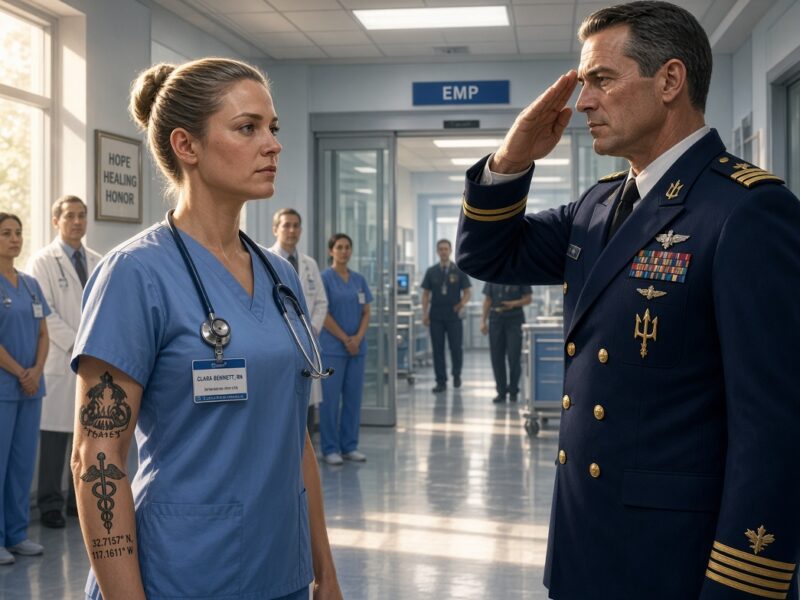
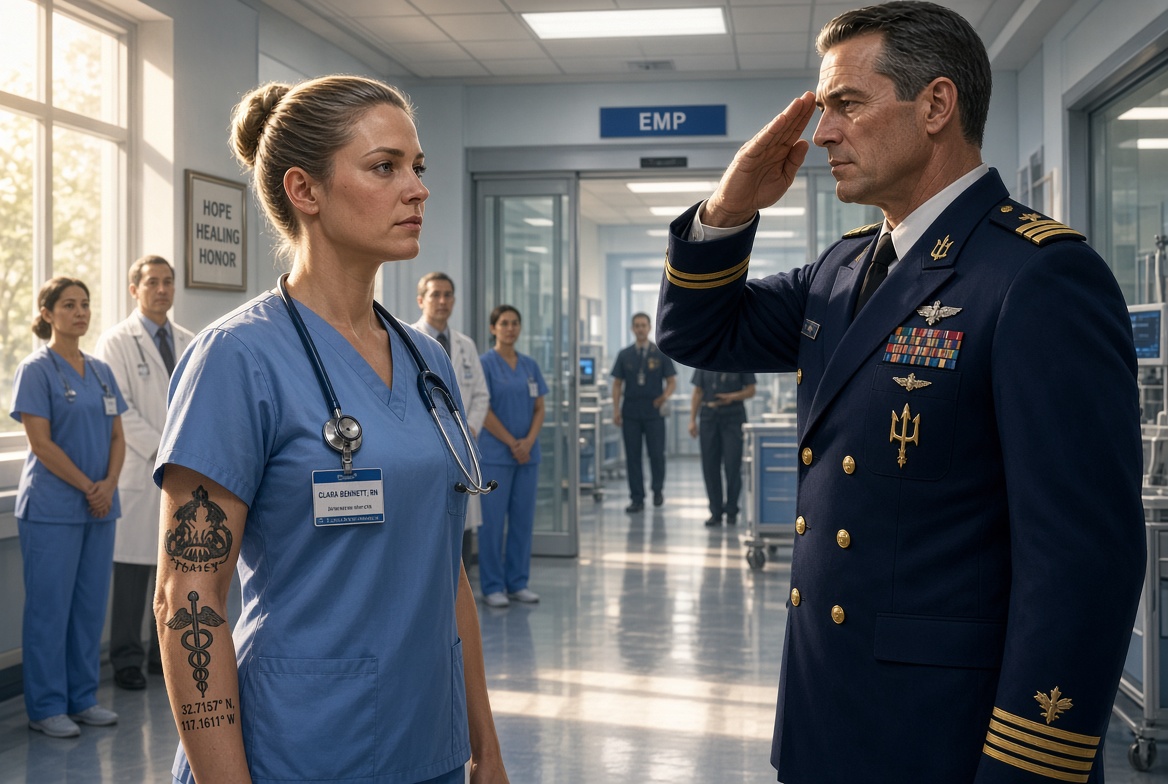
Slowly, sharply, with the utmost precision and respect, Commander David Miller raised his right hand to the brim of his cover in a crisp, flawless salute.
He held it there.
It wasn’t a casual greeting.
It was a deep, profound military honor, delivered by a high-ranking officer to a civilian nurse in the middle of a civilian hospital.
The silence stretched for ten long, agonizing seconds.
The weight of the gesture was not lost on anyone present.
Then, moving in perfect unison, the two wounded soldiers from the van crash, who had been wheeled out into the hall on their gurneys, despite their heavy bandages and pain, weakly raised their right hands, returning the salute to the woman who had just saved their brother in the trauma bay.
Clara stood tall.
She didn’t salute back. She was a civilian now.
Instead, she placed her right hand over her heart, bowing her head slightly in a quiet, deeply respectful acknowledgement.
Slowly, Miller lowered his hand.
He stepped forward and wrapped his massive arms around Clara, pulling her into a tight, fierce embrace.
“Thank you, Doc,” he whispered into her ear. “For then and for today.”
“Just doing my job, Commander,” Clara whispered back.
When Miller finally pulled away and walked down the hall to check on his men, the spell over the ER was broken.
Simon Allistar didn’t say another word.
He turned on his heel, walked into the locker room, and stripped off his bloody scrubs.
He handed in his resignation the very next morning, unable to face the staff or himself ever again.
Bethany Hayes requested a transfer to a different floor, too ashamed to look Clara in the eye.
As for Clara Bennett, she didn’t boast.
She didn’t demand an apology from Mrs. Gable, who quietly shredded the HR complaint that same night.
Clara simply reached down, grabbed the hem of her flesh-colored compression sleeve, and threw it into the nearest biohazard bin.
Leaving her scarred, jagged, beautiful tattoo fully exposed to the world, she walked over to the nurse’s station, picked up her tablet, and quietly asked, “Who’s my next patient?”
Clara’s faded tattoo wasn’t a mark of a troubled past.
It was a sacred badge of unimaginable courage, forged in the fires of war and mixed with the blood of heroes.
True heroes don’t need a pristine image or loud validation.
They move quietly among us, carrying the weight of the lives they’ve saved.
The ER at Harborview Memorial returned to its usual rhythm over the following weeks, but something fundamental had shifted in the culture of the ward.
The gossip died down. The petty hierarchies softened.
Nurses who had once whispered behind Clara’s back now nodded to her with quiet respect as they passed in the hallway.
Patients noticed the change too, though they never understood the reason.
They simply felt safer in Clara’s presence, as if her steady hands carried a strength that transcended the sterile confines of the hospital.
Commander Miller returned to Harborview three days after the incident, not for medical treatment, but to personally deliver a framed photograph to Clara’s station.
It was a picture of the surviving members of his team, taken at a reunion five years prior.
In the center of the group, standing tall despite the visible scars and the prosthetic leg that one of the men wore, was a smiling Clara Bennett, her left arm draped around the shoulders of a laughing SEAL.
The bone frog tattoo was clearly visible in the photograph, and beneath it, in Miller’s careful handwriting, were the words that would stay with Clara forever.
“To the Doc who never left a man behind. You are one of us. Always.”
Clara placed the photograph on her locker shelf, where it remained for the rest of her career at Harborview Memorial.
Whenever the shifts grew long and the weight of the work pressed down on her shoulders, she would glance at that photograph and remember the men who had given her the tattoo.
She remembered the dust and the fire and the desperate hours in the Korengal Valley.
She remembered the faces of the four men who hadn’t come home, and she reminded herself why she had chosen to spend her civilian life healing instead of hiding.
The tattoo on her arm was no longer a source of shame or secrecy.
It was a declaration.
It was a reminder that some scars are not meant to be erased, only understood.
And in the halls of Harborview Memorial, where life and death danced their endless dance, Clara Bennett walked with her sleeves rolled up and her head held high, a quiet hero among ordinary people who finally understood what courage looked like.
It looked like a faded bone frog on the arm of a nurse who had once run into the fire and refused to let it consume her.
It looked like the steady hands that saved lives without asking for recognition.
It looked like Clara Bennett, who had carried the weight of fourteen men on her shoulders and still found the strength to carry more.
The story of Clara Bennett and the tattoo that everyone mocked spread through the hospital grapevine within days, and then beyond the hospital walls.
A local Seattle journalist heard about the incident from a nurse who had witnessed the SEAL commander’s salute.
She tracked down Commander Miller, who had been reassigned to a training command on the West Coast, and asked him for an interview.
He declined at first, citing operational security and the classified nature of the Korengal Valley mission.
But then he thought about Clara.
He thought about the years she had spent in silence, carrying a burden that no one had ever acknowledged.
He thought about the way she had been treated by the staff at Harborview Memorial, mocked and belittled for a tattoo that represented the most profound sacrifice a person could make.
And he decided that her story deserved to be told.
He agreed to the interview on one condition.
Clara had to approve every word before publication.
The journalist, a woman named Rebecca Torres who had spent a decade covering military affairs, spent three weeks researching the mission and verifying the details.
She interviewed the surviving members of Miller’s team, all of whom confirmed Clara’s role in the ambush.
She spoke to the families of the four fallen SEALs, who had never known that a civilian medic had risked her life to try to save their loved ones.
And finally, she sat down with Clara herself in a quiet coffee shop in downtown Seattle.
Clara was reluctant to speak at first.
She had spent twelve years keeping her past buried, and the thought of exposing it to public scrutiny felt like reopening a wound that had barely healed.
But Rebecca was patient and gentle and asked questions that showed she understood the weight of what Clara had carried.
“Why did you keep it a secret?” Rebecca asked, her recorder placed discreetly on the table between them.
Clara wrapped her hands around her coffee cup, staring into the dark liquid as if it held the answers.
“Because it wasn’t a secret,” she said finally. “It was just something I didn’t talk about. There’s a difference. The people who needed to know, knew. The military knew. The families of the men who died, they were told what happened. But the rest of the world didn’t need to carry that weight. It was mine to carry. It still is.”
“But you were mistreated at the hospital,” Rebecca pressed gently. “People called you names. They tried to have you fired. Doesn’t that make you angry?”
Clara considered the question for a long moment.
“It made me tired,” she admitted. “But anger takes energy, and I didn’t have energy to spare. I was too busy trying to save lives. The doctors and nurses who mocked me, they didn’t know my history. They saw a tattoo and made assumptions. That’s human nature. But I knew who I was, and I knew what I had done. That was enough.”
“When Commander Miller saluted you in the hallway,” Rebecca asked, “what did you feel in that moment?”
Clara’s eyes grew distant, and for a moment, she was back in the corridor, the silence pressing down on her, the weight of the salute settling into her bones.
“I felt seen,” she said quietly. “For the first time in twelve years, I felt seen. Not as a nurse. Not as a woman with a strange tattoo. But as a soldier. As someone who had been there, in the worst place on earth, and had done what needed to be done. That salute wasn’t just for me. It was for the men who didn’t come home. It was for the ones I couldn’t save. And it was for every person who has ever served in silence, carrying wounds that no one else can see.”
The article was published six weeks later, and it spread like wildfire across the country.
Clara Bennett became an overnight sensation, though she refused all requests for television interviews and public appearances.
She continued to work at Harborview Memorial, showing up for her shifts with the same quiet efficiency she had always displayed.
But something had changed.
Nurses who had once avoided her now sought her out for advice.
Young doctors who had heard the story looked at her with a new respect.
And patients, sensing something different about the nurse with the faded tattoo, often asked to see her arm, wanting to touch the ink that had been mixed with the ashes of heroes.
Clara never refused them.
She would roll up her sleeve and let them look, answering their questions with the same patience she showed to her patients.
She told them about the Korengal Valley and the men who had held the perimeter so she could do her job.
She told them about the Blackhawk going down and the eleven hours of hell that followed.
She told them about the tattoo and why it had been inked into her skin, not as a mark of shame, but as a memorial.
And she told them about the four men who had died on that ridge, whose names she carried in her heart and whose blood was mixed with the ink on her arm.
The hospital administration, embarrassed by the revelations of how Clara had been treated, quietly implemented new policies to protect nurses from harassment and discrimination.
Mrs. Gable, the director of nursing who had issued the written warning, retired a year later.
In her farewell email to the staff, she mentioned Clara by name, acknowledging that she had been wrong and that Clara had taught her something about courage and humility.
Simon Allistar never returned to Harborview Memorial.
He took a position at a private practice in another state, but the story followed him.
He was known as the doctor who had mocked a war hero, and the shame of it haunted him for the rest of his career.
Bethany Hayes transferred to a smaller hospital in a different city, hoping for a fresh start, but she never forgot the look on Clara’s face when she had thrown the compression sleeve in the trash.
It was a look of quiet victory, of vindication, of peace.
Clara Bennett continued to work at Harborview Memorial for another fifteen years, saving lives with the same quiet dedication that had defined her career.
She never married and never had children, but she had something else.
She had the respect of her colleagues and the gratitude of thousands of patients whose lives she had touched.
She had the photograph of Miller’s team on her locker shelf, a daily reminder of the men she had served alongside.
And she had the tattoo on her arm, a jagged bone frog mixed with blood and ash, a sacred badge that she wore with pride until the day she retired.
When Clara finally left Harborview Memorial at the age of forty-nine, she walked out of the hospital doors with her sleeves rolled up and her head held high.
The staff lined the hallways, not because anyone had organized a ceremony, but because they wanted to see her go.
They wanted to witness the quiet exit of a woman who had taught them all something about courage.
Clara didn’t give a speech.
She didn’t say goodbye.
She simply walked through the doors one last time, her worn nurse’s shoes clicking on the linoleum, and stepped out into the Seattle sunshine.
The tattoo on her arm caught the light, and for a moment, it looked almost beautiful.
Not because the lines were clean or the design was elegant, but because it was real.
It was the most honest thing Clara had ever done, and she had carried it with her through twelve years of silence and fifteen years of service.
Clara Bennett was a hero, not because she had run into gunfire and dragged wounded men to safety, but because she had come home and continued to serve.
She had chosen to heal instead of hide, to save lives instead of nursing her own wounds.
And that, in the end, was the truest definition of courage.
The story of Clara Bennett and her tattoo became a legend in the halls of Harborview Memorial and beyond, a reminder that heroes often walk among us in the quietest of forms.
They wear scrubs and carry clipboards and speak in soft voices.
They carry scars that no one can see and memories that no one can share.
They endure mockery and misunderstanding without complaint, because they know that the work matters more than the recognition.
And every once in a while, if we are very lucky, we get to witness a moment of truth.
A moment when the past breaks through the surface of the present, and we see the heroes among us for what they truly are.
For Clara Bennett, that moment came in the hallway of an emergency room, when a SEAL commander recognized a faded tattoo and saluted the woman who had earned it.
It was a moment of recognition, of gratitude, and of deep, abiding respect.
It was a moment that changed everything.
And it all started with a quiet nurse and a tattoo that no one understood.









