They Mocked the Quiet Nurse and Called Her “Mouse” Every Morning… Until a Little Boy Said “Phoenix” and the Whole Hospital Fell Silent
Every morning, the new nurse in the emergency room hears the same cruel jokes from the same arrogant doctor.
She lowers her eyes, hides her trembling hands, and says nothing.
Then a bearded man walks in with two frightened little boys, and the smallest one cannot breathe.
The doctors hesitate, but the clock does not.
The older boy points at the quiet nurse in front of the entire lobby and says one name, and the whole hospital falls silent.
Who is she really?
And what did she carry out of the mountains that no one in this building was ever supposed to know?
Along the way, you will learn how to recognize and respond to a severe asthma attack in a child, step by step.
If this story touches your heart, hit like, subscribe to the Life of Rookie Nurse, and leave a comment telling us where you are watching from and who in your life deserves more respect than they ever received.
Stay with us, because the hardest part of this story is still ahead.
Sadie Porter had worked in the emergency room for five months, and Dr. Roland Thatcher had humiliated her on almost every one of those mornings.
On this morning, he did it in front of the entire department.
He stood at the nurses’ station with his silver hair perfectly combed and his blue bow tie perfectly straight, holding a paper sign that someone had taped to her supply cart.
The sign said, “Rookie, do not touch patients.”
Half the staff laughed.
The other half studied their shoes.
Sadie kept her eyes on the floor.
She was five foot four, small in scrubs that were bright blue and one size too big, with dirty blonde hair twisted into a messy bun and gray-blue eyes she almost never lifted.
A thin scar ran above her left eyebrow.
Small white scars crossed the backs of her hands, and whenever people watched her, those hands began to shake.
“Good morning, mouse,” Thatcher said loud enough for the whole lobby to hear. “I see you found your cart. Excellent. A rookie should stay close to the things she is qualified to touch.”
Three weeks earlier, Sadie had noticed a little girl wheezing in the waiting room and had quietly moved her to the front of the line.
The girl was fine.
Thatcher was furious.
He wrote Sadie up for acting beyond her role, and the hospital scheduled a formal review for eleven that morning to decide whether she would keep her job.
“Let me explain how this works,” he told her, smiling for the benefit of the crowd. “In this hospital, a nurse who talks is a nurse who is looking for a new job. So keep your mouth closed, keep your head down, and keep that mop moving.”
The staff laughed again.
The lobby of Compass Rose Naval Medical Center in Newport, Rhode Island, was always crowded.
A huge painting of a Navy warship hung above the reception desk between two flags and a brass anchor seal.
Sailors, retirees, and Navy families filled the rows of gray chairs because this hospital had cared for military families for sixty years.
Only one person in the room did not laugh.
Denise Okafor, the charge nurse, had worked in that emergency room for twenty-two years.
She looked at Sadie for one second too long, and then she looked away—ashamed of her own silence.
Nobody noticed the small things about Sadie Porter.
Nobody noticed that she always stood where she could see both exits.
Nobody noticed that when a siren rose outside, her shoulders curled but her eyes went to the doors before anything else.
Nobody noticed the thin black watchband she never took off, or the tiny brass feather charm that hung from her badge lanyard—the one she touched whenever she was afraid.
At 8:40, the automatic doors slid open, and the whole lobby changed.
A broad man in a green field jacket and a black cap came through first.
His beard was dark with streaks of gray, a heavy backpack hung from both shoulders, and he moved quietly with his eyes already checking every corner.
A boy of about seven held tightly to his jacket.
In his arms, the man carried a much smaller boy—perhaps three years old—who clutched a worn stuffed rabbit against his chest.
The little one was not crying.
That was the first thing that was wrong.
His shoulders were hunched up near his ears.
His belly pulled in and out so hard that his ribs showed through his yellow shirt, and every breath came with a thin, high whistle.
“Please,” the man said, and his voice cracked in the middle. “My nephew cannot breathe. I need a doctor.”
Thatcher turned slowly, studied the child for about two seconds, and sighed.
“Sir, there is a line, and there is a registration form. Toddlers wheeze every day. Take a seat, fill it out, and someone will call his name.”
The man sat the boy down on a chair.
“Look at his lips,” he said.
The lips of the little boy were turning the color of ash.
He opened his mouth to cry, and nothing came out.
The older boy—Owen—dug a folded paper from the backpack with shaking fingers.
“This is the asthma plan,” he said. “The blue inhaler is in the bag. Uncle Graves, please, Theo cannot wait.”
“Nobody opens a bag in my lobby,” Thatcher said. “A cough is not an emergency, and I have a fractured wrist waiting in bay three. Denise, keep the line moving. Protocol exists for a reason.”
Denise opened her mouth, and nothing came out of hers either.
Sadie stood ten feet away, gripping the handle of her cart.
The ribs pulling in.
The lips going gray.
A tiny chest working like a swimmer going under.
Her hands shook harder than they ever had, and the old voice in her head whispered the same three words it had whispered every day for five months.
Stay small.
Stay quiet.
Stay invisible.
“Mouse, back to your cart,” Thatcher said without turning around. “You are blocking my lobby.”
Sadie did not move.
At that moment, Owen lifted his head and saw her.
His eyes dropped to the lanyard around her neck—to the little brass feather swinging against her badge.
The boy went completely still.
Then he pointed straight at her, and his voice rang across the lobby.
“Phoenix,” he said. “Uncle Graves, it is Phoenix. She has the feather from Dad.”
The word fell into the room like a stone into deep water.
Every sound stopped.
The man called Graves turned his head slowly, and for the first time he truly looked at the quiet nurse with the trembling hands.
His eyes found the feather.
The color left his face beneath the beard.
Thatcher laughed once. “Phoenix. What is this, a child’s game?”
Nobody laughed with him.
Sadie closed her fingers around the brass feather.
For five months, she had been small.
Now something she had buried very deep stood up inside her.
She dropped to her knees in front of the little boy named Theo, and her hands—for the first time in five months—did not shake at all.
Here is what was happening inside Theo’s body.
In a severe asthma attack, the small tubes that carry air into the lungs tighten like fists.
The lining swells, and thick mucus fills the little space that is left.
Air can get in, but it can barely get out, so the chest works harder and harder until the child is exhausted.
The warning signs are fast breathing, a whistling sound, the skin between the ribs and at the base of the neck pulling inward, a child who cannot talk or cry, and lips that turn gray or blue.
A very quiet chest can be the most dangerous sign of all, because it can mean almost no air is moving.
Now watch what Sadie did, step by step.
First, she kept Theo sitting upright, leaning slightly forward—never lying flat—and she spoke in a slow, calm voice, because fear makes breathing worse.
Second, she took the action plan and the quick-relief inhaler the family carried—the one most people call the blue inhaler.
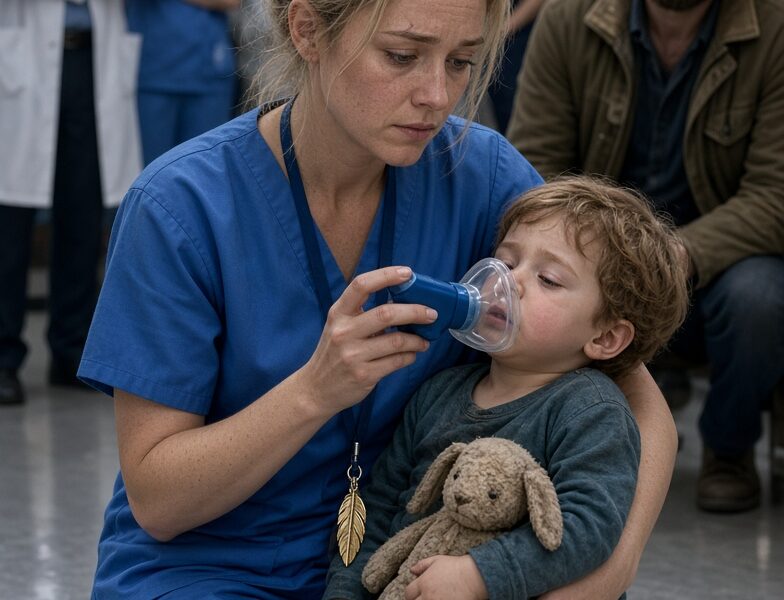
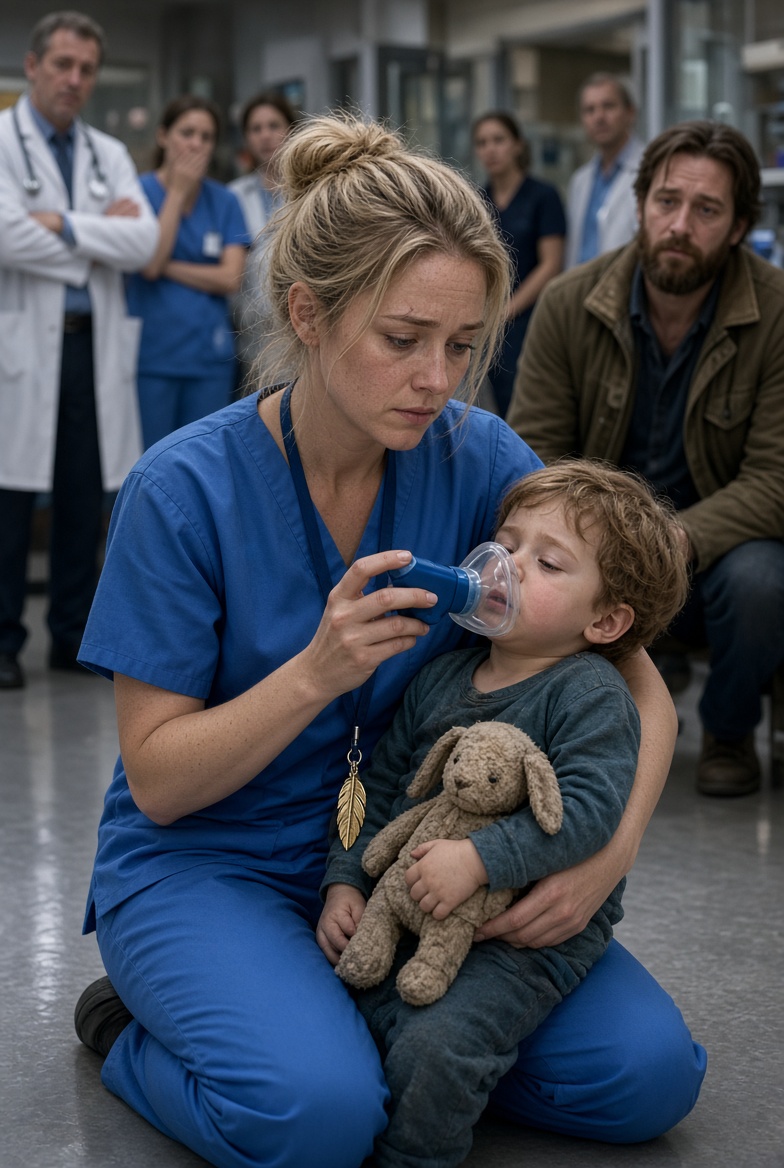
Third, she shook it, fitted it to the spacer with the soft face mask, and held the mask gently over his nose and mouth.
Fourth, she pressed the inhaler once, let him breathe slowly in and out several times, and repeated only as the plan allowed.
Fifth, someone called for emergency help immediately, because a severe attack always needs trained care, even when the child looks better.
Last, she watched his color, his ribs, and his voice, ready for oxygen the moment it arrived.
Sadie did not ask permission.
She took the backpack from Graves, found the plan on top, and read it in three seconds.
Then she found the blue inhaler and a small spacer with a soft face mask, and she lifted Theo onto her knee—upright and leaning a little forward, his back resting against her arm.
“Theo, look at me,” she said.
Her voice was low and warm, and it did not shake.
“My name is Sadie. We are going to breathe together, nice and slow. Hold your rabbit tight.”
“Denise,” she said without turning her head, “page pediatric rapid response to the lobby and bring oxygen.”
For one second, Denise looked at Thatcher.
Then she picked up the phone.
Thatcher’s face turned red.
“Step away from that child. You are not authorized to give anything to anyone. Security.”
Sadie did not look up.
She pressed the inhaler once and counted in a calm whisper.
In.
Out.
In.
Out.
In.
Out.
After a few slow breaths, the whistle in Theo’s chest changed.
His shoulders came down half an inch.
One small hand found the ear of the rabbit and held on.
Graves knelt beside them.
His voice came out rough. “Phoenix.”
“Not here,” Sadie said quietly, never taking her eyes off the boy. “Not yet. Hold his hand and keep your voice soft.”
A younger man in a gray hooded sweatshirt jogged in from the parking lot, saw the scene, and slowed.
Graves called him Mason.
Mason looked at Sadie’s hands—steady as stone on the little boy—and his mouth fell open.
“Chief,” he said, “nobody learns hands like that in a classroom.”
“No,” Graves said softly. “You learn them on a mountain.”
Two security officers arrived at a jog.
The older one, a gray-haired guard named Walters, stopped when he saw two large men and a nurse on her knees beside a child.
“Remove these men,” Thatcher said, “and remove her.”
Graves rose—not threatening, only tall.
“Doctor, I will say this one time. My nephew is breathing because of that nurse. You will not touch her.”
A hundred faces watched in the lobby, and not one of them breathed.
Then Sadie felt it in her palm.
The chest of the boy, which had been pulling so hard, was moving less—not because he was better, but because he was getting tired.
“That quiet is not better,” she said sharply. “That quiet is tired. Oxygen now.”
Thatcher saw his chance and stepped forward.
“I will take it from here. The child is agitated. Denise, bring me a sedative so he can rest.”
Sadie looked up at him for the first time in five months.
Her gray-blue eyes were level and cold.
“No, doctor. Sedating this child could slow his breathing until it stops. He is not agitated. He is exhausted and fighting for air. He needs oxygen and the pediatric resuscitation room, and he needs them now.”
Her voice was not loud, but it carried across the lobby like an order.
Thatcher blinked, speechless.
Then he found his anger.
“You are fired. Get out of my emergency room.”
“You may fire me after this child is safe,” Sadie said. “Not one second before.”
Denise stood up.
Twenty-two years of silence ended in one breath.
“Pediatric rapid response to the lobby,” she said into the phone, loud enough for everyone to hear. “Repeat, pediatric rapid response.”
Then she looked at Thatcher.
“I should have said something five months ago, Roland.”
But the pediatric team would need many minutes to push through the main hallway, where a line of stretchers waited bumper to bumper for beds.
Theo did not have many minutes.
“Chief, pick him up,” Sadie said. “Hold him upright against your shoulder and follow me. Mason, hold every door. Owen, grab the backpack and stay with me.”
Sadie ran—not toward the main hall, but toward a plain gray door beside the pharmacy that most people took for a closet.
She swiped her badge—the same badge that had cleaned every corner of this building at the order of Thatcher—and the door opened onto a bare service corridor.
Five months of mopping floors had taught her this building better than any map.
“Left at the laundry chute,” she called. “Right past the loading elevator. Straight through the swinging doors by the supply room.”
Every turn she took was exactly right.
And Graves followed—everyone followed—without a word.
Halfway down the corridor, Theo went limp against his uncle.
His chest barely moved at all.
“Stop,” Sadie said—and the word was a command, flat and sharp, a voice nobody in that hospital had ever heard from her.
Graves and Mason stopped as though a switch had been thrown.
A portable oxygen cart stood under a red light outside the dialysis room.
Sadie had checked its tank and tubing every week for five months, because it was her job to check the things nobody else wanted to check.
She pulled it free, fitted a small mask over Theo’s face, opened the valve, and laid one hand flat on his chest to feel each rise and fall.
“Stay with me, little man. Stay with me.”
For one second, the corridor lights became a ridge of black mountains and cold dirt.
A different man was bleeding under her hands.
“Stay with me, Chief.”
She had said that night in this same voice.
Then the second passed, and Sadie was back.
Ten seconds went by.
Then ten more.
Then Theo’s chest lifted and fell, and lifted again.
The ash gray of his lips slowly turned toward pink.
“Go,” Sadie said.
They ran the last forty feet and burst through the doors of the pediatric resuscitation room.
Dr. Priya Nair, the pediatric attending, was already pulling on gloves because the page from Denise had reached her.
“What do we have?”
Sadie answered in short, clean sentences—the way a report is given to a commander.
“Boy of three, severe asthma attack. Gray lips on arrival. One treatment from his own inhaler through a mask spacer. Oxygen started in the corridor. Improving but tiring. No sedation given.”
Dr. Nair looked at her for half a second.
“That is the cleanest report I have heard from a nurse in ten years. Respiratory therapy, continuous treatment now. I need IV access.”
The room moved like a machine.
Sadie stepped back against the wall and watched the numbers on the monitor climb.
Only when Theo began to cry—a thin, furious, beautiful cry—did her hands begin to tremble again.
Owen wrapped both arms around her waist and held on.
Graves stood against the far wall with his forehead pressed to the cold paint.
He had carried wounded men out of burning buildings and had never once cried in front of anyone.
Now his shoulders shook.
“Six years,” he said finally without turning around. “My brother and I looked for you for six years. Your record was sealed. Your name was gone. All we had was a call sign and a story.”
“I know,” Sadie said softly. “I wanted it that way.”
Footsteps pounded in the hall.
Dr. Thatcher stood in the doorway with two guards behind him, and beside him stood a woman in a gray suit whose face looked carved from stone.
Vivian Hobbs, the chief administrative officer of Compass Rose Naval Medical Center, wore a gray suit and a smile that never reached her eyes.
“Nurse Porter,” she said. “You abandoned your post, ignored a direct order from an attending physician, removed a patient from triage, and entered a restricted service corridor. Your review at eleven will be a formality. Security will escort you from the building afterward.”
Hobbs turned to Graves and Mason. “You gentlemen are visitors. You will wait in the lobby.”
Graves did not move. “My nephew is lying in that bed.”
“Then you may wait outside the unit.”
Thatcher stepped forward, smoothing his bow tie.
He had found his confidence again—the way a cornered man does.
“I have already entered the incident in the record,” he said. “Nurse Porter interfered with treatment. The condition of the patient worsened while he was in her care.”
Dr. Nair turned from the bed. “Roland, that is not what happened, and you know it.”
“It is what the record says,” Thatcher answered pleasantly. “You are a new attending, Priya. I would think carefully about your future.”
Sadie understood the new danger at once.
The doctor was not only going to humiliate her—he was going to turn her rescue into her mistake.
A false record could end her nursing license, and the signature on it would belong to the man everyone trusted.
Mason’s hands closed into fists.
The two security officers stepped between the men and the door, and Walters put a hand on his radio.
The room tightened like a rope.
Sadie took one step forward.
“Chief. Mason. Stand easy.”
Two words.
Graves unclenched at once.
Mason’s fists opened.
Both men—who had never taken an order from a nurse in their lives—took it from her without a blink, and the guards noticed.
Walters took his hand off the radio and looked at Sadie as if he was seeing her for the first time.
“These men are the family of a patient,” Sadie told the guards, quietly and evenly. “They will wait outside the unit. I will attend my review at eleven. I would like to hear everything that is said about me.”
Hobbs narrowed her eyes. “Then you will hear it.”
“And so will I,” said Dr. Nair.
“Denise, too.”
At 10:59, the conference room on the second floor held a long oak table, a pitcher of water nobody touched, and a very uncomfortable silence.
Hobbs sat at the head.
Thatcher sat on her right with a folder squared in front of him.
A human resources officer held a clipboard.
Sadie sat alone on the far side, small in her blue scrubs, her hands folded to hide the tremor that had returned.
Graves and Mason sat against the back wall.
Hobbs had tried to keep them out, but one line in the hospital’s contract with the Navy had stopped her.
Under the Navy Veteran Employment Partnership, any disciplinary action against a veteran employee required a liaison from the Navy to be present.
“A veteran,” Hobbs had said. “Her file lists only administrative service in the reserve.”
The door opened, and Captain Evelyn Shaw of the Navy Medical Liaison Office walked in wearing dress blues.
She took a chair by the window and opened a thick folder with a red seal.
“Please proceed,” she said. “I am only here to observe.”
Thatcher rose and began to speak the way he always spoke—as if he were reading a verdict.
He called her reckless.
He called her unqualified.
He said a rookie with no trauma training had taken a critically ill child out of triage, dragged him through a restricted corridor, and nearly killed him.
“The nurse is a danger to patients,” he said. “Frankly, she is a mouse who thinks she is a lion.”
Hobbs nodded slowly. “Nurse Porter, do you wish to respond?”
Sadie stood.
Her hands trembled against the table.
“I treated a child who could not breathe,” she said, in a voice so small that people leaned in to hear it. “I would do it again.”
“That is not a defense,” Hobbs said.
Thatcher smiled.
The door opened again.
Denise Okafor walked in without being invited, with Dr. Nair beside her.
“Twenty-two years,” Denise said. “I have worked in that emergency room for twenty-two years. For five months, I watched Dr. Thatcher mock this nurse every single day, and I stayed quiet because I was afraid. I am finished being afraid.”
She placed a small tablet on the table.
“The cameras in the lobby recorded everything. I asked security to bring it.”
Hobbs raised a hand. “Footage is not necessary.”
“I would like it shown,” Captain Shaw said without looking up from her folder.
Her voice was gentle, and nobody argued.
The screen lit up.
There was the lobby.
There was Thatcher saying, “Take a number.”
There was a small boy with lips the color of ash.
There was a quiet nurse dropping to her knees, and the way her hands went still, and the way a whole room of people fell silent as she gave one calm order after another.
When the video reached the moment when Sadie said, “You may fire me after this child is safe,” the only sound in the conference room was the hum of the air conditioner.
Thatcher cleared his throat.
“Luck is not protocol,” he said, and his voice was thinner than before. “The outcome was acceptable. The method was not.”
Captain Shaw closed her folder and finally looked up.
“Doctor Thatcher, a moment ago you said Nurse Porter has no combat or trauma experience. Is that correct?”
“It is what her file says.”
“Her file says what she asked it to say.”
The captain turned. “Petty Officer, with your permission—and under the terms of the partnership agreement, I’m authorized to read a portion of your record. May I?”
“Petty Officer?” Hobbs repeated.
Sadie lifted her eyes to the captain, then to the two men at the back wall.
She took one long breath.
“Yes, Captain.”
Captain Shaw opened the red-sealed folder.
“Hospital Corpsman First Class Sadie Porter, United States Navy, assigned to a Naval Special Warfare Team. Call sign Phoenix. Bronze Star with Combat Valor.”
The air in the room changed.
“Six years ago, in a mountain valley far from any road, she was the only medic with a team pinned down by enemy fire. A Chief Petty Officer named Samuel Mallory took a wound that should have killed him within minutes. She kept him alive for nine hours. When the helicopter could not land, she carried him on her back for two miles to a place where it could.”
Nobody in the room moved.
Hobbs had gone pale.
Thatcher stared at Sadie’s hands as if they belonged to a stranger.
From the back wall, Graves spoke, and his voice was rough.
“Sam is on a ship in the Atlantic right now. He has said your name at the dinner table every Sunday for six years. His boys know it the way other children know a superhero. The team called you Phoenix because you kept getting up when everyone expected you to stay down. Sam gave you that brass feather in a hospital in Germany. He kept the twin.”
“He did not need to,” Sadie whispered.
Captain Shaw spoke more softly now.
“On that same night, the team lost a young Marine named Jesse Tran. The petty officer could not save him. I believe she never forgave herself for the one she lost, even while the world thanked her for the one she saved. After the mission, she asked that her record be sealed, and she left the Navy within the year. She told me she only wanted to be ordinary.”
Sadie looked down at her hands.
For the first time, everyone in the room understood why they had shaken.
Captain Shaw closed the folder.
“Dr. Thatcher, I have read your incident note, and I have watched the footage. The note is false. Under the partnership agreement, a false report against a veteran employee triggers an immediate review of the physician who wrote it and of the hospital contract itself.”
She turned her eyes to Hobbs.
“Administrator, I suggest you reconsider the purpose of this meeting.”
Hobbs swallowed.
For a moment, the smile on her face simply fell off.
“This review is closed,” she said. “The write-up is withdrawn, and the incident note will be corrected.”
The human resources officer quietly closed his clipboard.
That same afternoon, Thatcher was removed from the leadership of the emergency department pending a formal peer review, and he was ordered to complete full retraining in pediatric emergencies.
But before he left the conference room, he stopped in front of Sadie, and for the first time in five months, he looked her in the eye.
“Nurse Porter,” he said, and his voice was rough. “I called you mouse because I was afraid that someone quiet might be better than me. I was right. I am sorry.”
Sadie stood.
Her hands were steady now.
She did not shout, and she did not celebrate.
“I do not want this hospital to lose a doctor,” she said. “I want it to lose the habit of looking down at the people who are trying to look up. Every new nurse who walks through those doors may be the phoenix of some family. Please do not wait six years to find out.”
The room stayed silent a long time.
Then Denise began to clap slowly, and Dr. Nair joined her, and then even the guard named Walters, standing by the door, lowered his head in respect.
Theo went home two days later with a clear chest and a firm rule from his doctor about carrying the blue inhaler everywhere.
Before the family left, Graves held a phone up in front of Sadie.
On the screen, a tired man in a navy shirt sat in a steel cabin on a ship, and he smiled.
“Hello, Phoenix,” Sam Mallory said.
“Please call me Sadie,” she answered.
“Sadie.” He stopped and started again. “You saved me on a mountain. Now you saved my son. I do not know how to thank someone twice.”
“You just did,” she said.
Graves placed a small box in her hand.
Inside lay a second brass feather, a little worn at the edges.
“Sam wants you to have both,” he said.
Sadie hung it on her lanyard next to the first one, and the two feathers touched with a small, bright sound.
The next morning, the huddle at the nurses’ station began differently.
Denise Okafor stood in front of the staff and said, “From now on, the newest nurse in the room speaks first.”
Every head turned to Sadie.
She lifted her chin, looked straight at forty faces, and gave the first report of the day in a voice that did not shake.
Nobody laughed.
Nobody studied their shoes.
Back in the supply room, the paper sign from her cart lay folded in the trash.
On the wall of the lobby, beneath the great painting of the warship, someone had taped a new sign in careful handwriting.
It said, “Look up before you look down.”
Sadie Porter was never small.
She had only been quiet, and now the whole hospital knew the difference.
A loud voice was never what she needed.
She only needed a reason to use it.
The end.
Here is a quick recap of what Sadie did, so you can remember it if you ever need it.
A severe asthma attack in a child is an emergency.
Keep the child sitting upright, leaning slightly forward, and keep your own voice calm.
Find the action plan and the quick-relief inhaler—usually blue—and use it with a spacer, one puff at a time, exactly as the plan says.
Call for emergency help right away, even if the child seems to improve.
Watch for gray or blue lips, a child who cannot speak, ribs pulling inward, and a chest that has gone quiet, because quiet can mean tired.
Never lay the child flat, and let trained professionals take over as soon as they arrive.
This story is for education and does not replace certified training or real emergency services.
The moral of this story is simple.
Quiet people are not weak people, and the ones who look the smallest in the room are often the ones carrying the most.
Treat every person with respect before you know who they are, because you may be standing beside someone who once carried a life on their back.
And remember, anyone can learn these skills.
A short first aid class can turn an ordinary person into the one who stays calm when everyone else freezes.
If this story reminded you that kindness costs nothing, please like this video, subscribe to the Life of Rookie Nurse, and comment with one person who deserves more respect in your life.
Thank you for listening, and we will see you in the next story.









