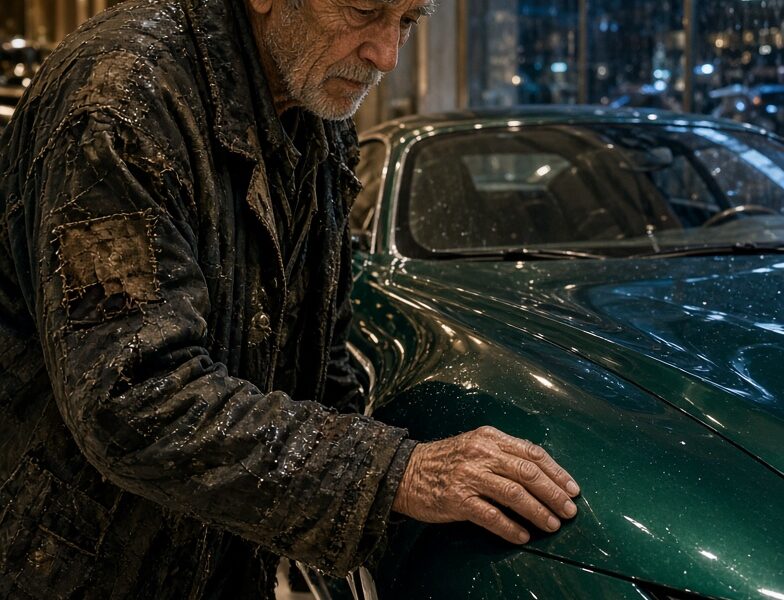
They Mocked the Old Man in the Patched Coat… Then He Bought the Entire Showroom
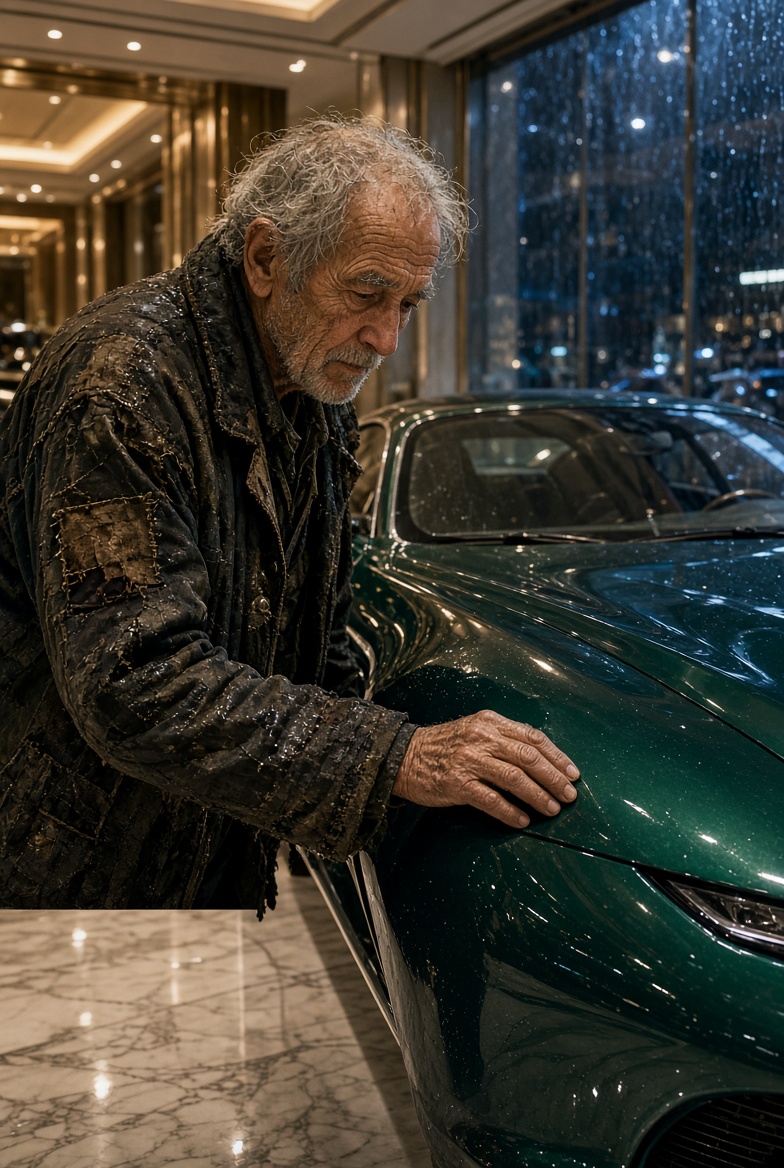
The rain came down in sheets that October night, turning the gleaming windows of Sterling Motors into blurred mirrors of neon and regret. Arthur Harrison stood outside, his breath fogging in the cold air, watching droplets trace paths down the glass like tears on a face. His coat—an old thing, patched at the elbows, smelling of motor oil and memory—clung to his shoulders, soaked through in three places where the seams had given up years ago.
A woman in a mink stole burst from the showroom doors, her heels clicking an angry rhythm on the wet pavement. She nearly collided with him, then recoiled as if he carried something contagious.
“Get away from that car, you filthy old man!” Her voice cut through the rain. “Wipe that floor before I throw you out!”
Arthur blinked water from his eyes. The floor inside—the pristine marble floor he’d admired through the window—was indeed marked with wet footprints. His footprints. He looked down at his shoes, at the holes where his socks peeked through, at the brown water pooling around them on the white stone.
“Please,” he said softly, not to her but to the air, to the night, to no one. “My wife’s photograph. It’s so cold tonight. Everything’s soaked.”
His fingers found the inside pocket of his coat, where a small leather case—worn smooth from decades of touch—held the only picture he had left of Margaret. The rain had somehow gotten even to that, streaking across the glass frame, obscuring her smile.
Come on, Richard. Keep moving. That green. Unbelievable.
A man’s voice, smooth and oily, drifted from the doorway. Richard. The name felt like a splinter under Arthur’s skin. Richard Vandermeer, the showroom manager, a man who wore his contempt like cologne.
“You’re even prettier up close,” Richard was saying to someone inside, his voice dripping with a charm that curdled on contact with the air.
Arthur stepped through the doors, drawn by the light, by the warmth, by the impossible green of the car displayed at the center of the room. The color of hope, Margaret had called it. The exact shade of the meadow behind their first garage, where they’d parked the first car they ever fixed together and watched the sun come up over forty acres of Wisconsin farmland.
“Excuse me,” he said, his voice barely a whisper. “May I look?”
The room fell silent. A saleswoman—young, sharp-suited, with kindness still visible behind her professional mask—turned toward him. Her name tag read Emily Parker.
“Who let him inside?” Richard’s voice cracked through the quiet like a whip.
A woman at the reception desk—Vanessa, according to her brass nameplate—rose from her chair. She was all angles and expensive perfume, a watch on her wrist that cost more than most people’s cars glittering under the spotlights. She looked at Arthur the way one might examine a stain on a white sofa.
“Sir, you’re soaked. Please take this.” Emily stepped forward, reaching for a towel that had been folded on a nearby display. She handed it to him without hesitation, her eyes meeting his with something that looked almost like recognition.
“Thank you,” Arthur said. He dabbed at his face, his hair, the precious bulge in his coat pocket. “Look at these lines.” He gestured toward the car—the green car—his voice trembling. “I never thought I’d see her again.”
Richard stormed across the showroom floor. “Who touched our display car?”
“He put his mouth on our car,” Margaret—no, not Margaret, a customer named Margaret who wore the same name like an insult to his wife’s memory—sneered from her position near the vehicle. She was draped in diamonds and disdain, her husband trailing behind her like a well-dressed shadow. “Clean your mess now.”
Arthur looked down at the hood of the car. There, in the polish so bright it reflected the ceiling lights like a mirror, was a small smudge. The imprint of lips pressed against metal. A kiss for the ghost of a woman who had loved the color green.
“You don’t have to do that, sir,” Emily said, stepping between Arthur and the car. She pulled a microfiber cloth from her pocket. “I’ll take care of it.”
Richard grabbed her arm. “Emily, my desk. Now.”
But Emily didn’t move. “What’s in that disgusting bag?”
The question came from Vanessa, who had crept closer, her eyes fixed on the canvas satchel slung across Arthur’s shoulder. It was old, military surplus, stained with years of work and weather.
“Oops,” Vanessa said, and the word was a weapon. She reached out and tipped the bag, watching as its contents spilled across the marble floor. “Slippery hands.”
Papers scattered. A wrench. A small tin of machine oil. A photograph—the one that had been in Arthur’s coat, now face-up on the cold stone—showing a young woman with kind eyes standing in front of a garage, a green car visible behind her.
“I’m sorry, Margaret,” Arthur whispered, kneeling to gather his things. His hands were shaking.
“Show everyone what he did,” Margaret the customer demanded, her voice rising. “Go on. Show them.”
“I came to ask about the car.” Arthur stood, clutching his bag to his chest. “Does it have the hand-stitched seats?”
The room had gone quiet again. Somewhere in the back, a phone was ringing, but no one moved to answer it. Richard’s face was a mask of controlled fury.
“Yes, sir,” Emily said, stepping forward. “The seats are hand-stitched. Eighteen hours of work per seat.”
“Could I arrange a test drive?”
Richard laughed—a short, ugly sound. “Everyone may request an appointment. We’ll see if one becomes available.”
“Thank you, Emily,” Arthur said, ignoring Richard completely. “I mean it.”
Richard’s composure cracked. “At least make yourself useful, Emily. He’s a customer, not your cleaner. My desk. Right now. And cancel his appointment.”
“He hasn’t broken any rule,” Emily protested.
“You’re humiliating a guest,” Richard hissed.
Emily’s jaw tightened. “Then I don’t want to cause trouble.” She turned to Arthur. “Please sit down and warm up. Here—” She guided him to a chair near the window, the warmest spot in the showroom. “It’s warm. Take your time.”
Arthur settled into the chair, his wet coat leaving a dark stain on the leather. He looked up at Emily, at the green car reflected in her eyes. “Is that from your old workshop?”
She followed his gaze. “From the first door I ever opened.”
“What makes that car so special?”
Emily paused. She glanced at Richard, who was watching them with the intensity of a hawk. Then she said, quietly, “The chairman’s wife called it the color of hope.”
Arthur’s breath caught. He looked at the car—really looked at it—and for a moment, he was fifty years younger, standing in a meadow in Wisconsin, watching the sunrise paint everything gold.
“Your little visit has a cleaning fee,” Richard announced, appearing at Arthur’s elbow. “Five hundred dollars. For the floor, the car, the disruption.”
“There is no such fee,” Emily said.
“We’ll see about that.” Richard’s smile was thin. “Then make him the problem.”
Vanessa had returned to her desk, where she was speaking in low, urgent tones to someone on the phone. Arthur noticed her eyes flicker to his wrist—to the watch he wore, an old Timex with a cracked face and a band held together with electrical tape.
Then she reached down and picked something up from the floor near Arthur’s chair—something that glinted.
“That watch is insured,” Vanessa said, her voice carrying across the room. “For eighty thousand dollars.”
Everyone turned. She was holding a men’s Rolex, its gold face catching the light. Arthur’s wrist, with its taped-together Timex, was bare of any such object.
“One missing watch,” Richard said, his voice dripping with satisfaction. “One suspect.”
“Make it quick,” Margaret the customer called out. “Some of us have dinner reservations.”
“May I see the warranty booklet?” Arthur asked, his voice calm. “For the car?”
Vanessa’s face twisted. “What are you doing?”
Emily stepped forward. “That bag was closed. I watched him spill it—nothing like that came out.”
“Nobody leaves,” Richard announced. “An item is missing.”
“The watch was in my bag,” Arthur said. “But I’ve never seen it before.”
“Caught red-handed,” Margaret crowed.
“Then check the security footage,” Arthur said.
Richard’s smile widened. “That camera is offline.”
“No, it isn’t.” A new voice—another salesperson, a young man named Daniel—spoke up from the corner. “I checked the system this morning. All cameras are recording.”
“Then I need a clean copy,” Arthur said. “Sign this and leave quietly.” Richard thrust a paper at him—a confession, pre-written, with a pen attached.
“I won’t confess to a lie.”
“He won’t even cooperate,” Vanessa said, her voice rising. “Do something.”
Emily stepped between Arthur and the manager. “Stop staging this humiliation and restore his status now.”
“You can leave with him,” Richard said.
Emily didn’t move. “Then I choose what’s right.”
Richard pulled out his phone. “Then you’re fired. Effective immediately.”
“You lost your job for me,” Arthur said, looking up at Emily.
She met his eyes. “I’d do it again.”
From somewhere in the back of the showroom, a door opened. A woman in a simple gray dress—Margaret the customer, but a different Margaret, this one softer, kinder—stepped into the room. She looked at Arthur, at Emily, at the chaos around them.
“Margaret,” Arthur said, his voice breaking. “What would you say? You haven’t eaten, have you?”
The woman frowned. “My father was judged by his clothes, too.” She looked at Emily. “And nobody stood up for him. That’s why I stand up now.”
She walked to Arthur and took his hand. “Maybe today can change something. First, get warm.”
“I’m not leaving this unfinished,” Arthur said. He squeezed her hand, then released it. “I’d like to speak to the manager again.”
“You again?” Richard appeared from his office, his face red with anger. “Haven’t you had enough?”
Arthur stood. He straightened his coat—the old, patched coat that had seen fifty years of winters—and walked toward the car. The green car. The one with the hand-stitched seats.
“I’d like to buy every one of them,” he said.
“Every what?”
“Every car in this showroom. All eighteen.”
Richard’s mouth fell open. “You’re joking.”
“That’s twenty-five million dollars,” Vanessa said, her voice a squeak.
Arthur reached into his coat—the same coat they’d mocked, the same coat that had held his wife’s photograph—and withdrew a black card. It was unmarked except for a single logo: a stylized letter H, embossed in platinum.
“A black card,” Richard said, laughing. “Cute prop.”
“Please process the purchase.”
“We don’t accept pretend money.”
“Then verify it properly.” Arthur held the card out. “The terminal can verify it.”
Richard’s eyes narrowed. “Fine. Let’s watch it fail.”
He took the card and swiped it through the terminal on his desk. The screen flickered. A loading icon appeared. Then another.
“Take your time,” Arthur said, settling back into the leather chair.
Richard’s face went pale. “Why is it calling private banking?”
“It’s just a routine check,” Emily said, but she was looking at Arthur with new eyes.
A phone rang—the landline on Richard’s desk. He picked it up as if it were a snake.
“Chairman Harrison’s office,” a voice on the other end said. “We have an authorization request from your terminal. Please confirm the purchaser’s identity.”
Richard dropped the phone. It clattered on the desk, the voice still echoing from the speaker.
“Chairman Harrison,” Arthur said quietly, “here.”
The room erupted. Vanessa was on her feet, her face white. Margaret the customer—the first one, the cruel one—was backing toward the door. Richard stood frozen, the black card still in his hand, as if it had turned to stone.
“Victor, what’s wrong?” Arthur asked the phone, his tone gentle.
“It’s a banking error,” Victor stammered. “We’ll fix it immediately—”
“No error,” Arthur said. “Daniel, it’s time. Bring the ownership papers.”
A young man in the back—the same Daniel who had spoken up about the security cameras—stepped forward. He was holding a leather portfolio. “Sterling Motors. Understood, chairman. On my way.”
“Now he’s pretending to be a chairman,” Richard said, but his voice had lost its venom. It was the voice of a man watching his world collapse.
“You will know soon enough,” Arthur said.
The showroom doors burst open. A team of lawyers in dark suits swept in like a tide, carrying briefcases and tablets. Behind them, a small army of security personnel—not the rent-a-cops Sterling employed, but professionals with earpieces and blank faces.
“There it is,” Arthur said, nodding toward the lawyers. “The whole truth. They need to see this. Enjoy the showroom.”
“I want the security footage first,” Emily said. She was still standing, still holding her ground, still fighting.
Arthur looked at her with something like pride. “I won’t buy where guests are bullied.”
“Who are all those people?” Margaret the customer whispered.
The lead lawyer approached. “Where is Mr. Harrison?”
A man in a gray suit stepped forward—the general manager, based on his nameplate. “Welcome. I’m—”
“I’m not here for you,” Arthur said.
The general manager’s face went slack as he recognized the man standing before him—not the old man in the patched coat, but the man behind the coat. The man whose face appeared in Forbes every quarter, who owned forty-seven percent of the company that owned this showroom.
“Chairman Harrison,” the general manager said, bowing slightly. “I apologize for the delay. You arrived at the right time.”
“That man is the chairman,” someone whispered—maybe Margaret, maybe Vanessa, maybe Richard. “This can’t be happening. He owns the company that owns this showroom.”
Arthur reached into his pocket and withdrew a small object—a key, brass and worn, the teeth rounded from decades of use. “I opened my first garage with this key,” he said. “I was eighteen. My wife—my Margaret—she chose the color of the car. That green. The color of hope.”
The general manager stepped forward. “Sir, I didn’t recognize you.”
“Would respect require recognition?”
“Please give me one more chance.”
Arthur turned to face him fully. “You mock the one thing I treasure.” His voice was quiet, but it carried to every corner of the showroom. “I was wrong,” he continued, “to think that a man’s clothes told the truth of him. A guest is a guest, rich or poor. That was my wife’s saying. She learned it from her father, who learned it from his. Now I see you’ve forgotten it.”
“Sir, please—”
“You put it in his bag,” Emily said, her voice cutting through the room. She was looking at Richard. “The watch. You told Vanessa to accuse him. Let’s review the original recording.” She pointed to the security monitor in the corner. “Watch the left side of the frame.”
All eyes turned to the screen. There, in grainy black and white, was Richard Vandermeer—fifty years old, paunchy, sweating—slipping the Rolex into Arthur’s canvas bag while Arthur knelt to gather his spilled belongings. The timestamp was visible. The crime was undeniable.
“No,” Richard said. “I can explain—”
“She framed an innocent man,” Emily said.
Arthur nodded. “I knew he was telling the truth. The truth matters.” He turned to the general manager. “So does dignity. You are suspended pending investigation.”
“Fifteen years,” Richard said, his voice small. “I’ve been here fifteen years.”
“Fifteen years should have taught you better.” Arthur’s voice was not angry. It was worse—it was disappointed.
“Please,” Richard begged. “I’ll give everything back—”
“Keep your property. Return your badge.”
Richard’s hands shook as he unpinned the badge from his lapel. He placed it on the desk and walked toward the door, past the lawyers, past the security guards, past Emily—who watched him go without pity.
“I’m sorry, Mr. Harrison,” the general manager said.
“Apologize to the man you thought was poor,” Arthur said. He gestured toward himself, toward the patched coat, toward the taped-together watch. “I’m sorry I treated you that way,” the general manager said, his eyes on the floor.
“I hear you,” Arthur said. “Accountability still matters.” He paused. “Time to start over.”
The general manager nodded and walked away, his career dissolving behind him.
“Emily Parker,” Arthur said.
Emily looked up, her face pale. “Me? But I was fired.”
“That decision is being reversed.” Arthur smiled—the first real smile he’d shown all night. “You saw a person, not a price tag.”
“I didn’t know who you were.”
“That’s exactly why it mattered.” He reached out and took her hand. “We’d like to offer you management training. A full program. And a position—if you want it.”
Emily’s eyes filled with tears. “I never expected this.”
Arthur squeezed her hand. “Neither did I. But that’s life, isn’t it? The unexpected.”
He turned to the small crowd of customers, salespeople, and lawyers who had gathered to watch. “And Mr. Miller—” he gestured to a man in the back, the janitor who had been standing silently with his mop, “—protected the truth. He could have stayed quiet. He didn’t. He called the number I’d given him—”
“Wait,” Emily said. “You knew? You knew something like this might happen?”
“I hoped,” Arthur said. “My wife, Margaret, she funded our first garage. She chose this green.” He walked to the car and rested his hand on the hood. “She called it the color of hope. She said—she said hope was the only thing worth having. That it was worth more than money, more than pride, more than anything.”
He turned to the small crowd of customers, salespeople, and lawyers who had gathered to watch. “Your car is ready, chairman,” Daniel said, stepping forward with a set of keys.
Arthur took the keys. He ran his fingers over the metal, then looked at the car—the green car, the color of hope—and for a moment, he was fifty years younger, standing in a meadow, watching the sun come up.
“I wish she could see it,” he said.
“She’d be proud of you,” Emily said.
Arthur looked at her—at the kindness in her eyes, the courage in her stance—and nodded. “I’ll keep this old coat,” he said. “Maybe it will remind me.”
He walked to the driver’s side door and opened it. The interior was hand-stitched leather, the color of cream, the color of old letters, the color of Margaret’s favorite dress. He slid behind the wheel and started the engine. It purred—a sound like satisfaction, like hope, like the beginning of something new.
“Drive safely, Mr. Harrison,” Emily called.
Arthur looked at her through the window. “I will,” he said. “And Emily—”
“Yes?”
“Kindness is worth more than any car.”
He drove out of the showroom and into the rain. The green car glistened under the streetlights, its color deepening as the water washed it clean. And inside, in his patched coat pocket, next to a photograph of a woman with kind eyes, the truth waited—not as a weapon, but as a seed.
The color of hope.
The color of home.
—
The rain followed him out of the city, past the suburbs, past the exit signs for towns he’d never visited. Arthur Harrison drove with the wipers on high, listening to the rhythm they made against the windshield. It was the same rhythm he’d heard in the garage sixty years ago, when he and Margaret had fixed their first car and driven it all night just to feel the wind.
He passed a green highway sign—exit 47—and thought of the car’s green. The color of hope, Margaret had said. She’d chosen it for their first garage: a small building on the edge of town, paint peeling, roof leaking, but full of light. She’d stood in the doorway on the first day and said, “This is it, Arthur. This is our hope.”
He’d laughed. “It’s a garage.”
“It’s a start,” she’d said.
He pulled into a rest stop twenty miles later, the car idling quietly while he sat in the dark. The rain had softened to a mist, the kind that clung to the trees and made everything look like a memory. He reached into his coat pocket and pulled out the photograph—the one Vanessa had spilled, the one the lawyer had bagged as evidence, the one he’d reclaimed at the end of the night.
Margaret looked out at him from the frame, standing in front of the first garage, a car behind her—not the green one, not yet, but a blue Ford she’d bought at auction for three hundred dollars. She was smiling, her hair pulled back, her hands on her hips like she was ready for anything.
“I did it, Margaret,” Arthur said. “I did it for you.”
The photograph didn’t answer. It never did. But he could almost hear her voice—that dry, warm voice—saying, “You did it for you, Arthur. I just gave you the color.”
He put the photograph back in his pocket and started the car. The road stretched ahead, dark and wet and full of possibilities. Behind him, the city glowed against the clouds; ahead, the highway curved toward the mountains.
Somewhere in the distance, a sign advertised a motel. Arthur smiled and drove toward it, the green car humming like a promise.
He would rest tonight. Tomorrow, he would start over. That was the thing about hope—it never ran out. It just changed color, changed shape, changed form. But it was always there, waiting.
The color of hope.
The color of home.
The color of a woman who had believed in him when he had nothing but a wrench and a dream.
Arthur Harrison drove on.
—
The morning came gray and soft, the way mornings do in the mountains. Arthur woke in a motel room that smelled of pine and old carpet, the green car parked outside his door like a faithful dog. He showered, dressed in the same patched coat, and walked to the diner next door.
The waitress—a woman in her sixties with kind eyes and a tired smile—seated him by the window. She didn’t look at his coat. She didn’t look at his shoes. She looked at his face, at the lines around his eyes, at the way he held his coffee cup like it was a treasure.
“What can I get you, honey?” she asked.
“Pancakes,” Arthur said. “And coffee. Black.”
She nodded and walked away. Arthur watched her go, then looked out the window at the green car. The sun had broken through the clouds, and the color of the car—the color of hope—caught the light like something alive.
His phone buzzed. A text from Emily: “The lawyers found three more employees who were treated badly. Richard’s been arrested. The manager resigned. We’re cleaning house.”
Arthur typed back: “Good. Take care of them.”
“We will,” Emily wrote. “Thank you, Mr. Harrison.”
He put the phone down and picked up his coffee. The waitress returned with pancakes—three of them, golden and steaming, with butter melting in the center. Arthur smiled.
“Everything okay?” she asked.
“Everything’s fine,” he said. “Better than fine.”
He ate his pancakes and watched the sun rise over the mountains. And in his pocket, next to a photograph of a woman with kind eyes, the truth waited—not as a weapon, not as a secret, but as a seed.
The color of hope.
The color of home.
The color of a new beginning.
Arthur Harrison finished his breakfast, paid his bill, and walked out into the morning. The green car was waiting. The road was waiting. Life was waiting.
And he was ready.









