They Mocked the New Nurse and Made Her Serve Coffee—Then an Admiral Revealed Who She Really Was
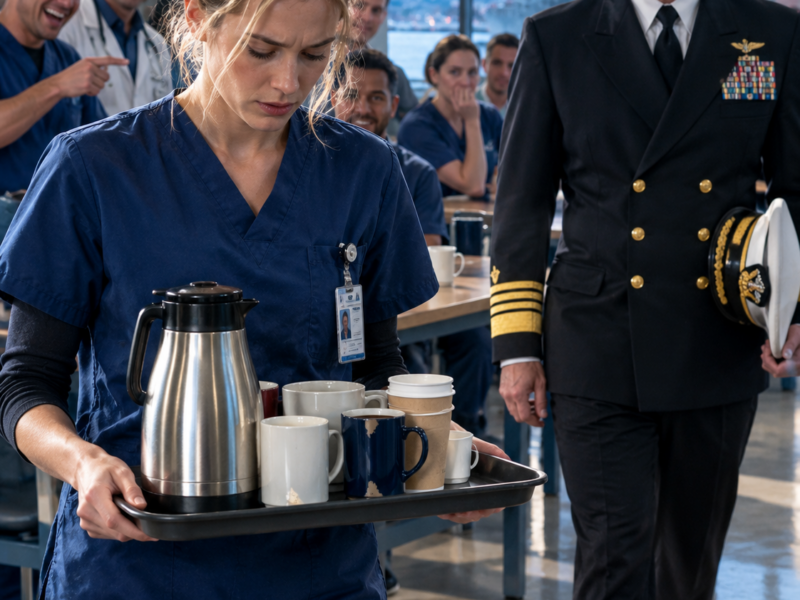
In the Naval Hospital cafeteria, the new nurse hears the chief doctor order: “Since you’re the rookie, serve everyone’s coffee.”
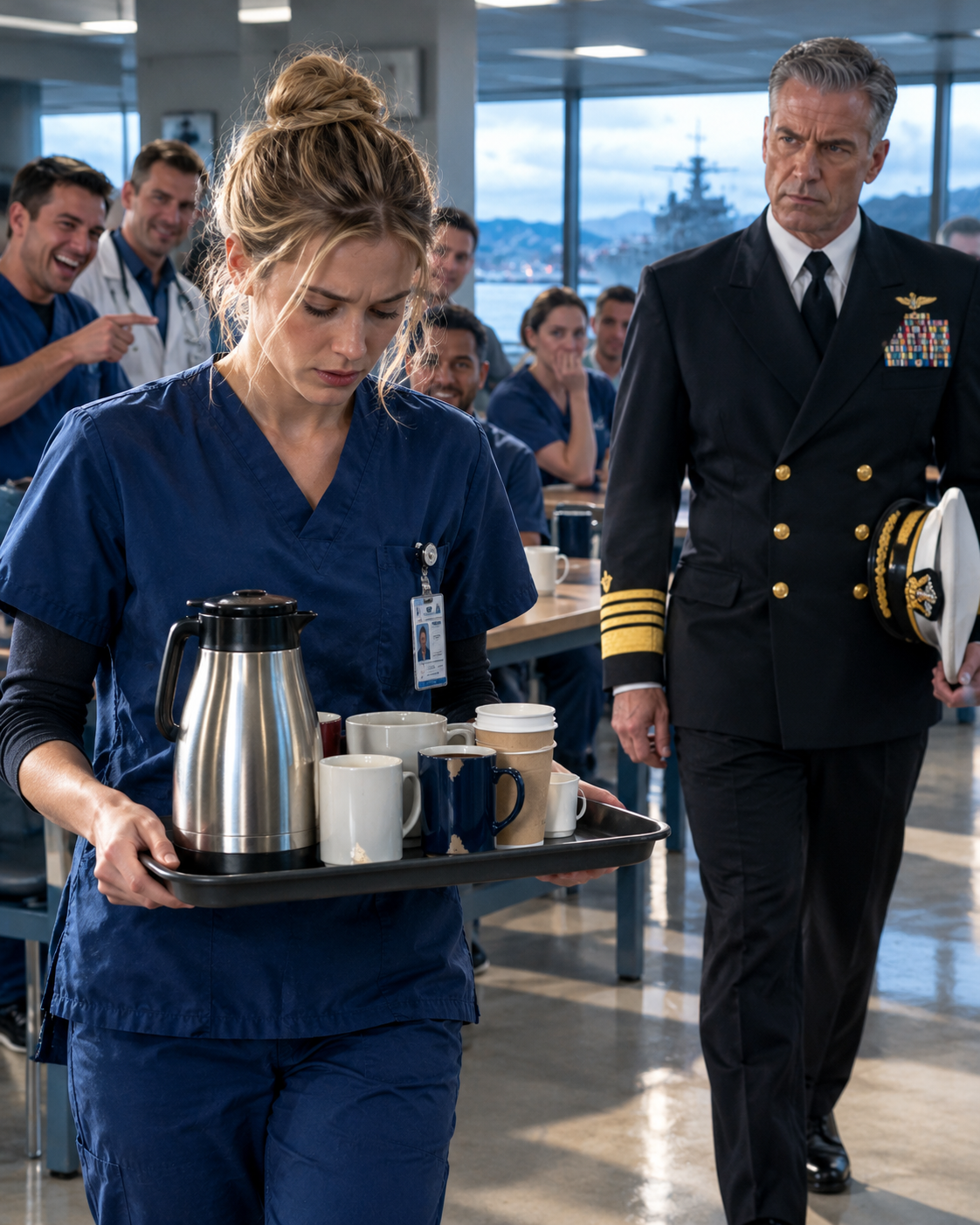
She crosses the room with her head down, the tray trembling in her hands.
Doctors and residents burst out laughing and point at her, and no one imagines who is carrying that tray.
While she walks in silence, swallowing the humiliation, the laughter stops all at once.
An admiral in full dress uniform walks into the cafeteria with his eyes locked on her, and what he says in front of everyone makes the man who humiliated her realize he has made the costliest mistake of his career.
“Serve the coffee, rookie. Every cup. And smile while you do it.”
Dr. Brent Hollander said it loud enough for the whole cafeteria to hear.
Paige Kendrick stood at the counter in Navy scrubs, her blonde hair twisted into a messy bun, her hospital badge three weeks old.
“Sir, I was told to report to the floor,” she said quietly.
“Tradition,” Hollander said, and he grinned at the table behind him. “Every new nurse in my ER pours the first round. Isn’t that right, gentlemen?”
Laughter rolled across the room.
Dr. Kyle Dunn slapped the steel tabletop.
Dr. Andre Wells shook his head, but he was smiling.
Dr. Elena Ruiz pressed a hand over her mouth.
It was not a tradition.
Paige had asked the night nurses the day before.
Hollander had made it up for her.
A charge nurse had explained it with a shrug. He picks the quiet ones. They never push back.
Paige looked at the counter.
A steel carafe full to the brim. Four paper cups. Six white mugs. One navy mug with a chipped handle.
A tray that was already too small.
She loaded it anyway.
Sandpoint Naval Medical Center sat on a hill above the harbor.
Through the tall windows, gray ships rested at their piers.
Paige kept her eyes off the water.
She lifted the tray. It weighed maybe twelve pounds.
She had carried far more across a pitching deck in the dark.
Her hands shook anyway.
Let them see the shaking. Let them think it was fear.
It was not fear. It was something older.
“Careful, sweetheart,” Hollander called. “That carafe costs more than your paycheck.”
Someone raised a phone. Someone whispered, “Post it.”
Paige walked.
The first table belonged to the residents.
Dunn leaned back in his teal scrubs. “Black, no sugar. And don’t spill it on my shoes.”
She set the mug down. She poured.
Not one drop landed outside the rim, and the tray never tilted.
Dr. Wells watched her hands.
He wore a surgical cap and a puzzled frown.
“You move like the floor is moving,” he said, almost to himself.
Paige’s eyes flickered. “Long shifts, Doctor.”
“Ooh, a comedian,” Hollander said. “Keep walking, rookie. Table by table.”
She kept walking. A paper cup, a mug, a paper cup.
The room blurred into a rhythm she knew too well.
Her mind slid sideways.
Black water. A man’s weight in her arms. A voice in her ear saying her name.
She pushed the picture down. Eyes up. Pour. Next.
At the window table she stopped for one second too long.
Out in the channel, a gray harbor patrol boat rode low in the chop.
Too low.
The stern sat deep and the whole hull leaned a few degrees to port.
The water out there was forty-nine degrees.
That boat is taking on water, she thought.
Her stomach tightened.
She looked toward the charge desk, then at Hollander, laughing with his phone out.
Not my place, she told herself. I’m just a nurse here.
That was the deal she had made with her life.
“Hey, rookie.” Hollander shouted. “My cup, lots of cream. And after this, there are forty trays in the kitchen. Hospitals need tough people.”
The room howled.
Paige’s cheeks burned.
She turned toward his table with the last two mugs.
Then the sound in the room changed.
Laughter did not end all at once. It thinned table by table like a tide going out.
Spoons stopped. Phones lowered.
At the far end, the double doors had opened.
A man in Navy dress blues walked through.
Gray hair, wide gold stripes on his sleeves, gold wings above a wall of ribbons.
A white cover tucked under one arm.
His face was set like stone. His jaw was tight.
His eyes had found the tray first, then the trembling hands holding it.
Then they found her face. He didn’t blink.
The cafeteria went completely, painfully silent.
The admiral crossed the room without hurrying. Every footstep echoed off the tile.
Chairs scraped. Doctors stood.
Hollander shot to his feet, buttoning his white coat with clumsy fingers.
“Admiral Dunore,” he said. “Sir, what an honor. We weren’t informed you were visiting.”
The admiral didn’t look at him. He didn’t look at anyone.
He stopped three feet from Paige and the shaking tray.
His eyes moved over her face, the messy bun, the pale scar across her left palm where the tray’s edge pressed it, the thin white line behind her ear.
His jaw worked once.
“Put the tray down,” he said. His voice was low and rough.
Paige set it on the nearest table. Cups rattled.
Her hands dropped to her sides, fingers straight, thumbs along the seams of her scrubs.
“Old habit,” she said. “Attention, sir.”
Hollander tried again. “This is just a little orientation exercise. Our new nurse is—”
The admiral raised one finger.
Hollander’s mouth snapped shut.
The admiral turned back to her.
“Eight years,” he said. “I have been looking for you for eight years.”
Paige’s throat moved. “Sir, I think you have the wrong person.”
“February. The North Pacific. Forty-one-degree water at night.” He spoke quietly, but every table could hear. “A fighter pilot hung in his own parachute lines, going under.”
Dunn’s grin froze.
“A woman dropped out of a helicopter without waiting for the all clear. She cut me loose. She held my head above water for twenty-eight minutes.”
His voice cracked.
“When I stopped breathing, she breathed for me.”
Nobody moved.
Dr. Ruiz’s hand fell slowly from her mouth.
“She told me the same two sentences over and over the whole time.”
Paige’s lips parted before she could stop them.
“Eyes on me, sir. Stay with me.”
A sound passed through the room, a low collective breath.
The admiral’s eyes shone.
“Seabird,” he said.
Nobody in this building had called her that.
Nobody in eight years.
Her knees almost gave out. She locked them. She had been trained to.
Hollander laughed. It came out thin and wrong.
“Sir, with respect, there’s some mistake. She’s a nurse. Three weeks on the floor. Yesterday she dropped a bedpan.”
She had not dropped a bedpan. Dunn had bumped her.
She had never corrected the story.
“Then I’ll watch her work, Doctor,” the admiral said without turning his head. “I’m not here to take your department. Not today.”
Hollander swallowed. “Of course, sir.”
“I read your orientation policy on the way up the hill,” the admiral added. “We will talk about it.”
Hollander went gray.
Paige stared at the floor, her heart hammering.
After all this time, someone had found her, and she wanted to run.
“Why now, sir?” she whispered.
“Last month the survival school sent me a training film,” he said. “Fourteen seconds of rescue technique they still teach. The swimmer in it was you. They had the wrong name on the file. It took me three weeks to find the right one.”
The wall speakers crackled.
“Attention. Attention. Harbor patrol boat capsized at Pier 4. Five in the water. Multiple cold exposure casualties. First ambulance four minutes out. All trauma staff to the bay.”
Paige’s head snapped toward the window.
The patrol boat was gone.
Only a ring of foam and a bobbing orange buoy marked the place.
“That boat,” she said. “I saw it going down at the stern twenty minutes ago.”
Hollander stared. “You saw it and you said nothing.”
“Yes, sir.” Her voice broke. “I thought it wasn’t my place.”
“It always was,” the admiral said without anger.
“Go.”
She was already moving.
Hollander recovered and hurried after her, shouting, “Nurse! Bay two!”
“Get warm blankets,” Paige said without slowing. “I need warmed saline at 104 degrees, two forced-air warmers, a chest tube tray, bedside ultrasound, and call cardiac surgery. Tell them to ready the ECMO team now.”
“I run this department.”
“Then run it, sir.” She hit the double doors with her palm. “Just make that call.”
Hollander opened his mouth.
Behind him, Admiral Dunore said calmly, “Make the call.”
Hollander made the call.
Outside, sirens climbed the hill.
The ambulance bay doors banged open, and cold air rolled in, smelling of salt and diesel.
The first stretcher hit the bay at a run.
“Seaman Luke Harmon,” the paramedic called. “Nineteen years old, twenty minutes in the water, shivering, slurred speech. Core 91.”
“Warm room, bay one,” Paige said. “Cut the wet clothes off. Don’t rub his arms. Move him gently.”
Dr. Ruiz hesitated. “Rubbing helps circulation, doesn’t it?”
“Not here. Cold blood in the limbs rushes back to the heart. It can trigger an arrhythmia.” Paige’s tone was calm and fast. “Keep him flat. Warm blankets on the chest first. Warm sweet drinks only if he can swallow.”
Ruiz nodded and moved.
The second stretcher came in.
“Petty Officer Ree Cutler, confused and slow. Core 88.”
Paige pointed him to bay two with one hand and caught the third stretcher rail with the other.
The paramedics’ faces had changed. Their eyes were wide and tired.
“Petty Officer Sam Delgado,” the lead medic said. “Thirty-one. Found under the hull. Forty-one minutes in the water. No pulse on scene. Our corpsman has been doing compressions for twelve minutes. Core temperature 76.”
Paige’s hands moved before the medic finished.
Carotid pulse. She held it for a full minute, not ten seconds.
Nothing.
The monitor showed a jagged fine line.
Her fingers found his wrist, then his neck again.
The skin felt like cold stone.
His jaw was stiff, but his pupils were not fixed and blown.
That mattered.
She noted it and said nothing.
“Fine ventricular fibrillation,” Dr. Wells said quietly.
Hollander arrived at the foot of the bed.
He looked at the monitor, at the blue-gray face, at the clock.
“Forty-one minutes under cold water, no pulse, no response.” He sighed. “We don’t spend resources on this. Call it.”
Dr. Dunn shifted. “Sir, the guidelines for hypothermia say—”
“I know the guidelines, Kyle.”
“Don’t stop,” Paige said.
Everyone in the bay looked at her.
“Nurse Kendrick,” Hollander said slowly, as if talking to a child. “You’ve been here three weeks. I’ve run this ER for eleven years. This man is dead.”
“He’s cold, sir.” Her voice was steady now. The tremor was gone from her hands. “A cold heart can sit silent for a long time and still start again. Nobody is dead until they’re warm and dead.”
“That’s a slogan.”
“It’s physiology. His brain is cooled. It’s using almost no oxygen. He has time. He doesn’t have much, but he has time.”
Hollander’s face reddened.
Dunn and Ruiz exchanged glances.
Wells looked at the monitor.
A hundred eyes seemed to bore into the room.
“Two minutes,” Hollander snapped. “Compressions. If nothing changes, we call it. Is that clear?”
“Sir, two minutes is not enough.”
“Is that clear, nurse?”
Paige looked at the face on the bed.
Young. Tattoo of an anchor on the forearm. A wedding ring.
Somewhere in her chest, a door she had kept closed for eight years began to open.
She put the heel of her hand on his sternum and began compressing, hard and deep, two inches, 110 a minute.
“Get the mechanical compression device,” she said. “Now.”
No one moved.
Hollander took a step toward her. “Nurse, stand down.”
She did not look up. She did not stop.
“I’m not standing down, sir.”
At the bay doorway, the admiral folded his arms and watched.
“Security,” Hollander said.
Nobody moved. The word hung in the air.
“Dr. Wells,” Paige said between compressions. “The device is on the wall rack, please.”
Wells looked at Hollander, then at the man on the bed.
He took a breath and pulled the mechanical compressor off the rack.
Hollander’s face flushed purple. “Andre, put that back.”
“Brent,” Wells said evenly, “if I’m wrong, you can have my license. If she’s right, I’m not going to be the doctor who let him go.”
Wells locked the device across the chest, and it began pounding in steady strokes.
Paige’s hands were free.
“Thank you, sir.” She turned. “Dr. Ruiz, cut the rest of his clothes. Keep him flat. Do not roll him. Do not jostle him. A rough movement can set off the heart.”
Ruiz sliced the wet fabric and wrapped him in warm layers.
Dunn, pale, ran the forced-air blanket hose into place.
“Core temperature?” Paige said.
“76,” Dunn answered.
“Esophageal probe. Warm fluid, 104. Two large-bore lines. Run it wide open.”
The warmed saline bags hung on the rapid infuser, and the numbers started to change slowly.
“Warm humidified oxygen through the tube. Ultrasound.”
Wells slid the probe under the sternum.
The screen showed a gray ghost of a heart quivering like a bag of worms.
“There’s movement,” he said, and his voice shook. “It’s fibrillating. It’s alive.”
“One shock,” Paige said. “200 joules, then back to compressions.”
Hollander stepped in. “You don’t give orders in my bay.”
“Sir, below 86 degrees we deliver three shocks at most. After that, we hold, because a cold heart won’t answer. We hold epinephrine too. It does nothing but injure the heart until we’re warm.”
She spoke fast, but she did not stumble.
“Where did you get that?” Hollander demanded.
“The North Pacific, sir. And a classroom with a pool.”
“That is not an answer.”
“It’s the only one I have.”
Dunn charged the defibrillator. “Clear.”
The body jumped.
The monitor showed a flat shiver of waves.
“No change,” Dunn said.
“Compressions. Keep warming,” Paige said, pulling on gloves. “We need heat inside the chest, not just outside. I’m placing a chest tube on the left. Two liters of warm saline in and out through the pleural space. Dr. Wells, you’ll take the second tube.”
“Nurse,” Hollander said, low and furious. “You are going to kill him.”
The admiral spoke for the first time. His voice carried to the corners.
“Dr. Hollander, step back. Let her work.”
Hollander turned, startled. “Admiral, with all respect, this is a clinical matter.”
“I’m aware.” The admiral did not raise his voice. “I’ve seen this woman work.”
The bay went still.
Paige made the cut. Scalpel, small incision, finger through the fascia, then the tube.
She had placed forty chest tubes at two in the morning with a helicopter vibrating overhead.
This was gentle by comparison.
Warm saline flowed into the left chest. Steam rose faintly from the outflow.
“Core temperature 79,” Dunn said. “Cardiac surgery on the line, sir. ECMO team’s eleven minutes out.”
“Tell them we’re keeping him ready,” Paige said.
She worked the second tube with Wells, steady, silent.
She counted compressions in her head. She counted degrees.
Her hands moved like they were remembering something her mind had kept hidden.
Then the monitor beeped, a pale, soft rhythm.
“82,” Dunn said.
She looked up.
For one second, the lights in the bay wavered.
Black water. A different man. A different night. A hand that slipped out of her glove. A voice saying, “Seabird, I can’t feel my—”
Her hand stopped.
Her pulse was drumming in her ears. Her breath came short.
“Not now. Please, not now.”
The tube slid in her fingers. Her whole body went rigid.
“Nurse Kendrick,” Wells said. “Paige.”
She couldn’t answer.
Behind her in the doorway, a gravelly voice spoke clearly, calm, almost gentle.
“Eyes on me, Seabird.”
She blinked.
“Stay with me,” the admiral said.
Paige breathed in. Out.
The bay came back. The beeping, the saline, the pale face on the bed.
“Eyes on the patient,” she whispered to herself.
Her hands began to move again.
“Core temperature?”
“83,” Dunn said. He sounded shaken.
“Climbing. Compressions steady. Keep the lavage running.”
Seven minutes passed, then eight.
Wells wiped sweat from his forehead. Ruiz hung a fresh bag of warmed saline.
The double doors burst open, and the ECMO team rolled in, led by a cardiac surgeon with a surgical cap and a pump on a cart.
“Where’s the arrest?” he called.
“Bay three,” Paige said. “Hypothermic. Forty-one minutes in water, core 83 and rising. Mechanical compressions twenty minutes. No epinephrine given. No more than one shock.”
The surgeon looked at the monitor, then at her. “Who ran this?”
“Nurse Kendrick,” Wells said, and his voice was thick.
“Mostly cannulating now,” the surgeon said. “Good work.”
Within minutes, tubes ran from the groin into the machine, and dark blood left the body, warmed, and returned bright red.
The chart showed the core temperature climbing.
85, 86, 87.
“Ready to shock,” Dunn said.
“Not yet,” Paige said. “A little more warmth.”
88.
They waited.
Everyone in the bay seemed to hold a single breath.
“88. Clear,” Dunn said. “Shock.”
The body jolted. The line on the monitor flattened.
Then it twitched. A wide, slow complex. Another.
Then a small, steady rhythm.
“We have a pulse,” Wells whispered. “We have a pulse.”
Nobody cheered. The bay was too stunned.
The only sound was the pump humming and the monitor’s soft, regular beep.
Paige checked the numbers one by one. Blood pressure, oxygen, potassium, core temperature.
Climbing a degree every few minutes, never faster.
“Rewarming too quickly could hurt him as badly as the cold,” she told the surgeon. “Let the heat come back at its own pace.”
The surgeon nodded. “Understood. You’ve done this before.”
“A long time ago,” she said.
Then Ruiz started crying.
Dunn leaned on the bed rail and covered his face.
Hollander stood at the foot of the bed with his arms at his sides, staring at the monitor like it was a ghost.
Paige’s knees finally shook.
Wells caught her elbow. She waved him off and stood straight.
“He’s not out of it yet,” she said, hoarse. “Watch for rewarming complications. Potassium, fluids, brain protection. He’s going to need the unit for days.”
The admiral stepped forward. He had been standing in the doorway for twenty-five minutes, and he had not moved once.
Now he walked to the bed and looked at the man on it, then at her.
“Everyone,” Admiral Dunore said, “listen carefully.”
The bay went silent.
“I’ve waited eight years to say this out loud. This woman is Aviation Survival Technician First Class Paige Kendrick, United States Navy. Call sign Seabird.”
Dunn lifted his head slowly.
“Eight years ago in the North Pacific, a carrier pilot named Everett Dunore ejected at night into forty-one-degree water. That was me.”
He placed a hand on his own chest.
“Seabird went in from a helicopter at sixty feet, against orders to wait. She was the only person within two miles who could have kept me alive.”
Someone drew a sharp breath.
“I recommended her for the Navy and Marine Corps Medal the following week. The award was approved. She never signed for it. She was already gone.”
Paige stared at the floor.
“In her career she pulled thirty-seven people out of cold water. Thirty-seven. That training film the survival school still uses, that’s her technique. That’s the technique she just used to bring Petty Officer Delgado back.”
Wells’s jaw dropped.
“Three weeks after my rescue,” the admiral said more quietly, “her crewmate, Petty Officer Cole Breen, was lost during a hoist in a gale. She went into the water for him. She couldn’t reach him. She left the Navy two months later. She told no one.”
Paige’s eyes closed, and a tear slid down her cheek.
“She did not run from the Navy,” the admiral said. “She ran from carrying that night alone. I have never forgotten what she did for me. Not for a single day.”
He faced the room.
“And this morning, I found her carrying a tray of coffee for a man who found it funny.”
Hollander’s face lost all color.
“Admiral,” he said, and the sound was small. “Sir, if I had known—”
The admiral’s voice was quiet. “That is exactly the problem.”
Hollander flinched.
“If you had known who she was, you would have bowed. You would have called her Petty Officer and held the door. She needed none of that. She needed only to be treated decently. The decency should not depend on her resume.”
Hollander lowered his head.
“Today a man nearly died because a department director decided a nurse was the wrong person to listen to.” The admiral’s tone was steady. “He stood in front of a monitor for two minutes with his mind already made up. It was not incompetence. It was pride.”
“I know,” Hollander whispered.
“Is that all?”
“No, sir.”
He turned to Paige. His hands were open, empty.
“Nurse Kendrick, I owe you an apology. Not for today. For the first day. For the coffee, for the bedpan story, for every quiet nurse I picked on because I thought they wouldn’t answer.”
The bay was silent.
Dunn looked at his shoes. Ruiz still cried.
Paige looked at Hollander for a long moment, and her voice, when it came, was calm.
“Dr. Hollander, I’m not going to say it’s okay. It wasn’t.”
She breathed.
“But you stood in this room and said it out loud. That’s harder than most people can do.”
Hollander’s eyes filled. “Thank you.”
“Here’s what I need from you,” she said. “A new nurse should never carry a tray to be laughed at. Not here. Not in any department you run.”
“Your first-day tradition is gone.”
“Yes.”
Admiral Dunore nodded once.
“There will be a command review of this department, Doctor. You will cooperate with it fully. Until it’s complete, Dr. Wells will run the emergency department.”
Wells blinked. “Sir—”
“You were willing to risk your license to follow the right call,” the admiral said. “That’s the kind of leader I want in the room.”
Hollander did not argue.
He pulled off his white coat, folded it over his arm, and looked once more at the man on the bed.
Dr. Dunn stepped forward, red-faced.
“Petty Officer Kendrick, the phone video from the cafeteria. I deleted it. I told everyone to delete theirs.”
“Thank you, Doctor,” Paige said.
“I should never have laughed.” He swallowed. “I won’t do it again.”
Dr. Ruiz nodded beside him.
Even Wells, standing taller than before, lowered his eyes.
None of them had meant to be cruel. They had simply followed the loudest voice in the room.
“Will he live?” Dunn asked, almost to himself.
“Ask her,” Dunore said.
Paige looked at the monitor. The rhythm was steady. The temperature read 94.
“His heart is strong,” she said. “The next forty-eight hours will tell, but he has a chance. Thanks to every person in this bay.”
Hollander nodded. He walked out slowly.
Nobody laughed. Nobody filmed.
Later, in the quiet hallway outside the unit, Paige leaned against the wall.
Her hands were finally shaking again, and this time she let them.
The admiral stood beside her. He didn’t speak for a while.
“I never got to say thank you,” he said at last.
“Sir, you don’t have to.”
“I do.”
He opened a small blue box. A metal lay on white satin edged in gold.
“Eight years in a drawer at Naval Personnel Command. I’d like to put it on you, but only if you’ll let me.”
Paige looked at the metal.
She thought of Cole Breen. She thought of his laugh.
“He should be here,” she whispered.
“Yes,” the admiral said. “He should. And he would be proud.”
She wiped her face with the back of her hand.
“Sir,” she said, “not in the hallway. If I wear it, I’d rather do it where everyone can see. Where I was told to carry the tray.”
Dunore smiled. It was a small, tired, grateful smile.
“The cafeteria, then,” he said.
A week later the whole hospital gathered there. Nurses, doctors, corpsmen, cooks.
Petty Officer Sam Delgado, awake and pale in a wheelchair, came down from the ICU with his wife beside him.
He held her hand, but his eyes were on Paige.
The admiral pinned the metal to her Navy scrubs.
Paige stood at attention, back straight, eyes forward.
The room rose and applauded until the windows hummed.
Dr. Hollander stood at the back.
He had been cleared for duty under supervision, with a letter in his file and a new rule on his desk.
He held a carafe.
He was pouring coffee for the newest nurse in the department, quietly, without an audience.
Delgado’s wife asked Paige to stay a moment after the ceremony.
She hugged her hard and could not say anything.
“Will you go back, Paige?” the admiral asked afterward. “The Navy would take you in a heartbeat.”
She thought about the helicopter, the water, the hands that slipped away.
Then she thought about Delgado’s pulse, and the nurses who still kept their heads down in the hallway.
“I’m staying on the floor, sir,” she said. “Somebody has to teach this hospital how to bring a frozen heart back, and somebody has to teach it how to treat the quiet ones.”
Dunore nodded. “Name the program.”
“Cold Water Resuscitation Team,” she said. “Every shift. Every hospital on the coast.”
He saluted her. She returned it.
Neither of them said anything more.
Titles can be loud. They can fill a room and still leave it empty.
Respect does not come with a rank on a sleeve.
It comes from how you treat the person who has nothing to give you.
The tray had trembled in her hands, the tray had carried the coffee she was mocked for serving, and the tray had been set down on a table so that an admiral could pin a medal to the chest of the woman who carried it.
Nobody in that cafeteria ever looked at a quiet nurse the same way again.









