They Marked Her 100-Year-Old Oak for Removal — Then the Appraiser Saw What Was Hidden in the Grain
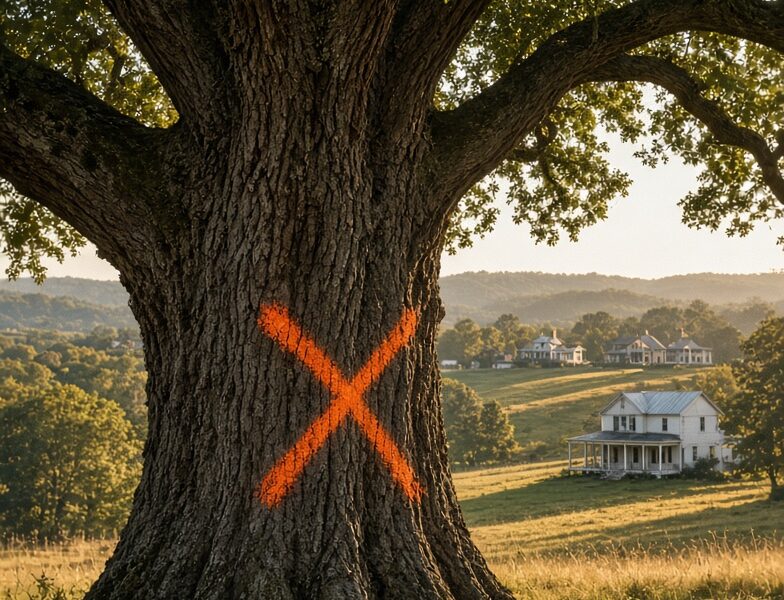
Victoria Carrington arrived on a Monday morning with three board members, a tree removal crew, and an orange X already painted across the trunk of Marin Holt’s enormous oak.
They called it overgrown, ugly, and dangerous.
One neighbor joked that the tree probably wasn’t worth enough to pay for the fence standing beneath it.
Marin didn’t argue.
She only asked them not to touch the trunk until one man she had called could get a look at it.
Forty minutes later, an aging timber appraiser stepped down from a dented pickup, stared at the bark for 10 silent seconds, and asked a question that wiped the smile off Victoria Carrington’s face.
Brier Glenn Estates had gone up fast, the way new money always does.
Nine years earlier, the land south of Asheville had been pasture and hay fields and a scatter of farmsteads held by families who had stopped farming decades before they stopped owning.
Then the developers came, and within four seasons the hills carried rows of tall gray houses with stone accents and lawns laid down in strips like carpet.
A clubhouse went in at the top of the ridge with a terrace built to frame a view of the valley.
The people who bought in those first years believed sincerely that they had built something, and that belief shaped how they looked at everything that had been standing before they arrived.
Marin Holt was one of the things standing before they arrived.
She owned a little over three acres at the eastern edge, a wedge of old pasture the developers had tried twice to buy and failed twice to get.
Her house was a white farmhouse from the 1920s with a tin roof and a wraparound porch, and she had spent 11 years fixing it one window sash at a time.
She was 39, lived alone, and restored antique furniture for dealers in Charlotte and Richmond, which meant her days smelled like hide glue and her hands were always marked with something.
She drove a Ford pickup older than some of her neighbors’ children and mended her own fence line in a canvas jacket with a torn pocket.
And to the people on Pelton Circle, those facts added up to a conclusion they never said aloud and never doubted.
In the middle of her front field stood a white oak so large that strangers slowed their cars for it.
The trunk was broader than a dining table was long, and the lower limbs left the stem at heights that suggested the tree had grown in the open for a very long time, never crowded, never racing anything upward.
In summer, the canopy threw shade across nearly half her property.
Her aunt Lenora had told her once that the oak had been standing there before the main road was paved, before the power lines, before the war that took Lenora’s brother.
Marin had been eight when she heard it, and years later she checked the county records and found that for once a family story was exactly true.
Lenora had left her everything that remained: the acreage, the farmhouse, a workshop full of tools, and seven boxes of papers she had never finished going through.
To Victoria Carrington, the oak was a flaw in an otherwise finished composition.
Victoria was 48, lived in the largest house in Brier Glenn, and had been president of the homeowners association for six years because nobody else wanted the job badly enough to fight her for it.
She had a genuine eye, and she had bullied the board into planting river birch along the entrance drive, which everyone agreed had been right.
But she had come to treat the neighborhood as a thing she was composing, and the oak sat in the frame like a thumbprint on a lens.
Over two years, she sent seven letters.
The branches did not conform to community landscaping standards.
The leaf fall was excessive.
The shade was damaging turf on an adjoining lot, and the canopy blocked part of the valley view from the new clubhouse terrace.
Marin answered every letter politely and in writing with the same two facts.
The tree stood entirely within her property line, more than 90 feet from the nearest boundary, and no qualified inspection had ever found it hazardous.
What she left out, because she did not want a war, was the third fact both women knew.
Her parcel had been deeded in 1926 and had never been annexed into Brier Glenn Estates, so the covenants did not run with her land, and the association held no authority over anything she did with a single blade of grass.
Victoria had been told exactly that by the association’s own attorney in a closed session and kept sending letters anyway, because pressure does not require jurisdiction, only persistence.
At the spring community meeting, during the open portion where residents raised concerns about garbage cans and speeding, Victoria stood with her folder against her chest and made an observation to the room.
“Some old things,” she said, “are not necessarily worth keeping simply because they managed to last.”
A few people laughed.
It was a small laugh, the kind that moves through a room on its way to somewhere else, and it was not entirely about a tree.
Marin sat in the third row with her hands in her lap and did not respond at all.
She turned her head toward the window, where across the dark field the top of the oak was just visible against a sky the color of a nickel, and she waited for the next item on the agenda.
She told herself that was the end of it.
It was not.
Nine days later, she walked out at dawn with her coffee to find a red placard zip-tied to her gate post, large enough to read from the road, printed in a typeface designed to look official.
“Tree Removal Order.”
Beneath that, in smaller text, three findings the board had apparently voted on without her knowledge.
The specimen presented a risk of limb failure over a common access area.
The specimen obstructed sightlines within the community.
The specimen diminished the aesthetic value and marketability of surrounding properties.
The notice gave her 10 days to arrange removal at her own expense, after which the association stated it would retain a contractor and forward her the invoice.
Marin stood in the wet grass reading it twice.
Then she went inside, sat at her kitchen table, and sent a single email requesting the arborist’s report that any finding of limb failure risk would have to be based on.
She asked for the inspector’s name, the date of inspection, and the credentials of whoever had made the assessment.
She copied the full board.
She was careful, and she was brief, and she understood, even as she wrote it, that she was not really asking a question.
She was asking whether a thing existed.
Victoria’s reply came that afternoon and ran to four paragraphs without containing any of the three items requested.
The board had acted on resident concern.
The board had relied on the judgment of experienced members.
The board considered the matter documented sufficiently.
There was no report.
There had never been a report.
What there was instead, two days later, was Preston Whitmore walking up her driveway in a quarter-zip pullover with his phone in his hand.
He was 52, vice president of the association, and the only person in Brier Glenn who had made his money from land rather than spending it on land.
He had developed four subdivisions across two counties and was unhurried in the way men are when they have watched other people run out of patience before them.
He looked a long while at the scaffolding on her north gable, then at the oak, and then he smiled at her like a man delivering good news.
“Fighting progress,” Preston said, “only tends to make things more expensive for the person fighting.”
He said the board could get loud, and that loud was costly.
He said he had always liked her place, that it had character, that character was underrated.
Then he mentioned, almost as an afterthought, that his standing offer on her front strip was still open, and that he could move the number up if she wanted to be done with all of it before summer.
It was the fourth time in three years he had made an offer on that specific frontage.
Not the house.
Not the back acreage.
Always the flat front piece where the oak stood and the driveway met the county road.
She had said no three times, politely.
She said no again, and he nodded as though she had agreed with him and walked back down the gravel.
The next association meeting was held in the clubhouse on a Thursday, and Victoria had prepared a presentation.
She put a photograph of the oak on the screen, taken in late autumn with the limbs bare and the sky flat and gray behind them, in that specific light that makes any tree look like a diagram of something dying.
She used the phrase “declining property” under the slide and spoke about how a community’s standards are only as strong as its willingness to enforce them uniformly.
A man near the front asked, with the genuine helpfulness of someone who has misread a room entirely, whether Marin had the means to hire a certified arborist, because they could maybe take up a collection.
The room went quiet enough that Marin could hear the HVAC cycling.
Then Victoria said the thing that people in Brier Glenn would still be repeating a year later, though by then they would be telling it very differently.
“We don’t want you stuck keeping an old tree,” she said, “simply because you can’t afford to get rid of it.”
She said it kindly.
That was the worst part.
She said it in the warm, lowered voice people use for charity.
And two women near the window exchanged a look that Marin saw and did not forget.
Marin stood up.
She was wearing work clothes because she had come straight from the shop, and her hands still had walnut dust in the creases, and she was conscious of all of it in a way she had promised herself she would stop being conscious of years ago.
“Money,” she said, “has never been the reason I keep it.”
Then she sat down.
The meeting moved on to the pool resurfacing bid.
Nobody in that room understood what they had just heard, including Marin, who meant it only as a statement about her aunt, and about stubbornness, and about the specific sound the oak made in a July storm.
It would be 11 weeks before that sentence meant anything else.
Preston Whitmore, sitting at the end of the board table with his pen capped, was the only person who wrote something down.
The following Tuesday, Marin hired an independent arborist out of Weaverville named Caleb Voss, 34, board certified, with a resistograph in the bed of his truck and no connection to anyone in Brier Glenn.
She hired him for exactly one reason, which was to produce the piece of paper the association had failed to produce.
She was not looking for good news.
She had privately braced herself for the possibility that the tree was in worse shape than she believed, because she had been raised by a woman who taught her that loving something is not a form of evidence about it.
Caleb spent four hours on the property.
He probed the root collar and found no girdling and no decay at the flare.
He drilled at three points on the lower stem and read the resistance traces and found sound wood with no hollow of structural concern.
He examined the major unions through binoculars and found no included bark, no cracking, no history of failure.
He mapped the canopy and noted that the farthest limb spread ended well short of any building, road, or common surface.
His written conclusion ran six words before the technical appendix.
“No defensible safety justification for removal.”
But somewhere in the second hour, he stopped working and stood still for a long time at the north side of the lower trunk, where the bark was rougher and the light came in sideways through the field.
Marin had been carrying a water bottle out to him, and she slowed down because of the way he was standing.
He had his hand flat against the stem, and he was moving it slowly, the way a person reads a surface rather than touches it.
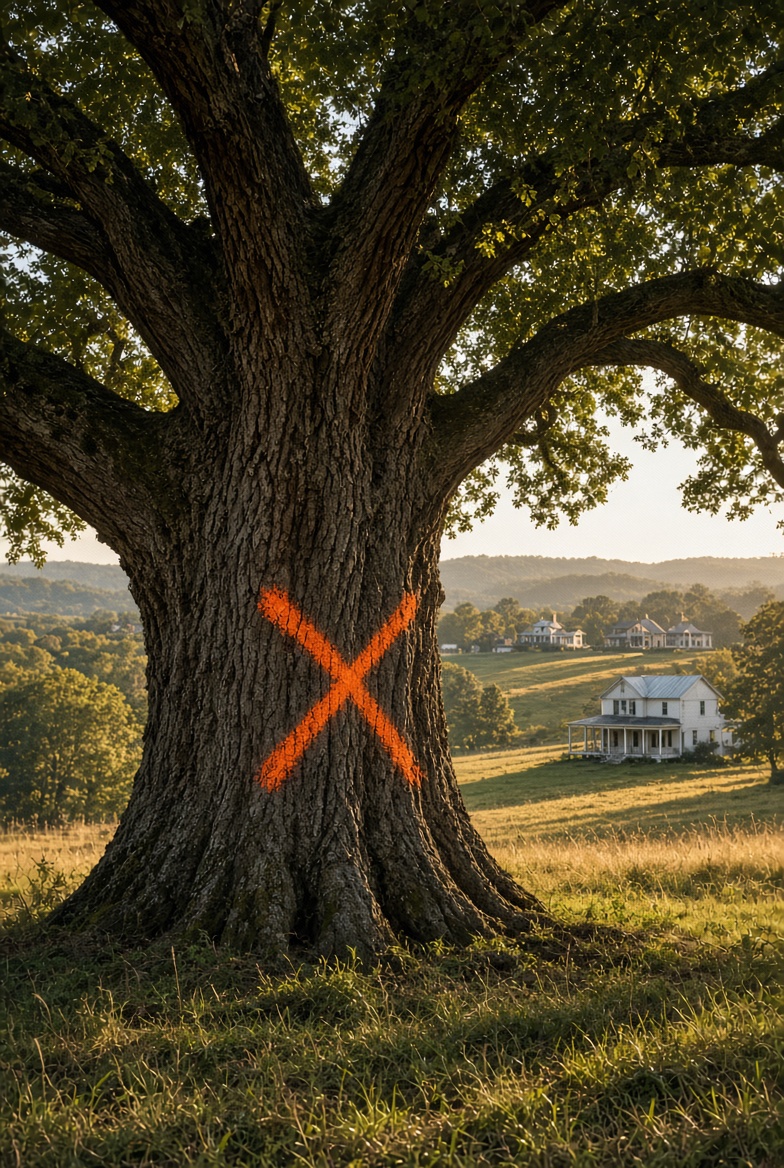
Under the bark plates there were long, soft undulations, a rippling that ran vertically and did not match the ordinary swelling of a buttress or a healed wound.
It covered a region of trunk much larger than Marin had ever paid attention to, because she had spent her life looking up at this tree rather than at it.
“Do you know what species this is?” Caleb asked.
Marin said her aunt had always called it the old white oak.
Caleb said that it was a white oak.
Yes, Quercus alba.
And that the species was not the part he was asking about.
He asked whether the tree had ever been topped, cabled, bolted, fenced into, nailed through, or struck.
She said not in her lifetime and not in her aunt’s.
And that there was a standing rule in the family that you did not drive anything into that tree.
Not a hook.
Not a nail.
Not a swing bolt.
Not even the little tags they used to put in the apple trees.
Caleb asked if there was any paperwork about it.
She said there were seven boxes in the attic she had never finished.
He gave her the report that evening and then stood at the tailgate with his hands on it.
“It might be nothing,” he said. “Surface figure doesn’t always go through, and plenty of trees look interesting on the outside and come out plain. But if it is what I think it might be, I wouldn’t let a single person put a chainsaw into that stem until somebody who buys timber for a living has looked at it.”
He said it twice, which was unlike him.
He wrote a name on the back of his invoice, Gideon Shaw, and a phone number with a Tennessee area code, and under it the words “veneer buyer, retired, honest.”
She called Gideon Shaw and left a message.
Then, unable to sleep, she pulled the attic boxes down and started through them on the dining room floor.
And in the third box, she found a photograph that stopped her.
It was black and white, printed small with a deckled edge, and on the back someone had penciled the year, 1931.
A man in a suit coat stood with his hat in his hand in front of the oak, and the tree behind him was already enormous, already the shape it had now, already old enough to make the man look temporary.
In the same envelope was a note about a timber company out of Hickory that had come through the county that fall, a line stating that the family had declined their offer on the standing timber, and a sum that meant nothing to Marin until she looked it up and understood it had been a staggering amount for a farm family to refuse.
And at the bottom of the envelope, on a scrap of paper torn from something else, in handwriting she recognized because it was her aunt’s, four words with no explanation, no date, and no context.
“Do not mill the North Oak.”
Marin sat on the floor with the scrap in her hand for a long while.
She decided it was sentiment.
It sounded like sentiment, like the kind of instruction a woman leaves behind when what she really means is “remember me.”
She put it in the kitchen drawer with the arborist report and went to bed.
And she did not understand for another two months that she had been holding a warning.
The trucks came at 7:40 on a Monday morning, before the 10-day window had even closed by Marin’s count, and the sound of air brakes on gravel brought her out onto the porch in her work shirt with her boots unlaced.
A bucket truck.
A chipper.
A pickup with a climber’s gear in the bed.
Four men in hard hats.
Victoria Carrington in a quilted vest with a clipboard.
Two board members behind her like punctuation.
And Preston Whitmore standing farther back near the road with his arms folded, close enough to watch and far enough to have been passing by.
And on the north face of the trunk, already, a bright orange X sprayed across the bark in a hand that had not hesitated.
Marin came down off the porch and crossed the wet grass and asked them to stop.
Victoria said the period for voluntary compliance had expired.
Marin said it had not, and that in any case there had never been a valid finding to comply with, and she handed Victoria a copy of Caleb Voss’s report with the certification number on the header and the conclusion on page one.
Victoria did not read it.
She held it the way a person holds a menu in a restaurant they have already ordered at, and she said that it was the opinion of someone Marin had paid to produce it.
One of the board members laughed through his nose.
A climber on the crew was already pulling a saw from the truck bed and looking at the lowest limb, judging the cut.
Marin walked between the crew and the tree.
She did not shout, did not put her body against the trunk, did not do any of the things that end up on a police report.
She stood on the grass with her hands loose at her sides and said, evenly, that she understood they thought it was worthless, and that she was asking them to wait for the appraiser she had called, who was already on the road.
Victoria looked at the oak, and then deliberately, slowly, at the peeling paint on Marin’s gable and the rust on the Ford and the fence posts Marin had set by hand that summer, and she laughed.
“Do you honestly think,” she said, “that a yard tree is going to save you from this?”
The foreman stopped anyway.
He had been in the business 22 years and had learned that the words “property line” and “appraiser” in the same morning are a reason to drink coffee.
He told his crew to stand down and told Victoria he would not put steel into anything while the landowner was objecting on her own deed ground, association paperwork or not.
Victoria began explaining the covenants.
He said covenants were not his department and liability was, and he sat on his tailgate.
Preston Whitmore uncrossed his arms and walked a few steps forward.
And for the first time that morning, somebody other than Marin looked impatient.
At 8:20, a dark red pickup with a bad muffler came up the county road and turned in at the gravel.
It was older than Marin’s truck.
The man who got out of it was 63, in a flannel shirt and canvas pants, with a tape measure clipped at the hip, and he moved like somebody whose knees had been paid for.
He wore no jacket, drove nothing anyone there would have recognized as a credential, and when Victoria saw him, her shoulders dropped half an inch in relief, because she had been preparing herself for a lawyer and had received, as far as she could tell, a handyman.
Gideon Shaw did not introduce himself to anyone.
He walked past the whole arrangement of people as if they were furniture, went to the tree, and began circling it slowly, maybe 12 feet out, taking the stem from base to first union.
Then he came in close, laid his palm on the bark, found the ripple, and followed it upward with his hand as far as he could reach.
He crouched at the flare.
He stepped back and sighted up the stem with one eye shut, checking for lean and sweep and taper, then walked a quarter turn and did all of it again.
It took 11 minutes.
He did not say a single word.
And in that silence, the crew stopped checking their phones.
Caleb Voss, who had driven over when Marin called him at 7:45, came up beside the older man.
Gideon finally spoke, and what he said was, “You see it, don’t you?”
Caleb nodded and said he had seen it two weeks ago and had not been willing to put a name to it.
Gideon took a hand lens out of his breast pocket and examined a branch scar that had healed over so long ago it was only a faint, flattened oval in the bark, maybe seven feet up.
He studied it for close to a minute.
Victoria, who had been standing with her clipboard and her crew and her authority, finally lost patience and asked loudly what exactly it was that everyone was pretending to see.
Gideon did not answer her.
He turned to Marin instead and asked whether anyone had ever bored this tree, cored it, tapped it, or taken a wedge out of it for any reason.
Marin said, “No. Never. Not in a hundred years that anyone had recorded.”
He asked whether it had ever been inside a fence line carrying wire.
She said no.
Her aunt had run the fence 20 feet wide of it and taken the loss of pasture rather than staple anything to it.
Gideon absorbed that.
Then he looked at the orange X and at the chainsaw sitting in the grass beside the gnarled root flare, and he said to nobody in particular, “Then don’t let anybody start today.”
What Gideon explained, standing in the field with 11 people listening and the chipper still idling, was narrower than anyone there wanted it to be.
Most old oaks, he said, are worth what any oak is worth.
Age by itself does nothing.
A big old yard tree is usually a liability to a sawmill, full of metal, full of knots from low branching, grown fast and wide in the open with wild grain that makes it tear itself apart on the saw.
“Nine out of 10 trees homeowners call valuable,” he said, “are firewood with good publicity.”
He said it directly to Marin so she would not get ideas, and again to Victoria so she could not later claim she had been ambushed by a fairy tale.
But occasionally, he said, you get a combination.
He counted it on his fingers.
A butt log that runs straight and clean for better than 16 feet before the first union.
A diameter well past anything the industry sees from managed stands anymore.
Growth rings tight enough to indicate decades of slow development, which in white oak means density and stability.
No wire, no nails, no cable bolts, no topping cuts, no storm-torn unions, which is almost unheard of for a tree that has spent a century within sight of a house.
And then, on top of all of that, figure.
Not knots.
Not burl.
Not damage.
A ripple in the grain itself, running vertically through the fibers, visible on the surface as those soft undulations under the bark.
Victoria said, with a laugh she had to manufacture, that apparently they were all pretending the tree was buried treasure.
Now Preston Whitmore did not laugh.
Marin noticed that, and she would keep noticing it for weeks.
Preston had been standing with his phone in his hand for 20 minutes and had not looked at it once since Gideon said the word figure.
Gideon refused to put a number on anything that morning, which did more for his credibility than any number would have.
He said surface indication is not proof, and that the only honest thing anybody could say was that the risk of destroying something irreplaceable was high enough to justify not cutting.
Over the following three weeks, he did the work properly.
He took a very small sample at a low, structurally insignificant point where the arborist approved the wound.
He photographed the end grain and the ripple under raking light.
He sent the images and the measurements, without naming the owner or the location, to two veneer buyers he had worked with for 20 years and who had no reason to flatter him.
The first buyer called back the same day.
The second took four days and then called twice.
Both came back with the same instruction before they came back with any opinion about value.
And the instruction was this.
If that tree ever comes down for any reason, it must not be processed by a tree service.
It must not be bucked into firewood lengths.
It must not be flat-sawn at a local mill.
It is to be handled as a specimen log.
The butt section kept whole.
Quarter-sawn or sliced by a shop that understands what the ripple does under the blade.
One careless cut across the figure.
One crew chief deciding where to chunk it for the loader.
Destroys the orientation that the entire value depends on.
That damage is instant and total and cannot be undone.
The conservative valuation came back eight days later.
Gideon delivered it in Marin’s kitchen with the two buyers’ written assessments stapled behind his own.
And he walked her through the assumptions line by line before he let her look at the figure, because he knew what the figure would do to her ability to hear anything.
It was not a few thousand.
It was not $20,000.
It was a range whose low end was more than Marin’s annual income had ever been in her best year, and whose high end made Caleb Voss put his coffee cup down on the table without drinking from it and ask Gideon flatly whether he had moved a decimal.
Gideon said he had not, and then spent 10 minutes dismantling any comfort anyone might take from it.
The range assumed the interior matched the surface, which could only be confirmed by cutting, which would be insane to do on speculation.
It assumed the log reached shops that pay for figure rather than board feet, and a buyer at the right moment, because the market for specimen material is thin and personal.
It was not a price.
Not an offer.
Not money.
And anybody who treated it as money was going to get hurt.
What it was, he said, was a reason to be very careful about who was allowed near it with a saw.
Victoria Carrington had come to the house that morning for an entirely different reason, to deliver a letter about the association’s position, and had ended up standing in the doorway of a kitchen listening to all of it.
When Gideon finished, she said the only thing left available to her.
“Whatever it’s supposedly worth,” she said, “it’s still just a tree.”
Gideon turned around in his chair and looked at her for a moment with something that was not quite contempt.
“Then all the more reason,” he said, “not to send men with chainsaws at a thing before you have bothered to find out what you’re cutting.”
She began pulling association records, which she was entitled to request as an adjoining landowner on several of the matters, and which a sympathetic board secretary named Diane Ashford handed over with more completeness than was strictly required.
Marin read 19 months of minutes at her dining table over four nights.
The pattern did not take four nights to find.
It took one.
The tree appeared in the minutes as a landscaping grievance twice.
In the first year, both times raised by Victoria, both times tabled.
Then, starting in March, it appeared in six consecutive meetings.
And in five of those six, it had been placed on the agenda, not by Victoria, but by the vice president.
It was Preston who had reclassified the matter from aesthetics to community safety, which was the reclassification that allowed the board to act under its emergency provisions without a full vote.
It was Preston who had recommended the contractor, a company out of Morgan, that he described to the board as a trusted vendor he had used on his own projects.
It was Preston who had pushed the 10-day timeline, arguing that a liability exposure of this kind should not wait for the next quarterly meeting.
And it was Preston, Diane confirmed quietly, who had personally arranged for the crew to arrive that Monday, having told Victoria the deadline had been satisfied when it had not.
Then Marin found the plat.
It was in the county’s online records, a preliminary layout filed four years earlier by a holding company whose registered agent listed the same address as Preston Whitmore’s development firm.
It showed a proposed internal connector road running north from the Brier Glenn service drive, across the flat front portion of the old Holt parcel, and out to the 41 acres of wooded hillside beyond it.
Forty-one acres that the holding company had under contract and that were at present landlocked.
The road alignment on that drawing ran directly through the ground where the oak stood.
There was no version of that access that worked with the tree in place, and there was no version of that development that worked without the access, which reframed everything.
Victoria’s hatred of the oak was exactly what it appeared to be.
Real.
Petty.
Aesthetic.
Sincere.
She wanted her view.
She wanted the neighborhood to look like the rendering in her head.
She had been obsessed about it loudly and publicly and for years.
And that obsession had made her the most useful instrument available to a man who needed the tree gone for reasons he never once stated aloud.
Preston had not created Victoria’s campaign.
He had simply waited for it, and then steered it, and let a woman’s vanity do the work that a purchase offer had failed to do three times.
There was a second possibility, uglier and harder to prove, that Marin turned over for two days before she said it aloud to Gideon.
The contractor Preston had recommended was not an arborist firm at all.
They advertised land clearing, lot preparation, and hardwood log recovery, and their filings listed a second entity with an officer in common, a timber broker in Burke County, whose company had worked two previous clearing jobs with Preston’s firm.
A tree service charges a homeowner to remove a tree.
A log recovery operation charges the homeowner to remove a tree and then sells the stem.
She raised it at the special meeting in May, in front of 41 residents, without accusation and without raising her voice, because she had learned a long time ago that the quietest sentence in a room is the one people repeat afterward.
She asked Preston a single question.
Why the company the board had retained to remove a tree for safety reasons held contracts for hardwood log sales, and why that company’s officer also appeared on the filings of a timber broker his firm had worked with twice.
Preston said that in a small industry everybody overlaps with everybody, which was true, and which was not an answer, and which 41 people heard as not an answer.
Then Gideon Shaw stood up at the back with a folder.
He was not a resident and had no standing to speak, and Victoria, chairing, let him anyway, which was the first independent decision she had made in two months.
He laid out, without drama, what the trade pays for specimen-grade figured white oak and what a landowner is typically paid when the stem leaves the property with a clearing crew.
The gap between those two numbers was not a matter of opinion, and he had printed it.
He said he had spent 40 years watching that gap get collected by men standing exactly where Mr. Whitmore was standing.
Every head in the room turned at once.
The full assessment came back in June.
Gideon had insisted on an independent panel: two veneer buyers who had not seen his earlier images, plus a wood technologist out of a forestry program who had no commercial interest at all.
They examined the sample, the growth analysis, the stem measurements, and a set of acoustic readings taken by equipment that had never touched the tree destructively.
The finding was stronger than Gideon’s conservative draft.
The figure was not a surface anomaly confined to one face.
The pattern indicated consistent expression through the commercial length of the butt log, and the growth rate placed the wood in a density class the market had almost stopped seeing.
The potential value, under the only honest condition that the tree be harvested correctly at the natural end of its life decades from now by people who knew what they were handling, exceeded the assessed value of several houses in Brier Glenn Estates.
Not the Carrington house.
But the four on Ashgrove Court, and the two newer builds near the entrance, and the one Preston Whitmore’s company had listed that spring at $490,000.
A tree the association had officially described in writing as diminishing the marketability of surrounding properties was worth more than the properties whose marketability it diminished.
What mattered more than the number was what Marin did with it, because that was the only part of the whole business that was actually a choice.
She did nothing.
She did not list the tree.
Did not contact a single buyer.
Did not take the standing offer that arrived in July from a shop in Lancaster County, wanting first refusal and willing to pay for the option.
Victoria asked her about it directly on the road one evening, with real bewilderment and not much hostility left.
“If it is truly worth that,” she asked, “why would you not sell?”
“Knowing what something is worth,” Marin said, “does not mean you are supposed to sell it.”
Then came the part that cost the association money.
Marin’s attorney, a careful woman in Asheville named Ruth Delgado, sent a seven-page letter that the board read in a closed session with their own counsel present and their own counsel visibly unhappy.
The association had no architectural or vegetative authority over the Holt parcel, which had never been annexed and whose covenants had never been recorded against it.
The removal notice was therefore void on its face.
The emergency safety finding had been made with no inspection, no inspector, and no report, and was contradicted by a certified assessment the board had been provided and had declined to read.
And then the sentence that changed the temperature in the room.
The entry of a contractor onto the Holt property on the morning of the 14th, with equipment, with marking paint applied to the owner’s tree over the owner’s stated objection, constituted trespass.
And as to the orange paint, damage to property, had any cutting occurred, the measure of damages would not have been the cost of a replacement shade tree.
It would have been the documented appraised value of a specimen log now established on the record by an independent panel, with the association’s own written notice serving as proof of intent.
Victoria Carrington had spent two years threatening to send Marin Holt an invoice.
She spent the last week of June on the phone with the association’s insurance carrier, asking, in a voice several residents described as unrecognizable, whether the general liability policy would have covered an event of that magnitude.
The answer, delivered by an adjuster with no interest in anybody’s feelings, was that it would not have covered it anywhere close to fully, and that the shortfall would have been assessed against the membership.
Forty-one households worked out what their individual portion of that would have been.
The arithmetic traveled through Brier Glenn faster than any gossip in its history.
The internal investigation was not Marin’s doing, and she declined to participate in it beyond providing the records she had already obtained legally.
The board hired an outside accountant because Diane Ashford refused to let the matter be handled by the officers it concerned.
And the accountant’s review took three weeks and produced a finding that was narrow, boring, and fatal.
Preston Whitmore had recommended a vendor with which he had an undisclosed prior business relationship, in violation of the association’s own conflict of interest provision, which he had helped draft in the second year of the community’s existence.
He had also, the review noted, failed to disclose that an entity in which he held an interest had property under contract adjoining the Holt parcel at the time he was voting on matters affecting access across that parcel.
That was the sentence that ended it.
Not the timber.
Not the broker.
Not the suspicion that he had been angling to haul away something valuable.
None of that was ever proven, and Marin never asserted it as fact.
What finished Preston Whitmore was a paperwork obligation he had considered beneath him, in a document he had written himself.
He resigned before the removal vote, in a letter calling the matter a misunderstanding of a routine vendor recommendation, and he stopped attending community functions.
The connector road never happened.
The 41 acres behind the Holt parcel remained landlocked.
The contract lapsed in the fall, and the holding company let it go, because a development with no access is a map and nothing else.
Two years of planning and three purchase offers and a six-week pressure campaign had been defeated, in the end, by a woman who simply kept saying no, and by a tree that happened to be standing in the correct place.
Victoria Carrington did not become a good person, which is the detail that made everyone who heard the story believe it.
She remained proud.
Remained certain about shrubbery.
Remained the sort of woman who corrects the placement of other people’s garbage bins.
She never once said she was sorry to Marin Holt.
But at the July meeting, with the room full and the minutes being taken, she read a prepared statement into the record.
The association, she said, withdraws the notice issued regarding the oak on the Holt property, acknowledges that it holds no authority over that parcel, and will take no action of any kind with respect to Miss Holt’s tree.
Marin, sitting in the third row again in the same canvas jacket, said only, “Good. That’s all I ever wanted.”
And that was the thing that cost Victoria the most.
There was no triumph in it.
No speech.
No list of grievances read back.
Marin did not demand an apology or a retraction or a payment for the paint she had scrubbed off the bark over two weekends with a soft brush and water.
She just accepted the withdrawal of a thing that should never have been issued and sat back down.
A room full of people who had been prepared to watch a fight watched instead a woman decline to have one, and some of them understood, finally, which of the two women in that room had ever actually been in control of herself.
It was August before Marin got back to the boxes, and she found it in the bottom of the fifth one, tucked inside the back cover of her aunt’s restoration ledger.
A plain envelope, unsealed, soft at the corners from being handled.
Inside was a letter dated November of 1987, typed on the letterhead of a hardwood buyer in Virginia, addressed to Miss Lenora Holt.
The man wrote that he had been through the county looking at standing timber, that he had stopped on the road to look at the white oak on her property, and that he had examined it from the public right-of-way without entering her land, for which he apologized.
He wrote that the stem showed indications he had seen fewer than a dozen times in a career, that he believed the tree carried figure through a very large portion of the merchantable length, and that he would like her permission to examine it properly.
And then he made an offer.
The figure, for one standing tree in 1987, was more than Lenora Holt had paid for the entire farm.
Marin sat down on the attic floor in the heat with the letter in both hands.
A second page was attached, a copy of Lenora’s reply, typed by her on the machine that still sat in the workshop.
It was two lines long.
It thanked him for his courtesy and not trespassing.
It declined, without explanation, and did not invite further correspondence.
At the bottom of the buyer’s original letter, in pencil, in her aunt’s barbed-wire handwriting, was a single sentence that had been sitting in a box in an attic for 39 years.
“Some things become valuable because nobody was ever allowed to ruin them.”
Marin read it four times.
And then the scrap in her kitchen drawer stopped being sentiment and became what it had always been: an instruction left by a woman who knew exactly what she owned and exactly how it would be lost.
“Do not mill the North Oak.”
Lenora had known since at least 1987.
And judging by the photograph and the refused offer behind it, two generations before her had known something like it, too.
The knowledge had been in the family the whole time.
It had simply never been treated as a bank account.
They had not protected the tree because it was worth money.
They had refused the money repeatedly across 90-odd years, and the refusing was the reason the thing stayed whole.
No nails.
No cable.
No topping.
No fence staples.
No coring.
Not because anybody was preserving an asset, but because somebody long ago had decided this particular living thing was not to be damaged for convenience, which turned the whole story inside out.
For months, everyone in Brier Glenn had been telling it one way.
The ugly old tree turned out to be secretly valuable.
Imagine that.
But that was backward.
The wood was not valuable despite the century of being left alone.
The wood was valuable because of it.
Every year that somebody declined to run wire through it, declined to bolt a swing to it, declined to take the generous offer from the man in the good coat, every one of those refusals was deposited in the grain.
The figure was rare because the restraint was rare.
A hundred years of people choosing not to treat a tree as lumber is precisely what produced the lumber everybody suddenly wanted.
A year later, the oak was still standing in the middle of the front field.
Marin put it under a maintenance agreement with Caleb Voss: annual inspection, soil work at the root zone, no pruning beyond deadwood.
She filed a conservation document against the deed restricting removal or commercial harvest by any future owner except on a hazard finding by two independent certified arborists, and requiring that if it ever did come down, the stem be handled as a specimen by a shop named on a list she maintains.
It cost her $4,000 in legal fees, which was the only money the tree ever generated and the only money she ever intended it to.
Brier Glenn Estates, meanwhile, began using photographs of the entrance in which the crown of the great oak rises behind the river birches, because the marketing company said it conveyed heritage.
Nobody on the board found this funny except Diane Ashford.
Victoria Carrington stopped using the word eyesore.
She did not start praising it either, which, from Victoria, was nearly affectionate.
In October, the leaves still came down across the clubhouse terrace in quantities that required a blower twice a week, and the grounds crew still complained, and not one person in that community ever again suggested doing anything about the cause.
On an afternoon in late September, Marin Holt sat in a folding chair in the shade with a cup of coffee and a half-stripped heirloom white chair leg across her knees, sanding by hand because machine marks always show on that curve.
Her house was still smaller than the Carrington house and always would be.
The Ford still had rust along the rocker panel.
Her jacket still had the torn pocket, and there was walnut dust in the creases of her hands.
Nothing about her from the road looked different than it had the morning the trucks came.
Nothing about her was different.
The only thing that had changed was in the people who used to drive past her and draw conclusions.
They had spent years deciding what Marin Holt was worth by looking at her roofline and her truck and her hands, and they had been very confident about it.
And then they had learned, in public and at considerable expense, that they had not even been able to correctly assess a tree that had been standing in plain sight in front of all of them for a hundred years.
If they could not read a thing that large and that still and that patient, it was worth wondering what else they had been getting wrong.
Sometimes the most valuable thing in sight is not the newest or the largest or the one with the best lighting.
And sometimes the person being looked down on is the only one in the room who understands what they are protecting.









