
They Left Six Dying Rangers With the “Rookie” Nurse… Then She Did Something That Silenced the Entire Hospital
Nobody in the emergency wing of Mercy General Military Medical Center paid much attention to the new nurse in Bay 3, and that was by design.
Ren Tully had been on staff for exactly four weeks, which meant she was still at the stage where attendings talked over her head and orderlies forgot to hold the elevator.
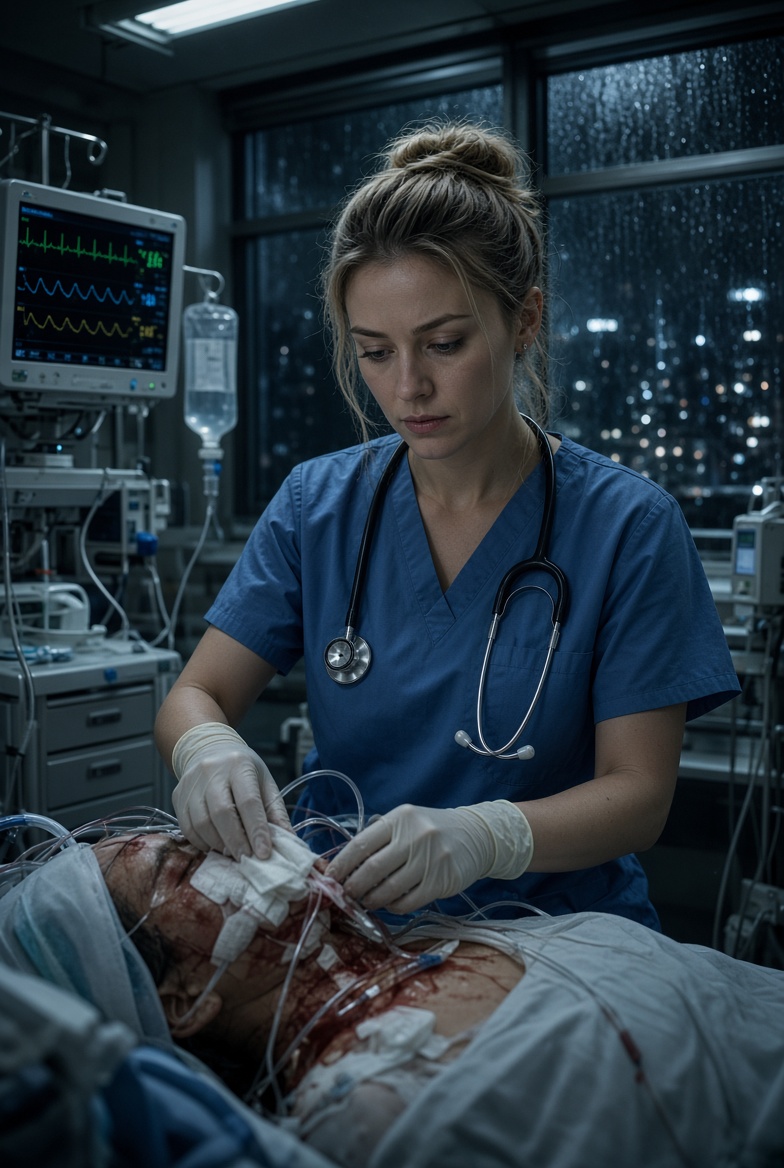
She wore standard-issue blue scrubs and a fresh RN badge that read Ren Tully, RN, in crisp block letters.
She was 29, with light brown hair she kept pinned in a flat bun at the back of her skull and gray eyes that had the unsettling quality of seeing slightly more than they let on.
She didn’t offer opinions during handoffs, and she didn’t laugh too loud at the nurses’ station.
She stocked the crash carts without being asked and double-checked the defibrillator calibrations on every shift, because she’d seen a faulty one fail a man in a forward operating base outside Mosul.
And she never quite stopped thinking about it.
Nobody knew that part.
The rain started around midnight, drumming steadily against the reinforced windows of the trauma wing at the civilian contract facility affiliated with Brooke Army Medical Center in San Antonio.
The kind of rain that made the fluorescent overheads haze harsher somehow and the hallways longer than they were.
It was 0147 on a Wednesday when the secure line at the charge desk rang with a clipped two-syllable code that meant incoming from a military transport.
Dr. Preston Wakely heard it from his office at the end of the corridor and arrived in the trauma bay buttoning his monogrammed cuffs with the particular unhurried authority of a man who believed his presence was the event itself.
Wakely was 52, chief of emergency surgical services, and he had a reputation that preceded him down every hallway he walked.
He had trained at Mass General, published in four journals, and had never in 23 years of practice been wrong about anything in a way he was willing to acknowledge.
He ran his department the way a mid-century boarding school headmaster ran a dormitory, with absolute hierarchy, selective cruelty, and an allergy to questions from people below a certain pay grade.
Nurses did not question his orders, residents did not offer suggestions, and rookies, he had made clear on multiple occasions, existed primarily to hand him things and stay out of his way.
He swept into the intake area, clapped his hands once, and the room organized itself around him like iron filings around a magnet.
“Listen up.” His voice was the kind that carried without effort. “Black flight incoming from Fort Bragg via Ramstein transit. We have a classified medevac. High-priority diplomatic passenger and six Rangers from an extraction that went sideways in the Horn of Africa. I want my full surgical team on the diplomatic passenger in Suite One. That is our priority, non-negotiable.”
He paused, letting his eyes move across the assembled staff.
“The Rangers go to the overflow bay. Basics.”
Charge nurse Dolores Mack, a 20-year veteran, calm as poured concrete, frowned.
“Dr. Wakely, six combat casualties from a hot extraction, we’re going to need coverage in basics. That’s overflow. It doesn’t have half the equipment of the main.”
“It has what they need.” Wakely cut her off. “They’re Rangers. They’re trained to tolerate extraordinary conditions. They can wait 20 minutes while I stabilize our VIP.”
He let his eyes travel the room a second time, and they landed on Ren, who was quietly laying out a fresh IV tray with the unhurried precision of someone who’d done it a thousand times before in worse lighting.
He pointed at her.
“Give the Rangers to the new girl.”
Dolores stiffened. “Ren, Dr. Wakely, she’s been here four weeks.”
“I am aware.” His voice carried the pleasantry of a man who was not even slightly amused. “She’s a nurse. Rangers are soldiers. Between them, they ought to be able to figure out how to take a pulse.”
A couple of the attending residents allowed themselves a small laugh.
Wakely was already turning away, already done with the conversation.
“If someone’s dying, she can call for help. Try not to need me for the next 30 minutes, Jenkins.”
He didn’t even get her name right.
Ren set down the IV tray.
She picked up her stethoscope, looped it over her shoulders, and walked toward Bay 6 without saying a word.
“I need two techs and a vent-capable respiratory tech,” she said quietly to Dolores as she passed. “And pull the level-one rapid infuser from storage. We’re going to need it.”
Dolores looked at her for a moment with the particular expression of a woman who has seen a great many things and suspects she’s about to see one more.
Then she reached for her radio.
Eight minutes later, the transport doors opened.
The diplomatic passenger went left, surrounded by Wakely’s entourage of senior attendings and a pair of federal agents in dark suits.
The Rangers went right.
They came in on six stretchers, and the smell arrived before they did, copper and gun oil and the particular bitterness of burned tactical fabric that had been flash-sealed against a field wound.
Their gear had been partially stripped by flight medics, leaving them in shredded remnants of their kit.
One of them was seizing mildly.
Another was barely breathing.
A third was conscious enough to grab at the side of his stretcher rail and was instructed, firmly and calmly, to let go.
Tomas, the younger of the two medical techs, stopped walking when he saw the full scope of what had been rolled into the room.
His face went the color of old chalk.
“Where is everyone?” he said. “Where’s the surgical team? There’s six of them.”
“It’s us.” Ren was already at the first stretcher, two fingers on a carotid, eyes moving across the man’s face and chest simultaneously.
Her voice had changed.
It wasn’t louder, and it wasn’t particularly different in tone, but it had the quality of a structural beam.
Everything in the room suddenly was arranged around it.
“Tomas, gloves on. Cut the rest of this kit off, starting with bed three. He’s got a tension pattern. I can see it from here.”
“Casey, get me the crash cart positioned between one and two. Don’t wait for me to ask twice.”
Casey, the respiratory tech, 38, twelve years on the job, stepped into the bay and stopped.
Then he started moving.
The next four minutes were unlike anything Tomas had ever experienced in a clinical setting.
Ren moved from stretcher to stretcher in a sequence that had no hesitation in it.
No checking of the wall charts, no visible consultation with the protocols printed in laminated sheets above each bay.
She wasn’t performing a protocol.
She was doing something that had become reflexive a long time ago, in conditions far less forgiving than this room with its intact lighting and its reliable suction.
First stretcher, Sergeant First Class Ruben Holt, 34, penetrating injury to the leg.
The field tourniquet had slipped during transport, and the gauze was soaked through and his pressure was dropping.
Ren was already reaching into her jacket pocket before the vitals monitor finished its alarm sequence.
She pulled out a combat application tourniquet, her own, not hospital issue, and applied it high and tight with one hand, cranking the windlass with a practiced violence that stopped the arterial pulse in seconds.
“Lock it. Write the time on his arm. Move.”
“That’s not standard,” Tomas started.
He had about 90 seconds.
She was already at the second bed, a younger Ranger, barely 23 by the look of him, Specialist Marcus Dune.
His oxygen saturation was at 76 and dropping.
He was breathing in the shallow, desperate way that people breathe when a rib has punched through its boundary and air is filling the wrong cavity.
The trachea was shifting visibly to the right.
“Tension pneumo,” Casey said, his voice tight.
“He needs a chest tube. He needs a physician. He needs the next 45 seconds to go right.”
Ren was already painting iodine in a wide circle on Dune’s left chest wall.
Her hands were not shaking.
They had never, in her experience, shaken during the moment of action.
That was a thing that happened afterward, in private, which was why she still occasionally woke at two in the morning with the feeling of doing this exact motion in the back of a shuddering transport over hostile terrain.
Tomas stepped forward.
“You cannot do a needle decompression. You’re an RN. If you perforate his cardiac wall, I won’t—”
She found the second intercostal space without measuring, purely from the accumulated geography of having done this before in places where measuring wasn’t an option.
The 14-gauge angio catheter went in with a single, fluid motion.
The hiss was immediate, loud, almost startling in the clean, sealed air of the hospital bay.
Marcus Dune’s chest expanded evenly for the first time since he’d arrived.
His oxygen climbed, 78, 83, 89, 94.
His heart rate, which had been frantic and irregular, began to organize itself into something a monitor could track with confidence.
Casey stared at her.
“I’ve seen combat medics who couldn’t do that,” he said, his voice very quiet.
Ren was already at bed four.
On the sixth stretcher, the commanding officer of the unit lay watching the ceiling with the half-focused intensity of a man fighting through heavy analgesics and a concussion that had partially rearranged his recent memories.
Lieutenant Colonel Declan Orin had taken shrapnel to the left shoulder, three fractured ribs on the right side, and a significant blunt-force injury to the head when his vehicle flipped on the extraction route.
He was fading in and out.
The pain was extensive, and the morphine from the field medics was doing an imprecise job, but the voice in the room was keeping him oriented in a way that surprised him.
Not because of what it was saying, but because of something in its frequency that his nervous system recognized before his brain had the vocabulary for it.
He turned his head slowly, accepting the cost of it.
Through the blur of moving scrubs and flashing monitors, he watched the nurse at work.
She was moving across the bay the way an experienced platoon sergeant moves through a casualty collection point, with an economy of motion that was almost aggressive in its efficiency, talking constantly to the two people working with her, directing without ceremony.
He watched her tie off a bleeder with a knot he recognized as a modified surgeon’s tie, the kind that field medics learned in advanced trauma courses that most RNs had never seen.
Then she stepped into his line of sight, leaned over him, and put a penlight to his pupils.
Her face came into focus.
“Track the light for me,” she said. “Don’t close your eyes.”
Her eyes were gray.
There was a small scar, thin as a thread, running along the left side of her jaw.
And something in the precise, authoritative gentleness of the way she held his head still reached into a very specific fold of his memory and pulled.
“Stay with me,” she said quietly, the efficiency dropping out of her voice for just a moment. “You’re stable. I’ve got you. Breathe slow.”
The phrase, exactly those words, in exactly that cadence, opened a door he hadn’t thought about in six years.
A bombed-out medical relay point in northern Syria, night, his unit hit during an exfil.
Two of his guys were down, and he had taken a fragment to the thigh and was losing blood faster than the field dressing could manage.
A woman in unmarked kit had found him in the rubble and held direct pressure on the wound for 40 minutes while the QRF worked its way to them, talking him through it with a voice like a mooring line in bad weather.
He’d never gotten her name.
His guys called her Ghost.
“Ghost,” he said, and his voice came out rougher than he intended.
The penlight wavered, the smallest possible physical reaction, a millimeter of hesitation.
Then the professional mask came back, smooth and immediate.
“Lie still, Colonel.” Her voice was very quiet. “You’ve got a concussion. Don’t move your neck.”
But she had looked at him, really looked at him, and whatever was in his face, she had recognized it.
She pulled the blanket over his uninjured shoulder and moved to the next bed without another word.
Fourteen minutes after the stretchers had arrived in Bay 6, all six Rangers were hemodynamically stable.
The monitors were reading in the organized rhythmic language of bodies that had been pulled back from the edge and were being allowed to recover.
IVs were running clean, and wounds were packed and dressed with a precision that owed more to field trauma than to standard hospital procedure.
It was at this point that the heavy doors of Bay 6 opened and Dr. Preston Wakely walked in.
He had his clipboard, and he had his expression, the one that accompanied visits to scenes of expected disaster.
He was already composing the reprimand in his head, the regulatory violation citations, the license suspension recommendation, the formal incident report language he would use to describe the catastrophic overreach of an inexperienced nurse who had panicked and improvised her way through a critical situation.
He got three steps into the room and stopped.
His eyes moved from stretcher to stretcher.
Then they found the 14-gauge needle in Dune’s chest wall, the hissing flutter valve, the stabilized saturation reading above the bed.
The color left his face in a single wave.
“Who authorized that?” His voice came out very controlled, which was more frightening in its way than if he had shouted. “Who performed a needle thoracostomy on this patient?”
Casey and Tomas both took a half step backward.
Ren peeled off her gloves with a deliberate snap and dropped them in the biohazard bin.
“The patient was presenting with a tension pneumothorax. He was decompensating acutely. I performed a needle decompression to preserve his life.”
Wakely crossed the room toward her with a long, measured stride, stopping close enough to make the intimidation unmistakable.
He was a tall man, and he used it.
“You are a registered nurse with four weeks of service in my department. You do not have the license, the training, or the authority to enter the pleural cavity of a patient in this facility. You may have just ended this man.”
He held his voice at a perfect pitch of cold fury.
“Hand me your badge. You are terminated, effective immediately. I am contacting the medical board and the office of the Inspector General. What you did constitutes the unlicensed practice of medicine.”
Ren did not step back.
She did not flush or tremble.
She looked at him with a steadiness that had been built over years of standing still under considerably more pressure than one angry physician could generate.
“He had less than a minute,” she said. “His trachea was deviating. His pressure was 60 over nothing. You were across the building prioritizing a VIP whose injury chart I reviewed on intake. He had a two-centimeter forearm laceration.”
Wakely’s jaw hardened. “You reviewed a classified—”
“I work intake. It crossed my station.”
She picked up her badge with two fingers.
“You left six critical combat casualties in a substandard bay to attend to a minor wound because of who the patient was. That is a triage ethics violation. You would like to discuss licensing.”
“I would like you out of my hospital,” Wakely said, his voice dropping to something cold and precise. “Security.”
“Touch that badge.”
The voice came from the sixth stretcher.
Lieutenant Colonel Declan Orin had pushed himself up on his good elbow.
His face was pale and drawn and damp with effort, and his eyes were the clearest thing in the room.
“Touch that badge,” he said again, looking at Wakely with the specific quality of attention that men developed after years of making rapid, irreversible decisions about other people, “and I will have your facility access reviewed by the Inspector General’s office before your shift ends.”
Wakely turned. “Colonel, you have sustained a traumatic brain injury. You are not in a position to—”
“I’m in a position to know what I’m looking at.” Orin’s voice was measured and quiet and utterly without doubt. “I’m looking at the six most capable minutes of emergency trauma care I have ever witnessed in a hospital setting. I’m looking at a woman who just saved Marcus Dune’s life with a procedure she’s done before. Not in school. Before.”
He paused.
“Do you want to keep talking, or do you want to think about that for a second?”
Wakely stared at him.
“She is a new graduate,” Wakely said flatly, the way a man states a mathematical proof. “She has no surgical history. She has no military record on file.”
“Then your HR department needs better clearance than it has,” Orin said.
He lowered himself back onto the pillow, his face tightening with the effort.
His eyes stayed on Ren.
Her name here was Ren.
He held the correction and let it go.
The doors opened again.
The man who came in first was Dr. Samuel Gord, the hospital director, a compact, precise man in a dark suit who looked like he had been pulled from somewhere he would rather be.
Behind him was a figure who commanded the room the way a weather system commands a landscape, not by announcing itself, but simply by being present.
Vice Admiral Constance Reese, commander of Army Special Operations Command’s medical liaison office, was 61 years old, silver-haired, and carrying the kind of earned stillness that took decades to develop.
She wore her dress uniform, and her ribbons were extensive.
She had flown in from Fort Liberty when the MEDEVAC manifest crossed her desk and she’d seen which unit was on it.
Her eyes swept the bay, the stretchers, the monitors, the combat tourniquet on Holt’s thigh, the IO line drilled perfectly into the tibia of the third man, the needle in Dune’s chest.
Then she looked at Ren Tully standing near the crash cart in her blue scrubs with the fresh RN badge.
Admiral Reese stopped walking.
The expression that crossed her face was not what anyone in the room expected.
It was not surprise.
It was something closer to profound, complicated recognition.
“Major Tully,” she said.
The title arrived in the room like a depth charge.
Dr. Gord turned to look at the nurse he had barely registered until this moment.
Wakely went very still.
“Admiral Reese.” Ren’s posture changed so subtly that most people in the room didn’t catch it, but it was a physical fact, something in the arrangement of her shoulders shifting into the bearing of someone who had spent years standing at attention. “I didn’t know you were going to be here.”
“I tracked the transport.” The Admiral moved further into the room, her eyes reading the bay with the efficiency of a field assessment. “Tell me your six are stable.”
“All stable. Dune needed a decompression on arrival. Holt had an arterial bleed from a tourniquet shift during transport. The others are—”
“I can see what they are.” The Admiral looked at the monitors one by one, and something in her face settled.
She turned to Director Gord.
“Samuel, do you know who is standing in your trauma bay?”
Gord looked at the badge. “She’s a recent nursing hire. She came from Johns Hopkins accelerated—”
“She is Major Ren Tully, United States Army Medical Corps, retired 14 months ago following a classified extraction in the Forgana Valley that cost her surgical team three members.” Reese paused. “She holds the Distinguished Service Medal, the Bronze Star with V device, and a commendation from the Joint Special Operations Command for field surgical work under direct fire in four separate theaters.”
The Admiral looked at Wakely.
“She performed more needle decompressions in her third year of active duty than most trauma surgeons perform in their entire careers.”
The silence in the bay was the kind that has weight to it.
Tomas was staring, his mouth slightly open.
Casey had gone very quiet in the particular way of someone recalibrating everything he thought he understood about the last 40 minutes.
Wakely had not moved.
He was holding his clipboard against his chest like a physical argument, but the argument had gone out of him.
His face had the quality of a man watching something he had built carefully over years collapse in a very short time.
“That is—” He cleared his throat. “There is nothing on her personnel file that—”
“Her discharge record is classified at a level your HR clearance doesn’t reach.” Reese looked at him steadily. “She stepped away from the service and enrolled in nursing school because she wanted to continue doing the work without carrying the operational weight. That is her right. It is also her right not to have her professional record interrogated by someone who decided without adequate information that she was a defenseless rookie to be discarded.”
The Admiral’s voice was not raised.
It didn’t need to be.
“You pulled your senior surgical staff from six critical combat casualties to attend a two-centimeter laceration because of the patient’s title. Do I have that right?”
Wakely opened his mouth.
Director Gord got there first.
“Richard.” His voice was level and terrible in its quietness. “Don’t.”
Wakely closed his mouth.
“You have placed this facility in an extraordinary liability position,” Gord continued. “You violated the foundational principle of triage medicine. You attempted to terminate and report to the medical board a clinician who saved multiple lives with precisely the judgment and training this situation required. And you did it in front of witnesses.”
He paused.
“I need your badge.”
“Sam, I am the chief of—”
“I know what you are. I know what you were.” Gord extended his hand. “Your badge, Richard. The MPs will escort you out. You’re suspended pending a full board review.”
The two military police officers who had been standing in the hallway since Reese’s arrival stepped into the bay.
Their presence was quiet and absolute.
Wakely stood there for a moment that seemed to stretch further than its actual duration.
Then he unclipped his badge, the one with the director-level gold border, the one he had worn for 11 years, and set it on the supply cart beside the crash kit.
He did not look at Ren as he walked out.
The doors swung closed behind him and the security escort, and the room let out a collective breath.
Admiral Reese stood for a moment in the center of the bay, reading the stabilized monitors one more time.
Then she looked at Ren.
“Do you need me to fly in a surgical team, Major?”
Ren looked at the six stretchers.
She looked at Tomas, who was standing a little straighter than he had been.
She looked at Casey, who was already checking the vent settings on the second bed with the quiet focus of someone who had decided to be useful rather than astonished.
She picked up a fresh pair of gloves from the dispenser and pulled them on with the deliberate snap of someone returning to work.
“No, Admiral. My team has it.”
She looked at Dune’s monitor, watched the saturation hold steady in the high 90s, and felt something in her chest ease by a fraction.
“I need to get him prepped for a proper chest tube. Casey, prime the infuser for bed three. Tomas, get me a second IV line on Holt. His pressure’s still low.”
The bay came back to life with a different quality than before, organized now in a way that had the shape of trust rather than just the mechanics of protocol.
From the sixth stretcher, Lieutenant Colonel Orin watched her move.
He had the slightly unfocused look of a man working through both a concussion and a significant recalibration.
He reached out with his uninjured hand as she passed, and she stopped.
“Six years,” he said, his voice rough and low. “I never knew your actual name.”
Ren looked at him for a moment, the gray eyes that carried more history than most people in this building would ever know.
“Nobody needed to,” she said.
He held onto her hand for one second.
Then he let it go and lay back on the pillow, his chest rising and falling in the slow, deliberate rhythm of a man who had been brought back from the edge and was now doing the quiet work of staying on the right side of it.
Admiral Reese stood in the doorway for a moment before she left, watching the bay with its six stabilized men and its small team working in the clean, efficient silence of people who had found their footing.
She looked at Ren Tully, Major Ren Tully, who had buried three of her people and gone back to school and walked into a hospital under a fresh badge and waited in the quiet, unassuming way of someone who was done needing to be seen.
Reese offered a single, precise salute.
Ren straightened, returned it crisply, then turned back to her work.
The monitors hummed in their reassuring, rhythmic chorus.
Outside, the rain against the reinforced windows was already beginning to ease.
By 0300 the unit was quiet in the way a trauma bay gets quiet, which is not really quiet at all but a lower, steadier register of machines and soft-soled shoes.
Ren finished the chest tube on Dune at 0221 and wrote the time on the dressing in blue ink.
She moved down the line one more time, checking pupils and pressure and the color under each man’s fingernails, and she did it the way she did everything, without asking anyone to notice.
Tomas followed her with the vitals cart and did not say a word for a full nine minutes, which for Tomas was a personal record.
Then he said, “You were a major.”
“I was a major,” Ren said.
“And you let Dr. Wakely call you Jenkins.”
“He called me a lot of things.” She checked Holt’s pedal pulse and pulled the blanket up over his shoulder. “He never called me the wrong one twice.”
At 0340, Dr. Gord came back through the doors without the MPs and without the suit jacket, and he stood at the foot of the crash cart with his hands in his pockets like a man who had been doing a great deal of thinking in a very short time.
“Major Tully,” he said. “I owe you an apology on behalf of this facility.”
“You owe me a functioning triage protocol,” Ren said. “The apology is optional.”
Gord almost smiled. “I’ve already started on the protocol. I’d like you to review it. Not as a nurse on my staff. As the person who just proved it doesn’t work.”
“I’ll review it,” Ren said. “On one condition.”
“Name it.”
“Charge nurse Mack gets a seat at the table. She saw the problem at 0147 and nobody listened to her. If the protocol doesn’t start with listening to Dolores Mack, it’s not a protocol. It’s a memo.”
Gord looked at her for a long moment, and something in his face rearranged itself into a kind of respect that had to be earned before it could be given.
“Done,” he said. “And Major—the job Wakely is leaving is going to need a director of trauma services. The board meets Friday. I’d like to put your name in front of them.”
“I’m an RN,” Ren said.
“You’re the most qualified trauma clinician in this building,” Gord said, “and I have six stabilized Rangers in Bay Six who would testify to it. Think about it.”
He left the way he came, quietly, and Ren stood with a chart in her hand and the rain nearly stopped outside the window.
At 0415, Lieutenant Colonel Orin woke up enough to ask for water and enough to ask a second question.
“Are you staying?” he said. “At the hospital. Or are you going back?”
Ren looked at the chart in her hand, at the fresh badge with her name in crisp block letters, at the six men sleeping the sleep of people who had been given a second chance by a stranger who happened to be very good at her job.
“I’m staying,” she said. “For now.”
“That’s an honest answer,” Orin said, and his eyes closed again.
“It’s the only kind I’ve got,” Ren said, and she went back to work.
The rain stopped at 0442, and by 0500 the first pale line of dawn was showing over the parking deck.
Ren walked out through the ambulance bay with her jacket over her arm and her hair coming loose from its flat bun.
Casey caught up to her at the crosswalk.
“For what it’s worth,” he said, “I’ve been a respiratory tech for twelve years, and I’ve never seen anybody move like that. Not in a hospital. Not anywhere.”
Ren looked at him, and for just a moment the gray eyes softened into something almost warm.
“Twelve years is a long time,” she said. “Keep watching. You’ll see it again.”
She crossed the street to her car, a modest sedan with 118,000 miles on it and a folded map in the glove box, and she sat in the driver’s seat for a moment with her hands on the wheel.
Then she started the engine and drove home through the gray San Antonio morning, past the taquerias opening their shutters and the school buses pulling out of their lots, and she did not think about the Forgana Valley or the three people she had buried or the penlight in a colonel’s eyes.
She thought about the protocol, and Dolores Mack, and the six men in Bay 6 who would wake up to breakfast trays and daylight and another day they had not been promised.
That was the part nobody saw, she thought.
Not the needle, not the tourniquet, not the six minutes.
The part after, when the machines hummed steady and the rain stopped and somebody had to stay and do the quiet work of keeping people on the right side of the edge.
She pulled into her driveway, and the sun came up over the roofline, and Ren Tully, Major, United States Army Medical Corps, retired, went inside to sleep.
Six days later the board met, and the vote was unanimous.
Charge nurse Dolores Mack sat in the front row with her arms folded and her chin up, and when the new director of trauma services walked to the podium in a dark blazer with her badge clipped to her lapel, Dolores Mack stood up first.
The rest of the room followed.
Ren Tully looked out at them, at the nurses and the techs and the residents and the two Rangers who had been discharged that morning and had come back to watch, and she did not give a speech about the Forgana Valley or the Distinguished Service Medal or the three people she had buried.
She gave a speech about triage.
“Six casualties came through those doors at 0147,” she said. “One charge nurse saw the gap and said so. One tech asked where the surgical team was. One respiratory tech moved when he was told to move. That is the whole story. Everything else was just hands doing what hands are trained to do. Train the hands. Listen to the people who see the gap. And never, ever let a title decide who gets treated first.”
She stepped down from the podium, and Dolores Mack hugged her, and outside the rain had finally stopped for good.
The new badge on Ren’s lapel caught the light from the window, and it read, in crisp block letters, exactly what it had always read.
Only now the whole building knew what it meant.









