They Left Him to Die on the Mountain — Then Five Military Helicopters Came Looking for One Name
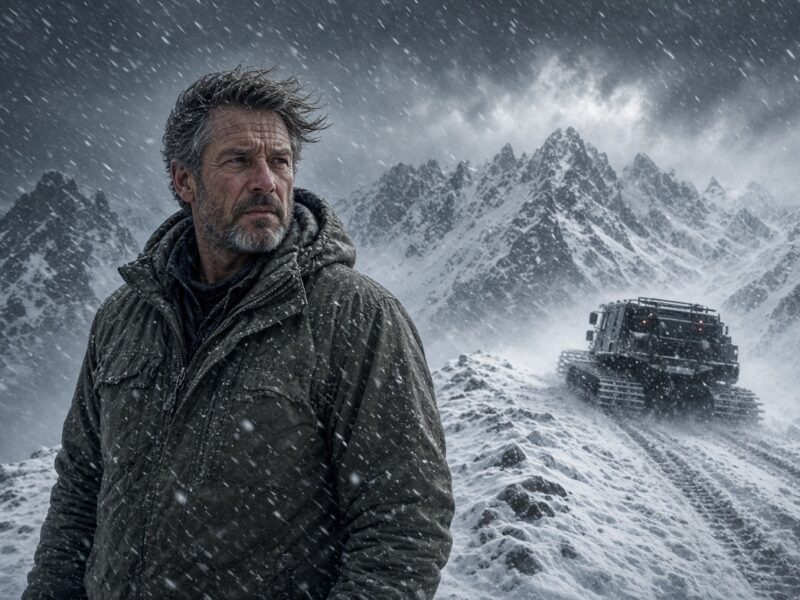
The wind on Mount Calder blew so hard that the engines of the convoy disappeared inside the white.
Sterling Blackwood climbed into the last snowcat and looked at the man standing beside a warning stake a few yards away.
“You keep telling everyone you understand this mountain,” the billionaire said. “So walk yourself down.”
The door sealed.
Caleb Rourke stood alone while the storm swallowed every track the treads had left.
Three hours later, civilian radar caught five military helicopters flying into weather every rescue team had been ordered to avoid.
The strangest part: they asked for a single name.
Two days earlier, on the eleventh floor of the Black Ridge Meridian building in Denver, the conference room smelled like fresh coffee and new carpet.
A billion-dollar mineral agreement was about to be announced on the Calder Range, and Sterling Blackwood had decided the announcement needed a backdrop nobody could forget.
He had arranged a survey trip for investors, senior executives, and a small technical crew, with photographs planned at a high ridge station where the peaks lined up like teeth.
The slide on the wall showed a helicopter shot of the range under a blue sky, taken in August.
Nobody in the room had been up there in winter except one man, and he was not sitting at the table.
Caleb Rourke stood at the back with a paper topographic map folded over his arm, waiting for his turn to speak.
He was forty-four years old, built like someone who had spent most of his life outside, with gray coming in at the temples and a jacket that had been repaired twice at the elbow.
His title at Black Ridge Meridian was terrain safety specialist and logistics technician, which meant he signed the documents that said a route was survivable before anyone drove it.
The executives knew his face the way people know the face of a man who fixes the elevator.
Vanessa Whitmore, vice president of operations, had once introduced him to a group of auditors as part of the building staff and had not corrected herself afterward.
Caleb had not corrected her either, which some people took for agreement and others took for something harder to name.
When Sterling finally gestured at him, Caleb unfolded the map across the end of the table and put two fingers on the northern approach.
He explained that a pressure system was sliding down off the Canadian front and dropping faster than the commercial forecasts had modeled, and that the real danger was not snowfall but upper-level wind loading on the eastern slopes.
He gave them a window: thirty-six hours before the northern route became a whiteout corridor with a strong chance of a secondary slide across the lower switchbacks.
He suggested moving the entire trip forward by one day or holding it until the following week.
The room was quiet for a moment, and then Sterling leaned back in his chair with the small pleasant smile he used before he took something away from someone.
“Are you the weather department now?” he asked.
Caleb did not raise his voice.
He said his job was making sure everyone who went up the mountain came back down it, and that was the only department he worked for.
Grant Wexler, the corporate security director, laughed at that and said the man checked batteries and tire chains for a living.
Vanessa added, without looking up from her tablet, that perhaps Mr. Rourke from maintenance could put his concerns in a memo so the team could review them properly.
A few people smiled.
Caleb folded the map along its original creases and did not argue, because he had learned a long time ago that the first person to get loud in a room like that loses the argument no matter what the facts are.
The forecast would not care who laughed.
Sterling, who enjoyed a small cruelty when it was polite enough to pass as curiosity, asked him where he had studied.
“Mostly in the field,” Caleb said.
Grant Wexler took that as an opening and spent the next ninety seconds describing his own years in uniform, the bases he had rotated through, the ribbons he kept in a frame in his office, before turning and asking what unit Caleb had served with.
Caleb said two words. “Search and recovery.”
Grant’s face relaxed into something close to relief. “So you’re the guy who brings the blankets after everybody else finishes the work,” he said.
Three people at the table laughed, and Caleb looked at him with the patience of a man watching weather he had already predicted.
Owen Beckett, a field supervisor three years from retirement who had been quiet the entire meeting, noticed something as Caleb packed up.
On the flap of the canvas bag, there was a shadow where a patch had been removed, the stitching picked out carefully by hand, the outline of an eight-pointed star still visible in the sun-faded fabric.
Owen had been around enough government contracts to know that patches get removed for a reason, and that men who remove them never bring it up first.
He opened his mouth to ask about it.
Caleb zipped the bag closed, nodded at him once, and walked out without explaining anything.
That evening, Caleb called his daughter from the kitchen of a two-bedroom house with a snow shovel still leaning against the inside of the front door.
Tessa Rourke was nineteen, a first-year student four hours away, and she had inherited her mother’s habit of hearing exactly what a person was not saying.
She told him to stop picking up extra shifts just because the company refused to hire enough people, and he laughed and said the shifts were how the tuition stayed paid.
Then she went quiet for a second and asked something that did not belong to the rest of the conversation.
“Dad, do you still carry the old beacon?”
Caleb looked at the small scuffed device sitting on the counter beside his keys, a gray rectangle with a worn rubber seal and no manufacturer’s name anywhere on the housing.
He had carried it in one pocket or another for twelve years, through three jobs and two moves, and had never once turned it on.
“Always,” he said.
Tessa let it go the way she always did, because her father answered that question honestly and never answered the next one.
After they hung up, he opened the weather service page one last time and watched the advisory band across the Calder Range change color while he stood there.
The forecast Sterling had called excessively cautious that afternoon had just gone from yellow to red.
The convoy left the staging yard at six in the morning with four snowcats, eleven passengers, and a drone case that cost more than Caleb’s truck.
Sterling had decided overnight to extend the route past the planned turnaround and push to the upper survey station, where the ridge gave a clean line of sight to the proposed extraction basin.
He wanted the investors standing in that exact spot when the announcement photographs were taken, because a photograph taken at the edge of something dangerous sells better than one taken in a parking lot.
Caleb heard about the change while loading fuel cans and walked straight to the lead vehicle.
He told Sterling that if the group went through Calder Pass later than two in the afternoon, the road back might not exist.
It was the first time anyone there had heard him put an edge on a sentence.
Sterling felt the eyes of two investors on him and heard the sentence as a challenge rather than a warning.
“Are you giving me orders?” he asked.
Caleb said no. He was saying the mountain would not care who owned the company.
Someone near the second snowcat made a small noise that might have been a laugh, and that sealed it, because Sterling Blackwood had never in his life been willing to lose a room.
He said the schedule stood, that the technical crew could stay behind if the technical crew was frightened, and that he expected everyone to be in position by noon.
Caleb looked at the sky for a long moment, then climbed into the third vehicle and started checking the tow straps.
Grant Wexler made a point of pulling up a commercial forecast on his phone at the first fuel stop and reading the snowfall percentage out loud in a voice meant to carry.
“Moderate,” he said. “Not even heavy.”
He gestured at the battered anemometer and the small handheld barometer clipped to Caleb’s jacket and asked whether that equipment had come out of a museum.
Caleb explained, without irritation, that the amount of snow falling was almost irrelevant, that what mattered was wind at altitude, moving existing snow, and loading the lee slopes until the pack could not hold its own weight.
Sterling, listening to both, chose the answer that let the trip continue.
By 10:30, the wind swung around to the northwest, and the character of the day changed in less than twenty minutes.
Visibility at the second switchback fell from about a mile to a few hundred feet.
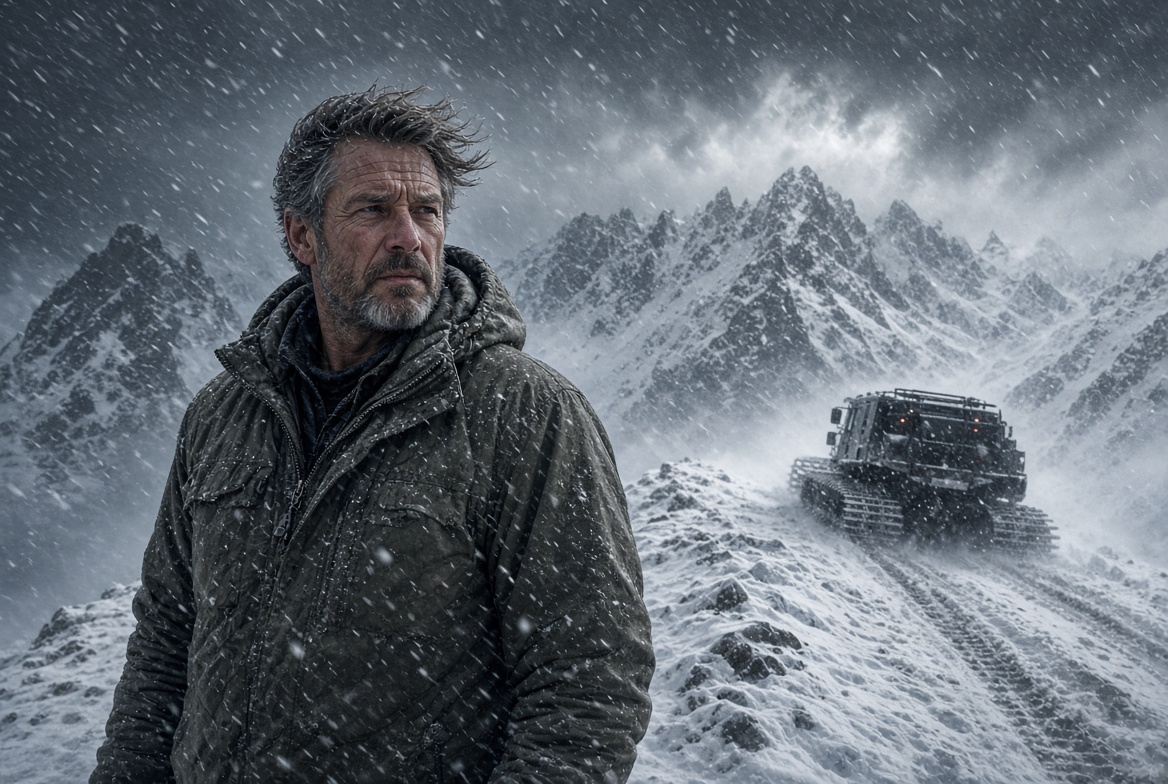
The flat light erased every shadow, and the driver started losing the edge of the road entirely.
Then the second snowcat stumbled and died with a fuel delivery fault, and the whole line stopped on a traverse with a drop on one side and a loaded slope on the other.
Caleb was out of his vehicle before anyone finished asking what had happened, lying on his back in the snow with a flashlight in his teeth, warming a frozen line with his bare hands until the engine caught.
He did not look heroic doing it.
He looked like a man doing something he had done many times.
He got the convoy moving again in a tight staggered formation with fixed spacing, taught the drivers a simple hand signal for stopping, and walked the forward edge of two blind corners on foot with the probe pole before letting the vehicles follow.
Twice he caught a tread drifting toward a cornice and brought it back.
At one point, Sterling’s own snowcat slid a yard and a half sideways on glazed rock, and Caleb put a strap on the rear tow point and anchored it to the vehicle behind before anyone had finished deciding whether to panic.
Sterling never said thank you.
Instead, somewhere between that moment and the next stop, he arrived at a comfortable conclusion: the technical man was manufacturing drama to prove his morning warning correct.
Vanessa, sitting beside him, agreed in a voice soft enough to sound like loyalty.
What nobody in the lead vehicle noticed was the way Caleb spoke on the radio when he was working.
He did not say the kind of thing company employees say.
He said, “Condition white, visibility twenty, marking route alpha nine, standby for spacing,” in a flat clip cadence with no wasted syllables.
And he gave the time in a format no one in that convoy used.
Grant Wexler, who had spent years in an office but had still spent them in uniform, heard it through the handset and stopped with his glove halfway on.
At the next stop, he came around the vehicle and asked where Caleb had learned radio protocol like that.
Caleb coiled the cable around his hand, clipped the handset back on its mount, and said, “Long time ago.”
They reached the upper survey station at one in the afternoon, and Caleb went straight to the remote snow sensor mounted on the eastern shoulder.
The readings were worse than he had expected: wind-loaded slab building fast on the lee side, with a temperature gradient inside the pack that he did not like at all.
He told Sterling plainly that the group needed to turn around within fifteen minutes, that the window had already narrowed from his morning estimate, and that he would not sign the condition certificate for any further delay.
Sterling wanted forty-five more minutes for the promotional footage, the drone flight, the handshakes against the skyline.
When Caleb refused to sign, Sterling heard it as insubordination rather than a professional opinion, and he glanced at Vanessa, who murmured that Mr. Rourke had been making things difficult for operations for months.
In that instant, removing Caleb from the team stopped being a personnel question and became a way to settle something.
They started down at ten minutes before two, forty minutes behind what Caleb had asked for, with the light going flat and gray and the wind rising from the northwest in long shoving gusts.
Caleb rode in the rear vehicle so he could watch the slope above the route.
Halfway through the upper traverse, he saw it: a thin dark line running across the white perhaps two hundred feet above the road, a fracture in the surface where the slab had already begun to separate from what was holding it.
He keyed the radio and told the lead to increase spacing, and stopped talking.
Then he sat back and did the arithmetic on how much time they had left, and the answer he got was not a number he wanted to say out loud.
The slide came at 2:23.
It was small, as these things go, which is the only reason the story did not end there.
A section of the slope above the lower traverse released, ran perhaps three hundred feet, and spread across the road in a tongue of broken snow about chest deep and sixty yards wide.
The lead snowcat had already passed.
The third one stopped with its nose eight feet from the edge of the debris, and for about ten seconds, nobody in any of the vehicles made a sound.
Nobody was hurt.
What they lost was the route marker beacon mounted on the rear of the second vehicle, torn off by a chunk of ice, along with any certainty about where the buried road actually ran under the new snow.
Caleb got out, walked the edge of the debris field, and came back with a decision.
He wanted the convoy held in place for ten minutes while he went out roughly three hundred yards to a marker stake on the shoulder and pulled data from a working snow beacon anchored there.
With that data, he could tell them whether the lower bypass was safe, and if it was not, where the alternate line ran.
He said it the way he said everything, like a man reading a checklist.
Sterling, who was frightened for the first time in a decade and had no vocabulary for it except anger, told him to hurry up.
While Caleb was gone, the argument started.
Grant Wexler insisted the lower road was still passable, that he could see the line of it, that they could be at the base station in ninety minutes if they stopped waiting around for a man with a probe pole.
Vanessa pushed harder, saying the group was burning fuel and daylight, and that the investors were now illegal exposure rather than guests.
Owen Beckett said the only sensible thing anyone said in those four minutes, which was that the man out there walking the shoulder was the only one who had been right about anything since breakfast.
Sterling listened to all of it with the particular stillness of someone who has already decided and is waiting for permission.
Then Caleb came back over the rise and heard the last thirty seconds of it.
He told them flatly that the lower road ran directly beneath a loaded bowl that had not released yet, and that driving into it would put every vehicle inside a secondary slide path with no exit.
He gave them the alternate line, which was slower, narrower, and required two of the snowcats to be winched over a bench of rock.
Sterling exploded in the controlled way wealthy men explode, saying Caleb had ruined an entire investor presentation with what he called professional fear, that the company paid him to solve problems rather than to collect reasons why things could not be done.
Then Caleb said quietly enough that the people standing nearest had to lean in: “Fear keeps people alive when arrogance doesn’t.”
Sterling heard it as an insult delivered in front of witnesses, which is exactly what it was.
Caleb turned back to the work anyway, because the work was still there.
He told them he needed one more reading, this time from a second beacon on the ridge spur above the bypass, because that unit measured the shear layer directly and would tell him whether the alternate line held or whether they needed to dig in and wait the storm out in the vehicles.
He said ten minutes, maybe twelve.
He left his larger pack strapped to the rear vehicle to move faster and took a radio, a probe, a headlamp, and the small gray device from his jacket pocket that he had carried for twelve years.
Sterling said, “Fine, go,” in a tone that sounded like agreement.
Caleb walked out along the spur and disappeared into the moving white at about 250 yards.
Four minutes later, the wind came up hard enough to rock the snowcats on their suspension, and Sterling made the decision he would spend the rest of his life explaining.
He told the lead driver to move out.
The driver, a contractor named Dale Vickery who had been doing mountain work for nineteen years, turned around in his seat and said he was not leaving a man on a ridge.
Grant Wexler pointed out that Caleb had a radio and survival equipment and knew the terrain better than anyone, which he delivered as a fact rather than as the excuse it was.
Vanessa gave the decision its paperwork: staying could trap eleven other people, and the company had an obligation to the eleven.
Sterling looked out at the white where Caleb had gone and said, loud enough for the second vehicle to hear, “Rourke says he knows this mountain better than all of us. Let him prove it.”
The convoy pulled out.
Owen Beckett opened his door and started to climb down, and Grant put a hand on his arm and told him not to be stupid.
And the moment passed the way those moments do, in under four seconds, with a decent man sitting back down because somebody stronger told him to.
The treads bit.
The vehicle swung into line, and the gap between the convoy and the ridge spur began to widen at eleven miles an hour.
Dale Vickery drove with his jaw locked and his eyes on the mirror.
The storm filled the space behind them so completely that within two minutes there was no evidence the convoy had ever stopped there at all.
Caleb came back over the spur at eleven minutes with the readings in his hand and saw four sets of taillights already small in the murk.
He stood still for perhaps three seconds.
Then he keyed the radio and called the convoy by name, gave his position, and asked for a hold.
Nothing came back.
He called again, slower, adding that he had the shear data and that the alternate line checked out.
In the lead snowcat, Grant Wexler heard the second call clearly and looked at Sterling, and Sterling looked at the handset the way a man looks at a phone he has decided not to answer and said, “Keep moving.”
Caleb understood.
Then he did not shout into the microphone, and he did not swear.
He stood in a crosswind that was stripping the surface snow off the rocks around him and said one sentence in a voice as level as a flat sea.
“Black Ridge Convoy, confirm you are abandoning field personnel.”
The silence that followed lasted long enough for every person in those four vehicles to know exactly what had happened and exactly what they were.
Then Sterling took the handset from the mount himself, pressed the key, and said, “You’re terminated, Rourke. Find your own way down.”
The radio clicked off.
In the second snowcat, Owen Beckett put his face in his hands.
Caleb turned his back to the wind and ran the inventory, because panic is a decision and he had never been interested in making it.
Temperature eleven degrees and falling.
Wind gusting past fifty on the exposed spur.
Headlamp battery good for about nine hours.
Radio three-quarters charged and now useless for its intended purpose.
Map, probe, two chemical heat packs, half a liter of water, four protein bars, and a space blanket in his jacket pocket.
What he did not have was his pack, his bivvy sack, and his stove, all of which were riding down the mountain in a vehicle belonging to a man who had just fired him.
The obvious move was to follow the convoy, and the obvious move would kill him.
On foot at that speed, in that visibility, he would reach the lower traverse right around dusk, which was precisely when the loaded bowl above it was most likely to go, and he would be walking under it alone with nobody within radio range to dig him out.
The counterintuitive answer was the only survivable one.
Go up.
There was an abandoned relay station on the saddle eight hundred vertical feet above him, built in the 1970s for a repeater network and never fully dismantled, with a concrete equipment shed that still had a door.
It was two and a half hours of brutal climbing in a storm.
It was also out of every slide path on that face, and it had walls.
He started up at a pace he could hold rather than one that felt fast, breaking the climb into segments between features he could identify, resting thirty seconds at the top of each one and no longer.
Once he stopped for ninety seconds at a rock band to hold his hands inside his jacket against his stomach until feeling came back into three fingers, and he spent those ninety seconds thinking about Tessa’s voice on the phone, asking about the beacon, which was the first time all day he had let himself think about anything personal.
At the halfway bench, he took out the gray device and looked at it for a long moment while snow collected in the seams.
It was not a civilian emergency locator.
It would not call the county sheriff or a volunteer rescue group or the state patrol, and it had no way to send a message to anybody who knew his name.
He turned it on.
The screen woke up gray-green, held for four seconds, and displayed two words.
Caleb stood with his back against the rock and the wind screaming over him and did not move for almost a full minute, because turning that device on meant reopening something he had closed deliberately and completely twelve years earlier.
Then he stripped his glove with his teeth and entered a sequence of characters he had never written down anywhere.
The screen cleared.
A single line appeared and stayed.
NORTHSTAR / SNICKS DISTRESS PRIORITY.
He put the device back in his pocket, put his glove back on, and kept climbing.
Four hundred twelve miles away, in a windowless operations room where the overhead lights never changed, a duty officer named Lieutenant Hollis Grady was working through the last hour of a shift that had produced nothing but routine traffic.
An alert tone sounded that she had heard exactly twice in her career, both times during system verification tests.
She read the line on her screen.
Then she read it again, stood up so fast her chair rolled back into the console behind her, and reached for the direct handset without taking her eyes off the display.
“Sir,” she said. “Northstar just went active.”
The convoy reached the Mill Creek base station at twenty minutes before six, scraped and shaken but intact, and the investors were handed hot coffee in a prefabricated building that smelled like diesel and wet wool.
Sterling Blackwood sat down at a folding table with Vanessa Whitmore and began, before anyone had even taken their boots off, to build the version of the day that would survive a lawyer.
Rourke had separated from the group against instruction.
Rourke had deviated from the approved route.
The company had lost contact with an employee during a severe weather event and had initiated appropriate protocols.
Vanessa was already composing an internal message on her laptop, with a timestamp that would later become one of the most expensive pieces of writing in the history of Black Ridge Meridian.
Owen Beckett stood in the doorway with melting snow running off his sleeves and listened to twenty seconds of it before he spoke.
“You didn’t lose contact with him,” he said. “You left him.”
The room went quiet in the particular way rooms go quiet when the truth arrives badly dressed.
Sterling looked up from the table with no expression at all and told Owen that if he continued to misrepresent an operational decision, he would find himself unemployed before the roads reopened.
Owen did not sit down, but he did stop talking, and he hated himself for it in a way that would keep him awake for three nights.
At six, a station technician came in holding a printout and said something that did not fit anywhere in Sterling’s reconstruction of the day.
Airspace over the entire Calder Range had just been placed under military priority control, and every civilian aircraft, including the two contract helicopters Black Ridge kept on standby, was grounded until further notice.
Sterling assumed it was a training exercise and said so.
Twenty-five minutes later, the first aircraft came over the ridge, low and loud, running without any marking anyone could read in the dark, and the windows of the base station buzzed in their frames.
Then a second one, heavier, with a wide sensor pod under the nose.
Then a third.
By seven, there were five.
They were not five identical rescue helicopters, which is what the investors standing outside with their phones assumed.
One was a long-range search airframe with thermal and radar mapping.
Two were medium-lift recovery aircraft rigged with hoists and heated litters.
One carried a weather and atmospheric team whose entire purpose was to find the gaps in a storm and tell everybody else where the gaps were.
The fifth climbed higher than the rest and simply stayed there, circling slowly, doing nothing visible at all, which was the part nobody in that parking lot understood yet.
Sterling decided out loud, in the confident voice he used for things he had not verified, that an aircraft must have gone down somewhere on the range and that the military was conducting a recovery.
It was a reasonable theory.
It lasted nine minutes.
At 11:07, a liaison officer came through the door of the base station in a flight suit with frost still on the shoulders, took one unhurried look around the room at the investors, the executives, the coffee, the expensive jackets, and asked a question that did not include any of them.
“Which one of you was last in contact with Caleb Rourke?”
The temperature in that room changed without anything mechanical happening to it.
Grant Wexler, who had spent nineteen years telling stories about being the kind of man who belonged in rooms with officers, heard his own voice come out thin.
“Why?” he asked.
The officer turned his head slightly, the way people do when they want to have identified the person they will later be asked about, and answered him evenly.
“Because five aircraft are currently flying into weather nobody else is authorized to enter, looking for him.”
Behind the officer, through the open door, the sound of rotors reorganized itself into something purposeful.
Sterling stood up and did the only thing he had ever had to do.
“I’m Sterling Blackwood,” he said. “This is my operation.”
The officer looked at him for perhaps a second and a half.
“I didn’t ask,” he said, and went back to the question he had come in with.
It was the first time in Sterling Blackwood’s adult life that his name had been treated as information he had volunteered rather than as a key to a door.
He sat back down without deciding to.
Vanessa, who had made a career out of standing next to whoever was most powerful in any given room, quietly closed her laptop and discovered that she had no idea where to stand.
Eight hundred feet above the convoy’s abandoned stopping point, Caleb Rourke reached the old relay station at 6:40 with ice in his eyebrows and no feeling in his left foot.
The concrete shed was half full of drifted snow, the door hanging on one hinge, but the back corner was dry and out of the wind, and there was a steel cabinet he could pull across the opening to cut the draft.
He got the space blanket around himself, broke both heat packs, put one against his chest and one in his boot, and made himself eat two of the protein bars, even though he did not want them.
Then he did the thing that would matter more than any of it.
He turned the radio on and started working through the open frequencies, not to call for help, but to listen.
At 7:10, he found a weak carrier on a low channel and a voice underneath it that was trying very hard to sound calm.
A three-person contract survey crew from a different company, working the southern drainage, had become trapped when their vehicle slid off the track into a gully.
They had no idea where they were relative to anything.
Their fuel was nearly gone, and they had been planning to walk out at first light along the valley floor.
Caleb pulled the map from his jacket, matched their description of a rock formation to a feature he knew, and understood immediately that the route they were planning to walk ran the full length of a runout zone he would not have crossed in daylight with a rope team.
He had a choice that he did not experience as a choice.
Every minute spent on that radio was a minute of battery, body heat, and attention he could have spent on his own survival, and nobody anywhere would ever have known he had heard them.
Instead, he spent the next fifty minutes talking three strangers through a route that went the wrong direction: uphill and east, to a forest service shelter that did not appear on their map because it had been built in the 1980s and never updated.
He gave them bearings in plain language, told them how to rig a hand line across the one bad section, and made them repeat the instructions back to him twice.
Then he told them to stay put once they were inside and to keep the radio on low at fifteen past.
He did not tell them his name.
Back at the base station, the liaison officer was working through the convoy roster with a tablet and a flat, courteous patience that was somehow worse than hostility.
He got to Grant Wexler and read something off the screen.
“You stated to your dispatcher that Rourke had served in search and recovery,” he said.
Grant produced a smile that did not reach anywhere. “Apparently,” he said.
The officer looked up from the tablet and held his eyes. “Do you know what Northstar was?”
Grant opened his mouth and found that he did know, in the vague way a man knows a phrase from a training module he half-listened to eleven years ago, and that the knowing was already making his stomach drop.
He said nothing at all.
At eight, a pilot’s voice came over the station’s patched speaker, clipped by distance and static.
“Possible visual on Northstar, east saddle, confirming.”
The entire room turned toward the sound.
Sterling Blackwood, who had spent the last hour assembling the sentence he would say when they brought Caleb in, felt something in his chest that was not quite relief and not quite dread.
Then the same voice came back forty seconds later with an edge of confusion in it that carried even through the distortion.
“Negative on extraction. He’s moving away from the pickup point.”
Nobody in that base station could make sense of it.
Five aircraft had been flying into a storm for an hour to pull one man off a mountain, and the man had just walked in the opposite direction.
The explanation was on an open channel for anyone with a receiver.
The search aircraft had found Caleb standing in a cleared patch of wind-scoured rock below the relay station with a headlamp held up and angled, and the pilot had put the nose into the wind and started talking him toward a hover pickup.
Caleb told them there were three civilian technicians trapped in the southern drainage with no shelter, no heat, and roughly four hours of usable time, and he gave their position in coordinates he had worked out by hand from a paper map in a storm.
If the aircraft came down for him first, the fuel and daylight math changed for the three in the gully.
“Take them first,” he said.
The pilot came back with the only thing he had been trained to say. “Northstar, you are the priority.”
Caleb keyed the handset. “Negative. Civilians first.”
Colonel Everett Shaw landed at the Mill Creek base station at nine.
Fifty-eight years old, gray to the scalp, with the unhurried manner of a man who had stopped being impressed by anything a long time ago.
He wanted the convoy’s route log and the radio recordings, and he got them in under four minutes, because nobody in that room was in any condition to refuse.
It was Owen Beckett who finally asked the question the whole building was holding.
“Who is he?”
Shaw did not tell it like a legend.
He told it like a man reading a file he had read many times.
Twelve years earlier, Shaw said, Caleb Rourke had been a senior rescue operations coordinator with a joint personnel recovery task group.
And during a winter operation, two aircraft had gone down within forty minutes of each other inside the same weather system.
Rourke had the authority to pull his teams back and wait for a window, and every model he had said the window would not open for eleven hours.
Instead, he rebuilt the entire flight corridor from scratch, stacked five aircraft at different altitudes so that each one solved a problem the others could not, and brought more than two dozen people out of a valley that had already been written off.
He had not done it by being braver than anyone else.
He had done it by making a system that was falling apart work together for one more hour, and the call sign he used that night had been kept inside the recovery network ever since as a priority signal.
Then Shaw told them the part that mattered.
The beacon did not summon five aircraft because Caleb Rourke outranked anyone, owned anything, or held some secret position in a government nobody could name.
It activated an automatic support protocol that pulled in whatever assets were nearest.
And the first weather assessment that came back had been bad enough that command moved to reduce to two airframes.
What changed the decision was that three pilots and a crew chief who had either worked that night twelve years ago or come up through training that used it as a case study asked to go anyway.
“They aren’t out there because Caleb Rourke outranks anyone,” Shaw said. “They’re out there because twelve years ago, when men they loved were trapped in weather like this, he refused to leave them behind.”
Nobody in the room looked at Sterling Blackwood.
That was somehow worse than if they had.
Grant Wexler was staring at the floor with his hands flat on the table, because he had finally placed the shape he had seen on the flap of a canvas bag at the back of a conference room: the eight-pointed star, picked out carefully by hand, and he knew exactly which program had worn it.
He had sat through a classroom module built around that operation.
He had used the phrase in a briefing once to sound like someone who knew things.
The man he had called the guy who carried blankets had been the case study.
He did not apologize to anyone then or later, because shame that arrives that completely does not come out as words.
The rescue itself nearly failed.
The two lift aircraft reached the southern drainage at 9:40 and found the three technicians already at the forest service shelter, exactly where Caleb had sent them.
And then the slope above the approach released for the second time that day and filled the only flat ground within half a mile.
There was no landing.
Caleb, who had descended 1,400 feet of broken terrain on foot to meet them, marked a hoist corridor with three flares set in a line he worked out from the wind direction in the rotor wash, and talked the technicians out one at a time, each one standing in the exact spot he had put them in, because a hoist cable in a crosswind forgives almost nothing.
He went up last.
The fifth aircraft, the one that had been circling high and doing nothing visible for two hours, was the only reason any of it was coordinated at all.
The ridge wall blocked every direct transmission, and that airframe sat above the whole thing, relaying the voices that kept four other crews from flying into each other.
In the cabin, with the door closed and the heat roaring and a crewman cutting his boot off his left foot, Caleb heard a voice in his headset that he recognized before he could place the face attached to it.
It did not say welcome back, and it did not say hero.
It said, “Good to hear your voice again, Northstar.”
Caleb looked out the window at the mountain going by underneath, black and white and entirely indifferent to every decision made on it.
“Wish I could say the same about this place,” he said.
Somebody in the back laughed, and it was the first laugh on that range in nine hours that had not been at somebody’s expense.
Sterling Blackwood believed for about thirty hours that his problem had been solved by Caleb surviving.
He had not yet understood what the word survived does to a timeline.
The moment military assets entered the operation, every transmission on every channel in that airspace was recorded, timestamped, and archived by a system that did not work for him and could not be asked for a favor.
Somewhere in that archive was a man’s voice saying, “Black Ridge Convoy, confirm you are abandoning field personnel.”
Nine seconds of silence.
And then another voice, clear enough to identify by spectrograph, saying, “You’re terminated, Rourke. Find your own way down.”
The rest of it assembled itself without anyone needing to be clever.
Vehicle telemetry showed the convoy had been stationary at the spur for eleven minutes and had moved out while the employee who requested the hold was still within 250 yards.
Atmospheric data pulled for the incident review confirmed that the warning Caleb had delivered in a Denver conference room two days earlier had been correct to within ninety minutes.
Vanessa Whitmore’s internal message, drafted at 5:51 in the evening, described an employee who had separated from the group against instruction, which was a statement composed before anyone had made any attempt to determine whether that employee was alive.
Owen Beckett, who had spent three sleepless nights deciding what kind of man he was going to be for the rest of his working life, agreed to give a statement and did not ask what it would cost him.
Dale Vickery, the driver who had turned around in his seat and said he would not leave a man on a ridge, gave one, too.
Sterling was still a billionaire, and billionaires do not fall over because one bad day arrives.
What moved was the board, and boards move for exactly one reason.
The projected liability, between the employee, the three contract technicians whose employer was now asking its own questions, and the certification requirements attached to a mineral agreement worth more than a small nation’s budget, was large enough to appear in a single column on a single page.
Conrad Blackwood, Sterling’s father, seventy-one years old and five years out of daily operations, flew in from Charleston and sat at the head of a table he had not used since the handover.
Everyone in that room expected the father to protect the son, because that is what everyone in that room would have done.
Conrad asked for the audio.
He listened to all nine seconds of the silence with his hands folded, and he listened to his son’s voice coming out of the speaker, and when it finished, he did not say anything about it at all.
He asked the general counsel one question. “Has Rourke filed?”
The lawyer said no.
Conrad let that sit for a moment and then asked the only question that mattered. “Why not?”
The answer was that Caleb Rourke was in a hospital in Granby being treated for moderate hypothermia and two frostbitten toes, that he had given a factual statement to investigators, and that he had not contacted a single attorney, because revenge had not occurred to him as a use of his time.
Conrad Blackwood understood then that he was not managing a lawsuit.
His son had very nearly killed a man for the crime of disagreeing with him in public, and had done it in a way that left a recording.
Sterling came to see Caleb nine days later in a rented office with a window that looked out on a parking structure, because Caleb had declined to meet anywhere expensive.
He opened with the sentence he had been practicing.
“I had eleven people to get off that mountain,” he said.
Caleb, sitting with his bandaged foot propped on a chair, considered that for a moment.
“Then you should have said that on the radio,” he answered.
Sterling had no reply, because there was none, and the silence stretched until Caleb finished the thought for him.
“You didn’t leave because you had no choice. You left because you wanted me to know you could.”
It was the first completely accurate description of Sterling Blackwood that anyone had spoken to his face in twenty years.
Sterling reached for the only instrument he had ever been taught to use and began talking about a settlement.
Generous, confidential, structured, however Caleb preferred.
Caleb never named a figure.
What he put on the table instead was four items written out longhand on a single page.
That Sterling be removed from all operational safety authority for the duration of the external investigation.
That the company establish independent stop-work authority for its safety engineers that no executive could override.
That no employee could be dismissed, reassigned, or penalized for refusing to certify unsafe conditions.
And that Owen Beckett, Dale Vickery, and anyone else who had objected face no retaliation of any kind, in writing, permanently.
He did not ask for a title.
He did not ask for a seat on anything.
He asked that the same thing never happen to somebody with less experience and fewer options.
Conrad accepted all four without negotiation, and then delivered the piece of information his son had not yet absorbed.
The Calder Range Agreement required independent risk certification from an outside auditor before any capital moved, and the auditor had suspended its review the morning the recording surfaced.
The partner consortium had frozen the transaction pending the outcome of the investigation, and two of the three investors who had stood on that ridge for photographs were quietly asking to be released from their commitments.
Caleb Rourke had not damaged Black Ridge Meridian.
The man who had been called nobody in a conference room was, as the record now showed in detail, the only person in the company who had tried to prevent the exact event that was currently costing it everything.
Six weeks later, Caleb went back to work, though not for Sterling, who had been suspended from operational duties by the board and was spending his days with attorneys.
Vanessa Whitmore left the company the week her message became an exhibit.
Grant Wexler resigned on a Friday without telling anyone where he was going.
The board offered Caleb a senior executive safety directorship with the corner office, and he turned it down and took an independent advisory contract instead, one that reported to no operations officer and carried the authority to halt any job on any site at any hour.
At the first safety meeting after the incident, a new manager introduced him as the company’s safety consultant, and a young technician in the back asked whether it was true that five military helicopters had come for him.
The room went completely still.
“They came because people were in trouble,” Caleb said.
The technician pushed. “But they were looking for you.”
Caleb picked up his map case and answered without any weight on it at all.
“They found everybody. That’s the part that matters.”
Tessa came home that weekend and found the gray device sitting on the kitchen counter beside his keys, where it had been her whole life.
“Are you finally going to retire that thing?” she asked.
He said he had been thinking about it.
She told him he had been saying that for ten years, stole half his sandwich, and the conversation moved on.
A package arrived from Everett Shaw that same month: the old eight-pointed star, restored and remounted, with a note that said, “You taught us never to leave one behind. Good thing some lessons stick.”
Caleb did not hang it on a wall.
He put it in the drawer beside a photograph of his wife and daughter, where the things that actually defined him were already kept.
By spring, the pass had reopened under clear sky, and a new sign stood at the control station with no name on it.
At Caleb’s insistence, crews at Black Ridge Meridian had begun saying something to each other that had not existed before that winter.
No deadline outranks a safe return.
Sterling had believed power meant being obeyed.
Caleb understood a different kind, the kind measured by who you are willing to carry when everything goes wrong.
And nobody becomes a nobody simply because their title is small.









