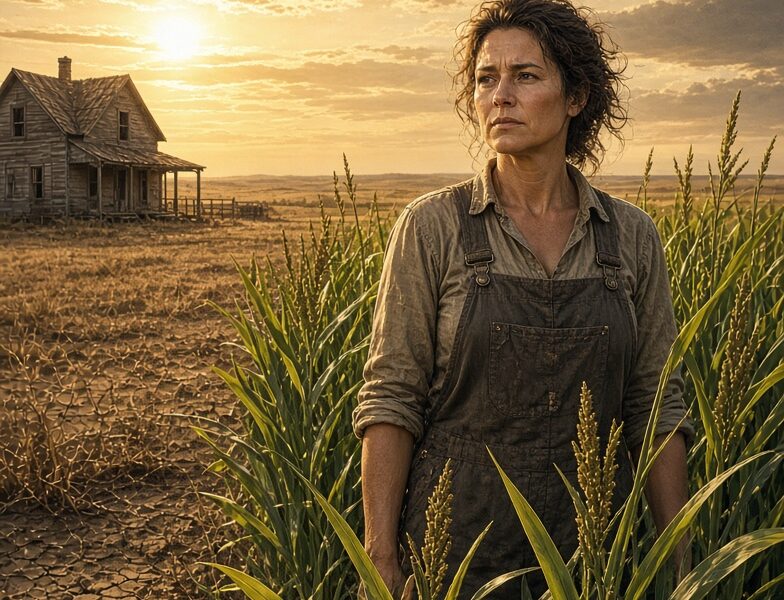
They Laughed When She Bought Expired Seeds for $50… Then Her Field Stayed Green in the Worst Drought
The auctioneer laughed when Willa Hart carried 300 packets of expired seeds to her truck.
“Fifty dollars,” he said, “was fifty dollars wasted.”
By July, the worst drought in half a century had turned Kansas cornfields brown, emptied irrigation ponds, and pushed families toward bankruptcy.
Yet, behind Willa’s weathered farmhouse, something green was growing.
At sunrise, pickup trucks began lining her gravel driveway.
Farmers who had mocked her were suddenly asking for help.
But when the county’s wealthiest landowner stepped out of his truck holding an old photograph, Willa realized those forgotten seeds carried a secret nobody had mentioned.
Dunphy’s Farm and Ranch Supply had been dying for three years, and on the last Saturday in February, it finally got around to the funeral.
The auctioneer worked from a folding table by the dead register, selling shelving units and bolt bins and a pallet jack with a bent fork, while the wind pushed grit under the front door and nobody bothered to sweep it.
Willa Hart stood near the back with her hands in the pockets of her father’s canvas coat, waiting on the one lot she had come for.
A spool of poly pipe long enough to limp her irrigation line through another season.
The pipe sold for more than she had.
She did the arithmetic twice, the way she always did when the answer was one she did not like.
And then she put her hand down and kept it down.
Her truck sat out front with the cracked pump housing in the bed.
Hollis at the machine shop had quoted $1,100 to make it right.
The note on the home quarter came due the first week of March, and the 24 acres behind her house had grown corn since before she was born without paying for itself in four years.
She was thirty-eight.
She had a boy in fifth grade who ate like a hired man, a well that pumped a little slower every August, and $91 in checking.
She found the crates in the stockroom under a workbench, behind cardboard that had gone soft at the corners.
Three wooden boxes, lids loose.
Each one packed with foil packets the size of a sandwich bag.
She counted a row, multiplied, and came up near three hundred.
Proso millet, pearl millet, grain sorghum in half a dozen lots, cowpea.
The printing on the packets was faded but legible.
And under each variety name sat a line that read “germination tested” followed by a month and a year that had passed a long time ago.
That line was the thing most people got wrong, and Willa knew it because she had spent six years behind a counter in a store exactly like this one.
A test date was not an expiration date.
It was the last day somebody had put a hundred seeds on wet paper and counted how many woke up.
Seed kept dry and sealed and reasonably cool could hold on for years, losing a little vigor each season, like a man losing a step.
She looked around the stockroom.
Concrete floor, north wall, no window, no heat vent.
Air so dry it made her lips crack.
Whatever else these seeds were, they had not been cooked or soaked.
Half the packets carried the same hand-stamped mark in the corner: BC17, a slash, and the word “trial.”
On one of them, somebody had written a line in ink gone the color of weak tea.
“Dryland plot, west block, do not mix.”
The handwriting caught at her the way a name you cannot place catches.
And she stood there in a cold stockroom turning a packet in her fingers and failing to remember why.
“You lost, Willa?”
Graham Whitmore filled the doorway.
Kingsley Agricultural stitched over his pocket, phone in one hand.
He ran operations for Conrad Kingsley, which in Briar Creek meant he ran a good deal of everything.
And he had a way of being friendly that left marks.
“Just looking.”
He glanced at the crates and left, not cruelly, which was somehow worse.
“Fifty dollars for something even the birds might refuse to eat.”
She did not answer.
He waited a second for her to, then went off to find the auctioneer about the forklift, and she heard him telling the story before he reached the front counter.
Conrad Kingsley caught her at the door.
He was fifty-six, built like a man who had done his own loading until about ten years ago, and he spoke to her the way he spoke to everybody, as if the conversation had already been decided and he was only being polite about the timing.
He said he had heard about the pump.
He said land in her section was bringing good money, and that if she sold now, she would clear the note, keep the house and the yard, and sleep at night.
“You’d be doing yourself a kindness,” he said.
“I’ve watched three families in this county hold on about a year too long.”
The worst part was that he was not wrong.
She had run that same arithmetic at two in the morning more than once.
She told him she would think about it, which they both understood to be a no, and he nodded and let it go without pushing.
And that cost her something, too, because it would have been easier if he had pushed.
When the auctioneer got to the stockroom lots, nobody wanted the crates.
He offered them at twenty-five and got silence, then bundled them with a box of split hose clamps.
Willa raised her hand at fifty.
She was not buying a miracle.
She was buying a question she could still afford to ask: whether there was anything out there that would make a crop on nine inches of rain, since corn had stopped doing it, and she had nothing left to lose but time.
She was sliding the last crate over the tailgate when a voice behind her said, “Where’d they come out of?”
Everett Boone had his reading glasses pushed up on his forehead and his eyes on the stamped corner of a packet.
He was sixty-seven, retired off a half section north of town, and he had been standing in the cold long enough that his ears had gone red.
“Back room,” Willa said. “Why?”
He did not answer her.
He went inside and asked the auctioneer which storeroom the crates had come out of, and whether there had been paperwork with them, and what had happened to it.
For eleven days, the kitchen table belonged to the seeds.
Willa worked at night after Dalton went to bed, one hundred seeds per lot counted onto damp paper towels, rolled, bagged, dated, laid on top of the refrigerator where the warmth came up steady.
Her son got interested around lot nine and started counting for her, licking his thumb to separate the sorghum, which was not the method, but was close enough.
“This one’s dead,” he announced on the fourth morning, holding up a towel with three pale threads on it.
“That one’s mostly dead,” she said. “There’s a difference, and the difference is three.”
Some lots came up empty.
Two cowpea packets gave her nothing but mold, but the proso millet ran near half.
One pearl millet lot did better than that, and three of the sorghum lots came in between fifty and seventy out of one hundred, with roots that looked like roots instead of like hair.
She wrote every number in a spiral notebook.
And when she was done, she had a page that told her plainly which of the three hundred packets were worth dirt and which were worth a trash bag.
She did not plant all of them.
That was the first decision she made, and the one she would defend for the rest of the year.
She took one packet from each decent lot, left the rest sealed in the crates in the mudroom closet where the floor stayed cold, and laid out eleven strips behind the house, each one forty feet long, each one flagged with a strip of orange tape and a code written in marker.
The rest of her ground went to corn because the note was real, and the bank did not take experiments as collateral.
Her father’s notebooks were in a feed box in the shop under a coffee can of carriage bolts.
Caleb Hart had died when Willa was twenty-six, and she had carried those books from house to house without ever reading them straight through.
The way people keep a language they never learned.
They were not diaries.
They were dull.
Dates, depths, rainfall, soil temperature at two inches and six.
A column he labeled “cover” with numbers she had to work out meant percent of ground still covered by last year’s stalks.
On one page in pencil: “Do not work this ground after the first week of April.”
On another: “Plant into the stubble, not into the dust.”
So she did it his way, which looked like laziness to anybody driving by.
She left the wheat stubble standing on the strips instead of tilling it black.
She hauled four round bales of weathered straw and spread it between rows by hand until her shoulders locked.
She ran shallow catchment furrows on the contour, three inches deep, nothing a neighbor would call fieldwork.
And when the April rains came, the water walked instead of ran.
Russell Pike stopped on his way back from the elevator and stood at the fence looking at the strips with his hat pushed back.
He was fifty-two and farmed the section east of her, and his family had been in Briar Creek two generations longer than hers.
“Millet,” he said. “Some of it. There’s no market inside of two hundred miles for millet, Willa. Sorghum, sure, if you get a stand.”
He was quiet a second.
“I’m not laughing at you. I just don’t want you betting your spring on something nobody’s buying.”
“I’m betting one acre and eleven flags. That’s what it starts as,” he said, and got back in his truck.
Everett came twice.
The second time he brought a photocopy of a page from some county bulletin, twenty-odd years old, with a paragraph about a dryland variety trial and no detail worth having.
He asked again about the BC17 stamp and said he had run plots for the extension service back then, moving stakes and taking stand counts for a man he could not quite picture anymore.
“I remember we had a west block,” he said.
“I remember being told to keep the lots separate and not being told why. That’s about all I’ve got, and I wouldn’t swear to the year.”
“You could be remembering a different program.”
“I could be.”
He looked out at the orange flags.
“You check germination on these?”
“On every lot.”
That seemed to settle something for him, because he nodded like a man who had been worried she was praying over them.
A good rain came the last week of May, nine-tenths of an inch, slow and all night.
The strips came up uneven, but they came up, and the millet went so fast it was embarrassing.
And for about three weeks, Willa let herself feel something she would have denied feeling if asked.
She still drove to the elevator four mornings a week to run the scale house, and she still did the books for a feed yard south of town on Sundays, and both of those jobs were the only reason the lights stayed on.
In the second week of June, the weather service put out the summer outlook, and the man on the radio used the word “persistent” about a ridge of high pressure and the words “well below normal” about rainfall.
Willa was standing in the shop with a wrench in her hand when he said it.
That evening she walked the fence line to the corner where her ground met Russell’s.
His corn was knee-high and already rolling its leaves in the afternoon, and between the rows the soil had opened in cracks you could lay a finger into.
July came in at 104 degrees and stayed there.
The ridge the radio man had described parked itself over the high plains and refused to move, and the thunderstorms that normally rode down from Colorado in the evenings either died on the state line or went around.
Briar Creek got eleven-hundredths of an inch on the second and nothing after that.
By the middle of the month, the county had the look of late October, except that nothing was ripe, only finished.
The wells told the story before the crops did.
The irrigation district pulled two feet of decline in six weeks on wells that normally moved six inches in a season, and men who had never watched a flow meter in their lives started watching one.
Sprinklers that threw one hundred gallons a minute in May were throwing sixty in July.
And water put out at midday burned off before it hit the ground.
So people ran at night and slept in the pickups at the end of the pivot road.
The county agent’s office logged the driest ninety-day stretch in its records, which went back fifty-one years.
Conrad Kingsley did what a man with contracts does.
He triaged.
He shut water off to three-quarters of dryland-planted milo and threw everything at the irrigated corn with delivery obligations against it.
And his lawyer spent two weeks in Garden City working on a lease that would let him pull from a neighbor’s permitted well for the balance of the season.
It was legal.
It was expensive.
And it was the sort of thing that made the men at the Nighthawk Cafe go quiet when the subject came up.
Willa lost plenty.
The garden went first, then the second strip of cowpea, which had emerged thin and never built a root worth the name.
Three of her eleven strips burned up entirely by the twentieth, including the pearl millet lot she had been proudest of in June.
Her corn, twenty acres of it, began aborting kernels at the tip, and she knew by the first week of July that she was looking at a crop that would not pay its own fertilizer bill, let alone the note.
The house well held, but she shut the hydrant off at the barn and hauled water to the chickens in a stock tank.
And she told Dalton the pool in town was closed for repairs because she could not spend four dollars twice a week.
And yet, behind the house, on something less than an acre, five strips stayed alive.
They were not beautiful.
The sorghum had rolled tight and gone a dusty blue-green, and the proso had fired its lower leaves until the bottom of every plant looked burned.
But the growing points held.
Willa dug a hole with a spade on the hottest afternoon of the month and found moisture at fourteen inches under the straw, where Russell’s bare corn ground was dry past her elbow.
Three things had happened, and she could name all of them.
Those lots had emerged early and put roots down before the heat set in.
The residue and the mulch had kept the top four inches from baking.
And the shallow furrows had held the May rain in place instead of letting it run to the ditch.
There was nothing in it that a careful person would call a miracle.
It was margin.
It was two weeks and eight inches of soil water, and in that July, two weeks and eight inches was the whole difference between a crop and a loss.
Nora Bellamy came out on a Thursday with a soil probe and a camera.
She was the extension agronomist for three counties, forty-one, sunburned across the nose, and she had the habit of asking four questions before offering one opinion.
She walked all eleven strips, including the dead ones, and she spent more time on the dead ones.
“You kept notes?”
Willa handed her the spiral notebook.
Nora read it standing up, turning pages with one knuckle, and when she got to the germination page, she stopped.
“You ran your own tests before you planted.”
“On every lot.”
“That’s the only reason this is worth anything,” Nora said.
“If you’d just thrown old seed at the ground and something lived, it’d be a story. This is data.”
Then she straightened up and put the notebook against her chest.
“Now hear the rest of it. One site, one year, no replication. I can’t tell you these varieties are tougher than what’s in the bag at the dealership. What I can tell you is that this ground held water that other ground didn’t. And that part isn’t about the seed at all.”
“I know that. You know it. In about a week, nobody else will.”
Willa looked out at the flags.
“That’s what I’d be thinking about if I were you.”
Willa thought about it that night and did not sleep much.
The crates in the mudroom held maybe fifty pounds of viable seed in total.
And if it turned out to be anything, people were going to want it in quantities that did not exist.
She had twenty-four acres and no insurance.
And she had learned by thirty-eight that the fastest way to lose something was to let people find out you had it.
She was still deciding when the weather decided for her.
On the twenty-fourth, a south wind came up at thirty-five miles per hour with a dew point near nothing and blew for eleven hours straight.
It hit the big field Kingsley had put in as a demonstration plot on the highway, four hundred acres of a new drought-tolerant hybrid with a sign at the entrance.
And it caught the crop at pollination.
Within four days, the sign was still there and the field behind it was not worth cutting.
That same week, somebody driving the section road stopped and took a photograph of Willa’s strips over the fence and put it on the Briar Creek community page with three words under it.
“Explain this one.”
By Friday, the picture had been passed around every farm phone in the county.
Saturday morning, Graham Whitmore’s truck turned into her driveway.
He got out slow, took off his sunglasses, and for the first time since she had known him, he did not have a joke ready.
“I need to know,” he said, “how much of that seed you’ve still got and what you’d take for all of it.”
Willa told Graham the truth, which was that she did not know.
She had not weighed what was left.
She had not cleaned it.
She had no idea how much of it would still grow after another winter in a mudroom closet.
And until somebody with a lab told her otherwise, she was not selling seed to anybody.
He listened with his jaw working, said he would be in touch, and backed out of the driveway slower than he had come in.
Russell Pike came at supper time.
He stood on the porch step with his cap in his hand, and it took him a while to get to it.
“We’re done,” he said finally.
“The corn’s done, anyway. I’ll cut what I can for silage, and I’ll still be short on the operating note. Darla’s going back to work at the clinic.”
He turned the cap around once.
“I’ve got six hundred acres I have to put into something next spring, and I don’t have another corn year in me, Russell. I’m not asking you for a handout. I’m asking what you planted and how you planted it, and whether you’d let me look at your book.”
He looked past her out at the strips because it was easier than looking at her.
“I told you in April you were wasting your spring. I’d like that back.”
She made him come in and eat.
That was the part she thought about afterward, that the first man to knock had done it with his hat in his hands at her door while his own ground blew away a mile east, and that she had almost said no out of pure reflex.
By seven the next morning, there were nine pickups along the section road.
They came the way country people come, which is to say they parked crooked, stood by their trucks for a while, and let somebody else be first through the gate.
Burl Hagen was there, who had done the loudest laughing at Dunphy’s.
The Keeler brothers were there.
A woman from up by Hoxie had driven fifty miles because her brother-in-law had seen the picture.
Nobody was begging.
Nobody was mocking.
They stood in the heat at the edge of eleven strips of half-burned forage crops and asked questions, and most of the questions were good ones.
What was the seeding rate?
How deep?
When did you plant?
Did you spray?
How much straw, and where did you get it, and what did it cost to spread?
What’s the ground underneath?
Is that sand, or is that the same tight clay we’ve all got?
Somebody asked if she would sell seed for fall.
Somebody else pointed out that nothing was going to fix this year, that this year was already in the ground and dead, and the question was next April.
“Most of what’s in those crates has never been tested,” Willa said more than once.
“Some lots came up at zero. And these plants”—she pointed at the sorghum—”haven’t made seed yet. They’re heading now. If we don’t get rain in the next three weeks, they’ll make chaff, and then I’ve got nothing to sell anybody and neither do you.”
Burl Hagen said what a lot of them were thinking.
“But it’s alive, Willa. Mine’s not. It’s alive because it got a start before the heat and it kept its water.”
She said, “I can give you the water part today for free. The seed part, I can’t give anybody yet because I don’t know what I’ve got.”
Graham came back at ten with a folder and asked for five minutes in the kitchen.
The offer was clean and it was serious.
Kingsley Agricultural would buy the entire remaining inventory of seed, all three crates, plus her germination records, her field notes, and the right to the trial data for an amount that would cover the pump, the past-due interest, and most of the principal on the note.
They would clean and test the seed properly, increase it on irrigated ground in two states, and have commercial quantities in three years instead of ten.
“You don’t have a seed company,” he said.
“You’ve got a closet. We have conditioning plants, storage, and a budget. Nobody else in this county can do anything with that seed except plant it in a bad year and eat it.”
It was not a stupid argument.
That was the problem.
Willa stood at her own counter with a folder in front of her and felt the whole thing tilt, because the number at the bottom of the page was the number that would let her stop lying awake.
And because the men outside in her driveway were going to be at somebody’s mercy either way, and at least Kingsley had a conditioning plant.
She was still holding the folder when another truck pulled in, and Conrad Kingsley got out of it holding a photograph.
He was not there to close the deal.
She could tell by the way he came up the walk, carefully, like a man on ice.
He handed her the picture without a word.
It was a color photo gone orange with age, nine people in a field, four men crouched in front, a line of short plots behind them with wooden stakes, and in the back row a tall man in a feed store cap squinting, one hand on the shoulder of the man next to him.
It was her father.
Willa had the same squint.
She had seen that cap in her own mudroom for ten years after he died.
“That was taken west of town,” Conrad said, “off the old Dunphy place, I’d guess, but I’d want somebody to confirm it.”
Willa turned the photograph over.
On the back in pen, in a hand that was not her father’s: “Briar Creek Dryland Trial, full field review.”
“Your dad and I weren’t friends,” Conrad said.
“I want to be straight about that. But I’ve spent two months pulling every file I can find on what grows here on nine inches of rain, and this photograph was in one of them.”
He paused.
“Did Caleb ever tell you why that program got shut down?”
He never had.
That was the honest answer, and it embarrassed her to give it.
Her father had talked about weather and cattle prices and the Royals, and when he talked about work, he talked about equipment.
Whatever he had done west of town with stakes and a clipboard, he had done it the way he did everything, alone, and then put it in a feed box under a coffee can of bolts.
It took Willa and Everett four evenings at the kitchen table to put it together, with Nora coming by on the second one and staying until midnight.
The feed box had three more notebooks under the ones Willa had been using, and a manila envelope she had never opened because it was taped shut, and she had assumed it was tax paper.
Inside were carbon copies of stand count sheets, a hand-drawn plot map of a field divided into forty-eight rectangles, and two pages of correspondence on letterhead from a regional dryland research program that had been funded by a mix of state money and a growers association.
Every rectangle on the map had a code.
Half of them started with the letters B and C.
“There it is,” Everett said, and put his finger on the west edge of the map.
“West block. I set those stakes. I was twenty-four years old, and I thought it was the dullest work in America.”
The codes matched the packets.
Not all of them.
A good third of the crates were plain commercial lots with nothing special about them but their age, but the stamped packets lined up with the map, lot for lot, and what the map showed was not one variety.
It was fifty-one entries, proso and pearl millet from four different sources, eleven grain sorghum lines, cowpeas, two forage lines that had failed so badly they were struck through with a single pen stroke.
It was a screening program.
Somebody had been testing everything that might live on this ground and writing down what happened.
And the letters told how it ended.
The program lost its state appropriation in a budget year when irrigation was expanding and the market was moving hard toward high-yielding corn that paid better per acre than anything in those plots could dream of paying.
There was no villain in the letters.
There was a man apologizing for the short notice, a line about remaining materials being held at the cooperating dealer pending transfer, and a request that the field cooperators return their stakes.
The materials had gone to the back room at Dunphy’s.
The transfer had never happened.
Somebody had set three crates under a workbench, and twenty-three years later, the store died and the crates went for fifty dollars with a box of hose clamps.
“So, they’re not special?” Willa said.
“No,” Nora said.
“That’s not the right word for it. Some of these lines are probably very good for this ground, and nobody’s grown them here in two decades. But there’s no magic seed in those crates. And if anybody goes around saying there is, this whole thing turns into a rumor and dies.”
Here was the part that reframed everything, and Willa saw it before anyone said it out loud.
Sitting there with her father’s handwriting in front of her, Caleb Hart had not bred a single one of those lines.
His name did not appear on the variety list anywhere.
His assignment, according to the plot map and the four notebooks she had been reading all spring without understanding what she was reading, had been the other half of the trial.
Residue cover, planting date, stored soil moisture, furrow configuration.
He had run the management plots.
The reason some of her strips lived in July was not that she had stumbled onto a secret variety in a dusty crate.
It was that she had planted decent old seed early into standing stubble, under straw, on contour furrows that caught nine-tenths of an inch in May and held it.
And she had done all of that because she had been copying a dead man’s notes without knowing whose work they were.
The seed was half the answer.
Her father was the other half.
And neither half would have done a thing without the other.
“He’d have liked that,” Everett said.
“He used to say the ground gets a vote.”
Nora pulled samples the next morning.
A measured draw from every stamped lot, bagged and labeled, sent to the lab in Manhattan for germination, purity, and seed-borne disease.
She put a stop to three things while she was at it.
She told the men who kept calling that nobody should plant unknown lots on acres they needed.
She made Willa write down the location and weight of every packet.
And she wrote up a one-page summary that said, in plain language, what the strips did and did not prove.
Conrad came back when the plot map was still on the table.
He looked at it a long time.
“My father sat on the growers board that funded this,” he said.
“He voted to let it go. I’ve got his minutes.”
He said it flatly, without defending the man or hanging him.
“I’m not here to tell you I’ve been looking for this my whole life. Two years ago I started buying water I don’t own, and I started doing the math on what this operation looks like in fifteen years, and the math is bad. I’d rather be early than right.”
“And you want it all.”
“I want it controlled,” Conrad said, “not out of greed. If this gets handed around the county, and half of it gets mixed in somebody’s grain cart, and the other half gets planted wrong and fails, it’s finished. And the next person who tries it gets laughed at. I can move it faster than a committee can. That’s not a threat, Willa. That’s just true.”
She almost respected him for saying it straight.
That was what made him hard to fight.
The lab results came back eleven days later, and Nora drove out to deliver them in person, which told Willa something before she opened the envelope.
“The good news first,” Nora said.
“Nine lots are clean, true to type, and better than I expected. Four of them are over seventy percent.”
“And?”
“And nine lots is about thirty-one pounds of seed worth multiplying.”
She let that sit.
“Willa, that’s a garden. If you hand it out at the elevator next week, every farmer here gets a coffee can. Every one of them plants it in a different way on a different soil. And in two years there’s nothing left to go back to. There’s no original anymore. You have one shot at increasing this, and it has to be done right, and it has to be done where somebody is watching it.”
August did not relent.
The sorghum went into grain fill in the worst possible stretch, eight days over one hundred degrees with a wind that never quit.
And Willa walked those strips every evening, pulling heads apart with her thumbnail to see whether there was anything in them.
Some lots filled from the top down and quit halfway.
One was blank.
The millet, which had come so fast in June that she had been embarrassed by her own hope, made a crop she would have called respectable in a normal year and small in any other.
The letter from the bank came on a Tuesday.
It was not a foreclosure notice.
It was worse in the way these things are worse.
A short paragraph noting the past-due payment and a date three weeks out by which Mr. Daughtry would need a written plan demonstrating her ability to service the debt through the following year.
Willa read it twice at the mailbox, folded it into her coat, and went to run the scale house without telling anybody.
Conrad improved his offer that same week, because he was a careful man who kept track of when notes came due.
Money now, enough to clear the arrears and fix the pump.
In exchange, Kingsley Agricultural would take an exclusive right of first purchase on all seed her farm produced from those lines for seven years and would own the commercial use of the trial data, including her father’s management records.
She would keep her name on it.
She would keep her farm.
She did not sign.
She sat in her truck outside the bank with the folder on the seat and felt how easy it would be.
And then drove home and spread her father’s plot map out on the table beside it.
And the thing she kept catching on was the seven years.
Seven years was long enough that if a man up by Hoxie wanted to put forty acres into it, he would have to call Garden City and ask permission.
Russell came on a Sunday with five men and a legal pad.
They had been talking, which in Briar Creek meant they had been talking for two weeks at the cafe before anybody said it to her face.
Eleven families, each one putting in a thousand dollars or the equivalent in work.
Russell had an empty machine shed with a concrete floor that could be sealed and cooled.
The Keeler brothers had a seed cleaner their grandfather had bought and a planter that could be set down to small-seeded crops.
Burl Hagen, of all people, offered eighty acres of his best ground for increase plots, laid out however Nora said to lay them out, with Nora’s protocols, or not at all.
“We’re not asking you to give us anything,” Russell said.
“We’re asking you to put the seed into something that isn’t a closet, and we’ll build the closet.”
Willa said no.
She said it fast, and she heard her own voice doing it, and she still could not stop.
She said the seed was not tested enough, that eleven families meant eleven ways to make a mistake, that if Burl’s eighty acres failed, she would be the one who had put him there, and that she had spent her whole life making sure that when something went wrong, the only person it went wrong for was her.
They left polite.
Dalton watched the trucks go from the porch and asked her why she was mad, and she told him she was not mad, and he said, “Okay,” in the way children say it when they know better.
Everett stayed.
He helped her carry the crates into the shop and then stood there with his hands on the workbench.
“You want to know what happened to that program?” he said.
“I’ll tell you what I think happened. It wasn’t just the money. The money got pulled in March, and those plots were still in the ground in September. Your dad kept running them on his own time for two more seasons. Nobody around here knew what he was doing out there because he never asked anybody for anything, and when he got sick, there was one person who understood those notebooks, and it was him.”
He picked up a packet and set it down again.
“Them crates sat under a bench for twenty-three years, Willa. That’s what doing it by yourself buys you.”
She was angry at him for three days.
Then she called Nora.
What they built over the next month was smaller and uglier than any of it had sounded on Russell’s legal pad, and it was real.
Nora wrote the protocols.
Nine lots, three locations, planting dates staggered, isolation distances held so the sorghum lines would not cross, stand counts taken by two people.
A sample from every lot held back and stored at Russell’s shed, and a duplicate held at the extension office.
Nothing left the cooperative except for research and evaluation until there was enough seed to be worth a sale.
Nobody’s acres went in that a family needed for income.
Willa kept the original packets.
She did not sign with Kingsley, and she did not shut the door, either.
What she took to Conrad was a counteroffer she wrote herself, on her own kitchen table, with Nora reading over her shoulder.
A non-exclusive agreement.
Kingsley Agricultural would get early access to evaluation data and the right to license commercial production on terms negotiated at the time, in return for conditioning and cold storage services at cost.
Any grower in the county could get seed from the cooperative under the same terms as anybody else.
It was worth a fraction of what he had put on the table.
Conrad read it in his truck for eleven minutes with the engine running.
“You understand you’re leaving a lot of money in the field,” he said.
“I understand I’d be the only one who got paid.”
He almost argued.
She watched him decide not to.
“I’ll take it to my people,” he said, which was not yes, and three weeks later it was.
The bank was harder, because banks are.
Willa went to Daughtry with a cash flow plan that was mostly not farming.
The scale house, the feed yard books, a small paid contract to host and manage increase plots, the silage value of her failed corn, and a request to extend the note with interest-only payments for eighteen months.
He gave her twelve months at a higher rate with a review in the spring, and he said plainly that if the review went badly, there would not be another one.
She signed it in a room that smelled like carpet glue and walked out into the heat feeling like she had bought herself a year with money she did not have, which is exactly what she had done.
The last thing was the meeting.
Forty-some people in the Legion Hall on a Thursday night in September, with Nora presenting the lab results and the protocols, saying the word “maybe” nine times, and hard questions about who owned what.
Graham Whitmore stood up near the end, and the room got still in the way rooms do when nobody knows what is coming.
“I made a joke about her at Dunphy’s in February,” he said.
“I’d like to own that. I looked at twenty-four acres, and I decided that small meant she didn’t know anything.”
He shrugged, uncomfortable, a man doing something he was not practiced at.
“I’ve got a four-hundred-acre field on the highway that says otherwise.”
Willa did not make him pay for it.
She had planned three or four things to say to Graham Whitmore someday, and none of them came out.
She put her father’s notebooks on the table in front of her and the spiral notebook and the plot map with the stakes marked on it.
“I didn’t save these seeds because I knew they’d work,” she said.
“I saved them because nobody had bothered to find out.”
They harvested the strips the first week of October with a plot combine borrowed from the extension office.
Four lots were a disappointment.
One was a failure.
The nine good lots together made less than Willa had let herself picture in June.
Enough to fill a handful of buckets, weighed and tagged and carried to a cooled shed with a concrete floor.
It was not a crop.
It was a start, and that was the first year she understood the difference.
The drought broke in pieces, which is how they usually break.
November gave them two inches of a wet snow, and then January was dry again, and March came in with a wind that took topsoil off every field in the county that had been worked black in the fall.
Willa’s ground, standing in last year’s stubble, stayed where it was.
Three of her neighbors noticed that before they noticed anything about seed.
The Briar Creek Seed Cooperative filed its paperwork in February and held its first meeting in Russell Pike’s shop with a space heater going.
It was eleven families, then nine when two decided the terms were too restrictive, then ten when a woman from up by Hoxie drove down and asked to join.
Its assets were a cleaner, a cooled shed, eighty acres of increase plots, a borrowed moisture meter, and thirty-one pounds of seed that had spent twenty-three years under a workbench.
Its first order of business was an argument about record keeping that lasted two hours and that Willa, to her own surprise, enjoyed.
Spring was uneven, because spring here is.
Two of the increase plots came up beautifully.
One washed out in a May storm that dropped an inch and a half in twenty minutes on ground that had not been contoured, and Nora stood in it afterward with her hands on her hips and said that failure was data, too, and nobody laughed.
Russell put ninety acres of his own into a sorghum line that had looked best in the strips, planted into standing stubble, and told everybody at the cafe that he expected to be wrong about half of it.
He got a crop.
It was not a great crop.
It was a crop in a year when his corn ground made nothing, and that was the number that moved people.
Nobody got rich.
The men who had wanted a miracle seed went back to their dealers and bought what they had bought before, and some of them were fine, and some of them were not.
The ones who stayed with the cooperative were the ones willing to measure things.
Kingsley Agricultural did not collapse and was never punished, because that is not how it goes, either.
Conrad lost money on the corn year and sold a quarter section in Finney County to cover it, and his company came out smaller and more careful.
He honored the non-exclusive agreement, conditioned the cooperative seed at cost, and put four hundred acres of his own into residue management that his own operations manual had discouraged for fifteen years.
In April, he asked Willa whether she would sit on an advisory group he was forming on dryland adaptation, and she said she would think about it, and then she did, and then she said yes with conditions.
Graham hauled seed for them in a Kingsley truck on a written contract at a fair rate and handled the cold storage logistics himself.
He never apologized again, which Willa came to understand was its own kind of apology.
Men like Graham repay things in equipment.
She kept the farm.
That sentence hides a year of work.
The scale house four mornings a week, the feed yard books, a plot-hosting contract that paid in the low four figures, a pump she rebuilt with Hollis’s help instead of replacing, and a note that still had a review coming every spring for as long as she could see.
Daughtry extended her again at a rate she did not like with a letter that said the plan was performing as presented.
She framed nothing.
She put it in the file.
The wooden box lived on the shelf in the mudroom where the floor stayed cold.
In it, she kept the four notebooks, the plot map with Everett’s stakes marked on it, the orange photograph of nine people standing in a field west of town, and one unopened packet stamped BC-17, which she never intended to plant.
That packet was not an heirloom, and it was not a trophy.
It was a reminder of a specific thing: that her father’s legacy had not been an invention that made anybody rich, and had not even been the seed.
It had been the habit of writing down what happened, and of not throwing away a question just because the answer had stopped being profitable.
Dalton turned twelve in April and took a stand count for the cooperative that spring, two rows at a time, licking his thumb to separate seeds, which was still not the method.
On a Saturday morning in late April, Willa stood at the edge of the new increase plots with a clipboard under her arm and watched the trucks turn in off the section road.
There were more of them than the summer before.
Nobody came up the driveway asking her for a miracle this time.
They came with their own seed and buckets, with moisture probes and tape measures, and spiral notebooks of their own.
And they spread out along the flagged rows and started writing things down.
And for a while, the only sounds were boots in dry dirt, and somebody calling out numbers to be recorded.
She had paid fifty dollars at a liquidation sale for three crates that a store had been ready to throw out.
It had not bought her a miracle.
It had bought her the chance to ask a question nobody else had thought worth asking, and the long, stubborn, unglamorous work of finding out the answer with her neighbors instead of alone.
Sometimes what the world calls worthless is only something it quit trying to understand.
And sometimes the greatest harvest isn’t what grows in your own field, but what you help the people around you grow in theirs.









