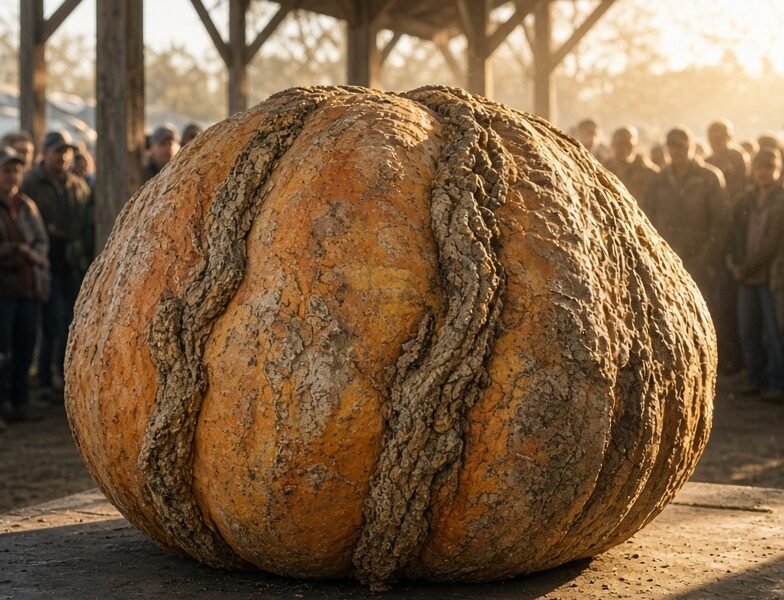
They Laughed at Her Ugly Scarred Pumpkin and Kicked Her Out — Then It Weighed 2,184 Pounds
One autumn ago, Mara Bellamy stood in the middle of the Bellweather Harvest Fair with a pumpkin so lopsided and so deeply scarred that the judges would not let her set it on the scale.
Gideon Ashcroft looked at it once and laughed in front of the crowd, saying such a thing belonged on a compost heap, not in a competition.
Mara was told to move her truck out of the exhibition yard before the opening ceremony.
She did not argue.
She took the pumpkin home.
But the next fall, when her truck rolled through that same gate, the laughing stopped.
Because what brought Mara back was never the size of the pumpkin.
The Bellweather Harvest Fair had been running for nearly 80 years in a farming town of 4,000 people in central Iowa.
And to anyone passing on the highway, it looked like an ordinary county celebration with fried dough, livestock pens, and a bandstand that needed paint.
To the people who lived there, it was something else.
A blue ribbon from Bellweather traveled.
It showed up in feed store windows and on grain trucks.
It opened doors with regional seed suppliers, and it decided which farms got mentioned when reporters came looking for a Heartland story in October.
Winning meant a year of being treated as someone who knew what he was doing.
The Ashcroft family had underwritten the fair for three generations.
They owned grain storage along the rail spur, a fertilizer company serving four counties, and most of the bottomland south of the river.
Gideon Ashcroft, 58, and always dressed as though about to be photographed, held the title of board president, though the title understated him.
He chose the judges, approved the vendors, and decided which categories were expanded and which were quietly retired.
Nobody had voted against an Ashcroft proposal in 11 years.
And nobody thought that strange, because the ribbons went to farms that looked the way a successful farm was supposed to look.
For three straight seasons, the giant pumpkin title had gone to Preston Whitmore, a 37-year-old commercial grower with 1,100 acres and a greenhouse that cost more than most houses in town.
Preston was skilled, and his fruit was glossy and symmetrical enough to be sculpted.
He also bought his fertilizer from Ashcroft Agricultural Supply and leased two of their buildings at a rate nobody else had been offered.
None of that proved anything, but it sat in the air the way humidity sits before a storm.
And the older farmers had learned not to say it out loud at the coffee counter.
Mara Bellamy pulled in at 7:20 that morning, driving a Ford pickup older than some of the volunteers, with a flatbed trailer behind it and a pumpkin strapped down under a tangle of ratchet straps.
It weighed a little over 800 pounds, which was large by any honest measure, and it was not pretty.
One side had grown flatter than the other, as though it had leaned against something invisible all summer.
The color ran orange in some places and a dull yellow in others.
Across the shoulders and down the ribs were raised, corky lines, thick and uneven, like old scar tissue that had healed badly.
People turned.
A teenager said it looked like a boulder somebody had painted, and his friends laughed, and the sound carried across the gravel.
Mara was 52, narrow through the shoulders, with gray at her temples and dirt worked permanently into the creases of her knuckles.
She did not look up at the laughing.
She walked the length of the trailer, checked each strap, tested the wooden cradle she had built, and waited with her hands in her jacket pockets for the registration table to open.
She had farmed alone since her father died and had learned that reacting to small cruelty cost more than ignoring it.
She had grown the thing in dirt she spent six years repairing, and she had brought it because the rules said anyone in the county could enter.
Vivian Carrington ran the produce judging and had done so for nine years.
She was 45, came from money three counties deep, and treated the competition like a dinner party she was curating.
When Mara handed over her entry form, Vivian read the address twice, and something in her face adjusted.
The Bellamy place was on the old north road, in a stretch of ground the extension office had written up years ago as depleted and marginal.
Vivian looked past Mara at the trailer, at the flattened side and the corky ribbing, and asked in a tone that was almost kind whether Mara seriously intended to enter that.
Mara said she wanted it weighed according to the rules, and then they could decide whatever they wanted to decide.
Vivian explained that the giant pumpkin category included a presentation standard, that specimens were expected to reflect a certain quality, and that the fair had an image to maintain for the photographs that would run all week.
It was at that point that Gideon Ashcroft came down from the pavilion with his coffee, and he did not raise his voice because he never did.
He looked at the pumpkin the way a man looks at a stain on a tablecloth.
He said the fair maintained standards for good reason, that if they weighed every overgrown thing that rolled through the gate simply because it was heavy, the event would lose the credibility that had taken generations to build.
Preston Whitmore stood 20 feet away with two of his crew and smiled into his cup.
Mara asked once more, plainly, for the scale.
She said it would take four minutes.
She said if the number embarrassed her, she would load up and drive home without another word, and that seemed to her like a fair trade.
Gideon shook his head and said the board was not going to spoil the opening ceremony just to prove that an ugly pumpkin was still an ugly pumpkin.
He said it lightly, almost pleasantly, and a few people near the fence laughed because the delivery gave them permission.
Then he gestured to a volunteer in a yellow vest and asked him to open the service gate at the back so the lady could get her trailer out before the crowd arrived.
The thing that stayed with her on the drive out was not losing.
Mara had lost at things her whole life and understood how it worked.
The thing that stayed with her was that she had not been permitted to lose fairly.
That the number which would have settled everything had been deliberately left unknown, and that the men who refused to find it had done so while standing beneath a hand-painted banner stretched above the main gate.
The banner had been repainted that spring in deep green and gold, and it read, “Bellweather Harvest Fair: Honoring Those Who Grow.”
She looked at it in the mirror until the road bent and the trees took it away.
She almost did not notice the older man who had followed her to the service gate on foot.
He was in his 60s, heavy-set, in a canvas jacket with a pen in the chest pocket, and he had not looked at the size of the fruit at all.
He crouched by the trailer and ran two fingers slowly along one of the raised, corky ribs, pressing the way a doctor presses at a swollen joint.
Then he straightened and asked a question that had nothing to do with the fair or the weight or what had just happened to her.
He asked where she had gotten the seed.
Mara said it came from a jar her father left behind.
And the man, Caleb Rowan, stopped smiling and asked her, please, not to throw that pumpkin away.
The Bellamy farm covered 27 acres at the end of a gravel road, with a house her grandfather had built, a machine shed with a sagging roof, and a windbreak of walnut trees that had been planted before the Second World War.
The ground there had been rich once.
Then it had been rented out for 11 years to an operator who ran corn on corn with no rotation and no cover.
And by the time Mara took it back, the soil was compacted into something closer to pavement than earth.
Water ran off instead of in.
Earthworms were scarce.
The extension office classified the parcel as marginal, which in practical terms meant nobody expected anything from it ever again.
Mara had spent six years changing that by methods unglamorous enough to make her neighbors pity her.
She hauled composted manure from a dairy 20 miles east, trading labor for loads.
She planted cereal rye and hairy vetch and tillage radish and rolled it flat instead of plowing it under, and rotated squash and beans and small grains on a pattern she kept on graph paper inside a cabinet door.
The farms around her installed pivot irrigation and nitrogen programs calculated to the pound, and they produced more per acre faster with less walking.
The kindest word anyone used for her was old-fashioned.
Her father, Warren Bellamy, had never been a scientist and would have laughed at the suggestion.
He had been a quiet, stubborn man who farmed the same ground for 41 years and who saved seed out of habit and thrift, keeping back the best fruit from every season, drying the seed on newspaper on the kitchen table, and putting it into mason jars labeled in pencil.
After the funeral, Mara had found two shelves of those jars in the cellar, some of them older than she was, the handwriting fading toward illegible.
One of them held broad, flat seeds the color of oatmeal, and the label said only, “Big Orange, North Field, ’89.”
She had planted a few of them the previous spring out of pure sentiment, with no intention of breaking any record, because she wanted to see something of his come up out of the ground again.
Caleb Rowan drove out to the farm four days after the fair.
He had spent 22 years as a soil and crop specialist for the state before retiring into a quiet house on the edge of town, where he kept bees and bothered no one.
He brought a measuring tape, a notebook, and a moisture meter, and he spent two hours with the rejected pumpkin where it sat in the shade of the machine shed.
He measured circumference at three points, measured the stem, tested the rind density, and asked Mara to walk him through exactly what she had fed it and exactly how often she had watered.
She answered everything, assuming the whole time that his interest was simply the interest any gardener has in something unusually large.
What he told her at the end of the second hour was not what she expected.
He said the size was the least interesting fact about it.
He explained that competition pumpkins of the modern commercial lines were extraordinarily demanding, that growers ran precise nutrient schedules and fungicide programs and still routinely lost fruit to splitting, rot, or stalled growth, and that such varieties punished poor ground immediately and without mercy.
Then he pointed at her compost pile and her thin stack of fertilizer receipts and said that by every expectation he had carried for three decades, her plant should have produced something around 200 pounds in that soil, in that season, on that little nitrogen.
It had produced four times as much.
That, he said, was not luck.
There was something else he did not tell her.
In the late 1980s, Caleb had worked briefly on a state program that collected seed from independent farmers for a drought-resilience trial, and he remembered the name Bellamy on a submission form, though he could not have said why it stayed with him for 30 years.
The program was defunded in the early ’90s.
Its collection split between two universities, and part of it had simply gone missing in the transfer.
He had no proof that Warren’s jar was connected to any of it.
So he kept it behind his teeth, because raising a woman’s hopes on a hunch was a cruelty of its own kind.
Mara, for her part, had decided she was finished with the fair.
She told Caleb she intended to cut the pumpkin up for the two steers she kept, save a handful of seed for the kitchen garden, and get on with the fall work that was already stacking up.
Caleb asked her to do it differently.
He asked her to cut it in quarters, keep the seed from each quarter in a separate labeled envelope, record the date and the weather and the position of the fruit on the vine, and store it somewhere dry and dark.
Mara looked at him for a long moment and asked whether he honestly believed that ugly pumpkin deserved a file of its own.
Caleb said he believed people had been looking at the wrong thing.
A photograph went around the county within a week, taken by somebody at the fence, showing Mara at the service gate with her trailer and a volunteer waving her through.
It traveled in text messages and then at the diner, and the jokes wrote themselves.
Somebody taped a printout in the hardware store window as a gag until the owner’s wife made him remove it.
Preston Whitmore was quoted in the county paper’s fair wrap-up saying, with a smile that made it to print, that not everything big is worth a ribbon.
Mara never responded, and her silence was read around town as embarrassment.
What she was actually doing was clearing a 30-foot patch on the south side of the house with Caleb, laying down four inches of finished compost, and preparing it for a single plant, one vine, one fruit.
Caleb built the bed layout himself with stakes and string.
And Mara dug in the amendments by hand because the tractor was down and the part was $80 she did not want to spend.
They planted in the middle of May from a numbered envelope.
And they wrote everything down from the first true leaf onward, and neither of them said out loud that this was now an experiment rather than a garden.
In early June, Caleb sent four seeds and a tissue sample to a private laboratory in Ames, paying for it himself out of a retirement account he rarely touched, and he told Mara it was a formality.
The results came back on a Thursday afternoon.
He read the summary once standing up in his kitchen, then sat down and read it again, and then he sat for a while without reading anything at all.
Then he picked up the phone and called the farm.
He told Mara not to sell a single seed from that jar, not to give any away, not to trade them, and not to let anyone photograph the envelopes.
And he told her specifically that nobody connected to the Ashcrofts was to learn that the material had been tested.
When he finally explained it, he explained it carefully, because he had spent a career watching people turn preliminary data into prophecy.
The laboratory had found that Mara’s line expressed an unusual efficiency in potassium uptake and an unusually conservative pattern of water regulation under load, meaning the plant could move and hold enormous volumes of water through tissue without the collapse that normally limits fruit of that size in poor ground.
He said that was interesting.
He said it was not proof of anything, that four seeds in a laboratory told you almost nothing about how a line performed in a field, and that single-season results were how reputations got destroyed.
To know anything real, they needed a plant grown to full maturity under documented conditions, measured on certified equipment, with an independent record.
Mara agreed to grow the one plant, and she set a condition before she agreed.
She said she would not turn her father’s farm into a laboratory, would not accept money from anyone during the season, and would not have strangers walking her fields with clipboards.
She was not doing it for a ribbon, and she was not doing it to prove Gideon Ashcroft wrong, though she admitted when Caleb pressed her that she had thought about his face more than once since October.
She was doing it because her father had kept that jar for 31 years through two bad decades and a bank threat, and she wanted to know what he had actually been holding on to.
Caleb said that was the best reason he had heard in years.
The growing was patient, ordinary work, and none of it involved a miracle.
She let the vine set several fruit and culled all but one, keeping the fruit on the strongest secondary vine at the right distance from the root crown, which meant cutting off three healthy pumpkins the size of basketballs and leaving them in the row.
She buried the vine nodes to grow secondary roots and built a low shade frame of scrap lumber and burlap so the rind would not harden early in the July sun.
She ran drip line to keep the leaves dry and measured circumference every Sunday before chores with a tape she kept in a coffee can on the porch rail.
The first three weeks after pollination looked unremarkable, within the normal range, and Caleb’s notes from that period are full of cautious, boring language.
Then, in the last week of June, the growth rate climbed and did not level off.
The fruit was putting on 26 pounds a day, then 31, then 38, in soil that had been called dead by a state office less than a decade earlier, on a nitrogen program a commercial grower would have described as starvation.
Caleb started checking the stem daily for stress cracking, because fruit that grows that fast usually tears itself apart.
It did not tear.
The ribbing thickened instead, those same corky raised lines spreading across the shoulders, ugly and deep.
And Mara found herself watching them with something that was no longer embarrassment.
A supply driver delivering drip fittings saw it in the second week of July and mentioned it at the counter in town, and within four days, Preston Whitmore’s truck stopped outside Mara’s fence.
He did not come in.
He stood on the other side of the wire with his sunglasses pushed up, looking at the shade frame and the dark canopy and the shape underneath it, quiet a good deal longer than he intended.
Then he called out, friendly as a neighbor, asking whether she was thinking about trying the fair again.
Mara said she had not decided.
Preston laughed and said he hoped this one came out prettier, and she went back to coiling hoses without answering.
Gideon Ashcroft heard about it by the end of the month and dismissed it as theater.
He told the fair board that the Bellamy woman had enjoyed the attention she got from the photograph and was angling for a second round of it.
And he said the board had an obligation to prevent the event from becoming a stage for personal grievances.
In August, the registration packet for the giant produce categories went out with a new clause requiring all oversized entries to submit photographs and measured dimensions 14 days in advance for preliminary review.
It applied to everyone.
Technically.
Everyone at that table knew who it was written for, and the ambiguity was the point, because ambiguity is what lets people deny things later.
By the end of August, the fruit had outgrown every piece of equipment on the farm.
Mara and Caleb spent two weekends building a lift harness out of rated nylon slings and a reinforced plywood pallet, calculating the load path the way Caleb had been taught to calculate culvert capacity, because a fruit that size can destroy itself and a person both if a strap lets go.
Mara filed her registration on the ninth day before the deadline, with clear photographs, honest dimensions, and nothing exaggerated.
She did not list a weight.
She did not call anyone.
Three days later, Vivian Carrington telephoned the farm to say, regretfully, that the committee had concerns the specimen might not satisfy the aesthetic standard of the category.
Mara asked her one question.
She asked whether the published rules of the Bellweather Harvest Fair contained any limitation on the shape, symmetry, or surface texture of an entry in the giant pumpkin division.
There was a silence on the line long enough for Mara to hear a clock in Vivian’s house.
Then Vivian said she would have to review the language and would be in touch, and she hung up, and she did not call back.
Mara set the phone down and went out to check the shade frame.
She had read the rule book 11 times that winter, including the appendices, including the two pages about protest procedure that nobody had invoked since 1994.
Something in her had shifted over those months, and it was not bitterness.
The previous autumn, she had driven to Bellweather wanting to be recognized, carrying the hopeful embarrassment of a person seeking approval from people she had privately decided were better than her.
That was gone.
She no longer needed Gideon to say she belonged, or Vivian to find her acceptable.
What she wanted now was narrower and much harder to refuse.
She wanted them to follow their own rules, in public, with the scale working and the numbers written down.
Caleb told her the rest on a cold evening in early September, with the notebook between them on the porch.
He said the line in her father’s jar might be a surviving branch of a crop development effort called Prairie Titan, a drought-tolerance project funded in the late ’80s and canceled in 1991, when the money moved to irrigation technology.
Farmer-submitted material had fed that project.
Warren’s name sat somewhere in his memory, on a submission form, and the collection had been partially lost.
Then he said the part that mattered.
Nobody could prove it from seed alone.
Confirmation required a fully mature fruit, weighed on certified equipment, with the growth records Mara had kept all summer.
There were three certified agricultural scales within 100 miles, and one of them sat under the pavilion at the Bellweather Harvest Fair.
That was the moment the trip stopped being about Gideon Ashcroft at all.
Mara understood, sitting there with her boots on the rail, that she was going to drive back through that gate, not to humiliate anyone, but because the only instrument that could validate 30 years of her father’s stubbornness happened to be owned by the people who had thrown her out.
She said it out loud, and Caleb nodded and said life arranges things that way more often than anybody admits.
Then she asked him whether the trailer would hold, and he said he had been worrying about exactly that for a month.
Three days before the fair, they hauled it in the dark at 11 miles an hour to an equipment dealership eight miles south with a certified platform for weighing implements.
The operator, a man named Dale, had been joking about the whole business right up until the slings came off the hoist.
He looked at the readout, said nothing, and then said the cell must have drifted.
He recalibrated with his test weights and ran it again.
The second number matched the first.
He looked out at Mara’s old Ford under the sodium light, then back at the screen, and said quietly that the thing on his platform weighed more than that truck did empty.
Mara asked whether he thought the trailer would make it to Bellweather.
She left the farm at 5:40 on the first Saturday of October, with the fruit cradled in the harness under a gray tarp, Caleb following in his own pickup with the documentation folder on the seat beside him.
They took the county roads at 20 miles an hour, going the long way around to avoid the bridge with the weight posting, and the sun came up behind them across the stubble.
At the entrance, the gate volunteer found the name Bellamy on his clipboard and his face did something complicated.
He asked them to hold and walked off to make a call.
Eleven minutes later, Vivian Carrington came down the midway with her arms crossed.
Vivian said the entry file needed additional review and that the committee had not finalized its position.
Mara handed over a printed confirmation from the fair’s own registration system, timestamped four days before the deadline, listing her name, her division, her entry number, and the word accepted.
She also had the submitted photographs, the dimension sheet, and a copy of the advanced review clause with the relevant sentence underlined.
Vivian read it twice.
There was no provision for revoking an accepted entry absent a violation.
None had been alleged, and the gate was backing up behind them with a hay wagon and two trucks of squash.
Gideon Ashcroft arrived before the gate opened fully, walking with the measured ease of a man who had never had to hurry, and he addressed Mara by her first name, as though they were old acquaintances.
He said he was sure nobody wanted a repeat of last year’s awkwardness, that feelings had run high, that the board had the highest respect for every grower in the county, and that there were constructive ways to resolve misunderstandings.
He spoke for most of a minute.
Mara waited until he was completely finished, because she had promised herself she would not interrupt him.
And then she gave him six words.
She said, “Then this year, just weigh it.”
Gideon’s jaw moved slightly, and he stepped back and told the volunteer to wave the trailer through to the weigh pavilion.
They pulled the tarp at 9:20, with maybe 60 people standing around the pavilion rail and more arriving as word moved.
The sound of the crowd did not rise.
It fell, which is a rarer thing and much harder to fake.
The fruit filled the trailer bed end to end, a dense orange mass sitting low in its harness.
And it was not beautiful.
It carried the same flat shoulder, the same off-center crown, the same thick corky ribbing running down the sides like welded seams, magnified now to a scale that made the texture look geological.
It was precisely the kind of pumpkin they had called ugly 12 months earlier, grown so far past the limits of the category that ugliness had stopped being a usable word for it.
Preston Whitmore, standing near his own entry 40 feet away, stopped talking in the middle of a sentence.
Vivian said the certified platform scale had a rated capacity, that the entry would likely exceed it, and that without a valid weight, the division could not be judged.
Caleb walked forward with the folder.
He produced the specifications for the auxiliary industrial scale stored in the fair zone equipment barn, the certificate of calibration dated in March, and the name of the licensed technician in Des Moines who had performed it.
He had called the man in August.
Vivian looked at the pages, and then at Gideon, and the pause lasted long enough for the crowd to understand what the pause meant.
Gideon changed the objection rather than abandoning it.
He said that before the fair put its name on any number, the board had to verify the specimen had not been altered, since there were known methods of injecting water into produce to inflate weight.
Mara agreed before he finished the sentence.
She accepted a moisture reading, a stem and blossom end inspection, a surface probe at any point of their choosing, and an ultrasonic scan for internal cavities, which a veterinarian from the livestock barn performed while four board members watched.
Every test came back clean.
Each demand removed one more explanation Gideon could offer later, and by the time the veterinarian shook his head, there was nothing left between the fruit and the scale.
The crowd had grown to perhaps 300 by the time the hoist took the load.
Preston stood beside his own entry, nearly perfectly round, a deep uniform orange, unblemished, the product of real craft and real expense.
Mara stopped on her way to the platform and told him honestly that it was a beautiful piece of work.
She meant it.
She had never resented Preston for being good at growing pumpkins.
What she resented was the quiet arrangement that decided who was allowed to compete against him.
The slings came taut.
The fruit lifted four inches off the pallet, swung slightly, and settled.
The digital readout cycled, hunted, and locked.
2,184 pounds.
The previous Bellweather record, set nine years earlier, was 1,692.
Preston’s entry, when they weighed it 20 minutes later, came in at 1,580, which in any ordinary year would have been a triumph.
The crowd made a sound like a wave hitting a seawall, and somebody’s cap went into the air.
A reporter from the county paper pushed to the front with his recorder and asked Gideon Ashcroft directly whether this was the same variety the fair had refused to weigh a year earlier.
Gideon said the board would be issuing a statement.
The reporter turned to Mara.
And here was the moment she could have taken everything, where one sharp sentence would have ended Gideon standing in that town inside an hour.
Mara said four words.
“Same line of seed.”
She did not elaborate, and she did not look at Gideon while she said it.
The restraint landed harder than any accusation could have, because it left every person standing there to do the arithmetic themselves.
And people believe their own conclusions far more than they believe yours.
And then, with the number still on the screen, Vivian Carrington announced that the best giant pumpkin award was determined by a composite score rather than weight alone, that the judges had completed their evaluation, and that the ribbon would be awarded to Preston Whitmore.
The pavilion turned ugly fast.
Somebody shouted the word rigged.
A man near the fence yelled that they had just watched the scale, and so had everyone else.
Mara did not join any of it.
She waited until the noise dropped enough for her voice to carry, and she asked Vivian politely to please publish the scorecard.
Vivian hesitated, and the hesitation was visible from the back row, and that was the thing people talked about afterward.
She said the scorecards were an internal working document.
A board member named Harold Finch, 71 years old and on that board for two decades, said loudly that in 1996 they had published scorecards on request, and he saw no reason to stop now.
The document came out of a folder and went up on the display board beside the ribbon table.
Caleb walked over, read it, and read it again, and then he came back to Mara and said quietly that they had just made a mistake they would not be able to talk their way out of.
The scorecard listed four weighted criteria, and the first line read, “Presentation and form: 40%.”
Caleb asked, in front of everyone, for the official published rule book for the current year, the one with the release date printed on the inside cover, the one that had been posted on the fair’s registration portal in July.
When Mara submitted her entry, a volunteer brought a copy from the office.
The giant pumpkin division in the published rules read: weight, 70%; condition and soundness of fruit, 20%; uniformity, 10%.
There was no presentation category.
There never had been.
Someone had built a different instrument and used it to measure people who had agreed to be measured by the first one.
Gideon said the revision was an internal procedural update adopted by the judging committee in August.
Harold Finch asked when the board had voted on it, and Gideon said it had not required a vote.
Finch, who had spent 38 years as a township assessor and understood exactly what it meant to apply unpublished criteria to a public competition, said that was not how any of this worked, and that he wanted the minutes.
Two other members drifted a step away from Gideon, which is how these things actually happen.
Not with a confrontation, but with people adjusting where they stand.
Preston Whitmore had been reading the three-year comparison sheets from the same folder.
He was not stupid, and he was not, underneath the sunglasses and the expensive equipment, dishonest.
He saw presentation weightings that had moved between years, and margins in two of those years that would have evaporated under the published rules.
He had believed those wins.
He had put them on his trucks, in his credit applications, in the speech he gave at the chamber lunch.
What rose in him, standing there, was not guilt about Mara so much as a cold, specific anger at having been handed something he had not been allowed to earn.
He walked to the front, took the microphone from the volunteer running the announcements, and said it plainly enough that nobody could soften it later.
He said that if the published rules stated weight counted for 70%, then the published rules were the rules, and that he did not want a ribbon that depended on anything else.
He said he had grown a 1,580-pound pumpkin, and he was proud of it, and he had been beaten by 600 pounds in front of everybody.
Then he set the microphone down.
Vivian Carrington went the color of paper.
They recalculated on the published criteria at the ribbon table, with three board members watching, and the arithmetic was not close.
And at 11:00, Gideon Ashcroft stood in front of 300 people and announced Mara Bellamy as the winner of the Bellweather Giant Pumpkin division.
She would have gone home after that, and the story would have been a small, satisfying one about a scale and a rule book.
But Caleb asked the board for 10 minutes and the fair’s microphone, and a woman in her 40s in a field jacket came forward from the crowd, where she had been standing quietly since 8:30.
Dr. Evelyn Shaw was a plant geneticist at the state university’s agronomy department, and she was not a coincidence.
Caleb had sent her the laboratory summary and his season-long growth records in July.
And she had told him that if the fruit reached full maturity and was weighed on certified equipment, she would drive the two hours to witness it herself, because verified field data from a single documented plant was worth more than a stack of speculation.
What Dr. Shaw told the crowd was careful and unglamorous, which was what made it credible.
Preliminary sequencing indicated Mara’s line held substantial genetic material in common with surviving accessions from the Prairie Titan project, discontinued in 1991, with part of its collection unaccounted for.
That, she said, was interesting to historians and to breeders.
Then she said the thing that mattered, slowly.
The remarkable property was not the size.
It was that the line reached that biomass on roughly 40% of the irrigation and a fraction of the nitrogen any comparable commercial variety would demand, in ground the state had classified as marginal.
And then she explained why, and the whole morning turned over on itself.
She walked to the fruit, put her hand flat against one of those thick, raised, corky ribs, and said that the traits the fair had rejected as ugly were not cosmetic defects at all.
The deep, irregular ribbing corresponded to reinforced vascular architecture that let the plant move and hold water through tissue under enormous internal pressure without splitting.
The heavy rind and the dense, uneven surface reduced moisture loss and protected against the stress cracking that destroys conventional giants in dry seasons.
The asymmetry came from growth that continued through conditions in which uniform fruit simply stops.
The scars were not damage.
They were the visible record of a plant that had learned to keep going when the ground gave it nothing.
Mara stood very still through all of it.
And the crowd was quiet in a way that had nothing to do with the number on the scale anymore.
Everything they had laughed at the previous October had been the evidence.
The flattened shoulder, the corky lines, the mottled color, the shape a teenager had called a painted boulder, were the outward signature of the very trait that made the line worth anything.
The judges had looked straight at the most valuable thing in that yard and declined to weigh it because it did not photograph well.
Caleb had said it a year earlier in the shade of the machine shed.
People had been looking at the wrong thing.
For Gideon Ashcroft, there was a second blade in it, and he felt it before most of the crowd did.
Ashcroft Agricultural Supply had spent 18 months and a considerable amount of money preparing a spring campaign around a drought-resilient seed and input program, with billboards already contracted on the interstate.
Their licensed variety required substantially more irrigation per acre than what was sitting on his own fairground scale, grown by a woman he had ordered off the property, in dirt his own extension reports had written off.
Before noon, a representative from a regional seed company in Nebraska had found Caleb at the rail and asked carefully whether anyone held a research agreement on the Bellamy material.
What that company eventually offered was not a lottery ticket, which is exactly why Caleb trusted it.
They proposed a three-year replicated trial across four climate zones, a modest annual licensing fee, full retention of ownership and seed rights by Mara, a royalty on any commercial release, and cost sharing on soil repair and irrigation at the Bellamy farm.
Nobody handed anybody a check for a million dollars.
The first year came to less than a new combine header.
It was, however, real money arriving at a place that had been operating at the edge of its credit line for nine years, in exchange for something Mara still controlled entirely.
Gideon Ashcroft made one attempt to land on his feet, and he made it in front of the reporter, which was his mistake.
He approached Mara near the ribbon table, extended his hand, and said, with the warmth of a man offering absolution, that it seemed they had all judged a bit too quickly last year.
Mara did not take the hand and did not raise her voice.
She said no.
She said she had brought it to him and asked him to weigh it, and that he was the one who decided it did not need weighing.
Then she turned back to the folder Caleb was holding.
It was 11 seconds of talking, and it ended Gideon Ashcroft’s version of events permanently, because there was no part of it he could deny.
Before Dr. Shaw left that afternoon, she asked Mara one more question, standing by the open door of her car with the pavilion emptying behind her.
She asked how much of the original seed from Warren Bellamy’s jar still existed.
Mara said about three dozen, counting what was in the envelopes from last year’s fruit and what remained of the pencil-labeled mason jar in the cellar.
Dr. Shaw looked back toward the weigh pavilion, where two men were still working out how to get 2,000 pounds of pumpkin onto a trailer without killing anybody, and she said that in that case, the pumpkin was not the most valuable thing Mara had brought to the fair that day.
The story moved through the region over the following weeks by way of farm radio and trade publications, and Mara handled it briefly and without enthusiasm.
She turned down an investor from Chicago who wanted exclusive rights to the whole line, because the agreement gave her no say in whether the seed was ever released, and she understood that a thing can be bought precisely so that it never has to compete.
She signed instead with the university and the regional company, with Caleb reading every clause and a farm attorney from Cedar Rapids reading it again.
The Bellweather Fair board opened a review of its judging procedures in November, and it was not dramatic.
Vivian Carrington was removed as head of produce judging for applying criteria that had not been published, which she contested in a letter, and then stopped contesting.
Gideon Ashcroft was not ruined, was not arrested, and did not lose his grain elevators or his supply company or his house.
The board voted 7 to 2 to replace him as president, which, for a man who had spent his entire life being the person who decided who belonged, was a far more precise injury than bankruptcy would have been.
The Ashcrofts remained wealthy.
They simply no longer got to decide who was permitted through the gate.
Preston Whitmore drove out to the Bellamy farm in the second week of November with a gallon of cider from the orchard in Colona, which he set on the porch rail instead of making a speech.
He admitted that he had laughed the first year, and that he had laughed because he had assumed she was staging something for attention, and that the assumption had been more comfortable than the alternative.
Mara told him he was not the first person to judge a thing by its surface and would not be the last, and that she had done it herself to the ground she was standing on when she first inherited it.
They walked out to the trial plot in the cold, and Preston looked at the beds and the cover crop a long time and said he had spent 11 years reading yield maps, and maybe it was time he learned to read dirt.
A year later, the Bellamy line was still in trial and still unproven.
And the honest version of this includes that several plants in the second season failed to reach any size at all.
And the water-use trait proved inconsistent across soil types, showing clear advantage in two of the four test zones and almost none in a third.
Dr. Shaw’s interim report used the word promising 11 times and the word confirmed exactly zero times.
What the data did support was that under restricted irrigation, the line held biomass where the controls declined, which, in a region watching its aquifer drop three feet a decade, is not a small sentence.
Mara had expected the work to take years, because she had spent six fixing a field.
The money was enough, and not more than enough, which suited her.
She put a new roof on the machine shed, replaced the drip line across all of her vegetable ground, bought the $80 part for the tractor, and then a used tractor to go with it.
And in March, she paid off the operating loan her father had carried and she had inherited.
She did not buy land or hire a crew or do any of the things the diner had predicted.
She bought one more item, a secondhand seed cooler for the cellar, and she moved her father’s mason jars into it one at a time.
The following October, she returned to Bellweather, and she did not bring the largest pumpkin on her farm.
She brought one of about 600 pounds, flat on one side, corky ribbing standing along the shoulders, the crown noticeably off center.
She pulled into the exhibition yard in the same Ford and waited her turn at the registration table like everyone else.
A 17-year-old volunteer, new that season, looked at the lopsided thing on the trailer and asked the woman running produce intake whether it even needed to go on the scale.
The new head of judging did not look up from her clipboard.
She said that at this fair, anything entered according to the rules gets weighed.
Mara heard it from eight feet away.
She did not say anything, did not introduce herself, did not explain why the sentence mattered.
She just signed her form and moved her truck forward into the line.
And for a few seconds, standing in the cold with her hands in her jacket pockets, she allowed herself to smile.
Later that morning, the pumpkin went on the certified platform and came in at 611 pounds, which placed fourth, and nobody made a sound about it one way or the other, which was exactly the point.
In the agricultural building that year, there was a new display at the end of the heritage row.
A modest one.
A table with a cloth and a trifold board, and two shallow trays of broad, flat seeds the color of oatmeal.
The sign across the top read, “Bellamy Heritage Seed Project.”
And beneath it was a photograph somebody had found in the cellar and had enlarged and framed.
Warren Bellamy in 1989, standing at the edge of the north field in a feed cap and a work shirt, squinting into the sun with his hands at his sides.
A man nobody outside two townships had ever heard of.
Mara stood in front of that photograph considerably longer than she had stood in front of the trophy case.
Her father had not left her a million-dollar seed, because he had never known what he had.
He had left her something plainer and more durable, which was the habit of refusing to throw away a thing of value simply because nobody else had recognized it yet.
There are people who look at a pumpkin and see only the scars on the rind.
There are people who look at an old field and see only the ground that stopped paying.
And there are people who watch a woman step down from a rusted truck and decide in under four seconds that she does not belong anywhere that winners are gathered.
Mara Bellamy never changed a single one of those minds by arguing with them.
She drove home, and she went back out to the field, and she planted again.
And 12 months later, she brought back the very thing they had laughed at, grown so far past their expectations that refusing to weigh it was no longer an option anyone could survive.
In the end, the largest thing she won was not the trophy and not the number on that scale.
It was forcing an entire town to understand that an imperfect surface is not always evidence of failure, and is sometimes the only proof you will ever get that something has learned to survive conditions the beautiful things could not.
Her father knew that about dirt.
He kept the best of what grew in the worst of what he had, and he wrote it down in pencil, and he waited 31 years without ever finding out whether he had been right.
Someone else got to find out for him.
That is usually how it goes.









