They Dug a Trench Across My Hayfield Without Asking — Then the Engineer Asked One Quiet Question
I knew something was wrong the moment I heard an excavator out in my field.
Not a mower. Not a truck on the county road. That heavy, loaded, working sound of a tracked machine under load—steel tracks grinding, hydraulic whine, the deep diesel grunt of something built to move earth. My body recognized it before my mind did. Eleven years as a field supervisor for an infrastructure contractor does something to a man. It wires certain sounds straight into your spine.
I set my coffee cup down on the kitchen counter and listened.
It was close. Much too close.
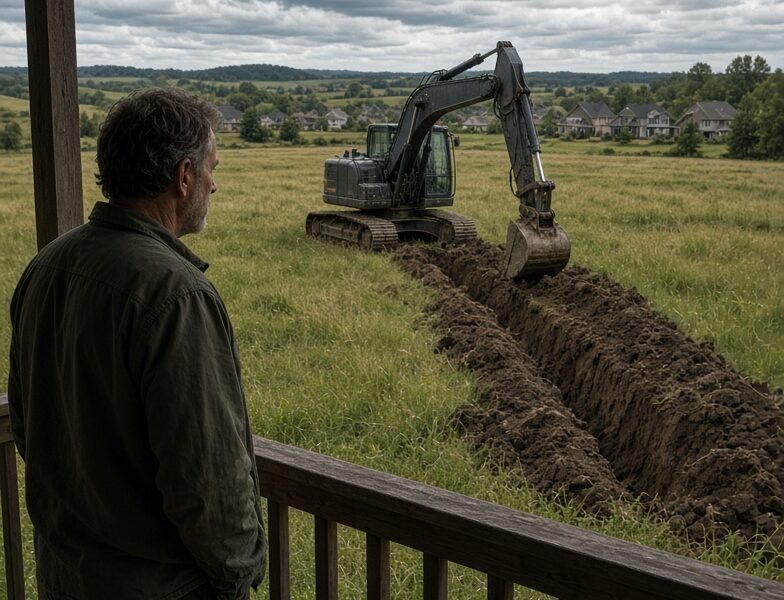
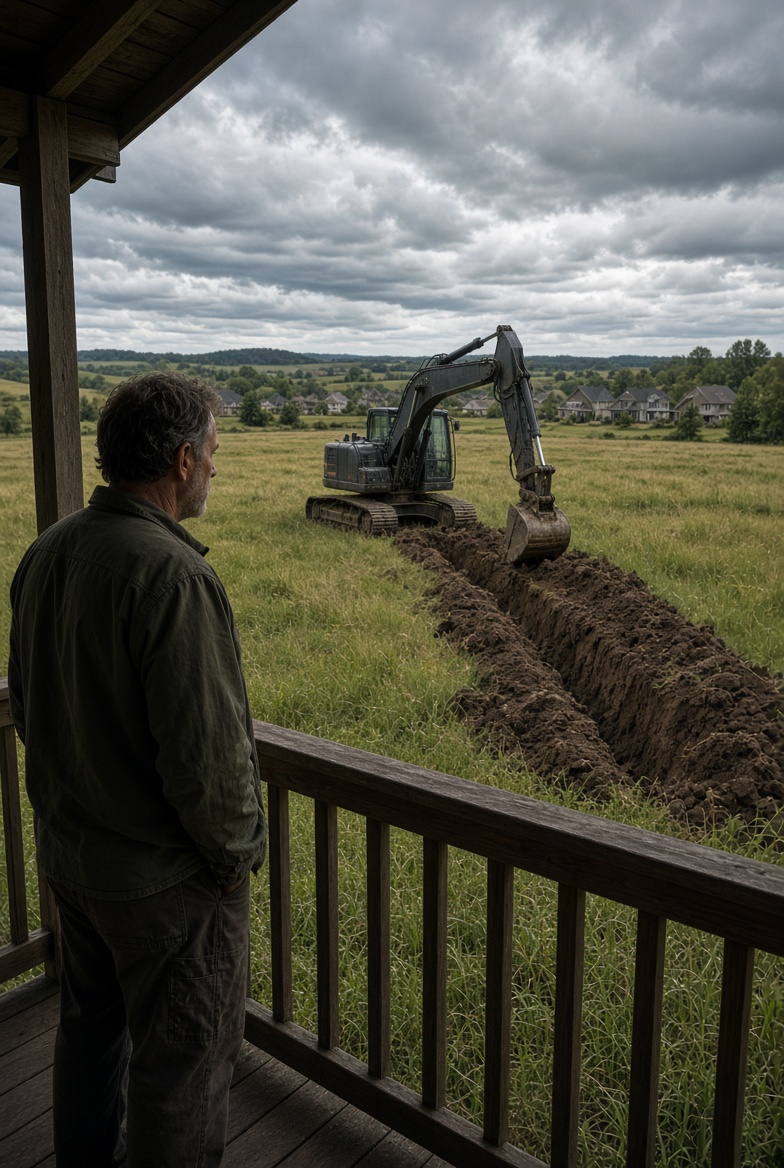
When I stepped out onto the porch and looked east across my own hayfield, I could see the boom rising above the grass like a metal arm reaching out of the ground. A deep trench had already torn across my land, running straight from the housing development’s holding pond toward the ditch at my back line. Dark soil lay heaved up in a windrow along the edge. The cut ran southeast, straight as a surveyor’s line, and it was not on anybody else’s property.
It was on mine.
I am Evan Hollis. Forty-nine years old. I own thirty-eight acres of open ground that sits directly behind a subdivision called Cedar Glenn. My grandfather bought that field when the whole area was still pasture and gravel roads, and it passed to my father and then to me long before anybody drew a single lot line on the other side of my fence.
I keep about half of it in hay and let the rest run down toward a natural ditch that has carried runoff toward the county culvert since before I could walk. I am not a member of the association. I have never paid a dollar in dues, and my mailbox has never held a single ballot from their board.
For most of the years those houses have stood there, that arrangement worked fine.
Neighbors waved at me from their back decks. Kids asked if they could watch me bale, and I gave away more sweet corn than I ever sold. I had spent eleven years as a field supervisor for an infrastructure contractor before my knees and my patience gave out, which means I can read a grading plan. I know what a swale is, and I understand what elevation numbers mean when they march down a page.
That does not make me an engineer, and I have never once claimed it did.
What it does mean is that when somebody points at a drawing and tells me water flows uphill, I notice.
That background sat quietly in the back of my mind for years, useless, like a tool in the bottom of a box. It turned out to be the single most valuable thing I owned, and it cost me nothing but the years I spent earning it.
Everything changed the spring Rebecca Sutter became president of the Cedar Glenn Association.
She was forty-six, sharp in the way a letter opener is sharp, and she treated the title like a commission from a higher authority. Within her first three months, she had produced a landscaping standard, a parking standard, and a fencing standard, and she carried a laminated copy of the covenants in her car the way some people carry a Bible.
I understood the appeal of all that. What I did not understand at first was why a woman with three hundred and some houses to manage kept looking over the fence at mine. It seemed to genuinely bother her that thirty-eight acres of ground sat that close to her jurisdiction and remained completely outside of it.
“I don’t live in Cedar Glenn,” I would say.
She never once accepted that as an answer. Instead, she would tilt her head and give me a small, tired smile, as though I were a slow student insisting on the wrong sum. And she would say something about how some men need a few dozen acres to feel important.
Once at the mailboxes on the county road, she told a resident standing beside her that I was, quote, “the fellow with the tractor.” As if that were both my name and the limit of my qualifications.
I let it go. I have found that people who need to say things like that in front of an audience are usually not having a good time inside their own heads. And I had hay down and rain coming.
I did not know then that I would hear that same phrase again, aimed at me like a stone, in front of a machine sitting in my dirt.
There is one more piece of geography you need to hold on to, because everything that followed turned on it.
Between the last row of houses in Cedar Glenn and the edge of my field, sitting entirely on association common ground, there is a stormwater detention pond. It is a shallow oblong basin with a grassy bank, and its whole purpose is to catch the runoff that a subdivision generates when rain hits three hundred roofs and a couple of miles of pavement, then release it slowly instead of all at once.
Ponds like that never hold everything. By design, they overflow, and the overflow is supposed to travel along a defined drainage corridor to a county culvert, which then feeds the public system downstream. That corridor, on every drawing ever stamped for Cedar Glenn, ran across association common ground.
Not one inch of it crossed my field.
Late the previous summer, Rebecca pushed through what she named the Cedar Glenn Beautification Initiative, and the strip of common ground along the pond became the centerpiece. Crews came in and built up a berm of imported soil, set decorative boulders in clusters, planted ornamental grasses and dogwood shrubs, and laid a low retaining wall of dry-stacked block along the back edge.
It looked expensive because it was expensive, and it photographed beautifully, and she stood in front of it at the annual meeting and called it proof of what focused leadership could accomplish.
I drove past it that fall on my way to the hardware store and slowed down because something about the shape of the ground bothered me. I remember thinking one clear thought and then talking myself out of it.
Did they just bury the old overflow route?
On a Monday morning in the middle of June, I was standing at my kitchen sink with a cup of coffee when I heard diesel.
Not a truck on the county road. Not somebody’s mower. But the heavy, loaded, working sound of a tracked machine under load—the sound of steel moving dirt. I set the cup down and listened because that noise belonged to my old life, and my body recognized it before my mind did.
It was close. It was much too close.
And when I stepped out onto the porch and looked east across my own hayfield, I could see the boom rising above the grass.
The excavator was not on association ground. It was three hundred feet inside my property line, and it was digging.
His name was Derek Puit. Forty-three years old, sunburned across the back of the neck, and he shook my hand before he understood who I was. When I told him he was standing in my field, he did not get defensive, which I appreciated then and appreciate more now.
He flipped a page on the clipboard and frowned at it, and I watched a small cold doubt land on him. He said the association had scheduled the work, that the route had been staked for him, and then he said the sentence that became the center of everything that followed.
“The association told us access was already confirmed.”
I asked him who at the association had told him that.
He said the president.
I asked to see the document that confirmed it, and he said he did not carry those, that the office handled paperwork, and that as far as he knew, everything was in order because it always is. I told him calmly that nobody had ever asked me for permission to enter this ground, that I was the sole owner of record, and that I needed the machine shut down until somebody could show me a legal right to be here.
He looked at the trench, then at me, then out toward the pond, and he raised his hand and made a slow cutting motion at his operator. The boom came down. The engine dropped to idle, then to nothing, and the quiet that followed was enormous.
That quiet lasted about ninety seconds before a white sport utility came bouncing down the pond access road, and Rebecca Sutter got out with a folder under her arm.
I have replayed her entrance many times, and the thing I keep coming back to is that she did not look worried. She did not look like a person who had just been caught. She looked like a manager arriving to correct a delay. And when she reached us, she spoke first to Derek and not to me and asked why her crew was idle.
Then she turned to me and told me I was interfering with a community infrastructure project. Not a word of apology. Not a question about whether I minded. No acknowledgement that a machine had opened a wound in ground she did not own.
She said the association held a drainage easement across my field, that it had been recorded when Cedar Glenn was built, and that the board had every right to perform maintenance within it. She said the pond had risen dangerously during the spring rains, that more than three hundred homes depended on this system, and that she was not going to let one man’s ego stand in front of an entire community.
She said all of it in a level public voice, the voice of somebody who expects to be repeated approvingly.
I asked her for the instrument number of the recorded easement. I asked which stamped drawing showed a drainage route across my property. I asked whether the county had issued a permit for the discharge and whether the engineer of record had signed a change order authorizing a new outfall.
Those are not exotic questions. They are the four questions any competent superintendent asks before a bucket touches ground, and I asked them in a flat voice with my hands in my pockets.
She heard all four, and she laughed.
“Owning a tractor does not make you an engineer,” she said.
I photographed the excavator with its machine number visible and the contractor’s door sign and Derek’s truck plate. I photographed the trench from both ends and from the pond and from my own fence line looking back, so that anyone could later see exactly where association ground stopped and mine began. I put my folding rule against the trench wall and photographed the depth. I photographed the windrow of ruined topsoil and the orange paint marks running southeast and the discharge point of the pond and the toe of the berm she had built the previous summer.
Then I turned the camera on my own boots on my own ground with a machine in frame behind me and I noted the time. Twenty-two photographs in about six minutes, and every one of them eventually mattered.
Then I told Derek, with Rebecca standing right there, that I was formally withdrawing any assumed permission to enter, that I would put it in writing before the end of the day, and that any further work would be trespass regardless of what he had been told.
Derek said that was fine, that his company would not touch it again until the paperwork came through his office, and I believe he was relieved.
Rebecca did not like losing him.
She opened the folder and pulled out a photocopy and held it up at my chest like a warrant. There was a plat on it, reproduced badly, and I could see a dashed line running across the parcel that was unmistakably mine. Beside the dashed line, in small capital letters, were two words I could read even at arm’s length.
They said DRAINAGE EASEMENT.
“There,” she said, tapping it hard enough to crease the paper. “See? I told you we have the right.”
I looked at that photocopy for a long moment, and I did not argue, because I had just noticed something she apparently had not expected me to notice. The line of text beside the dashed line did not end at the word easement. It continued, and the rest of it had been cut clean off the edge of the page.
I said nothing about that. I told her I would review it, folded my hands, and watched her drive away with her folder, satisfied, convinced she had settled the matter with a piece of paper.
The excavator got loaded onto a lowboy that afternoon and hauled out through the pond gate. By four o’clock, my field was silent, except for the wind moving through hay that would never be worth cutting on that hundred-foot strip again.
I walked the trench alone before dark, all the way to where the paint stopped, and I tried to think like the version of myself that used to get paid for this. Then I went inside, cleared the kitchen table, and pulled out every piece of paper my family had ever kept about that ground.
At eight the next morning, I was standing at the counter of the county recorder’s office with a legal pad while a clerk pulled the plat book, the development file, and the original drainage submittals.
Here is what I found.
There was an easement across my grandfather’s field. That part was real. And if Rebecca had stopped reading at the words she showed me, I understand why she believed what she believed. But the full text was not what she said it was, and the difference was not a technicality.
The instrument was titled, in plain language at the top, a Temporary Construction Easement. It had been granted by my grandfather to the original developer, not to any homeowners association, and it had a single stated purpose. It allowed heavy equipment to cross the field during construction of the subdivision’s stormwater facilities, because at the time there was no other way to reach the low ground with a scraper.
It permitted access. It did not permit permanent installation. It did not create a drainage route, and it conveyed no right to discharge one gallon of water across the parcel.
And in the last paragraph, in the exact place where somebody’s photocopy had run off the edge of the page, there was a termination clause. The easement expired automatically upon final acceptance of the Cedar Glenn infrastructure by the county.
I found the acceptance resolution in the same file, three folders over. The county had accepted Cedar Glenn’s streets and stormwater system more than ten years earlier, on a Tuesday in October, with a case number and two signatures.
Which meant the easement Rebecca had waved in my face at the edge of an open trench had been dead for over a decade. It had not been reduced or disputed or renegotiated. It had simply ceased to exist by its own terms before she ever moved into that neighborhood.
I sat back in that chair by the window and felt the whole shape of the thing shift under me, because if there was no easement, then the question stopped being about my inconvenience and started being about what somebody had actually done.
Then I opened the drainage plan, and my stomach went tight.
The stamped design was almost beautiful in its simplicity. Runoff from the streets and roofs collected in the storm sewer, discharged into the detention pond, and left the pond through a controlled overflow structure. From there, it traveled along an engineered grass swale that ran the length of the association’s common area, with check features to slow the flow and drop out sediment. And at the end of that swale, it entered a county culvert and joined the public system.
Three elements, one after the other. All of it on land Cedar Glenn owned. Nowhere on any sheet in any revision was there a line, a pipe, a channel, or a note indicating that water was ever meant to cross into my field.
So the trench in my hayfield was not maintenance of anything. It was not a repair. It was not a cleanout, and it was not covered by any right anyone had ever held. It was the construction of an entirely new, unapproved, unpermitted stormwater outfall onto private property, and it had been ordered by a woman who told me I did not understand modern infrastructure.
I made two copies of everything, put one set in a folder in my safe and one in a folder in my truck, and drove home in the kind of quiet focus I had not felt in years.
Then that evening, my phone buzzed with an email from Derek Puit.
He had been thinking too, and he did not want his company standing alone in whatever was coming. He had attached the work order his crew had been dispatched on, unedited, and a short note saying he hoped it was helpful, and that he had also pulled his people off any further association work until things were clarified.
The document was one page. It described the scope as excavation of a drainage channel from the pond to the rear ditch, gave a length and a depth, listed the equipment, and carried a signature block. And down in the notes field, typed in the same font as everything else, was a line I read four times.
Property owner consent confirmed by HOA president.
The next morning, I called the civil engineering firm whose stamp appeared on the Cedar Glenn drainage sheets. I did not lead with an accusation. I said I was a landowner adjacent to a project they had designed, that excavation had occurred on my property, and that I wanted to confirm whether their office had issued any revision authorizing a new discharge route.
The woman who answered took my parcel number and put me on hold for six long minutes. When she came back, her voice had changed, and she asked me to repeat the location of the excavation. Then she said something that I could hear her choosing carefully.
“I’m not seeing any change order like that,” she said. “Not in the file and not in the log.”
She asked if I could hold again, and this time it was nine minutes. When she returned, she told me the engineer of record for the original Cedar Glenn drainage design still worked there, that his name was Graeme Keane, and that he wanted to visit the site himself.
The following morning, she confirmed my gate location and asked me not to allow any backfilling before he arrived, which I thought was an interesting thing for her to say. I told her the trench was exactly as the machine had left it.
I hung up and stood in my kitchen for a while with the sun coming through the window. And the only thing I could think was that Rebecca Sutter had no idea he was coming.
She was busy with something else.
Because while I was in the recorder’s office and on the phone, Rebecca had decided that if she could not roll over me, she would wear me down. That afternoon, a letter arrived at my house on Cedar Glenn Association letterhead, with the logo embossed at the top and her signature at the bottom. It formally requested that I permit the drainage improvements to proceed without further delay in light of the flooding risk to the community, and it referenced my responsibilities as a neighboring property owner.
I read it twice, and the second time I actually laughed out loud in my own driveway, because of the one detail the entire letter ignored.
I am not a member of that association. I never have been. Their letterhead has exactly as much authority over my thirty-eight acres as a menu from a restaurant I have never visited. And the words “responsibilities as a neighboring property owner” have no legal content whatsoever.
But the letter told me something valuable anyway. She was building a file. She wanted a record of the association reasonably requesting cooperation from an unreasonable man, so that whatever came next could be framed as my fault. I recognized the technique because I had watched project managers do it for eleven years.
Because something had been nagging at me since the moment I first stood at the edge of that trench. And it was not the trench itself. It was the direction.
If a pond overflow already had an engineered route across association ground, why would anyone spend real money cutting a brand-new channel through hay in the wrong direction? Nobody digs two hundred feet of trench for fun. And nobody risks a trespass claim to solve a problem that already has a solution.
Which meant the existing solution had stopped working.
And I wanted to know why.
So over the next few evenings, I walked my fence line, and then I walked the public sidewalk along the outside of the common area with my hands in my pockets like any man out for exercise. The detention pond was high, higher than I had ever seen it in June, with a dark waterline stain on the bank a good foot above the current surface.
I found the concrete overflow structure at the north end, and it was intact and clean. And then I looked east along the line where the drawings showed a graded grass swale running toward the county culvert.
And I stopped walking.
The swale was gone. Not damaged, not overgrown, not silted in. Gone. In its place stood the Cedar Glenn Beautification Initiative, exactly as she had built it the previous summer, with its imported soil berm raised two and a half feet above the surrounding grade, its clusters of decorative boulders, its ornamental grasses in mulched beds, and its low dry-stacked retaining wall sitting like a dam across the alignment.
The prettiest one hundred and eighty feet in the subdivision had been constructed directly on top of the only legal path that water had out of that pond.
I stood on that sidewalk in the evening light and finally let myself think the whole thought at once. They were not digging through my field because my field was convenient. They were digging through my field because Rebecca had blocked her own association’s approved drainage route with a landscaping project she had personally championed, and water had started backing up, and she needed somewhere for it to go.
Tearing out the berm would mean destroying the achievement she had put her name on and explaining the cost to three hundred households. Cutting a trench across the property of a man she considered a nobody was cheaper, faster, and quieter.
That was the entire plan.
It had never been about protecting anybody’s basement.
Word travels fast in a place with three hundred mailboxes, and within two days, Rebecca knew I had been talking to residents. Her response was to bring it to the members before I could. At a regular meeting on a Thursday evening, she announced that an uncooperative adjacent landowner was obstructing a critical infrastructure repair and was now attempting to spread confusion among homeowners, and that his obstruction was going to cost Cedar Glenn money it should not have to spend.
She said it well. Several people apparently nodded, and every single word of it was recorded in the minutes by a treasurer named Lauren Fisk, who had spent the previous week trying to find out which board vote had authorized a trench she could not locate in the budget.
The next morning was a Friday, and it was clear and cool, and I was out repairing the gate at the field lane when a silver pickup slowed on the county road and turned in. It parked twenty feet from the end of the trench, and a tall man in his late fifties got out, took a reflective vest from behind the seat, put it on, and then reached into the bed and lifted out a heavy roll of large-format drawings.
He did not look at me first. He looked at the ground.
Graeme Keane was fifty-seven years old, gray at the temples, and he moved across my hayfield the way a doctor moves toward a patient—without hurry and without wasted motion. He walked the entire length of the trench before he introduced himself, stopping four times to squat at the edge and look down at the exposed soil layers. He set a small tripod up near the pond end and shot elevations back toward the ditch. He asked me two questions, both technical, both about the natural ditch at my back line and where it went from there.
He did not offer me an opinion. He did not commiserate, and he did not take my side, and I respected him enormously for that.
Within about ten minutes, Rebecca got out talking. She had clearly been notified that a man in a vest was measuring in my field, and she had decided the correct posture was ownership. She greeted Graham by his last name, thanked him for coming out personally, and told him that the board was making a minor field modification to improve drainage performance and that she would be happy to walk him through the reasoning.
She said the phrase “minor field modification” twice.
Graham let her finish completely, and then he asked his first question in a voice with no edge on it at all.
“Change order number?”
She said she would have to look that up.
Graham nodded and made a small mark on the drawing with a pencil and asked his second question. He asked to see the revised stormwater management plan for the new outfall.
She said the board had been advised the work fell under routine maintenance.
He nodded again and asked his third question, which was whether the county had issued a discharge approval for a new point of release onto adjacent private property.
She said the situation had been urgent.
He asked, without changing his tone at all, whether an urgent situation had been declared by anyone with the authority to declare one.
Nobody answered.
Rebecca turned her attention to Derek Puit, who had driven out because Graham’s office had asked him to be there, and she said that the contractor had been responsible for verifying site conditions before excavating. Derek did not blink. He handed Graham the same one-page work order he had emailed me and a printout of a hand-drawn sketch that had come from the association office showing a line from the pond to my back ditch with two dimensions written on it in ballpoint pen.
Graham held that sketch up in the sunlight for about four seconds. Then he said the only harsh thing I heard him say all day.
“This is not an approved engineering drawing.”
She said that route was no longer viable.
Graham asked why.
She said the corridor had degraded over time and no longer functioned.
Graham turned around slowly, put his back to the truck, and looked west across the pond toward the berm, the boulders, the ornamental grasses, and the low stone wall lying across the alignment like a seam. He did not say anything for what felt like a very long time.
Then he unrolled the second sheet, checked something against a station number, and looked back at her with an expression that was almost gentle. He pointed at her landscaping.
“Because somebody built that,” he said, “directly on the approved drainage route.”
Then he laid the full drainage plan out where all four of us could see it, and he walked the line with the tip of his pencil so there could be no ambiguity. Pond, overflow structure, swale, station by station, with its design depth and its check features, county culvert, public system. He tapped the swale twice and said, “This is the outlet. This has always been the outlet, and this is the only outlet this development has ever been permitted to use.”
Then he moved the pencil over to the blank white space where my field was, and he said quietly, “There has never been anything here on any sheet in any revision for twenty-two years.”
Rebecca changed tactics and reached for her folder, and she pulled out the photocopy again, and she put it on the hood and said that the association had relied in good faith on a recorded easement.
Graham slid it toward himself and read it. And then he did something I will remember for the rest of my life. He set his finger on the right edge of the page where the text ran off and asked her whether she had a complete copy.
She said that was the copy in the association’s file.
He asked her to obtain the original from the recorder.
And I said, without any drama at all, that I already had. And I opened my folder and set the full instrument down beside her photocopy. And everybody looked at the words she had never let me read.
Temporary. Terminates upon final acceptance.
She had no version of the story left that fit.
But the next blow did not come from Graham or from me. It came from Lauren Fisk, the treasurer, who arrived on foot from the pond gate with a manila envelope because Derek had called her the night before.
Lauren was fifty-two, wore reading glasses on a chain, and had spent eleven days going through association records with the quiet determination of somebody who signs financial statements and does not enjoy surprises. She said she had reviewed every set of minutes and every approved expenditure for the past fourteen months, and she had found exactly one board action relating to any of this.
The board had approved a modest sum to investigate drainage alternatives. To investigate. Not to design, not to excavate, not to enter anyone’s land, and not to construct anything.
There was no vote authorizing a trench. No vote authorizing an outfall. No vote authorizing work on my property. And no line item anywhere in the approved budget for the amount that had already been spent. The contractor’s work order had not been countersigned by any other officer. Rebecca had signed it herself under a purchasing authority that Lauren said flatly did not exist in the governing documents beyond a few hundred dollars in routine repairs.
Lauren then read the total already invoiced out loud, and Derek confirmed the number, and it was many times that limit.
And then Derek added the last piece, because he had brought printouts of his own. He had the email chain from the association office authorizing his mobilization. In it, in response to his project manager asking specifically whether landowner permission had been secured for the eastern portion of the alignment, Rebecca had written eight words that I do not think she ever imagined being read aloud on a hayfield in June.
She wrote that ownership permission had been handled and instructed the crew to proceed as marked.
Three truths were now standing in a row on the hood of that pickup, and every one of them was hers.
There was no valid easement, because it had terminated over a decade earlier, and she had circulated a copy with the termination clause cut off. There was no engineering approval, because the engineer of record was standing right there learning about the project for the first time. And there was no association authorization, because the board had funded a study and she had ordered a construction project.
Every instrument she had used to demonstrate her authority over me had become, in the space of one hour, evidence about her.
She still tried. That is the part that surprised me most. She looked at me and she found the same tone she had used at the mailboxes, and she said that I was seizing on technical language to make life difficult for an entire community, and that people would remember who chose paperwork over neighbors.
I did not need to think about my answer, because I had been carrying it for three weeks.
“No,” I said. “I’m asking you not to dig up my land without permission.”
Graham did not participate in that exchange. He rolled up his drawings, put them back in the bed of his truck, took out his phone, and walked about thirty feet away toward the trench. I heard him give his license number and the case number of the original Cedar Glenn approval. And then I heard him say the words “unpermitted alteration” and “unauthorized discharge” to the county stormwater office.
He was on that call for six minutes. When he came back, he told all of us that an inspector would be on site Monday morning, and that nothing in the trench, on the field, or in the landscaped area was to be moved, filled, or altered before then.
Rebecca asked whether that was really necessary.
He said it had stopped being optional.
Nora Beckett arrived at nine on Monday in a county truck with a magnetic placard, and she brought a camera, a measuring wheel, a clipboard, and no patience for adjectives. She was fifty years old, a stormwater management inspector with fourteen years in the office, and she conducted herself as though feelings were a category of information she had never found useful.
There were no police. Nobody raised a voice. There was no scene of any kind. And I want to be clear about that, because everything that happened to Rebecca Sutter over the following month happened through procedure and paper. That is the whole reason it stuck.
She asked her questions in a specific order, and every answer went onto her clipboard. Rebecca opened by saying the work had been performed under emergency conditions to protect homes from imminent flooding. Nora looked up and asked who had declared the emergency.
Rebecca said the situation had been obvious to the board.
Nora asked again, with the same words, whether any authority had issued a declaration, and wrote down that none had.
Then she went around the circle. She asked Graham whether the engineer of record had approved the trench, and he said no. She asked Derek for the permit number under which the excavation had been performed, and he said there was none, and that he had been told the association had it. She asked me whether I, as owner of record, had granted any right of entry, and I said no, and she asked me to confirm that in writing, and I did.
Rebecca made one last attempt to move the weight off herself, and she made it in the worst possible direction. She told Nora that the contractor had exceeded the scope he was given and had excavated beyond the intended area.
Derek did not argue with her. He simply handed Nora the work order with Rebecca’s signature on it. Then the sketch that had come from the association office. Then the email that said, “Ownership permission has been handled. Proceed as marked.”
Nora read all three, made a note, and asked Rebecca whether the signature on the work order was hers. Rebecca said it was.
Nora wrote that down, too.
Nora issued a written stop-work instruction before she left the field, prohibiting any further excavation or extension of the trench. Then she outlined what the county would require, and she gave the list to Lauren rather than to Rebecca, which I noticed and I think Rebecca did too.
The association would have to backfill the trench, restore the stripped topsoil on my property to its original depth and grade, install and maintain erosion control until vegetation was reestablished, and remove the unpermitted fill and structures from the approved swale alignment. Then it would have to reconstruct the swale to the accepted design, verified by survey, and submit a full restoration plan sealed by a licensed engineer before any of that work began.
Nothing on that list was negotiable. And everything on it had a deadline.
And there it was, the thing that I suspect hurt more than any of the rest. Restoring the approved drainage route meant tearing out the Cedar Glenn Beautification Initiative. The berm, the imported soil, the clustered boulders, the mulched beds of ornamental grasses, the dry-stacked walls she had photographed for the newsletter and described at the annual meeting as evidence of what focused leadership could accomplish.
All of it had to come out with a machine, because it was sitting on top of the only lawful path water had out of that pond. The monument to her presidency had become the primary item on a county correction order.
She stood next to it for a while after everyone else had gone, and I did not watch, because there is no pleasure in that.
But one question was still unanswered, and it was the only one my neighbors actually cared about. Somebody was going to write checks for all of this—for the excavation, the demolition, the reconstruction, the surveys, the engineering, and the restoration of my field. Three hundred households were about to find out how large that number was, and who had committed them to it.
The answer came that same evening in the clubhouse on Cedar Glenn Drive, at a special meeting that Lauren Fisk called under a provision of the bylaws that I doubt anyone had read in years.
I have been in a lot of rooms full of angry people, and that was not one of them, which made it far more effective. About ninety residents came, and they sat in folding chairs with the calm of people who intend to get an answer, and nobody threw anything or called anybody a name.
Lauren went first, and she used a projector. She showed the single approved budget line for investigating drainage alternatives, then the invoices already received, then the signature authority in the governing documents, then the work order. She did not editorialize once. She let the four documents sit next to each other on the wall and let the room do its own arithmetic.
Graham went second, and he brought the drawings and set them on an easel. He explained the design system in the same plain language he had used on the hood of his truck. And then he explained what the berm had done to it. And then he explained what the trench would have done to the county culvert downstream during a serious storm.
When a man in the third row asked whether the pond flooding was an old problem that had finally caught up with them, Graham said no. He said the system had been performing as designed for over twenty years and had been compromised within the last twelve months by unpermitted fill placed across the conveyance swale.
Somebody in the back said out loud that they had paid for that fill.
What made the room go quiet was not the number. It was Lauren’s next slide, which had three lines on it. If the approved swale had not been buried, no trench would have been needed. If the landowner had been asked, there would have been no dispute. If the matter had gone to the board, the engineer would have caught the error before a machine ever left the yard.
Every dollar on that estimate existed because of three decisions, and all three had been made by one person without telling anybody.
A woman near the front asked Rebecca directly why she had not simply picked up the phone and called me. Rebecca stood up and said that she had made a judgment call under pressure to protect the community, and that the landowner had refused to cooperate from the beginning.
That was the moment I stood up, and it was the only time I spoke all night. I did not give a speech. I have no talent for speeches, and I did not need one, because the room already had every document.
“You never asked me,” I said. “You put an excavator on my land and then you told me I had to accept it.”
Rebecca looked around that room and understood, I think for the first time, that she did not have the votes. The board went into a short executive session and came back in eleven minutes. She was removed as president that night, and Lauren was named acting president until the next election.
The review that opened the following week eventually turned up two other agreements she had signed alone. And the woman who had told me on my own ground that owning a tractor did not make me an engineer had to sit in a folding chair in her own clubhouse and listen to an actual engineer explain, sheet by sheet, that her signature project had broken the neighborhood’s drainage.
There was one more turn left, and it is the part I think about most, because it happened without anyone gloating.
In order to restore my field, a contractor had to bring machines back onto my property. There was no way around it. The trench had to be backfilled in lifts, compacted, and regraded, and my topsoil had to be separated back out of that windrow and returned. Every bit of that work required a tracked machine, a dozer, a truck, and about nine days on ground that they now knew, on the record, they had no right whatsoever to enter.
So this time they asked.
Lauren Fisk and Graham Keane came to my house on a Wednesday afternoon, and they sat at my kitchen table, and they brought a draft temporary access agreement prepared by an attorney. It was four pages. Lauren said straight out that the association had entered my property without authority, that she was sorry, and that they could not perform a single hour of the county-ordered restoration unless I signed. Graham said the county would not accept the restoration plan without documented landowner consent attached.
I sat there for a moment and let myself feel exactly how far the ground had shifted, because two months earlier a woman had waved a mutilated photocopy at my chest and laughed at me for asking a question.
A licensed surveyor would stake the work limits before anything moved, and no equipment would travel outside those stakes. The contractor would carry general liability and provide me a certificate naming me as an additional insured for the duration. Access would follow one defined route in and out along my existing field lane, at hours we agreed to in advance. The stripped topsoil would be separated and replaced to original depth across the full disturbed area, then seeded and mulched. Any damage to my fence, my lane, my gate, or my remaining hay would be repaired or compensated at documented cost. The agreement would expire on a stated date, and it would state plainly that nothing in it created a permanent easement or any continuing right of any kind, and any future work of any nature would require my separate written consent obtained in advance.
They agreed to all of it. Lauren signed for the association. Derek’s company provided the certificate within two days, and the surveyor stakes went in on a Monday morning with orange flagging that I could see from my porch.
I walked out there and looked at those stakes for a while, and I thought about how simple it all could have been. Everything in that four-page agreement is what I would have said yes to on the very first day if anyone had knocked on my door in June and asked. Not one condition on my list was unreasonable, and not one of them would have cost the association a dollar it did not already have to spend.
Rebecca came out once, near the end. The dozer was finishing the final grade over the old trench line, and she parked on the shoulder of the county road and walked to the fence and stood there in a way that told me she had been thinking about what to say. She was no longer president. The internal review was still open, and I had heard she had put her house on the market.
She said that all of this could have been avoided if I had been willing to cooperate.
I looked at the raw line of scraped earth running across ground my grandfather cleared, and at the machine smoothing over the last of it, and I did not feel angry. I felt tired in a clean sort of way.
“You’re right,” I said. “It could have been avoided if you’d asked before you dug.”
She stood there another few seconds, and then she walked back to her car, and I turned around and went back to work. That was the last conversation we ever had.
Six weeks later, my field looked like a field again. The topsoil came back, the grade came back, and the seed took well because we caught a soft rain three days after they finished. By the end of the season, there was a slightly greener stripe of new growth running southeast across the hay, the way you can always see where ground has been worked, and I expect it will still be faintly visible in ten years.
I do not mind it. Some scars are just records, and that one is mine.
On the Cedar Glenn side, the picture was the reverse. A machine came in and took out the berm, the boulders, the dry-stacked wall, and the mulched beds, and hauled the imported soil away by the truckload. Then a crew cut the swale back in to the accepted design, station by station, to the elevations on the sheet Graham Keane had sealed twenty-two years earlier, and a surveyor certified it, and Nora Beckett signed off on a Friday afternoon.
It is not pretty. It is a wide, shallow, grassy trough with a defined bottom, and it looks like nothing at all, which is precisely what a working drainage swale is supposed to look like.
The real test came in October, with a storm that dropped four inches in eleven hours. I stood under my porch roof with a cup of coffee at dusk and watched the water come. The pond filled the way it was built to fill, rising slow and brown until it reached the lip of the overflow structure. And then it started to move, and it went where it was designed to go, along the swale, through the check features, into the county culvert, and away into the public system downstream.
Not one drop crossed my fence. Not one basement in Cedar Glenn took water. Nobody needed an emergency, a photocopy, or a machine in somebody else’s field.
I stayed out there a long time, watching that ditch run in the dark.
Rebecca Sutter believed that a title on an association letterhead gave her the right to dig wherever she decided was necessary, and for a while it worked, because most people never ask for the instrument number. But land, drawings, and signatures do not care who talks loudest in a room full of folding chairs.
In the end, what buried her authority was not the trench she cut across my hayfield. It was one engineer’s simple question, asked quietly on a Friday morning over the hood of a pickup truck.
Who approved this?









