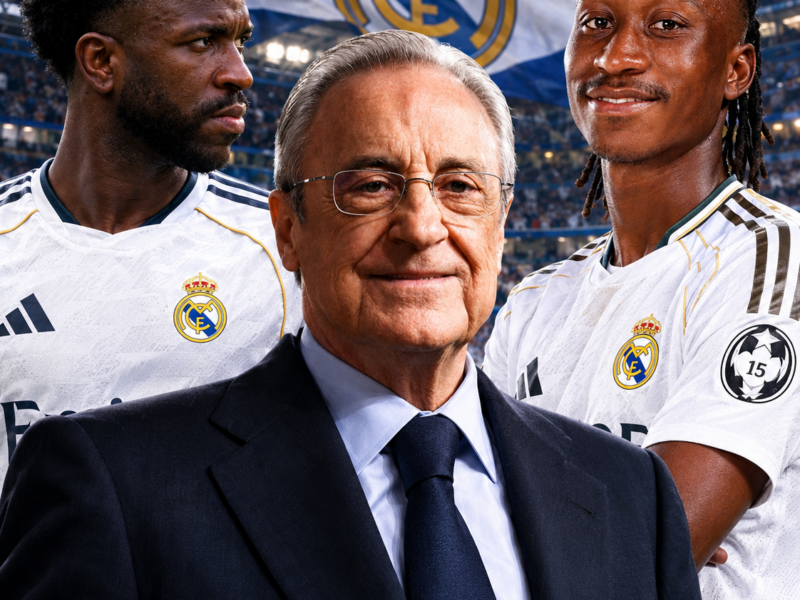
“They Can’t All Be This Bad”: The Brutal Truth Behind Real Madrid’s Collapse, and Why Two Superstars May Never Work Together
Who actually survived this inferno at Real Madrid?
Ask that question out loud and the answer comes back uncomfortably fast: the goalkeeper, and maybe nobody else.
One host offered Federico Valverde as a candidate, and the other shot him down almost immediately. In his view, Valverde is in worse shape now than he was during the miserable 2024-25 season.
That is the mood of this conversation. Everyone is a suspect, and the list of innocents is very short.
Consider a question a radio host put to one of these commentators the day before. Name one player on your team, without naming the team, who would hurt you most if he got injured.
The answer was Thibaut Courtois, and it did not come easily.
Years ago, he admitted, the answer would have been Cristiano Ronaldo, Sergio Ramos, Luka Modrić or Toni Kroos.
Now he sees everyone else sitting at roughly the same level. The players from that golden era, and the ones who arrived after them, are simply worse than we believed they were.
And yet he refuses to accept the obvious conclusion.
They cannot all be this bad, he keeps saying. It is impossible for Real Madrid to fail on every single signing, and impossible for players who were among the best in the world in 2023 and 2024 to become bad overnight.
Something happened, he argued, and everyone can see the outline of it.
The structure of the team is broken. Communication is lacking, competitiveness is lacking, and so is hard work.
Then came a detail that gave him chills.
Rodri recently told a Spanish newspaper that the punishing physical training Hansi Flick put him through was nothing like Pep Guardiola’s approach. The host immediately wondered what physical training looks like at Real Madrid right now.
He admitted he does not know the answer yet.
But the phrase “they can’t all be bad, they can’t all be wrong signings” was exactly what people used to say about Manchester United. That comparison, he said, should frighten any Madrid fan.
So where does the rot start? The hosts kept coming back to one word: plan.
What was the plan for Franco Mastantuono, they asked, beyond his individual talent? He has been placed out of position as a winger, and this is a player who has neither blistering pace nor a dribbler’s trickery.
The same question hangs over Endrick.
One host confessed he keeps pushing the point, but he wants to know what career plan exists for a young striker who barely plays.
Then the conversation turned to Diomande, and the room split into two camps.
One host said that if the interest is real, the only role for Diomande at Real Madrid is the left wing, which clashes with any plan to renew the player who currently holds that spot.
A colleague then dropped his own information.
Madrid, he said, signed Diomande because it expects Vinícius Júnior to leave.
A third voice backed him up. Around the time a deal looked close, he had written a piece after being told something very similar: Madrid was preparing for Vinícius’s departure.
He also claimed it was the first time people from Rock Nation, the agency around the player, had told Vinícius that the time to go had arrived.
Not everyone agreed on the details.
One host said no one confirmed to him that Arsenal had made an offer to Real Madrid. In his version, the Arsenal story is a creation of Rock Nation, which had begun to feel danger and was floating names, possibly Martinelli, to see whether a real option existed for Vinícius.
The agency, he said, knew Diomande was coming to Madrid long before the world did. The signing stayed secret until reporters Mario and Ornstein revealed it.
According to him, Rock Nation told the club: here is what we have on Vinícius, and if you prepare an offer, we believe we can get him out. The plan, in this telling, was to sell him as soon as Diomande signed.
Which raises the puzzle the hosts could not resolve.
How did the club go from that plan to renewing his contract? One host said Madrid believed Vinícius would never accept the offer because the club was never willing to improve it, and then, at the last moment, he agreed.
That version made another host sound almost angry.
Are you telling me, he asked, that Madrid has a player waiting for another one to leave, a player who has hurt the club for two years, and offers the other a renewal with one extra year, hoping he refuses?
The answer he got was more nuanced.
Madrid always wanted to renew him, a colleague said, and the two things are not mutually exclusive. But the club had clearly protected itself by lining up a replacement, though not everyone at Madrid was on the same page.
Some inside the club believed his time was up, they explained. The most important people in the sporting department, more even than Florentino Pérez himself, kept working as long as they believed a renewal was possible.
Then came the criticism. How could the club, or Rock Nation, misread the situation so badly? These are serious people, the host said, and yet it happened.
He recalled a familiar pattern of Madrid giving ground at the last minute.
Modrić was ready to leave, he said, cried enough, and explained that his wife and family told him they would not follow him anywhere because they wanted to stay in Madrid. His contract was renewed for one more year.
The same conversation drifted to Dani Carvajal.
A person close to him told one host that Carvajal wants to walk away from the elite level. The story went that when someone asked whether he would not want to play for a big European club, the answer was that if he wanted that, he would have stayed in Madrid.
A colleague added that Carvajal had reportedly received offers in Spain and the Premier League and rejected them. In his view, it is now more likely he announces his retirement any day.
Still, one host said that if a club offered him six or eight million euros extra, he would not stand in the way. But playing for crumbs, which for Carvajal means two or three million, after what happened to his knee and the career he has had, makes no sense to him.
Then came the sentence that summed up the whole discussion.
For Real Madrid to succeed, the host said, either Vinícius or Mbappé has to fail.
He explained the logic carefully. If Vinícius fails, it leaves room for Mbappé. But the club signed Mbappé to a six-year deal.
If Vinícius recovers his form, then tell me where he is supposed to play.
The conclusion, he said, is brutal. Madrid is stuck with two incompatible operations: the most expensive signing in club history and the most expensive renewal in club history.
And in his view there is no individual or collective scenario in which both of them work at the same time.
A colleague agreed, though he said this is only the outside view.
From the club’s perspective, at least the people who matter most still believe the partnership works. They believe Mbappé and Vinícius can function together.
For the host, that is exactly the problem.
One of the keys to Madrid improving sporting-wise, he said, is breaking the Mbappé and Vinícius partnership by any means.
He had a longer list ready, and he read it out to the chat.
An organized midfielder. A hierarchy in the dressing room. Leaders who actually lead. A break-up of the Vinícius and Mbappé duo. A clearly defined position for Jude Bellingham.
More footballers and fewer influencers. Merit as the basis for selection. A plan for the next three to five years.
Decisions that are, in his words, not painful for the squad. A restored sense of urgency to win. Less refereeing against them in the league. More self-criticism.
And the last item, the one he said needs no explanation: an orderly and fast succession for Florentino Pérez.
His colleague called the diagnosis accurate, and said the organized midfielder was the most important point on the list.
On refereeing he was more careful. He was not claiming Madrid is being robbed, but he said it will be very hard in the league and that things are happening.
He pointed to the incident at Elche, which he said people forget while talking only about the derby. In normal circumstances, he added, if the derby had gone differently, Madrid would have won.
But he did not think the answer is simply a new midfielder.
He laughed at the idea that signing Rodri would have changed everything. Even when it looked like Rodri might arrive, he said, it felt as if Superman was coming, and he never believed one player could fix it.
Which brought the conversation to Florentino himself.
One host said the issue is not his age but the length of his rule. It was a very successful system, he said, but it has gone on too long, and he believes Madrid is now on the way out of it.
He asked a question that hung in the air. Can the people who put the club in this position over the last few years be the ones to get it out?
His answer was that there is no future as long as this system remains. If Florentino leaves, everything will obviously change.
His colleague was more measured. He understood the point, but said the club’s present would bring moments in which many changes could soon be possible.
He also reminded listeners that the club is coming from an election in which Florentino won with less power than expected.
Then the host who had been sharpest all night was asked the direct question: is the season completely lost?
He said yes, and added that he hopes with all his heart he is wrong.
He said he has spent many years in this business and knows someone will call him a fool for saying it. He would love to swallow every word and celebrate a title.
But he sees no scenario in which Madrid wins at the Camp Nou. None. The league, in his view, is gone.
He does not see Madrid winning the Champions League either, and he does not even see them winning the Copa del Rey.
Some of these players, he said, could easily be beaten by a side like Albacete, who did it to them in last season’s Copa.
He did offer a number.
If Madrid has a 3 percent chance in the Champions League, he said, they have 1.5 percent in the league. And he reminded everyone that last year Madrid was one goal or one red card away from beating Bayern Munich, and the team travels to the Emirates in December.
He recalled a conversation with a fan who wanted to hold on to hope.
The fan pointed to how Barcelona had fared at the Bernabéu last year. The host answered by asking how that Barcelona compares with this Madrid.
The last part of the conversation was almost a prophecy.
One host said he expects something Madrid has not seen since the days of Lorenzo Sanz or Ramón Calderón. Nothing remains after Mourinho, he argued, no one else to bring in, and the squad’s level is already known.
Then he came back to the pitch.
There are players at Madrid, he said, who play at the Bernabéu as if they were away from home, and Vinícius is the clearest case. Fans whistle at him three minutes into a Champions League match.
And that is why he wants one thing above all.
He wants Mbappé to win the Ballon d’Or, just to witness what could be the first time a Ballon d’Or winner is booed by his own stadium.
A month would pass, he said, if Mbappé wins it and has to walk out at the Bernabéu.
Would the crowd cover it up?
The conversation ended on that question, and nobody answered it.
A note for readers: everything above reflects opinions, predictions and transfer rumors shared in a casual conversation between commentators. None of it is confirmed, and claims about contracts, offers and player intentions remain subject to official announcements.









