They Called Him a Fisherman… Until He Walked Onto the Thinning Ice and Saved the Women Who Ruined Him
Seven women sat inside a tilted airplane in the middle of a frozen lake in Alaska, listening to the ice talk.
Black water had already found the cracks under the fuselage, the rescue coordinator’s voice came through the radio in pieces, and none of those pieces promised a helicopter before dawn.
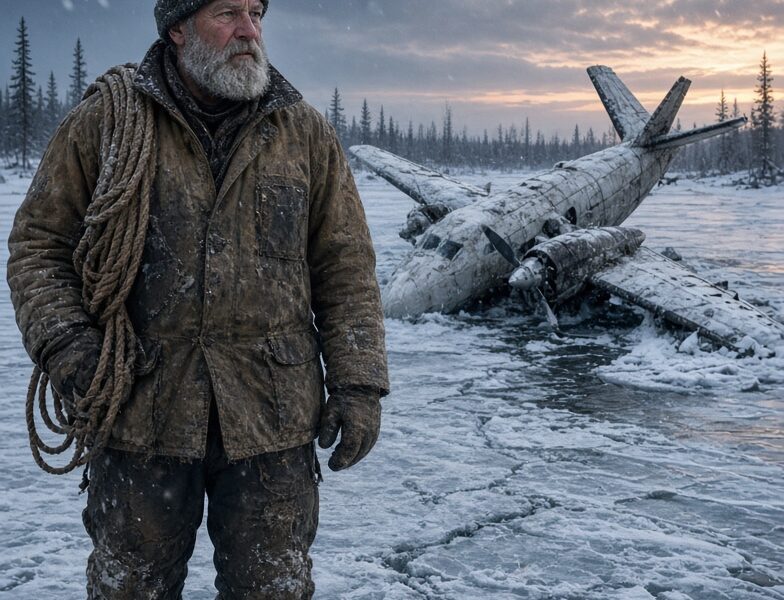
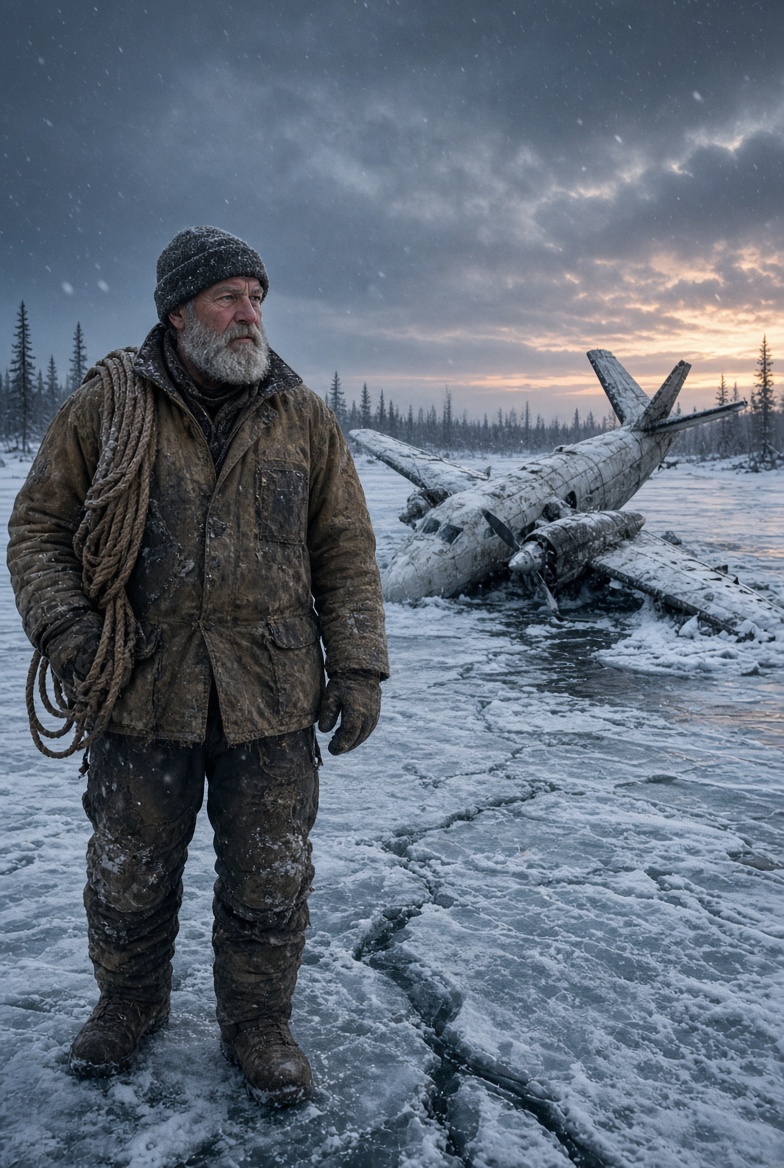
Then a man walked out of the tree line with a coil of rope and a coat patched more than once.
The captain looked him over and said they needed a specialist, not a fisherman.
He did not answer.
He studied the ice and asked who had chosen this lake.
The flight had been scheduled for the last week of February, which was the first thing that went wrong, and almost everyone on board knew it before the wheels left the ground in Fairbanks.
The forecast out of the interior stations showed a cold front sliding down off the Brooks Range, faster than the models had promised the day before.
Captain Tessa Whitam read the update twice in the operations trailer with her gloves still on and coffee going cold beside the printer, and then she walked out and climbed into the left seat.
The aircraft was a twin-engine turboprop, a working airplane, the kind that hauled freight and fuel drums into villages with gravel strips and no tower.
It had been fitted that winter with a prototype navigation package from Wexford Aerospace, and the whole point of the trip was to fly a bush route in bad light with bad weather and see whether the new system held its position better than the old one.
Seven certified pilots were aboard, only two flew at a time, and the rest observed, logged, cross-checked, and waited their turn, which is how operational evaluation flights are run and how they are supposed to stay boring.
Vivien Wexford sat in the first row of the cabin with a tablet on her knee and her coat still buttoned.
She was a certified backup pilot, which let her be on the manifest, and she was also the executive who had put the program in front of a room full of investors scheduled for Thursday.
When Tessa mentioned the front, Vivien said that weather was exactly the condition the system had been built for and that a delay would read as a lack of confidence.
Tessa did not argue.
That was something she would think about later in a hospital hallway for a long time.
They lost the first engine sixty miles past the last village in gray air with blowing snow and a ceiling that kept dropping like a hand pressing down.
Before that, the navigation display had done something strange twice.
It had shifted their position east by almost two miles and then corrected itself without a fault message both times, and Sloan Barrett had called it out from the jump seat both times in the same flat voice.
The second time Sloan said, “It’s not a glitch if it’s twice.”
Marin Callaway in the right seat had already switched the primary back to the legacy unit.
Then the left engine surged, lost power, and would not come back, and the conversation about navigation ended.
A loaded turboprop on one engine in a downdraft does not climb in that country, it descends politely while you look for somewhere to put it.
Tessa looked.
There was no strip within reach, no river bar long enough, nothing but black spruce and ridges that had killed better pilots than her.
What there was, nine miles ahead and slightly left, was a long white oval in a bowl of timber.
Blackstone Lake, four miles of flat.
“Taking the lake,” Tessa said.
“Copy,” Marin said, and started reading the checklist out loud, because at that point the only useful thing is procedure.
They came over the shoreline at ninety knots with the snow going sideways, and Tessa held the nose off as long as she could and set it down near the center where the surface looked oldest and most uniform.
The landing gear held for perhaps three hundred feet.
Then the left main hit a pressure ridge buried under the drift and folded, and the airplane and the world became noise.
When it stopped, the fuselage lay canted twelve degrees to the left with a wingtip in the snow, nose pointed back along its own skid marks about four hundred yards from the western shore and considerably closer to a stretch of lake that looked no different from any other stretch of lake.
Delaney Brooks had been the only one not strapped in correctly.
She had unbuckled to pass a logbook forward in the second before the gear collapsed, and her right leg had gone under the seat frame.
She was conscious, swearing softly and steadily, and the ankle was already swelling against her boot.
The heater died with the engines.
Inside the cabin, the temperature began its slow walk toward the temperature outside, which was twenty-four below zero and falling.
Hadley Pierce got the emergency radio out of the survival locker and raised a repeater on the third try.
The voice that came back belonged to Nolan Briggs, who coordinated search and rescue out of a converted garage in a town of six hundred people.
He told them he had them.
He told them the ceiling was on the deck from the coast to the foothills and no rotorcraft was leaving the ground tonight.
He told them a ground team could stage at the end of the winter road, but the last eleven miles were unplowed and it would take hours, probably most of the night.
Then he asked a question that nobody in the cabin understood yet.
“Say again your position. You’re on the ice or you’re on the shore?”
“On the ice,” Hadley said. “Center of the lake.”
There was a pause long enough to hear the wind.
“Stay where you are,” Nolan said. “Don’t move around in there. I’m going to try to raise somebody under the floor.”
Something in the lake made a sound like a rifle fired a long way off.
Nobody breathed for a moment.
Then it came again, farther away, running out toward the west like a crack traveling through glass.
And Sloan Barrett, who had flown in that country for nineteen years, said quietly that she had never liked this lake.
Gideon Ror had been pulling a net out of a hole in the ice near the western shore.
When he heard the engine note change, he knew airplanes the way some men know trains.
He heard the left side go, heard the right side get loud and ragged, carrying the whole load, and he stood up straight with his hands full of wet line and watched the shape come down out of the snow over the north shore lower than anything had any business being.
It touched, it slid, it made a long scar across his lake, and it stopped where he had told the state biologist two winters ago not to park a snow machine.
The cabin stood eighty yards back in the spruce.
Inside on a shelf beside the door were things he had owned longer than he had owned the cabin, an ice auger with a shortened handle, a drill and rod depth kit in a canvas roll, two hundred feet of static line, a pair of ice awls on a lanyard, three float coats in different sizes, and a yellow plastic rescue sled with a sealed hull that he had rebuilt himself.
He took all of it.
He loaded the sled, clipped into the harness, and went down to the shore.
He did not walk straight out toward the airplane.
He turned south along the bank for sixty yards, then stopped where the drift thinned, and looked at the lake the way a man reads a page.
By the time he reached them, the women had the forward door open and were standing in a loose group on the ice beside the fuselage with their arms crossed against the cold, and Delaney was sitting on the step with her boot off.
“You need to move everybody to the tail side,” he said before anyone spoke. “Now. And stop standing together.”
Tessa Whitam turned around.
She saw a man in his fifties in a canvas coat gone pale at the seams, a wool cap, a beard with ice in it, hauling a plastic sled like a trapper.
“And you are?”
“I live here.”
“That’s not an answer.”
“It’s the one that matters tonight.”
Vivien Wexford came around the nose with the tablet still in her hand, which struck Gideon as the strangest thing he had seen all day.
“We’ve transmitted our position and we’re in contact with search and rescue,” she said. “A team is coming. There’s no need for a local to involve himself.”
“There’s a need,” he said. “You landed on the wrong third of the lake.”
“We landed,” Tessa said. “Because we lost an engine.”
“I know why you landed. I’m telling you where.”
He crouched and brushed snow off the surface with his glove.
Two quick sweeps and the ice under it was not white but a dull translucent gray, like a frozen window.
“Four feet in front of the shoreline and eleven inches out here. And this isn’t the eleven inches. There’s a current channel under the center of this lake from the inlet. It never freezes the same as the rest of it. You put a seven-thousand-pound aircraft across a stress line and then you stood twelve people’s worth of weight on top of it.”
“Seven,” Tessa said.
“With equipment,” he said, “call it twelve.”
“We’ll wait for people who are actually qualified,” Vivien said. “You should go back to your cabin and let trained personnel handle this.”
Gideon looked at her for a second longer than he looked at anyone else, which no one noticed at the time.
Then he pointed with two fingers at a thin dark line in the snow about fifteen feet off the left wing, running away at an angle.
“That’s going to open toward the tail in the next couple of minutes,” he said. “It’s following the ridge. When it does, don’t anybody run.”
“Why not?” Sloan Barrett said.
“Because running is weight in one place.”
Nobody answered him.
The wind came across and the loose snow moved over their boots like smoke, and Tessa was in the middle of saying something about the chain of command when the ice made the rifle sound again.
Very close this time, and the thin dark line widened into a black seam the width of a hand and ran precisely where he had pointed, eighteen feet toward the tail, and stopped.
Water came up into it and lay there shining.
Nobody ran, but Hadley Pierce took three steps backward and sat down hard on the step beside Delaney, and Vivien Wexford did not say anything at all.
Hadley got Nolan Briggs back on the radio with the volume turned up so the others could hear.
“Nolan, we have a man out here on the ice. Says he lives on the lake. Big fella, gray beard, doesn’t talk much.”
“That’s him. Then you’ve got better luck than you deserve,” Nolan said. “Put him on.”
Gideon took the handset with his glove still on.
“It’s me, Gideon.”
“What you got?”
“Aircraft across the ridge, three hundred yards off the channel. Surface is failing on the east side already. I’ve got one injured, no heat, and seven people with nowhere to stand.”
“Nothing flies tonight. Ceilings on the ground. I’ve got Dit and four guys staging at the end of the winter road, but they’re breaking trail with a cat and it’s eleven miles. Best case, I’ve got them at the west landing by two in the morning.”
“That’s too late for the airplane.”
“It’s not too late for the people.”
“Your call out there,” Nolan said. “You want me to log you as on scene?”
There was a pause before Gideon answered that none of the pilots understood either.
“Log me as a local resident assisting,” he said.
He handed the radio back.
Tessa was watching him with the particular attention of someone revising an opinion against her will.
“Two in the morning,” she said. “What’s the temperature going to be at two in the morning?”
“Thirty below, maybe more with the wind out of the north and the cabin. The airplane is a steel box full of cold air sitting on ice that’s working against itself. It’s shelter until it isn’t. And when it stops being shelter, it’ll stop fast.”
He was already unrolling the canvas kit on the lid of the sled.
“Here’s what I want. Everybody gets a float coat who doesn’t have one. Nobody walks anywhere without telling somebody. Nobody goes forward of the nose. You keep your injured one inside out of the wind, wrapped, with somebody awake next to her, and you give me two hours to find the way off.”
“Two hours,” Vivien said. “To walk four hundred yards twice in the dark with seven people without putting anybody in the water.”
“Yes.”
“And if we simply walk to the shore ourselves?”
“Then I’d be fishing somebody out of a hole in about nine minutes. And after that, I’d have six of you standing on the edge of it, which is how two become four.”
Tessa made the decision out loud because she had learned to make decisions out loud.
“He has the ice. I have the crew. Nobody steps off this fuselage without him clearing it. Marin, you’re with him.”
“Copy,” Marin said, and was moving before anyone could object.
Vivien said, “Captain, I want it noted that I consider this irregular.”
“Note whatever you want.”
It was while he was handing out the float coats that Evelyn Shaw came up beside him.
She had been the quiet one so far, the safety check pilot, the one who wrote things down.
She took the coat he offered and did not put it on right away.
He had pulled his glove off to work the buckle, and on the back of his right hand, running up under the cuff, was an old burned scar, white and shiny and wide as a thumb.
“You worked out of North Ridge,” she said, not loudly. “Didn’t you?”
Gideon put the glove back on.
“Coat goes over the parka,” he said. “Not under it.”
The thing Marin Callaway noticed first was the notebook.
He worked from it, not from memory, not from instinct, from a water-stained spiral notebook with a rubber band around it.
And when he knelt at the first test hole, he thumbed back four pages before he drilled anything.
“What is that? Measurements from when?”
“From every day since October.”
He let the auger bite and leaned into it, and she heard the change in sound when the blade came through.
He dropped the weighted rod, read it against his glove, and wrote two numbers and an arrow.
“Thirteen and a quarter,” he said. “Clear ice over four inches of slush. Mark it.”
She marked it with a willow stake from the bundle on the sled.
He had cut forty of them.
Apparently, at some point in his life, when nothing was happening, they went out in a line that made no sense to her at first, not toward the shore, which was west and close, but south, almost parallel to it, in a shallow curve that added two hundred yards to the distance.
“The short way is shorter,” she said.
“The short way crosses the channel.”
“You said the channel’s in the middle.”
“The channel comes out of the middle.”
He stopped and drilled again, eleven inches, frowned at it, moved nine feet, and drilled again.
“Fourteen. That’s what I mean about thickness. A number tells you about one hole. A line of numbers tells you about the lake.”
She crouched to hold the rod for him and found she had stopped feeling any particular way about his coat.
By the second hour, he had staked a route in a long arc to the south and west, anchored at three points where he set screws into blue ice and ran the static line through them, and he had learned the lake’s answer at nineteen separate holes.
The last stretch, the one that mattered, ran within forty feet of a spit of rock and gravel that came off the western shore like a knuckle.
He had known about that spit before he left the cabin, it was the reason there was any route at all.
Behind them at the airplane, the argument had not stopped, it had only gotten colder.
Vivien wanted the equipment off the aircraft.
The prototype navigation unit had a sealed data module in it, and she had made Sloan help her pull the whole assembly out of the pedestal and crate it in a yellow case that weighed eighty pounds with the batteries in it.
Tessa told her twice to leave it.
“It’s company property.”
“It’s ballast.”
“It is also the only record of what the system displayed, Captain, which I would think you’d want to exist.”
That landed because it was true, and Tessa hated that it was true.
When Gideon came back in, he saw the yellow case sitting on the ice outside the door, and he stopped walking.
The case had a logo on the lid and a stenciled line under it, Wexford Aerospace evaluation unit, not for surface use.
He looked at it for three or four seconds, then he looked at Vivien Wexford, then at nothing in particular, and when he spoke, his voice had gone flat in a new way.
“Whose company?”
“Mine,” Vivien said.
“Huh,” Gideon said.
He crouched and put his hand on the lid and read the stencil again, the whole line, the way a man reads something he has seen printed somewhere else.
“Put it back inside,” he said. “Nobody carries eighty pounds across that ice tonight. Not for anything.”
“We’ll discuss it.”
“We won’t.”
He stood.
“I’ve got a line staked. Two at a time, roped, with a float coat, spaced thirty feet. I take the first two, I come back, I take the next two. It’s going to be slow and it’s going to be boring, and boring is the whole point.”
“Why not all of us at once?” Vivien asked. “It would be half the trips.”
“Because seven people on one piece of ice is one piece of ice holding seven people,” he said, and went to get the sled.
Vivien Wexford did not believe she was arrogant.
She believed she was decisive and that the difference was obvious to anyone who had ever had to sign something.
She also had one hour and forty minutes of experience with this man and eleven years of experience with liability, and in her experience, when an operation went wrong, the people who survived it were the ones who controlled the record.
The data module in the yellow case was the record.
Everything else was testimony, and testimony changed.
So when Gideon took Hadley and Sloan out on the first run, and the ice at the airplane went quiet, Vivien told Sloan’s empty seat, and then told Evelyn, that they were moving the case to the stake line so it would be ready when he came back.
Evelyn said no.
Vivien took one end herself and asked Delaney, who could not stand, and then looked around and found she had a crew of people who were not hers.
In the end, she dragged it alone, which took her eleven feet past the last stake Gideon had put in and about four feet off the line he had marked, because the stakes were buried to the collar in blowing snow and she had chosen the direction that looked flatter.
The ice there did not crack like a rifle.
It made a soft, wet, descending sound like a heavy door opening in another room, and the surface under her left boot tipped and went dark.
Evelyn was eighty feet back and shouting.
Vivien let go of the case and sat down, which was the only correct thing she did, and the case slid away from her and went through, and the water came up around her left leg to the knee, and then the pan she was sitting on held.
Sloan Barrett, coming back along the line with Gideon, was the one who reached her.
She went flat on her stomach, got her hand around the drag strap of Vivien’s coat, and pulled her backward across the surface for twelve feet before Gideon arrived and stopped her.
“Don’t stand her up,” he said. “Stay down. Both of you, elbows and knees, straight back along my bootprints.”
“My legs wet,” Vivien said.
“I know.”
They got her inside the fuselage and he did it fast and without any particular gentleness.
Boot off, sock off, the wet trouser leg cut to the knee with a knife he had been using on fish an hour and a half earlier.
Dry wool from his own kit, a spare bib from the sled that was two sizes too large, a chemical heat pack against the femoral, and another at the sole of her foot.
He kept talking while he worked, short questions to make her answer them.
“What’s your first name? How old are you? Count backward from thirty.”
She hated every second of it, and she did all of it.
Tessa Whitam stood in the doorway with the wind at her back and watched a woman she had taken orders from for two years being dressed like a child by a man she had called a fisherman.
And something in her finally turned over all the way.
“Vivien,” she said, “you’re done giving instructions tonight. You’re done. You’re a passenger. If you say one more thing about that case, I’ll strap you to the sled myself.”
Gideon did not look up, he did not say anything clever, and he did not look pleased.
And Marin, watching, understood that he had seen this before enough times that it was not interesting to him.
He pulled the blanket up over Vivien’s shoulder and finally said the only thing he said about it at all.
“The lake doesn’t know who you are.”
Vivien turned her head.
The cabin was lit by two chemical sticks and a headlamp, and in that light his face was mostly shadow and beard, and she could not have picked him out of three men.
“You’re not from Dit’s outfit.”
“No.”
“Where did you train?”
“Long time ago.”
“I asked. Where?”
He stood up and his knees cracked, and he said it the way a man gives his address.
“North Ridge.”
Vivien Wexford lay very still.
The heat pack was working against her foot and she could feel every one of her toes now, and she wished she could not, because feeling them meant being awake for the arithmetic that had just started running in her head.
North Ridge, a man about the right age, a burn scar, a beard, Ror, Nolan had said on the radio, Gideon.
“Oh,” she said.
He had already turned away to get the rope.
Evelyn Shaw waited until Gideon was out on the line with Delaney’s stretcher harness and the others were busy, and then she said to Marin quietly, “I knew him before I saw him.”
“What does that mean?”
“He said four words on the radio to Nolan and I was sure.”
Evelyn had her hands around a thermos cup she was not drinking from.
“I spent two years listening to that voice on a recorded channel. You’d be surprised what you keep.”
Marin waited.
“There was a station up on the Noatak called North Ridge Polar Region Rescue. Mostly medevac and downed aircraft. He coordinated there.”
“He was?”
“He was.” She stopped and tried again more carefully. “There were people who could read a glacier the way you read a chart. He was better than that. If he said a surface would hold, it held.”
“What happened?”
“Eleven years ago, a rescue flight went into the hills and weather. Two crew aboard. One of them was a man named Caleb Harlland, who had been Gideon’s partner on that station for nine years.”
Evelyn turned the cup.
“The accident report concluded the mission had been launched into known unsafe conditions and that the on-scene coordinator had authorized it. That was him. He was suspended, and then his certification went, and then he was gone. Nobody in the industry would touch him.”
“There’s a line in that report that got quoted for years, and you were there.”
“I was twenty-nine, and I was the one who transcribed the communication logs,” Evelyn said, and she said it evenly, which cost her something. “I had the raw tapes and the raw timestamps. And when the technical findings came back from the contractor that did the data review, there were things in the summary that did not match what I had typed.”
“What things?”
“Order of events. Who said what and when.” She shook her head. “It wasn’t a forgery. It was worse than that. It was a summary that left out a conversation. And once it’s left out, it never happened.”
“Did you report it?”
“I told my supervisor. He said the technical review stood and that my job was transcription.”
Evelyn finally drank and made a face.
“I was a lieutenant with a career ahead of me. I decided it was somebody else’s problem. I have had eleven years to find out it wasn’t the contractor.”
Marin said, “Who did the technical review?”
Evelyn did not answer.
She did not need to.
In the forward row under two blankets, Vivien Wexford had been listening with her eyes closed and her jaw set.
She had been thirty-five, she had been three years into the family firm, and the firm had held the analysis contract, and she had been given a binder and a deadline and a very clear sense of what a problem the alternative would be.
She had read a summary prepared by two engineers she trusted, and she had signed the technical concurrence page without insisting on seeing the primary records.
That was the entire crime, and she had known its exact size since the week she committed it.
She had told herself for eleven years that a signature on a concurrence page is not a conclusion.
It had worked, mostly, right up until she heard a man on a frozen lake say the name of the station out loud.
Later, when Gideon came back in to warm his hands and drink something, Tessa asked him the question the others had been avoiding.
“Why didn’t you fight it?”
He looked at the cup.
“Caleb’s widow had two kids and a settlement that paid out in sixty days if nobody contested the findings. If I filed, that goes to litigation, three years, maybe five. Maybe she wins, maybe she doesn’t.”
He drank.
“I was forty-two and single. She wasn’t.”
“So you let them write it.”
“I let them write it,” he said. “Then I moved out here.”
Nobody said anything for a while.
The wind rose and fell against the skin of the fuselage.
“The flight data from that night,” he said at last, not to Tessa. “The primary recorder file. Does it still exist, or was it dispositioned?”
Evelyn set down her cup.
“There was a duplicate archived,” she said. “Internal records, not the public docket. It would have a retention code on it. If nobody pulled it, it’s still on a shelf in a building in Anchorage.”
“Would you know the code?”
“I wrote it on the box.”
The wind came up hard a little after midnight, the way it does when a front finishes arriving, and it took the last of the radio with it.
Hadley got one more exchange with Nolan.
The cat was through the worst of the trail, four miles out from the west landing, and then the battery indicator went to a single bar, and she shut it off to save what was left for a position call.
Gideon took Hadley and Sloan first.
It went the way he had promised, which is to say it took fifty minutes to cover five hundred yards, and nothing happened at all.
He walked ahead with the rod, they followed at thirty feet, roped to the static line with a locking carabiner each, and when he said stop, they stopped.
At the spit, he unclipped them, pointed at a cut in the bank where a game trail went up through the alders, and told them to get to the cabin, get the stove going, and leave the door open.
“Come back with you,” Sloan said.
“No. I’ve got nineteen years in an airplane.” He was already turning. “Get her inside and get water hot. That’s not nothing. That’s the part that keeps people alive.”
After he brought Evelyn and Marin across on the second run, on the third he took Tessa and Delaney, because Delaney was going to be the hardest and he wanted Tessa for it.
And because he had decided somewhere in the last two hours that Tessa Whitam was the only one out there who would do exactly what he said at the moment he said it.
Delaney could not bear weight.
They put her on the plastic sled with her bad leg strapped straight and a float coat zipped over her parka, and Gideon took the bow line and Tessa walked beside the sled with a hand on the rail, and they started out two hundred yards along past the third anchor.
The surface changed.
He felt it before he saw it, a softness through the boots, a give that had not been there ninety minutes earlier.
He stopped and put the rod down, and it went through the slush and stopped on something that was not ice so much as the memory of ice.
“Back up,” he said. “Slow. Don’t turn the sled.”
Tessa backed up.
The sled did not.
The runner on the downhill side dropped three inches as the pan tilted, and Delaney, strapped in, slid toward the low edge and the black seam opening along it.
What Gideon did then he did without any apparent urgency, which Tessa thought about for a long time afterward.
He dropped flat on his chest, spread his legs, drove both ice awls in over his head, and let the sled’s bow line come tight across his right shoulder.
Then he took the load.
The pan tipped further, the sled slid another foot and stopped, hanging at the edge of the open water with Delaney’s boot in it, and the whole weight of her and the sled and the drag of the water came onto one rope, over one shoulder, through one man lying on ice that was telling him in plain language exactly how much it had left.
“Tessa,” he said conversationally. “On your belly, behind me. Grab the back of my belt, not the rope.”
She did it.
“Now don’t pull me. Anchor me.”
It took four minutes to walk the sled back up onto the solid pan, four minutes of nothing but breathing and the sound of water moving under the surface.
And when it was done, Gideon could not use his right arm properly, and both his gloves were soaked through and freezing, and Delaney was crying in a way that had nothing to do with her ankle.
They went the long way around the soft spot, which added five hundred feet.
Halfway to the spit, Delaney said from the sled, “You could have gone across with the first two.”
“Yep.”
“We were pretty rude to you.”
“You weren’t. The other one was.”
“That’s not an answer.”
He adjusted the harness on his bad shoulder and kept walking.
“You were still out there,” he said.
They reached the gravel at twenty minutes past one.
He unclipped them, sent Tessa up the trail with the sled, and stood looking back along his own stake line at the black shape of the airplane, four hundred yards out with one strobe still flashing on a dead battery.
Vivien Wexford was still in it.
And the line he had staked, the line he had tested nineteen times and walked six times tonight, had a new crack running across it at the second anchor, black and wet and already a hand wide, cutting the route in half.
Tessa came back down the game trail eight minutes later with a headlamp and the empty sled.
“Sloan has Delaney by the stove,” she said. “Hadley’s melting snow. I told them I’d be an hour. I didn’t ask for you.”
“No, you didn’t.”
She clipped herself into the line without waiting.
“Here’s where I am. Two hours ago, I decided you were a guy in a bad coat who was going to get in the way, and I decided it in about four seconds. And I’ve been wrong about almost everything since the moment I signed for that airplane. I’m not going to be wrong about this, too. You’re running this. Tell me what to do.”
Gideon looked at the crack.
“The route’s gone,” he said. “There’s a seam opened at the second anchor, and it’ll be two feet by morning. I’m not taking anybody across it, and I’m not jumping it with a sled.”
“Then what?”
“Then we go around the rock.”
He pointed northeast with the rod, out along the dark line of the shore where the spit ran and then dropped away and the bank came back in a long shallow bay.
“There’s a shelf that runs off that point about ninety yards out and hooks back toward the inlet side. It’s shallow water under it, eight or nine feet, and it freezes first and it freezes thick. I’ve walked it every winter for eleven years. It’ll put us about a hundred fifty yards off the tail of that airplane.”
“A hundred fifty yards of what?”
“Of unknown,” he admitted. “I’ll drill it. It’ll take me twenty minutes and I’ll have an answer. And if the answer’s no, then she stays in the airplane until Dit’s cat gets here with a boat, and we do it in daylight and hope.”
Tessa thought about that.
The honest version of it, she noticed, was that Vivien Wexford would probably die of cold about an hour before daylight.
“Does she know you?” she asked. “Is that what that was back there?”
“She signed her name to something a long time ago.”
“And you’re going out there for her anyway.”
“I’m going out there because there’s a person on the ice,” Gideon said, and there was nothing noble in the way he said it, he sounded tired and slightly annoyed. “That’s the whole job. There was never any more to it than that.”
He gave her the tasks the way he would have given them to anyone with hands.
She carried the auger and the rod and marked the holes.
He drilled and read and wrote in the notebook, left-handed now, because the right shoulder had stopped working for anything above the waist.
It went the way he said.
The shelf held, fifteen, sixteen, eighteen inches of good blue ice all the way around the point, and then dropped to eleven, and then, within sixty yards of the aircraft, to nine and a half, with a seam of white in it that he did not like at all.
“That’s our edge,” he said, and put the last stake in. “She walks the last sixty yards to us. She’s barely been on her feet, so she’ll walk it light, slow, and alone. One person’s weight on that is a risk. Two is a decision I’m not making.”
What Evelyn Shaw noticed from the bank, watching the two lights crawl out around the point in a line that made no sense unless you knew the lake, was that she had seen it before.
Not the lake.
The pattern. Survey, stake, anchor, stage, move the fewest people the fewest times.
It was the North Ridge winter protocol, point for point, down to the bundle of marker stakes cut in advance.
Eleven years out of the service, with no certificate and no title and no one to answer to, and he was still running the book he had written.
She started crying then, standing in the alders with a thermos in her hand, and it was not about the airplane.
Vivien heard them before she saw the light.
The whole airframe had begun to make a sound by then, a low groan every few minutes as the pan beneath it settled, and she had been lying in the dark doing arithmetic about how long a person stays conscious at thirty below in a steel tube, and she had come up with an answer she did not like.
Gideon stopped at the nine-and-a-half-inch stake and put his light on the door.
“Wexford.”
She came out onto the step with the blanket still over her shoulders, dragging the leg that had been wet.
“Drop the blanket,” he called. “It’ll catch wind. Zip the coat to the chin. You’re going to walk to me.”
“How far?”
“Sixty yards. You’ll follow my light. You walk flat-footed. You don’t stop. You don’t look down. And if you hear anything, you keep walking.”
“Alone?”
“Alone.”
She stood there in the doorway of a forty-year-old airplane that her own test equipment had helped put on a lake, with a man she had helped ruin standing out in the dark, offering her the last functional thing in her life, which was his judgment.
“Ror,” she said.
“Walk.”
She walked.
It was the longest sixty yards of her life, and it took four minutes, and a third of the way across something popped behind her somewhere under the tail, and she kept walking because she had been told to.
When she got close enough to see his face, he put his left hand out and took her wrist and turned her ninety degrees onto the stake line without a word and clipped her to the rope.
And then he and Tessa took her around the point.
They were still on the shelf about two hundred yards along when the lake finished with the airplane.
It was not dramatic.
There was a long tearing sound, and the strobe tilted, and the tail came up maybe fifteen feet against the sky, and then the whole thing went down through the surface in about nine seconds, and the water that came up over the broken edge froze into a gray scab before any of them reached the shore.
Nobody said anything.
There was nothing to say that the lake had not already said.
Dit’s crew got the cat to the west landing at ten minutes past three with two sleds, a medical kit, and a heated wall tent.
And they found seven women and a wood stove and a cabin so hot that the frost on the inside of the windows was running down the sills.
They also found Gideon Ror sitting against the wall by the door, still in his wet gloves, because he had been the last one up the trail and had not gotten around to it.
He had a dislocated shoulder that had been partially reduced by three hours of hauling, two fingers on the right hand that would eventually cost him the tips, and a core temperature that made the medic stop talking for a second and start moving faster.
It was Tessa who got the wet gloves off him.
It was Tessa who walked beside the sled down to the cat.
And it was Tessa who, when the trooper at the landing opened a notebook and asked who had been running the evacuation on the ice, said it loudly enough that everyone standing around the machine heard it.
“He was Gideon Ror. He surveyed the route. He set the anchors. He ran every crossing. And he went back out for the last one after it had already cut him off.”
She looked straight at the trooper’s pen.
“Put it in the record exactly like that. I called him a fisherman at 2200. I’d like that in there, too.”
In the warm tent an hour later, Evelyn Shaw asked Nolan Briggs which federal investigator would be assigned to the accident, and then asked if she could speak to that person privately before anything else happened.
Nolan, who had known Gideon for twenty years and had never once asked him about North Ridge, said she could.
“What’s it about? The crash tonight?”
Evelyn said, “And one from eleven years ago that I believe was closed wrong.”
Investigations are slower and duller than people imagine, and almost nothing in them happens in a room with everyone present.
The Blackstone inquiry took five months.
The airplane came up through a cut hole in April, and the engine failure turned out to be a fuel control unit with a known service bulletin and a maintenance record that did not reflect it.
That was the probable cause and the final report said so.
But the sealed data module had gone through the ice with the yellow case and was recovered eleven feet down, and it worked.
And what it showed was that the prototype navigation system had produced two uncommanded position shifts of 1.9 miles in the forty minutes before the engine failure, consistent with a filter fault that had appeared in three prior evaluation flights.
The investigators did not conclude that the navigation system caused the accident.
They concluded that it had displayed unreliable information to a crew during an emergency, that the prior occurrences had been logged internally and not reported, and that the evaluation program at Wexford Aerospace required a full audit.
Evelyn Shaw gave a statement in March that ran to forty pages.
At the end of it, she wrote down a retention code for a box in a records facility in Anchorage, and the box was still there, and the duplicate recorder file in it had not been opened since the week it was sealed.
What it contained was a conversation.
Twenty-two minutes before the North Ridge flight launched, the on-scene coordinator had recommended twice, and on a recorded line, that the mission be held until the icing layer lifted.
He had been overruled by a regional operations supervisor two hundred miles away who had a survivor’s family on one line and a kennel on the other.
The recommendation existed.
The timestamps matched.
The transcript Evelyn Shaw had typed at twenty-nine was accurate, and the contractor’s technical summary had begun its narrative eleven minutes after the recommendation was made, so that in the official account of that night, Gideon Ror never said it at all.
He had not failed to recognize a danger.
He had named it out loud on tape and been told to proceed.
The concurrence page of that technical summary carried the signature of Vivien Wexford.
She was not charged with anything.
She had not written the summary, had not pulled the tape, had not instructed anyone to omit a conversation she did not know had occurred.
What she had done was accept a document about a dead man’s judgment without reading the primary record, because the primary record would have been inconvenient to a firm that bore her name.
The board placed her on administrative leave in May and she did not come back from it, and the inquiry into the evaluation program went on without her for another year.
She wrote to Gideon once.
It was four sentences long and it did not ask for anything, which was the only version he would have read.
And the thing that changed when the amended findings were published that autumn was not that a man became rich or famous.
Nothing like that happened.
What changed was the meaning of eleven years.
The notebooks in the cabin, thirty-one of them, rubber-banded, stacked on a shelf beside the door, temperature and wind and ice depth and the behavior of one small lake every day for over a decade, had looked to everyone who ever saw them like the harmless strangeness of a man who lived alone.
They were not that.
They were a man doing the only part of his job nobody could take away from him, on the only stretch of country he still had responsibility for, in case somebody ever came down on it.
Somebody did.
In October, a polar rescue association in Anchorage offered him a consulting position, ice assessment, winter recovery doctrine, two weeks of instruction four times a year.
He thought about it for a month and took half of it.
He would teach, he would not move.
He told the director that he was fifty-three years old and had gotten used to the quiet, and the director, who had read the amended findings, said that was fine.
Tessa Whitam drove out the winter road in November with a photograph and an envelope.
The photograph had been taken at a hangar in September, seven women, one of them on crutches, one of them not smiling.
The envelope held a letter with six signatures, and Vivien Wexford’s name was not among them, and Tessa did not explain why and Gideon did not ask.
He read the letter at the table while she looked at the shelf of notebooks.
“They’re going to call you to testify at the program audit,” she said.
“I know.”
“Will you go?”
“Yes.”
She stayed for coffee.
She told him Delaney had passed her medical in August, and that Evelyn had resigned in June and was teaching now at a college in Oregon, and that Sloan still would not fly over that lake.
Before she left, she said, “I’m sorry.”
And he said, “I heard you the first time at the landing,” and that was all either of them ever said about it.
In the morning, he went out on the ice.
The old wooden box was on the sled where it had always been, and beside it was a new one, a case of digital depth equipment with a borehole sensor and a data logger, sent up by the local rescue squad with a note taped inside the lid that said they figured he was going to keep doing it anyway.
He drilled his first hole of the season about forty yards off the spit, dropped the rod, and wrote the number down by hand first, the way Caleb Harlland had taught him in a different century.
For eleven years, Gideon Ror lived beside a lake that other people saw only as ice, and he knew better.
The most dangerous thing is not always underneath the surface.
Sometimes it is the certainty of people who believe their position titles them to decide whose voice goes into the record.
Be slow to measure someone by a coat, a job, or an address.
There is always more underneath.
The notebook was the thing, and the thing was the notebook, and the notebook was thirty-one spiral-bound records of one small lake, and the notebook was a man saying I was here and I was paying attention.
The notebook was the thing.
The notebook is always the thing.









