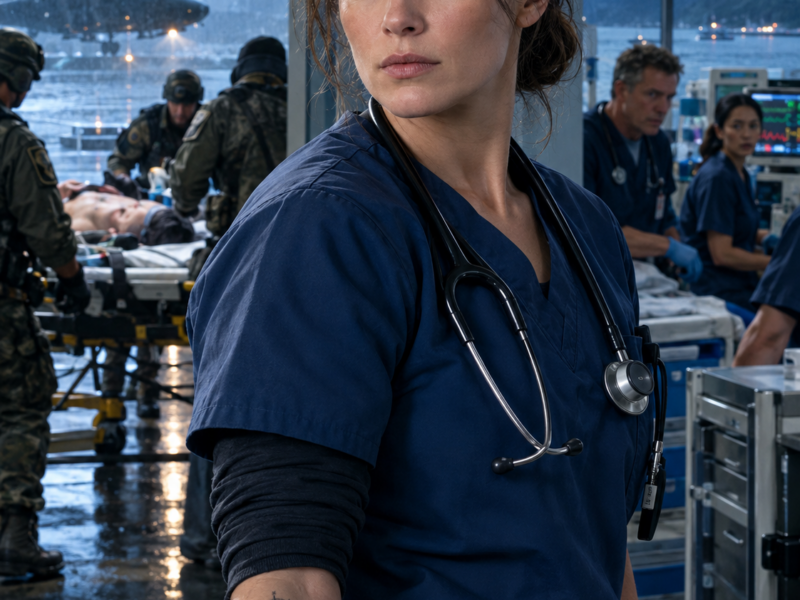
They Called Her Just a Nurse—Until an Elite Military Team Recognized Her Secret Past
Nobody in Ridgecrest Regional saw her pull her sleeve down.
That was the thing. She did it so fast, so automatically, every single morning when she clocked in, that three years had passed and not one person on the floor had ever caught her doing it.
They only ever saw the result. Vera Quinn, night shift nurse, long-sleeved undershirt beneath her scrubs in the middle of a British Columbia summer.
Sleeves always down, always even with her wrist bones, always exactly so.
The rain in Prince Rupert had been coming down for four days without interruption, which was not unusual, because Prince Rupert was the kind of place that treated rain as a permanent condition rather than a weather event.
Ridgecrest Regional Medical Center sat on a low bluff above the Skeena Estuary, twelve floors of pale concrete that caught the fog off the water and held it against the windows like something the building couldn’t let go of.
On a clear night you could see the lights of the fishing fleet from the fourth floor corridor.
Tonight there were no clear nights.
Tonight the sky and the sea had agreed to become one unbroken thing, and the whole coast was running blind.
Vera Quinn had worked the night shift at Ridgecrest for thirty-one months.
She had come north from nowhere anyone could confirm.
Her application listed a previous address in Kelowna that turned out to be a postal outlet, and she had been hired because the north was always short of nurses and Vera Quinn’s references were impeccable.
She was thirty-eight years old, brown-haired, gray-eyed, medium height, medium build, the kind of person your gaze slid across without purchase.
She wore her hair pulled back, kept her voice low, never argued with physicians, never raised her hand in a resuscitation, never ate lunch with the rest of the floor, and in thirty-one months had not accumulated a single patient complaint.
She had also not accumulated a single close friend, which the nursing staff discussed in the locker room with the comfortable certainty of people who have already made up their minds about a person.
“Stand-offish,” said Kelsey, who was twenty-six and drew hearts on the whiteboard when she wrote her name.
“Thinks she’s better than us,” said Donna, who had worked medical floors for nineteen years and had opinions about everything.
“There’s something off about her,” said Trevor from respiratory therapy, who had based this assessment on the fact that Vera had once corrected his ventilator settings without saying a word, simply adjusted the dial, checked the patient, and walked away.
The patient had been crashing. The settings had been wrong.
Trevor did not mention that part.
Dr. Alister Ford ran the emergency department the way certain men run departments, loudly in public and with the assumption that volume was a substitute for precision.
He was fifty-two, heavyset, gray at the temples, and had the particular talent of a man who had spent three decades being the smartest person in whatever room he happened to occupy.
He was not, in fact, always the smartest person in the room, but he had never once been required to notice.
“Nurse Quinn,” he said on a Tuesday evening in October, standing at the nursing station with a chart held at arm’s length as if it had offended him personally. “Can you explain to me why you’ve drawn up the magnesium before I’ve signed the order?”
“Because your verbal order was at 16:40 and pharmacy takes twenty minutes,” Vera said, not looking up from the IV pump she was programming. “The order would have been signed by the time it needed running. Drawing it early saved the patient thirty minutes.”
“I don’t give verbal orders for IV magnesium. That is hospital policy.”
“You gave this one. Cheryl from pharmacy was standing right there.”
“Cheryl from pharmacy,” he repeated with the slow gravity of a man for whom repetition was a rhetorical weapon. “Right. Wonderful. In that case, when the patient’s pressure drops because you’ve extrapolated from a conversation, we’ll call Cheryl from pharmacy as our expert witness.”
The unit clerk, a young man named Tobias who had been at Ridgecrest for eight months and was still at the age where injustice produced a visible flinch, looked at his screen.
Vera said nothing.
She finished programming the pump, hung the bag with the economy of someone who had done that gesture in the dark, in worse places than this, and moved down the hall to her next patient.
The patient’s magnesium ran without incident, and the patient’s pressure held.
No one mentioned either of these facts.
There was a woman in room 11 who noticed things because she was the sort of person who had spent seventy-four years noticing things and had no intention of stopping.
Her name was Beverly O’Shea, and she was in Ridgecrest for a hip replacement she had been putting off for two years because, as she explained to Vera with great precision, she did not have time to be in hospital.
She had four grandchildren and a garden that required supervision.
She was now in hospital anyway, and so she was supervising the floor instead.
“They’re hard on you,” Bev said one night when Vera came to check her drain output.
“People are people,” Vera said.
“That one with the gray hair is the worst. He does it in front of everyone on purpose.”
Vera noted the number on the drain, wrote it, moved the sheet back.
“Doesn’t bother you?” Bev asked.
Vera looked at her. “Not the way he thinks it does,” she said, and that was all.
Bev watched the nurse’s hands as she worked.
They were very still. Not the stillness of someone suppressing a tremor, the opposite.
The stillness of hands that had been trained into quiet the way a river is trained into a channel. All the force still there, just directed.
“My late husband had hands like that,” Bev said. “He was a surgeon. The best ones always have still hands.”
Vera said nothing to that, but she didn’t deny it, which Bev filed away and did not forget.
Vera had kept the tattoo for reasons she had never been able to fully explain to herself.
When she had walked out of the Canadian Forces Medical Services building in Petawawa four years ago, with a discharge that was legally impeccable and operationally convenient, it had been, in every practical sense, the end of someone who had existed for twelve years.
The administrative officer had mentioned, as a courtesy, that there were people who could take care of identifying marks.
It had been phrased exactly that way. Take care of.
She had looked at the man who said it and understood that he was not the sort of person who had ever been required to carry other people’s names on his body, and she had said, “Thank you,” and left.
The tattoo was on the inside of her left forearm, six names arranged in a column in a small precise hand that was not quite calligraphy and not quite standard printing, but something between.
The handwriting of a person who had learned to write quickly and legibly under conditions that did not allow for either revision or flourish.
Above the names, a compass rose.
Below them, coordinates that no mapping software would have recognized, because the location they described had no official designation and would not appear on any Canadian Forces documentation, because the operation that had taken place there had no official documentation.
She kept the names because she was the one left to keep them.
That was the arithmetic. It was not complicated.
Five other people had known all six names by heart.
She was the only one still alive, and so the knowing fell to her, and the ink was where the knowing lived in the world outside her head.
She had rebuilt herself carefully.
Vera Quinn was not her first name and not her last, and she had answered to it for four years until it fit well enough.
She was a good nurse because she had always been a good medic, and being a good medic had required understanding hospitals well enough to work around them, and working around them had turned out to require simply being inside them.
She had found Prince Rupert the way a person finds a place they’ve been unconsciously navigating toward.
It was at the end of a long line of choices that each seemed minor at the time. Remote, small population, high turnover, a hospital that needed nurses badly enough not to look too carefully, fog that closed in reliable as a curtain.
Nobody would think to look in Prince Rupert for a decorated JTF2 combat medic who had been operationally killed four years ago in a classified incident that had never been officially acknowledged and never would be.
Nobody had. Until now.
She felt it at 2200. Not heard. Felt.
That specific harmonic in the bones of the building, the frequency of military rotors at speed, the sound that a civilian hears as helicopter and a trained person hears as weight and urgency and someone’s very bad night.
She was at the nursing station entering labs when it started, and her pen stopped moving and she held still the way a hunting dog holds still, weight already shifting toward the balls of her feet.
Two aircraft, heavy. Coming fast out of the northeast, which meant over the mountains and across the Skeena Basin, which meant they had not come from the coast, which meant they had not come from a ship.
Ford was at the station. He heard it too, eventually.
“What on earth is that?”
“Griffins,” Vera said, still not moving. “Military.”
He looked at her. “And you know this how?”
She had already turned toward the ambulance bay.
The first aircraft came down in the rear parking lot with no warning and no ceremony, and the rotor wash hit the glass doors of the emergency bay like a flat palm and every loose piece of paper on the nursing station became briefly airborne.
The pilot had chosen the parking lot because the hospital’s rooftop pad was rated for three thousand kilograms, and a Griffin with a full team and casualties weighed considerably more than that.
And the pilot had made that calculation in about four seconds of professional judgment while simultaneously landing in a fog bank in driving rain.
Which was the kind of flying that did not happen often, and when it did meant the people in the back had run out of every other option first.
The side door came open before the wheels had fully settled, and Vera watched from behind the glass as figures moved through the rain with a controlled urgency she recognized the way you recognize a language you were raised in.
Five men in unmarked fatigues, no insignia, no name tapes, carrying a litter between two of them in the broken jogging gait of people who understood every second of delay as a precise clinical cost.
One clearing the path, one staying close to the casualty with a hand on his shoulder, talking to him without stop.
And one tall one moving ahead who pushed through the ambulance bay doors while the litter was still crossing the lot, and stopped inside, and swept the department with a single flat pass of his eyes that cataloged everything in less time than most people need to find a light switch.
He was perhaps fifty, hard-jawed, dark-eyed, a scar running from the corner of his left eye into his hairline that had healed clean, been properly tended.
When he spoke, his voice was the voice of a person who had spent decades having people do things because he said them.
“I need to know something before anything else happens.” He spoke to the room, not to any individual. “We have a casualty. He’s going to die in the next twenty minutes if the right person doesn’t see him. We were told by a frequency we trust that there is someone in this building.”
He paused one beat.
“We’re looking for a call sign. Ridgeline. Is there a Ridgeline in this hospital?”
Ford had appeared behind the station.
The charge nurse, a capable woman named Sandra Ip, who had run the floor for eleven years and had the face of someone who had seen most things, stood at the corridor entrance with her arms folded.
Around them, the department had frozen in the particular way of civilians confronted with something that had walked in from a different category of existence.
Nobody moved. Nobody spoke.
Vera Quinn stood at the glass doors to the ambulance bay with her back to the room. Her hand was on the doorframe.
The litter came through the doors.
The man on it was twenty-seven years old and the color of old candle wax.
His name, one of the team said in the flat shorthand of men who had been past pleasantries for some time, was Rourke.
Training accident in the mountains east of the Bulkley Valley, terrain that the team had used a dozen times because it was isolated and the topography matched what they trained for.
A fast-rope insertion that had gone wrong in conditions that were worse than forecast.
He had hit a rock face at speed.
There was blood in his chest and his breath sounded like something wet and torn.
The flight medic, who had been working on him for forty minutes, was standing at the foot of the litter with the gray, specific exhaustion of a man who has done everything he knows how to do and understands that he has reached the edge of what knowing it can accomplish.
“Hemopneumo,” the medic said. “Right side. I’ve got a needle in. It’s not holding. He needs a tube and a chest surgeon, and I don’t think he has the time for the surgeon.”
Ford had gloved. He had moved to the litter with the confidence of a man accustomed to being the answer in a room full of questions.
And for thirty seconds he was moving with the decisive momentum of experience, calling for the tray, asking for imaging, issuing orders that the trauma team moved to carry out.
And then Rourke stopped breathing.
Not gradually. Not with warning.
One moment the wet, labored sound continued, and the next it did not.
And the monitor that had been attached in transit screamed its single note, and the department stopped making any sound at all.
Ford called for the paddles. He called for them again.
His hands, moving over the tray, were looking for something the tray did not seem to contain in the right configuration.
His voice had an edge in it that Vera had heard before in a different context. The edge of a person who has reached the border of their competence and not yet acknowledged where they are.
The tall operator, the one the other members of the team called Crane, had his arms crossed against the wall and was watching Ford’s hands with the expression of a person doing arithmetic about a problem they cannot solve by themselves.
Sandra started to say something about imaging.
One of the younger operators said words under his breath that were not words, exactly, just sound pushed through grief.
Vera was already moving.
It was not a decision. She would think about this afterward and be unable to locate the moment of choice, because there was no moment of choice.
The man on that litter had his call sign on a patch somewhere in a memory she wasn’t supposed to carry, and her body had made its own accounting before her mind arrived at the conclusion.
The door to the trauma bay opened quietly. The room turned.
She had pushed her sleeves up to the elbow on her way across the floor without noticing she had done it, and the left forearm was bare under the fluorescent light.
Six names in column under a compass rose, and the coordinates below.
And she was gloved and at the bedside before Ford had fully registered that she had entered the room.
“Get out of here,” Ford said. “Quinn, get out of my trauma bay right now.”
“Her name is Quinn,” Sandra said from the door with a precision that surprised her as much as anyone.
Vera looked at the monitor, at the chest, at the needle that had been placed and was not doing enough.
She said quietly, to no one and everyone, “He has a tension. The needle’s not sufficient. I need a finger thoracostomy kit and I need it now, and I need somebody to tell me the last vitals.”
“You do not have the authority,” Ford said. “You are a floor nurse. You are not a physician. This is my department and you will remove yourself.”
“His lips are blue,” she said, the way you say a fact about the weather. “You have about forty-five seconds before the window closes entirely. You can do the thoracostomy, or you can explain to this team why you didn’t.”
The room held still.
And then Crane uncrossed his arms and stepped forward, not fast, not threatening, simply present, and said in a voice that had no drama in it, “Let her work, doctor. Please.”
The please was the most frightening part.
It was the please of a person who had decided that courtesy was the last thing they were going to try before the other options.
Ford stepped back.
The kit was in Vera’s hands seventeen seconds later.
Afterward, and there would be an afterward, because Rourke took a breath, a real one, the right side of his chest rising and the monitor finding its rhythm again, the sound that went through the trauma bay was not a cheer but a long collective exhale.
The sound of people discovering simultaneously that they had not been breathing either.
Afterward, the staff of Ridgecrest Regional Emergency would disagree about many of the details of the next three minutes.
But every one of them would remember the hands.
Not the procedure, not the words, not the sequence. The hands.
How they moved, the absolute absence of hesitation in them, the quality of motion that was not speed exactly but something closer to inevitability, the sense of watching a thing done by someone to whom it was as familiar as their own name.
The senior trauma nurse, a twelve-year veteran named Adey who had trained in three provinces and seen most of what a northern emergency department could produce, would say two days later in the staff lounge that she had spent thirty seconds of that intervention doing nothing but watching Vera Quinn’s hands, and that in thirty seconds she had understood something she had not understood in twelve years.
“That’s not nursing school,” Adey said. “I don’t care what anyone says. That is not nursing school.”
Rourke stabilized. He was not fixed.
The work he needed was surgical, and the surgeon problem had not been solved, and they had perhaps an hour before stable became unstable again.
But he was breathing, and his color was returning, and the monitor spoke in steady intervals instead of alarm.
And the flight medic, whose name was Corporal Tremblay and who had been awake for twenty-two hours, sat down heavily on a supply cart and put his hands over his face and made no sound at all.
Crane stood at the foot of the bed. He had not moved since he’d stepped forward.
His eyes were on the compass rose on Vera’s forearm.
“Ridgeline,” he said. Not a question.
She stripped off her gloves. She did not pull her sleeve down.
“How did you find me?” she said.
He exhaled slowly.
“Nine months ago, a reservist doing a northern rotation rode along with a Prince Rupert ambulance crew on a training night. They brought in an MVA. He watched the night nurse do a tactical tourniquet assessment on a femoral bleed, the exact sequence, the exact hand positions, and then watched her apologize to the attending physician for overstepping and put her sleeves back down and disappear into the corner of the room.”
She said nothing.
“It took six months to find anyone who would listen to the story,” Crane continued, “and three months after that it found me. When our bird went down tonight and our options went to zero, I looked at the map.”
He stopped.
“I want to tell you I chose this hospital for Rourke. The truth is I chose it for the story. At a fifty percent chance that the story was real, I would have made the same call.”
Ford had not left the room. He was standing against the wall beside the tray he had never fully used, gloves still on, watching.
And there was something happening in his face that was not his usual register.
The comfortable outrage had gone, replaced by something raw and less manageable.
He was an intelligent man underneath the performance of his certainty, and intelligent men, in the moments when the performance fails, sometimes arrive somewhere unexpected.
“Sandra,” he said, “I need imaging to confirm the placement.”
Sandra looked at Vera.
Vera said quietly to Ford, “Chest film will show you a good placement on the right and a second issue on the left that I haven’t mentioned yet because I was managing the immediate problem. You should look at the left lower lobe. The medics’ notes will tell you the mechanism.”
Ford looked at her for a long moment, and then he ordered the imaging.
And then he reviewed it with the care of a person who has decided to actually do the work rather than perform it.
And when it came back and showed exactly what she had said it would show, he stood very still for a moment and did not comment, and called the on-call thoracic surgeon in a voice that had lost its music.
He was, for the rest of that night, an excellent physician.
Several staff members would say this later, with the particular bewilderment of people watching a machine they thought was broken run correctly.
And the bewilderment was real, because it was real.
Some jammed mechanism in Alister Ford had been struck at the correct angle and had, gracelessly and late, begun to turn.
The second aircraft came down forty minutes later.
Vera had known it was coming.
She had read Crane’s face when he pressed his hand to his ear the second time, had read the particular quality of stillness that crosses a person’s face when they are receiving information they expected but hoped not to receive.
She had said nothing, simply moved back through the department and began preparing for what she now understood the night was going to require.
“Three more,” she said to Sandra on her way past.
Sandra did not ask how she knew. She started making calls.
The second Griffin brought a crew chief named Juanita with a dislocated shoulder and two cracked ribs from the same descent, a navigator named Pittman with a head laceration that needed imaging and stitches and observation, and an operator the team called River who had a forearm that had been splinted in the aircraft and would require an orthopedic surgeon and considerable creative language when the anesthesia wore off.
None of the three were in immediate danger. All three were in pain.
River’s language, creative as promised, made the unit clerk put down his coffee and stare at the ceiling in involuntary admiration.
The department ran the way departments run when they are being asked to operate above their ordinary altitude.
Imperfectly, loudly, with moments of genuine competence interrupted by the friction of systems designed for a different kind of night.
But it ran, because Vera Quinn moved through it the way water moves through terrain.
Not announcing, not performing, finding the low path, going there, accomplishing what needed doing and moving on.
She knew Ridgecrest. She had spent thirty-one months learning it the way she had learned every environment she had ever inhabited.
Systematically, quietly, cataloging its capacities and its gaps.
She knew which tech locked up under pressure and needed tasks in single clear sentences.
She knew which of the young nurses was better than her own confidence and required only one calm look to unlock.
She knew where the emergency supply caches were and which of them had been restocked and which had not.
And she moved through the building that night like a person who had memorized the map in advance for exactly this occasion, because she had.
Ford took River’s fracture without being asked.
He did it without ceremony, without announcement, without the usual production number.
He was at the imaging station with the x-rays and he was at the bedside with the reduction kit, and he worked through it with a focus so clean it was almost a different person wearing his face.
The team watched him work. Nobody said anything.
This was its own form of acknowledgment.
The thoracic surgeon, a woman named Dr. Kwame Aj who had been pulled from a dinner party in the East End and had arrived with a container of rice in her coat pocket and a surgical mask around her neck and the expression of a person fully committed to the night ahead, walked into the trauma bay, assessed Rourke in forty-five seconds, looked at Vera’s intervention, looked at Vera, and said, “Good placement. He’s ready.”
Then she said, “Where did you train?”
Vera said, “Somewhere with worse lighting.”
Aj looked at her for one long second, at the sleeve and the names, at the five quiet men arranged around the bay, and then she went to scrub in and said nothing further, because thirty years of trauma surgery teaches a person when a story belongs to someone else.
The wait was its own kind of weather.
Crane sat in the corridor outside surgical with his back against the wall, and two members of his team sat with him, and the young operator who had prayed out loud during the thoracostomy, whose name was Sergeant Ellery Dodd and whose team called him Thread, sat with his elbows on his knees and his head down, burning down time the only way that kind of time gets burned.
Vera used the hour the way she had been trained to use all waiting. Efficiently.
She moved through her other patients. She reset the bay.
She found Corporal Tremblay still on the supply cart and sat with him for seven minutes and took him through his interventions in the aircraft step by step, and when they reached the part where the needle wasn’t holding and the numbers kept sliding and he had run out of options, she said, “You gave him the forty minutes that made my forty seconds possible. That is how this arithmetic works.”
He looked at her. The shake went out of his hands.
Aj came out at 0230. She did not make the corridor wait.
“He’s stable. Damage was survivable and now it’s repaired.” She paused. “I have never received a handoff that clean from an emergency floor at this level of acuity.” She looked at Crane. “You were right to come here.”
Crane looked at Vera.
The storm began pulling back around 0300, the way Pacific storms do.
Not retreating so much as reconsidering, drawing back out over the water, leaving the land stunned and sodden and oddly still.
The fog thinned enough that the lights of the fishing fleet reappeared in the estuary below the bluff, scattered and yellow, familiar as a sentence you’ve been trying to remember.
Sandra found Vera at the medication station at 0310 doing the one thing that never waited no matter what else was happening. The charting.
Sandra did not say anything for a moment. She stood beside her, which was its own kind of sentence.
“There are going to be questions in the morning,” Sandra said finally.
“I know,” Vera said.
“Ford.”
“I know.”
“Administration.”
Vera kept charting.
Sandra said, “I’m going to be asked to give a statement about the thoracostomy, about who authorized it.”
Vera said nothing, which was its answer.
Sandra said, “I’m going to tell them exactly what I saw. I’m going to tell them that I watched a nurse with thirty-one months of flawless patient care and zero complaints perform an emergency procedure that saved a Canadian Forces operator’s life while the attending physician was present. I’m going to tell them that the attending physician subsequently provided excellent care for the remainder of the shift, and I’m going to suggest that if the hospital has a concern about the first part, they might want to think carefully about the kind of public conversation that gets started when a story like tonight’s reaches anyone with a microphone, which it will. Stories like tonight always do.”
She said this in the flat, calm tone of someone who has been running emergency floors for eleven years and has learned that institutional courage is mostly just saying the true thing in the right order.
Vera looked at her.
Sandra said, “I’ve been the charge nurse on this floor for eleven years. I know what I’m watching, and what I’m watching didn’t come from a nursing school.”
“It did eventually,” Vera said. “Just not in the order you’d expect.”
In room 11, Beverly O’Shea had not slept, because Beverly O’Shea did not sleep when interesting things were happening, and tonight had been full of interesting things.
When Vera came in for a routine check at 0330, Bev was propped against her pillows with the alert expression of a person who had been watching the hall traffic and drawing conclusions.
“Those men with the helicopters,” Bev said. “They knew your name.”
“No,” Vera said. “They knew my call sign.”
Bev considered this. “Is there a difference?”
Vera checked the drain, wrote the number, moved the sheet back.
The left forearm was still bare, and Bev looked at it without looking away, the way a person looks at something they have been polite about not looking at for thirty-one months.
“My husband had hands like yours,” Bev said. “Still ones. He used to say the best hands are the ones that remember what they’ve done. He said memory lives in hands before it lives anywhere else.”
Vera finished her notes and straightened, and for a moment she stood in the room with the six names visible in the early morning light and the fog thinning in the window, and Beverly O’Shea’s steady gaze holding her without pity and without judgment, the way very old people sometimes look at things they have decided to simply see.
“Get some sleep, Bev,” she said.
“That was good work tonight, Vera.” The older woman closed her eyes. “Whoever taught you, they should be proud. Whatever you lost, it was in service of something.”
Vera stood in the doorway for a moment.
“Thank you, Beverly.”
Crane was waiting in the corridor outside room 11 when she came out.
He had changed into civilian clothes, a dark jacket over a gray shirt, and he looked only somewhat less like what he was.
He held two cups of coffee from the machine at the end of the hall and offered one.
They stood for a moment without spending words.
Through the window at the end of the corridor, the estuary was beginning to show itself beneath the receding fog, flat and silver and enormous in the pre-dawn light.
“I want to make a call,” Crane said. “By noon there’d be a uniform in this building with paperwork that corrects a record. Your rank, your name, your service history, all of it.”
“I know you do,” she said.
He looked at the window.
“The people who signed your casualty report,” he said carefully, “are no longer in positions to sign anything. That’s been three years in the making, and I’m not going to pretend it wasn’t partly done for this conversation.”
She drank her coffee. “I know,” she said again.
“And the six of them,” he said. “What was done in that valley is documented now. Not publicly, but documented. It exists in a file that the right people can access. That matters to me. It matters to families.”
He stopped.
“It matters to a private named Gideon Osay, who was twenty-four years old in that valley, and whose mother, I’m told, has been writing letters every year asking what happened to him. If there’s someone left alive who was there, she has a right to know. I know that’s not a fair thing to say to you.”
Vera looked at the window for a long time.
“Gideon Osay,” she said, in the careful way of someone handling something old and very specific. “He had his mother’s eyes. He told me that. He said she would understand why he’d joined if she’d been there to see the view from the ridge that morning.”
Crane was quiet.
“He was the fastest medic in the unit,” Vera said. “I told him that the morning before. He knew, and he went anyway, and I don’t think there’s a word for what that kind of courage costs the person watching it.”
She set down the cup.
“Tell me where she is,” she said. “Gideon’s mother. I’ll call her myself. I owe her that. I owe her more than that, and I don’t know if there’s an amount that balances it, but I’ll start there.”
Crane nodded. He reached into his jacket and produced a folded piece of paper.
He had already written it down, she noticed. He had come prepared for the answer she had given.
That was the kind of man he was.
“And the record,” she said. “Let them correct it quietly. No press, no ceremony. That was the deal I made with myself when I walked out of that building in Petawawa. I don’t need a flag. I need the six names to be real somewhere outside my own head.”
“They’re real,” Crane said. “They’re on a wall that doesn’t show up in any media coverage and that the right people can visit. They were always real. The record just hadn’t caught up yet.”
She folded the paper and put it in her pocket.
Below the window, the lights of the fishing fleet sat steady on the water, yellow and ordinary and entirely indifferent to everything that had happened in the last six hours.
The way the world always manages to be ordinary from a distance.
The fog was gone. The coast was clean. The morning was very bright and very cold.
The questions came at 0900, as expected, in the small administrative conference room off the main lobby that smelled of old coffee and institutional carpet.
The director of nursing, a carefully measured man named Gerald Quinlan, sat across from Vera with a notepad and the expression of a person who was trying to understand something that kept not fitting the shape of the forms he had available for it.
Ford was there. A woman from the risk office named Carolyn Meade was there with a tablet and a stylus and the focused attention of someone whose job was to find the edges of liability exposure.
Carolyn led with the procedure.
“Unauthorized clinical intervention,” she said. “Physician-level intervention performed by a registered nurse without documented authority.”
She said it carefully, because she was careful, and because she understood that what she said in this room was going to matter.
Ford spoke before Vera could.
His voice was flat and precise, stripped of its usual architecture.
“I was present,” he said. “The intervention was performed in my presence. I did not object. The patient’s outcome was directly attributable to the speed of that intervention.”
He set a piece of paper on the table.
“I’ve written a statement to that effect. I’ve also written a separate statement for the medical staff office regarding my conduct toward Nurse Quinn over the past thirty-one months. That statement is not related to last night’s events. It’s simply something I should have written a long time ago.”
Nobody in the room spoke for a moment.
“I reviewed every intervention from last night’s shift,” Ford said. “Every single one was clinically correct. Several were faster than I would have been. Some I would not have had the training to recognize.”
He looked at his hands briefly.
“I have been practicing emergency medicine for twenty-six years, and last night I watched a colleague outperform me in my own department on the worst call of the year. I’m choosing to find that instructive rather than the other alternative.”
Gerald looked at Vera. Vera looked back at him.
She said, “I have a nursing license in this province that is in good standing. I have thirty-one months of clean patient outcomes at this facility. I have six names on my left arm that belong to people who died in a valley that doesn’t have an official name. And for four years I have kept those names and done my job and not asked this hospital for anything except the chance to do it right.”
She paused.
“The team I helped last night will be sending a letter,” she said. “The forces will send one as well. I’m asking you not to wait for them. I’m asking you to look at last night’s record and make the decision that the record supports. But I want to say one other thing.”
Gerald nodded.
“I want to run a trauma preparedness program for this floor,” she said. “I’ve watched this department for thirty-one months, and I know where its gaps are. Some of those gaps will cost someone their life in a mass casualty event. This is a coastal community in a seismically active region in a province where the military trains in the back country, and a mass casualty event is not a question of whether. I can build that program. I can train the staff. I can make this hospital ready for the next night like last night. That’s what I’m asking. Not protection. Not a medal. Just the chance to make this place what it should be.”
The room was very quiet.
Gerald wrote something on his notepad. Carolyn closed her tablet.
“I’ll need the record reviewed by noon,” Vera said, and she stood up, because there were patients on the floor and patients did not wait for institutional decisions.
And she went back to work.
Thread was still in the building when she came through the ambulance bay for a supply run at 1100.
He was standing outside in the thin October sun with his jacket open and his face tilted toward the light like a man who has been underground and is reminding himself that the sun exists.
He was twenty-three years old, she thought. Maybe twenty-four.
The age when surviving something still costs you more than it will later. When the body knows it survived but the mind is still doing the count.
She stood beside him.
“You okay, Sergeant?”
He thought about it, which she respected.
“I keep thinking about the part where I couldn’t get the needle to hold,” he said. “I keep going back to it. Like, I know the placement was right. I checked it twice. I just couldn’t get it to hold in the air in that weather with those vibrations, and I keep wondering if I did something.”
“You gave him the forty minutes,” she said. “I said this to you at 0200, and I’m saying it again because it’s still true. A needle thoracostomy in a moving aircraft in a mountain fog bank with those conditions. Your placement was correct. The physics of that environment limited what it could do. That’s not your technique, that’s the physics. You handed me a live patient with a correct diagnosis and a correct intervention, and the only gap was the geography. You did your job. He’s in recovery because you did your job.”
He looked at her.
“How long were you,” he said, and then stopped.
“Long enough,” she said.
He nodded slowly.
Then he said quietly, “Ridgeline. Is that where it’s from?”
“From a ridge in a valley that doesn’t have a name yet,” she said. “Six years ago. I haven’t used it in four.”
He was quiet for a moment.
“The guys are going to want to know your real name,” he said. “Not the call sign. When Rourke is better and we debrief and people are buying rounds, they’re going to want to know who to thank.”
She looked at the estuary below the bluff. The water was flat now, the color of old pewter, the fishing boats gone out.
A heron stood at the edge of the low-tide mud with the absolute patience of something that had decided to stop requiring the world to be different.
“My name is Vera,” she said. “That’s real enough.”
He nodded.
After a moment, he said, “Thank you, Vera.”
She went back inside.
Rourke was awake at 1400.
She had been told he was asking for her.
She came into the recovery room, and he was propped at an angle, gray at the edges and wired and tubed and blinking at the ceiling with the wondering expression of someone relearning the basic fact of being alive.
He was twenty-seven years old, and he had his whole career in front of him, and he had come about forty-five seconds from not having anything.
He turned his head when she came in.
“I was told,” he said, and his voice was a wreck, “I was told you reached into my chest in a hospital parking lot.”
“Trauma bay,” she said, pulling the chair to the bedside. “I was inside.”
He managed something that would eventually become a laugh.
“Did it hurt?”
“You were unconscious.”
“Small mercies.”
He was quiet for a moment. His eyes had found the forearm, the names.
“Can I ask?”
“Six people I served with,” she said. “In a valley east of the Stikine. Four years ago.”
He looked at the names, at the compass rose.
“I have a friend in the unit who was at the Stikine op,” he said carefully. “He talks about it sometimes. Not the details. Just, he said there was a medic.”
He stopped.
“He said the medic held the line for four hours. Work continued. With no air support and no extraction and six wounded. He said he never knew what happened to her afterward.”
He said it in the way people say things about someone they thought was gone.
Vera said nothing for a moment.
“Tell him she’s here,” she said finally. “Running a trauma program at a coastal hospital that needed one. Tell him she sends her regards.”
Rourke looked at her with the uncomplicated gratitude of someone who has had a very clear view recently of what the alternative would have looked like.
“You can come back,” he said. “To the unit. Crane would make one call. I heard him talking this morning.”
“I know,” she said.
“You’re staying.”
She looked at the window, the estuary beyond it, the mountains past the estuary, dark and enormous and very close.
“I spent a long time learning how to be invisible,” she said. “I think it’s time I learned how to be useful instead.”
He was quiet for a while.
Then he said, “Those two things aren’t always different.”
“No,” she said. “But the reasons are.”
Gerald came to find her at 1600 while she was charting the afternoon’s labs, and he sat down at the station beside her with the manner of a man who has made a decision and is now arriving at the moment of saying it out loud.
“The record has been reviewed,” he said. “The statement from Dr. Ford has been filed. The risk office has determined that, given the extraordinary circumstances, the physician’s concurrent presence, and the outcome, there is no basis for disciplinary action.”
She kept charting.
“I’ve also spoken to the chief of medicine,” he said. “He’d like to discuss the trauma program. He used the words long overdue.”
She stopped charting.
“We have a staff meeting scheduled for next Tuesday,” Gerald said. “I thought you might want to speak to it. About the program. About what you’d need.”
She looked at him.
He said quietly, “I know the record doesn’t tell the whole story. I suspect it never did. What I know is that this department has been lucky for thirty-one months. Last night made the luck visible.”
He set down his pen.
“I would rather this hospital be competent than lucky. If you’re willing to teach us, we’re willing to learn.”
Vera Quinn set down her pen.
Outside the window, the last of the fog had burned away completely, and the mountains to the east stood clean and enormous against a sky that had decided, after four days, to be simply blue.
The estuary caught the late afternoon light and threw it back in pieces, shifting and scattered and ordinary.
A hospital shift was ending. Another was beginning.
The monitors spoke their steady intervals in the rooms along the hall.
Somewhere in recovery, a man named Rourke was learning the new geography of his own breathing.
She picked up her pen.
“Tuesday,” she said. “I’ll be there.”
In room 11, Beverly O’Shea was asleep at last, and on her face was the particular expression of someone who has decided that the world has earned a few points back, and who is resting now because there is work in the morning and she intends to supervise it.
Down the corridor, the left forearm was covered again, not because the sleeve had been pulled down, but because it was October in Prince Rupert and the hospital ran cold and the undershirt was practical.
The names were still there. They would always be there.
But the posture had changed.
Somewhere between midnight and morning, the shoulders that had practiced small for thirty-one months settled back into the configuration they had been trained to, the one that takes up exactly the space it needs and no more and no less.
The mountains were still there east of the Stikine, enormous and indifferent, and in a valley without a name the coordinates on her forearm pointed to a place where six people had died and one had walked out, and four years had passed before anyone had cause to understand what walking out had cost and what it had preserved.
An echo is the voice that comes back after everyone swears the sound is gone.
She had not used that call sign in four years.
Standing at the window at the end of a very long shift, watching the mountains go blue in the last light, she understood that the silence had been its own form of keeping faith, and that now the faith required something different.
The night shift began at 1900.
She was there.









