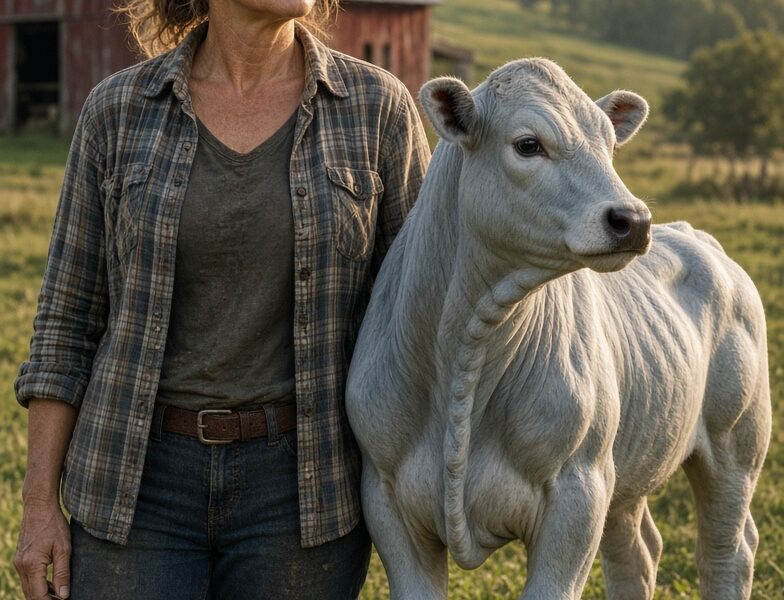
They Called Her Calf Worthless and Walked Away… Then It Grew Into Something Nobody Could Ignore
“148 pounds. That’s your Belgian Blue. I’ve seen dairy calves with more meat on them.”
“He got sick at two weeks. He’s catching up.”
“Catching up to what? Those hindquarters are flat as a fence board. Muscle is the whole reason anybody pays for this breed.”
“His papers are right here. Read them first.”
“I buy cattle with my eyes, Mrs. Whitcomb. Not with stories in a folder.”
“Five minutes. That’s all I’m asking.”
“You’re asking twenty-four hundred dollars for a sale-barn calf. Walter, take Whitcomb off my list. Her whole group.”
“You never even opened it.”
“Take him home. He’s not worth the paper.”
“You didn’t look at his sire, his dam, or one page,” Laurel snapped. “That’s not judging. That’s guessing.”
Preston swung back.
“That calf won’t bring seven hundred dollars anywhere in this county. Nobody here buys what I pass on.”
“Then he’s not for sale.”
Preston walked off.
Buyers along the rail looked at their boots.
In under a minute, Laurel had lost the sale she’d planned for weeks.
With $7,800 due in six weeks, she could have dumped Gideon on the first trader by noon.
Instead, she rattled his feed bucket, and the calf who’d balked at the scale followed her to the trailer.
The folder’s top page named a sire her late husband had chosen himself.
Preston never glanced at it.
Walter Boone caught up with her at the trailer gate.
He held out a weigh ticket, the ink still fresh, and kept his eyes on the calf instead of her.
“Your copy. Mine goes in my book. Every ticket that crosses my scale does.”
Laurel slid it into the folder right behind the semen certificate Preston hadn’t touched.
“Thanks, Walter.”
“I’ve seen uglier calves turn out fine.”
He rubbed the back of his neck.
“Don’t tell anybody I said so.”
She latched the trailer and pulled out of the lot with Gideon bawling behind her.
A thin, worried sound that followed her all the way home.
Whitcomb Hollow sat in a fold of hills outside Paris, Kentucky.
It had forty-six acres, a red barn faded almost to pink, and a fence line that needed more posts than she could afford.
Near the waterers, a dark patch spread across the gravel where the new line was leaking again.
Laurel led Gideon into the pen beside his mother.
Juniper, a big blue roan cow with a long scar low on her flank, pushed her nose through the boards and sniffed him all over.
Laurel checked the water, forked in hay, and stood there longer than she needed to.
Then she went inside to face the kitchen table.
Evelyn had stacked the mail by the coffee maker.
The envelope from the equipment dealer sat on top, and Laurel didn’t need to open it.
$7,800 for the automatic waterers and the new water line, due in six weeks.
The plan had been to sell a group of calves through Preston’s buying program and cover it.
“He wouldn’t even look at the others?” Evelyn asked.
“Scratched us off. All of them.”
Laurel dropped into a chair.
“I’ll find another buyer for the group. It’ll just take time.”
“And Gideon?”
“Walter thinks he’ll bring commercial price.”
“Maybe.”
Evelyn poured two cups of coffee and sat across from her.
“Then maybe that’s the answer, honey. Sell him for what he’ll bring and stop carrying it.”
Laurel looked out the window at the barn.
Eighteen months ago, Daniel had collapsed in the hayfield on an ordinary Tuesday, and everything he’d started had landed on her.
Most of it she understood.
Juniper and those straws she never had.
He’d bought the cow and four semen straws from a bull Laurel had never heard of, then written out a breeding calendar in his square, careful handwriting.
Seven and a half months after the funeral, she’d had Naomi breed Juniper on the exact date he’d circled.
It was the last plan he’d ever made, and she couldn’t stand to let it go to waste.
Gideon came by C-section, small and wet and furious.
At two weeks old, scours nearly killed him.
Laurel had spent three nights in that pen with a heat lamp and a bottle of electrolytes.
“Daniel never picked a calf by how it looked the day it hit the ground,” Evelyn said quietly.
“Daniel’s not here to tell me what he saw in this one.”
Evelyn didn’t argue.
She slid the envelope across the table.
Laurel turned it over in her hands.
She honestly didn’t know if keeping Gideon was a business decision or just a way of holding on to Daniel’s handwriting.
But Preston had made up his mind in five seconds.
And she wasn’t going to let five seconds decide this.
“I’ll give him some time,” she said.
“Not forever. And I’ll sell the others somewhere else.”
Naomi Mercer rattled over the cattle guard four days later.
She was the one who’d cut Gideon out of Juniper on a cold spring night, and she’d come back three times during the scours.
She climbed into the pen without being asked and ran her hands over his ribs, his spine, his hind legs.
“Guts good, coat coming back. He’s not small because something’s wrong with him, Laurel. He’s small because he spent two weeks fighting to stay alive. Now he’s catching up.”
“Preston said there’s no muscle on him.”
“There isn’t much yet in this breed. A calf that got knocked back early can take a while to show what he’s got.”
Naomi straightened.
“Or he might not have much to show. I can’t tell you that by looking.”
“Is there anything that’ll speed it up?”
Naomi’s face went hard.
“If you mean growth promotants, no. Not on a calf you want anybody to take seriously, and not on my watch.”
She pulled a battered green notebook from her jacket and flipped it open.
Every visit since the night Gideon was born was there, dated, every dose and every treatment in her tight handwriting.
“Nothing goes into this calf that isn’t written in my book. Feed him right, keep his legs sound, and let him grow.”
That afternoon, Laurel dragged the old livestock scale out of the machine shed and leveled it in the alley.
Gideon refused to step on it until she rattled his bucket.
“Come on, Gid.”
He climbed up, trembling, and the needle settled at 153 pounds.
She picked a spot by the corner post of the red barn where the morning light fell clean across the alley and took two pictures, one from the side and one from behind.
Flat hindquarters, narrow shoulders.
She printed the side view at the feed store and pinned it to the barn wall beside the feeding chart.
At the end of the second week, she stood Gideon by the same post and took the second picture.
She held it beside the first.
Maybe his hip looked a little fuller.
Maybe she just wanted it to.
Her phone buzzed.
Walter had a trader who would take her Belgian calf.
He said $650, commercial price.
Laurel shut her eyes.
It wasn’t even a third of what she’d asked.
“I won’t sugarcoat it,” Walter said.
“Preston sits on the advisory board at the Central Bluegrass Cattlemen’s Association. When he passes on a calf in front of half the county buyers, remember that’s the best number you’ll see right now.”
“I’m not blaming you, Walter.”
“I know,” he sighed.
“I run the scale at the association’s young cattle evaluation at the end of summer. If that calf ever turns into something, you know where to find me.”
“I need more time,” she said.
That night, the water line split open again by the waterers.
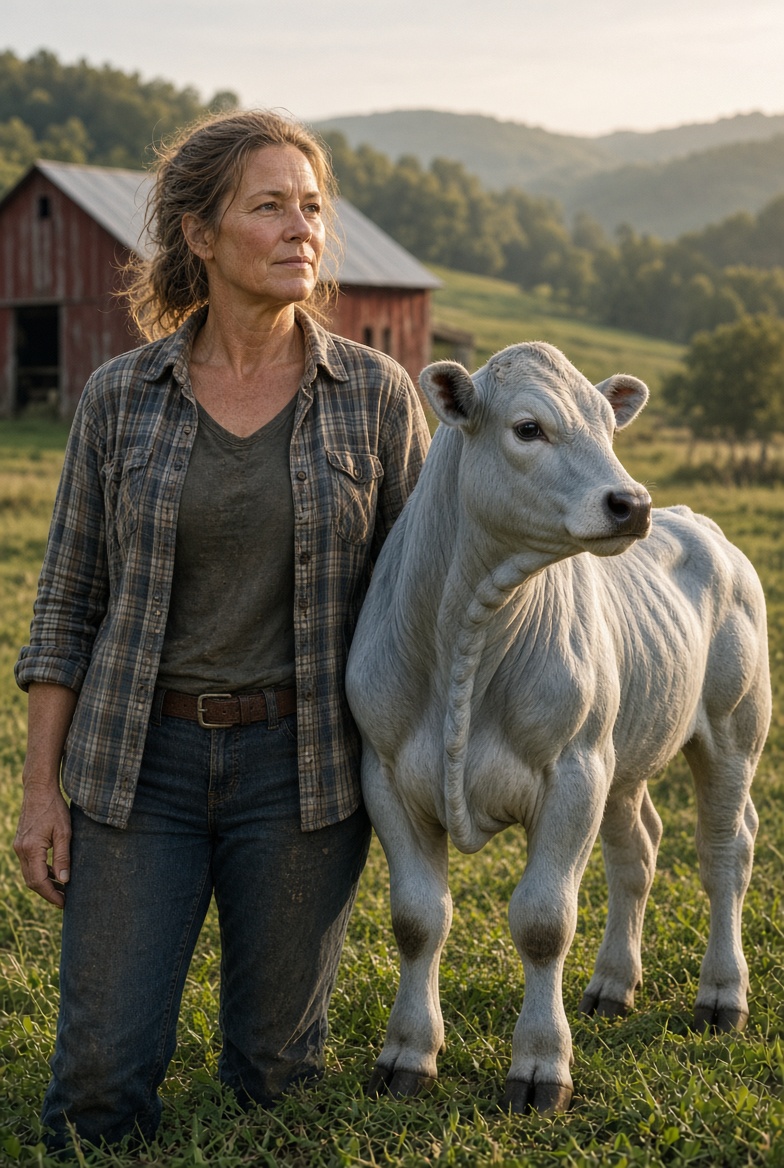
Laurel stood in the mud with a flashlight, shut the valve, and walked back to the barn, soaked to the knees.
The two pictures hung side by side on the wall.
She looked at them a long time.
Then she took a marker off the shelf and drew a box around a date on the barn calendar, eight weeks from the day at the sale barn.
First thing in the morning, she called Walter back and turned down the $650.
By noon, she’d booked a different hauler for the rest of her calves.
There was no other offer for Gideon now.
Whatever he was going to be, she’d have to prove it herself.
Week three brought nothing dramatic.
Laurel fixed fence, hauled hay, and checked the waterers twice a day.
Gideon grew the way calves grow, a little at a time, never enough to notice.
Next to the others, he still looked ordinary, and some mornings Laurel caught herself wondering if she’d turned her husband’s handwriting into a business plan.
Then the new hauler called.
His schedule had filled, and he couldn’t take her group for another month.
The dealer wouldn’t wait a month.
Laurel loaded two of the calves herself, hauled them to the Saturday sale, and took market price, $3,100.
Not what she’d planned, but cash.
On Monday, she drove into Paris, sat across from the dealer’s office manager, and laid $2,000 on the desk.
She asked for terms on the rest.
After a phone call and a lot of frowning, they put it in writing.
The remaining $5,800 plus a $150 late fee, due by the end of week twelve.
No more extensions.
She signed on the drive home.
She did the math twice.
About $1,100 left in the account and a deadline that wouldn’t move.
In week four, the change finally showed up where she could see it.
She opened the barn early one morning, and Gideon walked out ahead of the others and stopped at the fence.
The sun came in low across his body.
His hindquarters had rounded.
When he shifted his weight from one back leg to the other, lines of muscle moved under the short blue-white coat, there and gone, and there again.
Laurel grabbed her phone.
At the corner post, she took the third picture and held it beside the first.
She didn’t have to squint this time.
She texted both to Naomi, who showed up the next afternoon with a tape and a clipboard.
Naomi measured him, checked his legs, pressed her fingers into his hindquarters, and looked for any swelling that might fake a fuller shape.
She didn’t find any.
“That’s real growth,” she said.
“And it’s muscle, not fat.”
Laurel let out a breath she felt like she’d been holding since the sale barn.
“So Preston was wrong. He judged too early.”
Naomi coiled her tape.
“Let’s not judge too early the other way.”
“How do we find out for sure?”
“There’s a genetic test for the myostatin gene, MSTN. It’s behind that double-muscled look Belgian Blues are known for. A blood or hair sample, a lab. A couple of weeks.”
Naomi glanced at the prints on the barn wall.
“When you’re ready to pay for it, call me.”
Laurel checked her bank balance and didn’t call.
Not yet.
At the end of week five, Evelyn came out to the barn carrying a cardboard box with Daniel’s handwriting on the side.
“I was cleaning out his office,” she said.
“You need to see this.”
Inside were breeding certificates, invoices, and a brown leather notebook Laurel hadn’t seen since the funeral.
She sat on an overturned bucket and opened it.
Page after page of Daniel’s square letters, notes on bulls and cows, and bloodlines she’d never paid attention to.
Near the middle, one line was underlined twice.
“Don’t pick on newborn looks. Track growth, legs, fertility, test MSTN.”
Laurel read it three times.
She’d thought Juniper was a hobby, something Daniel tinkered with between hay cuttings.
This wasn’t tinkering.
He’d planned to test his calves for the exact gene Naomi had just explained to her.
The invoice for the straws was clipped inside the back cover.
Four straws, one lot, with the lot code and the semen company’s name printed across the top.
Laurel called Naomi on the spot.
“How many did we use?”
“One on Juniper,” Naomi said.
“The other three are still in the nitrogen tank at my clinic. Daniel paid the storage through the end of the year.”
Laurel kept turning pages.
In the margin beside a list of farms Daniel had apparently contacted, one line made no sense at all.
“APC. No.”
“Any idea what that means?”
Evelyn shook her head.
“He used initials for everything.”
Laurel photographed the invoice, the underlined line, and the margin note.
That evening, she emailed the semen company and asked them to confirm the lot and Daniel’s purchase records.
In week six, the fourth picture stopped her cold.
Gideon’s shoulders had widened.
His hindquarters bulged out past the line of his hips.
From behind, he didn’t look like the calf in the first print anymore.
He looked like a Belgian Blue.
She called Naomi.
“Run the test.”
Naomi pulled blood and a tail hair sample and sent them off.
The test and the farm call came to about $350, and Laurel watched it leave her account with her jaw set.
Naomi’s truck was barely out of the driveway when Laurel’s phone rang again.
“Ashford Premier Cattle, Mrs. Whitcomb.”
Preston’s voice was warm, almost friendly.
“I’ve been hearing some talk about that calf of yours.”
“Have you?”
“I’d like to take him off your hands. Thirty-five hundred. I’ll send my own trailer. You won’t even have to haul him to the barn.”
Laurel stared at the prints on the wall.
“Six weeks ago, you wouldn’t open his folder. What changed?”
“A good businessman always reconciles. Out of Daniel’s Belgian Blue program, isn’t he? His straws.”
Her grip tightened on the phone.
She had never said Daniel’s name to Preston.
She’d never said a word about straws.
“I’ll need that offer in writing,” she said.
“And I’m having him tested first.”
“Then I can’t promise the number will still be there.”
“Then it’ll have to wait.”
The line went dead.
Laurel stood in the alley with the phone in her hand.
How did a man who wouldn’t read a single page know whose straws had made this calf?
By the end of week eight, Gideon was fourteen weeks old.
Laurel opened the barn at six, the way she always did, and he walked out into the sun ahead of the others.
He stepped up onto the rise of packed dirt by the gate and stopped there, broadside to her, with the light coming in from the east.
Two masses of muscle stood out across his hindquarters, round and hard, rolling under the coat with every shift of his weight.
His shoulders had broadened.
His back ran thick and level into his hips.
He was still a calf, all knees and curiosity, but nobody on earth would have called him plain.
Laurel didn’t move.
Then she turned toward the house.
“Evelyn, come out here.”
Evelyn crossed the yard in her slippers.
She looked at Gideon.
Then at the first print pinned inside the barn door, then back at the calf.
Her voice came out barely above a whisper.
“Oh, Daniel.”
Laurel led Gideon to the corner post and took the fifth picture.
Then she rattled the bucket.
“Come on, Gid.”
He climbed onto the scale without hesitating, and the needle settled at 265 pounds.
She pulled Walter’s ticket from the folder.
148 pounds, dated the morning Preston turned his back.
She pinned the new print at the end of the row.
Five pictures, eight weeks, and a change nobody could argue with.
Naomi came out before lunch.
She watched him walk, picked up each foot, ran her hands down his legs and over every joint, then stepped back with her arms folded.
For once, she didn’t start with a warning.
“Legs are good. Joints are good. He moves right.”
A slow smile spread across her face.
“Now we find out why.”
Gideon wandered over and shoved his head into Laurel’s hip, hunting for the bucket.
She stumbled into the fence and laughed out loud.
It surprised her.
She couldn’t remember the last time she’d laughed in that barn.
The results came in week nine.
That same morning, the semen company had emailed back confirming the lot and Daniel’s purchase.
Naomi read the lab report at the kitchen table while Evelyn leaned over her shoulder.
“Two copies,” Naomi said.
“He carries the myostatin variant from both sides. Juniper’s registered Belgian Blue, so one came from her. The sire gave him the other. That’s your muscle.”
Laurel pressed a hand over her mouth.
For eight weeks, she’d been half afraid she was fooling herself.
Now it was on paper from a lab.
“I need you to hear the rest,” Naomi said, setting the page down.
“This explains the muscle. It doesn’t make him a great bull. We won’t know about his fertility until he’s mature. And double-muscled bulls can sire calves too big to be born easily.”
She tipped her head toward the window, toward the barn where Juniper stood with that long scar on her flank.
“You’ve seen what that looks like. If he’s ever used for breeding, every one of those calvings has to be managed. That’s not a small thing.”
“So what’s he worth?”
“I can’t tell you that from a lab report.”
Naomi wrote a name and a number on the back of an envelope.
“Graham Ellis. He evaluates bulls for breeding programs. He doesn’t care who you know. He cares about records.”
After she left, Laurel sat alone with the report.
Preston had stood at that scale and said there wasn’t an ounce of muscle on this calf.
The calf carried the very gene that made his breed famous for it.
She called Graham that night.
Preston got there before Graham did.
His truck came up the drive on a Tuesday in week ten, and he walked straight to the fence without knocking.
Laurel came out of the barn wiping her hands.
He was looking at Gideon, and for the first time since the sale barn, he wasn’t smiling.
“Eight thousand,” he said.
“Today.”
She ran the number twice in her head.
Eight thousand would cover the rest of the dealer’s bill with room to spare.
“Contracts in the truck. Standard terms plus a confidentiality clause. Neither of us discusses the details.”
“Have you seen his test results?”
“Don’t need to.”
Laurel looked at him for a long moment.
Ten weeks ago, he hadn’t needed to read the papers to turn this calf down.
Now he didn’t need to read them to buy him.
Preston’s eyes drifted past her to the pen where Juniper stood chewing.
“Daniel ever use all those straws?”
She didn’t answer that.
“Last time you said I was asking too much. Now you want me to decide too fast. He’s getting an independent evaluation first.”
“Markets change, Mrs. Whitcomb. Offers don’t last forever.”
“Neither did your last one.”
He held her eyes a second longer, then walked back to his truck.
The contract never came out of it.
Graham Ellis showed up two days later, a quiet man with reading glasses hanging from a cord.
He spent an hour with Gideon before he said much.
He watched him walk on gravel and on grass, studied the five prints, read Naomi’s report twice, and checked Walter’s ticket against Laurel’s scale log.
“He’s worth following,” he said finally.
“Too young to call a herd sire, but worth following.”
Then he picked up the semen invoice and went still.
“I know this lot. This sire line got offered around to a lot of operations two, two and a half years back. Most passed. Harland Creek Genetics down in Tennessee didn’t. Their bull calves out of this line sold strong at their sale last fall.”
Something clicked.
Laurel went into the house, opened Daniel’s old email on the laptop, and searched for Ashford.
The thread was short.
Daniel had written to Ashford Premier Cattle with a summary of his plan, the sire line, the testing, and an offer to compare notes.
Preston’s reply was two sentences.
The line didn’t fit the phenotype standards his operation pursued.
Thanks, but no.
APC, no.
She carried the laptop out to the barn and turned it toward Graham.
He read it and took off his glasses.
“So when people started talking about a muscled-up Belgian calf from Daniel Whitcomb’s program,” Laurel said slowly, “he knew exactly which program that was.”
“Looks that way. He passed on this line twice. Once in an email, once at the scale, and a competitor made good money on it in between.”
Graham handed the laptop back.
“Doesn’t mean he knew this calf’s genotype. Nobody did until last week. But it explains the hurry and the confidentiality.”
“What’s Gideon actually worth?”
“If he passes his evaluations, a lot more than anything Preston’s put on the table.”
Graham nodded toward Juniper.
“And a calf like this, with the cow that made him and the straws that are left, is worth more together than any of them sold apart.”
The contract came in week eleven by courier, in a crisp white envelope.
$10,000, seventy-two hours to sign.
Laurel’s knees went loose.
Ten thousand would clear the dealer, fix the water line, and give her breathing room for the first time in a year and a half.
She had a pen in her hand before she made herself put it down and call Graham.
He read every page at the kitchen table that evening while she and Evelyn waited.
“Three things,” he said, tapping them one by one.
“Here, he gets an option to buy Juniper and any remaining straws from that lot at a fixed price. A low one. Here, everything about this calf stays confidential, including your records. And here, you waive any claims after the sale.”
He slid it back.
“He’s not buying a calf, Laurel. He’s buying Daniel’s whole program for ten thousand dollars, and your silence with it.”
Evelyn’s mouth went tight.
Laurel stared at the line with Juniper’s name in it.
“There’s another way,” Graham said.
“The Bluegrass Sire Development Program. They follow promising young bulls and pay an upfront participation fee if they accept one. You keep ownership, but they can say no, and they don’t move fast.”
The next morning, Laurel called Preston’s office and declined.
Then she went to work.
Naomi wrote a full health report.
Evelyn put every invoice and certificate in order.
Laurel assembled the five prints, Walter’s ticket, the scale log, and the lab results, and submitted the application with ten days left before the deadline.
Two days later, Marcus Reyes from the program called.
“Mrs. Whitcomb, we’ve put your application on hold. A member of the association’s advisory board raised a concern. A change this fast in a calf that started out undersized could be consistent with growth promotant use. Promotants disqualify a bull from our program.”
“I’ve never put anything in that calf.”
“Then you’ll have the chance to show it. We’ll make a final decision at the association’s young cattle evaluation this Saturday.”
Laurel looked at the calendar.
Saturday was five days before the payment was due.
Preston’s offer had expired that morning.
The program was frozen, and every dollar she needed now hung on one Saturday in a sale barn full of people who’d watched Preston laugh at her calf.
She didn’t have to ask who’d filed the concern.
Friday night, Laurel sat on a hay bale in the barn with the folder in her lap and the calendar staring down at her.
She could call Preston’s office in the morning and ask if ten thousand was still on the table.
She knew what it would cost her.
Juniper, the straws, her silence.
She could load Gideon and sell him to the first trader who’d take him at whatever price a rumor about drugs would leave him worth.
Or she could walk into that barn tomorrow and put everything she had in front of everyone who’d watched her get turned away.
She went through the folder page by page.
Walter’s ticket, Naomi’s report, the lab results, five prints, Daniel’s notebook open to the underlined line.
Then she tucked the folder under her arm, checked Gideon’s water one last time, and went to bed.
The association held its young cattle evaluation at the sale barn where it had all started.
The scale, the rail, a lot of the faces, all exactly where she’d left them.
Laurel caught people looking at her and looking away.
Walter stood at the scale with his log book open.
Marcus Reyes sat at a folding table near the ring with two association members.
Graham leaned on the rail with his glasses on, and Naomi stood beside him with her kit.
At the end of the advisory panel, in a pressed white shirt, sat Preston Ashford.
Gideon hated all of it.
The clanging gates, the loudspeaker, the crowd pressed along the rail.
He backed into Laurel and trembled against her leg.
She kept a hand flat on his neck and talked low to him until the shaking eased.
When their number was called, Preston stood before she reached the ring.
“Before we go any further, I want my concern on the record.”
He turned so the crowd could hear.
“Not three months ago, on that scale, this calf weighed 148 pounds and didn’t have muscle worth mentioning. I’ve judged cattle my whole life. I’ve never seen a turnaround like that without help. Implants, perhaps. I think this panel deserves to know what’s been put into him.”
A murmur rolled down the rail.
Some of the men who’d laughed that first morning were looking at Laurel now, and not kindly.
Marcus Reyes looked at her.
“Mrs. Whitcomb?”
Laurel led Gideon to the scale.
He planted his feet at the edge of the metal, eyes rolling at the noise.
Someone in the crowd snickered.
She rattled the bucket.
“Come on, Gid.”
He stepped up.
The needle settled at 310 pounds.
Somebody along the rail let out a low whistle.
“Mr. Ashford’s right about one thing,” Laurel said.
“He weighed 148 pounds that morning. Walter weighed him.”
Walter didn’t wait to be asked.
He flipped back through his log book, pulled out a carbon copy, and laid it on the panel table beside the ticket.
Laurel sat down.
The carbon matched hers to the date and to the pound.
“Same ticket,” Walter said, “and I was standing right here when Mr. Ashford wouldn’t open her folder.”
Laurel set the five prints in a row on the table, the first beside the last.
Same post, same angle.
The difference sat right there where everyone could see it.
Naomi stepped up and opened her green notebook.
“I delivered this calf. Every visit, every dose, every treatment since the night he was born is in here, dated. There’s no promotant in it because he’s never had one.”
She pulled a pair of sample tubes from her kit.
“And if anybody wants to be sure, I’ll draw residue samples right now in front of Mr. Reyes.”
Marcus nodded.
Naomi drew them at the rail while the crowd watched, sealed them, and handed them across the table.
Graham spoke next, quiet and even.
“He was sick at two weeks and undersized at six. What you’re looking at is a calf catching up at a rate that falls inside what’s normal for a healthy one. And there’s this.”
He laid the lab report on top of the prints.
“Two copies of the myostatin variant. No drug on earth gives a calf this genotype. He was born with it.”
Preston’s jaw worked.
“Fine. He’s muscled. That doesn’t make him profitable. Plenty of good-looking calves never earn a dime.”
“You’re right,” Graham said.
“That’s exactly why nobody should call a calf worthless after a three-second look.”
A few people along the rail laughed, low and short.
Laurel picked up the folder, the same battered one, and set it on the panel table directly in front of Preston.
“I brought these papers on the very first day.”
He looked at it for a long moment.
Then, with the whole barn watching, he opened it.
Marcus cleared his throat.
“The hold stays until the residue results come back. If they’re clean, we’ll move forward.”
They came back clean three days later, on a Tuesday.
Marcus called that afternoon.
“The program’s accepting Gideon on a conditional basis,” he said.
“We’ll send the agreement tonight.”
Laurel read it at the kitchen table with Graham, every line.
A $6,000 participation fee upfront.
Part of the testing costs covered.
Evaluations at set intervals.
The program got the right of first negotiation if she ever chose to sell, but no right to take Gideon or use him for breeding before he qualified.
Laurel kept ownership of the calf.
Juniper and the three straws weren’t mentioned at all.
She signed it that night.
The fee landed in her account the next morning.
And that afternoon, one day before the deadline, she drove into Paris and paid the dealer $5,950.
The office manager stamped the paperwork and slid it back across the desk.
Preston’s truck was in her drive when she got home.
He met her at the fence, hat in his hand for once.
“I misjudged that calf,” he said.
“I’ll own that. But I buy on what the market rewards. Experience told me what I was looking at.”
“Your experience wasn’t the mistake,” Laurel said.
“Refusing to check the evidence was.”
She held his eyes.
“Twice.”
He didn’t ask what she meant.
He just glanced toward the barn.
“If you ever decide to sell him or those straws—”
“Then it’ll go through an independent evaluation and a contract anybody can read,” she said, opening the gate.
“Same as everybody else.”
He put his hat back on and left.
Week thirteen was ordinary, and Laurel was grateful for it.
After the dealer, she had about $800 left.
She bought pipe and fittings in town, dug up the bad section of water line herself, and fixed it in an afternoon.
She wasn’t rich.
The fences still needed posts.
Gideon still needed feed, care, and years of watching.
Naomi came out for a checkup and gave him a clean bill.
At her truck, she said only one thing.
“If he’s ever bred, every calving gets planned. No exceptions.”
Laurel kept her records anyway.
Now the ledger had new columns.
What he cost, what the tests found, and what nobody knew yet.
Walter called on Friday.
“Thought you’d want to hear it from me. The association asked Preston to sit out the evaluation panel next season, since his complaint didn’t hold up. And a couple of his buyers have started asking how he picks his calves.”
Preston still had his 1,800 acres and his name on the gate.
But for the first time, people were asking him to show his work.
In week fourteen, on a cool morning with the first edge of fall in the air, Laurel walked out to the barn with Daniel’s notebook.
Gideon stood by the fence, his blue-white coat bright in the sun.
He turned toward the water trough, and the muscle across his hindquarters moved like it had always been there.
She opened the notebook to the underlined line.
“Don’t pick on newborn looks.”
Beneath it, in her own handwriting, she wrote the date and the time of his next evaluation.
Then under that, one more line.
“Juniper, next spring. Straw, too.”
Evelyn leaned in the barn doorway.
“You keeping that old picture? The one from the sale barn?”
Laurel unpinned the first print and the fifth and held them side by side.
“Both of them. One, so I remember how he got judged. The other, so I remember that what people see isn’t always the whole truth.”
She closed the notebook.
Gideon walked slowly out into the pasture, and Laurel stood at the fence of her own land and watched him go, with the red barn behind her and the Kentucky hills rolling away green in every direction.
Nobody was going to tell her what he was worth.
She already had it in writing.









