They Called Her a Librarian… Then Someone Whispered “Wraith” on the Radio
Someone whispered “Wraith” into the radio.
On the platoon net, sixteen men stopped breathing at once.
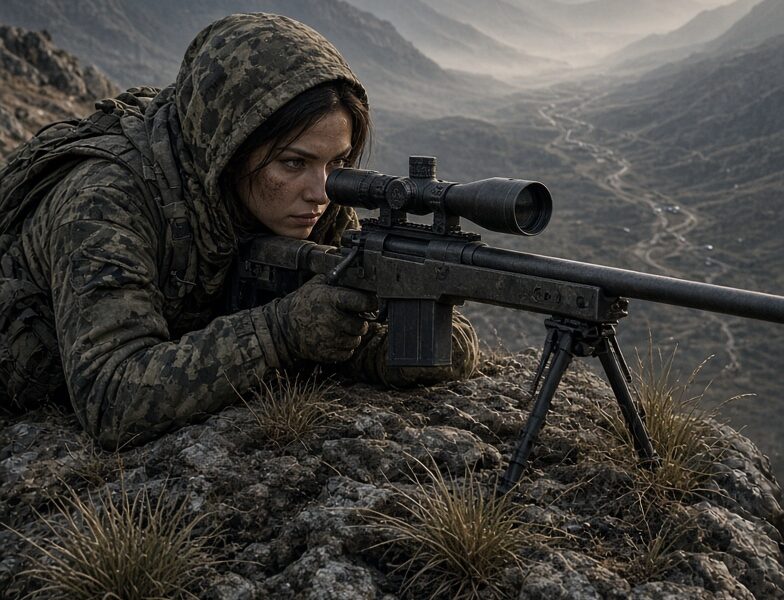
Nine hundred and eighty yards below the ledge, a pickup truck bounced along the wadi track with its headlights off, dust boiling white behind it in the first gray light of morning.
The woman behind the rifle did the thing she always did before the hard ones.
Two light taps on the scope with her index finger.
The way you knock twice before entering a room.
Then the rifle spoke once, and the whole valley went silent.
Fifteen hours earlier, the helicopter set Petty Officer First Class Cora Bennett down at Forward Operating Base Kestrel at 1500 hours with her seabag, her rifle case, and a service record that told almost nothing.
The record said eight years in.
It said marksmanship instructor, Dam Neck, three years.
It did not say where she had been before that, because those pages had been pulled and replaced with a single stamp line.
Assignment history redacted.
She was twenty-nine years old, five foot four in boots, and quiet in the way that made loud men assume she was lost.
Lieutenant Nathan Cross read her orders twice on the tarmac as if the second reading might produce a different sailor.
He was thirty-one, Annapolis, on his second deployment, and he had asked battalion for a sniper and received instead a woman with an instructor’s tan and a redacted file.
“Bennett,” he said, “you ever done real overwatch?”
“I’ve looked through glass before, sir,” she said.
Behind Cross, Petty Officer Third Class Jesse Cole, twenty-three, the platoon spotter, all elbows and confidence, leaned toward the corpsman and said it just loud enough to carry.
“They sent us a librarian.”
Nobody laughed.
That was worse.
Senior Chief Tom Reiker stood apart from the group with his arms crossed, forty-four years old and twenty of them spent in platoons like this one.
He watched Cora Bennett the way old chiefs watch everything, without appearing to watch at all.
His eyes went to her hands where they rested on the rifle case.
Steady.
Still.
The hands of someone who had carried weight.
“Stow your gear,” Cross said. “Brief at 1900. You’re with Cole on glass until I decide otherwise.”
It was not a warm welcome.
It was barely a welcome at all.
An hour later, Cross called Reiker into the cramped command tent and dropped Cora Bennett’s file on the folding table between them.
“Talk to me, Senior,” Cross said. “Eight years in, three of them teaching trigger squeeze at Dam Neck, and everything before that is a black bar. Battalion sends me that instead of a shooter.”
Reiker picked up the file, thumbed past the redaction stamp, and set it back down.
“Sir, in twenty years I’ve learned that a black bar usually means somebody did something worth not talking about.”
“Or nothing worth talking about,” Cross said. “A sealed record can mean she washed out of somewhere and they papered it over.”
“It can,” Reiker agreed mildly.
“You’re not worried.”
“I’m always worried, sir. It’s in the job description.”
Reiker’s weathered face gave away nothing.
“But I’ll say this. Watch her hands. Hands don’t have a redaction stamp.”
Cross frowned.
“What’s that supposed to mean?”
“You’ll see,” Reiker said, and left the tent.
He had already seen on the tarmac the way she set the rifle case down.
Not dropped.
Not placed.
Settled.
The way you’d set down something that mattered.
Twenty years teaches a man to notice small things.
The file told him nothing.
The hands told him plenty.
He just didn’t know yet what plenty meant.
The platoon hooch smelled of boot leather and CLP.
Cora took the last bunk, the one by the door where the draft came through, and nobody offered to trade.
She ate without looking up, and the conversation flowed around her like water around a stone.
Vance found her there.
Petty Officer First Class Eric Vance, thirty-three, the platoon’s actual sniper, or he had been until three weeks ago, when a training accident put his right index finger in a splint that wasn’t coming off for another month.
He sat down across from her with his tray and nodded at her rifle case.
“Don’t mind Cole,” he said. “He was born at full volume.”
“I’m not minding anything,” Cora said.
“You shoot?”
“A little.”
Vance smiled crookedly.
“That’s what they all say.”
He lifted his splinted hand.
“Three weeks. Soon as this comes off I’m back behind the glass. Till then I’m the world’s most overqualified radio operator.”
He studied her for a moment.
“Dam Neck, huh?”
“Instructor duty.”
“You miss it?”
“It was quiet,” she said.
“Quiet’s underrated,” Vance said, and left it there.
At 1630, Cora took her rifle to the armory to draw ammunition and confirm zero.
Cole came along because Cross had told him to.
Babysitting duty, his expression said.
The rifle was a MK 13, scarred and honest.
Cora broke it down on the mat with movements so economical they barely looked like movements at all.
She checked the bore, the crown, the torque on the rings.
Then she did a small strange thing.
Two light taps on the scope with her index finger.
Tap tap.
The way you knock twice before entering a room.
Cole frowned.
“What’s that? A good luck thing?”
“Habit,” she said.
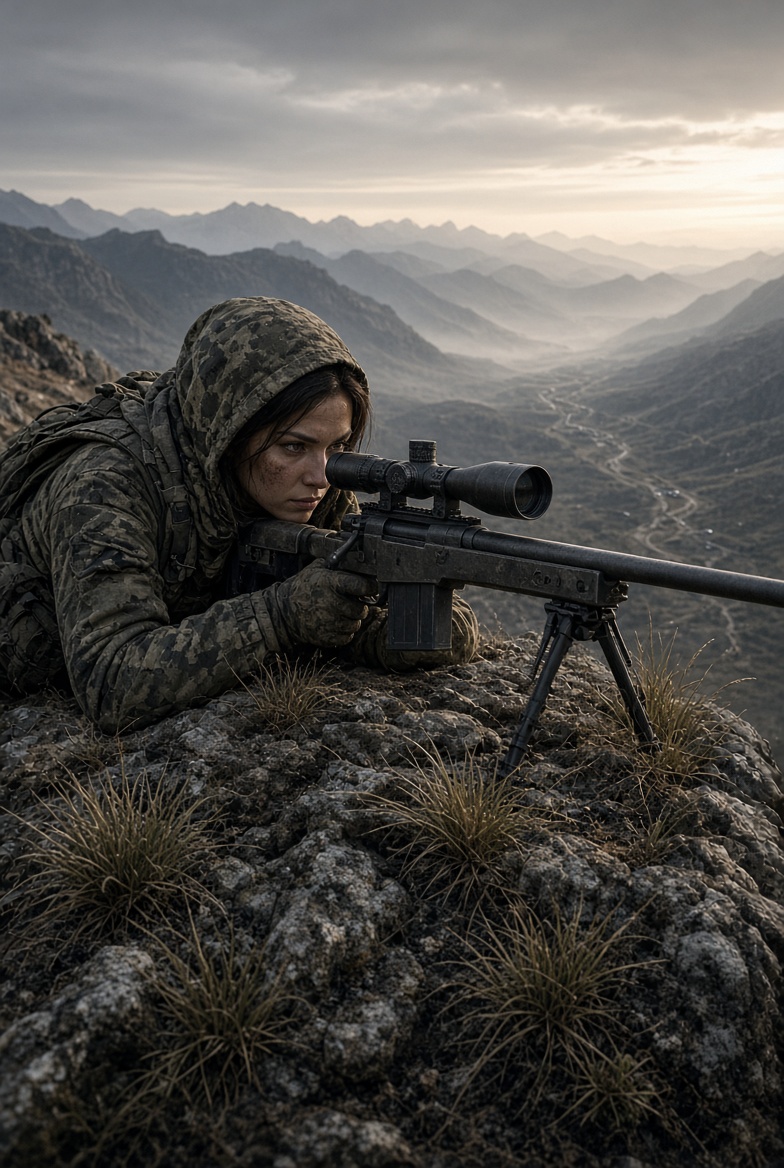
On the range behind the wire, she settled into the dirt and sent three rounds downrange at six hundred yards.
The spotter called them.
One inch apart.
Dead center.
A group you could cover with a coin.
Cole lowered his binos slowly.
“Three rounds. Rifle was already close,” Cora said, packing up.
“Nine’s my best,” Cole said quietly. “Nine rounds to zero.”
Cora glanced at him.
“The rifle doesn’t care how many rounds it takes.”
She walked back to the hooch alone, and Cole stood on the range for a long time looking at the three holes in the paper, grouped tight as a secret.
Reiker watched her from the doorway of the team room.
He had seen the three-round zero through the armory window.
He said nothing.
Old chiefs know that some questions are better carried than asked.
At 1900, the platoon crowded into the briefing room, and Cross laid out the operation on the map with a red marker.
The Kesar Valley.
A weapons handoff at dawn.
Crates of rifles and worse, changing hands between two groups who did not trust each other, which made them careless.
The platoon source was inside the meeting, wearing a wire that would go dead the moment anyone swept him.
The job, overwatch the handoff, and if it went bad, stop the weapons from reaching the pass at the valley’s north end.
Cross traced the wadi track with the marker.
“The buyers come in from the south road. The sellers hold the compound. Exchange happens here, in the open ground between. Our source is the gray-jacketed man. He’ll be near the compound door. If anyone searches him, the wire dies and he’s on his own.”
Reiker pointed at the north end of the map.
“The pass is the whole game. Once a vehicle gets through there, it’s gone. The far side drops into country we don’t patrol. Whatever happens, nothing with wheels gets past that line.”
He drew an X across the track.
“This is where it ends, one way or another.”
Cora studied the map in silence.
After a moment, she said, “Sir, the east spur. Does it see the north track?”
Cross glanced at her, surprised she’d spoken.
“Partial. The rock formation at the bend blocks the last two hundred yards.”
“And the ledge?”
“Full lane, nine eighty to the bend.”
Cross’s mouth tightened.
“Which is why the ledge matters.”
Cora nodded once and said nothing more.
But Reiker noticed she hadn’t asked about the compound or the source or the exfil.
She’d asked about the two firing lanes.
And in that order.
It was the question a shooter asks, not a spotter.
“Two overwatch positions,” Cross said. “Primary on the east spur. Vance, you’re on glass and net control. Secondary, the ledge above the wadi. Cole, you’re spotting.”
He paused.
“Bennett, you’re on the rifle at secondary. It’s the backup gun. The east spur covers the compound. The ledge probably won’t even need to fire. And it’s the only gun we have left.”
The room was very still.
Cole said, “Sir, with respect, she’s been here four hours.”
“And Vance has a splint,” Cross said flatly. “The ledge is a nine-hundred-eighty-yard lane with a twelve-mile crosswind. You want to take it, Cole?”
Cole’s jaw worked.
He was a fine spotter.
He was not a sniper.
“No, sir.”
“Then Bennett takes it.”
Cross looked at her.
“Just keep your head down, call what you see, and do not take a shot you can’t make. If the truck moves, we lose it. That’s the job.”
It was the kind of assignment you give someone you don’t trust with anything harder.
After the brief, the platoon drifted to the smoke pit, and Vance, benched, restless, talkative, told the story.
Every platoon has one, and this was theirs.
“Four years ago,” Vance said, “a ridge in the east. Patrol pinned down in a wadi at last light, no air, no arty. One shooter, one rifle, thirteen hundred yards through a dust gap. One round. The ambush just stopped. Nobody ever saw the muzzle flash. They called the shooter Wraith, because that was the only thing that made sense.”
“Sea story,” Cole snorted. “Probably. Thirteen hundred yards. Sure. And I’m the tooth fairy.”
The corpsman laughed, but it was a nervous sound.
A couple of the younger guys exchanged glances, the kind of look men exchange when a story is too good to believe and too good to let go of.
Nobody laughed that time, either.
In the corner of the smoke pit, Senior Chief Reiker had gone very still.
He looked at the ground for a long moment, then stood and walked away into the dark without a word.
Cora Bennett sat on an ammo crate apart from the group, cleaning her rifle.
She did not look up during the story.
Her hands kept moving.
Bore, bolt, cloth.
Steady as a metronome.
But for just a second, her thumb brushed the scope turret.
Tap tap.
Twice, light as a heartbeat.
Reiker saw it from the edge of the dark.
He stopped walking.
He stood there a long time.
At 2100, Cross ran a rehearsal on the ridge behind the wire, dry runs of the movement, the glass, the calls.
The night was cold and the wind came down off the high ground in gusts that tugged at sleeves and made the range flag snap.
Cora lay behind the rifle on the rehearsal berm with Cole beside her on the spotter scope.
Downrange, two hundred yards out, a row of steel targets waited in the dark.
Cole read the Kestrel.
“Wind eight miles, full value, left to right. Hold left edge.”
Cora said quietly, “Gust coming in three seconds.”
Cole frowned at the meter.
It still read eight.
Steady.
He opened his mouth and the flag downrange snapped hard sideways as a gust rolled through, exactly three seconds later.
He stared at her.
“How did you—”
“Grass,” she said, nodding at the slope below. “It lays down before the meter catches it. Watch the grass, not the box.”
Cole was quiet for a moment.
Then, with the particular cruelty of twenty-three-year-olds testing strangers, he said, “You know what I think? I think Dam Neck taught you to shoot paper. Paper doesn’t shoot back, Bennett.”
Cora didn’t answer.
She settled a fraction lower behind the rifle, breathed out, and began working the steel targets.
Five rounds.
Five targets.
Each one falling with a clean metallic clang that rolled down the dark ridge like slow applause.
She never adjusted.
She read each gust in the dark like it was printed on the air, and the rifle barely seemed to move.
When she was done, she safed the weapon and stood.
“Kestrel’s honest,” she said mildly. “It tells you exactly what you did.”
Cole had no reply for that.
He coiled the Kestrel’s lanyard around his fingers, uncoiled it, and said nothing all the way back down the trail.
Reiker stood behind them with his binoculars down at his chest.
He had watched the whole string.
When Cora stood and brushed the dust from her knees, he said, very quietly, “Where’d you learn to read wind like that, Bennett?”
“Dam Neck, Senior Chief,” she said. “We had a lot of windy days.”
Reiker held her eyes for three heartbeats.
“Sure,” he said. “Windy days.”
He walked away, and Cora watched him go with an expression that was not quite worry and not quite anything else.
At 0345, the platoon woke to the smell of coffee and gun oil.
At 0400, they stepped off into the dark, moving in single file up the goat trail toward the valley rim.
By 0530, they were in position.
Vance and the command group on the east spur.
Cora and Cole on the narrow ledge above the wadi.
The rest of the platoon spread in a loose cordon below.
The climb had been brutal in the thin predawn air.
Loose shale underfoot.
The trail narrowing to nothing in places.
Every man carrying glass and guns and water up a slope that wanted them back down.
Cora moved through it without a wasted step, her breathing even, the rifle riding high on her pack where she could reach it.
Twice Cole slipped on the shale.
Twice her hand was on his elbow before he knew he was falling.
He didn’t thank her.
He didn’t have to.
The second time, he just nodded, and something in his expression shifted a fraction.
The ledge was barely wide enough for two.
Cole set up the spotter scope with quick, practiced hands, and for a while they lay in silence watching the valley fill with gray light.
Below them, the meeting site.
Three vehicles.
A low mud-walled compound.
Men moving between them like pieces being set on a board.
Cooking smoke rose from the compound in a thin blue line.
A dog barked somewhere and was hushed.
The valley was waking up the way valleys do.
Slow.
Ordinary.
Utterly unaware that sixteen armed men were watching it hold its breath.
“Winds building,” Cole murmured, reading the meter. “Ten, gusting fourteen.”
“Left to right.”
“Fourteen by sunup,” Cora said, not looking up from her scope. “It’ll lay down after, when the walls heat even.”
Cole checked the meter again.
Ten, gusting fourteen.
He made a small mark in his notebook and said nothing.
“There,” Cole whispered as a fourth vehicle arrived. “That’s the buyer’s truck.”
Cora was already watching it through her scope.
“Two men in the cab.”
“Crates in the bed, tarped.”
“Driver’s nervous. Keeps checking the pass road.”
Cole glanced at her.
He had not mentioned the pass road.
“Our source is the one by the compound door,” Cora said. “Gray jacket.”
“He’s favoring his left side. They searched him already.”
“Wire’s probably gone.”
On the net, Vance’s voice was calm and professional.
“Command, primary. We have eyes on the handoff. Four vehicles. Count twelve men. Source is in place.”
Cross, beside Vance on the spur.
“Copy. All stations, weapons tight. We watch and wait.”
The sun came up behind the east ridge and poured gold down the valley walls.
The handoff began.
Crates carried from one truck to another.
Men counting, arguing, counting again.
Cora watched it all through nine-power glass, breathing slow, her finger straight along the trigger guard.
Then the gray-jacketed man by the compound door made a mistake.
He reached inside his jacket for the dead wire.
For reassurance.
For anything.
And one of the buyers saw it.
Everything changed in four seconds.
A shout.
A rifle butt swinging.
The source went down hard against the mud wall, and two men dragged him upright with a gun at his head.
The buyers’ truck, the one with the crated rifles in the bed, roared to life, and the driver swung it toward the north track.
Toward the pass.
On the net, Cross’s voice went sharp.
“Primary, talk to me.”
Vance answered fast.
“Command, primary. I have no lane. The spur blocks the north track. Say again, no lane on the moving vehicle.”
Cora was already moving.
Below the ledge, the wadi track curved into view.
A nine-hundred-eighty-yard lane.
The pickup gathering speed, dust boiling behind it.
In four minutes, it would reach the pass.
Air support was twenty minutes out.
There was no other gun that could reach it.
Cole’s voice cracked.
“Bennett, that’s nine eighty. Moving. Twelve-mile wind gusting eighteen. Nobody makes that shot.”
Cora settled behind the rifle like water finding its level.
Her breathing slowed.
Her finger found the trigger.
And she did the thing she always did before the hard ones.
Two light taps on the scope with her index finger.
Tap tap.
The way you knock twice before entering a room.
Two hundred yards away on the east spur, Senior Chief Tom Reiker was watching her through the big spotter scope.
He saw the two taps.
Four years collapsed into a single second.
A ridge in the east.
Last light.
Dust hanging in the air.
A shooter settling behind a rifle with that same small ritual.
Tap tap.
And then one round at thirteen hundred yards that no one could explain.
Reiker’s hand found the radio handset.
His voice came out as barely a breath, and it went out over the platoon net to sixteen men.
“Wraith.”
On the ledge, Cora Bennett heard it in her earpiece.
She did not flinch.
She did not look up.
She simply breathed out, held the last of it, and watched the pickup bounce through her crosshairs.
Leading it.
Feeling the wind.
Waiting for the gust to die the way she had waited a thousand times before.
Then the rifle spoke.
Once.
And the whole valley went silent.
The pickup’s driver folded over the wheel at nine hundred and eighty yards.
The truck veered hard left, plowed nose-first into the wadi bank, and stopped in a settling cloud of dust.
The crate stayed in the bed.
The men at the compound froze, and in that frozen second, the platoon moved.
Cross’s voice cut through the shock on the net.
“All stations, go. Go.”
What happened in the next twenty minutes happened the way platoon operations are supposed to happen.
Fast.
Violent.
Over.
Reiker’s squad went straight for the compound wall, getting between the gray-jacketed man and the guns before anything else.
The cordon closed.
The buyers scattered and were gathered.
The weapons never reached the pass.
On the east spur, Vance lowered the spotter scope with hands that weren’t entirely steady.
He had called hundreds of shots in his career.
Watched them.
Measured them.
Written them up in after-action reports with dispassionate precision.
He had never seen anything like what he’d just seen.
Nine hundred and eighty yards.
A moving truck.
A twelve-mile wind with gusts to eighteen.
One round.
Beside him, Cross stood motionless, the radio handset still halfway to his mouth.
The lieutenant’s order, take the shot, don’t take the shot, had died unsaid.
He stared down the valley at the thin white dust still hanging over the wadi track, and his mind replayed the last hour with sudden, terrible clarity.
The woman he’d handed the secondary gun to like it was a consolation prize.
The wind call she’d made three seconds before the meter.
The three-round zero at the armory.
“Senior Chief,” Cross said slowly, “did you know?”
Reiker was watching the ledge through his binos, where two small figures were breaking down their position with unhurried efficiency.
“I suspected, sir.”
“Since the smoke pit.”
He paused.
“The taps, yes. But also the sling. She coils it left-handed the same way. After that mission four years ago, I watched her pack up her rifle at twenty paces and told myself I’d imagined the whole thing.”
“And you didn’t tell me.”
“You didn’t ask, sir.”
Reiker lowered the binos.
“And some things a man has to see for himself before he’ll believe them.”
Below, at the compound wall, the corpsman worked over the source.
A split lip.
A fractured cheek.
Nothing worse.
The gray-jacketed man clutched the corpsman’s sleeve and kept repeating one phrase in a local dialect over and over until the interpreter leaned in.
“He says,” the interpreter told Cross, “the woman on the hill saved his life. He says he saw the whole thing through the doorway. He says—”
The interpreter hesitated.
“He says, ‘She is a very good shot.'”
Cross looked up at the ledge, high and far above the wadi, where Cora Bennett was coiling her sling with the same economy she’d shown breaking down the rifle.
“Yes,” Cross said quietly. “She is.”
On the ledge, Cole lay beside the spotter scope with his mouth open.
He had watched the entire shot.
The lead.
The hold.
The single crack rolling down the valley.
His hands were shaking.
“Nine eighty,” he whispered. “Moving. In that wind.”
He turned to stare at her.
“Who are you?”
Cora was already breaking down the rifle, her movements unhurried.
“Petty Officer First Class Bennett,” she said. “We should move. They’ll want the ledge cleared.”
But the platoon net had heard Reiker’s whisper, and whispers travel faster than helicopters.
By the time the platoon regrouped at the vehicles, sixteen men were looking at Cora Bennett with entirely different eyes.
Cross stood by the command vehicle with Reiker beside him, and the lieutenant’s face was doing something complicated.
“Senior Chief,” Cross said quietly, “you want to explain what you said on the net?”
Reiker looked at Cora.
She met his eyes and gave a single small nod.
Permission or resignation, it was hard to tell.
“Four years ago,” Reiker said, “I was a chief on a ridge in the east. Patrol caught in a wadi at last light. No air, no arty, nothing. One shooter put one round across thirteen hundred yards of dust and ended it. I watched the whole thing through glass. Nobody saw the flash. The patrol started calling the shooter Wraith because nothing else made sense.”
He paused.
“The shooter did two taps on the scope before every hard shot. Tap tap. Like knocking before entering a room. I never saw another shooter do it before or since.”
He looked at Cora.
“Until twenty minutes ago.”
The silence that followed had weight.
Cross turned slowly to Cora.
“That was you.”
“It was a long time ago, sir,” she said.
“Your record says instructor duty. The deployments before that were classified.”
“The command pulled those pages, not me.”
Her voice was even.
“Afterward I asked for a quiet billet. The name got too big. I didn’t want to be a legend. I wanted to be a sailor.”
Cole found his voice.
“The zero. Three rounds. The wind call. You knew.”
He stopped.
“At the smoke pit, when Vance told the story, you didn’t even look up.”
“I was cleaning my rifle,” Cora said.
“You tapped the scope,” Reiker said softly. “Twice. I saw it from the dark.”
Cora almost smiled.
“Old habits.”
Cross was quiet for a long moment.
Then he did something no one expected.
He took off his cap, ran a hand through his hair, and said, “I gave you the secondary gun because I didn’t trust you with anything harder. I told you not to take a shot you couldn’t make.”
“Yes, sir.”
“You made it anyway.”
“The truck was going to reach the pass, sir.”
Cross nodded slowly.
“I’m not arguing with the call, Bennett. I’m—”
He stopped, and when he spoke again, his voice had changed.
“I owe you an apology. In front of the platoon, if you want it.”
“I don’t want it, sir,” Cora said. “I want the source to make it home. Everything else is noise.”
It was the most words anyone had heard her say at once.
The exfil was quiet.
On the helicopter, Cole sat across from Cora and stared at his hands for a long time before he spoke.
“Teach me,” he said.
Cora looked up.
“Teach you what?”
“The wind. The way you read it. The grass. The three seconds. I want to learn that.”
She studied him.
The same young spotter who had called her a librarian on the tarmac the previous afternoon.
There was no mockery left in his face.
Just hunger to be better.
“All right,” she said.
It was enough.
It was everything.
Back at Kestrel, Cross found Reiker alone by the team room, cleaning his own rifle with slow, practiced strokes.
“She asked me to keep it quiet,” Reiker said before Cross could speak. “The name. Wraith retired four years ago, as far as she’s concerned. What the platoon saw today, that’s just Bennett being Bennett.”
“Can you keep a thing like that quiet?” Cross asked. “Sixteen men heard you say it.”
“I can try,” Reiker said. “Legends are like smoke, sir. They go where they want.”
He looked up.
“But I’ll tell you this. I’d follow that woman through any door on any night. And I’d have said the same four years ago, if I’d known her name.”
That evening, Cora Bennett sat at the end of the table at chow, in the same seat as the night before.
But this time, when she sat down, the conversation didn’t flow around her like water around a stone.
It stopped.
Shifted.
Made room.
Vance slid his tray down to sit beside her and grinned.
“So. Instructor duty.”
“So,” she said.
“Thirteen hundred yards.”
He shook his head.
“I told that story for two years and never believed half of it.”
“Believe all of it,” Cora said. “It happened.”
Cole sat down on her other side without asking, like he belonged there now.
“Tomorrow,” he said. “The wind thing. First light.”
“First light,” she agreed.
Across the table, Cross caught her eye and lifted his coffee in a small, private salute.
Not officer to enlisted.
Shooter to shooter.
Cora returned it with the faintest nod.
Later, alone in the hooch, she broke down the rifle one more time, cleaned it, and laid it in its case.
Her hands moved with the same economy as always.
Bore, bolt, cloth.
Steady as a metronome.
Before she closed the case, her index finger brushed the scope turret.
Tap tap.
Two light taps.
The way you knock twice before entering a room.
Somewhere out in the dark, the wind moved through the wire, and the base settled into its nighttime rhythm.
And Petty Officer First Class Cora Bennett, who had been a whispered name for four years, slept the deep, dreamless sleep of someone who no longer had to hide.
Nobody whispered her name that night.
They didn’t have to.
They knew it now.
And more importantly, they knew the woman who carried it.









