The Wild West Was Never What You Think: 18 Shocking Truths About the 1880s That Hollywood Buried Forever
The 1880s were not one world.
They were two.
In the same decade, in the same country, Americans were living in completely different centuries.
In New York, businessmen were making phone calls and riding electric streetcars.
On the Great Plains, cowboys had never seen a telephone and probably never would.
In Chicago, workers were building the first skyscrapers, steel skeletons reaching toward the sky.
In Kansas, families were living in houses made of dirt, praying the roof would not collapse in the rain.
The American bison went from sixty million to fewer than a thousand in just fifteen years.
The telegraph stretched across the entire continent, ending the age of the easy getaway.
And in the middle of all that, cowboys were still driving herds of two thousand cattle along dirt trails.
The Old West was living in two centuries at the same time.
And the facts from that era seem made up precisely because of that.
This is the story they never told you.
These are the truths Hollywood buried under decades of myth.
This is the real Wild West.
Fact One: In 1883, There Were More Dead Bison Than Stars Visible to the Naked Eye
Before Europeans arrived, around sixty million bison lived on the Great Plains.
There were so many that when a herd moved, the ground shook like an earthquake.
In just fifteen years of organized commercial hunting, that number crashed to fewer than one thousand animals.
Think about that.
Sixty million reduced to fewer than a thousand.
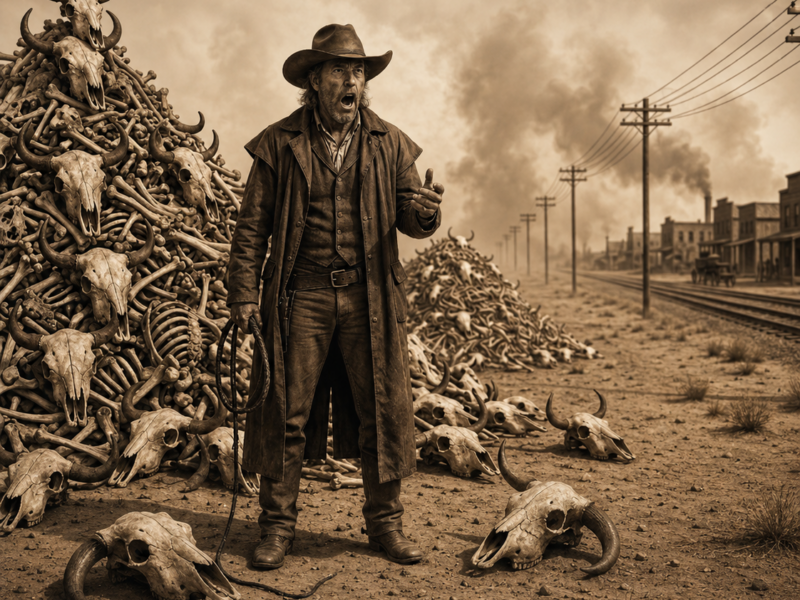
Photographers who went out to the plains in 1883, hoping to capture the last herds, found only mountains of bones bleaching in the sun.
And here is the detail most people do not know.
All that destruction was carried out by fewer than five thousand professional hunters.
A group smaller than the population of a tiny town wiped out more mammals than any event in recorded human history.
It was the equivalent of erasing the entire current population of North America in less than two decades.
It was not an accident.
It was method, industrial scale, and indifference.
The bison were not just killed for food.
They were killed to destroy the way of life of the Plains tribes who depended on them.
It was a strategy.
And it worked.
Fact Two: Wyatt Earp Was Working as Casino Security in 1883
Everyone knows the gunfight at the OK Corral.
October 1881.
Tombstone, Arizona.
Thirty seconds of gunfire that became legend.
But what happened to Wyatt Earp after that?
Two years later, in 1883, he was in Dodge City, Kansas, working as security at a gambling hall.
That is right.
The man Hollywood turned into a national hero was making a living protecting card tables and chips.
Back then, there was no pension for former lawmen.
No health insurance.
No government retirement.
A thirty-five-year-old guy with a reputation as a fast shooter used exactly that to pay the bills.
The skill with a revolver that nearly got him killed in Tombstone was the same one that paid the rent in Dodge City.
That idea of the sheriff hanging up his hat and living peacefully on a porch was invented by movie screenwriters.
In real life, men like Earp stayed in the same cycle because the only work available required exactly what they already knew how to do.
Fact Three: While New York Had Telephones, Cowboys Had Never Seen One
In 1877, Alexander Graham Bell’s telephone started working commercially.
Three years later, the United States already had nearly forty-eight thousand devices in use.
By 1886, that number had passed one hundred fifty thousand.
But here is the detail most people do not stop to think about.
While a businessman in New York could already call the office by phone, a cowboy on the Great Plains had never even seen one of those things and probably never would during his entire working life.
In 1882, Edison opened the first electric power station in Manhattan.
Cities in the East already had electricity, streetcars, and telephone lines.
Meanwhile, the West was still living practically in the pre-industrial age.
Two Americans born in the same year, living in the same country at the same moment, existed in completely different eras.
The cowboy of 1880 and the Manhattan banker of 1880 shared the same flag, but not the same century.
The United States was literally two worlds at the same time.
Fact Four: Buffalo Bill Created a Show About the Old West While the Old West Still Existed
In 1883, William Cody put together a traveling show about the wildlife of the American West.
The detail most people do not stop to think about is that at that time real cowboys were still driving cattle along the trails and Plains tribes were still resisting on the frontiers.
Cody did not invent anything from scratch.
He had been a bison hunter hired by the railroad, an army scout, and a guide for military expeditions.
The guy had lived it firsthand and decided to turn it into a show before the whole thing was even over.
The troop traveled across the United States and later crossed the Atlantic, bringing the show to audiences in England, France, and Italy.
The cast included real cowboys, sharpshooters, and actual Sioux warriors.
In 1885, Sitting Bull himself joined the tour only nine years after Little Bighorn.
The West was being turned into myth while it was still breathing right outside the circus tent.
Fact Five: Jesse James Was Killed by a Member of His Own Gang in 1882
Jesse James was living in hiding in St. Joseph, Missouri, using the fake name Thomas Howard.
He had a wife, kids, and neighbors who had no idea who he was.
On the morning of April 3rd, 1882, while Jesse was straightening a picture on the living room wall, Robert Ford pulled out his revolver and shot him in the back.
Jesse was thirty-four.
Ford was a recent member of the gang and had already made a secret deal with Governor Crittenden, who had promised ten thousand dollars for Jesse’s head.
After the shooting, Ford turned himself in expecting to become a hero.
That is not what happened.
The public called him a coward.
The court sentenced him to hang, but the governor granted him a pardon.
The promised reward was never paid in full.
Ford spent the next few years trying to cash in on his fame, putting on shows where he reenacted the murder.
It did not last long.
In 1892, exactly ten years after killing Jesse, Ford was shot twice in a bar in Colorado.
Fact Six: Coca-Cola Was Born the Same Year Geronimo Surrendered
In 1886, an Atlanta pharmacist named John Pemberton mixed a dark syrup with carbonated water and started selling it at the pharmacy counter for five cents a glass.
No one imagined that homemade remedy would become the most recognized drink on the planet.
But while Pemberton was serving his first glasses in Georgia, nearly two thousand miles away in the Arizona desert, Geronimo, the last Apache leader still resisting with weapons in hand, surrendered to the US Army in September.
With that surrender, the last major military campaign against indigenous peoples in the Southwest came to an end.
And there is more.
That same year, the Statue of Liberty was dedicated in New York and the American Federation of Labor was founded.
All of this happened in the same twelve months.
An entire country was changing its skin.
At the same time, symbols of the future were being born while America’s oldest chapter was closing for good.
Fact Seven: Most People Think Wyatt Earp Ran Tombstone. He Did Not.
He was never the sheriff of that town.
The man who held that job was Johnny Behan, an open rival of Earp’s.
Wyatt served as a deputy US Marshal, a federal role with no direct authority over local matters.
That difference changes everything about the gunfight at the OK Corral.
It was not simply good guys versus bad guys.
It was a clash between two spheres of power, federal and local.
Earp and Behan were competing for political influence in the region, and each had his own allies and interests.
The confrontation grew out of that real rivalry, not some abstract sense of justice.
Hollywood merged the two roles into one heroic character because it was easier to sell.
But the real Old West operated with overlapping layers of authority that often came into conflict.
Local politics in Tombstone was just as complicated as any power struggle in Washington.
Fact Eight: Pioneer Sod Houses Held Heat Better Than Wooden Ones
This might surprise you.
In the 1880s, thousands of families in Nebraska and Kansas lived in houses made from blocks of earth with grass on top.
They called them sod houses.
And here is the detail most people do not know.
These rough-looking buildings kept the inside temperature between sixty and sixty-five degrees Fahrenheit, even when the thermometer outside was below zero.
The walls were two to three feet thick.
They worked like natural insulation that many wooden houses of the time could not provide.
So, why did people abandon these homes?
It was not because of the cold.
It was because of pride and real problems.
When it rained for days on end, the earth soaked up water and the inside became damp and dark.
On top of that, living in a sod house meant you still had not made it.
As soon as a family saved enough money, they traded the dirt house for a wooden one, even knowing they would be colder during the plains winter.
Fact Nine: The Original Cowboys Were Mostly Black and Mexican
When you think of a cowboy, you probably picture John Wayne on a horse.
But the reality on the cattle trails of the 1880s was very different.
Historians estimate that one in every three cowboys was black.
Another third was Mexican.
The white cowboy Hollywood turned into an icon was actually a minority in the real hard work.
After the Civil War, thousands of formerly enslaved people headed west.
Out there, prejudice existed, but it did not have the same brutal laws as the South.
During Reconstruction on horseback, everyone faced the same sun, the same dust, the same risk of death.
The pay was the same, too.
The difference showed up when it came time for promotion because black cowboys almost never became foreman.
This story was not hidden on purpose.
It simply never interested the movie studios, which preferred to sell a more convenient version of the American frontier.
Fact Ten: Old West Saloons Were Way More Than What the Movies Show
Forget that classic Western movie scene with a bar, a piano, and a few card tables.
The reality was much wilder.
Places like the Bird Cage Theater in Tombstone, which opened in 1881, worked as a bar, theater, gambling house, and brothel all under the same roof.
And here is the part that gets you.
That place stayed open twenty-four hours a day, seven days a week for eight straight years without closing once.
Upstairs, there was a stage with live shows, acrobats, and magicians.
Along the sides, there were private boxes where high-stakes gambling and private meetings happened.
In the basement were the rooms of the so-called soiled doves, the prostitutes of the time.
Tombstone was a mining town with around ten thousand people and almost no entertainment options.
So, everything was packed into one place.
Deadwood and Dodge City had similar setups.
The real saloon was the shopping mall, the theater, and the red-light district of the American frontier.
Fact Eleven: The Winter of 1886 to 1887 Destroyed the Western Cattle Industry in a Single Season
Before that winter, the cattle business in the West worked in a way that seems insane today.
Millions of head of cattle were left loose on the open range all year long with no fences, no shelter, and no backup food supply.
The owners simply trusted nature to handle it.
And for years, it worked until it did not.
The winter of 1886 to 1887 brought temperatures of forty below Fahrenheit for weeks at a time.
Blizzards piled the snow so high that cattle could not reach the grass underneath.
In states like Montana, Wyoming, and parts of Texas, between seventy-five and ninety percent of the open range herds froze or starved to death.
Entire fortunes vanished in a matter of months.
When the spring of 1887 arrived, ranchers found plains covered with carcasses everywhere they looked.
That disaster forced a complete change in how cattle were raised with fences, shelters, and stored hay.
The age of the great free-roaming herds ended right there.
Fact Twelve: Billy the Kid Was Only Twenty-One Years Old When He Was Killed
Most Old West outlaws were older men hardened by the sun and the road.
Billy the Kid broke that rule when Sheriff Pat Garrett shot him in July 1881.
The Kid was only twenty-one years old, and he already had a record that men twice his age did not have.
He had been sentenced to hang for murder, but escaped from jail by killing two guards on the way out.
No one knows for sure how many people he killed.
The numbers range from four to twenty-one, depending on who is telling the story.
What we do know is that he was nothing like what Hollywood later showed.
He was skinny, short, with crooked teeth.
But he had something guns cannot buy.
People liked him.
Friends risked their own lives to hide him for years.
That mix of charisma and violence made him a legend before his body was even cold on the ground.
Fact Thirteen: Many Towns in the West Had a Photographer Before They Even Had a Doctor
In the 1880s, settlements with fewer than two thousand people got photography studios as one of their first permanent businesses.
And there was a very practical reason for that.
Mortality was high.
People moved around all the time and no one knew if they would ever see their relatives again.
A photo sent to family back East was proof that you were still alive and doing well.
That is why the business made money.
People paid to pose in the best clothes they had in a tidy setting with a serious expression and a strong posture.
The result was an image that showed a life more put together than it really was.
It was not a document of reality.
It was personal marketing.
You sent that photo to your mother in Ohio and she slept easy thinking her son was prospering.
Meanwhile, the town might not even have had a place to treat a fever.
Fact Fourteen: The Telegraph Ended the Easy Getaway in the Old West
Imagine this situation.
You are an outlaw in the 1860s.
You rob a bank in a small town in Kansas, get on your horse, and ride about fifty miles to the next county.
Over there, nobody knows who you are.
Nobody has your description.
You start a new life like nothing ever happened.
That is how it worked.
Now jump to the 1870s.
Telegraph poles start crossing the territory from coast to coast.
And suddenly that same robber discovers something unsettling.
His physical description, the horse he was riding, the direction he fled.
All of that reached the next town in a matter of minutes.
He was still halfway there and was already a wanted man at his destination.
The Jesse James gang figured that out fast.
They started choosing targets in areas where the wire still had not arrived.
But every month, those places got smaller.
The telegraph did to the old West what the internet did to the modern world.
It eliminated the possibility of simply disappearing.
Fact Fifteen: In 1869, Wyoming Gave Women the Vote, But the Reason Had Nothing to Do With Equality
The Wyoming territory had a serious problem.
Too many men and not enough women.
The region was harsh, isolated, and needed families in order to grow.
The solution they came up with was practical, offering women the right to vote as a way to attract female settlers to the territory.
It was basically a marketing move, and it worked.
Now, the most interesting part came later.
When Wyoming asked to be admitted as a state in 1890, Congress said it would accept, but on one condition, take away women’s voting rights.
Wyoming’s answer was direct.
They would rather remain a territory than give up that right.
Congress backed down.
Wyoming entered the Union with women’s suffrage intact, becoming the first American state to guarantee it permanently.
All of this happened fifty-one years before the Nineteenth Amendment, which only extended that right to the rest of the country in 1920.
Fact Sixteen: The First Competitive Rodeo Was in Prescott, Arizona in 1888
For decades, cowboys held informal contests with each other after work on the ranches.
No rules, no judges, no prize money at all, just pride.
But on July 4th, 1888, the town of Prescott, Arizona changed that forever.
They organized the first rodeo in American history with registration, paid admission, and documented cash prizes.
Cowboys came from ranches all across the region to compete.
And here is the detail that stands out.
The guy who won the bronc riding took home twenty-five dollars.
That may not sound like much, but back then it was basically a full month’s pay for an ordinary cowboy.
In a single day, what had always been ranch hand fun became organized entertainment, and Prescott never gave up that title.
To this day, the city holds Prescott Frontier Days, recognized as the oldest continuously running rodeo in the United States.
Fact Seventeen: Geronimo Was Never Captured. He Voluntarily Surrendered Three Times.
History books say the US Army captured Geronimo.
That is not true.
He turned himself in willingly three times in 1877, 1883, and 1886.
And each time he negotiated the terms before laying down his weapons.
During the final surrender, the situation was unbelievable.
Geronimo had only thirty-six warriors by his side.
On the other side were five thousand US soldiers and thousands of Apache scouts.
Even then, he did not simply give up.
He spent days negotiating with General Nelson Miles.
The final agreement promised that he and his men would go to Florida for two years and then return to Arizona.
Geronimo accepted, but the army broke that promise.
He never went home.
He lived as a prisoner until he died in 1909 at Fort Sill, Oklahoma.
Even surrounded by an entire army, Geronimo was never captured.
He chose when and how to surrender.
Fact Eighteen: An 1880 Sheriff Made Less Than an Ordinary Cowboy
Here is a fact that destroys everything you thought you knew about lawmen in the Old West.
In the 1880s, a county sheriff in most Western towns earned between fifty and one hundred dollars a month.
An ordinary cowboy on a cattle drive made about thirty to forty dollars a month plus food.
Sounds like the sheriff made more, right?
But here is the catch.
The sheriff had to pay for his own ammunition, his own horse, his own equipment, and sometimes even his own deputies.
After expenses, many sheriffs were lucky to break even.
Meanwhile, outlaws were making hundreds of dollars in a single robbery.
A bank hold-up could net five thousand dollars or more.
That was more than most lawmen made in a lifetime.
The economics of the Old West were completely upside down.
Crime paid better than the law.
And that is why so many lawmen eventually crossed the line.
The line between sheriff and outlaw was thinner than anyone wants to admit.
Wyatt Earp worked as casino security.
Pat Garrett wrote a book full of lies to make money.
The men who wore the badge were just as desperate as the men they hunted.
The Old West was not a world of heroes and villains.
It was a world of survivors.
And survival did not care about which side of the law you were on.
The 1880s were a time of impossible contrasts.
Sixty million bison reduced to fewer than a thousand.
Telephones in New York and sod houses in Kansas.
Cowboys who were mostly black and Mexican being erased from history by Hollywood.
A president’s son killed by his own gang.
A pharmacist inventing Coca-Cola while Geronimo surrendered.
A telegraph that ended the age of disappearing.
A winter that destroyed an entire industry.
A twenty-one-year-old outlaw who became a legend before his body was cold.
A rodeo that started as a simple contest and became a national tradition.
A Apache leader who was never captured, only betrayed.
And a sheriff who made less money than the men he arrested.
This is the real Wild West.
Not the version you saw in the movies.
Not the version you learned in school.
The real one.
The one that was messy and complicated and human.
The one that was living in two centuries at the same time.
The one that was dying and being born at the same moment.
The one that still fascinates us because it was never as simple as good versus evil.
It was always more interesting than that.
And it always will be.









