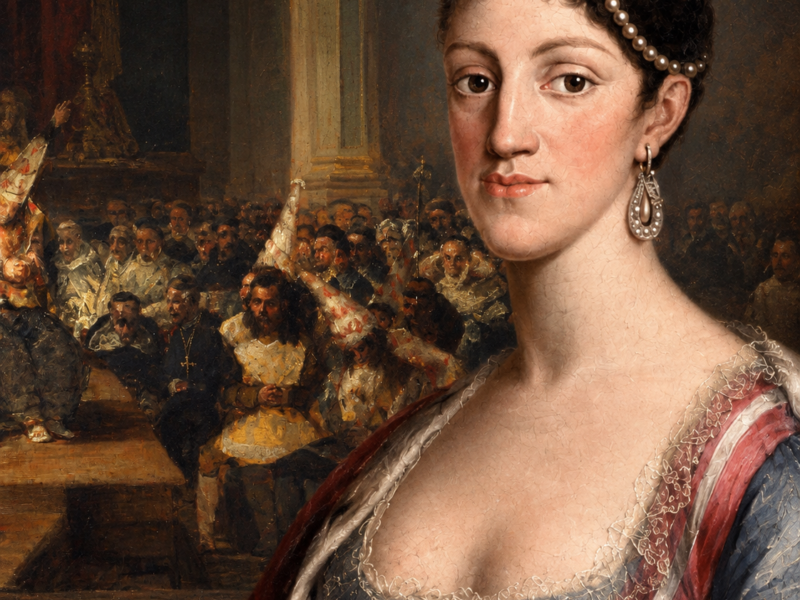
The Ugliest Queen in History | Carlota Joaquina of Spain
In the winter of 1807, as Napoleon’s army swept through Portugal, the royal court fled across the Atlantic to Brazil. For the Portuguese monarchy, it was a humiliating retreat. For one ambitious princess, it was the opportunity of a lifetime.
Her critics branded her a monster. They ridiculed her appearance and feared her relentless ambition. Carlota Joaquina earned a reputation as one of the most infamous and hated queens in European history.
Carlota Joaquina of Spain was born on April 25, 1775. She was the eldest surviving child of the future King Charles IV of Spain, who took the throne in 1788. An earlier son, Charles, had died before she was born.
Her mother, Maria Luisa of Parma, was still quite young at the time, but the years that followed brought a run of family tragedies. She gave birth to several healthy daughters, yet each of her later sons died in infancy. That raised real worries about the succession, and for much of her childhood, Carlota was in line to the throne.
A healthy son, Ferdinand, finally arrived in 1784, when Carlota was nine. Perhaps her early awareness of her place in the line of succession awakened a craving for power that would shape her later life.
Growing up, she received a strict education from Roman Catholic tutors, built around subjects considered suitable for a female royal. It included history, geography and languages, alongside painting, sewing and writing. She emerged exceptionally well educated and intelligent, though none of it suppressed the mischievous, playful personality she was often remembered for.
Behind the palace walls, family life was far from stable. Her mother was a domineering presence at court, and rumors even circulated of an affair with the head of the Spanish government, Manuel Godoy. That made her a vilified figure in Spanish society, and some of Carlota’s own poor reputation later on was the product of being painted with the same brush.
Spain had also declined rapidly as a power since the middle of the seventeenth century. It still held a vast colonial empire in the Americas, stretching from California and Cuba south to Chile and Argentina. Even after Ferdinand’s birth, Carlota remained an important figure as the eldest daughter of the future king, which made her one of the most valuable royal brides in Europe.
In 1785, at just 10 years old, she was married off. It was a shockingly young age even by eighteenth-century standards. It was also only the beginning of a marriage that would slide into scandal, hatred and political intrigue.
Negotiations between the Spanish and Portuguese governments had been under way since the late 1770s for Carlota to marry Dom John, the second in line to the Portuguese throne. His parents, who were uncle and niece, had taken the throne as dual monarchs in 1777, as King Peter III and Queen Maria I. Peter died in 1786, but Maria lived until 1816.
That meant Carlota’s life would be shaped heavily by her relationship with her mother-in-law, the first queen to rule Portugal in her own right.
The agreement was concluded in 1785, and a proxy wedding took place that May, weeks after her tenth birthday. John was 18. Because of her age, it was agreed that the marriage would not be consummated until 1790, when she was considered old enough to conceive and bear children.
Still, only days after the proxy ceremony, the 10-year-old princess was sent to Lisbon with a Spanish entourage. She left her family behind years before her marriage truly began.
She was at the Portuguese court when the politics of the realm shifted. On September 11, 1788, the heir to the throne, her brother-in-law Dom José, died of smallpox. Carlota’s husband became the new heir.
Queen Maria also suffered from depression for much of her later life, and she was declared insane in 1792. John was expected to step in as regent and de facto monarch as early as the 1790s, which made Carlota a kind of unofficial queen consort from a young age. In recognition of their status, the couple held the titles of Prince and Princess of Brazil.
Through the 1790s and 1800s, as she became a more prominent figure at the Portuguese court, Carlota became an object of ridicule and hatred, both among courtiers and in wider Portuguese society. She was seen as a woman grasping for power who didn’t understand the conservative court culture around her.
She had been raised in the far more lavish Spanish court, and she struggled to adapt to Portugal’s deeply religious and austere royal life. Her outspoken personality, her political involvement and her unconventional public behavior for a royal woman fueled gossip and malicious rumors. Widespread anti-Spanish xenophobia made things worse.
She was criticized for her behavior. She was attacked even more viciously for her looks.
During her stay in Lisbon, the French writer Laure Junot, Duchess of Abrantes, left one of the most scathing descriptions of her on record. She wrote of untidy hair, thin purplish lips, uneven teeth and a thick mustache. “I couldn’t convince myself that she was a woman,” she added.
Her husband, Jean-Andoche Junot, echoed the sentiment after arriving at the Portuguese court. He reportedly exclaimed, “how ugly the princess is,” and added that they were all ugly.
The remarks didn’t come only from French observers. Contemporary accounts frequently described Carlota as short, with a face marked by smallpox scars, a prominent aquiline nose and the distinctive Bourbon underbite. Some also noted a slightly stooped posture.
In many ways she was the opposite of eighteenth-century courtly beauty ideals. One particularly cruel later account even claimed she had “the most bizarrely monstrous head” ever to walk the earth.
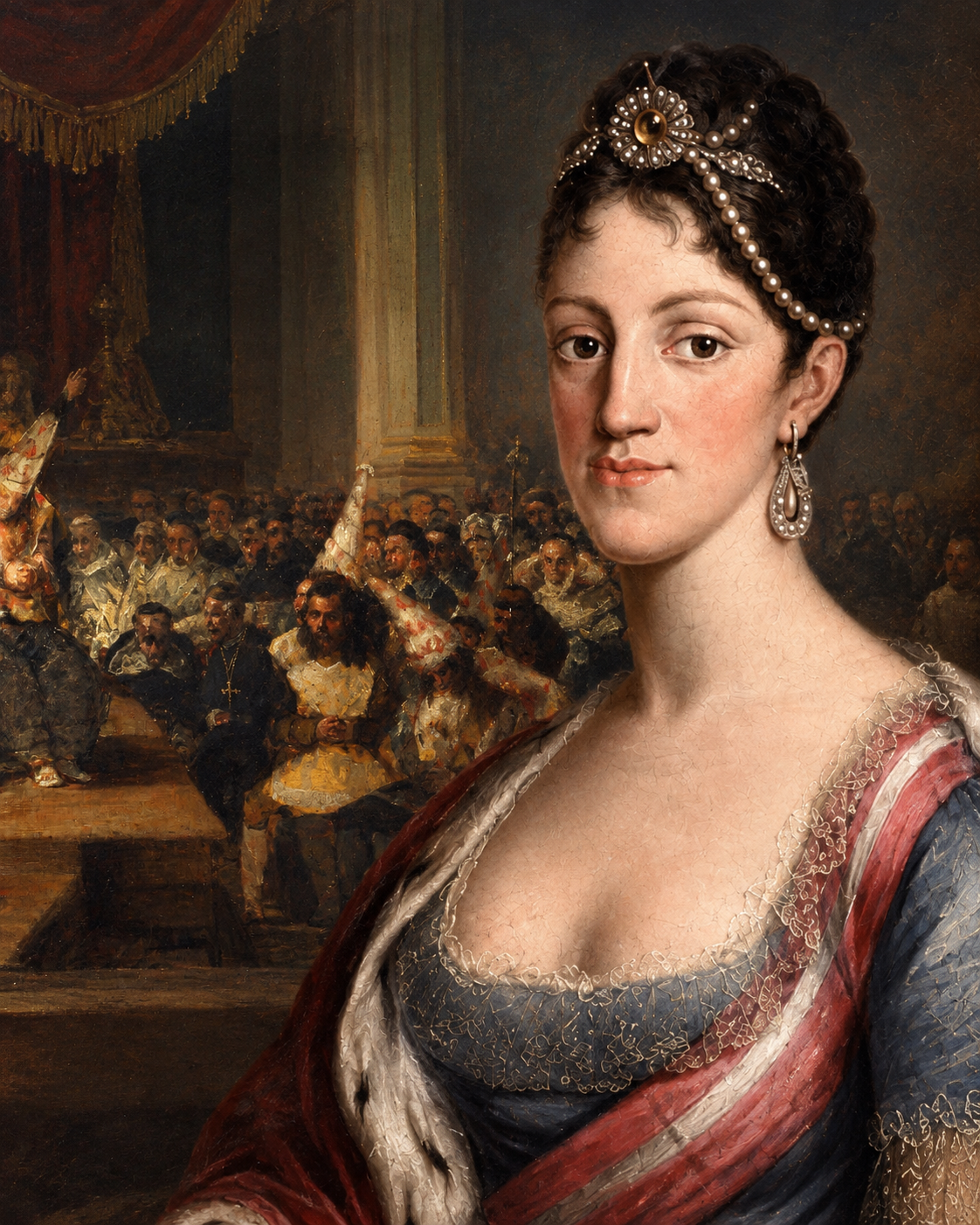
Her public image was only one source of misery. Behind the scenes, her marriage was unhappy too. Their first child, a daughter named Maria Teresa, arrived in 1793. Eight more children followed over the next 13 years, and only one, Francisco António, died young.
Despite the strains on the marriage, Carlota was known to be attentive to her children’s health and welfare. Even her role as a mother, though, was wrapped in scandal. Persistent court rumors claimed that not all her children had been fathered by John, with suspicion falling most heavily on her son Miguel. The claims were never proven. They added to the gossip and hostility that trailed her for life.
The marriage was strained by John’s lack of affection and, even more, by his increasingly erratic behavior. In an age when the ideas of the Enlightenment and the French Revolution were spreading across Europe, he developed an obsessive fear that revolution would reach Portugal. Court rumors even claimed he wandered the palace halls at night in a semi-delirious state.
By the early 1800s the royal marriage had turned into open political warfare. In 1805, when Carlota was 30, she conspired to seize power from her husband, the Prince Regent. She planned to have him arrested and declared unfit to rule, just as his mother had been.
The plot was uncovered, and her co-conspirators were arrested. Carlota avoided prison only because John refused to expose the scandal publicly. Instead he banished her to the palaces of Queluz and Ramalhão while he withdrew to Mafra, effectively ending the marriage. During that exile she earned the infamous nickname “the Shrew of Queluz.”
Her life in Portugal, especially from around 1806, was shaped by wider developments in Western Europe. A few years after her marriage, the French Revolution broke out in 1789. At first it was a moderate revolution aiming at a constitutional monarchy. It gradually grew more radical, and by 1792 it had become a counterrevolution and a pan-European war that pulled in almost every power on the Continent.
Portugal was one of the outliers. For centuries the kingdom had largely tried to stay out of Europe’s endless religious and dynastic wars. It also had a loose alliance with England dating back to the early 1660s, when Catherine of Braganza married King Charles II. Portugal did join the War of the First Coalition against France in 1793, but it never played a major role in the French Revolutionary Wars that followed.
What changed things for Portugal, and for Carlota, was the rise of Napoleon Bonaparte and his conquest of much of continental Europe between the mid-1790s and the mid-1800s. In 1807, fresh from conquering Germany and Poland, Napoleon turned west and invaded Portugal, hoping to fold Iberia more firmly into his empire. A year later he would make his brother Joseph king of Spain.
Before that, Portugal had been overrun. Carlota, along with the rest of the royal court and government, fled across the Atlantic to set up a government in exile in Brazil, Portugal’s vast South American colony.
The voyage in the winter of 1807 was dreadful. A lice infestation aboard the ship forced Carlota to shave her head. The exiles finally reached Rio de Janeiro, where she would spend the next 13 years, among the most turbulent and politically ambitious of her life.
It was in South America that her ambition to rule became clear. Her mother-in-law remained the nominal ruler of Portugal and its empire, but events elsewhere in South America offered Carlota a chance to extend her influence.
Wars of independence broke out across the Spanish colonies after France took over Spain itself. One faction in the Viceroyalty of the Río de la Plata even proposed making Carlota its regent, a movement that became known as Carlotism. It made a certain sense, since she was a daughter of King Charles IV of Spain.
The scheme won the support of the British admiral Sir Sidney Smith. It faced opposition from her own husband, the Portuguese government in exile, Spanish officials and many local elites. Carlota also undermined her own chances by insisting on exercising the powers of an absolute monarch, while many of her supporters had imagined a constitutional figurehead.
The movement collapsed. After the Latin American wars of independence, the United Provinces of the Río de la Plata eventually became the Republic of Argentina.
Her time in Brazil was controversial in other ways. She was said to be disdainful of the people and to drink heavily, and she allegedly took to drinking marijuana tea. She also became the subject of persistent rumors of an affair with a prominent Brazilian businessman. Her defenders argue that much of this was hostile gossip. Her critics say the stories matched what they already knew of her.
Amid the scandal came the moment she had long awaited. On March 20, 1816, Queen Maria I died at 81. At 40, Carlota finally received the title she had waited decades for: queen consort of Portugal.
But after finally gaining the crown, her biggest political battles were still to come.
By the time John and Carlota became king and queen, Portugal had already been liberated. The Portuguese and Spanish, with significant British help, had pushed the French out of the Iberian Peninsula in 1813 and 1814, as Napoleon’s empire collapsed after his ill-judged invasion of Russia in 1812.
Even so, the royal court didn’t move back to Lisbon right away, even after Napoleon’s final defeat in the summer of 1815. The delay came from deep uncertainty about what kind of kingdom would be rebuilt after the Napoleonic Wars.
That uncertainty came to a head with the Liberal Revolution of 1820, when a military uprising demanded a constitutional monarchy and forced the royal family to return to Portugal. They left Brazil on April 26, 1821.
According to the Viscount of Porto Seguro, the emotions of the king and the royal family at leaving Brazil showed in the tears of everyone except the queen. Carlota, who had never enjoyed life in Brazil, was reportedly delighted to go.
One famous story claims that before boarding the ship, she shook the dust from her shoes. She supposedly declared, “I shall not take even the dust of this land.” Whether she said it or not, the line has stuck to her.
Back in Portugal, John accepted the country’s first constitution in 1822, an attempt to end absolutism. It was only minimally successful and was quickly abandoned in 1823. Meanwhile, Brazil split away in 1822 to become an independent empire under Carlota’s son Pedro, removing a colony Portugal had relied on for its wealth throughout the eighteenth century.
The liberal revolution reflected the complex political situation that Carlota, her husband and the rest of the royal establishment were returning to after the Napoleonic Wars. A power struggle followed. Carlota allied with her youngest son, Miguel, to try to take power from her husband.
John briefly became a prisoner in all but name. A British intervention in 1824 led to Miguel’s exile, and John and his supporters regained control of the government. He ruled until his death in March 1826, aged 58.
It was something of a miracle that the marriage lasted until one of them died, given the acrimony. Carlota refused to visit John during his final illness.
His death plunged Portugal into a complex succession crisis. Miguel, the expected heir, was still in exile, while his elder brother Pedro was ruling newly independent Brazil. Pedro briefly claimed the Portuguese throne before abdicating in favor of his young daughter, who became Queen Maria II in May 1826.
Miguel returned in 1828 to claim the crown, with a plan to head off civil war by marrying his niece, Queen Maria. That plan never materialized.
By the time this rapid turnover of rulers was over, Carlota had been pushed to the margins of Portuguese politics. Despite Miguel’s earlier alliance with his mother, he did not recall her to court after he became king in 1828. She spent her later years embittered and estranged from court life, in the countryside outside Lisbon at the Palace of Queluz.
She died on January 7, 1830, aged 54. By then a fresh civil war was under way, and it would end four years later with Miguel’s removal. He lived out the remaining 32 years of his life in exile, and Maria II reclaimed the throne in 1834.
Carlota was first buried in Sintra, then reinterred in 1854 beside her estranged husband in the royal pantheon of the Braganza dynasty in Lisbon.
She had always aspired to greater power. Yet she spent nearly her entire adult life at the heart of one of the world’s largest monarchies, serving as princess regent and then queen of Portugal and its vast empire stretching across Brazil, Africa and Asia.
To her enemies, she was an ugly, scheming, power-hungry foreign queen. To others, she was an intelligent, determined woman who refused to accept the limits placed on royal women of her age.
Perhaps the truth lies somewhere in between. Either way, she remains one of the most fascinating and controversial queens in Iberian history.









