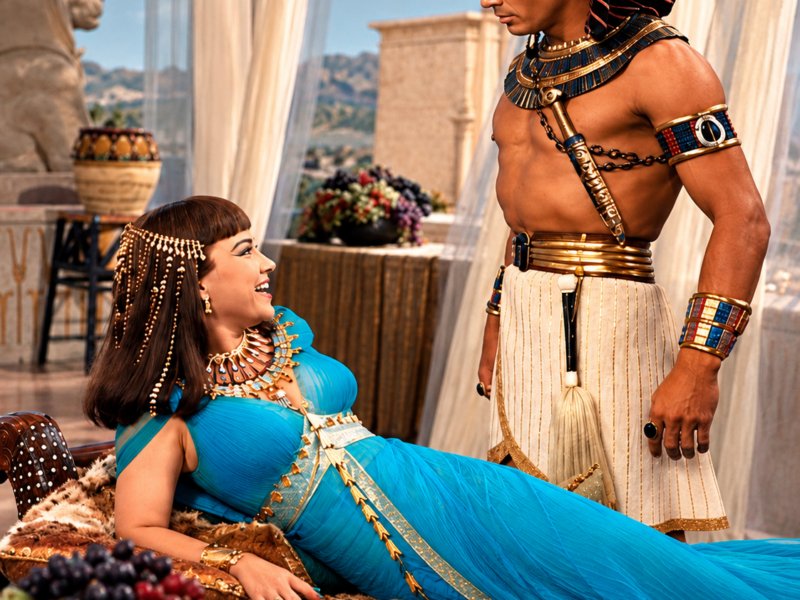
The Ten Commandments (1956): 18 Shocking Facts You Totally Missed
The Red Sea in this movie was 360,000 gallons of water played backwards. Baby Moses was Charlton Heston’s real son, and his basket leaked. The director suffered a heart attack in Egypt, and the whole epic turns out to be a remake of his own silent film.
Those are only the opening cracks in one of the most famous movies ever made. The last surprise on the list is the one that happens every spring in living rooms across America.
It starts in 1922, when Cecil B. DeMille could not decide what his next picture should be. So he asked the public. Through a contest in the Los Angeles Times, he offered a thousand dollars for the best idea.
The winner was F. C. Nelson, a lubricant manufacturer from Lansing, Michigan, who mailed in a single line: “You cannot break The Ten Commandments. They will break you.” Other entrants had suggested the same subject, and DeMille paid them, too.
The result was The Ten Commandments of 1923. Only its first part told the story of Moses, with veteran actor Theodore Roberts as the lawgiver. The rest was a modern drama about two brothers, one who kept the commandments and one who broke them.
It cost roughly a million and a half dollars and used some 2,500 extras and 3,000 animals. Its Red Sea was a slab of gelatin, filmed up close and combined with shots of marching crowds. It became the highest-grossing film of 1923.
When DeMille announced his new project in 1952, it was described as that biblical prologue stretched into a full epic. Two members of his old crew came back for the encore: cinematographer J. Peverell Marley and editor Anne Bauchens, who had cut every DeMille picture since 1918.
Thirty-three years after the first version, the director was telling the same story again. This time it came in widescreen VistaVision and ran nearly four hours.
The coincidences began with the man who would play Moses. Charlton Heston was born on October 4, 1923, in Illinois. Exactly two months later, on December 4, DeMille’s silent Ten Commandments premiered at Grauman’s Egyptian Theatre in Hollywood.
The baby in Illinois had no idea he would one day inherit the role. DeMille looked at plenty of other names, including William Boyd, the cowboy star known to millions as Hopalong Cassidy, along with Kirk Douglas, Rock Hudson, and Jeff Chandler.
Heston had an advantage. DeMille already knew him well, having cast him as the circus boss in The Greatest Show on Earth, which won the Oscar for best picture of 1952.
Another factor, by most accounts, was a statue. DeMille thought Heston looked remarkably like Michelangelo’s marble Moses in Rome, the famous figure with the long beard and the tablets under his arm.
According to the American Film Institute, Heston even stopped in Rome after the Egyptian shoot to be photographed beside it. The comparison followed him for years. In 1965 he played Michelangelo himself in The Agony and the Ecstasy, and his Moses ranks 43rd on the AFI’s list of the greatest heroes in movie history.
Then came one of the most charming stories of the production. Heston and his wife, actress Lydia Clark, were expecting their first child when DeMille made them an offer. If the baby was a boy, he could play the infant Moses.
Heston mentioned the idea in a speech on January 30, 1955. Less than two weeks later, on February 12, Fraser Clark Heston was born. Fraser has said the first telegram his mother received after the birth came from DeMille, confirming the part.
Fraser was three months old when his scenes were filmed. The Nile had been built on the Paramount backlot, and the reed basket turned out to be less than watertight. By the time his father waded out to pick him up, the basket was floating about four inches lower than when it started.
Fraser still tells the story with a laugh, and he has joked that his career could have ended very early. So when the baby drifts toward Pharaoh’s daughter, played by Nina Foch, the infant and the man who grows up to lead the Exodus are father and son. Fraser Heston later became a director and producer himself.
Behind the camera, the story was far less lighthearted. In November 1954, DeMille was 73 years old and filming at Beni Yousef, outside Cairo. To check a special-effects shot, he climbed to the top of the enormous gate built for the Exodus, a structure 107 feet high.
Soon after, he suffered a heart attack. Doctors told him to stay in bed, but DeMille had a different worry. If the studio or its insurance company learned how serious it was, he could be replaced on his own picture.
Fraser Heston has said DeMille kept it quiet and described it as a stomach complaint. Whether the studio ever truly suspected is unclear, but this was the 70th film of a career stretching back to 1914, and he was not about to let it slip away.
Within days he was back behind the camera. He finished the Egyptian location shoot, then spent five more months filming at Paramount in Hollywood, from March to August 1955.
He never fully regained his strength, and The Ten Commandments became the last film he ever directed. Cecil B. DeMille died on January 21, 1959, a little more than two years after the premiere.
The Egyptian chapter of the shoot was staggering in scale. The great Exodus, with the Hebrews pouring out of the city, was filmed on location in Egypt. Contemporary estimates put the crowd at somewhere between 7,000 and 10,000 extras, along with about 5,000 animals, and four VistaVision cameras were shipped over from Hollywood to capture it all.
Directing a crowd that size was a problem of language as much as logistics. The Hollywood Reporter counted 88 assistant directors on the shoot. Only six came from Hollywood, and the other 82 were hired in Egypt to help control the crowds.
DeMille also needed the Egyptian government. He arrived in Cairo on October 6, 1954, and met Colonel Gamal Abdel Nasser the very next day. Egypt supplied about 200 cavalry soldiers with their horses, and in return Paramount produced a short travel film about the country called Ancient Egypt and Modern Egypt.
The main unit began shooting on October 13, and the last day of filming in Egypt was December 3. That is less than two months for many of the scenes audiences remember first.
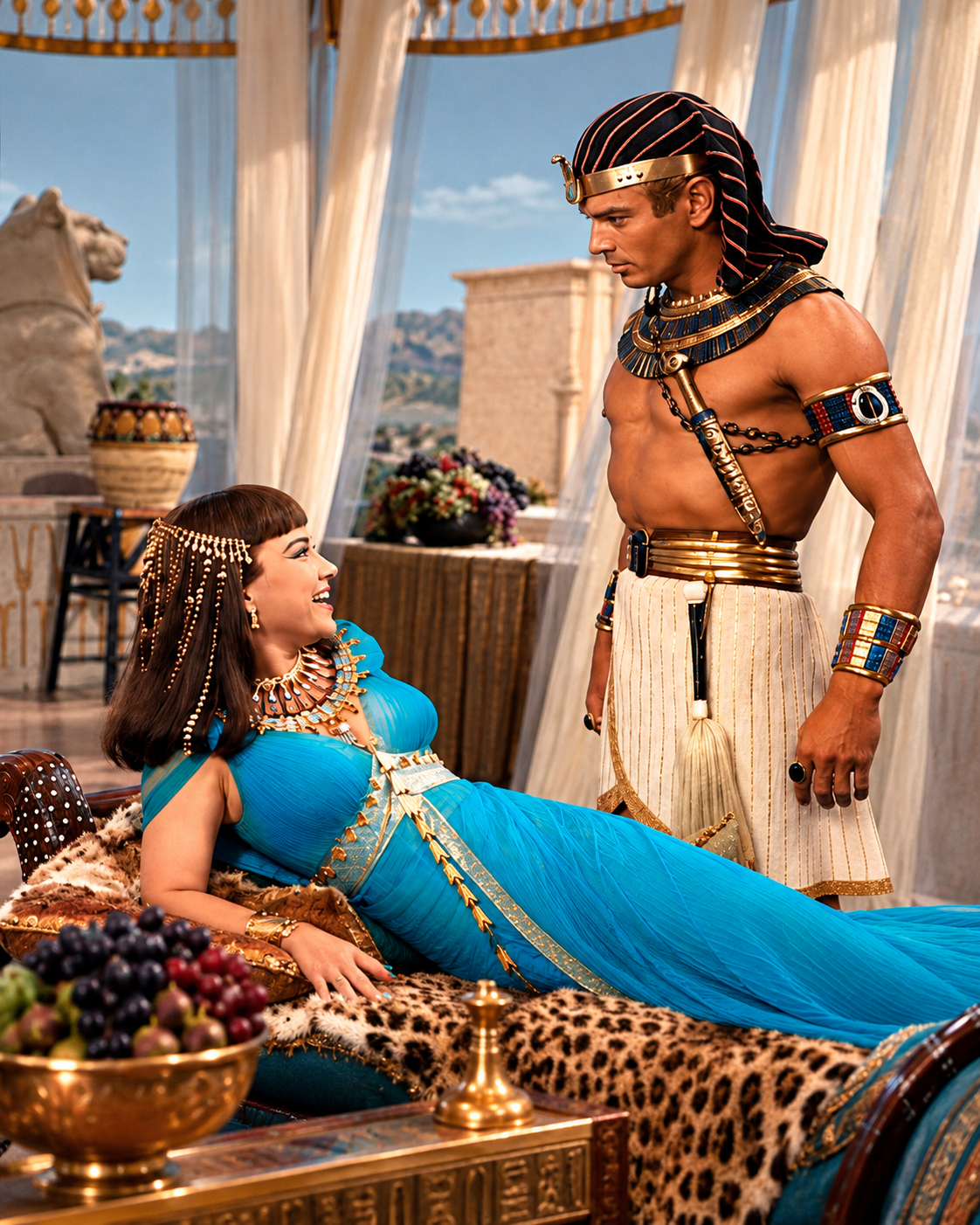
One face in those crowds deserves a second look. Former football star Woody Strode was first hired to play one of the bearers carrying the litter of Pharaoh’s daughter. Then, when the studio could not find an actor for the King of Ethiopia, who arrives bearing gifts for Pharaoh, DeMille gave that part to Strode, too. One actor ended up in two roles at opposite ends of the procession.
The city they built for all of it was just as ambitious. Per Rameses rose from the sand near Cairo and covered about 60 acres. Its centerpiece was the great gate, a pylon 107 feet high and 325 feet long, approached by an avenue of sphinxes.
It was designed by Egyptian architect Anas Seif El Rag Eldine, and the gate alone cost more than $250,000. When filming ended, Egyptian officials made an offer: leave it standing, and they would turn it into a museum. DeMille said no and ordered it demolished.
There is a sad twist to the story. The country that hosted the shoot, lent its cavalry, and held the biggest set of the picture did not get to see the finished film. In December 1959, The New York Times reported that no one in Egypt, then part of the United Arab Republic, had seen it. Pakistan banned it in 1958, and the Soviet Union kept it out, too.
The most famous sequence of all, the parting of the Red Sea, had its own tragedy attached. The man who started work on it never saw it finished. Gordon Jennings, Paramount’s head of special effects and a longtime DeMille collaborator, began preparing the sequence years in advance, but he died of a heart attack on January 11, 1953.
The job went to John P. Fulton, the effects wizard behind the original Invisible Man. His team built a tilted ramp on the Paramount lot, about 32 feet high and 80 feet long, at one-fifth scale. An elevated tank held 360,000 gallons of water, released through 15 hydraulic valves so it poured down the ramp in a thin sheet.
Wooden strips along the ramp broke the flow into choppy waves. Then the footage was run in reverse, so the water seemed to rise up and roll apart.
That was only one layer. Shots from the real Red Sea shore and from Abu Rawash in Egypt were combined with the Hollywood footage, with as many as 12 pieces of film stacked into a single shot and painted rocks hiding the seams. DeMille was demanding even here, and one composite was thrown out because he felt the walls of water were not tall enough.
The price tag depends on who is counting. The Hollywood Reporter put the sequence at $500,000, while Time magazine later claimed more than a million. Of the film’s seven Academy Award nominations, the only win went to Fulton for special effects.
Some of the film’s most striking images came from the most ordinary sources. DeMille wanted the burning bush to look exactly as the King James Bible describes it, “burning but not consumed.” Nothing looked right until his secretary, Doris Turner, bought a novelty clock shaped like a fireplace, with a wavy light glowing over artificial logs.
DeMille showed it to Fulton, who recreated that soft, rippling glow on the bush. Another staff member, Lynn Hayne, looked out a window one day and sketched a cloud that seemed to have fingers. That drawing became the angel of death, the creeping green mist that slides through the streets during the final plague.
For the pillar of fire and the finger of God carving the commandments, Paramount borrowed animators from the Walt Disney studio, including Joshua Meador. The pillar of fire was built from nine shades of color, and three separate drawings were animated for every single frame of the writing of the commandments.
The swirling sparks came from slow-motion footage of burning magnesium. According to the American Film Institute, one of the 35 layers of sound effects on the soundtrack was a recording of an atomic test.
Then there was the question of how God should sound. DeMille called it the greatest single problem in the entire picture. For the burning bush, he found an answer in a Jewish teaching from the Midrash, which says God first spoke to Moses in the voice of his father, Amram, so as not to frighten him.
DeMille’s solution was to use the voice of Moses himself. Charlton Heston recorded the lines, and the sound was slowed down and deepened. Heston later said he had asked DeMille for the part over dinner.
The voice that thunders the commandments on Mount Sinai is a different story. The credits name no one. Over the years several candidates were put forward, among them a bass singer from the Mormon Tabernacle Choir named Jesse Delas Jukes, the actor Guy Prescott, and even DeMille himself.
In 1996, Parade magazine looked into it and concluded that only two men ever knew for certain: DeMille and his sound chief, Loren Rider. Both took the answer to the grave, so each theory remains a claim rather than a proven fact.
DeMille also wanted audiences to know he had not simply made things up. His research chief, Henry Noerdlinger, kept a careful tally. By his count, the team studied 950 books, 984 periodicals, nearly 1,300 clippings, and almost 3,000 photographs.
Four screenwriters spent about three years on the script, and the words of scripture spoken on screen came from the King James Version. The challenge was that the Bible says almost nothing about Moses between his rescue as a baby and his flight into the desert as a grown man.
To fill those years, the writers drew on the ancient historians Philo of Alexandria and Flavius Josephus, on the Midrash, and on three novels, including Dorothy Clarke Wilson’s Prince of Egypt. Critics have long debated how much of the result is scholarship and how much is Hollywood invention, and the film’s defenders and detractors still do not agree.
That is why the original version opens in such an unusual way. Before the credits, DeMille himself walks out from behind a curtain and speaks to the audience for about two minutes. He explains the missing 30 years and the sources, and says the real theme is whether men are to be ruled by God’s law or by the whims of a dictator. Many viewers have never seen it, because ABC’s broadcasts leave it out.
Keeping Moses consistent across a lifetime was its own puzzle. Heston had to play him from a young prince of Egypt to an old man with a white beard coming down from the mountain. DeMille turned to Arnold Friberg, an illustrator he hired after seeing his paintings of scenes from the Book of Mormon.
Friberg spent about three years on the picture as DeMille’s chief artist. Among his work were eight oil portraits of Moses at eight key moments of his life. Makeup chief Wally Westmore used them as guides for Heston’s hair, beard, and makeup in each scene.
For roughly 60 years, those portraits were credited to the makeup artist. Only around 2014 were they recognized as Friberg’s, and today they belong to Brigham Young University.
Friberg also designed the famous robe, dark red with black and white stripes, colors traditionally linked to the tribe of Levi, the tribe of Moses. After filming, DeMille gave the robe to Friberg as a thank-you.
The work earned Friberg an Academy Award nomination as one of the film’s five costume designers. Fifteen of his paintings of scenes from the picture toured the world in 1957 and 1958 and filled the pages of the souvenir program sold in theaters.
The casting of Pharaoh came faster than anything else. Yul Brynner was the very first actor cast. DeMille saw him on Broadway in The King and I, went backstage between the acts, and offered him the role of Ramses II, telling him he was the only person for the part.
His casting was confirmed in October 1953, a full year before the cameras rolled in Egypt. He spends much of the film bare-chested, face to face with the taller Charlton Heston, and with his shaved head and cold stare, he holds his own in every scene they share.
It paid off. 1956 was Brynner’s year, as The King and I, Anastasia, and The Ten Commandments all reached theaters. The National Board of Review named him Best Actor, and a few months later he won the Academy Award for The King and I. His Pharaoh also gave the film its most quoted line, the royal decree that ends “So let it be written, so let it be done.”
Behind other casting choices was a quiet story about Hollywood’s political climate. In the early 1950s, Edward G. Robinson, the tough guy of Little Caesar and Key Largo, found himself on Hollywood’s gray list. His name had been linked to left-wing groups, and he went before the House Un-American Activities Committee more than once.
This was a star who had headlined major pictures since 1931. He was cleared, but the big studios stopped calling, and he was left making small, low-budget pictures.
DeMille was one of the most outspoken anti-communists in Hollywood, yet in September 1954 he cast Robinson as Dathan, the scheming overseer who turns the people against Moses and pushes them toward the golden calf. Robinson never forgot it. In his autobiography, All My Yesterdays, he wrote that DeMille had restored his self-respect.
The role put him back in a major studio picture, and not just any picture, but the top film of 1956.
A similar story unfolded with the film’s music. In the mid-1950s, Elmer Bernstein was in his early 30s, and his career had stalled. He had written a few music reviews for a left-leaning newspaper, and that was enough to put him on the gray list. There was no formal ban, but producers were afraid to hire him.
DeMille brought him in for a modest job: the dance music and the other songs heard on screen. The full score was meant for DeMille’s longtime composer, Victor Young, but Young’s health was failing, and he had to step aside. So DeMille handed the entire score to Bernstein.
Bernstein’s son Peter later wrote that, in the process, DeMille saved his father from the blacklist. Elmer Bernstein went on to score The Magnificent Seven, The Great Escape, and To Kill a Mockingbird, and he won his Oscar for Thoroughly Modern Millie. Victor Young died on November 10, 1956, just two days after The Ten Commandments premiered in New York.
Several famous names came close to joining the cast and did not. Audrey Hepburn was considered for Nefertiri, the Egyptian princess who loves Moses, but the filmmakers decided she was not curvaceous enough for the costumes. Jane Russell was also in the running.
The part went to Anne Baxter after DeMille watched her in a circus picture called Carnival Story three times. Baxter, the granddaughter of architect Frank Lloyd Wright, then spent about eight months in fittings with costume designer Edith Head.
For Zipporah, the shepherd’s daughter who becomes the wife of Moses, DeMille’s first choice was Grace Kelly, who was not available. The role went to Yvonne De Carlo, who eight years later became Lily on The Munsters.
And for Lilia, the water girl, MGM refused to lend Pier Angeli, so DeMille borrowed Debra Paget from 20th Century Fox. Several cast members, including Paget, John Derek, and Nina Foch, wore brown contact lenses to look the part. De Carlo tried them, too, but could not keep them from popping out.
All of this came at a price nobody had paid before. Final cost estimates came to more than $13 million, the most anyone had ever spent on a film up to that time. DeMille himself pointed out that only six pictures in history had grossed that much, and before the release he announced that he would share a quarter of his profits with 50 key members of his team.
He need not have worried. The film opened at the Criterion Theater in New York on November 8, 1956, and stayed there for 70 weeks. It played only in reserved-seat engagements at higher prices, and by April 1957 it had already taken in about $10 million from more than seven million admissions in just 80 theaters.
Neighborhood theaters did not get it until 1958. It was the top film of 1956, and by the end of 1960 it had even passed Gone with the Wind at the North American box office, at least for a while, before Ben-Hur came along.
Paramount kept bringing it back, in 1966, when it earned about $6 million more, and again in 1972 and 1989. Yet on Oscar night, the best picture award went to Around the World in 80 Days.
Remember the 1923 version? For its Exodus, DeMille built an entire Egyptian city on the Guadalupe-Nipomo Dunes on the central coast of California. It had gates about 110 feet tall, four 35-foot statues of Pharaoh, and 21 sphinxes, all put up by some 1,600 workers.
When filming ended, the set was left behind, and the shifting sand slowly swallowed it. Stories spread that DeMille had dynamited it and buried it on purpose. In his autobiography, DeMille joked that if archaeologists dug beneath the sands of Guadalupe a thousand years from now, he hoped they would not announce that ancient Egypt had reached the Pacific coast.
They did not wait a thousand years. A filmmaker named Peter Brosnan went looking for the site in the 1980s, following that very clue. Excavations in 2012 and 2014 brought up a sphinx, and in 2017 archaeologists recovered another sphinx head weighing about 300 pounds. That plaster had spent more than 90 years under the sand.
Brosnan told the whole story in a documentary, The Lost City of Cecil B. DeMille, released in 2016. Today, pieces of DeMille’s first Egypt are on display at the Dunes Center in Guadalupe.
The film’s reach also extended far beyond the screen, and into granite. In 1946, a juvenile court judge in St. Cloud, Minnesota, named E. J. Ruegemer gave a teenager in trouble an unusual sentence: learn the Ten Commandments. It worked so well that, through the Fraternal Order of Eagles, he began sending paper copies of the commandments across the country.
While making the film, DeMille called the judge with a bigger idea: make them permanent, as lasting reminders for young people. Together they settled on granite. It suited the film perfectly. DeMille even had a pair of tablets cut from dark red granite from the slopes of Mount Sinai, and the commandments on screen were lettered in an ancient Canaanite script designed by scholar Ralph Marcus.
In 1956, the Eagles honored DeMille with a replica tablet of Mount Sinai granite of his own. The Eagles paid for the monuments, and Paramount supplied some Hollywood glamour, sending stars from the picture to a few of the dedications. Estimates of how many were put up range from a few hundred to several thousand.
One of them, given to the state of Texas in 1961, stands on the Capitol grounds in Austin. In 2005 it reached the Supreme Court in the case of Van Orden v. Perry, and the justices voted five to four to let it stay. An idea born during the making of a movie had become part of American constitutional history.
And then there is the surprise that hits closest to home. On Sunday night, February 18, 1973, ABC showed The Ten Commandments on network television for the first time. It was not Easter week. It was an ordinary winter night in February, and TV Insider puts the audience that night at about 24 million people.
ABC brought it back the next year and the year after that. Apart from 1999, the network has shown it every single year since, and over time it settled into the season of Passover and Easter. Today it usually airs on the Saturday night before Easter.
With commercials, it runs four hours and 44 minutes, longer than the film itself. DeMille’s curtain speech, the overture, and the intermission music are left out.
Charlton Heston used to tell fans who said they had seen it on television that they had not really seen it. He meant the giant screen it was made for. But for millions of families, that yearly broadcast is exactly how they know it: the parted sea, the burning bush, and the tablets of stone coming back every spring.
On April 4, 2026, the night before Easter and in the film’s 70th anniversary year, ABC aired it once again. About three million people still tuned in, more than for any other program in that time slot.
Cecil B. DeMille never saw a single one of those broadcasts. He told this story twice, 33 years apart, and the second time it became something he never could have planned: a tradition passed from parents to children to grandchildren.
It is a story told twice, with a Red Sea poured backwards, a baby in a leaky basket, and a director who hid a heart attack to finish what he started. Seventy years later, it still comes back every spring, and it still fills the room.









