The Strangest Painting of Jesus
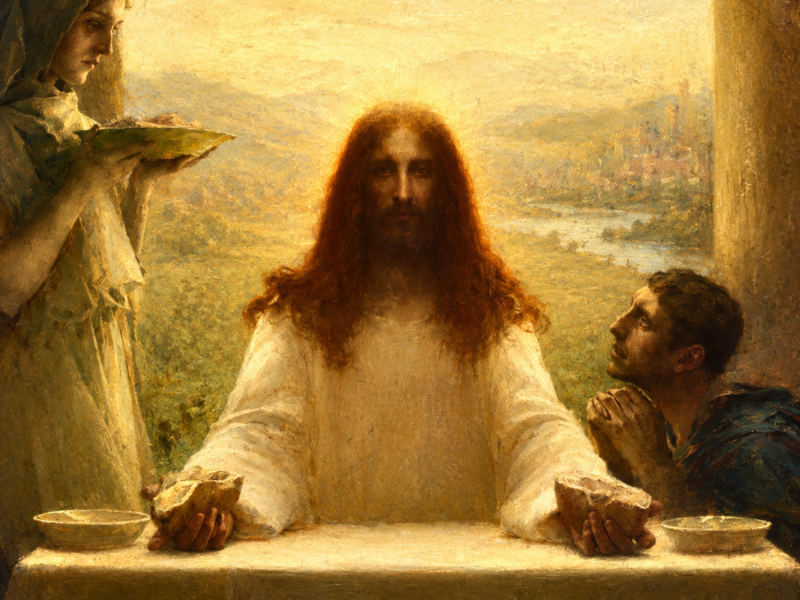
There are thousands of paintings of Jesus in the history of art, but this may be the strangest one of all. Look at his face for a moment.
His gaze is not directed at the bread in his hands. He is not looking at his disciples either. He is looking at us, directly, with dark, fixed eyes that can become quite disturbing.
His face is not painted like the rest of the figures. He appears blurred, wrapped in a luminous haze, with a halo of light burning behind his head, as if we were looking at an apparition.
To the sides, the disciples raise their hands in astonishment. A servant, pale as a statue, stops halfway through her step. And in the right corner, among the shadows, three figures dressed in clothes from another era watch the scene in silence.
Everything in this image feels strange: the light, the figures and, above all, the way Jesus was painted. But once you learn who the people hidden in that corner really are, you begin to understand why some call it the strangest painting of Jesus ever created.
The work is titled Christ and the Disciples at Emmaus. It was painted by the French artist Pascal Dagnan-Bouveret between 1896 and 1897, and today it hangs in the Carnegie Museum of Art in the United States.
The scene captures one of the most mysterious moments in the New Testament. According to the Gospel of Luke, shortly after the crucifixion, two disciples were walking toward a village called Emmaus when a stranger joined them on the road. For hours they walked together, talking about the scriptures and about everything that had happened in Jerusalem.
When they reached Emmaus, they invited the stranger to dinner. It was then that he took the bread, blessed it and revealed himself to them as the risen Jesus. According to the gospel, the instant they recognized him, he vanished from the place.
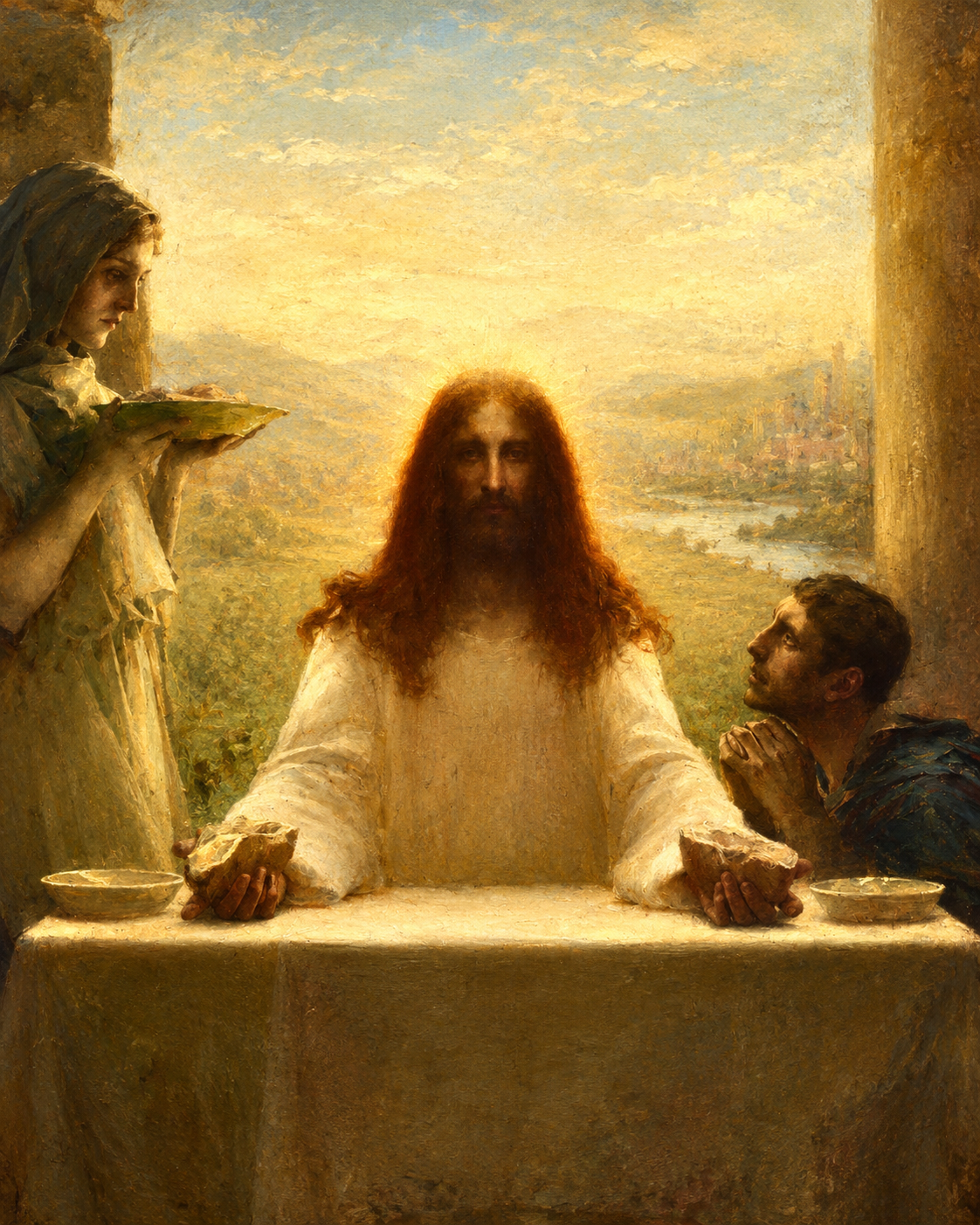
That is most likely the exact moment the artist froze on canvas.
Look at the composition and Christ sits in the exact center. He is seated at the table with the broken bread in his hands, about to bless it. His figure radiates light, and the glow outlines his hair and face against the open landscape behind him.
Historians have pointed to a fascinating technical detail. Dagnan-Bouveret painted the scene looking toward the source of the light, which turns Christ into something close to a luminous apparition, perhaps a nod to the resurrection itself.
That choice is far harder than it looks. Painting against the light normally means everything in front of the source falls into dark silhouette. Yet the artist did the opposite with Christ: the white robe, the face and the hands stay clearly visible, as if the light were coming not from the landscape but from his own body.
The setting sun and the figure of Jesus merge into a single glow, to the point that it is impossible to tell where one ends and the other begins.
Around him, the reactions are divided. One disciple looks at him with astonishment and disbelief, while the other leans toward him, captivated at seeing his master once again. Beside them, the servant of the place stands petrified by what her eyes are seeing.
But the most curious detail is that these three are the only figures the Bible mentions. On the right side of the painting, three completely unknown figures stand watching: a man, a woman and a child, dressed in 19th century clothes.
A preparatory study of the work still survives, and it tells us exactly who they are. They are Pascal Dagnan-Bouveret himself, his wife Anne-Marie and their son Jean.
So the artist painted himself and his entire family as witnesses to the supper at Emmaus. That is why their presence feels so unsettling. We are looking at three people from the Paris of 1896 inserted into an event that took place in Judea 2,000 years ago.
Why would he do such a thing? The answer, at least in part, lies in the life of the artist.
Dagnan-Bouveret was one of the most successful painters in the France of his day. He studied under the great Jean-Léon Gérôme and became famous for peasant scenes painted with an almost photographic level of realism. In fact, he was among the first artists to use photography as a tool for building his compositions.
In the 1890s, curiously, his painting took a radical turn toward the religious. Some historians suggest the influence of his wife, Anne-Marie, a devout Catholic who may have been the driving force behind his decision to place faith at the center of his life and art. It is a plausible theory, though the reasons for such a personal shift are hard to prove.
By painting himself and his family into the scene, the artist was not necessarily breaking tradition on a whim. Experts describe the decision as the personalization of religious experience, the idea that the miracles of the gospel are not distant events from a remote past, but experiences that keep happening for those who have faith.
That reading has an unusual effect on the viewer. Standing in front of the painting, we occupy the same place as the artist’s family, becoming spectators of a miracle that, in the artist’s view, continues to unfold before anyone willing to see it.
Skeptics might say a self-portrait among the witnesses could just as easily be an act of vanity as an act of faith. The painter left no note settling the matter, so both readings remain open.
When the painting was presented, it made a profound impression. To grasp its success, it is enough to look at who bought it.
Henry Clay Frick was the steel magnate of Pittsburgh, a partner of Andrew Carnegie and one of the richest and most demanding art collectors in the world. His collection included works by Rembrandt, Vermeer and Goya. When he saw this painting, he decided it had to be his.
Years later, he donated it to the Carnegie Museum, where it remains to this day.
At that moment, Dagnan-Bouveret was at the top of the art world. He won the medal of honor at the Universal Exposition in Paris, and in 1900 he was elected a member of the Institut de France, the highest honor a French artist could aspire to. His work sold for enormous prices, and his name was mentioned among the great living painters of Europe.
But fate was ironic with him. After his death in 1929, the art world changed completely. The modern avant-garde, impressionism, cubism and everything that followed swept away the academic art he represented.
Twentieth-century critics dismissed his whole generation as outdated and sentimental. Defenders of academic painting have long argued that this verdict was too harsh, pointing to the technical mastery on display in works like this one. Even so, a name that once filled the salons of Paris was practically forgotten.
Today, very few people know this painting, and even fewer know the secret of the family hidden within it. Perhaps that is its greatest paradox: an artist who wanted to paint himself into eternity ended up largely forgotten by history, while the quiet figures in the corner keep watching.









