The Retired Police Dog Who Wouldn’t Let the Puppy Inside
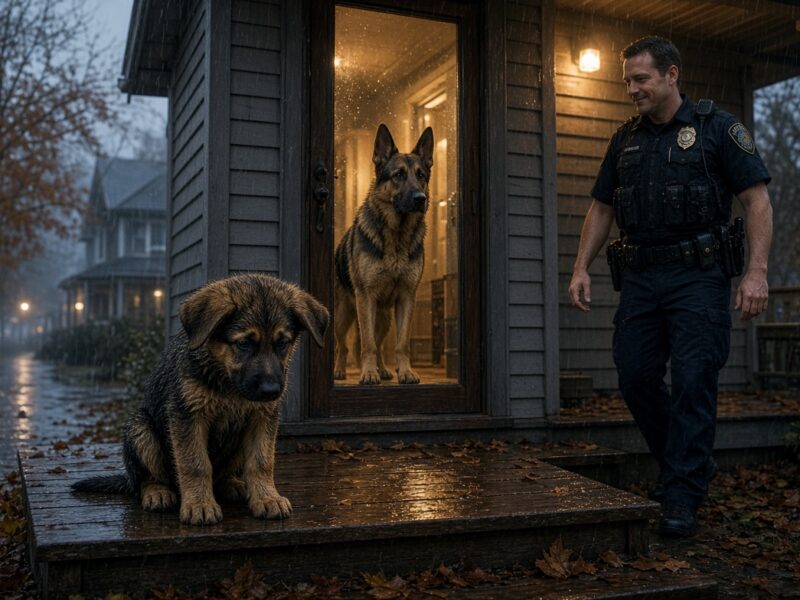
Officer Gabriel Patterson had barely pulled into his driveway when he noticed something strange on the front porch.
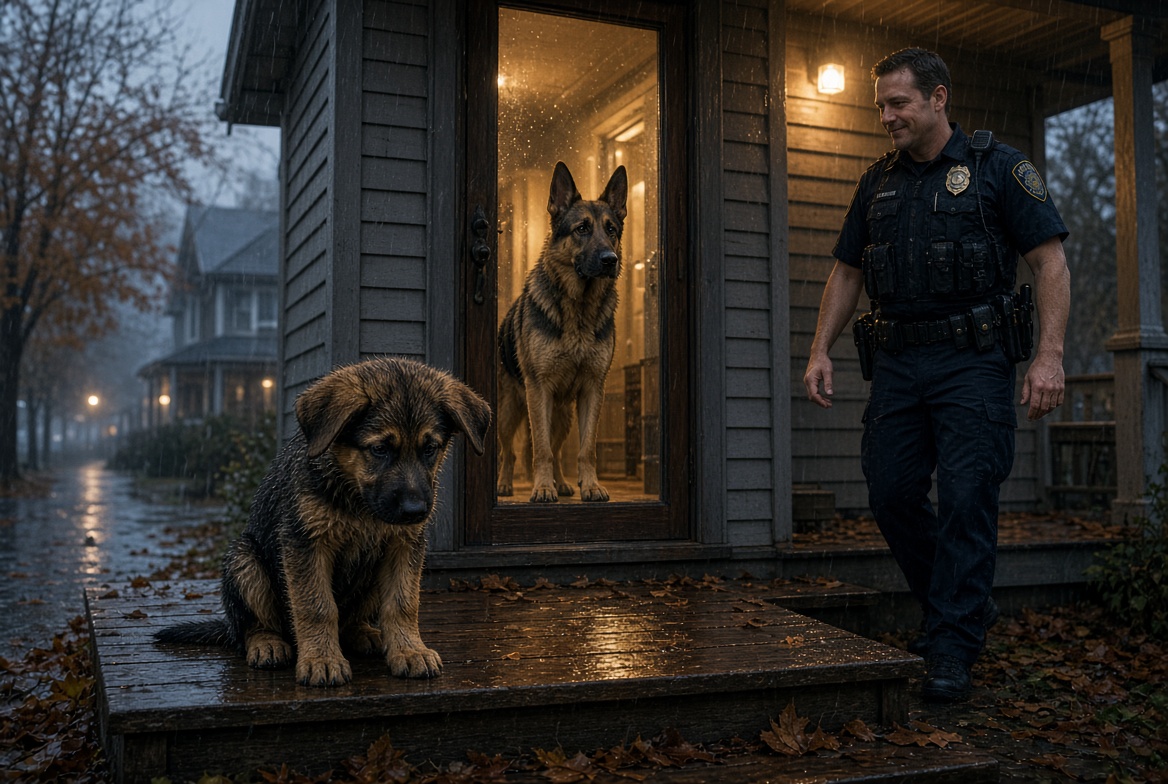
Boomer, his three-month-old German Shepherd puppy, was sitting outside in the cold with muddy paws, drooping ears, and the guilty expression of a child who had just been sent out of class.
Inside the house, Knox, Gabriel’s eight-year-old retired canine, stood behind the glass door, staring straight at him.
Gabriel laughed, climbed the porch steps, and gently scooped the puppy into his arms.
“Come on, little man. What did you do to your buddy this time?”
But when Gabriel tried to carry Boomer inside, Knox quietly stepped into the doorway and refused to move.
No growling. No aggression. Just one old police dog standing his ground.
At first, Gabriel thought Knox was simply tired of the puppy’s endless mischief.
Then he noticed something strange.
Knox wasn’t just blocking the door. He was stopping Boomer from following.
Late autumn had settled over Clamath Falls, Oregon, bringing cold rain, early darkness, and a thin mist that softened the quiet streets beyond downtown.
By the time Officer Gabriel Patterson turned into his neighborhood that evening, porch lights were already reflecting across the wet pavement.
Gabriel was forty-one and had spent most of his adult life in law enforcement.
He had just finished a long patrol shift, and his left knee was stiff from sitting in the cruiser for hours.
The injury had come from a pursuit nearly a year earlier.
It no longer kept him from working, but on cold evenings like this one, it always reminded him that some things healed more slowly than expected.
He pulled into the driveway, shut off the engine, and reached for the small bag on the passenger seat.
Then he looked toward the front porch and stopped.
Boomer, his three-month-old German Shepherd puppy, was sitting alone near the top step.
His front paws were muddy. The fur around his chest was damp, and his ears hung slightly to the sides.
He was not scratching at the door or whining to be let inside.
He simply sat there with his head lowered, looking like a child who had been sent out of class for causing trouble.
Gabriel smiled before he even opened the cruiser door.
Then he noticed Knox.
The eight-year-old German Shepherd stood behind the glass storm door, watching Boomer from inside the house.
Knox had served beside Gabriel as a police canine for nearly seven years before arthritis in his hips forced him into retirement six months earlier.
He could still walk comfortably, trot around the yard, and manage a short burst of speed when necessary, but long pursuits, obstacles, and demanding shifts were no longer safe for him.
Even retired, Knox still carried himself like a working dog, and right now he looked unusually serious.
Gabriel climbed the porch steps.
The moment Boomer saw him, the puppy’s head came up and his tail began sweeping across the wooden boards.
“Well, there you are.”
Gabriel crouched, slipped one arm beneath Boomer’s chest, and lifted him.
“Come on, little man. What did you do to your buddy this time?”
Boomer immediately licked his chin.
Gabriel laughed and reached for the door.
Knox moved sideways.
The older dog placed himself directly across the entrance.
Gabriel stopped.
“Knox.”
Knox looked at him but did not move.
There was no growling, no raised fur, and no sign that he wanted to hurt the puppy.
He simply stood there, calm and firm, as if Gabriel had missed some important part of the situation.
Gabriel lowered Boomer back onto the porch.
The instant his paws touched the boards, the puppy tried to rush inside.
Knox leaned forward and used his shoulder to guide him back.
Boomer blinked, moved to the right, and tried again.
Knox shifted with him. Blocked.
Boomer went left. Blocked again.
Gabriel folded his arms and watched.
“What exactly happened while I was gone?”
He stepped inside alone and made a quick inspection.
The couch cushions were still in place. The trash had not been touched. Nothing had been pulled from the kitchen counter.
Near the back door, however, several muddy paw prints crossed the floor.
That appeared to be the worst of it.
Gabriel returned to the entrance.
Boomer was still outside. Knox was still waiting.
After years of working with the older dog, Gabriel recognized the difference between aggression and discipline.
Knox was not angry. He was waiting for Boomer to do something.
Gabriel pointed toward the porch.
“Boomer, sit.”
The puppy lowered himself, although one back paw slid slightly on the damp wood.
“Wait.”
Boomer looked at Gabriel, then at Knox. His tail kept moving.
Gabriel let several seconds pass.
“Okay.”
Knox immediately stepped away from the doorway.
Boomer trotted inside.
Gabriel closed the door and looked down at his retired partner.
“Were you teaching him?”
Knox turned and walked toward the living room as if the matter required no explanation.
Gabriel shook his head.
Boomer had been part of the household for almost two months.
Gabriel had first seen him near the scene of a minor traffic accident where the frightened puppy had been found without an owner.
Gabriel helped get him to a shelter, then returned three days later, telling himself he would only foster him until someone adopted him.
That plan had quietly disappeared.
Boomer now had beds in more than one room and had already claimed several of Gabriel’s old towels as his own.
More importantly, the house felt different with him in it.
Before the puppy arrived, Knox had spent much of his retirement sleeping near the window or watching Gabriel prepare for work without him.
Neither of them had adjusted easily to the change after so many years together on the canine unit.
Boomer had brought noise back into the house. Sometimes too much noise.
But Gabriel had also noticed Knox moving around more, watching the puppy, following him into the yard, and occasionally correcting him when his excitement took over.
That evening, Gabriel saw it happen again.
He placed the dogs’ food bowls on the floor.
Boomer rushed forward.
Knox stepped into his path, then calmly sat.
The puppy stopped. He stared at the bowl, then at Knox.
After a moment, Boomer slowly sat too.
Gabriel waited.
“Okay.”
Both dogs moved forward to eat.
Gabriel leaned against the counter, watching them.
Knox had lived by simple rules for years.
Wait before leaving a vehicle. Wait at a doorway. Stay where you were told until released.
Retirement had changed his daily life. But it had not erased those habits.
Boomer knew almost none of those rules yet. He simply watched Knox.
And apparently, that was enough to start learning.
Later that night, Gabriel sat on the couch finishing a small amount of paperwork.
Knox rested nearby while Boomer slept on the rug, finally exhausted.
Gabriel reached for his police radio to check the next morning’s schedule.
The moment it came to life, Boomer lifted his head.
A second later, he jumped up and moved toward Gabriel.
Knox rose too.
The old canine crossed the room and placed himself between Boomer and the front door.
Boomer tried to move around him. Knox shifted sideways.
The puppy changed direction. Knox blocked him again.
Gabriel lowered the radio.
“Relax, Knox. Nobody’s going anywhere.”
Knox remained in position until the radio went quiet.
Only then did he return to his bed.
Gabriel looked from one dog to the other.
Stopping Boomer at the food bowl made sense. Stopping him at an open doorway made sense too.
But this was different.
Over the next several days, Gabriel began noticing the same pattern whenever his radio sounded.
Knox watched Boomer. When Gabriel picked up the cruiser keys, Knox moved closer to the puppy.
And whenever Gabriel put on his uniform and headed toward the front door, Knox made sure Boomer stayed behind.
With almost everything else, the retired canine was patient.
With this one rule, he never gave Boomer an inch.
And Gabriel was beginning to wonder why.
—
Over the next several days, Gabriel began noticing just how closely Boomer watched Knox.
The puppy seemed to study every movement the older dog made, then tried to repeat it in his own clumsy way.
When Knox walked toward the back door to check the yard, Boomer hurried after him.
When Knox settled beside Gabriel’s chair, Boomer squeezed into whatever space remained, even when there was clearly not enough room for both dogs.
One evening, Gabriel looked down from the couch and found Boomer stretched halfway across Knox’s back, fast asleep, as if the retired canine were simply another piece of furniture.
Knox opened one eye and looked up at Gabriel with a tired expression.
Gabriel smiled. “Your problem now.”
Knox gave a quiet sigh and lowered his head again.
He could easily have moved away, but he did not.
That small moment made Gabriel laugh, but it also showed him how much the relationship between the two dogs had changed.
When Boomer first arrived, Knox tolerated him more than welcomed him.
The puppy was noisy, curious, and almost always in motion.
Knox preferred quiet routines and predictable spaces.
Yet, little by little, the old dog had begun making room for him.
Boomer was also learning.
He no longer charged through every doorway the instant it opened.
He was beginning to wait before meals.
His recall was still inconsistent, but he was improving.
Gabriel could call him from across the yard, and most of the time, Boomer would turn and come back instead of pretending not to hear.
The progress was never perfect.
One afternoon, Gabriel worked with him in the backyard.
“Boomer, stay.”
The puppy sat.
Gabriel took one step backward. Boomer stayed.
Two steps. Still there.
Three steps. Gabriel almost smiled.
Then a dry leaf rolled across the grass.
Boomer forgot everything.
He sprang after it, chased it halfway across the yard, pounced on it, then looked back at Gabriel as if the exercise had somehow been completed successfully.
Knox was lying near the porch.
He lifted his head, watched the entire thing, then rested his chin on his paws again.
Gabriel pointed at the puppy. “Don’t encourage him.”
Knox did not react.
Boomer trotted back proudly with the leaf in his mouth.
Despite moments like that, Gabriel could see small changes almost every day.
Boomer watched Knox before stepping through a door.
He watched him before approaching a food bowl.
If Knox stopped, Boomer often stopped too, even if he did not understand why.
Gabriel did not try to turn those habits into anything complicated.
He simply reinforced them when they appeared.
Every evening after dinner, he spent fifteen or twenty minutes working on basic commands with Boomer.
Sit, stay, come, wait. Nothing more advanced than that.
Knox usually rested nearby. Sometimes he watched, sometimes he slept.
Gabriel found himself enjoying those sessions more than he expected.
They were quieter than the canine training he had once known.
There were no obstacle courses, no long tracking exercises, and no pressure to meet performance standards.
Boomer was simply a puppy learning how to live in a home.
That was enough.
One morning, however, Gabriel heard a crash from the small storage room beside the laundry area.
He immediately stood up.
“Boomer.”
Another thump followed.
Gabriel walked in and stopped at the doorway.
An old K-9 harness was lying partly on the floor.
Boomer had apparently pulled it from the lower shelf and somehow managed to get one of the straps around his head.
The puppy backed up. The harness moved with him.
Boomer backed up faster. He bumped into a laundry basket, stumbled over the edge, and fell onto his side.
Gabriel covered his mouth, but it did not help.
He started laughing.
Boomer twisted around, trying to understand why the strange object refused to let him go.
Knox appeared behind Gabriel.
The older dog looked at the harness, then at Boomer, then at Gabriel.
Gabriel leaned against the door frame. “I know. Disrespectful.”
Knox stepped into the room.
Boomer finally managed to pull his head free and immediately ran toward him, tail wagging as if he had just completed some difficult assignment.
Knox sniffed the top of his head.
Then he turned and walked away.
Gabriel picked up the harness and returned it to the shelf.
For a moment, his hand remained on it.
That piece of equipment had once been part of almost every workday.
Gabriel had fastened it onto Knox before searches, patrols, and long nights when neither of them knew exactly what the shift would bring.
Now it sat unused in a storage room.
Gabriel closed the cabinet door and followed the dogs back into the house.
That afternoon, Officer Pamela Baker stopped by to drop off several forms Gabriel had left at the station.
Pamela was thirty-nine, a patrol officer who had worked with Gabriel for several years and had known Knox throughout much of his canine career.
She was practical, observant, and one of the few people who could tease Gabriel without irritating him.
Boomer was sitting beside Knox when she entered.
Pamela looked down at them. “Well, that’s new.”
Gabriel took the folder from her. “What is?”
She pointed toward the dogs. “Looks like Knox got himself a rookie.”
Gabriel laughed. “Worst rookie in Oregon.”
Boomer stood up immediately at the sound of his voice, then sat again when he noticed Knox had not moved.
Pamela watched him. “Maybe not the worst.”
Gabriel glanced at Knox. Pamela did too.
Then her expression softened.
“Knox still looks happier than he did six months ago.”
The comment stayed with Gabriel after she left.
He had noticed the change himself but had avoided thinking too much about it.
Since Boomer arrived, Knox spent less time alone by the window.
He moved through the house more often. He followed Gabriel into the yard.
Sometimes he even brought an old toy out when Boomer became particularly determined to play.
None of that made Knox young again.
It did not change his hips or restore the years behind him.
But the house no longer felt like a place where two former partners were quietly waiting for their old routine to return.
That evening, Gabriel sat on the front porch with both dogs.
The rain had stopped, leaving the air cold and clean.
Knox sat beside his chair.
Boomer watched him, then tried to copy the older dog’s upright posture.
He held it for several seconds before one front paw slid forward and he leaned awkwardly to one side.
Gabriel smiled. “Maybe some of you is rubbing off on him.”
Knox turned his head toward him.
At that moment, Gabriel’s police radio came to life at his belt.
Boomer reacted instantly.
He jumped up and moved toward the driveway where Gabriel’s cruiser was parked.
Knox stood.
The change in him was immediate.
He moved in front of Boomer and blocked the path.
Boomer tried to go around him. Knox shifted.
The puppy tried the other side. Knox blocked him again.
Gabriel watched carefully.
This was the same pattern he had noticed at the end of the previous week.
“Boomer, sit.”
The puppy hesitated, then lowered himself.
Knox remained standing between him and the driveway.
Gabriel had to leave for a short call, so he walked to the cruiser and opened the driver’s door.
Knox did not move.
Gabriel looked back. “He’s not coming, Knox.”
The old dog stayed exactly where he was.
Gabriel climbed in and started the engine.
As he pulled away, he checked the rearview mirror.
Boomer was still sitting on the porch. Knox stood in front of him.
The puppy’s eyes followed the cruiser until it turned at the end of the street.
Gabriel kept thinking about the image as he drove.
Knox had been patient with Boomer about almost everything else.
But whenever the radio sounded, the keys came out, or the cruiser became part of the moment, the retired canine changed.
He became focused, firm, unwilling to let the puppy follow.
Gabriel still did not know exactly what was behind that old habit, but he no longer thought it was simply funny.
—
Three days later, a light rain had been falling over Clamath Falls since early afternoon, leaving the neighborhood streets dark and slick beneath a low, gray sky.
Gabriel had been home for less than an hour when his police radio suddenly came to life with a call about a serious traffic accident several miles away.
He had barely finished changing out of his wet outer jacket.
At the sound of the dispatcher’s voice, he reached for the radio, pulled the jacket back on, and headed toward the front door.
Knox lifted his head from the living room rug.
By the time Gabriel reached for his keys, the retired canine was already standing.
For a moment, the old routine returned so naturally that Gabriel almost forgot how much had changed.
Knox moved toward him with the same focused expression he had worn during years of night calls, searches, and hurried departures.
Gabriel rested a hand on his head. “Not tonight, partner.”
Knox stopped.
Boomer stood several feet behind him, watching both of them.
The puppy’s ears lifted when Gabriel opened the front door.
Earlier that afternoon, a delivery driver had brought a package to the side entrance.
He had closed the gate behind him, but the latch had not caught completely.
From the house, nothing looked unusual, and Gabriel had no reason to check it before leaving.
He hurried down the steps and crossed the wet driveway.
Behind him, Knox remained near the porch.
Boomer did not.
The puppy moved toward the side of the house, drawn by the sound of Gabriel opening the cruiser door.
Gabriel climbed in, started the engine, and answered the dispatcher.
The radio filled the cabin with quick instructions as he backed out of the driveway.
Boomer heard the engine, then the radio.
The familiar combination was enough.
He ran toward the side gate and pushed against it with his chest.
The gate swung open.
Gabriel had just turned toward the end of the block when movement in the rearview mirror caught his attention.
At first, he saw only a small shape in the rain.
Then his stomach dropped.
Boomer was running after the cruiser.
“Boomer!”
Gabriel hit the brakes.
The puppy heard his name and lifted his head.
Instead of stopping, he ran faster, apparently convinced that Gabriel was calling him closer.
The distance was not far, barely a few dozen yards from the house, but the residential street crossed another road just ahead.
A pickup truck was approaching from the right.
The driver was moving at a normal neighborhood speed, but the wet pavement would make any sudden stop harder.
Gabriel threw open the cruiser door.
“Boomer, stay!”
The command reached him.
Boomer slowed.
For one brief second, Gabriel thought the puppy might stop completely.
Then Boomer saw him standing beside the cruiser.
His tail lifted. He stepped off the grass.
The pickup was getting closer.
Gabriel started running.
His injured knee protested immediately, but he barely noticed it.
“Boomer!”
Behind the puppy, another shape appeared through the rain.
Knox.
The old German Shepherd had come through the same open gate.
He was not moving with the smooth, powerful speed Gabriel remembered from his working years.
His stride was shorter and less even, but for those few seconds, instinct seemed to carry him forward.
Knox closed the distance.
Boomer took another step toward the roadway.
The pickup driver saw him and hit the brakes.
Tires hissed across the wet pavement.
Knox reached the puppy first.
He came in from the side and drove his shoulder into Boomer’s body, knocking the smaller dog away from the road and onto the soaked grass.
The pickup passed the edge of the crossing, then stopped several yards farther ahead.
Boomer rolled once and scrambled back to his feet.
Knox did not.
His rear legs slipped beneath him on the wet pavement, and his body went down hard.
Gabriel reached them seconds later.
He dropped to his knees beside Knox.
“Hey, easy.”
Boomer stood a few feet away, trembling, his fur darkened by rain.
He had a shallow scrape along one front leg but was otherwise standing normally.
Knox tried to rise. His front legs pushed against the ground, his hindquarters lifted halfway, then collapsed again.
Gabriel felt fear move through him faster than the cold.
“Don’t stay down.”
The pickup driver, a man in his fifties who had already stepped out of his vehicle, offered to help.
Together, they kept traffic away while Gabriel carefully moved Knox onto a blanket from the cruiser.
Within minutes, Gabriel was heading toward the nearest veterinary clinic with Knox lying behind him and Boomer pressed into the corner of the back seat.
The clinic was still open when they arrived.
Dr. Helen Mitchell, a fifty-two-year-old veterinarian who had treated retired working dogs for many years, examined Knox while a technician cleaned Boomer’s small scrape.
Gabriel stood near the exam table, watching every movement.
Helen checked Knox’s hips and rear legs, then ordered X-rays.
The waiting felt longer than it was.
Boomer sat beside Gabriel’s chair, unusually quiet.
When Helen returned, she placed the images on a screen.
“There’s no fracture.”
Gabriel released a breath he had not realized he was holding.
“And Boomer? Mostly frightened. A few superficial scrapes. He was lucky.”
Gabriel looked back at Knox.
Helen pointed toward the area around the older dog’s hip.
“The problem is here. He already has degeneration in the joint, and that sprint put a lot of stress on the muscles around it. He strained the area badly.”
“Will he walk?”
“Yes.”
The answer came quickly enough to calm him.
But Helen did not stop there.
“He needs rest, pain medication, and very limited activity for a while. He can still have a good life, Gabriel. He just can’t keep asking his body to do what it did years ago.”
Gabriel looked at Knox.
The old dog was awake, watching him.
Helen softened her voice.
“He can still be a dog. He just can’t keep trying to be the dog he was five years ago.”
The words followed Gabriel all the way home.
He had spent the last several weeks watching Knox correct Boomer whenever the puppy rushed toward a door, a vehicle, or the sound of the radio.
Gabriel had treated some of it as amusing behavior from an old working dog.
Now he understood it differently.
Knox had not known that a pickup would be coming.
He had not predicted an accident.
He was simply following a rule that had been repeated thousands of times during his working life.
Do not rush through an opening. Do not leave without permission. Wait until released.
Boomer had broken that rule once, and Knox had responded with the only thing he had left in that moment.
His body.
That evening, Gabriel spread a thick bed near the living room wall and helped Knox settle onto it.
The medication was already making the old dog drowsy.
Boomer hovered nearby.
For several minutes, he seemed unsure what to do.
Then he disappeared into the hallway and returned carrying a rubber ball.
He placed it in front of Knox.
Nothing happened.
Boomer nudged the ball closer with his nose.
Knox opened his eyes, looked at him for a moment, then closed them again.
The puppy sat beside the ball.
Gabriel watched from across the room.
There was no way Boomer could understand what had happened the way Gabriel did.
He only knew that Knox was not getting up.
Gabriel went through the house before dark and checked every door and every gate twice.
He secured the side latch, moved several training items into storage, and decided that for a while, Boomer’s lessons would be calmer and simpler.
He did not blame the puppy.
Boomer was three months old. Excitement came before judgment.
He did not blame Knox either.
What bothered Gabriel was how much he had enjoyed seeing pieces of their old working life return.
The radio, the commands, Knox becoming alert again, Boomer following along.
For a little while, it had made the house feel like time had moved backward.
But it had not.
That night, Boomer lay several feet from Knox’s bed instead of climbing beside him.
Every few minutes, the puppy lifted his head and looked across the room.
Knox remained asleep.
For the first time since Boomer had arrived, the old dog was no longer able to rise every time the puppy needed to be stopped, guided, or corrected.
Sooner or later, Boomer would have to remember some of those lessons without Knox standing in front of him.
—
The days after the accident moved at a slower pace.
Knox took his medication on schedule, walked only when necessary, and spent most of his time resting on the thick bed near the living room window.
The house was quieter than usual.
Not because Boomer had suddenly become calm, but because the three-month-old puppy seemed confused by the change in the dog he had followed everywhere.
At first, Boomer kept trying to bring the old routine back.
He carried a rubber ball to Knox and dropped it beside his front paws.
When that did not work, he picked up a rope toy and pushed it closer.
Sometimes he stood near the back door and looked over his shoulder, waiting for Knox to get up and follow him into the yard.
Knox usually answered with nothing more than a lifted head or a slow movement of his tail.
Boomer would wait for a few seconds, then try again.
Gabriel watched the pattern repeat for several days.
He could tell the puppy did not understand injury.
Boomer only knew that Knox, who usually got up when he moved, was staying down.
The old dog, who had blocked doors, waited beside food bowls, and quietly corrected him, was suddenly spending most of the day asleep.
Little by little, Boomer stopped trying to pull him into activity.
Instead, he began lying nearby.
Sometimes he curled up a few feet from Knox’s bed.
Other times, he carried a toy over and chewed it quietly while the older dog slept.
The change was small, but Gabriel noticed it.
He also kept Boomer’s training simple.
Before the accident, it had been easy to enjoy the way the puppy copied Knox.
Gabriel had even wondered how far that natural interest might go.
Now he made a deliberate choice not to turn it into anything more than basic obedience.
There was no old canine harness, no fast drills, no work around the cruiser.
He focused on the things Boomer actually needed.
Wait at the door. Stay when asked. Come when called. Walk beside him without pulling. Settle down when excitement took over.
Boomer still made mistakes.
One morning, Gabriel called him from the kitchen, and the puppy came running so fast that he slid across the floor and bumped into a chair.
Another afternoon, he held a perfect sit until a bird landed on the fence, then forgot Gabriel existed.
Gabriel did not get frustrated.
Boomer was still very young.
What mattered was that he was beginning to pause before acting.
That became clear one cold afternoon about a week after Knox came home from the clinic.
Gabriel was carrying two boxes from the house into the garage.
He had already made several trips, and on the last one, he left the back door slightly open without noticing.
Boomer was in the kitchen.
Knox was asleep on his bed near the window.
Gabriel had just stepped into the garage when movement outside caught Boomer’s attention.
A squirrel ran along the top of the fence, stopped for half a second, then jumped onto a low branch.
Boomer froze, his ears lifted, his body leaned forward.
The squirrel moved again.
Boomer walked toward the open door.
Gabriel was still several steps away, both hands occupied by the box.
He saw the puppy reach the doorway.
“Boomer.”
The puppy did not turn.
One front paw crossed the threshold.
Gabriel shifted the box, trying to free one hand.
Before he could move closer, Boomer stopped.
The squirrel was still there. The yard was open.
Nothing physically stood in his way.
For several seconds, Boomer stared outside.
Then he looked back into the house.
His eyes found Knox.
The older dog was asleep.
Knox did not lift his head. He did not stand. He did not move toward the doorway.
Boomer looked outside again.
Gabriel stayed still.
The puppy slowly brought his front paw back inside.
Then he lowered himself into a sit.
Gabriel set the box down.
He did not speak immediately.
For a moment, he simply looked at Boomer sitting beside the open door, then at Knox sleeping across the room.
The old dog had not corrected him.
He had not needed to.
The rule was beginning to remain even when Knox was not standing there to enforce it.
Gabriel walked over and closed the door.
“Good boy.”
Boomer looked up at him, tail tapping against the floor.
That evening, Gabriel thought about the moment more than he expected.
For years, he had measured progress through performance.
Faster response. Better control. Cleaner execution.
Working with Knox had taught him to notice precision because precision mattered.
Boomer was different.
The puppy’s progress came in smaller forms.
A pause. A choice. A moment of remembering.
Gabriel began to realize that not everything valuable had to look impressive.
That thought followed him into his own life as well.
Since leaving the canine unit, he had spent too much time comparing ordinary patrol work with the years he had spent beside Knox.
A traffic stop felt smaller than a search.
Paperwork felt dull after years of responding to calls where Knox had a clear job to do.
His injured knee only made the comparison worse.
On days when it hurt, Gabriel used to hide the limp as much as possible.
He avoided asking for help unless he absolutely needed it.
That began to change.
If his knee became stiff during a shift, he slowed down instead of pretending it did not matter.
If another officer was closer to a physical call, he let them take the lead.
When he needed backup, he asked for it without treating the request like some kind of failure.
Knox was not the only one learning to live differently.
The following weekend, Gabriel decided to build a small ramp beside the porch steps.
He measured the height, cut the boards, and spent most of Saturday morning putting it together.
It was simple, low, and wide enough for Knox to use without putting too much strain on his hips.
When he finished, Gabriel stood looking at it longer than necessary.
Part of him disliked what the ramp represented.
It made Knox’s age visible.
There had been a time when the dog could leap into the back of a cruiser without hesitation.
Now Gabriel was building something to make three porch steps easier.
Knox did not seem bothered by any of that.
Gabriel called him outside.
The old dog walked to the ramp, sniffed it once, then used it on the first try.
Gabriel stared at him. “That’s it?”
Knox continued into the yard.
Boomer, on the other hand, immediately decided the ramp was the most exciting object Gabriel had ever built.
He ran up it, then down, then up again.
By the fourth trip, Gabriel pointed toward the grass.
“That is not for you.”
Boomer stopped halfway down the ramp and looked at him.
Knox was already lying near the porch watching.
For the first time since the accident, Gabriel laughed without feeling guilty about it.
Over the next several days, Knox began moving more comfortably.
He still needed rest, but he was no longer sleeping through most of the day.
Boomer remained energetic, but his energy seemed less careless than before.
The house slowly found a new rhythm. Not the old one. A different one.
Gabriel began to believe the worst part might be behind them.
Then, in the middle of a cold November night, everything changed again.
It was shortly after two in the morning.
The house was dark and quiet.
Boomer was asleep near the sofa when a sharp scraping sound woke him.
His head lifted.
For a moment, he remained still.
Then the sound came again. Nails sliding across the floor.
Boomer stood.
Knox was in the middle of the living room.
The older dog was trying to stand normally, but his body leaned hard to one side.
He took a step. His rear legs shifted beneath him.
He tried another.
Boomer moved closer.
Knox swayed.
Then he fell.
Boomer reached Knox before the older dog could make another attempt to stand.
He circled once, uncertain, then pushed his nose against Knox’s shoulder.
Knox tried to lift himself, but his legs slid beneath him again.
His head remained tilted to one side, and his eyes moved rapidly in a way Boomer had never seen before.
The puppy stepped closer and licked Knox’s muzzle.
Knox gave a low, uncomfortable sound.
Boomer froze.
He had seen Knox tired. He had seen him sore after the accident.
He had watched him sleep through long afternoons while his hip healed.
This was different.
Knox was awake, but his body was not doing what he wanted it to do.
Boomer backed away several inches and stared at him.
Knox tried to shift his weight again. His body leaned sideways.
The puppy moved forward, sniffed his face, then suddenly turned and ran toward the stairs.
Upstairs, Gabriel was asleep behind his closed bedroom door.
Boomer reached the landing and scratched at the wood.
Once. Then again.
Gabriel did not wake.
Boomer scratched harder.
Still nothing.
The puppy began barking.
One sharp bark. Then another.
Gabriel stirred but did not fully wake until the barking became continuous.
He sat up. “Boomer.”
The scratching stopped immediately.
Gabriel swung his feet to the floor and opened the door.
Boomer was waiting on the other side.
The moment he saw Gabriel, he turned and ran down the stairs.
Gabriel frowned. “Boomer? What is it?”
The puppy did not stop.
He reached the bottom, looked back once, then hurried toward the living room.
Something in that movement made Gabriel follow without hesitation.
Then he saw Knox.
The old dog was lying on his side near the center of the room.
Gabriel crossed the distance quickly and dropped to his knees.
“Knox.”
The German Shepherd opened his eyes.
His head lifted, but instead of remaining level, it pulled noticeably toward one side.
Gabriel touched his shoulder. “Easy, partner.”
Knox tried to move.
His paws scraped against the floor, but his balance failed almost immediately.
Gabriel felt a cold rush of fear.
For one terrible moment, the word stroke entered his mind.
He had seen people lose balance that way.
He had seen confusion arrive without warning.
Knox’s strange eye movement only made the fear stronger.
Gabriel forced himself to focus on what he could actually do.
He kept Knox from trying to stand again and reached for the blanket folded over the back of the couch.
Boomer stayed close, pacing several feet away and watching every movement.
Gabriel carefully slid the blanket beneath Knox.
“Come on, old man. I’ve got you.”
Knox was heavy, but Gabriel managed to support most of his weight and guide him toward the front door.
The ramp made the descent easier.
Boomer followed.
Outside, the cold November air hit Gabriel’s face as he opened the rear door of his personal vehicle.
He lifted Knox onto the padded back area as carefully as he could.
Boomer immediately jumped in after him.
Gabriel reached toward the puppy. “No, you stay home.”
Boomer moved farther into the vehicle and looked toward Knox.
For once, he did not bounce or paw at anything.
He simply stood there watching the old dog.
Gabriel paused.
“Fine. Stay back there.”
He shut the door and got behind the wheel.
The drive to the veterinary emergency hospital felt longer than it was.
Gabriel kept checking the mirror.
Knox lay still, his breathing steady, while Boomer remained beside him without touching him.
When they arrived, Gabriel carried Knox inside.
Dr. Helen Mitchell was working the overnight emergency rotation.
She took one look at Knox’s tilted head and unstable posture and brought him into an examination room.
Gabriel stayed close while she checked his eyes, ears, heart rate, and coordination.
Boomer waited near the wall.
Helen asked when the symptoms began.
“A few minutes before I woke up,” Gabriel said. “He was on the floor when Boomer came to get me.”
Helen looked at the puppy briefly, then returned her attention to Knox.
Gabriel swallowed. “Is it a stroke?”
“I can’t tell you that without examining everything carefully,” Helen said. “But there is another condition in older dogs that can look very frightening at first.”
She watched Knox’s eye movement again and gently supported his head.
“The signs fit something called old dog vestibular syndrome. It affects balance. Dogs can suddenly become dizzy, tilt their heads, fall, or have rapid eye movements.”
Gabriel looked at Knox.
“It just happens sometimes. Very suddenly.”
“Is it connected to his hip injury?”
Helen shook her head. “No. This looks separate.”
That answer brought relief and worry at the same time.
Gabriel had spent days wondering if Knox’s earlier injury might lead to something worse.
Now he knew this was different, but that did not make the sight of his partner struggling any easier.
“Will he recover?”
Helen did not answer too quickly.
“Many dogs improve significantly over the next several days or weeks. But Knox is eight, and I don’t want to promise that he’ll return completely to the way he was before tonight.”
Gabriel nodded slowly.
He had heard a similar truth before.
Knox could improve, but improvement was not the same as going backward in time.
Helen kept Knox for observation while Gabriel waited in the hallway.
Boomer lay beneath Gabriel’s chair.
Normally, keeping the puppy still for more than a few minutes required effort.
He would investigate a sound, pull toward a doorway, chew something he should not, or climb halfway into Gabriel’s lap.
That night, he barely moved.
Gabriel looked down at him.
For several minutes, neither of them did anything.
Then Gabriel reached down and rested a hand on the puppy’s head.
“Good job, little man.”
The words came out quietly. There was no teasing behind them.
Boomer looked up.
Gabriel rubbed behind one ear. “You knew something was wrong.”
He did not pretend the puppy understood every word.
Boomer had not diagnosed Knox.
He had not performed some impossible rescue.
He had seen the older dog fall. He had tried to get a response.
Then he had gone looking for the one person in the house who could help.
That was enough.
Several hours later, Helen returned and told Gabriel that Knox was stable.
They could see him briefly before the hospital kept him for continued observation.
Gabriel entered the room with Boomer beside him.
Knox was lying on a low, padded bed, his head still tilted slightly to one side, but his eyes looked calmer than they had at home.
Boomer saw him and started forward.
Gabriel instinctively reached down, ready to stop him from rushing onto the bed.
He did not need to.
Boomer stopped on his own.
The puppy stood several feet away from Knox.
Then he sat.
Gabriel stared at him.
Boomer did not pull forward. He waited.
Knox opened his eyes.
For a moment, the old dog simply looked at the puppy.
Then his tail moved against the bed. A soft tap. Only once.
Gabriel felt something tighten in his throat.
He placed a hand on Boomer’s shoulder.
“Okay.”
Boomer rose.
He approached slowly, sniffed Knox’s face, then lowered himself beside the bed.
He did not climb onto Knox the way he sometimes did at home.
He did not bring him a toy or try to make him stand.
He simply settled close enough for his back to rest lightly against the older dog’s side.
Knox closed his eyes again.
Gabriel sat beside them.
A few weeks earlier, Knox had used his remaining strength to knock Boomer away from a moving pickup.
Tonight there had been no road, no speeding vehicle, and no dramatic act of strength.
Boomer had simply noticed that Knox could not get up.
Then he had gone to find Gabriel.
The older dog had protected the puppy with his body.
The puppy had protected the older dog in the only way he knew how.
By getting help.
And for that night, it was enough.
—
Two months later, winter had settled over Clamath Falls.
A thin layer of snow covered the roofs, lawns, and quiet sidewalks, and the cold mornings often left a silver edge along the porch steps before the sun reached them.
Knox had recovered from the vestibular episode better than Gabriel had dared to hope, though not completely.
The old dog could move around the house on his own again and walk through the yard without assistance, but some changes remained.
When he was tired, his head still tilted slightly to one side.
On especially cold mornings, he sometimes stayed on his bed for several extra minutes before pushing himself upright.
Gabriel no longer rushed him.
The ramp beside the porch had become as ordinary as the front steps.
Knox used it every day without hesitation, and Gabriel had stopped seeing it as proof of something being lost.
It was simply part of the house now, another small adjustment that allowed Knox to move through his days without forcing his body to do more than it could.
Boomer had changed too.
At five months old, he was noticeably larger, though still very much a puppy.
He stole socks whenever Gabriel forgot to close the bedroom door.
He dug holes in places that made no sense.
He once carried an empty paper towel roll through three rooms as if it were the most important object in the house.
Squirrels could still make him forget nearly everything Gabriel had taught him for several seconds at a time.
But beneath all that puppy energy, something steadier was beginning to appear.
Before leaving the house, Boomer stopped at the doorway.
Before meals, he waited.
When Gabriel called from across the yard, the puppy usually came back quickly instead of turning the recall into a game.
None of those behaviors were perfect, but Gabriel no longer expected perfection.
One of the changes he noticed most happened around Knox.
Boomer had once climbed over the older dog, dropped toys onto him, and pushed his nose beneath Knox’s chest whenever he wanted attention.
Now he seemed to sense that Knox moved differently.
When the two dogs crossed the yard together, Boomer often began at his usual quick pace, then slowed when Knox fell behind.
He did not always stay beside him.
Sometimes a smell or a bird still pulled him away, but he came back.
Gabriel noticed it one morning when the three of them walked around the edge of the backyard after a light snowfall.
Boomer rushed toward the fence, nose low to the ground, following some invisible trail.
Knox stayed near Gabriel.
A few seconds later, Boomer looked back.
He saw the distance between them, turned around, and trotted back until he was beside Knox again.
Then he matched the older dog’s pace for several steps.
Gabriel said nothing.
He had learned not to explain every meaningful moment while it was happening.
Sometimes it was better simply to notice.
The house had become quieter in a different way too.
Not empty. Comfortable.
Gabriel still went to work without Knox.
The police radio still sounded.
The cruiser still waited in the driveway.
Those things no longer seemed to create the same tension inside him.
For years, he had understood his work through partnership.
Knox had been beside him during long shifts, difficult searches, and ordinary patrol nights that blurred together until a single call changed everything.
That chapter was over.
Gabriel had spent months resisting that fact, even while knowing it was true.
Now he was beginning to understand that accepting the end of one part of life did not erase its importance.
Knox had already done his work. He did not have to prove anything else.
One afternoon, Pamela stopped by after her shift and found Gabriel working with Boomer in the yard.
The puppy was practicing a simple recall.
Gabriel walked several yards away. “Boomer, here.”
Boomer came running.
For once, he reached Gabriel without being distracted.
Pamela nodded. “That’s better.”
Gabriel handed Boomer a small reward. “Some days.”
Boomer noticed a ball lying near the porch.
He immediately forgot both of them and ran toward it.
Pamela laughed. “Still thinking about testing him for canine someday?”
Gabriel looked at the puppy.
Boomer grabbed the ball, tossed it upward with his mouth, tried to catch it, missed completely, and rolled sideways into a shallow pile of snow.
He came up with snow across his nose and the ball underneath one paw.
Gabriel smiled. “I don’t know.”
Pamela waited.
A few months earlier, Gabriel might have given a longer answer.
He might have talked about Boomer’s drive, his focus, or how much he copied Knox.
Now the question did not feel urgent.
He watched Boomer shake the snow from his fur and run toward Knox.
“He’s got plenty of time to figure out what he is.”
Pamela nodded. “So do you.”
Gabriel glanced at her.
She smiled, then changed the subject.
After she left, Gabriel thought about the exchange only briefly.
For the first time, he did not feel the need to imagine Boomer wearing a canine harness.
The puppy did not need to become Knox.
He did not need to continue a career that belonged to another dog.
What Knox had given him was already showing up in quieter ways.
That was enough.
Several days later, Gabriel returned home near sunset after another cold patrol shift.
A light snow had started falling again.
He turned into the driveway, slowed the cruiser, and looked toward the porch.
Then he started laughing before the engine had even stopped.
Boomer was sitting outside.
His ears hung low, his front paws were covered in dark mud where the snow had melted near the flower beds.
Knox stood behind the glass door.
The scene looked almost exactly like the one Gabriel had come home to months earlier.
He climbed out of the cruiser and walked up the path.
Boomer’s tail immediately began moving.
Gabriel reached the porch and looked down at him.
“Come on, little man. What did you do to your buddy this time?”
Boomer leaned against his leg.
Gabriel looked toward the yard.
One of the large flower pots near the porch had been tipped over.
Soil covered the boards, and a gardening glove lay half buried beside it.
Gabriel stared at the mess, then at Boomer.
“Ah. I see.”
Boomer lowered his head, though his tail kept moving.
Gabriel opened the door.
Months earlier, Boomer would have rushed through the opening before Gabriel could stop him.
This time, he walked toward the threshold, then stopped.
Knox remained inside.
He did not move forward to block the doorway.
Boomer looked at him.
Then, without being told, he sat.
Gabriel felt a slow smile spread across his face.
“Wait.”
Boomer stayed where he was for a few seconds.
None of them moved.
Then Gabriel said, “Okay.”
Boomer stood and entered the house.
Knox turned toward the living room and began walking at his slower, careful pace.
Boomer followed.
At first, he almost passed him.
Then he adjusted and stayed a step behind.
Gabriel remained on the porch for a moment, looking into the warm room.
Knox would never run beside his cruiser again.
Boomer was still young enough to make mistakes every day.
Gabriel still had moments when he missed the old canine years more than he expected.
None of that had disappeared, but neither had what Knox had taught.
It remained in small things.
In a puppy who stopped at an open door.
In the few seconds he waited instead of rushing ahead.
In the way he slowed down when the old dog beside him could no longer move as fast.
Gabriel stepped inside and closed the door against the cold.
Knox continued toward his bed.
Boomer followed him.
They had not returned to the life they once had.
They were building a different one.
And for the first time, Gabriel understood that different did not mean less.
—
The snow continued through the night and into the next morning, blanketing Clamath Falls in a silence that made the small house on Maple Street feel like its own private world.
Gabriel woke before his alarm, a habit he had never been able to break, and lay in bed listening to the quiet.
No scratching at the door. No barking at squirrels. No clatter of a food bowl being nudged across the kitchen floor.
For a moment, he felt a flicker of worry, the kind that had become familiar over the past few months whenever things seemed too calm.
Then he heard it.
A soft, rhythmic thump. Then another.
He smiled and threw back the covers.
Downstairs, he found both dogs in the living room.
Knox was stretched out on his thick bed near the window, his head resting on his paws, his eyes half-closed.
Boomer was lying beside him, his body pressed against the older dog’s side, his tail sweeping lazily across the floor every few seconds.
The thumping Gabriel had heard was Boomer’s tail hitting the baseboard.
“You two look comfortable.”
Boomer’s head lifted at the sound of Gabriel’s voice, but he did not get up.
He simply wagged his tail harder and let out a small, contented sigh.
Knox did not move at all, but his eyes opened and tracked Gabriel as he crossed the room.
Gabriel crouched beside them and ran a hand along Knox’s back.
“How’s the old man this morning?”
Knox’s tail gave a single, slow wag.
“That good, huh?”
Gabriel scratched behind Boomer’s ears, then stood and walked to the kitchen.
He filled the coffee maker, then measured out two bowls of dog food.
When he set them on the floor, Boomer did not rush forward the way he once had.
He waited.
He looked at Knox, who was still on his bed, then back at Gabriel.
“Go ahead,” Gabriel said.
Boomer stood, stretched, and walked calmly to his bowl.
Knox remained where he was.
Gabriel carried a smaller portion over to him on a low plate, along with his morning medication wrapped in a piece of cheese.
The old dog took it gently from his hand, then ate the food without getting up.
“Taking it easy today, partner?”
Knox licked his fingers and settled his head back down.
Gabriel poured himself a cup of coffee and leaned against the counter.
Through the window, he could see the snow still falling, soft and steady.
The street was empty. The neighborhood was quiet.
For the first time in a long time, Gabriel did not feel the urge to check his phone or his radio.
He just stood there, drinking his coffee, watching his dogs, and letting the morning be what it was.
—
The call came in just after ten o’clock.
Gabriel had been home for the morning, a rare stretch of time off that he had planned to spend doing nothing in particular.
He was sitting on the couch with a book he had not opened in weeks when his phone buzzed on the coffee table.
He glanced at the screen.
Dispatch.
He answered.
“Patterson.”
“Officer Patterson, we’ve got a situation over on Cedar Street. A neighbor reported a dog running loose near the elementary school. No collar, no tags. Animal control is tied up on another call. Can you take a look?”
Gabriel glanced at the window.
The snow had stopped, but the streets were still slick.
“I can be there in ten minutes.”
He hung up, set the book aside, and stood.
Boomer immediately perked up, tail wagging.
Knox lifted his head.
Gabriel reached for his jacket.
“Not this time, buddy.”
He said it to both of them, but his eyes were on Knox.
The old dog watched him for a moment, then lowered his head again.
Boomer, however, was already on his feet, dancing toward the door.
Gabriel knelt and caught him gently by the collar.
“No. You stay.”
Boomer’s tail slowed. He looked up at Gabriel with an expression that was almost comically disappointed.
Gabriel laughed.
“Someone has to keep an eye on Knox.”
At the sound of his name, Knox’s ears twitched.
Boomer looked over at the older dog, then back at Gabriel.
Then, slowly, he walked over to Knox’s bed and lay down beside him.
Gabriel stared.
“Well, I’ll be.”
He grabbed his keys and headed for the door.
Before he left, he looked back once more.
Boomer was pressed against Knox’s side, his head resting on the older dog’s back.
Knox’s eyes were closed.
Gabriel closed the door quietly behind him.
—
The call turned out to be exactly what dispatch had described.
A young Labrador mix, no collar, no tags, had been wandering near the elementary school playground.
By the time Gabriel arrived, a teacher had managed to coax the dog into the school’s front office with a handful of treats.
The dog was friendly, well-fed, and clearly someone’s pet.
Gabriel checked for a microchip, found one, and called the number on file.
A relieved owner answered on the second ring.
Twenty minutes later, a tearful woman arrived to collect her dog, thanking Gabriel repeatedly for staying with her until she got there.
“It’s no problem, ma’am. Just glad she’s safe.”
He watched them drive away, then returned to his cruiser.
The whole call had taken less than an hour.
As he pulled back into his own driveway, he found himself thinking about how different this work felt now.
A few years ago, he might have seen a loose dog as a minor annoyance, something to clear quickly so he could get back to more important calls.
Now he understood that even the small things mattered.
That the work was not always about pursuits and searches and high-stakes operations.
Sometimes it was just about being there.
He climbed the porch steps and opened the front door.
Boomer was waiting for him.
Knox was still on his bed, but his head was up, watching the door.
“Missed me?”
Boomer’s tail thumped against the floor.
Gabriel hung up his jacket and walked into the living room.
He sat on the floor between the two dogs, his back against the couch.
Boomer immediately climbed into his lap, which was now a much bigger undertaking than it had been a few months ago.
Knox remained where he was, but he stretched one front paw out until it touched Gabriel’s leg.
Gabriel rested a hand on the old dog’s paw.
For a long time, none of them moved.
The house was warm. The snow was melting outside. The radio was silent.
And for the first time in months, Gabriel felt like he was exactly where he was supposed to be.
—
Christmas came and went, a quiet affair with just Gabriel, the dogs, and a small dinner he cooked for himself.
Pamela stopped by on Christmas Eve with a plate of cookies and a new chew toy for Boomer, which he immediately tried to bury under the couch cushion.
Knox got a new orthopedic bed, which he inspected carefully before curling up on it and falling asleep.
“Best gift ever,” Gabriel said, watching him.
Pamela laughed. “You’re easy to shop for.”
They sat in the kitchen drinking coffee while Boomer raced around the living room with his new toy.
“How’s he doing?” Pamela asked, nodding toward Knox.
“Better. The vestibular stuff seems to have mostly passed. He still tilts his head when he’s tired, but he’s moving around more.”
“And his hip?”
“Good days and bad days. Mostly good, lately.”
Pamela nodded.
She watched Boomer for a moment, then looked back at Gabriel.
“You know, I wasn’t sure about you getting a puppy.”
Gabriel raised an eyebrow. “No?”
“I thought it might be too much. With Knox getting older, with your schedule. I thought maybe you were trying to replace something that couldn’t be replaced.”
Gabriel did not answer immediately.
He looked into the living room, where Boomer had finally settled down and was now lying on the floor, chewing contentedly on his toy.
Knox was asleep on his new bed, his breathing slow and even.
“I wasn’t trying to replace him,” Gabriel said finally. “I just didn’t want the house to be so quiet.”
Pamela nodded. “I get that.”
They sat in comfortable silence for a while.
Then Pamela stood and grabbed her coat.
“I should get going. Early shift tomorrow.”
Gabriel walked her to the door.
“Thanks for the cookies.”
“Don’t eat them all in one night.”
“No promises.”
She laughed and stepped out into the cold.
Gabriel closed the door and turned back to the living room.
Boomer had abandoned his toy and was now standing beside Knox’s bed, looking down at the older dog.
Gabriel watched, curious.
Boomer lowered his head and gently nudged Knox’s ear with his nose.
Knox did not move.
Boomer nudged him again.
This time, Knox’s tail gave a slow, sleepy wag.
Boomer’s tail wagged back, and he lay down beside the bed, his body pressed against its side.
Gabriel smiled.
“Good boys. Both of you.”
—
January brought a cold snap that kept most of Clamath Falls indoors.
The streets were quiet. The schools closed for two days. Even the police station ran on a skeleton crew.
Gabriel was on light duty due to his knee, which always ached more in the cold.
He spent most of his shifts at a desk, handling paperwork and phone calls, a job he had once dreaded.
Now, he found he did not mind it as much.
It gave him time to think.
And thinking, he was beginning to realize, was not always a bad thing.
One afternoon, he sat at his desk with a stack of files in front of him and a cup of coffee going cold beside his keyboard.
He was supposed to be reviewing incident reports from the past week.
Instead, his mind kept drifting back to the house, to the two dogs waiting for him there.
He thought about Knox.
About the years they had spent together on the canine unit.
About the night calls, the searches, the long hours in the cruiser with nothing but the radio and each other for company.
He thought about the day Knox had officially retired, how the department had given him a small ceremony, a plaque, and a bag of his favorite treats.
Knox had not understood what was happening.
He had just been happy to be there, surrounded by people who had known him for years.
Gabriel had understood.
He had known, even then, that something was ending.
He just had not known what would come next.
Now he knew.
Boomer.
Not a replacement. A new chapter.
A different kind of partnership.
Gabriel closed the file he had been pretending to read and reached for his phone.
He pulled up a photo he had taken a few weeks earlier: Knox and Boomer curled up together on the living room floor, Boomer’s head resting on Knox’s back, both of them fast asleep.
He stared at it for a long moment.
Then he set the phone down and went back to work.
—
February arrived with a thaw that turned the snow to slush and filled the air with the smell of wet earth.
Gabriel took both dogs for a walk around the neighborhood, something he had been doing more often as Knox’s strength returned.
They moved slowly, at Knox’s pace.
Boomer ranged ahead on a long leash, sniffing every tree, every mailbox, every patch of grass.
Whenever he got too far, Gabriel called him back.
Most of the time, Boomer came.
Sometimes he did not.
But he was learning.
The walk took twice as long as it would have a few months ago, but Gabriel did not mind.
He had nowhere to be.
The sun was setting, painting the sky in shades of orange and pink.
The air was cold but not bitter.
For the first time in months, Gabriel felt something close to contentment.
They turned the corner onto their street, and Gabriel saw the house up ahead, its porch light glowing warm against the fading day.
He thought about the first time he had come home to find Boomer sitting outside, muddy and guilty, with Knox blocking the door.
He thought about all the moments since then.
The training sessions. The mistakes. The small victories.
The night Knox had fallen. The night Boomer had barked.
The morning Gabriel had woken to find them curled up together.
It had not been an easy few months.
But it had been worth it.
They reached the porch, and Gabriel unclipped Boomer’s leash.
The puppy—no longer really a puppy, but still young—trotted up the ramp and waited at the door.
Knox followed more slowly, using the ramp with the ease of long practice.
Gabriel climbed the steps and opened the door.
Boomer waited.
He looked at Knox, who had not yet reached the doorway.
Then he sat.
Gabriel watched him.
The rule was there now, even when Knox was not standing in front of him.
Even when no one was watching.
“Good boy.”
Boomer’s tail wagged.
Knox reached the door and walked inside.
Boomer followed a step behind.
Gabriel closed the door and stood in the entryway, listening to the quiet sounds of his home.
The click of claws on hardwood.
The soft sigh of an old dog settling onto his bed.
The thump of a younger tail against the floor.
This was his life now.
Not the one he had planned.
Not the one he had grieved.
Something different.
Something good.
—
The days turned into weeks, and the weeks turned into months.
Spring came to Clamath Falls, bringing with it green grass, longer days, and the first flowers pushing up through the soil.
Gabriel built a small garden bed along the side of the house, more for something to do than for any real love of gardening.
Boomer supervised by digging holes in the freshly turned soil whenever Gabriel was not looking.
Knox supervised from his bed on the porch, his head tilted slightly to one side, watching the younger dog’s antics with what Gabriel could only describe as tolerant amusement.
One afternoon, Gabriel sat on the porch steps with a glass of lemonade, watching the two dogs play in the yard.
Boomer had found a stick and was running circles around Knox, trying to get the older dog to chase him.
Knox, who had not chased anything in months, simply followed the puppy with his eyes, occasionally lifting a paw as if to say he was considering it.
“You’re not going to make it easy for him, are you?”
Knox did not answer, but his tail gave a small wag.
Boomer eventually gave up and flopped down in the grass a few feet away, panting.
Knox rose slowly, walked over to him, and sniffed his head.
Boomer’s tail thumped against the ground.
Gabriel smiled and took a sip of his lemonade.
He thought about the first day he had brought Boomer home, how Knox had barely tolerated the puppy’s presence.
Now, the two of them were inseparable.
Not in the way Gabriel and Knox had once been inseparable.
But in a new way.
A different way.
A way that worked for them.
—
That evening, Gabriel sat on the couch with his laptop open, scrolling through emails he had been ignoring for days.
Most of them were routine: department notices, training schedules, reminders about upcoming meetings.
One caught his eye.
Subject: K-9 Unit Reunion — Save the Date.
Gabriel opened it.
The email was from the head of the canine unit, inviting former handlers and their retired partners to a reunion event at the station.
There would be a barbecue, a chance to catch up with old colleagues, and a small ceremony honoring the dogs who had served.
Gabriel read it twice.
Then he closed the laptop and leaned back on the couch.
Boomer was asleep on the floor, his legs twitching as he chased something in his dreams.
Knox was on his bed, watching Gabriel with half-closed eyes.
“Did you hear that, old man? They’re having a party for you.”
Knox’s tail gave a slow, sleepy wag.
Gabriel looked at the invitation again.
He had not been back to the canine unit since Knox retired.
It had felt too much like visiting a place that no longer belonged to him.
But now, for the first time, he thought maybe it was time.
Time to see the old faces.
Time to remember without it hurting.
Time to bring Knox back for one more day in the sun.
He typed a quick reply.
“Count us in. Patterson and Knox.”
Then he closed the laptop and settled back to watch his dogs sleep.
—
The reunion was held on a warm Saturday in early May.
Gabriel parked the cruiser in the lot behind the station, then walked around to the passenger side to let Knox out.
Boomer stayed home, much to his disappointment, but Gabriel had decided the event would be too much for him.
Too many people. Too many dogs. Too much excitement.
Boomer had sulked at the door when Gabriel left, but Knox had simply waited by the cruiser, ready for whatever came next.
Some habits never faded.
Gabriel clipped a leash to Knox’s collar—not because the old dog needed it, but because the department required it—and together they walked toward the station.
The K-9 unit had set up a small event area in the back lot, with tables of food, a few shade tents, and a roped-off area for the dogs.
Gabriel saw familiar faces everywhere.
Handlers he had worked with. Dogs he had known.
Some of the dogs were still working. Others were retired, like Knox.
Some had been replaced by younger partners.
Gabriel recognized the look on the faces of the handlers who had new dogs—the same mix of pride and grief he had felt when he first started working with Boomer.
He understood it now in a way he had not before.
“Patterson!”
Gabriel turned.
A tall man with gray hair and a broad smile was walking toward him.
“Captain Reynolds.”
They shook hands.
The captain looked down at Knox, who was sitting calmly at Gabriel’s side.
“Look at him. Still got that spark.”
“He’s doing well.”
“I heard about the accident. The hip. And the other thing—the balance issue.”
Gabriel nodded. “He’s recovered. Mostly.”
“But not completely.”
“No. Not completely.”
The captain nodded slowly.
“He was one of the best, you know. Knox. I don’t think I ever told you that.”
Gabriel felt something catch in his throat.
“Thank you, sir.”
“He saved your life more than once, didn’t he?”
“More than I can count.”
The captain crouched and ran a hand along Knox’s back.
The old dog leaned into the touch, his eyes closing.
“He’s earned this.”
Gabriel nodded.
He could not speak.
The captain stood and clapped him on the shoulder.
“Enjoy the day. You both deserve it.”
He walked away, leaving Gabriel alone with Knox.
They stood there for a moment, watching the other handlers and dogs.
Then Gabriel felt a tug on the leash.
Knox was pulling toward the far end of the lot, where a group of retired dogs were lounging in the shade.
“Alright, old man. Lead the way.”
They walked slowly across the pavement, the sun warm on their backs.
Knox greeted the other dogs with a sniff and a tail wag, then settled onto the ground beside them.
Gabriel sat on a nearby bench, watching.
The old dogs did not play. They did not run.
They simply lay there together, in the sun, breathing the same air they had once run through together.
For them, that was enough.
—
The ceremony came at the end of the afternoon.
The captain stood at a podium and read the names of the dogs who had served, both the active and the retired.
When he got to Knox, Gabriel stood.
The captain read a brief summary of Knox’s career: the searches, the arrests, the lives saved.
Then he handed Gabriel a small plaque.
“We honor Knox for his years of service, his courage, and his dedication. He was more than a partner. He was a member of this team.”
Gabriel took the plaque.
His hands were steady, but his throat was tight.
He looked down at Knox, who was sitting at his feet, looking up at him with the same steady gaze he had always had.
“Thank you, sir.”
The crowd applauded.
Gabriel knelt beside Knox and held the plaque where the old dog could see it.
“We did it, partner. We did it.”
Knox’s tail wagged.
Gabriel pressed his forehead to the dog’s.
For a moment, they were the only two creatures in the world.
Then someone called Gabriel’s name, and the moment passed.
He stood, and he and Knox walked off to the side, out of the way.
The ceremony continued.
Gabriel watched the other handlers receive their honors.
He watched the new dogs, the young ones, with their bright eyes and endless energy.
He thought about Boomer, at home, probably running circles in the yard.
He thought about everything that had happened in the past year.
The retirement. The puppy. The accident. The nights in the vet clinic. The slow recovery. The small victories.
He thought about what it meant to be a partner.
Not just in work, but in life.
He thought about Knox, who had protected him for years, and who had spent the last months protecting and teaching a puppy who would never work a day in his life.
He thought about Boomer, who had learned patience, and discipline, and love from an old dog who had no reason to give them.
He thought about himself, and how much he had learned from both of them.
The ceremony ended.
The sun began to set.
Gabriel and Knox walked back to the cruiser.
As they drove home, Gabriel glanced over at the passenger seat.
Knox was lying down, his head on his paws, watching the world go by.
“You did good today, old man.”
Knox’s tail gave a small wag.
“So did you.”
Gabriel reached over and rested a hand on the dog’s back.
They drove in silence, the way they had done a thousand times before.
Only this time, it was not a patrol.
It was just a ride home.
—
When they got back, Gabriel opened the front door and was immediately tackled by Boomer, who had clearly been waiting by the door for hours.
“Easy, easy. I’m happy to see you too.”
Boomer jumped up, licked Gabriel’s face, then ran over to Knox and sniffed him from head to tail, as if checking to make sure he had come back whole.
Knox tolerated the inspection with the patience of a dog who had long ago accepted that this was just part of life now.
Then he walked past Boomer into the living room, climbed onto his bed, and fell asleep.
Boomer watched him go.
Then he trotted over to his own bed and curled up.
Gabriel stood in the doorway, watching both of them.
The house was quiet.
The sun was setting outside the window, casting long shadows across the floor.
He thought about everything the day had meant.
About the old life, and the new one.
About the things he had lost, and the things he had found.
He thought about Knox, who had given him a career.
And about Boomer, who had given him a future.
Neither dog was a replacement for the other.
They were simply different parts of the same story.
Gabriel closed the door, hung up his keys, and walked into the living room.
He sat on the floor between the two beds.
Knox was already asleep.
Boomer lifted his head, then laid it back down, content.
Gabriel reached out and rested one hand on each dog.
The room was warm. The house was quiet.
And for the first time in a long time, Gabriel felt like he was home.
—
Summer arrived, and with it, a new rhythm.
Gabriel worked his shifts, came home to two dogs who greeted him at the door, and spent his evenings in the backyard, watching Boomer run and Knox watch.
The training continued, but it was different now.
Gabriel no longer thought about what Boomer might become.
He focused on what Boomer was: a young dog with a good heart and a lot to learn.
Every day was a small lesson.
Wait at the door. Sit before eating. Come when called. Slow down when the old dog is behind you.
Boomer learned them all, little by little.
Not perfectly. Not quickly. But steadily.
Gabriel learned something too.
He learned to let go of the idea that everything had to be like it was before.
He learned that new could be good, even when it was different.
He learned that love did not have an expiration date.
And he learned that some partnerships never really end.
They just change shape.
One evening in late July, Gabriel sat on the porch with a cold drink and watched the sun go down.
Knox was asleep on his bed inside, enjoying the air conditioning.
Boomer was chasing fireflies in the yard, his tail wagging wildly every time he missed one.
Gabriel laughed.
He thought about the first night he had brought Boomer home.
The puppy had been terrified, hiding under the couch for hours.
Now he was king of the yard, chasing bugs and rolling in the grass without a care in the world.
He thought about Knox.
The old dog had been so patient, so steady, so unwilling to let the puppy rush headlong into danger.
He had taught Boomer everything that mattered.
And in doing so, he had taught Gabriel something too.
That purpose did not disappear with age.
It just found new ways to show itself.
Boomer finally gave up on the fireflies and trotted up the porch steps.
He was panting, his tongue hanging out, his fur covered in grass and dirt.
He flopped down beside Gabriel and rested his head on his knee.
“Good boy.”
Boomer sighed contentedly.
Gabriel rubbed his ears.
“You know, you’re not a puppy anymore.”
Boomer looked up at him.
“You’re going to be a good dog. Maybe even a great one.”
Boomer’s tail wagged.
“Not that it matters. You’re already great to me.”
They sat there together, watching the last of the light fade from the sky.
Inside, Knox slept on.
The house was quiet.
The night was warm.
And for Gabriel, the world was exactly as it should be.
—
The story of Knox and Boomer did not end there, of course.
It continued, the way all stories do, in small moments and quiet days.
There was the morning Boomer brought Gabriel a sock he had stolen, dropping it at his feet with a look of such pride that Gabriel could not bring himself to scold him.
There was the afternoon Knox decided to join Boomer in the yard, moving slowly but steadily, his tail wagging as he sniffed the flowers Gabriel had planted.
There was the evening both dogs fell asleep on the couch while Gabriel watched a movie, their bodies pressed together, their breathing in sync.
There was the day Gabriel realized he had stopped counting the months since Knox’s retirement.
There was the night he woke up to find Boomer standing beside his bed, alert and watchful, and realized the puppy had become a guardian in his own right.
There were good days and bad days.
Days when Knox’s hip bothered him, and he stayed on his bed.
Days when Boomer forgot every command he had ever learned and chased a squirrel across the street.
Days when Gabriel’s knee ached, and he had to ask for help.
Days when the house felt too quiet, and days when it felt too loud.
But through all of it, there was love.
The kind of love that did not need words.
The kind that was shown in small gestures.
A nose pressed against a hand.
A body blocking a doorway.
A tail wagging at the sound of a familiar voice.
The kind of love that lasted.
—
One year after Boomer arrived, Gabriel found himself sitting on the porch on a cool autumn evening, watching the leaves fall.
So much had changed in twelve months.
Knox had slowed down even more. His hip still bothered him on cold days, and his head still tilted when he was tired.
But he was happy.
Gabriel could see it in the way he moved, the way he watched Boomer, the way he settled onto his bed at night with a contented sigh.
Boomer had grown into a strong, handsome dog.
He was still silly. Still excitable. Still prone to chasing squirrels and stealing socks.
But he was also patient, and gentle, and kind.
He watched over Knox the way Knox had once watched over him.
He slowed down when the old dog fell behind.
He waited at doorways.
He came when called.
He was not a police dog.
He never would be.
But he was something better.
He was a good boy.
Gabriel leaned back in his chair and closed his eyes.
The sounds of the evening washed over him: the rustle of leaves, the distant bark of a neighbor’s dog, the soft breathing of two dogs who were exactly where they belonged.
He thought about the journey that had brought him here.
The injury that had ended one chapter of his life.
The puppy that had started another.
The old dog who had bridged the gap.
He thought about the title of the story someone might write about them someday.
The Retired Police Dog Who Wouldn’t Let the Puppy Inside.
It was a good title.
But it was not the whole story.
The whole story was about love, and loss, and learning to live with both.
It was about the things we pass on, even when we think we have nothing left to give.
It was about the difference between a career and a calling.
Between a job and a life.
Between who we think we are and who we actually become.
Gabriel opened his eyes.
The sky was dark now, filled with stars.
Boomer was asleep at his feet.
Knox was asleep on his bed inside.
The house was warm.
The night was quiet.
And Gabriel was home.
He stood, stretched, and called softly to Boomer.
“Come on, little man. Time for bed.”
Boomer rose, yawned, and followed him inside.
Knox did not stir.
Gabriel checked on him, rested a hand on his old friend’s head, then walked upstairs.
Boomer padded behind him.
In the bedroom, Gabriel lay down.
Boomer curled up on the floor beside the bed.
Through the window, Gabriel could see the stars.
He thought about Knox, and Boomer, and himself.
He thought about the past, and the present, and the future.
And then, slowly, he fell asleep.
—
In the morning, Gabriel woke to the sound of rain.
It was a gentle rain, the kind that softened the world and made everything feel quiet.
He lay in bed for a while, listening.
Then he got up and went downstairs.
Knox was still on his bed, his eyes closed.
For a moment, Gabriel felt a flicker of fear.
Then he saw the rise and fall of the old dog’s chest.
Still breathing. Still here.
He crouched beside the bed and rested a hand on Knox’s side.
“Good morning, partner.”
Knox’s eyes opened.
His tail gave a slow wag.
Gabriel smiled.
“Come on. Breakfast.”
He helped Knox to his feet, the way he did every morning now, and together they walked to the kitchen.
Boomer was already there, waiting by his bowl.
He did not rush forward.
He waited.
Gabriel filled both bowls and set them down.
“Okay.”
Both dogs moved forward to eat.
Gabriel poured himself a cup of coffee and leaned against the counter.
The rain continued outside.
The house was warm.
The dogs were happy.
And Gabriel knew, with a certainty that had taken him a long time to find, that everything was going to be alright.
—
The story of Knox and Boomer did not have an end.
It had a beginning, and a middle, and a series of moments that would continue for as long as they were together.
But if it had a lesson, it was this:
That the things we learn from those we love never really leave us.
That the lessons we pass on can outlive us.
That growing older does not mean losing purpose.
That different does not mean less.
And that sometimes, the best thing we can do is to stop trying to be who we were and start being who we are.
Knox had been a police dog.
Now he was a teacher.
Boomer had been a lost puppy.
Now he was a companion.
And Gabriel had been a man grieving the end of one life.
Now he was a man living another.
They had not returned to the life they once had.
They were building a different one.
And for the first time, Gabriel understood that different did not mean less.
It just meant different.
And that was enough.









