The Retired Officer Waited for His Daily Visitor—But When the Old Shepherd Finally Arrived, Something Was Missing
At exactly 3:00 every afternoon, a retired police dog named Chief nosed open the screen door of a weathered cabin above Cumberland Gap, Tennessee.
Then he walked nearly a mile down a gravel road to a dented black mailbox with a faded Tennessee Volunteers sticker peeling off the post.
About forty minutes later, he always came back carrying the same thing, held gently between his teeth.
A handwritten letter.
It came from the daughter Philip Meyers had pushed out of his life a year earlier.
Philip never wrote back.
He never called.
And he never admitted that long before 3:00, he was already watching the clock above the stove.
But Chief seemed to understand what Philip refused to say.
The old German Shepherd would place each envelope on Philip’s knee, then stay right there, watching him, until the letter was finally opened.
Then, one cold December afternoon, Chief came home with nothing in his mouth.
Philip told himself Abigail was probably just busy.
But the next day, the old dog came back empty-mouthed again.
This time, Chief did not walk away.
He simply rested his silvered muzzle on Philip’s knee and looked up at him.
And as Philip stared into those tired brown eyes, the truth he had spent a year hiding from finally broke through.
For the first time, he could no longer pretend he wasn’t afraid.
Afraid the letters had stopped for good.
And even more afraid that he had waited too long to answer them.
Late November had settled over the mountains around Cumberland Gap.
Frost silvered the roadside grass every morning.
The oaks and hickories had nearly lost their leaves, and by the middle of the afternoon, the light was already sliding down behind the ridges like someone quietly closing a door.
At sixty-two, Philip Meyers had been retired from police work long enough that most people in town had stopped asking when he planned to come around.
He had spent nearly three decades in uniform, many of those years working K-9.
Now he lived in a weathered cabin at the end of a narrow mountain road and drove into town only when he needed groceries, gas, or something from the hardware store on Main.
His phone rang often.
He rarely answered it.
Visitors were rare, and Philip seemed perfectly comfortable keeping it that way.
The only one who shared the cabin with him was Chief, a nine-year-old male German Shepherd and Philip’s former partner.
Chief was still a big, steady dog.
But silver had spread across his muzzle like frost on a windshield, and cold mornings made his back leg stiff when he first stood up.
Every afternoon, a few minutes before three, Chief would wake, stretch those aging legs, and walk to the front door.
Then he would turn his head and look at Philip.
That afternoon, Philip sat at the kitchen table with a cup of black coffee going cold beside him.
He saw Chief waiting.
“No,” Philip said.
Chief stayed exactly where he was.
“You’re retired.”
The German Shepherd did not move.
Philip picked up his coffee and took a slow sip, as if that settled the matter.
Chief kept staring.
“You know, retirement is supposed to mean less work.”
Nothing.
“Most dogs your age sleep eighteen hours a day. I read that somewhere.”
Chief’s ears stayed forward.
Philip finally pushed back his chair with a scrape.
“Fine. Go.”
The moment the door opened, Chief stepped out onto the porch and started down the road.
He knew the route by heart.
Past the leaning split-rail fence.
Past the lightning-struck poplar.
Down around the lower bend, where the gravel turned to cracked county blacktop.
Philip had never trained him to make this particular trip.
Somehow, over the months, it had simply become part of their lives, the way sunrise was part of their lives, the way silence was.
Philip closed the door.
For the next several minutes, he found small things to keep his hands busy.
He carried another split log to the woodstove.
He rinsed his coffee cup and set it upside down on the drying rack.
He tightened the loose handle on a kitchen drawer that had been loose for weeks without bothering him once.
At 3:20, he checked the clock.
Then he told himself not to do it again.
By 3:35, he was standing at the front window with his arms crossed.
Chief was getting older, that was all.
The road could be slick after a cold night.
There were deer in those woods, and every so often some kid in a lifted pickup came around the lower bend a little too fast.
A man could worry about plenty of reasonable things.
That was what Philip told himself.
He did not tell himself the other thing.
At last, a familiar dark shape appeared between the bare trees.
Philip’s shoulders came down half an inch.
Chief came up the road at an easy trot, a white envelope held carefully between his teeth, the way he had once carried evidence bags without leaving a single tooth mark.
Philip opened the door before the dog even reached the steps.
“Took you long enough.”
Chief walked right past him as if the remark did not deserve an answer.
The letter came from Abigail Ross, Philip’s thirty-five-year-old daughter, who worked at a family medical clinic down in town.
For months, Abigail had been writing to him regularly.
Philip had never asked her to.
He had also never asked her to stop.
Chief crossed to Philip’s chair and waited until Philip sat down.
Then he placed the envelope on Philip’s knee.
On the front was one word in Abigail’s familiar, slanted handwriting.
Dad.
Philip picked it up and set it on the table.
Chief sat down in front of him.
Philip looked at the dog.
“I’ll get to it.”
Chief waited.
“I said I’ll get to it.”
Chief waited harder, somehow.
Philip sighed through his nose.
“Fine.”
He opened the envelope.
Only then did Chief turn one slow circle and settle down in front of the woodstove.
Philip unfolded the page.
Abigail’s letters rarely held anything important enough to justify a stamp, let alone a dog.
At least, that was what Philip told himself.
That afternoon, she wrote about her SUV.
It had started making a clicking sound every time she turned left.
I can already hear you telling me I should have had someone look at it two weeks ago.
Philip frowned at the page.
“That’s because you should have.”
Chief opened one eye.
Philip kept reading.
Apparently Abigail had finally made an appointment at the repair shop on Cumberland Avenue.
The mechanic had quoted her $640 for a CV axle, and she had nearly fainted in the waiting room.
She insisted the car was not falling apart, as Philip would undoubtedly describe it.
It’s just expressing itself, she wrote.
Philip snorted before he could stop himself.
Near the bottom of the page, she had added one more line.
Is Chief still hiding your socks under the chair? If he is, don’t blame him. He learned from you how to keep things that belong to other people.
Philip lowered the paper and looked toward the woodstove.
Chief had closed his eye again.
“The girl’s getting disrespectful.”
One ear twitched.
Philip tried to keep a straight face.
He didn’t quite manage it.
The small laugh was gone almost as quickly as it came, but he read the rest of the letter slowly instead of folding it away.
When he reached the last line, he stayed there for several seconds.
Nothing dramatic was written there.
Just Abigail saying she hoped the temperature didn’t drop too low that night.
Keep Chief warm, Dad. And yourself.
Philip folded the paper along its original creases.
He didn’t take out a pen.
He didn’t write anything back.
He didn’t know yet that every letter he left unanswered was quietly adding up to a debt he would one day have to count by hand.
That evening, after Chief had eaten and the cabin had gone quiet except for the tick of the stove, Philip carried Abigail’s newest letter into his bedroom.
Beneath a low oak cabinet sat a plain wooden box.
It had once held his service commendations.
He had moved those to the closet months ago to make room.
He opened the lid.
Dozens of envelopes stood inside, arranged by date.
Some were still crisp.
Others had gone soft at the folds from being opened again, and again, and again.
Philip slid the new one in at the end of the row and closed the lid.
His eyes drifted to the small desk beside the window.
A yellow legal pad rested there, next to a small stack of unused envelopes and a book of Forever stamps he had bought at the post office in June and never opened.
Philip stood still for a moment.
Then he sat down.
Chief appeared in the doorway, but did not come in.
Philip picked up a pen.
The blank page waited.
He wrote two words.
Dear Abby,
The pen stopped.
Philip stared at the line.
There were a hundred things he could have written.
He could have told her to get the SUV fixed before the clicking turned into something that cost two grand.
He could have told her that yes, Chief had in fact hidden another sock, a wool one, and that Philip had found it that morning under the recliner with a suspicious damp spot on the heel.
He could have asked whether she was eating real meals or living on vending machine crackers between patients.
Those were the easy things.
Still, his hand didn’t move.
Ten minutes passed.
Then twenty.
Chief quietly crossed the room and sat beside the desk.
Philip noticed.
“Mind your business.”
Chief stayed.
Philip looked at the empty space beneath Dear Abby.
It looked like a road with no one on it.
He closed the legal pad.
Chief’s tail tapped the floorboards once.
Philip pointed toward the hall.
“Don’t start.”
The dog finally got up and walked out.
Philip sat at the desk for another minute before switching off the lamp.
In the dark, the two words he had written were still there, waiting for the rest of the sentence.
The next afternoon, the cabin was quiet again.
Chief slept beside the woodstove.
Philip sat at the kitchen table pretending to read a paperback Western he had already read twice.
At 2:47, he glanced at the clock.
He turned back to the page.
At 2:53, he glanced again.
A few minutes later, Chief opened his eyes.
Philip said nothing.
The old German Shepherd rose, stretched his stiff back legs one at a time, and walked toward the door.
Philip was already standing up to open it.
“Don’t dawdle,” he said.
Chief looked back at him once, the way he used to on a search, as if to say, You’re the one who dawdles.
Then he was gone down the road.
There had been a time when Philip Meyers was not a man who watched his daughter from a distance.
There had been a time when he didn’t need an old dog to carry her words home.
When Abigail was little, he had been the father who got up before sunrise, packed lunches badly, and drove her to school in his patrol car whenever the shift schedule allowed.
On winter mornings, he would lay her little red mittens on the dashboard while the heater blasted.
Abigail would climb into the passenger seat, grab the mittens, and complain they were almost too hot.
Philip always gave her the same answer.
“Better too warm than too cold.”
Back then, she believed her father had an answer for nearly everything.
Philip probably believed it, too.
She wore her hair in a ponytail held by cheap brown plastic clips she bought in packs of twelve at the Dollar General, and she lost them everywhere.
Between the patrol car seats.
Under couch cushions.
In the silverware drawer.
Once, inexplicably, inside one of Philip’s winter boots, which he discovered at 5:00 in the morning with his whole weight on it.
“How,” he had asked the kitchen, holding the crushed clip up to the light, “does a person lose a hair clip inside a boot she has never worn?”
Abigail, eight years old and eating cereal, had shrugged.
“It’s a talent.”
His wife, Doris, had laughed so hard she had to set her coffee down.
Doris Meyers had worked for many years as the front office secretary at the elementary school.
She had the kind of humor that could soften Philip without ever embarrassing him.
She liked to tell people that her husband could stay perfectly calm with three police radios squawking at once.
“But one leaky kitchen faucet,” she would add, “and the man comes apart before breakfast.”
Once, after Philip spent an entire Saturday repairing that faucet and somehow made the leak worse, Doris set a stockpot underneath it and announced to the family that the problem was solved until a professional arrived.
Abigail laughed so hard she nearly dropped her cereal bowl.
Philip stood in the middle of the kitchen holding a pipe wrench, pretending to be deeply offended.
“I had it,” he said.
“You had it,” Doris agreed, “all over the floor.”
Even he laughed eventually.
The cabin used to sound like that.
A radio playing country music by the sink.
Doris calling from another room.
Abigail hunting for a library book she had left somewhere completely obvious.
And later, Chief’s nails clicking across the hardwood as he followed whoever was holding food.
Silence had not always lived there.
It had moved in slowly, one room at a time, the way cold creeps into a house after the fire goes out.
The first change came near the end of Philip’s career.
During a pursuit, he made the call to send a small team into a building after information suggested the suspect inside had been contained.
The information was wrong.
A twenty-eight-year-old patrol officer named Danny Whitaker, four years on the force, was seriously hurt before the situation was brought under control.
Danny survived.
After months of rehab, he came back to a desk assignment in records.
The department reviewed the operation and found no misconduct in Philip’s decision.
Even Danny told him, more than once, that he didn’t blame him.
“Sarge, you made the call anybody would’ve made,” Danny said the first time Philip visited him in the hospital. “The intel was bad. That’s on the intel.”
“I made the call,” Philip said.
“Yeah. And I’d follow you through that door again tomorrow.”
Philip thanked him.
He nodded.
He carried those words home, and he never once believed them.
Before that day, he had trusted his judgment, because thirty years had taught him when to move and when to wait.
After that day, every decision came with a second voice behind it.
What happens if you’re wrong again?
What happens if the next person who gets hurt is someone you can’t live without?
He retired not long after.
For a while, Doris kept the house from changing too much.
She dragged him to church potlucks.
She signed him up to help with the Christmas parade without asking.
She made him laugh when he didn’t want to.
Then illness came into their lives quietly, and it stayed.
Abigail came around more often during those months.
Chief, already near the end of his working years, stopped being just Philip’s K-9 partner and became part of the family.
Some nights Abigail slept on the sofa because she was too worn out to drive home after helping her mother.
Chief would settle on the rug beside her and stay there until morning.
Philip noticed those things.
He rarely spoke about them.
He was better at bringing water, checking the locks, picking up prescriptions from the Walgreens in Middlesboro, and making sure everybody had enough blankets.
Practical things still made sense to him.
There were steps.
There were outcomes.
There was something useful to do with his hands.
Feelings had no steps.
That was the whole problem with them.
Near the end, there was one afternoon when Philip had driven into town, and Abigail sat alone beside her mother’s bed.
Doris was tired that day, her voice thinner than usual, but her mind was clear as creek water.
She looked toward the doorway Philip had walked through an hour earlier.
“Your father has always known how to bring other people home,” she said. “I’m afraid one day he may forget how to come home himself.”
“He’ll be okay, Mom,” Abigail said. “He’s Dad.”
Doris gave her the small, knowing smile she used whenever she thought someone was being hopeful instead of honest.
She reached for Abigail’s hand.
“Abby. Listen to me.”
“I’m listening.”
“If that happens, don’t stop knocking just because he forgets how to open the door.”
Abigail remembered those words long after the room, the pill bottles, and the grocery store carnations on the windowsill had turned into memories.
She would need every one of them.
After Doris was gone, Philip didn’t fall apart.
In some ways, that would have been easier for Abigail to understand.
Instead, he got smaller.
He stopped going places where people might ask how he was holding up.
He let calls ring through to voicemail.
He turned down invitations with polite excuses, and then he stopped bothering with excuses at all.
Abigail kept coming.
She brought casseroles he claimed he didn’t need.
She reminded him about his cardiology checkups.
She invited him to dinner at the diner on Colwyn Avenue, where the pie was good and nobody would make him talk.
Sometimes he let her in.
But the visits kept getting shorter.
Eventually he started telling her over the phone that she didn’t need to make the drive.
“The road’s bad this time of year, Abby.”
“It’s September, Dad.”
“Still.”
Then he stopped answering altogether.
A year before Chief started bringing the letters regularly, Abigail drove up the mountain anyway.
Philip saw her SUV through the front window.
He knew exactly who it was.
Chief knew too.
The dog hurried to the door, tail swinging, then looked back at Philip in confusion when the door stayed shut.
Abigail knocked once.
Then again.
Philip stood in the hallway with one hand pressed flat against the wall, as if the wall were the only thing holding him up.
Nearly an hour passed in pieces.
Soft knocking.
Long stretches of nothing.
Chief pacing back and forth between Philip and the front door, as if he could not understand why two people separated by two inches of pine were acting like they lived in different states.
“Dad,” Abigail said at one point. “I can see your truck. I know you’re in there.”
Philip didn’t answer.
“I brought that chicken and rice thing. The one Mom used to make. It’s probably cold now.”
Silence.
“Dad, please.”
Finally, she spoke loud enough that there was no pretending he couldn’t hear.
“Dad, I’m not coming because I think you’re weak. I’m coming because I still want a father.”
Philip closed his eyes.
His hand found the doorknob.
For one second, it seemed he might turn it.
Instead, he heard himself say, “Then stop wasting your life worrying about mine.”
The words sounded harder once they were out in the air than they had sounded in his head.
Abigail didn’t answer.
He heard her footsteps cross the porch.
Then the car door.
Then the engine turning over.
His hand tightened around the knob.
He turned it halfway.
By the time he opened the door a crack, her taillights were already disappearing into the trees.
On the top step sat a foil-covered casserole dish, still faintly warm.
Chief stood beside him and watched the empty road for a long time.
Philip picked up the dish, went back inside, and closed the door.
He ate every bite of it over the next three days.
He never told her.
Abigail didn’t come back to the porch after that.
She found another way.
The letters started quietly.
At first, it was an accident.
Chief happened to be down near the old mailbox on one of his wandering afternoons when Abigail pulled over there, working up the nerve to try the cabin one more time.
She saw him and got out of the car.
“Hey, buddy. Hey, old man.”
Chief leaned into her the way he always had, his whole weight against her knees.
Abigail crouched in the gravel and held his face in her hands.
“You’re taking care of him, aren’t you?”
Chief licked her chin.
She laughed, and then she cried a little, and then she dug a pen out of her purse and wrote a short note on the back of a pharmacy receipt.
She folded it into an envelope from her glove box.
“Take this home,” she said, and tucked it gently into his mouth. “Go on. Take it to Dad.”
Chief carried it up the mountain like it was the most important thing in the world.
The next day, he went back to the same spot at the same time.
So did she.
Then again the day after that.
Soon, the exchange needed no instructions at all.
Abigail left the letters.
Chief carried them home.
Philip complained about it every single time.
He opened every single one.
One evening, months later, Abigail wrote, Tell Chief I still remember the night after Mom’s funeral. He stayed with me until I finally went inside.
Philip stopped reading.
He remembered that night, too.
After the last casserole had been delivered and the last pickup truck had pulled away, Abigail had sat alone on the front steps in her black dress, unable to make herself stand.
Chief had wandered out holding an old, chewed-up rubber ball.
He set it down beside her shoe.
Then he sat down next to her.
He didn’t paw at her.
He didn’t ask her to throw it.
He simply stayed.
Philip had watched the whole thing through the kitchen window.
He had wanted to go out there.
He had stood with his hand on the screen door for twenty minutes.
He never went.
When Abigail finally stood up, Chief followed her into the house, and Philip stepped back from the window so she wouldn’t know he’d been watching.
Now, all these months later, Philip looked across the room at the same old dog, asleep by the fire.
He folded the letter and said nothing.
But that night, he didn’t sleep much.
A few days later, he drove into town for groceries and found himself turning onto a street that did not lead to the Food City.
He pulled over across from the medical clinic where Abigail worked.
Through the big front windows, he saw her helping an elderly woman into a heavy wool coat.
Abigail said something.
The woman laughed and patted Abigail’s cheek.
Abigail smiled, the same crooked smile she’d had at eight years old with a hair clip hanging loose over one ear.
Philip watched his daughter laugh, and for a moment, the years between the little girl with the too-warm red mittens and the grown woman across the street felt much shorter than he wanted them to.
His hand moved to the door handle.
He sat there with his fingers resting on it.
Go on, he told himself. Walk across the street. Say hello. That’s all. Just hello.
Then a car pulled in behind him and honked, and Philip started the engine.
He drove home without crossing the street.
That night he told Chief he’d forgotten the milk.
Chief looked at him as if he knew exactly what Philip had forgotten, and it wasn’t milk.
Early December brought a sharper cold to Cumberland Gap.
The last brown leaves had been stripped from the trees, and thin patches of frost clung to the shaded parts of the road long after sunrise.
For weeks now, Philip had grown used to hearing Chief rise from beside the woodstove a little before three, stretch his stiff hind legs, and wait at the door.
The routine had become so familiar that Philip rarely stopped to think about how much of his day leaned on it.
Breakfast.
Wood.
A walk to the shed and back.
A sandwich at noon.
And then three o’clock, the one hour of the day that actually meant something.
That changed on a Tuesday.
Chief had been gone longer than usual.
Philip tried to keep himself busy at the kitchen table, but after checking the clock twice in five minutes, he gave up pretending.
By the time forty-five minutes had passed, he was standing on the porch with his Carhartt jacket pulled tight, looking down the mountain road.
At last, Chief appeared between the bare trees.
Philip let out a breath he hadn’t realized he’d been holding.
“There you are.”
The German Shepherd walked steadily toward the cabin, but something looked wrong before Philip could name what it was.
Then Chief came close enough.
There was nothing in his mouth.
Philip glanced past him, down the road, almost expecting an envelope to be lying somewhere back there where the dog had dropped it.
No letter.
Chief climbed the steps and stood beside him.
Philip waited one more second.
Then he opened the door.
“She’s probably busy.”
He said it casually, as if Chief had asked for an explanation.
Inside, the dog lay down by the stove.
Philip went back to his chair, but his eyes kept drifting to the window until the dark swallowed the road completely.
Some silences are just quiet.
Others are an answer.
The next afternoon, Chief left at three, same as always.
Philip did not stand at the window this time.
At least, not right away.
At 3:25, the rural mail carrier’s little white Jeep came crawling up the mountain road, which it only did when there was a package too big for the box.
Philip was on the porch before it stopped.
Marlene Hodge had been driving Route 4 for twenty-two years.
She rolled down her window and held out a slim cardboard mailer.
“Your blood pressure cuff from the pharmacy, Phil. Wouldn’t fit.”
“Thanks.”
He took it.
He didn’t go back inside.
Marlene looked at him over her reading glasses.
“You looking for something else?”
“No.”
“Uh-huh.”
She put the Jeep in reverse, then stopped.
“Your dog’s down at the box. Just sitting there. Been sitting there since I came by.”
Philip’s jaw tightened.
“He does that.”
“I know he does. I’ve seen that girl of yours meet him down there most every afternoon since spring.” Marlene paused. “Haven’t seen her this week, though.”
Philip said nothing.
Marlene had been in the business of people’s mail long enough to know when not to push.
“Well. You take care, Phil.”
“You too, Marlene.”
When Chief came home twenty minutes later, his mouth was empty again.
Philip watched the dog cross the room and lie down.
He picked up his phone from the kitchen counter, woke the screen, and set it back down.
No missed calls.
No messages.
He told himself Abigail had a demanding job.
Long shifts at the clinic.
Flu season.
Errands, bills, the SUV and its $640 axle, a dozen ordinary things that could make a thirty-five-year-old woman forget to write a letter, or two.
He carried the phone into the living room anyway.
He set it face up on the arm of his chair.
He checked it four times before bed.
On the third day, snow started before noon.
It came light at first, fine little flakes drifting between the trees, then thickened enough to whiten the porch railing and pile up along the edges of the road.
At three, Chief stood.
Philip saw the dog hesitate when his back leg straightened.
The cold always made it worse.
“Enough,” Philip said.
Chief looked at the door.
“You’re not going today.”
The dog stayed on his feet.
Philip went back to the book in his lap.
Chief didn’t move.
Several seconds passed.
Philip looked over the top of the page.
“I said no.”
Chief’s ears stayed forward.
Philip sighed and set the book down.
“You’re nine years old. That’s sixty-something in people years. You don’t have to prove anything to anybody.”
Still, the dog waited.
Philip knew that look.
He had seen it in the back of patrol cars, in training yards, in dark parking lots at two in the morning, on long nights when Chief had locked onto something Philip couldn’t see yet.
It was the look that said, I’m right about this, and you’ll figure it out eventually.
Finally, Philip got up and opened the door.
“Fine. But don’t take all afternoon.”
Chief disappeared into the falling snow.
Philip stayed close to the front room after that.
He fed the stove.
He looked out the window.
He walked away.
He came back.
Forty minutes passed.
Then fifty.
At fifty-five, Philip had his boots on and one arm in his jacket.
Then Chief finally appeared, snow dusting his back and his silver muzzle.
He was moving slower than before.
And again, there was no letter.
Philip got the door open fast.
Chief came in, shook the snow off in a spray across the floor, and walked straight to Philip’s chair.
Every other afternoon, this was the moment when an envelope landed gently on Philip’s knee.
This time, Chief had nothing to give him.
So the old German Shepherd stopped between Philip’s boots and simply laid his empty muzzle across Philip’s knee.
Philip looked down.
For a long moment, neither of them moved.
His hand came to rest on the gray fur beside Chief’s ear.
“Yeah,” he said.
Chief stayed.
Philip stroked him slowly, the way he had after bad calls, back when they both still wore a badge.
After a while, much quieter, he added, “I know.”
It was the first time in a year Philip had said out loud that he knew anything at all.
That evening, he carried his phone into the bedroom.
He sat on the edge of the bed for several minutes before he opened Abigail’s contact.
Her name filled the screen.
Abby.
Under it was the photo Doris had set years ago: Abigail at twenty-two in a graduation gown, squinting into the sun, a brown plastic clip holding back her hair.
His thumb hovered over the call button.
He almost put the phone away.
Instead, he pressed it.
The first ring made him sit up straighter.
Then the second.
Then the third.
No answer.
When it rolled toward voicemail, Philip hung up.
He stared at the screen as if the decision had been a practical one.
Ten minutes later, he called again.
This time, he let it ring all the way through to her recorded greeting.
Hi, you’ve reached Abigail. I’m probably with a patient. Leave me a message and I promise I’ll call you back.
The beep came.
Philip opened his mouth.
Nothing came out.
He ended the call and set the phone on the quilt beside him.
Chief was lying across the doorway.
Philip saw the dog watching him.
“Don’t.”
Chief lowered his head onto his paws.
Philip slept badly.
He dreamed about a door he couldn’t find the handle for.
The next morning, he called once more.
This time the call didn’t reach her at all.
The mailbox is full and cannot accept any new messages.
Philip stood in the middle of the kitchen holding the phone long after the automated voice had stopped talking.
He knew there were harmless explanations.
Abigail could be swamped.
She might keep her phone in a locker during shifts.
Her voicemail could be full simply because she hated deleting old messages, which, now that he thought about it, she always had.
She still had voicemails from her mother.
She’d told him so once, in a letter.
I keep them so I can hear her say my name.
Those explanations should have settled him.
They didn’t.
Philip went into the bedroom and pulled the wooden box out from under the cabinet.
He didn’t search at random.
He knew exactly which letter he wanted.
Abigail’s most recent one sat at the very end of the row.
He unfolded it at the kitchen table.
At first, he read the familiar parts.
A short complaint about the weather.
A funny story about a patient who had brought the entire front desk homemade fudge.
A reminder to drip his faucets if the temperature dropped below twenty so the pipes didn’t freeze.
Then he reached the last paragraph.
One sentence stopped him cold.
Dad, sometimes I wonder how long someone can keep speaking when the other person never answers.
Philip read it again.
Then once more.
The page stayed steady in his hands, but something in his face shifted.
Another sentence came back to him, one that had never been written down.
His own voice, through a closed door.
Then stop wasting your life worrying about mine.
At the time, he had told himself Abigail would understand.
He had told himself that distance would get easier once enough time went by.
For the first time, he wondered what those words had sounded like on the other side of the door.
He wondered if she had cried on the drive home.
He already knew she had.
The following afternoon, Chief stood at three.
Philip didn’t stop him.
The dog went out into a cold, colorless day, the old snow packed hard beneath his paws.
A few minutes later, Philip put on his coat.
He followed.
Not close enough for Chief to turn around, but close enough to keep the dog in sight around the bends in the road.
It had been a long time since Philip had tailed anyone.
His knees reminded him of every one of those years.
Chief reached the old black mailbox and sat down beside the post.
Philip stopped farther uphill, behind the trunk of the lightning-struck poplar.
Ten minutes passed.
Chief didn’t move.
Another ten.
Nothing came up the road.
No car slowed.
No familiar figure stepped out near the mailbox.
A school bus rumbled by on the county road below, yellow and loud, and then even that sound was gone.
At thirty minutes, Philip finally walked down.
Chief glanced at him but didn’t get up.
“How long were you going to sit here?” Philip asked.
Chief looked down the road.
Philip understood.
As long as it takes.
He pulled open the metal door of the mailbox.
Empty.
He ran one hand along the inside anyway, as if an envelope might somehow be hiding flat against the back.
His fingers touched something small down in the lower corner.
He pulled it out.
A brown hair clip.
Cheap plastic.
Slightly scratched along one edge.
Philip stared at it.
He knew that clip the way he knew his own badge number.
Not that exact one, maybe.
But its hundred brothers and sisters, lost in patrol cars, couch cushions, kitchen drawers, and one very unfortunate winter boot.
Abigail had worn clips like this her whole life.
She was still wearing one in that graduation photo.
She must have dropped it the last time she was here.
Reaching into the box.
Leaving a letter.
Maybe the last letter.
Chief looked up at him.
And for one instant, Philip saw her at eight years old again, asleep across the back seat of his patrol car while he finished paperwork after a late shift, her hair half fallen out of a clip exactly like this one.
He remembered carrying her inside because she’d refused to wake up all the way.
Her small arms had hung loose around his neck.
“Daddy,” she’d mumbled into his collar. “You smell like coffee and the car.”
“That’s the job, kiddo.”
“I like it.”
The memory vanished as fast as it had come.
Philip closed his fingers around the clip.
Chief got slowly to his feet beside him.
They started back up the mountain together.
Neither of them hurried.
The light was sliding off the ridge by the time they reached the upper bend.
Philip kept that little brown clip in his hand the entire way home.
He had spent a year telling himself there would always be another letter.
The mailbox had just told him otherwise.
The next morning, Philip drove down the mountain before the roads had fully thawed.
Thin snow still clung to the shady shoulders, and the sky over Cumberland Gap was pale and clear.
Chief stayed home by the stove.
Philip made the trip alone.
He didn’t call Abigail.
He didn’t text.
He just drove toward the clinic.
When he got to town, he parked across the street in the same spot as before.
The brown clip was in his shirt pocket.
He could feel it there, small and light, like it weighed about forty pounds.
For several minutes, nothing happened.
Then Abigail appeared.
She crossed the waiting room carrying a folder under one arm and stopped beside an older man near the front desk.
He seemed to be asking her something.
Abigail listened, nodded, smiled, and pointed toward one of the hallways.
Philip watched her walk away.
She looked tired.
There were shadows under her eyes he could see from across the street.
But she was upright.
She was working.
She was safe.
The tension that had followed him through the night slowly let go of his shoulders.
He stayed a few more minutes.
Once, Abigail passed close enough to the window that he could see her clearly, a pen tucked behind her ear the way Doris used to wear one.
He almost reached for the door handle.
His hand stopped halfway.
He had come to make sure she was all right.
She was.
For that morning, he decided, it was enough.
He was wrong about that, and some part of him knew it.
Philip started the truck and drove home.
Chief was waiting when he walked into the cabin.
The German Shepherd came over, sniffed Philip’s coat thoroughly, then looked past him toward the door as if expecting someone else to come in behind him.
Philip hung up his jacket.
“She’s fine.”
Chief kept watching him.
“I saw her.”
The dog finally turned away.
At three that afternoon, Chief woke up beside the stove.
He stretched, stood slowly, and walked to the front door.
Philip noticed right away.
“No need.”
Chief looked back.
“She’s okay, buddy.”
The dog stood there another second.
Then he walked back to the stove and lowered himself onto the rug with a long, heavy sigh that sounded almost human.
Philip watched him settle.
The cabin went quiet again.
It was a different kind of quiet now.
It had edges.
That evening after supper, Philip went into the bedroom and brought out the wooden box.
He set it down in the middle of the kitchen table.
Chief followed and lay down nearby.
Philip lifted the lid.
The letters stood in order, exactly as they always had.
Some were thick enough to hold three or four pages.
Others were a single sheet folded once.
Philip began taking them out, one by one.
He made a stack on the left side of the table.
Then another.
Then a third.
When he was finished, he counted them.
One hundred eighty-seven.
Philip stared at the stacks.
Then he counted again, slower this time, the way he used to count evidence at a scene.
The number didn’t change.
One hundred eighty-seven letters.
One hundred eighty-seven days when Abigail had found something to tell him.
At forty-some minutes a trip, that was more than a hundred and twenty hours of an old dog walking a mountain road so a man wouldn’t have to.
And Philip had answered none of them.
Not one.
He sat back in his chair.
Chief lifted his head.
“One eighty-seven,” Philip said to him. “You counting too?”
Chief’s tail moved once across the floor.
Philip ran his thumb along the edge of the nearest envelope, then pulled one from the middle of the pile.
He recognized the date.
Early fall.
Inside, Abigail had written about trying to make her mother’s chili.
Philip knew that recipe.
Or rather, he knew there had never been a recipe.
Doris never measured anything.
She added ingredients by sight, tasted twice, complained once, and somehow served the exact same pot of perfect chili every single time.
Still too spicy, Abigail had written. Mom would be disappointed in both of us.
Philip smiled.
For a moment, the kitchen wasn’t quiet anymore.
He could almost see Doris at the stove years ago, arms folded, watching Philip and a teenage Abigail argue over how much chili powder to dump in.
“It needs more,” Philip had insisted.
“Way more,” Abigail had agreed immediately.
Doris had plucked the jar right out of his hand.
“You two don’t need seasoning,” she’d said. “You need a fire extinguisher.”
Abigail had laughed until she snorted.
Philip had tried to defend the recipe on principle.
Doris had simply carried the jar across the kitchen and set it on the top shelf, where neither of them could reach it without a step stool.
Sitting at the table now, Philip laughed quietly.
Chief raised his head.
Philip looked at him.
“She was right.”
Chief put his head back down.
Philip folded the letter carefully and slid it back into its envelope.
He didn’t read another one right away.
Several minutes passed before he reached for a shorter letter near the bottom of the stack.
This one was only a few paragraphs long.
Abigail had written about work, about a burned-out bulb in her apartment hallway that the landlord refused to replace, about a thunderstorm that had knocked branches all over the parking lot.
Then came the final lines.
I know you think staying away protects me. But being shut out hurts too.
Philip stopped.
The words were simple.
There was no anger in them at all.
Somehow, that made them harder to read.
He laid the page flat on the table.
Chief shifted by the stove but didn’t come closer.
Philip looked around the kitchen.
At the empty chair across from him.
At the wooden box.
At the three stacks of envelopes Abigail had filled while he had said nothing back.
For months, he’d told himself silence was safer.
No promises.
No arguments.
No chance of saying the wrong thing and hurting someone he loved the way he’d once hurt a twenty-eight-year-old kid named Danny.
But every letter on this table had crossed the distance he’d built.
Only one direction had ever stayed closed.
His.
Philip reached into his shirt pocket and took out the brown hair clip.
He set it on top of the tallest stack.
Then he got up and went to the desk by the bedroom window.
He came back with the yellow legal pad.
Chief noticed.
Philip sat down.
He uncapped a pen.
The two words were still there from weeks ago, waiting at the top of the page.
Dear Abby,
He stopped.
Chief watched him from across the room.
Philip looked at the empty space beneath the greeting.
This time, he didn’t close the pad.
He wrote another line.
Then another.
The words came slowly at first.
He crossed out a whole sentence and started over.
He tore off one page, balled it up, and threw it at the woodstove, where it bounced off and rolled under the table.
Chief got up, retrieved it, and dropped it back beside Philip’s chair.
“Thank you,” Philip said dryly. “Very helpful.”
He kept going.
He paused often, sometimes for several minutes at a time.
But every time, he came back to the page.
He didn’t try to explain everything.
Some things wouldn’t fit into one letter.
Some things he wasn’t ready to say right yet.
So he wrote what he could.
He wrote until the room turned cold and the stove needed another log.
He wrote until the clock passed eleven.
At some point, Chief came over and lay down against his chair, a warm weight against his ankle.
Near midnight, Philip reached the bottom of the final page.
He read it through once.
Then again.
He didn’t change a word.
He folded the pages and slid them into an envelope.
On the front, he wrote one name.
Abigail.
Chief stood up and came closer.
The old dog sniffed the envelope with great seriousness.
Philip laid one hand over it.
“Not your business.”
Chief looked at him.
The corner of Philip’s mouth moved into the beginning of a smile.
“Tomorrow.”
He carried the envelope to the small table by the front door and set it there.
For several seconds, he just stood looking at it.
Then he turned off the kitchen light.
Chief followed him down the hall.
The envelope stayed by the door all night.
It hadn’t been delivered.
But for the first time, Philip had finished something he’d spent months unable to start.
He had no way of knowing that “tomorrow” was about to become the most dangerous word in his vocabulary.
Several days went by, and the envelope addressed to Abigail stayed right where it was.
Philip saw it every morning when he let Chief out.
He saw it every night when he checked the deadbolt.
More than once, he picked it up, turned it over in his hands, and set it back down in exactly the same spot.
He had finished the letter.
Sending it was proving harder.
Writing it was a confession.
Sending it was a question, and Philip had never been any good at waiting for answers.
That morning, the temperature dropped again.
Philip hauled an armload of wood from the shed and started splitting logs beside the cabin.
Chief lay on the porch, watching every swing.
Halfway through the next round of oak, Philip stopped.
A pressure had settled behind his breastbone.
Not sharp.
Not bad enough to scare him right away.
Just a heavy tightness, like someone had set a sack of feed on his chest, that made him lower the ax and straighten up slowly.
He took a careful breath.
Chief was already on his feet.
The German Shepherd crossed the yard fast and pressed his nose hard into Philip’s hand.
“I’m fine,” Philip said.
Chief sniffed him again, his chest, his wrist, his face.
Philip rubbed the silver fur between his ears.
“Old age. That’s all.”
He waited until the pressure eased, then picked the ax back up.
Chief did not go back to the porch.
He stood two feet away until Philip carried the last of the wood inside.
The blood pressure cuff Marlene had delivered sat unopened on the kitchen counter, still in its cardboard mailer.
Philip walked right past it.
By afternoon, the clouds had thickened over the mountain.
The cabin was warm.
Philip sat by the stove pretending to read while Chief rested near his chair.
At three o’clock, nothing happened.
Philip glanced at the clock.
Then at Chief.
The dog stayed on the rug.
Philip waited another minute.
“You’re late.”
Chief lifted his head, but he didn’t get up.
Philip lowered the book.
For months, he had grumbled every time Chief insisted on making that walk.
Now the absence of that familiar movement made the whole room feel wrong, like a clock that had stopped ticking.
He looked at the front door.
“Go see if there’s mail.”
Chief just watched him.
“She might have written.”
Still nothing.
Philip stood up.
The envelope with Abigail’s name on it was only a few feet away.
His eyes settled on it.
Then he looked back at Chief.
“I miss them too.”
The words came out so quietly that for a second Philip seemed surprised to hear them in his own voice.
Chief’s ears came forward.
Philip took his coat off the hook.
“All right. If you won’t go, I will.”
Chief was up instantly.
Philip almost smiled.
“Oh, so now you understand English.”
He reached for the doorknob.
Chief stepped in front of him.
Philip stopped.
“Move.”
The dog planted himself across the doorway.
Philip stepped left.
Chief stepped left.
Philip moved right.
Chief matched him.
“Chief.”
The German Shepherd let out a low whine.
He pushed his nose into Philip’s hand, then leaned his whole head against Philip’s leg, pressing him backward, away from the door.
It was the same pressure he’d once used to hold Philip back from a doorway at a warehouse in 2014, three seconds before a shelving unit came down where Philip would have been standing.
Philip frowned.
“What’s gotten into you?”
He tried to step around him again.
The pressure in his chest came back.
This time, it came hard.
Philip froze.
His hand shot out to the doorframe.
The room seemed suddenly too small, the air too thin to pull all the way down.
Chief pressed close against him.
Philip swallowed and tried to straighten up.
“Go,” he rasped.
Chief didn’t move.
Philip’s knees started to give.
“Go get the mail.”
The dog stayed beside him.
This time, he stayed.
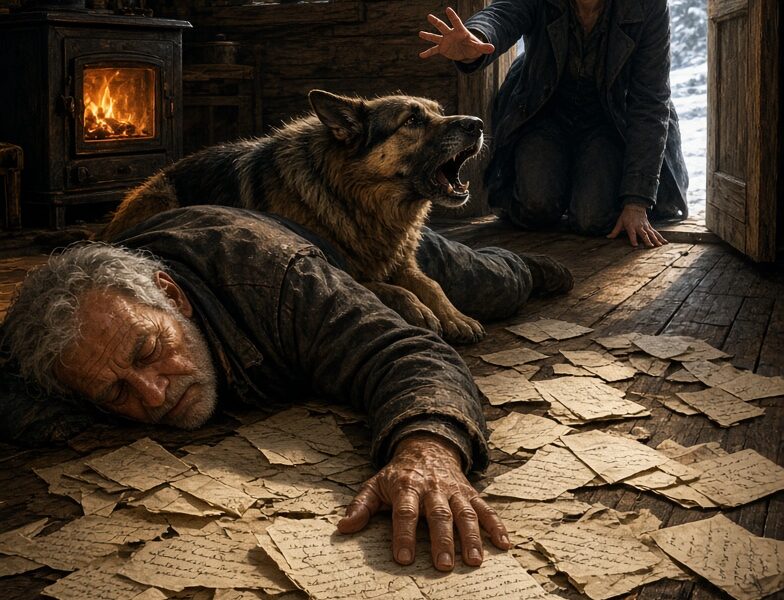
Philip’s grip slid off the doorframe.
As he went down, his shoulder caught the edge of the little table.
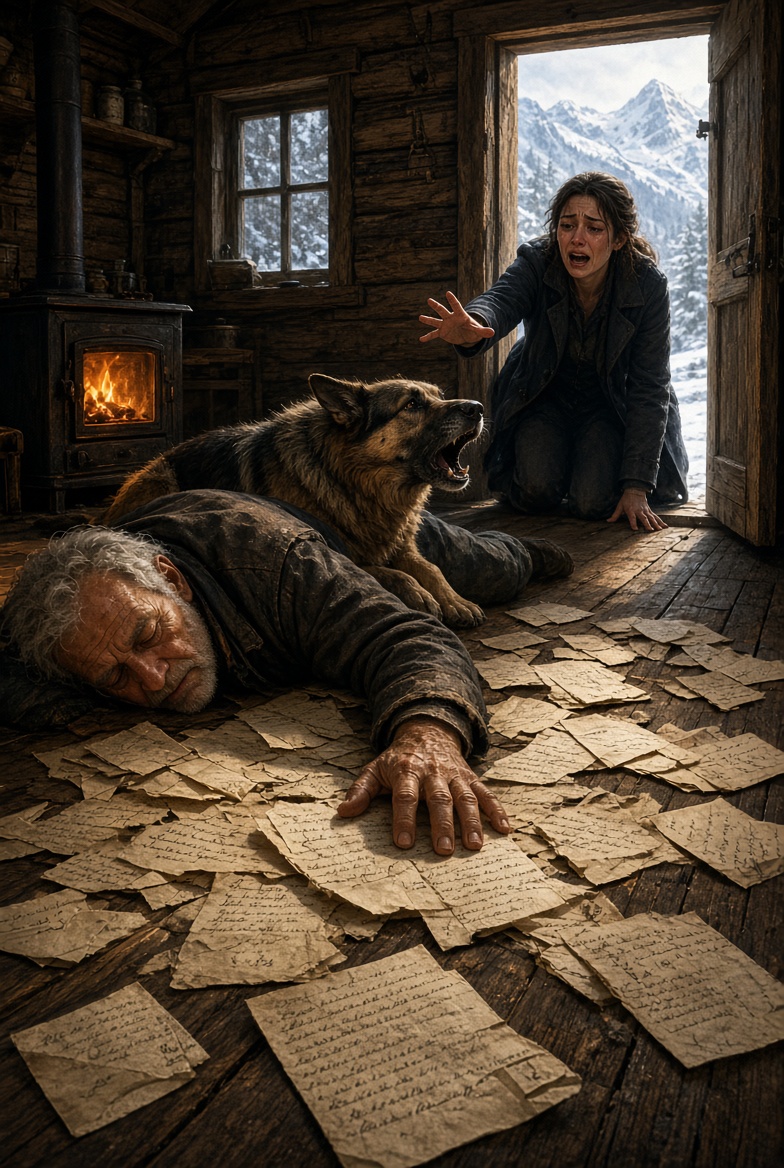
The wooden box of Abigail’s letters, which he’d left sitting there after counting them, tipped over the edge and hit the floor.
The lid popped loose.
One hundred eighty-seven envelopes fanned out across the floorboards like a deck of cards thrown into the wind.
The little brown hair clip skittered across the wood and came to rest against Philip’s open hand.
Chief started barking.
Not the lazy, single warning bark Philip heard when a car drove by too slowly.
This was continuous.
Urgent.
The same bark that had once told a whole SWAT team exactly where to look.
It carried off the porch and out into the cold afternoon, down the mountain, into the trees.
Several miles away, Abigail had spent most of her lunch break rewriting a letter.
She had stopped sending them eight days earlier.
Not because she was angry.
Because she no longer knew whether continuing made any sense.
For one hundred eighty-seven days, she had found something to say.
The SUV.
The chili.
The fudge.
The broken hallway light.
Then she had decided to try something she’d never tried before.
She would go quiet, and see if silence from her side might finally earn an answer from his.
“Maybe he needs to miss them,” she had told her coworker, Tasha, in the break room. “Maybe he doesn’t even notice.”
“He notices,” Tasha said. “Men like that always notice. They just die before they say so.”
Abigail had laughed.
She hadn’t laughed about it since.
Her phone had been sitting in a drawer at the nurses’ station all week, because she couldn’t stand watching it not ring.
When she finally checked it that morning, she saw three missed calls from Dad.
Three.
In one night.
She had stared at the screen until her coffee went cold.
Her voicemail was full, the way it always was, stuffed with messages from her mother she couldn’t bring herself to erase.
He hadn’t left a message.
Of course he hadn’t.
But he had called.
That morning, she wrote to him again anyway.
She folded the page before her shift ended and set it in an envelope on the passenger seat.
Her plan was simple.
Drive to the old mailbox.
Leave the letter where Chief would find it.
Turn around.
But when Abigail reached the mailbox, she didn’t stop.
Her foot eased off the brake.
She looked up the narrow road toward the cabin.
A memory came back to her with startling clarity.
Her mother’s tired voice.
Don’t stop knocking just because he forgets how to open the door.
Abigail tightened both hands around the steering wheel.
“Okay, Mom,” she whispered. “One more knock.”
Then she drove past the mailbox.
For the first time in nearly a year, she followed the road all the way up to her father’s house.
Before she’d even come to a full stop, she heard Chief.
Abigail was out of the driver’s seat almost instantly.
“Chief?”
The barking didn’t stop.
She ran up the porch steps and shoved through the half-open door.
Philip lay on the floor near the entry.
Chief stood over him.
“Dad!”
Abigail dropped to her knees.
Philip’s eyes were partly open, but his breathing was ragged and uneven.
All around him, dozens of envelopes covered the floor.
Abigail stared for only a second.
Her handwriting was everywhere.
She recognized birthdays.
Ordinary Tuesdays.
Summer dates.
Rainy-week letters.
Notes she’d scribbled half-asleep after twelve-hour shifts.
Every envelope had been opened.
Some had gone soft at the edges.
Several had pale, worn fold lines from being opened and closed again and again.
He had read them.
He had read all of them.
More than once.
Abigail’s breath caught in her throat.
Chief barked again, sharp, right beside her ear.
The sound snapped her back.
She pulled out her phone and dialed 911.
“911, what’s the address of your emergency?”
Abigail gave it, her voice shaking, then steadying, the way it did at work when a patient went pale in an exam room.
“My father is sixty-two. He’s conscious but his breathing is irregular. Possible cardiac. He has a history of high blood pressure.”
“Okay, ma’am, help is on the way. Is he able to talk to you?”
Abigail kept one hand on her father’s shoulder.
“Dad. Dad, stay with me.”
Philip moved slightly.
His eyes found her face.
“Abby.”
“I’m here.”
The words came out unsteady, so she said them again, stronger.
“I’m here, Dad. I’m right here.”
As she shifted to support his head, Abigail noticed something beside his hand on the floor.
A brown plastic hair clip.
Hers.
She had lost it at the mailbox eight days ago, the last afternoon she’d waited for Chief, crying in the cold with her hair coming loose.
He had found it.
He had kept it.
Then she saw another envelope, still sitting on the table by the door, untouched by the fall.
This one was different.
The handwriting was her father’s.
One word across the front.
Abigail.
She stared at it.
Her hand moved toward it.
Her fingertips stopped just short of touching the paper.
For several seconds, she stayed like that.
Then she pulled her hand back and turned to her father.
Whatever was in that envelope could wait.
He couldn’t.
Chief stayed pressed against Philip’s side until the ambulance arrived, its siren winding up the mountain road eleven minutes later.
The first paramedic through the door was a forty-one-year-old EMT with a gray beard and calm hands.
He checked Philip’s pulse and breathing while his partner brought the stretcher up the porch steps.
“Sir, can you tell me your name?”
“Philip Meyers.”
“Okay, Philip. You know where you are?”
“On my floor,” Philip muttered. “Embarrassingly.”
The EMT almost smiled.
“Good. Grumpy’s good. Grumpy means you’re still with us.”
They worked quickly, speaking to Philip and Abigail in short, clear sentences.
Philip was still conscious when they lifted him.
Abigail followed them outside.
Chief tried to follow too.
She knelt in the doorway and wrapped both arms around the old dog’s neck.
“You stay here. I’ll come back.”
Chief looked past her, toward the ambulance.
“I promise, buddy.”
Only then did she stand up.
In the back of the ambulance, Philip drifted between awareness and exhaustion.
The monitor beeped steadily above him.
Abigail sat close enough that he could see her every time he opened his eyes.
After several quiet minutes, Philip turned his head toward her.
“Chief.”
Abigail leaned in.
“He’s fine. He’s home.”
Philip closed his eyes again.
A thin breath left him.
“He didn’t listen.”
Abigail laughed through the tears she’d been trying to hold back.
“No. He didn’t.”
She wiped her cheek with the heel of her hand.
“Maybe that’s why you’re still here.”
Philip survived what the ER doctor at the regional hospital called a serious heart rhythm episode.
“You were lucky, Mr. Meyers,” the doctor said the next morning, flipping through his chart. “If you’d been out on that road alone, halfway to your mailbox, we might be having a very different conversation.”
Philip glanced at Abigail.
She was looking out the window, very hard.
“My dog wouldn’t let me leave the house,” Philip said.
The doctor raised an eyebrow.
“Then I’d like to shake your dog’s hand.”
“He doesn’t shake,” Philip said. “He’s retired.”
Surviving, the doctors made clear, did not mean he could go home and pretend nothing had happened.
He left the hospital four days later with two new prescriptions, a cardiology follow-up, and a printed list of things he was not supposed to do alone for a while.
Split wood.
Drive long distances.
Walk the mountain road by himself.
Abigail read the list carefully, twice, then highlighted three lines.
Philip read it once, folded it in half, and tucked it into his coat pocket, as if that settled the matter.
Chief met him at the cabin door with more energy than his aging legs had shown in months.
Philip lowered one hand to the German Shepherd’s head and stood there far longer than he needed to.
“You caused a lot of trouble,” he said.
Chief leaned his whole weight against Philip’s leg.
Philip rubbed the silver fur around his ears.
“Yeah. I know.”
His voice cracked on the last word.
Neither of them mentioned it.
Abigail didn’t move into the cabin after that, and Philip never asked her to.
She had her own home, her work at the clinic, and a life that had kept going through all the months he’d shut himself away.
Instead, she started coming by more often.
Sometimes for an hour.
Sometimes longer.
Neither of them tried to fix everything at once.
One afternoon, they sat together on the porch while the winter sun slipped behind the trees.
Chief lay between their two rocking chairs with his head on his paws.
Philip got up and went inside for a moment.
When he came back, he was holding the envelope Abigail had seen on the day he collapsed.
He set it on the little table between them.
“This was for you.”
Abigail looked at the handwriting on the front.
Her name.
She picked it up carefully, the way she’d pick up something that might break.
Philip turned toward the yard while she opened it.
He didn’t watch her read.
The letter was longer than she’d expected.
Seven pages.
She moved through it slowly, sometimes stopping for a long time before she went on.
Once, she pressed her knuckles against her mouth.
Philip kept his hands folded and stared down the road.
When she was done, she folded the pages back along the same creases he’d made.
For a while, neither of them spoke.
A cardinal landed on the porch railing, looked at them both, and left.
Then Abigail asked quietly, “Why did it take you so long?”
Philip looked down at his hands.
“I kept thinking I’d know what to say tomorrow.”
Abigail waited.
He rubbed one thumb slowly across the back of his other hand.
“Too many tomorrows.”
Abigail lowered her eyes to the letter in her lap.
She didn’t tell him everything was forgiven.
Philip didn’t ask her to.
Instead, she laid one hand flat on the table between them.
A moment later, Philip slid his hand closer until the sides of their fingers touched.
Chief opened one eye, saw them, and closed it again.
The weeks that followed were built out of smaller things.
Abigail started coming for dinner most Sundays.
Philip usually cooked, though his idea of measuring spices had not improved with age.
The first time he made chili after coming home from the hospital, Abigail took one bite and lunged for her water glass.
“You did this on purpose.”
Philip tasted his own bowl thoughtfully.
“It’s fine.”
“It could strip paint off a barn, Dad.”
Chief sat beneath the table, watching both of them with deep, patient concentration.
Philip tore off a corner of cornbread and let it fall.
Chief caught it before it hit the floor.
Abigail pointed under the table.
“You’re rewarding bad behavior.”
“He’s retired.”
“That has become your excuse for everything he does.”
Philip almost smiled.
“You should try it sometime.”
Some Sundays they talked about Doris.
A forgotten recipe would bring her name into the room.
A song on the radio would remind Abigail of something her mother used to sing badly while she cooked.
Once, Philip found an old grocery list at the back of a kitchen drawer and recognized Doris’s handwriting right away.
Coffee. Onions. ABSOLUTELY NO MORE CHILI POWDER.
Abigail laughed until she had to set the paper down and wipe her eyes.
Philip laughed too.
Other times, a memory arrived, and neither of them knew what to say.
The silence still came.
It just didn’t end the visit anymore.
A silence you sit inside together is a completely different thing from a silence you hide behind.
Philip was still Philip, of course.
A few weeks later, Abigail found out he had driven himself into town when she’d specifically asked him to take things slow.
She showed up that afternoon already irritated.
“You could have called me.”
Philip was standing at the kitchen counter.
“I can still drive.”
“That’s not what I said.”
“I made it there and back.”
“That’s also not what I said.”
Philip’s patience thinned.
“I don’t need permission every time I leave my own house, Abigail.”
She stared at him.
“I’m not trying to give you permission.”
“Sounds like it.”
The words landed badly.
Abigail picked up her coat.
“Fine.”
She left earlier than she ever did.
The door closed behind her.
Philip stayed in the kitchen.
The old, familiar quiet came back almost immediately, like it had been waiting in the next room.
For several minutes, he didn’t move.
His phone lay on the table.
Chief lay by the stove.
Philip looked at the phone.
Then at the dog.
“Don’t.”
Chief went on looking at him.
Philip walked to the table.
“Not one word.”
Chief’s ears stayed forward.
Philip picked up the phone and typed with one slow finger.
Still mad?
He set it down.
Less than a minute later, the screen lit up.
A little.
Philip glanced at the pot simmering on the stove.
He typed again.
Chili?
The reply came fast.
Too spicy.
Philip looked at the pot.
Probably.
This time there was a longer pause.
Then: Give me 20 minutes.
Philip read the message twice.
He said nothing to Chief.
Chief said nothing back, but his tail thumped the floor three times.
Twenty-five minutes later, tires crunched across the gravel outside.
Philip heard a car door shut.
He was in the front hallway before Abigail reached the porch.
She raised her hand to knock.
The door opened first.
A year ago, she had knocked for an hour and the door never opened.
This time, it opened before she even touched it.
A few months later, early spring softened the mountain road.
The last patches of snow disappeared from the shady ground, and small green leaves came back to the trees around the cabin.
The redbuds bloomed purple along the ridge.
Chief had slowed down over the winter.
His back legs needed more time every morning, and Philip no longer let him make the nearly one-mile trip to the mailbox alone.
One morning, Philip sat at the kitchen table with a clean sheet of paper.
He wrote to Abigail.
There was no apology in this letter.
He’d already written that one.
This one told her the kitchen faucet was leaking again, and that he had no intention of touching it with a wrench this time.
“Your mother’s stockpot is currently on duty,” he wrote.
He reported that Chief had stolen one of his socks and placed it under the same chair as always.
He also informed her that Sunday’s chili had probably been too spicy, though he refused to admit it officially.
When he finished, he folded the page and slid it into an envelope.
Then he reached into his shirt pocket and took out the little brown hair clip.
He’d carried it every day since the mailbox.
He clipped it to the corner of the envelope, right over her name.
She was always losing these.
This time, he’d make sure one found its way home.
Then he set the envelope down in front of Chief.
The old German Shepherd looked at the envelope.
Then at Philip.
Then Chief lowered himself back onto the rug and closed his eyes.
Philip laughed out loud.
“Right. You’re retired.”
He put on his coat and carried the letter outside himself.
The morning air was cool, but no longer bitter.
Philip started down the road.
After a short distance, he heard the slow rhythm of paws on gravel behind him.
He turned around.
Chief was following.
The dog wasn’t moving quickly.
Philip stopped and waited.
When Chief caught up, Philip started walking again, matching his pace to the dog’s.
Past the leaning split-rail fence.
Past the lightning-struck poplar.
Down around the lower bend.
This time, the envelope stayed in Philip’s hand.
Chief carried nothing.
He just walked beside him.
At the black mailbox with the peeling Volunteers sticker, Philip opened the little metal door and set the letter inside, the brown clip catching the spring sunlight.
He raised the red flag.
Then he stood there a moment with one hand resting on Chief’s head.
“That’s how it’s done,” he told the dog.
Chief looked up at him as if to say, I know. I’ve been showing you for a year.
That Sunday, when Abigail came up the mountain for dinner, she was wearing the brown clip in her hair.
She didn’t say a word about it.
Neither did Philip.
But he noticed.
And she noticed him noticing.
Back at the cabin, the wooden box still held all one hundred eighty-seven letters.
Philip kept every one.
And the days that remained were enough for him to begin answering them.
At its heart, this story isn’t only about one hundred eighty-seven letters, or even about an old German Shepherd who carried them home.
It’s about how love can stay present even when people forget how to speak to each other.
Philip believed silence would protect the people he loved.
But silence only built a greater distance.
Abigail kept reaching out.
Chief quietly carried that connection, one afternoon at a time, until Philip was finally ready to take the next step himself.
Sometimes we wait for the perfect words, the perfect moment, or one more tomorrow.
But the people we love may not need perfect words.
They may simply need to know that we are still willing to open the door.
So take care of yourself.
Take care of the people you love.
And never leave an important word waiting for too many tomorrows.









