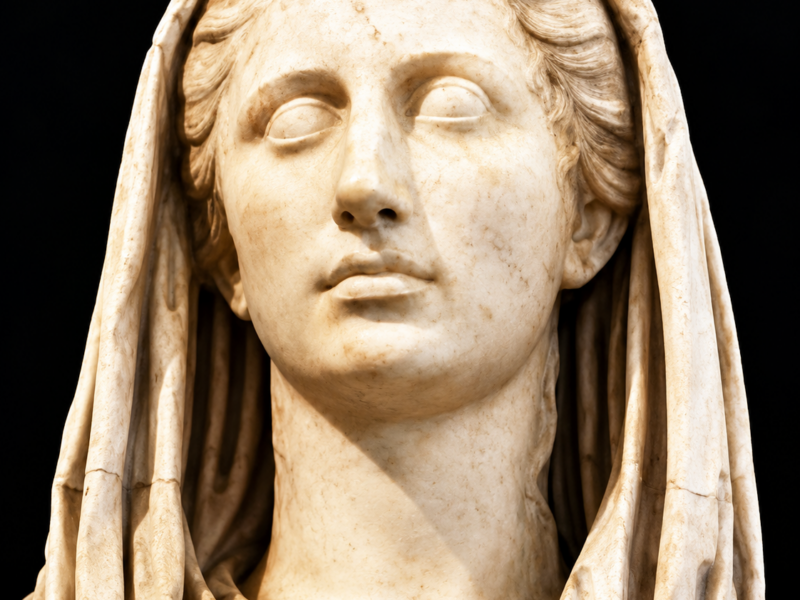
The Reckless Roman Who Lost an Empire for Cleopatra and Died by His Own Sword
On the first day of August in 30 BC, a Roman general who had once commanded the largest army in the world drove a blade into his own stomach.
He believed the woman he loved was already dead.
She was not.
So they carried him, bleeding, through the halls of her palace in Alexandria, and he died in her arms. According to the ancient accounts, his last request was for a glass of wine.
His name was Mark Antony.
He had been Julius Caesar’s right hand, the man who stood beside the dictator when the Republic collapsed. He had led over a hundred thousand soldiers and ruled half the Roman world.
And he lost all of it.
So how does a man with that much power throw it away? And why does a drunk, debt-ridden aristocrat from Rome’s rougher side end up as one of the most unforgettable figures in history?
The answer starts long before Cleopatra.
It starts with a boy born into a city tearing itself apart.
Mark Antony was born on January 14, 83 BC, in Rome.
His father, Marcus Antonius Creticus, came from the Antonia, a plebeian family.
The plebeians were the lower rank of free Roman society, below the aristocratic patricians and the equestrian class.
But the enormous expansion of the Roman state in the third and second centuries BC had made society surprisingly fluid.
Many plebeian families had acquired wealth and political prestige, and the Antonia were among those rising families.
Antony’s grandfather had become a senator, then governor of the province of Cilicia in what is now southern Turkey in 102 BC.
Three years later, he was elected consul of Rome.
Antony’s mother, Julia, came from the other side of the social ladder.
She belonged to the old patrician family of the Julii, and she was a cousin of a young man named Gaius Julius Caesar.
Caesar was sixteen when Antony was born.
He would become the central figure in Antony’s life, as will soon become abundantly clear.
But the world Antony entered was not a calm one.
Rome had grown from a small city-state in central Italy into the dominant power of the Mediterranean.
Its conquests had made it a great power, and they had also made its generals so powerful that they, not the Senate, had become the real masters of the state.
This got worse after the general Gaius Marius pushed through a slew of reforms in 107 BC that expanded and professionalized the Roman army.
Power now flowed to the men who commanded the legions.
Marius soon had a rival in Cornelius Sulla, and a quasi civil war between their supporters dragged on through the nineties and eighties BC.
In 87 BC, during a period when the Marians held Rome, Antony’s grandfather was killed in a purge of Marius’s enemies.
The old general himself died soon after, but the fight did not.
His son and Sulla went to open war in the spring of 83 BC, just weeks after Antony was born.
In November 82 BC, while Antony was still an infant, Sulla’s forces crushed the Marians at the Battle of the Colline Gate outside Rome.
Sulla made himself dictator.
He retired in 79 BC and died the following year.
But the Republic had been left in tatters by decades of instability.
And everyone could see the lesson.
Supreme power could be seized by any individual with the ability and the ruthlessness to copy what Sulla had done.
Antony’s early life was hard.
His grandfather had died in one of the Marian purges before he was born.
Strangely, this helped his father.
When the Marians were defeated, the dead man’s son suddenly looked like a loyal ally of Sulla’s faction.
He began a steady climb as an official. In the seventies BC he was given a military command in the eastern Mediterranean, tackling the piracy that was rife across the region.
That kept him away from his family.
And then, in 71 BC, he died on the island of Crete, leaving Antony fatherless.
His mother remarried, but his stepfather, Publius Cornelius Lentulus, was a dubious influence.
Antony’s chaotic home life, combined with a circle of feckless young aristocrats a few years his senior, pushed him toward a dissolute life in Rome in the sixties BC.
Among those friends were Gaius Scribonius Curio and Publius Clodius Pulcher.
He spent his days drinking, gambling, and carousing.
At the very time that senators like Cato the Younger were warning about the breakdown of traditional Roman values and the growing self-indulgence of wealthy families, Antony was seemingly a symptom of exactly that decay.
By the time he reached his twenties, he had piled up enormous debts around the city.
Then things got worse.
In 63 BC, his stepfather was implicated in a coup attempt led by a politician named Lucius Sergius Catilina, and he was executed for it.
With the family name battered and creditors shouting louder by the day, Antony decided to make himself scarce.
He left Rome for the east.
He went first to Athens, where he allegedly studied philosophy and rhetoric.
The philosophical life clearly did not hold him.
He soon joined a Roman military expedition traveling to the Levant, where Roman provincial government was still in its infancy after a series of conquests several years earlier.
And there, Antony’s opportunism went on full display.
He wormed his way into the inner circle of several senior Roman commanders and pushed for a more aggressive policy toward Ptolemaic Egypt.
Egypt was one of the successor kingdoms of Alexander the Great’s empire, and the last major power in the eastern Mediterranean still outside Rome’s control.
During a foray into Egypt to support one royal faction in a quasi civil war within the Ptolemaic dynasty, Antony appears to have met a princess of that same household.
Her name was Cleopatra.
She was only fourteen or fifteen years old.
Four or five years later, she would become queen of Egypt, ruling alongside her brother Ptolemy XIII.
Neither of them could have guessed what that first meeting would become.
Back in Rome, meanwhile, the political ground was shifting again.
Sulla’s retirement and the defeat of the Marians had left a vacuum, and new popular generals rushed to fill it.
The first to do so was Pompey the Great, who won a series of great wars in the eastern Mediterranean against the Kingdom of Pontus and the Seleucid Empire, conquering much of Anatolia and Syria.
At home, he became hugely powerful and hugely popular.
But he had rivals.
One was Marcus Crassus, reputedly the wealthiest man in the Roman world.
The other was Antony’s distant cousin, Julius Caesar, a dangerous populist who had stirred the Roman people to his side through a series of provocative acts and election campaigns.
Together, the three formed a political alliance to share power in Rome.
It is known as the First Triumvirate.
But in the fifties BC, Caesar began to eclipse his partners.
He launched a series of rapid conquests north of the Alps against the Celtic tribes of Gaul, the ancient name for what is now France and the Low Countries.
Crassus was killed in 53 BC while on campaign in the east.
Pompey’s glory days seemed long behind him.
Caesar was now the rising star of the Roman Republic.
And Antony gravitated toward his cousin.
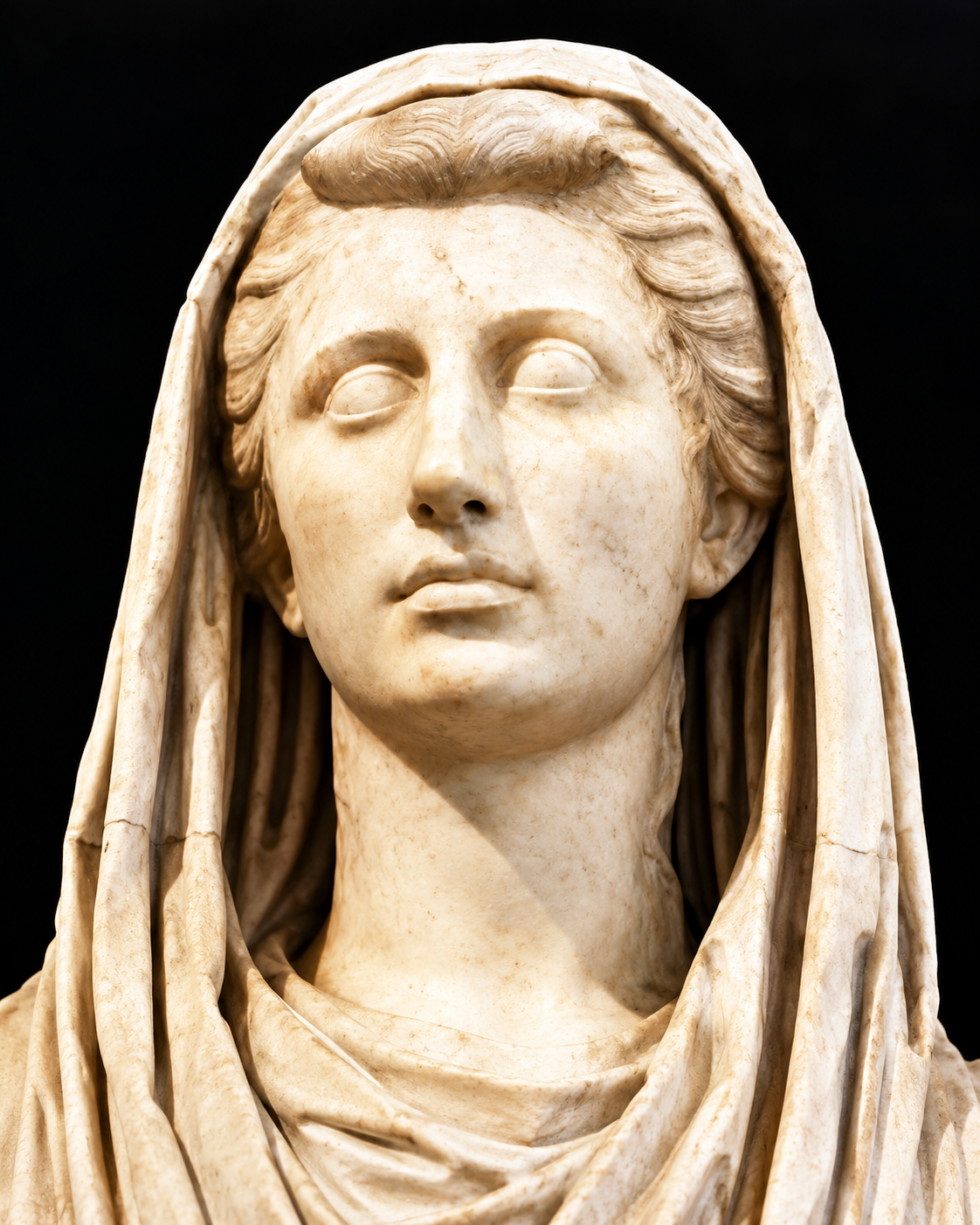
By 54 BC, Antony had made his way back to Rome and then north across the Alps to find Caesar.
Caesar was in the north of Gaul at that moment, between two reconnaissance missions in which he crossed the English Channel to Britain to see whether the island could be conquered.
The Romans knew almost nothing about it.
When Antony joined Caesar’s army, he rose fast.
Caesar warmed to him almost instantly, and Antony became one of his closest allies.
He was appointed one of the senior commanders, and he quickly won the affection of his troops by living much as the common legionary did.
Over the next two years, he served in Gaul.
From Caesar’s own book on the Gallic Wars, we know that Antony was present at the siege of Alesia in September 52 BC.
This was the defining conflict of the Gallic Wars.
A grand coalition of Celtic tribes, led by a warlord named Vercingetorix, was defeated by Caesar and his legions.
The victory crushed Gallic resistance, and Caesar spent the next year or two reorganizing the vast territory he had conquered into new Roman provinces.
It was most likely sometime after this that Antony married Antonia Hybrida Minor, a woman from a mix of patrician and plebeian background.
Historians have long debated whether she was his first wife.
Years later, Cicero claimed that Antony had briefly been married in his youth to a woman named Fadia.
It is unclear whether that was true, because Cicero may simply have been trying to smear him by suggesting he had married the daughter of a freed slave.
Whatever the truth, the marriage to Antonia Hybrida produced a daughter, also named Antonia.
Plutarch, who loved capturing the personalities of his subjects, gives us a vivid portrait of Antony at this time.
He describes a man of noble dignity, with a shapely beard, a broad forehead, and an aquiline nose.
These features, Plutarch says, were thought to show the manly qualities seen in portraits and statues of Hercules.
Whenever Antony expected to be seen by a crowd, he wore his tunic belted up to his thigh, a large sword at his side, and a heavy cloak around his shoulders.
But there was more to him than that bearing.
Plutarch notes that many people found his jesting and boastfulness offensive.
Yet his soldiers loved him, thanks to his common touch and his generous handing out of money to the legionaries.
Even so, Plutarch concluded that he was possessed of countless faults.
After the victory at Alesia, Caesar decided it was time for Antony to head to Rome and begin his own political career.
Caesar’s long absence in Gaul had let Pompey and the aristocratic faction in the Senate start undermining him in the capital.
Caesar had been building up his own faction in response, and now he sent Antony to join it.
The immediate trigger was the murder, that same year, of Antony’s old friend Publius Clodius in Italy.
Clodius had been one of Caesar’s principal supporters in Rome for years.
Antony climbed the ladder of Roman political offices quickly.
He was elected quaestor, a low-ranking office with responsibility for the municipal government of Rome.
Crucially, quaestors automatically received a seat in the Senate, and so Antony now sat in the main deliberative body of the Republic.
There, he positioned himself as a leading figure in the popular faction, the senators who looked to the support of the Roman people for their power and largely stood behind Caesar.
Opposing them were the optimates, the traditional aristocrats who favored Pompey and were broadly led by figures like Cato and Cicero.
These were not political parties in the modern sense.
But they mattered, because the struggle between them was about to rip the Republic apart.
Antony stayed in Rome through the late fifties BC, a period of growing tension across the city.
Caesar used figures like Antony to stir the Roman people into mobs that demanded more political power for him.
This was a direct answer to Pompey and his allies in the Senate, who were plotting to recall Caesar from Gaul and strip him of the eight legions he commanded there.
Those legions represented an army of forty thousand men.
And the optimates were now afraid that Caesar might refuse to give it up when his governorship ended.
In this charged climate, Antony was elected one of the tribunes of the people for 49 BC, an important office, second only to the consulship.
Everything boiled over in the first days of January 49 BC.
In the Senate, Cato and other optimates moved to recall Caesar from Gaul, with the clear intention of prosecuting him for exceeding his authority as governor.
Antony answered on Caesar’s behalf.
Caesar would return to Rome, he said, if he were given command of two legions and the governorship of Illyricum, around what is now Croatia, along with immunity from prosecution.
Pompey was inclined to accept.
But Cato and the other optimate leaders refused, and Antony fled north.
He met Caesar just north of the Rubicon, the river that marked the boundary beyond which legions were forbidden to march toward Rome.
After talking through the situation in the capital with Antony, Caesar decided that compromise was impossible.
On January 10, 49 BC, he crossed the Rubicon.
Civil war had begun.
It is often described as a clash between Caesar and Pompey, and that is true to a point.
But it might be more accurate to call it a struggle in which traditionalists and aristocratic conservatives in the Senate, led by Pompey and Cato, tried to stop a populist demagogue from seizing the Roman state.
And that demagogue was abetted by enforcers and henchmen like Antony.
The war lasted several years, with regional clashes between legions and governors who had declared for Caesar and pockets of Pompeian resistance.
The decisive clash came in Greece in 48 BC.
Pompey had retreated there with his senatorial supporters and begun preparing an army for a possible invasion of Italy.
Caesar followed him.
At the Battle of Pharsalus on August 9, Caesar inflicted a severe defeat on the Pompeians.
The exact numbers are disputed, because many of the most detailed sources, including Caesar’s own account, were clearly written to exaggerate his military genius.
Pompey fled to Egypt, where the Ptolemaic government killed him in hopes of winning Caesar’s favor.
Cato seized part of North Africa and tried to hold it for the optimate cause.
In 46 BC, he killed himself there rather than be captured.
The war dragged on, with pockets of resistance around the Mediterranean.
But after Pharsalus, Caesar was effectively the ruler of the Roman state, governing through the office of dictator.
That was a constitutional power that gave a commander enormous authority to deal with military emergencies, and it is the origin of the modern concept of a dictator.
Antony played a major role in all of this.
At Pharsalus, he commanded two of Caesar’s legions.
Afterward he returned to Italy with Caesar, who appointed him magister equitum, the master of the horse.
That made Antony the dictator’s second in command.
It was an enormously important position, because the constitution required that anyone with dictatorial powers still obtain the agreement of the master of the horse for major decisions.
It showed how much Caesar trusted him.
So did Caesar’s decision to appoint him governor of Italy in 47 BC.
In effect, Antony was left in control of the government in Rome while Caesar went to North Africa to fight the remaining optimates and Pompeians.
This was also a period of shifts in his personal life, and they overlapped with his politics.
Around the time he became governor of Italy, Antony grew suspicious that his wife Antonia was having an affair with Publius Cornelius Dolabella.
Dolabella was an important senator who had first sided with the Pompeians but later switched to Caesar.
When Antony learned of the affair, he divorced Antonia.
He quickly married Fulvia, a woman of the Roman aristocracy who had probably been his mistress for several years.
She was the widow of Clodius, Antony’s old friend and Caesar’s ally, who had been murdered back in 52 BC.
The scandal also led Antony to block legislation Dolabella brought before the Senate to relieve the debts people had built up during the civil war.
Whether he did it out of spite or for some gain of his own is unclear.
What is clear is that it was just one example of his mishandling of the government in 47 and 46 BC.
When the dictator returned to Rome, he found the atmosphere tense.
Relations between Caesar and Antony cooled for a time, because Caesar believed Antony had acted poorly as his understudy while he was away in North Africa.
In time, the two men reconciled.
But it was clear that Caesar was also grooming his great-nephew, a boy named Octavian, who was entering his late teens and showing remarkable promise as a political heir.
That did not stop Antony from gathering power of his own.
Caesar appointed him one of the two consuls for 44 BC.
We will never know how the politics between Antony and the young Octavian might have played out with Caesar still alive.
Because in the spring of 44 BC, Caesar was assassinated.
He was killed at a meeting of the Senate by a group of senators who opposed his decision, just weeks earlier, to extend his dictatorship for life.
That day was March 15, the Ides of March in the Roman calendar.
Caesar was stabbed upward of three dozen times and died on the spot.
His death created more problems than it solved.
On the surface, the man who had usurped the Republic and, unlike Sulla three decades earlier, refused to give up his power once the civil war was over, was gone.
But Rome had also lost the very men who might have restored the Republic.
Instead, there were many individuals ready to simply take Caesar’s place.
Antony and Octavian were chief among them.
Antony initially fled Rome, wary of a possible purge of Caesar’s allies.
He returned soon after, and together with another Caesarian, Marcus Lepidus, he negotiated an amnesty for everyone associated with the former regime.
In the weeks that followed, he went further.
He stirred up mobs across Rome and tried to present himself as Caesar’s populist successor.
Then he used his new power to pressure the government into granting him the governorship of much of Gaul.
The Senate was understandably wary of putting Antony in the same military position Caesar had held in the fifties BC.
A standoff followed.
Antony built a power base in the Alpine region in the autumn of 44 BC, and the Senate lined up against him.
Some historians call the clashes that followed a limited civil war between Antony and the government.
It is known as the War of Mutina, after a battle fought as part of it in 43 BC.
As Antony maneuvered to become Caesar’s successor, one of Rome’s great literary figures raised the alarm.
Cicero, the writer, orator, and statesman, warned the Roman political classes of the danger Caesar’s closest ally posed to the Republic.
He modeled his approach on the Athenian orator Demosthenes, who in the fourth century BC had rallied against the rule of Philip II and Alexander the Great over Athens.
Cicero composed fourteen speeches attacking Antony, known as the Philippics, a literary name for an invective against a political enemy.
He delivered them in the Senate and at gatherings around Rome between September 44 BC and April 43 BC.
In them, he condemned Antony again and again.
He warned of the threat Antony posed and of how he was trampling over the codes of conduct expected of a Roman official or commander.
Finally, he called on the Senate and the people of Rome to wage war on Antony before he claimed absolute power.
For several months, Cicero succeeded.
But in the end, Antony had the last word.
At the end of 43 BC, he had Cicero proscribed in a purge of his enemies.
Cicero was executed while trying to flee Italy.
His head and his hands, the hands that had written against Antony, were cut off and displayed in the center of Rome.
Cicero may have believed that Antony posed the gravest threat to restoring the Republic after Caesar’s fall.
But he was not the only one reaching for Caesar’s mantle.
By 43 BC, there were several individuals with their own factions emerging as Antony’s rivals.
That autumn, Antony joined with Octavian and Lepidus to form a new alliance.
It was the Second Triumvirate, imitating the one formed nearly twenty years earlier by Caesar, Pompey, and Crassus.
Using a number of pliant officials in Rome to propose the legislation, they had a law passed, the Lex Titia, that established the arrangement.
On paper, the three men were charged with restoring the Republic.
In reality, it was a political alliance designed exclusively to consolidate their power and bring some stability to the state, as a mere prelude to fighting it out among themselves over who would succeed Caesar as master of Rome.
Their first priority was to end a war started by the men who had assassinated Caesar.
Historians call them the Liberators.
They had fled Rome after the killing and gathered their forces overseas to prepare for conflict with figures like Antony, who would now step into the void left by the dictator’s death.
The Liberators’ civil war reached its climax in October 42 BC, in the first and second battles of Philippi.
They were fought near the city of Philippi in Macedonia.
Antony and Octavian led by some estimates over one hundred thousand soldiers against a similarly sized force led by Marcus Brutus and Gaius Cassius.
The two battles, fought three weeks apart, were chaotic.
Morale was low on every side after years of civil war.
Rank-and-file legionaries must have wondered what they were actually fighting for, other than money, at a time when the Republic was simply lurching from crisis to crisis.
In the end, the clashes themselves were not decisive.
What ended the war was Brutus taking his own life after an indecisive engagement, and the general collapse of leadership among the Liberators.
Smaller conflicts in other provinces, involving other rebel leaders, smoldered across the Mediterranean afterward.
With the Liberators beaten, Antony, Octavian, and Lepidus began to work out how they would share power.
The solution was to divide up a large number of Rome’s provinces among them.
Antony initially took Gaul and the Alpine region.
That mattered, because it included the plain of Lombardy and meant he had legions just north of the Rubicon.
Lepidus held mostly Hispania, though Rome was still at war with some stubborn native groups in Cantabria in the north.
Octavian’s base was in North Africa, where he controlled the provinces of Africa and Numidia, and where the Kingdom of Mauretania, in what is now Morocco and western Algeria, was a client state.
From 42 BC onward, this arrangement slowly changed.
The eastern territories the Liberators had controlled were retaken, and Antony began to shift his power base from Gaul to the eastern Mediterranean.
And as these arrangements evolved, his personal life once again collided with his politics.
His marriage to Fulvia, which was either his second or third, and which had given him two more children, became a problem in 41 BC.
Tensions between her and Octavian escalated in Italy while Antony was away in the East.
The immediate cause was Octavian’s decision to renounce his wife Claudia, who was Fulvia’s daughter from her earlier marriage to Clodius.
The clash between Fulvia’s supporters and Octavian’s is known as the Perusine War, after the town of Perusia in the Umbrian countryside, where Fulvia had strong support.
The irony is bitter.
Even as Fulvia was trying to boost her husband’s chance of becoming preeminent in Rome, Antony was in the East negotiating a new diplomatic arrangement with the Ptolemaic royal family of Egypt.
And during those negotiations, he began an affair with Queen Cleopatra, the woman he had first met many years earlier.
Cleopatra was a born survivor.
Faced with the prospect of Egypt being brought under Roman rule, she had started an affair with Julius Caesar during the civil war and had a son by him named Caesarion.
Now she wooed Antony when they met again in 41 BC.
It was a relationship that would dominate the rest of his life.
Back in the West, Octavian crushed Fulvia’s partisans in the first months of 40 BC and banished her to the Greek city of Sicyon.
Her presence there might have been an ongoing problem for relations between Antony and Octavian, had she not died unexpectedly shortly after arriving in Greece.
Antony might have married Cleopatra then.
Instead, a political marriage was quickly arranged.
In October 40 BC, he married Octavia, Octavian’s sister.
The union was meant to bring the two men closer and let Caesar’s great-nephew and the man Caesar had made master of the horse share power between them.
It had the opposite effect.
Antony behaved as though the marriage barely existed.
He settled in Alexandria in Egypt and continued his relationship with Cleopatra as though it were her he had married.
Cleopatra gave birth to twins by Antony, a son named Alexander Helios and a daughter named Cleopatra Selene.
A third child of Antony and Cleopatra, another boy named Ptolemy, was born in 36 BC.
Perhaps one reason Antony spent twenty years getting into trouble was his drinking, along with his gambling, his debts, and his tangled relationships.
People drank a lot in ancient times, in part because alcohol was often safer than water in places where the water supply could be a petri dish of disease.
Weak wine, mead, and in some parts of the empire beer were consumed throughout the day.
That is why it is meaningful that people took note of how much Antony drank.
In his biography, Plutarch points out that Antony was known for being frequently intoxicated.
From the first century AD encyclopedist Pliny the Elder, we learn that Antony even allegedly wrote a book boasting about his love of drinking.
He titled it On His Drunkenness.
His habits only got worse over time, and there are many examples of excessive drinking in the eastern provinces throughout the thirties BC.
It is worth remembering, when we consider his career, that he might well have been what we would now call a high-functioning alcoholic.
The years after Fulvia’s death, with Antony’s marriage to Octavia and his growing bond with Cleopatra, were a critical phase for the Second Triumvirate.
Much of it focused on the war with Sextus Pompey, the son and heir of Pompey the Great.
In the chaos after Caesar’s assassination, Sextus, who as leader of the Pompeians still commanded a good deal of support across the Republic, had taken control of the island of Sicily.
With a powerful fleet, he controlled the island and sometimes pushed out to Sardinia and southern Italy.
By dominating the waterways between the western and eastern Mediterranean, he became a powerful figure in his own right.
In the early thirties BC, he kept winning victories over all three triumvirs as they variously sent forces against him.
But in 36 BC, Octavian finally launched a successful invasion of Sicily.
Sextus fled east, hoping to find an alliance with Antony, but he was hunted down and killed the following year.
The larger significance was that in the West, Octavian took over Sextus’s territory and also pushed Lepidus aside.
By 35 BC, Lepidus was a broadly insignificant figure.
The power struggle now came down almost entirely to Octavian against Antony.
The battle lines had in fact been drawn years earlier.
An agreement made at Brundisium back in 40 BC had already ensured that Octavian’s main base was in Italy, Hispania, and Gaul.
Now, with control of the Italian islands and growing influence over North Africa, where Lepidus had once held sway, he was all but in charge of the western half of Rome’s provinces.
Antony’s sphere, by contrast, had been defined at Brundisium as Greece, Anatolia, and the Levant.
Egypt, theoretically still a quasi-independent client state of Rome, was assured to him through his relationship with Cleopatra.
He based himself in Alexandria, the second-largest city of the empire and its intellectual capital.
So it was that in the course of the thirties BC, Octavian came to largely control the western provinces and Antony the eastern.
Antony benefited from the fact that the East was considerably wealthier and more productive.
But in Rome, Octavian could manipulate the Senate and win the support of the Roman people.
Everything pointed toward a new civil war.
Perhaps if Antony had reformed his behavior and made the marriage alliance with Octavia actually work, conflict could have been avoided.
But Antony was not the sort of man to prioritize conflict resolution.
With the Second Triumvirate evaporating into a rivalry between two men, Antony decided to gain mastery over the Republic the old-fashioned way.
Marius in the hundreds BC, Sulla in the eighties, Pompey in the sixties, and Caesar in Gaul in the fifties had each, in turn, reached a preeminent position by conquering new territory for the Senate and the people of Rome.
Now Antony would try to eclipse Octavian by expanding the empire himself.
And there was an obvious target.
Only one state other than Rome, anywhere in the known world, had a strong centralized government, extensive territory, and a large army.
That was the Parthian Empire, based in Persia and Mesopotamia, around modern Iran and Iraq.
What was more, Rome carried a stain on its honor.
Marcus Crassus, the third member of the First Triumvirate, had been heavily defeated and killed in the desert along the Syrian and Turkish border at the Battle of Carrhae back in 53 BC.
At the time of his assassination in 44 BC, Caesar had been planning to march east against the Parthians and avenge the loss of several Roman legions at Carrhae a decade earlier.
His death put an end to any such effort.
Instead, the Parthians took advantage of the chaos after the assassination to invade the Roman East and occupy some of the border regions.
Now, with the war against Sextus Pompey coming to an end in the West, Antony gathered upward of sixteen legions in the East and began preparing to invade Parthia.
A great victory there might have been the triumph that let him outflank Octavian back in Rome.
The war that followed is sometimes called the Atropatene campaign, after the region of northern Persia near the Caspian Sea where most of it played out.
Antony marched east in 36 BC.
As in many campaigns against Parthia, the Kingdom of Armenia, an independent buffer state in the southern Caucasus, played a role.
Antony won King Artavasdes II over as an ally against King Phraates IV of Parthia.
He marched into Armenia and then swung south toward northern Persia, a route many Roman generals followed to avoid crossing the Syrian desert.
Our sources vary on the numbers, but Antony clearly had one of the largest Roman armies ever to campaign in the East, with around one hundred thousand men under his command.
And despite those enormous resources, the campaign became an unmitigated disaster.
He began a siege of the city of Phraaspa, near modern Ganzak in northwestern Iran.
Disease broke out in the camp.
Then his Armenian allies abandoned him, and he came under attack from the Parthians.
Dismayed, Antony ordered a retreat west through Armenia and finally to Syria.
He had lost as many as thirty thousand men and achieved nothing.
He planned another campaign, both to take revenge on the betrayal of the Armenians and to strike again at the Parthians.
But it never fully materialized, because his attention was drawn west to the increasingly inevitable showdown with Octavian.
One success Antony did have in these years was in Judea.
Back in the middle of the second century BC, the Jewish people had managed to establish themselves as an independent nation once again after centuries of foreign domination by the Babylonians, Persians, Macedonians, and the Seleucid Empire.
That came through the Maccabean Revolt, after which a new Jewish monarchy was set up.
But a century later, when Pompey conquered Syria, the Hasmonean dynasty agreed to become client kings of Rome, a form of vassalage in which Judea remained only semi-independent.
The Hasmoneans tried to exploit the chaos after Caesar’s assassination to reassert their independence.
Antony was determined to reverse that, and he ordered the governor of Cilicia and Syria, Gaius Sosius, to campaign into Judea.
Military clashes followed in the Levant between 40 BC and 37 BC.
At the end of them, Herod, a commander from western Judea of Idumean origin, was placed on the throne as Rome’s new favored client king.
Herod would rule for the next four decades.
He is better known as Herod the Great in the historiography because of the success of his reign, though he is a reviled figure in both Christian and Jewish tradition for allying with the Romans who ravaged Judea for decades and paved the way for the destruction of the Temple in Jerusalem in 70 AD.
It is often forgotten that Antony was the one who put the Herodian dynasty in place as clients and allies of Rome.
As the years went by and Antony spent more and more time in the eastern provinces, he appears to have adopted many of the trappings of Eastern monarchy.
Nations often define themselves as much by what they are not as by what they are.
The Greeks, centuries earlier, had defined themselves as a free people, the antithesis of the tyrannical absolutism of the kings of Persia.
Rome, with its republican government, took on that mentality when it expanded into the eastern Mediterranean, seeing itself as the opposite of Parthia.
Now Antony seemed to be drifting toward exactly the kind of autocratic government Rome despised.
He aspired toward monarchy and lived as a king with Cleopatra in Egypt, a country with the oldest tradition in the world of revering its rulers as representatives of the gods on earth.
If Octavian’s propaganda in the West is to be believed, Antony’s court in Alexandria became a place of people bowing and scraping before their rulers, wrapped in forms of iconography and wealth considered un-Roman.
His enemies made the most of this picture of Antony as an emerging despot.
How much of it reflected reality, and how much was the product of a propaganda campaign, is hard to say for sure.
Antony did little to calm the worries.
Alexandria seemed to be becoming the capital of what was practically an independent realm of his own in the East.
His decision in 34 BC to hold a Roman triumph, a military celebration normally held in Rome itself, in Alexandria only sharpened that impression.
The occasion was his raid into Armenia, where he captured King Artavasdes, who had betrayed him two years earlier during the Parthian campaign.
Artavasdes was led as a prisoner through the streets of Alexandria during the triumph.
That evening, Antony and Cleopatra, purportedly dressed in imitation of the Egyptian deities Osiris and Isis, issued a series of decrees known as the Donations of Alexandria.
Through them, the children of Antony and Cleopatra, along with Cleopatra’s son by Caesar, Caesarion, were given royal titles.
Caesarion was proclaimed king of Egypt and heir to Julius Caesar.
That last claim was a direct attack on Octavian’s position as Caesar’s political heir.
Alexander Helios, Antony and Cleopatra’s oldest son, was named king of Armenia and Parthia.
His twin sister, Cleopatra Selene, was proclaimed queen of Cyrenaica, in what is now Libya.
And Ptolemy Philadelphus was made king of Syria.
If anyone in the West was looking for proof of Antony’s alleged turn toward despotism, they could not have found clearer evidence than the Donations of Alexandria.
These actions handed Octavian the ammunition he needed to press the case for total war between the Roman government in the West and Antony’s forces in Egypt and elsewhere.
We should be cautious about how readily we accept later portraits of Antony’s despotic behavior in this period, because many of our records may be colored by the concerted propaganda campaign that Octavian and his supporters were now running from Rome against their rival.
It was ultimately a successful campaign.
In 32 BC, Octavian exaggerated reports that Antony was planning to establish a rival Senate in Alexandria, effectively splitting Rome’s empire in two.
Then Antony made an ill-judged decision.
That same year, he married Cleopatra in Alexandria without first arranging an official divorce from Octavia.
Together, these things tipped the Senate in Rome into backing Octavian’s call for war.
The new civil war, known as the War of Actium, involved the largest military buildup of all the civil wars of the late Republic, with upward of two hundred thousand legionaries and allies on each side.
Despite the enormous numbers, it was decided in just one major battle.
That battle took place at Actium, in the waters off the northeastern shores of Greece, at the mouth of the Gulf of Corinth.
Antony had chosen to build up his forces in Greece, where many supporters and members of the Roman Senate had fled from Italy to join his cause.
There he found himself blockaded.
On September 2, 31 BC, he decided to break the blockade by sailing out against Octavian’s fleet.
Hundreds of galleys, the standard Roman warship, clashed across the gulf in one of the largest and most consequential naval battles in human history.
Antony and Cleopatra had the larger, more powerful ships.
But Octavian’s smaller, more agile boats, and the naval tactics of his foremost general, Marcus Agrippa, won the day.
Many of Antony’s ships were sunk.
Communication broke down across his fleet after Cleopatra’s Egyptian contingent became separated from the main body of Antony’s galleys.
Eventually Antony broke free of the fighting with one of his ships, abandoning the battle when it became clear that all was lost.
Most of his fleet, and with it his chances of winning the war, was destroyed.
In the weeks that followed, Antony tried to gather the remnants of his forces from around the eastern Mediterranean in Egypt.
Many of his former allies abandoned him.
He and Cleopatra both sent word to Octavian that they would step down from their positions and retire as private citizens if he would pardon them.
Caesar’s heir was in no mood for mercy.
He did take his time before launching the final campaign.
He dealt with matters in Greece and Italy through the winter of 31 BC, then sent his troops to Egypt in the spring and early summer of 30 BC.
A battle was fought around Alexandria through July.
When it was lost at the end of the month, Antony knew that nothing awaited him but death, and the possible humiliation of being dragged to Rome to be paraded in Octavian’s triumph.
He killed himself on August 1, 30 BC, stabbing himself in the stomach.
Plutarch’s life of Antony suggests that he mistakenly believed Cleopatra had just died, and only learned he was wrong after he had stabbed himself.
He was carried to her and allegedly died in her arms, calling for a glass of wine before he did.
The Egyptian queen killed herself a week and a half later, after being captured by the Romans.
Legend says it was the poisonous bite of an asp, though most ancient accounts say she drank poison.
She and Antony were buried together somewhere around Alexandria.
The tomb has never been found.
With Antony’s defeat and death, Octavian was left without a major rival in the Roman world.
He had firmly succeeded his great-uncle as the preeminent figure in the state.
And he would not make the same mistakes as Caesar.
Despite his relative youth, Octavian proved himself an immensely shrewd politician.
In 27 BC, three years after Antony’s death, he reached a new political settlement and established what is known as the principate.
He would not take the dictatorship that had given Caesar such immense authority but had also proved his undoing.
Nor would he try to rule as a sort of eastern despot, the way Antony had in the eastern provinces.
Instead, he granted himself a number of well-established powers through long-standing Roman political offices, such as the office of tribune of the people.
He held the consulship frequently for years to come and became pontifex maximus, the chief priest of Rome.
Finally, he adopted the name Caesar Augustus.
As Caesar Augustus, Octavian declared to all that he was now the first citizen of Rome, though not its ruler.
The facade of preserving the Republic worked extremely well, and the new arrangement was accepted by all.
We should not be fooled in retrospect.
What Octavian did in 27 BC was begin to establish a new position in Rome, that of emperor, of which he was the first.
Antony stood in the shadow of two men in his time, first Caesar and then Octavian.
Yet he remains a huge figure in the story of the Republic’s demise.
His relationship with Cleopatra, and the way he carved out the eastern provinces as his own territory for the better part of a decade, have ensured that people have been fascinated by him ever since.
Plutarch deemed him one of the individuals who shaped Roman history, and he included him in his biographies of the most eminent Romans, alongside Caesar and Augustus.
At the height of the English Renaissance, more than a millennium and a half after Antony’s death, his relationship with Cleopatra became the subject of one of William Shakespeare’s plays.
John Dryden took up the same theme in his play All for Love a century later.
In the twentieth century, versions of Shakespeare’s Antony and Cleopatra were adapted for the screen, and Antony was played by both Charlton Heston and Marlon Brando in the 1950s.
Yet it is surely the 1963 film Cleopatra, with Richard Burton as Antony and Elizabeth Taylor as Cleopatra, that is the most infamous modern take on him.
That production became the most expensive movie ever made up to that time, and it contributed to the decline of the golden age of the Hollywood studio system.
Mark Antony was one of the most striking figures of Roman political history.
He rose as a military and political figure in the fifties BC, gravitated into the orbit of Julius Caesar, and became his closest ally and most trusted military accomplice.
When civil war broke out with Pompey, Antony played a vital role in defeating the Pompeians, and he was rewarded as master of the horse.
Unsurprisingly, when Caesar was assassinated, he was able to step into the breach as one of his potential successors.
But Antony was never just an important political figure.
He was also one of the most colorful characters in ancient Roman history.
A man who ended up in the Greek East as a young man because of his debts.
A serial philanderer who married four or five times.
A noted heavy drinker in an age when you really had to drink a lot for people to make a special note of it.
In the end, his disregard for convention was his undoing.
By setting himself up in the East, by wrecking his relationship with Octavian through his affair with Cleopatra while married to Octavia, and by ruling the eastern provinces like a despot, he made sure a new civil war would have to be fought.
His gamble did not pay off.
Antony’s defeat and Octavian’s triumph changed the course of history, because the Roman Empire emerged under the man who beat him.
Could Antony have become Rome’s first emperor if he had not made the mistake of spending so many years away from Rome itself with Cleopatra in Egypt?
Or was he never a match for the political guile of Octavian?









