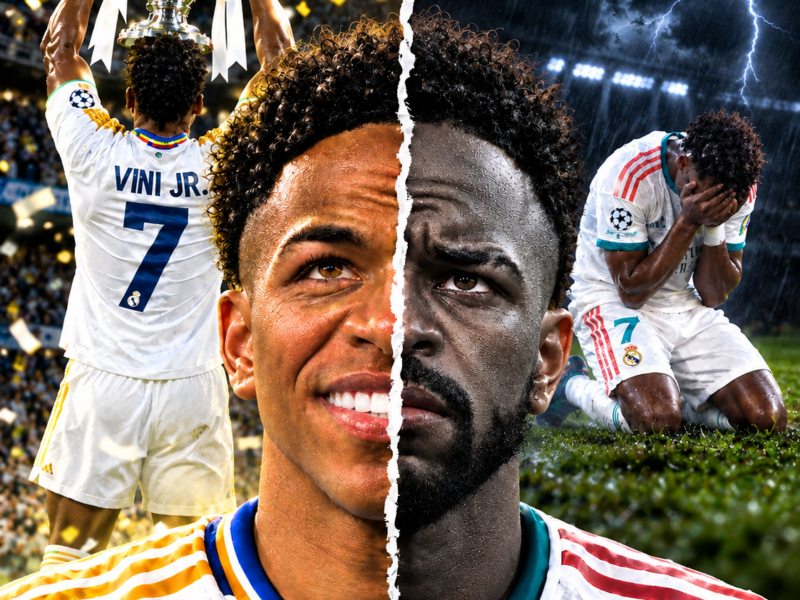
The Real Madrid Insider Theory: Why Vinicius Junior’s New Contract Might Actually Be the Beginning of the End
Real Madrid just handed Vinicius Junior a contract that runs all the way to 2032, and in the very same summer, they quietly spent roughly 140 million euros on a teenager who plays his exact position.
That is not a coincidence anyone should be comfortable ignoring.
If the club truly believes their former Champions League hero is about to snap back into form, why hedge that bet with a fortune spent on someone capable of replacing him.
There is a version of this story where both moves make perfect sense together, and once you see it, you cannot unsee it.
This is the story of what happened to Vinicius Junior, why the numbers and the body language on the pitch tell a very different tale than the headlines suggest, and why Real Madrid’s own transfer business might be the clearest signal of all that something has fundamentally shifted.
The Nightmare Matchup That Used to Be Automatic
For several unforgettable seasons, facing Vinicius Junior meant facing a problem you could see coming and still couldn’t stop.
Defenders knew exactly what he was going to do. He was going to attack the outside shoulder, accelerate past them, and there was rarely anything they could do about it even with full knowledge of the plan.
He wasn’t sneaking up on anybody. He was simply too fast, too direct, and too relentless to matter whether the opponent guessed correctly.
Now, watch a random midweek fixture involving Real Madrid, and there are entire stretches where Vinicius barely troubles the fullback in front of him at all.
And the explanations keep repeating on a loop. He needs confidence. He needs a goal to get going again. The next match will be the one where he finally looks like himself.
Except the months keep passing. The coaches keep changing. And the version of Vinicius everyone is waiting for keeps not showing up.
He is 26 years old, an age that should represent the physical peak of a professional athlete’s career, not a mystery to be solved.
So what actually happened.
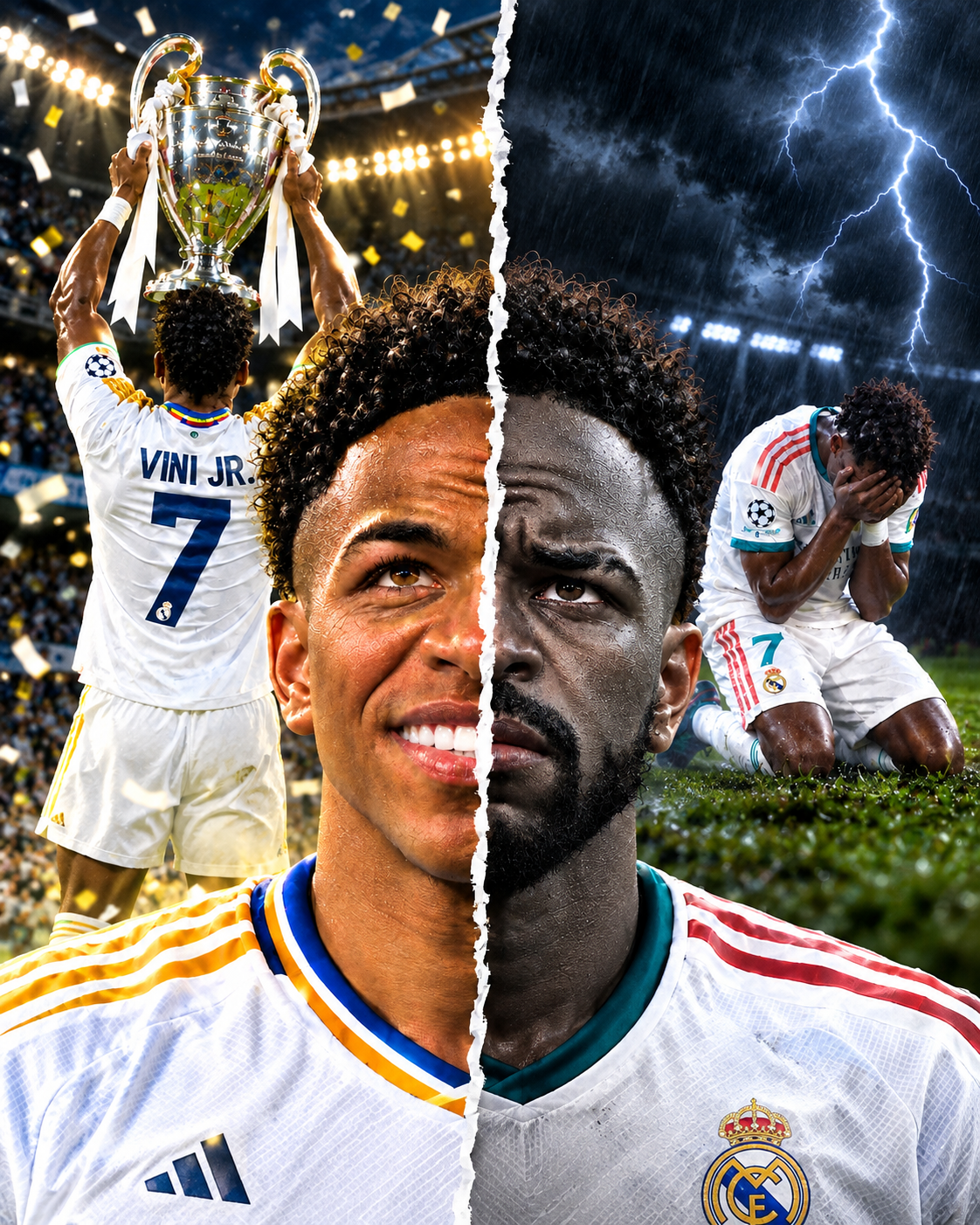
The deeper you look into how his game has changed, the harder it becomes to believe this fixes itself with a couple of good performances. And the more you study what Real Madrid has actually done in the transfer market this year, the more a quiet, uncomfortable theory starts to make sense.
Maybe somebody inside the club has already stopped waiting for the old Vinicius to come back.
What Made Peak Vinicius Nearly Impossible to Stop
To understand what has been lost, you have to understand exactly what made peak Vinicius so brutally effective in the first place.
His greatest weapon was almost unfair in its simplicity. He could telegraph the exact same move over and over, and defenders still couldn’t stop it.
His first step off a standing start let him receive the ball facing his fullback, provoke a reaction, and burst past before the defender had even finished turning his hips.
From there, his raw speed did the rest, protecting the advantage he had just created before the defender could recover any ground.
But the truly demoralizing part for opponents wasn’t a single moment of brilliance. It was that he could do it again. And again. For ninety straight minutes.
Stopping him once solved nothing. You had to chase him down on the very next play, and the one after that, until your legs started to give out while his somehow kept firing at full intensity deep into the second half.
That is the exact quality that appears to have gone missing.
Today’s version of Vinicius doesn’t create the same separation from his marker in that opening burst. He needs more distance to build up speed, which gives defenders enough time to stay in stride alongside him instead of getting left behind.
And critically, the continuity is gone too. He can still produce one explosive, dangerous action in an otherwise quiet match, but a single burst here and there doesn’t make a winger dominant. What broke defenses for years wasn’t one great moment, it was repetition, over and over, relentlessly.
Now there are simply too many stretches, sometimes entire matches, where he disappears from the game almost entirely.
None of this comes from an official speed-tracking report claiming a permanent, measurable decline. This is a reading of what shows up on the field, match after match. But the gap between what Vinicius used to be and what he currently looks like is too significant to wave away with a simple explanation like a lack of confidence.
He is 26. This should be a conversation about him entering his physical prime, not a search for reasons why imposing himself physically on a football pitch has suddenly become this difficult.
The current Real Madrid boss has publicly defended him throughout the rough patch, and there is a reasonable argument that shielding your player publicly is exactly the right call for team morale. But a coach’s support in a press conference does not win the next one on one battle out on the grass. That responsibility belongs entirely to Vinicius himself.
And when a player has built his entire footballing identity around the ability to leave a defender behind, losing that ability doesn’t just cost him one specific skill. It puts his entire game under a microscope, because every other weakness that used to feel manageable suddenly becomes impossible to ignore.
The Finishing Problem That Used to Be Easy to Forgive
Because here’s an uncomfortable truth that got buried for years underneath all that explosiveness: Vinicius Junior has never been a reliably clinical finisher.
He has improved enormously compared to the raw, unfinished talent who first arrived at Real Madrid as a teenager. But even at his absolute peak, nobody watching closely would have described him as a striker capable of calm, consistent precision in front of goal.
That flaw used to be easy to overlook, because it was cheap. He generated so much danger so constantly that missing one chance barely mattered. He would simply turn around, attack his man again, and manufacture another opportunity thirty seconds later.
He would waste the final pass or fluff a finish, but he still had the legs and the burst to break his fullback down again on the very next attack, so the cost of that mistake stayed low.
Now, those same mistakes come at a far steeper price.
If generating even one clear advantage has become this difficult, and then that rare advantage gets wasted with a poor final decision, the team loses on both fronts at once. No more relentless production of chances, and no reliable conversion when a chance finally does arrive.
Scoring in two separate Champions League finals proves, beyond any argument, that Vinicius is capable of showing up in the biggest moments a football career can offer. But that does not automatically transform every other part of his game into a strength.
And that is precisely the trap of judging Vinicius purely by his goal tally. He could score this coming Sunday and still turn in a genuinely poor overall performance, because a single goal can end a drought or silence a bad run of form, but it cannot retroactively fix everything that failed to happen before the ball ever reached the net.
Trapped With Nowhere Left to Go
If Vinicius wants to rebuild his influence on matches, he needs to find some new way of generating advantages against defenders. And this is exactly where his options start running out fast.
A winger can absolutely lose a step of pure explosiveness and remain an elite, difference making player. But making that transition requires offering something new in its place, some added layer of game intelligence or skill set that compensates for the lost speed.
He could theoretically drift closer to goal, reinvent himself as a genuine center forward or a deeper-lying second striker, learning to receive possession between the lines. But that kind of conversion demands a very specific toolkit.
Consider a completely different type of forward as a contrast, a player whose entire value inside the penalty area comes from reading spaces, intelligent off-ball movement, relentless pressing, and the ability to finish with a minimum number of touches. You cannot simply relocate a player like that from the wing and expect the exact same production, because the skills required in a central role are fundamentally different from the ones required out wide.
With Vinicius, there is no obvious version of that reinvention currently visible. He has absolutely hurt opponents by drifting into central areas before, there’s no disputing that. But cutting inside occasionally after starting a run from the left touchline is an entirely different skill from actually living in that central zone permanently, receiving with your back to goal, and solving problems while surrounded by multiple defenders.
He has not shown, consistently, over a sustained period of time, that he can organize play between the lines the way a genuine attacking midfielder does, nor has he demonstrated the kind of off-ball movement inside the box that makes teammates around him better, the way an elite center forward naturally does.
And even if he wanted to make that leap and fully commit to learning it, the positions themselves simply are not available to him.
The middle of Real Madrid’s attack currently belongs to Kylian Mbappé, operating as the central striker, and to Jude Bellingham, occupying the number ten role just behind him.
Rebuilding Vinicius from the inside out would require restructuring the roles of two of the single most important players in the entire Real Madrid project. That is an enormous institutional cost to absorb just to accommodate one player’s search for a new identity.
Which is exactly why he appears trapped in his current spot. His most natural position remains the left wing, which happens to be precisely where the loss of that old explosive unpredictability is most visible and most damaging.
The uncomfortable question hanging over the entire situation is whether Vinicius can genuinely reinvent himself into a different type of player at all, and right now, there is no clear guarantee that he can.
The Hierarchy Shift Nobody Wants to Say Out Loud
This footballing puzzle is unfolding at the exact same time as a separate, quieter shift, the shift in where Vinicius actually sits inside Real Madrid’s internal pecking order.
This is a player who scored the winning goal in the 2022 Champions League final, and then did it again in 2024. By any reasonable measure, he had fully earned the right to feel like the undisputed face and biggest star of Real Madrid.
Then that same summer, Kylian Mbappé arrived, a player who had also built the majority of his career operating from the left wing, and who landed in Madrid carrying the weight of a transfer pursuit that Florentino Pérez and the club had chased relentlessly for years.
Even though Mbappé ultimately settled into the central striker role rather than the left wing, his mere arrival reshaped how space, responsibility, and attention were distributed across the entire team.
Vinicius had helped drag Real Madrid to the very top of European football, and now, almost overnight, he had to hand a significant share of that spotlight to a superstar who had just walked through the door.
A few months later came another gut punch. The Ballon d’Or.
The award went to Rodri, not to Vinicius.
Nobody can climb inside another person’s head and know exactly how that landed emotionally. But it is entirely reasonable to imagine that moment as a genuinely crushing psychological blow for a player who had spent the better part of a year positioning himself as a serious candidate to be recognized as the best footballer on the planet.
Within the span of a few short months, two enormous shifts collided at once. Real Madrid brought in another global superstar, and the trophy Vinicius had waited his entire career for slipped through his fingers and into someone else’s hands.
None of that proves, on its own, that those two events single-handedly triggered his decline. It doesn’t fully explain his physical drop-off either. But it absolutely helps explain the surrounding context. A player who seemed on the verge of having it all suddenly had to process two consecutive, very public setbacks in rapid succession, one from the very club he had just delivered two Champions League titles to in three seasons, and another from the footballing world at large.
And all of that accumulated frustration matters enormously if it walks out onto the pitch alongside him.
Because there are matches now where Vinicius genuinely looks like he has an unresolved argument going with the entire stadium at once, with the referee, with the opposing players, with his own home crowd. And while he’s busy managing all of that emotional noise, the match simply keeps moving without him.
The clock does not pause for frustration. The minutes keep ticking regardless of how justified his complaints might be in that moment.
To be fair, these protests and flashes of frustration were never entirely absent even during his very best seasons. The difference is that back then, his football was loud enough to drown out all of that noise completely. Now that creating a genuine mismatch against a defender takes so much more out of him physically, every mental disconnection costs him double, sometimes triple, what it used to.
Watching from the outside, there are stretches in matches where it genuinely looks like football has slipped into second place for him personally in that moment.
Nobody can honestly claim to know his private priorities. But it is entirely fair to question the level of focus he’s showing during actual matches, because the instant a play ends badly, the team immediately needs him locked in and ready for the very next one.
If he is still mentally protesting the previous incident while the next phase of play unfolds, he is effectively gifting the opposition a second advantage on top of the first.
And a player working with a smaller physical margin than before has to make smarter decisions on every single touch. When to sprint. When to release the ball. When to time a run to receive possession again. There is simply no more room left to waste effort or squander possessions carelessly.
Meanwhile, Real Madrid has decisions of their own to make, and obviously, the club cannot afford to wait around indefinitely for one player to sort himself out.
The Contract That Explains Everything, and Nothing
Which brings us directly to the contract renewal itself, because that deal sits right at the center of this entire analysis.
If Real Madrid genuinely believes the peak version of Vinicius is never coming back, why lock him into a deal that stretches all the way to 2032. Why commit that deeply to him at all.
Here’s the answer. There is an enormous difference between privately accepting that a player will probably never again be exactly who he once was, and simply letting a player still valued at roughly 140 million euros by Transfermarkt walk away for free.
His previous contract was set to expire in 2027, and that looming date was steadily pushing the club toward an increasingly uncomfortable negotiating position. Real Madrid essentially had two options on the table: sell Vinicius now for a reduced price, or gamble on keeping him and risk losing him entirely for nothing once his contract simply ran out.
Vinicius still carries real market value, genuine international prestige, and an age profile that keeps a future transfer fully realistic whenever the time comes.
Renewing his deal accomplished two things simultaneously. It let the club continue benefiting from him on the pitch right now, and it let them negotiate any future sale from a position of real strength, rather than negotiating under the pressure of an expiring contract ticking down toward zero.
Now add the second half of this story: the signing of a young winger named Diomandé.
Real Madrid spent somewhere around 140 million euros on a nineteen year old attacker capable of playing effectively on either flank.
A transaction of that scale is never made simply to add depth to a matchday squad list. Signings that size are made with a very specific plan in mind, built around a player the club expects to eventually occupy a genuinely important role in the team.
Consider the logic here. If Arda Güler fully establishes himself on the right wing, Diomandé is not locked into competing exclusively for that specific spot. He is just as capable of playing on the left wing instead, which happens to be Vinicius Junior’s position.
That is precisely why this signing does not read, at least not entirely, as simple squad depth or extra competition. It reads just as easily as a genuine alternative designed to eventually replace him outright.
Somebody with real decision-making power inside Real Madrid signed off on a massive financial investment in a player who offers the club an exit ramp if Vinicius never rediscovers his old level.
That is the honest reading of the club’s broader planning here.
There is, of course, a more charitable explanation too, that the signing simply increases internal competition for places, which is a completely normal part of running a squad at the highest level of the sport. But regardless of intent, the practical consequence is identical either way. Real Madrid now has significantly more flexibility to stop depending entirely on Vinicius Junior whenever they choose to use it.
The contract renewal protects his financial value as an asset. The Diomandé transfer provides a genuine sporting alternative, both immediately and well into the future.
Put those two decisions side by side, and they fit together perfectly, almost too perfectly to be a coincidence.
So Is Vinicius Finished
So where does that actually leave him. Is Vinicius Junior finished as a footballer.
Here is the honest answer. The player can absolutely continue his career at the highest level. But the specific phenomenon the football world witnessed between 2021 and 2024, that particular, unstoppable version of Vinicius Junior, appears to be over.
He will still score goals moving forward. He will still produce genuinely excellent individual performances from time to time. And every time he does, the same headlines will inevitably return, declaring that he’s officially back.
But recovering that old level requires something far more demanding than one strong performance. It requires forcing every single fullback in Europe to dread facing him, every single week, without exception. It requires opposing coaches assigning extra defensive help to his marker as a matter of course. It requires being the player his own team turns to automatically the moment everything else breaks down around them.
That is what once made Vinicius genuinely irreplaceable. And that is precisely the level nobody should reasonably expect to see return in full.
He may still find a way to reinvent parts of his game. Nothing here rules that possibility out completely. But Real Madrid cannot afford to mortgage their entire attacking plan on the hope that he eventually pulls it off, especially with the club already sitting two full years without lifting a major trophy.
The contract renewal lets Real Madrid hold onto a still-valuable asset on their own terms. The Diomandé signing gives them a genuine alternative up front if Vinicius never gets back to where he once was.
That, in the end, is the real message buried inside the club’s own transfer business this summer.
Vinicius Junior has a contract that runs all the way through 2032. But under absolutely no circumstance does that guarantee him a starting spot for even one more season, let alone eight more years.









