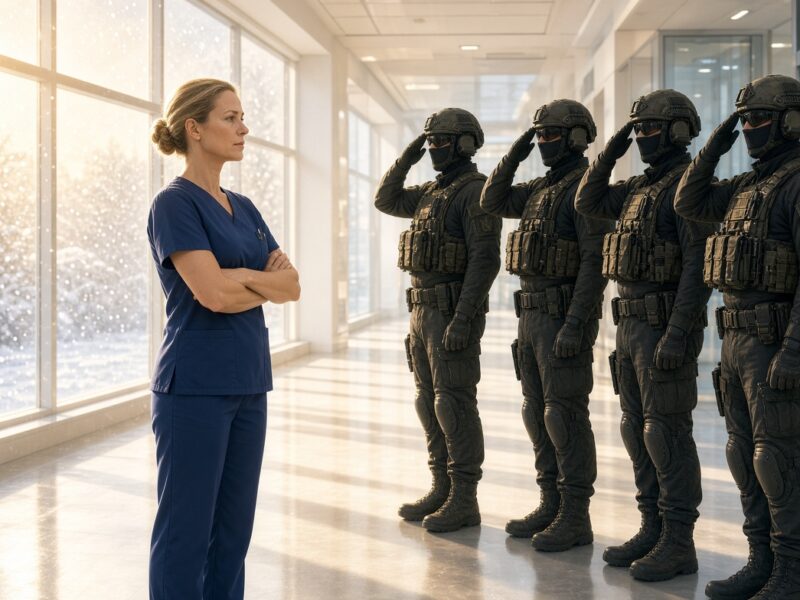
The Quiet Nurse Everyone Ignored — Until Elite Soldiers Landed and Called Her Major
She was the nurse everyone ignored.
The one who took out the trash, smiled softly, and never spoke out of turn.
But when the deafening roar of a military Black Hawk shook the hospital windows and a decorated commander dropped a crisp salute, they realized the quiet woman taking their coffee orders was a ghost they never should have crossed.
Sacred Heart Memorial Hospital in Billings, Montana, was the kind of underfunded, overworked regional medical center that ground idealistic health care workers into dust.
The fluorescent lights perpetually flickered in the Level II trauma center, casting a sickly pale hue over the linoleum floors.
Amid the organized chaos of alarms, groaning patients, and shouting doctors, Evelyn Gallagher was entirely, perfectly invisible.
Evelyn was 38, though her tired eyes and the sharp, weathered lines around her mouth suggested she had lived several lifetimes.
She wore standard-issue navy blue scrubs that hung loosely on her lean, athletic frame.
Her sandy blonde hair was always scraped back into an unforgiving, severe bun, and she wore zero makeup, zero jewelry, and absolutely no perfume.
When she had arrived three months prior, the human resources department barely noted her.
Her file was agonizingly ordinary.
A recent nursing degree from an online fast-track program, a few unremarkable clinical rotations, and a mailing address at a nondescript apartment complex on the edge of town.
To the rest of the staff, Evelyn was a glorified orderly.
She was the one the younger, more ambitious nurses pushed the grunt work onto.
If a patient needed to be cleaned after a messy accident, Evelyn did it.
If the biohazard bins were overflowing, Evelyn tied them off.
She rarely spoke unless spoken to, and her voice was a flat, unaccented murmur that invited no follow-up questions.
Her direct supervisor, charge nurse Brenda Carmichael, appreciated the silence but thought Evelyn was painfully slow.
“She lacks the hustle,” Brenda would gossip over stale break-room coffee.
“You need a certain fire for the ER. Gallagher’s just existing. I give her another month before the stress breaks her.”
But nobody tested Evelyn quite like Dr. Gregory Keller.
Keller was a third-year attending physician with a god complex that outpaced his actual medical acumen.
He thrived on the hierarchy of the hospital, wielding his medical degree like a blunt instrument against the nursing staff.
It was a Tuesday evening when Keller first actively tried to humiliate her.
A 62-year-old male was wheeled into Trauma Bay 3, clutching his chest, his face pale and slick with diaphoresis.
The monitors screamed a rapid, chaotic rhythm.
SVT.
Supraventricular tachycardia.
“His heart rate is 220,” Keller barked, adjusting his stethoscope.
“Get me 6 milligrams of adenosine. Fast push. And get the crash cart. Where is the charge nurse?”
“Brenda is on break, doctor,” Evelyn said quietly, appearing beside the bed with a pre-filled syringe.
“Adenosine is ready.”
Keller snatched the syringe from her hand without looking at her.
He pushed the medication into the IV line, followed by a saline flush.
The monitor flatlined for two terrifying seconds, the standard effect of adenosine as it attempts to reboot the heart’s electrical system, before the jagged, erratic spikes returned.
The heart rate climbed back to 230.
“Damn it, it didn’t break the rhythm,” Keller muttered, a bead of sweat tracing down his temple.
His confidence was brittle, easily fractured under real pressure.
“Give me 12 milligrams now.”
Evelyn didn’t move toward the medication cabinet.
Instead, she stood perfectly still, her pale blue eyes locked onto the monitor.
“Doctor,” she murmured, her voice barely carrying over the alarms.
“Look at the QRS complex. It’s widening. This isn’t SVT anymore. He’s shifting into ventricular tachycardia.”
Keller whipped his head around, his face flushing red.
“Are you diagnosing my patient, Gallagher? I said get me the adenosine.”
“If you push adenosine into VTAC, you will kill him,” Evelyn stated.
There was no inflection in her voice, no panic, no anger.
It was a simple, icy statement of fact.
For a fraction of a second, Keller looked at the monitor.
The rhythmic spikes had indeed widened into the deadly rolling hills of ventricular tachycardia.
The patient’s eyes rolled back in his head.
He was losing consciousness.
Keller froze.
The protocol vanished from his mind, replaced by the sudden, terrifying realization that he was about to lose a patient on his watch.
In that microsecond of hesitation, Evelyn moved.
It was so fast that Keller later convinced himself it hadn’t happened the way he remembered.
Evelyn’s hands flew over the defibrillator console.
She didn’t wait for his order.
She charged the paddles to 200 joules.
“Clear,” she said.
It wasn’t a shout.
It was a command that seemed to suck the air out of the room.
She pressed the shock button.
The patient’s chest arched off the table.
The machine wailed, processed the new data, and then settled into a steady, rhythmic beep.
Normal sinus rhythm.
Heart rate 85.
Keller stood frozen, his hands hovering over the bed.
Evelyn quietly stepped back, fading immediately into the shadows of the room.
She picked up a discarded wrapper from the floor and threw it in the trash.
“Patient stabilized, Dr. Keller. Good catch on the rhythm change,” she said softly, handing him the metaphorical trophy.
When Brenda rushed into the room a moment later, demanding to know what happened, Keller puffed out his chest.
“Patient coded into VTAC. I shocked him. He’s stable. Get him up to the ICU.”
Brenda nodded approvingly.
Evelyn merely grabbed a sanitizing wipe and began cleaning the blood pressure cuff, her expression as blank as a sheet of fresh snow.
She wanted it this way.
Recognition meant questions.
Questions meant background checks.
And Evelyn Gallagher could not afford a real background check.
But the mask of the quiet, incompetent nurse was heavy, and Evelyn’s muscle memory, forged in the blood-soaked sand of places that officially didn’t exist, was getting harder to suppress.
The illusion shattered three weeks later during the first heavy blizzard of the season.
It was a Friday night.
Interstate 90 had turned into a sheet of black ice, resulting in a horrific 30-vehicle pileup involving a commercial logging truck and a Greyhound bus.
Sacred Heart Memorial was the only Level II trauma center within 100 miles.
By 9:00 p.m., the ER was a war zone.
The double doors of the ambulance bay blew open every three minutes, bringing in a relentless tide of shattered glass, crushed limbs, and screaming victims.
The hospital’s PA system blared continuously.
Every doctor, nurse, and technician had been called in.
Evelyn was assigned to triage, instructed by Brenda to simply take temperatures and blood pressures and stay out of the way of the real medical professionals.
Evelyn complied, moving systematically through the crying patients in the hallways, her face an unreadable mask amid the blood and hysteria.
Then paramedic unit 4 rushed through the doors, pushing a gurney slick with arterial blood.
“John Doe, approximately 40 years old, pinned beneath the bus,” the lead paramedic shouted, slipping on the linoleum.
“Massive blunt force trauma to the chest and a severe laceration to the right femoral artery. We have a tourniquet on, but it’s failing. He’s crashing. BP is 60 over palp.”
Dr. Keller intercepted the gurney, his face pale.
“Bring him to Bay 1. Let’s go.”
Evelyn was wrapping a child’s sprained wrist nearby.
She heard the vitals.
She saw the bright, frothy blood bubbling from the man’s lips.
She saw the dark crimson pooling rapidly on the lower half of the stretcher.
Her eyes narrowed.
Femoral bleed.
Tension pneumothorax.
Time to death: 90 seconds.
Her brain calculated instantly.
It wasn’t a conscious thought.
It was a tactical assessment beaten into her synapses by a decade of combat medicine.
She finished wrapping the child’s wrist, stood up, and walked purposefully toward Trauma Bay 1.
Inside the bay, chaos reigned.
Keller was shouting conflicting orders.
Two nurses were frantically trying to establish an IV line in the man’s collapsed veins.
The paramedic’s makeshift tourniquet had slipped, and blood was pulsing rhythmically onto the floor, painting Keller’s shoes red.
“I need a central line kit and someone clamp that leg. Where is the general surgeon?” Keller screamed, his voice cracking.
“Surgeon is in the OR with a ruptured spleen. They are 10 minutes out,” Brenda yelled back.
The heart monitor began to alarm, a terrifying high-pitched squeal.
The patient was bradycardic.
His heart was slowing down, starved of blood and oxygen.
His chest was visibly asymmetrical.
The right side was horribly swollen, trapping air in the pleural cavity and crushing his heart.
“He’s dying. Get me—” Keller stammered, looking at the tray of instruments, paralyzing indecision gripping him.
“Step away from the table, doctor,” a voice said.
It wasn’t a loud voice, but it cut through the screaming alarms and the panic like a scalpel through tissue.
Keller blinked, looking up to see Evelyn Gallagher standing on the opposite side of the bed.
She had pulled on a pair of sterile gloves.
Her posture had completely changed.
The slouch was gone.
Her shoulders were squared, her jaw set, her eyes burning with a cold, terrifying authority.
“Gallagher, what the hell are you doing? Get out of here,” Keller yelled.
Evelyn ignored him.
She reached over, grabbed a pair of trauma shears, and ripped the man’s bloody pant leg open.
The paramedic’s tourniquet was useless.
She didn’t bother readjusting it.
She shoved her gloved hand directly into the gaping, mangled wound in the man’s thigh.
Her fingers dug deep into the muscle tissue until she found the severed femoral artery.
She pinched it shut against the femur bone with brute mechanical force.
The bleeding stopped instantly.
“Brenda, get a 14-gauge angiocath needle. Now,” Evelyn commanded, not looking up.
Brenda, stunned by the sudden shift in the quiet nurse, instinctively obeyed, slapping the large needle into Evelyn’s free hand.
“Gallagher, I am ordering you to step away,” Keller lunged forward to grab her shoulder.
Evelyn didn’t even look at him.
She just shifted her weight and drove her left elbow backward, striking Keller squarely in the sternum.
The doctor gasped, stumbling backward into a supply cart with a loud crash.
“Do not touch me while I am working,” Evelyn said, her voice dropping an octave, echoing with military menace.
Holding the man’s artery closed with her left hand, she located the second intercostal space on the patient’s swollen right chest with her right hand.
Without waiting for alcohol swabs or anesthetic, she plunged the 14-gauge needle directly into the man’s chest cavity.
There was a loud, sharp hiss, like a punctured tire.
The trapped air rushed out.
The patient’s chest immediately deflated, relieving the pressure on his heart.
The heart monitor’s tone shifted, the heart rate instantly jumping from a lethal 30 beats per minute up to 110.
The room went dead silent, save for the rhythmic beeping of the monitor.
The two assisting nurses stared at Evelyn with their mouths open.
Keller was on the floor, clutching his chest, his face purple with outrage and shock.
Evelyn didn’t relax.
She kept her grip on the femoral artery.
She looked at Brenda, her eyes hard.
“He needs two units of O negative blood, rapid transfuser. I need a surgical clamp for this artery and prep a chest tube kit. The needle decompression is only a temporary fix.”
Brenda swallowed hard.
“Yes. Yes. Right away.”
For the next 45 minutes, Evelyn ran the trauma bay.
When the general surgeon finally burst through the doors, apologizing for the delay, he stopped in his tracks.
The patient was stabilized, a chest tube perfectly placed, the artery temporarily clamped, and prepped for vascular repair.
“Who did this?” the surgeon asked, looking at the masterful life-saving work.
Evelyn silently stripped off her bloody gloves, threw them in the biohazard bin, and stepped back into the shadows.
“Doctor Keller was overseeing,” she murmured, her voice returning to its flat, unremarkable tone.
She walked out of the room before anyone could stop her.
An hour later, in the hospital administrator’s office, David Thornton was staring at Dr. Keller, who was pacing furiously.
“I want her fired. She assaulted an attending physician. She practiced medicine without a license. She is a liability, David,” Keller spat.
Thornton, a weary man in his 50s, rubbed his temples.
“Gregory, the surgeon said whoever placed that chest tube and clamped that artery did it with the precision of a combat surgeon. She saved that man’s life while you were paralyzed.”
“I was not paralyzed.”
“Be that as it may,” Thornton said, turning his computer monitor around.
“I tried to pull her file to begin the termination process. Look at this.”
Keller leaned over the desk.
The screen showed Evelyn Gallagher’s employment profile, but where her education history, previous employers, and references should have been, there were only solid black bars.
“What is that, a glitch?” Keller asked.
“It’s a federal redaction,” Thornton said quietly.
“I called the background check agency. They said her file was flagged by the Department of Defense. She doesn’t exist before three months ago. The nursing license is a federally issued alias.”
Keller’s face went pale.
“Who the hell is she?”
Before Thornton could answer, the heavy, rhythmic thumping of rotor blades began to echo through the reinforced glass of the administrator’s window.
It wasn’t the high-pitched whine of the hospital’s civilian LifeFlight chopper.
It was a deep, chest-rattling bass.
Thornton stood up, walking to the window.
Outside, cutting through the blizzard, a massive matte-black UH-60 Black Hawk helicopter was descending directly toward the hospital’s helipad, its navigation lights blinking ominously in the snow.
There were no medical insignias on its side, only a dark stenciled serial number.
“I don’t know who she is, Gregory,” Thornton whispered, watching the military aircraft touch down.
“But I think her ride is here.”
The massive UH-60M Black Hawk settled onto the hospital’s rooftop helipad, its downwash blasting the accumulating snow into a blinding white hurricane.
Inside the ER, the frantic energy of the mass casualty event ground to a sudden, eerie halt.
Doctors, nurses, and patients alike turned toward the reinforced glass doors leading to the helipad elevator.
Dr. Gregory Keller stood by the nurse’s station, his face still pale from his encounter with the quiet nurse, his hand rubbing his bruised sternum.
Administrator David Thornton hurried down the corridor, his tie flapping, flanked by two bewildered hospital security guards.
“What in the world is a military gunship doing here?” Keller demanded, his voice shaking.
“We don’t have authorization for military medevacs.”
“I don’t think they’re asking for authorization, Gregory,” Thornton replied, his eyes fixed on the elevator bay indicators lighting up.
“Rooftop. Floor 5. Floor 3. Lobby.”
The elevator doors slid open with a soft ping that sounded unnaturally loud in the silenced emergency room.
Four men stepped out.
They were giants clad in unmarked, snow-covered tactical gear, multicam black fatigue pants, heavy plate carriers, and drop-leg holsters carrying suppressed sidearms.
They wore no name tags, only subdued infrared American flag patches on their shoulders.
The leader, a broad-shouldered man with a salt-and-pepper beard and eyes like chipped flint, surveyed the ER.
He radiated an aura of lethal, unapologetic authority.
The hospital security guards, armed with nothing but pepper spray and walkie-talkies, immediately stepped back, instinctively clearing a path.
Keller, attempting to salvage his bruised ego, stepped forward.
“Excuse me, this is a restricted trauma center. You cannot bring weapons in here. Who is your commanding officer?”
The team leader didn’t even look at Keller.
He looked right through him, fixing his gaze on Thornton.
“I am Colonel James Donovan, Joint Special Operations Command. I am looking for an Evelyn Gallagher.”
Thornton swallowed hard.
“She—she is a nurse here, but her file—I just pulled it, and her file is classified under the National Security Act.”
“Mr. Thornton, which is exactly why my team was alerted the second you initiated a background query,” Donovan stated coldly.
“Where is she?”
Down the hall in the stark, fluorescent-lit glow of the women’s locker room, Evelyn had already traded her blood-stained navy scrubs for dark denim jeans, a black tactical fleece, and heavy hiking boots.
She was zipping up a canvas duffel bag.
She knew the protocol.
The moment her federally redacted file was pinged by a civilian administrator, the ghost identity of Evelyn Gallagher was burned.
She swung the duffel over her shoulder and pushed open the locker room door, walking straight into the main corridor.
The crowd of hospital staff parted for her as if she were Moses at the Red Sea.
They stared at the woman they thought they knew, the invisible orderly who cleaned bedpans and took coffee orders.
Now she moved with the predatory grace of an apex predator.
Her posture rigid, her blue eyes scanning the tactical team with clinical detachment.
Colonel Donovan saw her approach.
He immediately snapped to attention.
His boots clicked together on the linoleum.
The three elite operators flanking him did the same.
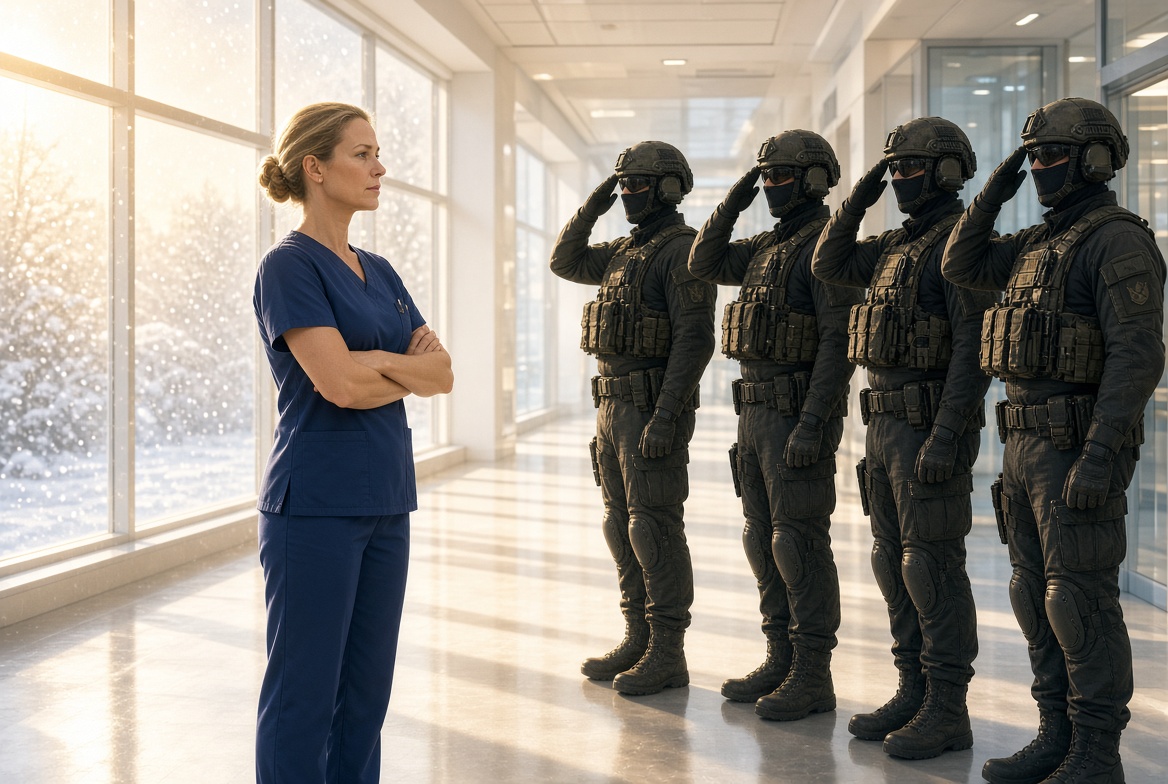
In perfect unison, the four heavily armed men threw a crisp, razor-sharp salute to the woman holding a duffel bag.
“Major Shaw,” Donovan said, his voice ringing out through the silent ER.
The hospital staff gasped.
Keller’s jaw physically dropped.
Major Evelyn—Major Jessica Shaw—did not return the salute.
She stopped 10 feet away, her expression hardening into granite.
“Evelyn Gallagher is the name on the badge, Jim. And I told General Richard Clark when I left Syria that I was done. I am out. I’ve stitched up enough ghosts.”
The mention of the legendary four-star general sent a murmur through the few staff members who recognized the name.
“I know what you said, Jess,” Donovan replied, dropping the salute, his tone softening just a fraction, revealing a desperate urgency.
“And JSOC respected it. Even when you were working off the books for the Constellis Group in Damascus, we gave you your space. But we didn’t come here to drag you back to base. We came because we are out of time.”
Donovan motioned to the elevator bay.
Two more operators emerged, pushing a military-grade field stretcher.
On it lay a man in tactical gear, his face gray, surrounded by a terrifying amount of blood.
“Call sign Viper is down,” Donovan said, his voice tight.
“Hit during a HALO insertion over the Canadian border. It’s a high-velocity rifle round through the descending aorta. My medics deployed a REBOA balloon catheter in the field to temporarily block the blood flow and keep him alive. But the balloon can only hold for another 20 minutes before his lower organs necrose from ischemia. The blizzard grounded our flight to Seattle. You are the only Tier 1 trauma surgeon within a 500-mile radius who has performed this specific vascular graft under field conditions.”
Jessica stared at the man on the stretcher.
The heavy silence of the hospital pressed in on them.
She wasn’t just a nurse.
She was one of the most highly decorated black-ops trauma surgeons on the planet.
She dropped her duffel bag.
“Which side is the entry wound?” she snapped, her voice transforming into a sharp, commanding bark.
“Left posterior thorax. Exit through the right lateral abdomen,” a medic answered, sprinting forward.
“Get him into OR 1 now,” Jessica commanded.
The emergency room exploded into motion.
But this time, Jessica was conducting the orchestra.
She marched toward the surgical wing, the tactical team rolling the stretcher behind her.
“Wait, you can’t just commandeer my operating room,” Keller yelled, finally finding his voice, jogging after them.
“She doesn’t have surgical privileges here. She’s a nurse. David, stop them!”
Colonel Donovan stepped gracefully in front of Keller, putting a massive gloved hand squarely on the doctor’s chest, stopping him dead in his tracks.
“Dr. Keller, as of this exact second, Sacred Heart Memorial is under federal military jurisdiction. If you step past this line, I will have my men zip-tie you to a wheelchair and lock you in a janitor’s closet. Am I understood?”
Keller looked into Donovan’s dead, unblinking eyes and swallowed his protests, stepping back in absolute humiliation.
Inside OR 1, Jessica had already scrubbed in.
There was no time for hospital protocols.
The military medics acted as her surgical nurses, opening sterile packs of specialized equipment they had brought in airtight Pelican cases.
Brenda, the charge nurse, had followed them in, standing paralyzed in the corner.
“Brenda,” Jessica barked.
“Don’t just stand there. I need you to run the rapid transfuser. Hang four units of O negative blood now.”
Brenda jolted to life, her hands shaking as she grabbed the blood bags, relieved to be taking orders from the woman she had gossiped about just hours earlier.
“Patient is prepped. Heart rate is 140, BP is 50 over palp. The REBOA balloon is at maximum inflation,” the military medic reported.
“Scalpel,” Jessica demanded.
What followed was a master class in extreme trauma surgery, executed with a brutal, terrifying speed that left Brenda breathless.
Jessica didn’t hesitate.
She opened the operative’s chest cavity with swift, precise movements, navigating the pool of dark blood to find the shredded aorta.
The tension in the room was suffocating.
The rhythmic beeping of the heart monitor was erratic, screaming warnings of impending cardiac arrest.
“I have the tear,” Jessica said, her hands deep inside the chest cavity, remarkably steady despite the chaotic pulsing.
“I need vascular clamps. Deflate the REBOA on my mark. If we don’t get the graft on in exactly four minutes, he bleeds out on the table.”
“Clamps ready,” the medic said.
“Mark.”
The balloon was deflated.
A geyser of arterial blood erupted, painting the front of Jessica’s gown crimson.
She didn’t flinch.
In a blur of motion, she clamped the massive artery above and below the tear, isolating the damage.
The monitor flatlined as the blood pressure plummeted.
“He’s coding,” Brenda screamed.
“Ignore the monitor. Keep squeezing that blood in,” Jessica ordered, entirely unfazed.
She moved her hands with mechanical precision, suturing a synthetic Dacron graft over the gaping hole in the aorta.
Her suturing was impossibly fast, a blur of silver needles and thread tied off with flawless military knots.
“Releasing clamps,” Jessica said.
Precisely three minutes and 40 seconds later, she slowly released the pressure.
The graft held.
No leaks.
The massive artery began to pulse rhythmically once again, sending life-saving oxygenated blood down to the dying lower half of the soldier’s body.
“Push 1 milligram of epinephrine,” Jessica ordered.
The medic pushed the drug.
Five seconds later, the flatline on the monitor jumped, spiked, and fell into a rapid but stable sinus rhythm.
“Blood pressure is rising. 90 over 60. He’s stabilizing,” the medic breathed, wiping sweat from his forehead.
Jessica stepped back from the table, exhaling a long, slow breath.
The icy demeanor melted for just a fraction of a second, revealing the sheer exhaustion beneath.
She looked at the stabilized soldier, then at Brenda, who was staring at her with wide, reverent eyes.
“Close him up,” Jessica told the military medics.
She pulled off her blood-soaked gloves and gown, throwing them into the corner.
She walked out of the OR.
The hallway was completely silent.
The hospital staff, including Thornton and a thoroughly broken Dr. Keller, watched her emerge.
Nobody dared to speak.
Colonel Donovan stepped forward.
“Incredible work, Major.”
“The graft will hold for transport to Walter Reed,” Jessica said, her voice returning to a quiet murmur.
She walked over to her canvas duffel bag, picking it up.
“But I meant what I said, Jim. I’m a ghost. Lose my number.”
“Understood, Major,” Donovan said softly.
Jessica walked toward the helipad elevator, the crowd parting silently to let her through.
She didn’t look back.
Ten minutes later, the heavy thumping of the Black Hawk’s rotors shook the hospital once more as the matte-black gunship lifted off into the blizzard, disappearing completely into the dark winter sky.
Back in the administrator’s office, David Thornton slowly approached his computer to look at Evelyn Gallagher’s personnel file one last time.
As he watched, the screen flickered.
The black redaction bars vanished, replaced by an error message.
“File not found.”
The quiet nurse who saved two lives in one night had been erased from the system, leaving nothing behind but a legend that Sacred Heart Memorial would never forget.
The legend of the quiet nurse who saved two lives and vanished into a winter storm still echoes through the halls of Sacred Heart Memorial.
No one knows where Evelyn Gallagher went, but they never forgot the day the shadows revealed a true hero.









