The Painting Morphy Said He Could Win, and What the Engine Found
In the autumn of 1861, at a dinner party in Richmond, Virginia, the best chess player in the world rose from the table. He walked over to a picture on the wall and stood in front of it for a long time.
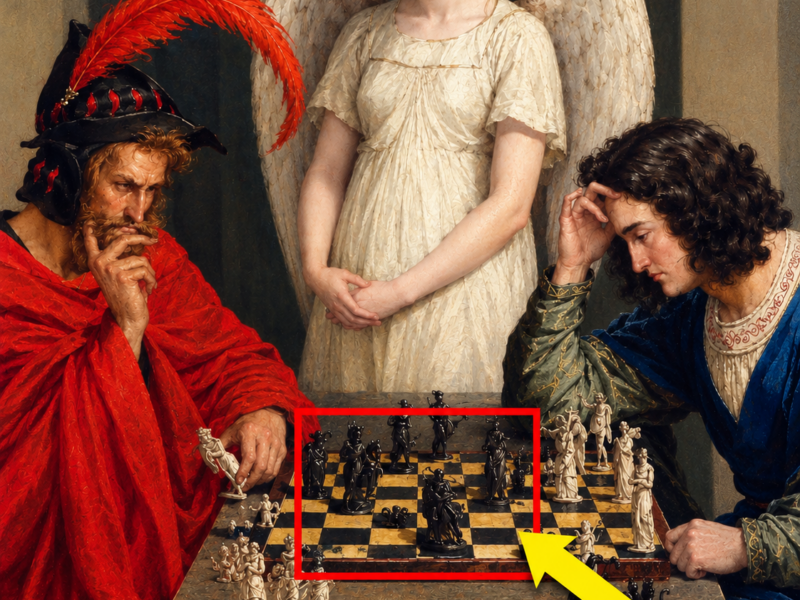
It showed a young man playing chess against the devil, with his soul as the stake. The devil lounges in a red cloak, chin in his hand, staring at his opponent. The young man clutches his forehead, and behind them an angel looks down at the board with something close to pity.
Everyone in that room read it the same way: the young man had lost. The chess player thought otherwise. What happened next has been retold ever since, mostly from pulpits, and it usually ends with the line “the king has one more move.”
Plenty of chess players online call the whole thing a fairy tale. People have drawn this board many times, and hardly any two diagrams agree. So the question is worth testing. Rebuild the position piece by piece from the painting, own every judgment call, and hand it to Stockfish, an engine that would beat any human who has ever lived and has no interest in sermons.
The design is by Moritz Retzsch, a professor at the Dresden art academy who made his name illustrating Goethe’s Faust. According to a study of the picture published in 2011, he worked this scene out himself, right down to the chess pieces. A drawing exists from around 1827, and by 1831 it was in print as an etching titled Die Schachspieler, “the chess players.”
There is not just one version. Besides the etching there are painted versions, and they do not match in every detail. One, sold at Christie’s in London in 1999, has the devil in dark green. The version analyzed here, with the red cloak, is the sharpest image available, and where the versions disagree, the differences are flagged.
The chess player at that dinner was Paul Morphy of New Orleans. In 1858, at twenty-one, he toured Europe and beat every serious player who would sit down with him, then came home and more or less gave the game up.
His host, R. R. Harrison, a lawyer who later became a clergyman, owned a print of the picture. Morphy turned to him and said, modestly, that he thought he could take the young man’s game and win. He took the young man’s side and won.
The other guests assumed the devil had simply been badly played, so one by one they tried his side themselves. Morphy beat every one of them.
The story first appeared in August 1888, in a New York paper called the Columbia Chess Chronicle, four years after Morphy was found dead in his bath. The article says the young man won. It never says how.
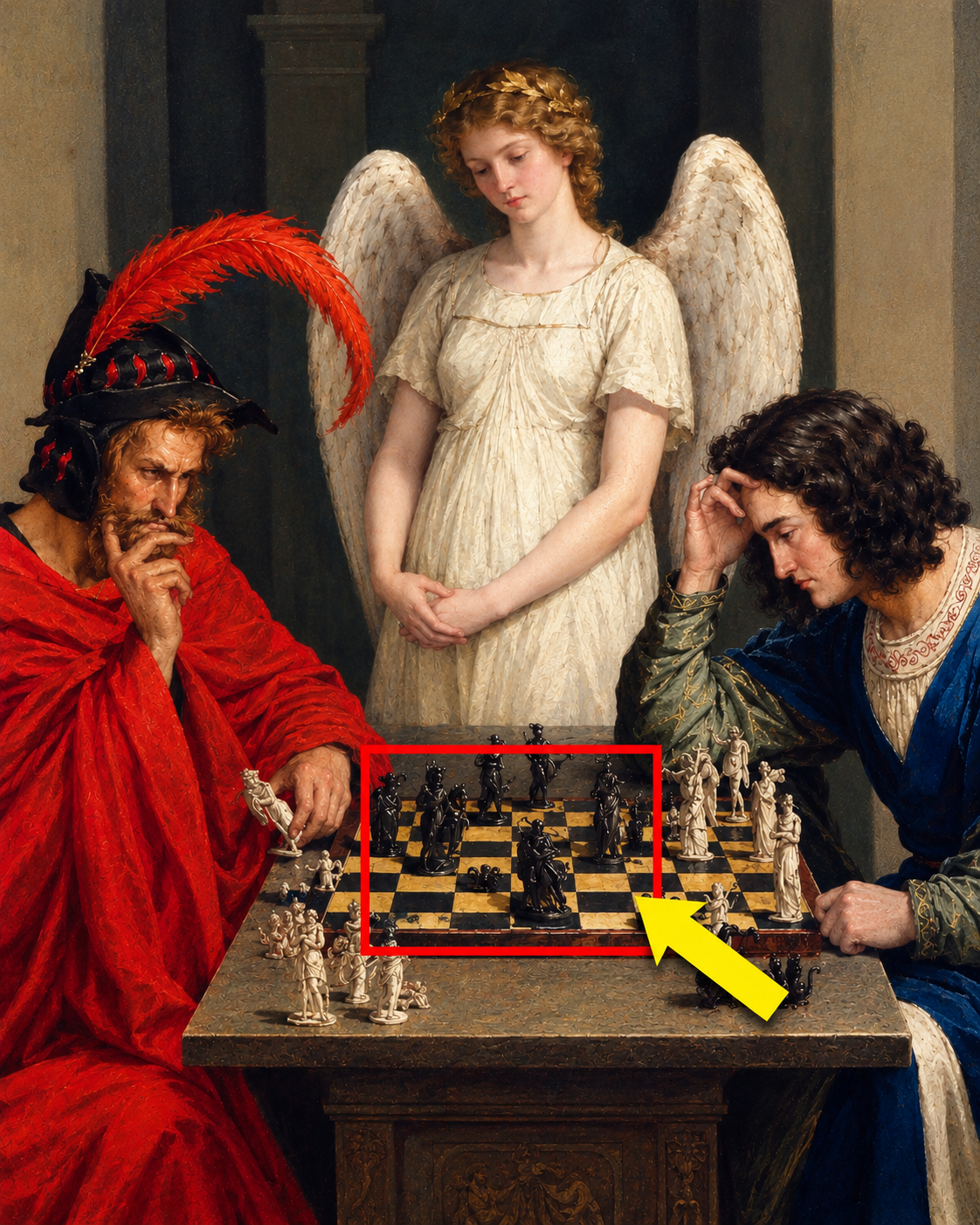
To find out, you first have to get the position right. Every square on a chessboard has a name, a letter from a to h and a number from 1 to 8, and the young man plays White, from the right. A grid laid over the painting puts each figure on the square where its feet stand.
As a check, forty of the forty-six squares clearly visible came out the right color. The six that did not are partly hidden by figures. The back rows are squashed by perspective, so that is where the uncertainty is greatest.
Then comes the question of who is who. In 1837 the picture was published with a text by Retzsch’s friend Karl von Miltitz, written, according to that 2011 study, from hints Retzsch gave him. It describes every piece, and it is the guide here.
The young man’s queen is Religion, a winged figure with a cross, arm held out in protection, on d2. His king is his own Soul, wearing butterfly wings, standing behind her on d1. In the corners are Hope, with her anchor, on a1, and Truth, with a torch and a reflecting shield, on h1. The text says Truth stands with Hope as a castle, the old word for rook.
His three remaining pawns, angels’ heads that signify Prayer, sit on a2, e2 and e3.
The devil’s king “represents himself,” cloak and all, on d8. His queen is Pleasure, a voluptuous figure offering the cup of intoxication, on d4. Indolence, with the head of a swine, sits on a5. Pride, with his splendid peacock’s tail, is on g5. Unbelief, an impudent horned figure, is on c7. The bent, lean figure on f6 fits Avarice, which leaves Falsehood, by elimination, on g3.
The small bat-winged Doubts stand on a3, b6, e4, g6 and h2. A sixth is mostly hidden behind the horned figure on f7, so that one deserves caution. By the count, one more Doubt should be on the board. It could not be found, so it has been left off.
Count what is on the board, on the table and in the devil’s hand, and all sixteen of White’s pieces are accounted for. Peace is still in the devil’s hand, which means he has just moved. It is the young man’s turn.
The text leaves one thing out. It names the king, the queen, the pawns and the two castles, but the devil’s six officers appear only as a numbered list. Every one of the devil’s pieces, pawns aside, stands on a dark square. A bishop never leaves its color, so his light-squared bishop cannot be on the board. It must be the piece he has lost, and apart from one pawn, the only piece he has lost is Anger.
So Anger was a bishop, and either Pride or Falsehood has to be a rook. The old sources that assign roles both make Pride a bishop, so Falsehood becomes the rook. That is a judgment call, and the part of the setup that is least certain, which is why the alternatives were tested too.
There is also a reason the diagrams online disagree so much. About a month after the Morphy story ran, a reader named Charles Gilberg sent the Chronicle a diagram of the position, and it is still passed around today. It does not match this painting.
But flip the painting left to right and twelve of the twenty pieces land on the same squares as Gilberg’s, including both kings and both queens. The best guess is that he worked from a reversed print, an easy mistake when a picture is copied onto a printing plate.
Now the position itself. If you play chess, you have probably spotted the obvious move. Religion takes Pleasure. The young man’s queen captures the devil’s queen, and because nothing stands between her and the devil’s king, it is check. It is the move people point to as proof Morphy was right.
Stockfish has an answer ready. The devil does not move his king. He slides Indolence, the pig, along the row and into the gap, which blocks the check and pins the young man’s queen to her own king. She cannot get out of the way, and she is lost. The laziest piece on the board is the one that does it.
The other way to take Pleasure is with the pawn, and it fails for a nastier reason. That pawn was the only thing standing between Religion and Pride on the same diagonal. The pawn moves, and Pride takes Religion.
Taking with the queen lasts longest, and even then the young man is checkmated in thirteen moves. Everything else loses faster.
Because the piece identities could be wrong, all thirty legal ways of deciding which of the devil’s figures is a rook, a knight or a bishop were tested. The devil wins in twenty-nine. The thirtieth is a draw, and only if the pig is a bishop and Pride is a knight, when the old sources make him a bishop.
Leave out the hidden pawn on f7, or move the young man’s pawn from e3 to d3, as some diagrams do, and the devil still wins.
So what did Morphy do? The 1888 story never claimed a forced win. It says he beat a string of dinner guests, so that was tested as well: twenty games, with Stockfish at full strength as the young man and the devil held back to different human levels.
The young man won once, against the weakest devil tried. Every stronger devil won every game. Morphy was the best player alive, facing gentlemen who were not. That is enough for one remarkable night in Richmond.
Whether Retzsch worked out the chess, nobody can say. But the text written from his hints in 1837 warns that the game “must be lost, if Religion be sacrificed.” On this board, take Pleasure either way, and Religion is what you lose.









