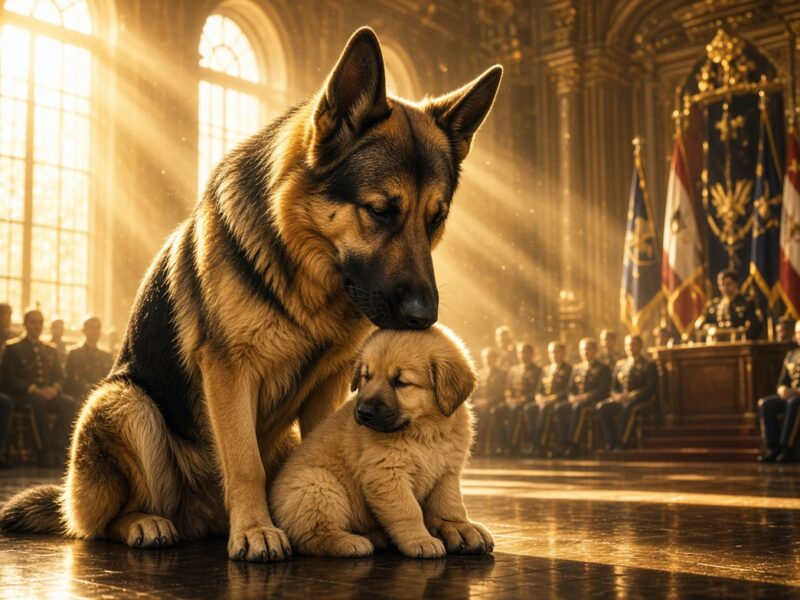
The Old War Dog Didn’t Flinch… Until a Tiny Puppy Sat on His Paw in Front of 200 Soldiers
The dog didn’t move when the puppy came through the door.
Two hundred soldiers were watching.
The ceremony had been going for forty minutes. Speeches, a citation, a framed photograph of eleven years of service.
And through all of it, Sergeant Major, the nine-year-old German Shepherd who had ruled Joint Base Lewis-McChord’s military working dog unit since before half the people in that room had enlisted, had sat at perfect attention beside his handler.
Ears forward. Eyes ahead. The way he had sat in Kandahar and Mosul, and on the flight line at 0300 when the temperature was nineteen degrees and the mission was already going badly.
He had not flinched. He had not wandered. He was, even now, even today, doing his job.
Then they brought in the puppy.
She was fourteen weeks old, blonde and stumbling, and approximately half the size of Sergeant Major’s head. And she crossed the linoleum floor of the K9 unit ceremony hall with the specific purposeless confidence of a creature that has not yet learned what it is supposed to be afraid of.
She reached Sergeant Major’s front left paw and sat on it.
Just sat on it. Like it was hers.
Nobody laughed. Nobody spoke. They were all watching Sergeant Major.
And what Sergeant Major did next was something that no one in that room, not the handlers, not the commanding officer, not the two reporters from the base newspaper who had come expecting a thirty-minute ceremony, would be able to describe adequately for weeks afterward.
Before we go any further, tell us where you’re watching from in the comments below. If this story moves you, please subscribe and stay with us all the way to the end. We read every single comment and this story is one we want to travel as far as it can go.
Gunnery Sergeant Nathan Cole, retired, was forty-one years old and had the kind of build that doesn’t come from a gym. It comes from seventeen years of doing things that require your body to function when it has no reasonable right to.
He stood six foot two and had wide squared shoulders that had never fully lost their military set and dark hair gone thoroughly silver at the temples in a way that had happened fast, the way it happens after certain deployments, not gradually.
His face bore three days of growth and a jaw that suggested his patience was larger than his expression. His eyes were a steady pale gray-green that people described, when they tried to describe them, as somewhere else, not absent, not distant, but calibrated to a frequency most people couldn’t hear.
He was not a man who performed things. He was a man who simply was and the room adjusted to him.
He had served as a military police K9 handler for the United States Marine Corps across four deployments, two in Helmand Province, one in Ramadi, and one in the Korengal Valley that he did not discuss in specifics and had signed documentation agreeing not to.
He had come home from the Korengal with a Silver Star, a traumatic brain injury from a vehicle-borne IED that had taken the vision in his left eye entirely and reduced the peripheral in his right to roughly sixty percent, and a nine-year-old German Shepherd named Sergeant Major who had been blown through the same vehicle door and had survived without a scratch.
Which Nathan, when he was in the mood to discuss it, called the clearest evidence he had ever personally witnessed that God has priorities, and they are not always the ones you’d expect.
He had retired from active service twenty-two months ago and was living in Lakewood, Washington, outside the base, doing training consultation work for civilian law enforcement units that wanted to build K9 programs. He was good at it.
He was not at peace.
What he still carried, twenty-two months out, was the particular loneliness of a man who had operated at the highest level of a team for seventeen years and was now consulting alone, mostly by phone, occasionally in person, for organizations that were not his unit and never quite would be.
He had Sergeant Major. He had the work. He was not unhappy, but the silence of a house that holds one man and one dog has a quality to it that a man who has spent seventeen years sleeping four feet from other people will feel in the bones long before he admits to it in language.
The ceremony today was not his idea.
The base had reached out three weeks prior, asking if he would attend Sergeant Major’s formal retirement ceremony, the official military working dog service recognition, the framed citation, the honorable discharge documentation.
He had said yes because Sergeant Major had earned it and because saying no to something Sergeant Major had earned was not a thing Nathan Cole was capable of.
Sergeant Major was a nine-year-old German Shepherd with a coat so dark it was nearly black along the spine, fading to deep amber at the legs and jaw, with a face that had settled over the years into an expression of permanent and unhurried authority.
He weighed ninety-seven pounds. His left hip carried the particular stiffness of a working dog who had been on hard surfaces for a long time, and he had begun in the last year to rise slowly in the mornings in a way he had never done before. Though once he was up, he moved with the same deliberate weight he had always carried.
His right ear bore a thin scar along the outer ridge from a piece of fragmentation in Helmand in 2016 that had grazed him without slowing him.
He had never in nine years and four combat deployments and six years of stateside duty failed to find what he was sent to find. He had been retired from active duty status six weeks prior.
He did not appear to have been informed of this.
The puppy’s name was Biscuit provisionally because the handler who had brought her in, a twenty-three-year-old Corporal named Okafor, who was two months into his K9 training, had not yet been formally assigned to her, and the unit had been calling her something while they waited.
She was a yellow German Shepherd, which was unusual. And she had the look of a dog who would be magnificent in about eighteen months, and was currently an extremely enthusiastic disaster.
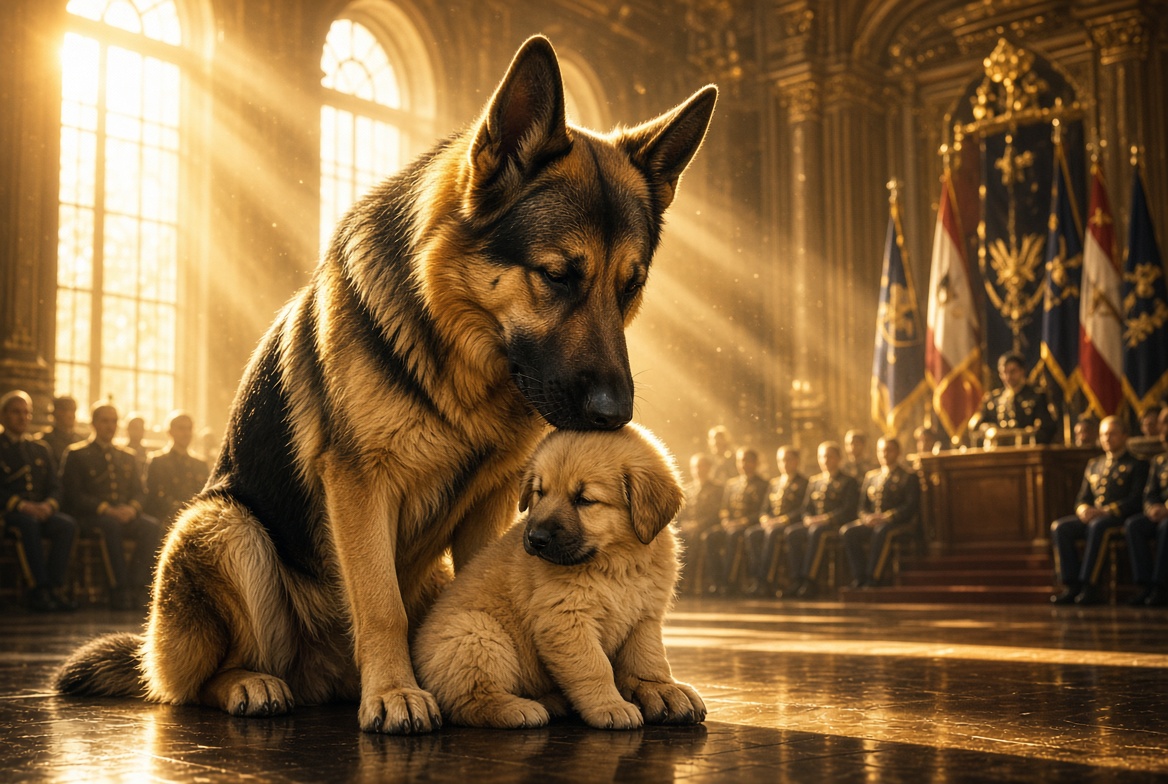
When she sat on Sergeant Major’s paw, he looked down at her.
His amber eyes went from the puppy’s face to the room and back to the puppy’s face. Then he lowered his great head very slowly and pressed his nose against the top of her head and held it there.
Two hundred soldiers went completely silent.
It was not the silence of people who were being polite. It was the silence of people who are watching something that they understand on a level below language to be important.
Captain Richard Harlan was the base’s military working dog program director. And he had been sitting in the front row for the ceremony with his arms folded and the expression of a man who considers forty minutes an unreasonable amount of time to be acknowledging a dog.
Harlan was forty-four years old and had come up through logistics and had been assigned to the K9 program directorship fourteen months ago after the previous director had retired.
And he had arrived with two priorities. Reduce the program’s operational budget by eighteen percent and consolidate the unit’s training schedule to free up facility space for a vehicle maintenance expansion he had been lobbying for since before he had the authority to pursue it.
He was a precise, efficient man who believed that sentiment was a resource leak.
He had publicly referred to the military working dog program in a meeting that three handlers had been present for and that none of them had forgotten as a legacy expenditure with diminishing tactical returns. He had smiled when he said it.
He was not an incompetent man. That was what made him dangerous.
He understood budgets with a fluency that most officers developed only after years of command. And he used that fluency the way some men use physical size. Not aggressively but as a background fact that shaped every conversation before it began.
His recommendations landed with the authority of precision. His memos were models of careful, insulated language.
When Staff Sergeant Reyes had pushed back on his first training schedule reduction, pointing out with documented evidence that the compressed timeline failed to meet Department of Defense standards for MWD handler certification, Harlan had listened to her with full attention and then reissued the directive unchanged three days later with a single added line noting that the schedule had been reviewed in consultation with appropriate oversight.
There was no record of such a consultation. There never was.
He had done this twice more in the following months on two separate directives and both times the record had been equally clean, equally undisprovable, equally designed to make disagreement look like misunderstanding.
He had been working through channels that he kept carefully above reproach toward a recommendation that would reduce the base’s active canine roster from fourteen dogs to eight and redirect the recovered budget to the vehicle maintenance project.
He had the numbers. He had the language. He had a meeting scheduled with the base commander for the following week.
He had made sure that this retirement ceremony was brief, that the citation was standard issue, and that the event would conclude before lunch so the facility could be prepared for an afternoon use he had already scheduled without informing the canine unit.
He had not expected two hundred people.
The ceremony had been announced internally as a small unit event. The invitation had gone to the canine unit’s current personnel and a handful of former handlers.
What Harlan had not anticipated was that the announcement had moved as these things move on a military base, from inbox to inbox and group text to group text. And that the story of Sergeant Major, eleven years, four deployments, two combat citations, one handler who had come home from the Korengal with sixty percent of his vision, had traveled through this base’s institutional memory in a way that a logistics-minded captain who had been assigned fourteen months ago would have no framework for measuring.
Two hundred soldiers had shown up. Some were in dress uniform. Some had driven from off post.
One man, a retired master sergeant named Calvin, who had been Sergeant Major’s original handler before Nathan, had driven four hours from Portland without telling anyone he was coming and was standing in the back of the room in civilian clothes with his arms at his sides and his jaw set in the way that men set their jaws when they have decided they are not going to cry in public and are losing the argument.
Harlan was aware of all of this and it had not changed his plan.
After the ceremony, he intended to deliver a memorandum to the K9 unit’s current senior handler, a staff sergeant named Reyes, informing her that the facility request for the afternoon had been approved and that the unit should plan for reduced operational space beginning the following month as the vehicle maintenance renovation was scheduled and scoped.
He intended to do this publicly in the room while people were still gathered. He believed that doing so while morale was high from a ceremony was tactically advantageous.
He had miscalculated what kind of room he was standing in.
The memorandum was in his jacket pocket when the puppy sat on Sergeant Major’s paw.
And then Nathan Cole, who had been standing at the front of the room with Sergeant Major at his left side, turned to face the assembled soldiers in the silence that followed.
Two hundred people who were not making a sound. And he spoke for the first time since the commanding officer had asked him early in the ceremony if he had anything to say.
He had said no then. He had something to say now.
He spoke without notes and without raising his voice. And the room was quiet enough that every word reached the back wall.
He said that Sergeant Major had found eleven IEDs over four deployments. And that the math on what eleven IEDs found versus not found produces was not a number he would say aloud. Because numbers that large become abstract.
And what was not abstract was the specific faces of the men in his unit who would come home.
He said that Sergeant Major had stayed in a blown vehicle in the Korengal for forty-seven minutes while the extraction team worked. Lying across Nathan’s chest with his full weight because the vest Nathan was wearing was not holding heat. And it was thirty-one degrees and Sergeant Major had made a decision about what his job was in that moment that Nathan had never been asked for and had never been able to repay.
He said he had lost most of his left eye in that vehicle and had come home still able to see his daughter’s face, which was not a thing he took lightly and which he attributed, without qualification, to the dog now standing beside him.
He paused.
Then he said, “There is a memorandum in this room tonight that recommends reducing this unit’s operational capacity by forty percent.”
He said he had seen it. He said it had been shown to him by a staff sergeant who believed he should know.
He said he wanted to be clear. And he wanted to be clear in front of the two hundred people standing in this room about what that recommendation actually means. Not in budget language, but in the only language that has ever mattered to him, which is what happens to the people who go to the places where these dogs are needed.
Harlan was on his feet.
Nathan Cole looked at him. His pale gray-green eyes, the ones that only worked at sixty percent, found Harlan’s face without difficulty and held it without expression.
“I know who you are,” Nathan said. “And I know what’s in your pocket.”
The room did not make a sound.
He said the rest of what he had to say in four sentences.
He said that the base commander had received that afternoon a formal request for review of the K9 program directorship’s budget recommendations, co-signed by seven former K9 handlers with a combined forty-three years of military working dog experience and submitted through JAG because he had been advised that was the correct channel.
He said that two members of the House Armed Services Committee had been contacted by a veterans advocacy organization he would not name at this time who had expressed interest in the program’s situation.
He said that Staff Sergeant Reyes had documented in writing every directive that had come from the program director’s office in the past fourteen months and that documentation was currently with the base Inspector General.
He said he hoped that was helpful information.
He said all of this in the same voice he had used to brief command in Helmand. Factual, complete, without any decoration.
When he finished, he did not look at anyone for a reaction. He looked down at Sergeant Major.
The dog had not moved. He was looking out at the room with the same settled attention he brought to everything, and his tail, which had not moved once during the entire ceremony, moved now once, slowly, from one side to the other and then was still again.
Harlan’s face had gone three distinct expressions during Nathan’s remarks. The first was dismissal. The second was calculation.
The third was something that had no good name, but that everyone in a room of two hundred soldiers recognized immediately because they had all seen it at one point or another in someone who has just understood that the terrain is different than they believed it was and that the exit they planned is no longer available.
He looked at Nathan Cole. He looked at the room. He did not speak.
A woman in the third row, a captain from the base’s legal office who had not been on anyone’s list of attendees and who had simply heard about the ceremony and come, was writing something in a small notebook.
Harlan put the memorandum back in his pocket. He walked to the side door. He opened it. The sound of it closing behind him was the only sound in the room for a long moment.
Calvin, the retired master sergeant from Portland, who had driven four hours and was standing in the back of the room with his arms at his sides, exhaled slowly, all the way out.
Sergeant Major looked up at Nathan. He leaned his great dark head against Nathan’s left leg and held it there. Nathan put his hand on the dog’s neck without looking down and the puppy, still sitting on the paw, wagged her tail three times and went back to sleep.
Captain Richard Harlan submitted a transfer request two weeks later. It was approved.
He left Joint Base Lewis-McChord in March and was assigned to a logistics post in Georgia with no canine component.
The budget recommendation he had drafted was formally withdrawn by the base commander following the Inspector General review, which concluded that the documentation provided by Staff Sergeant Reyes was consistent and credible, and that the program director had operated outside the scope of his authority on four separate directives.
The K9 program’s operational budget was restored in full. The vehicle maintenance expansion was redesigned at reduced scope and did not require the K9 facility.
Four months later, in the spring, Corporal Okafor and the yellow German Shepherd, now officially designated Scout, completed their formal certification together and were cleared for active duty.
On the day of their certification, Nathan drove to the base and sat in the back of the observation room and watched.
Scout was seventeen months old and no longer stumbled. And the particular way she moved through a search pattern, methodical, close to the ground, ears working independently, had the look of something that had always been in her and was now simply being expressed.
When she finished her final assessment and Okafor put her through her cool down, she saw Nathan across the room and sat down and looked at him with the amber eyes that all German Shepherds seem to share regardless of coat color, and her tail moved once, slowly, and she looked away.
Nathan drove home on roads wet with April rain with Sergeant Major sleeping in the backseat in the way old dogs sleep, fully, without reservation, with the total confidence of an animal that has decided the world will still be there when he wakes up.
The stiffness in the old dog’s hip had not improved. The silver in Nathan’s hair had not reversed. The sixty percent was still sixty percent and would not be more.
He thought about the room. About two hundred people who had shown up to a ceremony that had been scheduled to be quiet and small. About Calvin in the back with his arms at his sides and his jaw set.
About Staff Sergeant Reyes who had been keeping records in a folder for fourteen months without being asked to. Doing it the way good soldiers keep records. Not because they know what they’ll be used for. But because something in them understands that the truth requires a witness.
About the puppy sitting on a paw that had walked four combat deployments and had never once been asked to sit still for something this small. And had done so anyway with the same seriousness it had brought to everything else.
But in the spring evening with the rain on the windows and the old dog breathing steadily in the back, Nathan Cole felt something he had not felt clearly in twenty-two months of working alone in a quiet house.
He felt accounted for. Not celebrated. Not honored. Simply counted.
Known, seen by people who understood what the work was and had shown up to say so. And had shown up in a number, two hundred. That a logistics-minded captain with a memorandum in his pocket had not predicted and could not answer.
Sometimes the bravest thing a soldier ever does has nothing to do with the battlefield. Sometimes it happens in a ceremony room on an ordinary Thursday when a dog who has already given everything he had to give lowers his head over a sleeping puppy and reminds two hundred people without a single word what loyalty looks like when it has been fully lived.
God places that kind of witness in our path when we need it most. Not with thunder. Not with announcement. With a dog’s breath and a sleeping puppy, and a room that goes quiet because it recognizes in the oldest part of itself something true.
The world still has men who will stand up in a room of two hundred people and say what is right. Not because they are certain it will work, but because silence in that moment would be a betrayal of everyone the dog had carried home.
That is the whole story. It is also everything.
If this story touched your heart, share it with someone who needs to be reminded that loyalty still exists in this world. Leave a comment and tell us where you’re watching from.
And if you’ve ever seen an animal do something that left a room speechless, we would love to hear that story. Your words may reach someone who needs them tonight.
If you believe in stories of service, courage, and the faithful bond between a soldier and his dog, please subscribe to the channel so you never miss the next one.
May God bless you, protect your family, and remind you always, those who served faithfully are never forgotten, not by the ones who were there.
—
The weeks that followed the ceremony moved in a way that Nathan Cole had not expected and did not have language for.
He had spent twenty-two months building a life that was small by design. A house in Lakewood with a fenced yard. A truck that ran. A consulting schedule that kept him on the phone four days a week and on the road one or two.
He had built it the way a man builds a shelter after a storm. Methodically. Without decoration. With an eye on what would hold.
And then a ceremony he had agreed to attend out of duty had opened a door he had not known was there.
The first phone call came three days after the ceremony. A number he did not recognize. A woman’s voice, older, careful.
“My name is Dorothy Klein,” she said. “I’m the mother of a Marine who served with you in the Korengal. He came home because of what your dog found.”
Nathan was standing in his kitchen with a cup of coffee going cold in his hand. Sergeant Major was on the floor by the back door, asleep in a patch of afternoon sun.
“Which Marine,” Nathan said.
“Jason Klein. He was a corpsman attached to your unit. He’s a physician now in Tacoma. He saw the story about the ceremony on the local news and he asked me to call you because he didn’t think you’d answer if he called himself.”
Nathan was quiet for a moment. He remembered Jason Klein. A kid with glasses and a steady voice and hands that had worked on three men in the back of a vehicle in the Korengal while Sergeant Major had lain across Nathan’s chest and kept him warm.
“He doesn’t need to thank me,” Nathan said.
“He knows that. He wants to thank the dog.”
Nathan looked at Sergeant Major. The old dog’s breathing was slow and even. His paws twitched once, twice, the way they did when he was dreaming.
“Tell him to come by,” Nathan said. “The dog doesn’t do much these days but sleep. But he’ll remember him.”
Jason Klein came the following Saturday. He was thirty-eight now, tall and thin with the kind of calm that Nathan recognized because he had seen it in combat medics before. The kind of calm that comes from having been the last person between someone and the end of their life.
He sat on the floor next to Sergeant Major and did not say anything for a long time. He just put his hand on the dog’s side and let it rest there.
Sergeant Major opened his eyes. He looked at Jason Klein for a long moment. Then he closed his eyes again and let out a breath that seemed to come from somewhere deep in his chest.
“He remembers,” Jason said.
“Yeah,” Nathan said. “He does.”
They sat in the kitchen for two hours. Jason talked about his work at the hospital in Tacoma. About his wife and his two daughters. About the fact that he had thought about that day in the Korengal every week for seventeen years and had never found a way to say what it meant.
“I was twenty-one years old,” Jason said. “I had been in country for six weeks. I didn’t know anything. And when that IED went off and everything went sideways, I was the only medical person within ten miles.”
He looked at Sergeant Major.
“Your dog found the second IED before we hit it. He found the third one while we were waiting for extraction. There were four more in that road. Four. And he found every one of them.”
Nathan did not say anything.
“I have three daughters now,” Jason said. “And I think about the fact that I almost didn’t come home. And I think about the fact that a dog who had no way of understanding what he was protecting made a decision to lie on top of a man who was bleeding out and keep him warm for forty-seven minutes.”
He stopped. His jaw worked.
“I named my youngest daughter after him,” he said. “Not Sergeant Major. That would be strange. But I named her Major. Because I wanted her to have something in her name that meant what that dog meant.”
Nathan looked at the floor. Then he looked at Sergeant Major. The old dog was awake now, watching Jason Klein with the same steady amber eyes that had watched over four combat deployments.
“He doesn’t know what he did,” Nathan said. “He just knew it was his job.”
“I know,” Jason said. “That’s what makes it matter.”
—
The story of the ceremony did not stay in the room.
It moved through the base the way stories move through institutions that have been waiting for a reason to feel something. The two reporters from the base newspaper who had come expecting a thirty-minute ceremony wrote something that ran longer than they had planned and shorter than the story deserved.
A local television station in Tacoma picked it up. Then a Seattle paper. Then a national outlet that covered military affairs.
By the end of the second week, Nathan Cole had received forty-seven emails from people he had never met. Veterans. Handlers. Men and women who had served with dogs in Vietnam and Iraq and Afghanistan and had never found a way to explain what those dogs had meant to them.
One email was from a woman named Sarah Whitfield, who had been a K9 handler in the Air Force in the nineties and had spent the years since her retirement running a rescue organization for retired military dogs.
“Your story is the reason I’m writing,” she said. “Not because I want anything. Because I’ve spent twenty years watching dogs like Sergeant Major retire into silence and I’ve never seen anyone stand up and say what you said.”
She had attached a photograph. A black and white image of a German Shepherd in a field, ears up, eyes forward.
“That was my dog. Rex. He died in 2010. I still dream about him.”
Nathan read the email three times. Then he wrote back.
“Thank you for your service. And for Rex’s.”
That was all he said. But Sarah Whitfield wrote back within an hour.
“You don’t understand what you did,” she said. “You made people remember that these dogs aren’t equipment. They’re not line items. They’re not legacy expenditures with diminishing tactical returns.”
Nathan read that phrase twice. Legacy expenditure with diminishing tactical returns.
He had not known that was the phrase Harlan had used. He had guessed. But reading it in Sarah Whitfield’s email made it real.
“The story is already changing how some of these units talk about their dogs,” she said. “I’ve had three program directors reach out this week. Three. They want to know how to build better retirement protocols. They want to know how to honor what these dogs have given.”
Nathan put his phone down. He looked at Sergeant Major, who was asleep on the floor by the back door in the same patch of sun he had claimed for the past three years.
He had not planned any of this. He had not intended to start a conversation that would move through institutions and change policies and reach people he would never meet.
He had stood up in a room because a captain had been about to deliver a memorandum that would have reduced the unit that had saved his life. And he had spoken because silence in that moment would have been a betrayal of everyone the dog had carried home.
That was all. That was everything.
—
The following month, Nathan received an invitation he did not expect.
It came in a plain white envelope with the return address of the House Armed Services Committee. Inside was a single sheet of paper with a handwritten note from a representative he had never heard of.
“The story of your dog is the reason we’ve added language to the defense appropriations bill that will create a formal retirement protocol for military working dogs across all branches of service. The language is small. It will not change the world. But it will mean that dogs who have served will have a pathway to dignity when their service ends. We would like you to be present at the committee hearing next month. Not to testify. Just to be there. To remind us what this is about.”
Nathan read the note twice.
He did not know what to do with it. He had spent seventeen years in the Marine Corps doing work that was designed to be invisible. The best outcomes were the ones that never made the news. The best days were the ones where nothing happened and everyone came home.
He had spent twenty-two months after retirement trying to build a quiet life. And now a puppy sitting on a paw had opened a door he had not known was there and a room full of people had walked through it and the world was asking him to be present in a way he had never been asked before.
He called Sarah Whitfield.
“There’s a hearing in Washington,” he said. “They want me to be there.”
“What are you going to do?”
“I don’t know. I don’t like being visible. I don’t like people looking at me.”
“You don’t have to like it,” she said. “You just have to show up.”
Nathan was quiet for a moment.
“That’s what Sergeant Major did,” he said. “For eleven years. He showed up.”
“Yes,” Sarah said. “He did.”
—
The hearing was in a room that was smaller than Nathan had expected. A long table, a row of microphones, flags behind the chairs where the committee members sat.
Nathan sat in the back. He had brought Sergeant Major, who was allowed in the building under a special accommodation that had been arranged by someone on the committee staff who understood what the dog was.
Sergeant Major lay on the floor beside Nathan’s chair. His hip was stiff. The walk through the corridors had been slow.
But he was there. He had shown up.
The hearing lasted two hours. The witnesses included a retired general, a veterinarian who specialized in working dog medicine, a representative from a veterans service organization, and a woman named Sarah Whitfield who had been asked to speak about the state of retirement protocols for military working dogs across the branches.
Sarah spoke for twelve minutes. She spoke about dogs she had seen retired into kennels where no one visited them. She spoke about dogs who had been separated from their handlers because the paperwork did not allow for adoption. She spoke about the gap between what dogs gave and what they received.
At the end of her testimony, she said something that Nathan did not expect.
“One of the reasons I’m here today,” she said, “is a story that a lot of people have heard by now. About a ceremony at Joint Base Lewis-McChord. About a dog named Sergeant Major. And about a man who stood up in a room of two hundred soldiers and said what needed to be said.”
She looked at Nathan.
“I don’t know if he wants to be recognized. But I want the record to reflect that without his willingness to speak, we might not be here today.”
The room was quiet. Nathan looked at the floor.
Sergeant Major lifted his head. He looked at the committee. He looked at Sarah. Then he put his head back down and closed his eyes.
The representative who had sent the invitation looked at Nathan with an expression that was not quite a smile. It was something else. Something that suggested she understood what it cost a man like Nathan Cole to be seen.
After the hearing, Nathan stood in the hallway with Sergeant Major beside him. People came up to him. They shook his hand. They thanked him. They told him stories about dogs they had known.
One man, a former Army handler who had served in Iraq, stood in front of Nathan for a long moment without saying anything. Then he said, “I had a dog named Rusty. He died three years after we came home. I still think about him every day.”
Nathan nodded.
“They don’t leave,” he said.
“No,” the man said. “They don’t.”
—
The defense appropriations bill passed six weeks later. The language that created the retirement protocol was small. It was buried in a section that most people would never read.
But it was there. A pathway to dignity for dogs who had served.
Nathan read about it in a news article that was three paragraphs long and appeared on a page that was mostly advertisements. He read it three times.
Then he looked at Sergeant Major, who was asleep on the floor by the back door in the same patch of sun he had claimed for the past three years.
“We did something,” Nathan said.
Sergeant Major did not open his eyes. His tail moved once, slowly, from one side to the other.
Then it was still.
—
That summer, Corporal Okafor and Scout completed their first deployment together. They were sent to a base in the Middle East where the work was steady and the days were long.
Scout found three IEDs in her first two months. She found a weapons cache in her third month. She did exactly what she had been trained to do and did it with the same methodical intensity that Nathan had seen in her at seventeen months old.
Okafor sent Nathan a photograph. Scout sitting beside a concrete barrier with her ears up and her eyes forward and the same amber eyes that all German Shepherds seem to share regardless of coat color.
“She’s incredible,” Okafor wrote. “She doesn’t stop. She doesn’t quit. She reminds me of Sergeant Major.”
Nathan looked at the photograph for a long time.
Then he wrote back.
“She learned from the best. Not from me. From him.”
—
The years that followed were not dramatic. They were not the kind of years that produce headlines or stories that travel across the country.
They were the kind of years that happen when a man builds a life around a dog who has given everything and a purpose that has been earned through service.
Nathan Cole continued his consulting work. He expanded it. He began to travel more. He spoke at conferences for law enforcement K9 units. He helped departments build training programs that were based on what he had learned in seventeen years of handling dogs in combat.
He was not alone. He had never really been alone. He had Sergeant Major.
But the silence in the house changed. It was not the silence of a man who had operated at the highest level of a team and was now working alone. It was the silence of a man who had been seen. Who had been counted. Who had been reminded that the work he had done mattered in ways that could not be measured in budgets or tactical returns.
Sergeant Major slowed down. His hip grew stiffer. His walks became shorter. His sleep became deeper.
But every morning, when Nathan woke up, Sergeant Major was there. Ears forward. Eyes ahead. Waiting for whatever the day would ask of him.
And every morning, Nathan would put his hand on the dog’s neck and say the same thing.
“We’re still here, old man. We’re still here.”
—
The last chapter of Sergeant Major’s life was quiet.
He died in the fall, three years after the ceremony, at the age of twelve. He died in the same patch of sun by the back door where he had spent so many afternoons. Nathan was sitting beside him. The veterinarian had come to the house.
Sergeant Major did not seem afraid. He looked at Nathan with the same steady amber eyes that had watched over four combat deployments. Then he closed them.
His breathing slowed. Then it stopped.
Nathan sat with him for a long time. The sun moved across the floor. The house was silent.
He thought about the ceremony. About two hundred soldiers who had gone silent when a puppy sat on a paw. About a captain who had walked out a side door and never come back. About a room that had recognized in the oldest part of itself something true.
He thought about the Korengal. About forty-seven minutes in a blown vehicle with a dog lying across his chest. About the warmth that had come from somewhere other than his vest.
He thought about the fact that he had come home. That he had been able to see his daughter’s face. That a dog who had no way of understanding what he was protecting had made a decision about what his job was in that moment and had never wavered.
He thought about the puppy sitting on a paw that had walked four combat deployments. About the way Sergeant Major had lowered his great head and pressed his nose against the top of her head and held it there.
He thought about the fact that the story had traveled further than he ever could have imagined. That it had reached people who needed to hear it. That it had changed policies and protocols and the way some units talked about their dogs.
And he thought about the fact that Sergeant Major had never known any of that. He had just done his job. He had shown up. He had stayed.
That was all. That was everything.
Nathan buried him in the back yard, under the tree where they had spent so many afternoons together. He put a stone over the grave. He did not write anything on it.
He did not need to. He knew what was there.
—
The following spring, Nathan received a letter from Corporal Okafor. Scout had completed her second deployment. She had been recommended for a citation. She was coming home.
The letter included a photograph. Scout in a field, ears up, eyes forward. The same amber eyes. The same steady attention.
“She’s the best dog I’ve ever worked with,” Okafor wrote. “And I wanted you to know that she’s still doing what Sergeant Major taught her.”
Nathan looked at the photograph for a long time.
Then he wrote back.
“Sergeant Major didn’t teach her anything. He just showed her what it looked like to do the job. She learned the rest on her own.”
—
Nathan Cole lived for another eleven years. He continued his consulting work. He spoke at conferences. He helped build programs that honored what dogs gave and what they deserved.
He never got another dog. He did not need to. He had Sergeant Major.
But sometimes, in the quiet of the evening, he would think about the puppy sitting on a paw. About the room that had gone silent. About the moment when a dog who had already given everything he had to give lowered his head over a sleeping puppy and reminded two hundred people without a single word what loyalty looks like when it has been fully lived.
He would think about the fact that the bravest thing he had ever done had nothing to do with the battlefield. It had happened in a ceremony room on an ordinary Thursday when he had stood up and spoken because silence would have been a betrayal.
And he would think about the fact that God places witnesses in our path when we need them most. Not with thunder. Not with announcement. With a dog’s breath and a sleeping puppy, and a room that goes quiet because it recognizes in the oldest part of itself something true.
That is the whole story. It is also everything.
—
If this story touched your heart, share it with someone who needs to be reminded that loyalty still exists in this world. Leave a comment and tell us where you’re watching from.
And if you’ve ever seen an animal do something that left a room speechless, we would love to hear that story. Your words may reach someone who needs them tonight.
If you believe in stories of service, courage, and the faithful bond between a soldier and his dog, please subscribe to the channel so you never miss the next one.
May God bless you, protect your family, and remind you always, those who served faithfully are never forgotten, not by the ones who were there.









