The Most Terrifying Painting of Satan
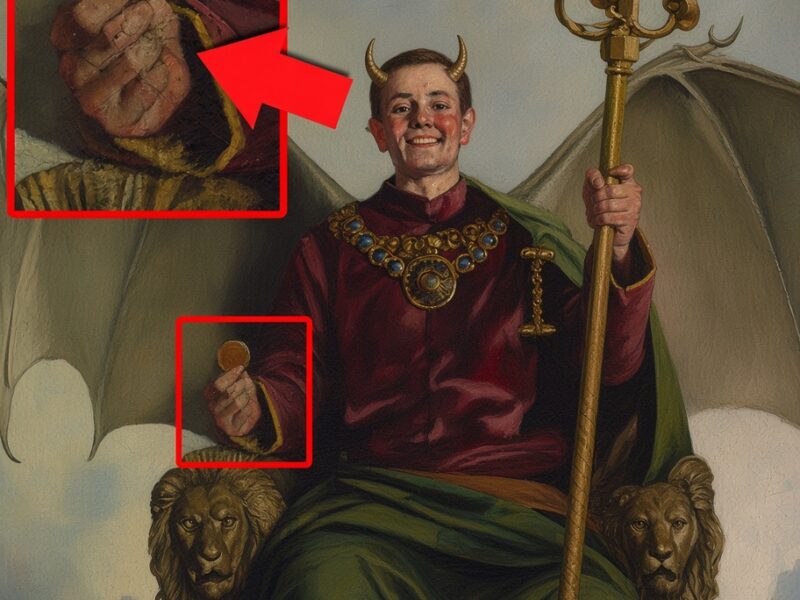
At first glance, this painting seems completely unfrightening. A man sits on an enormous throne. He is smiling, dressed in bright red and green robes, and holding a long staff. He looks like some kind of ruler.
But once the eye leaves the main figure and moves across the rest of the composition, details begin to emerge, and with them the true meaning of the work.
A small horned figure adorns his staff. Huge wings unfold behind him, and human skulls are scattered at the foot of the throne. His left hand points straight at the viewer, as if choosing the next victim. The message reads almost like a whisper: you will be next.
Gradually the separate details merge into one image. This is no longer simply a mysterious ruler, but Satan in human form.
The painting is Allegory of Satan, also known as Lord of the World, by the Polish artist Ludwik Stasiak, created around 1900.
Look at the face. It is not the face of a monster. It is entirely human, and yet the smile is disturbing, almost sinister. Stasiak deliberately avoids showing Satan as a creature one would instantly run from. He gives him the look of a powerful ruler, someone before whom a person might willingly bow.
The figure sits upright and faces the viewer directly, almost like a monarch in a formal portrait, looking down. Around him are all the attributes of grandeur and power. His luxurious robes resemble both royal garments and ecclesiastical vestments.
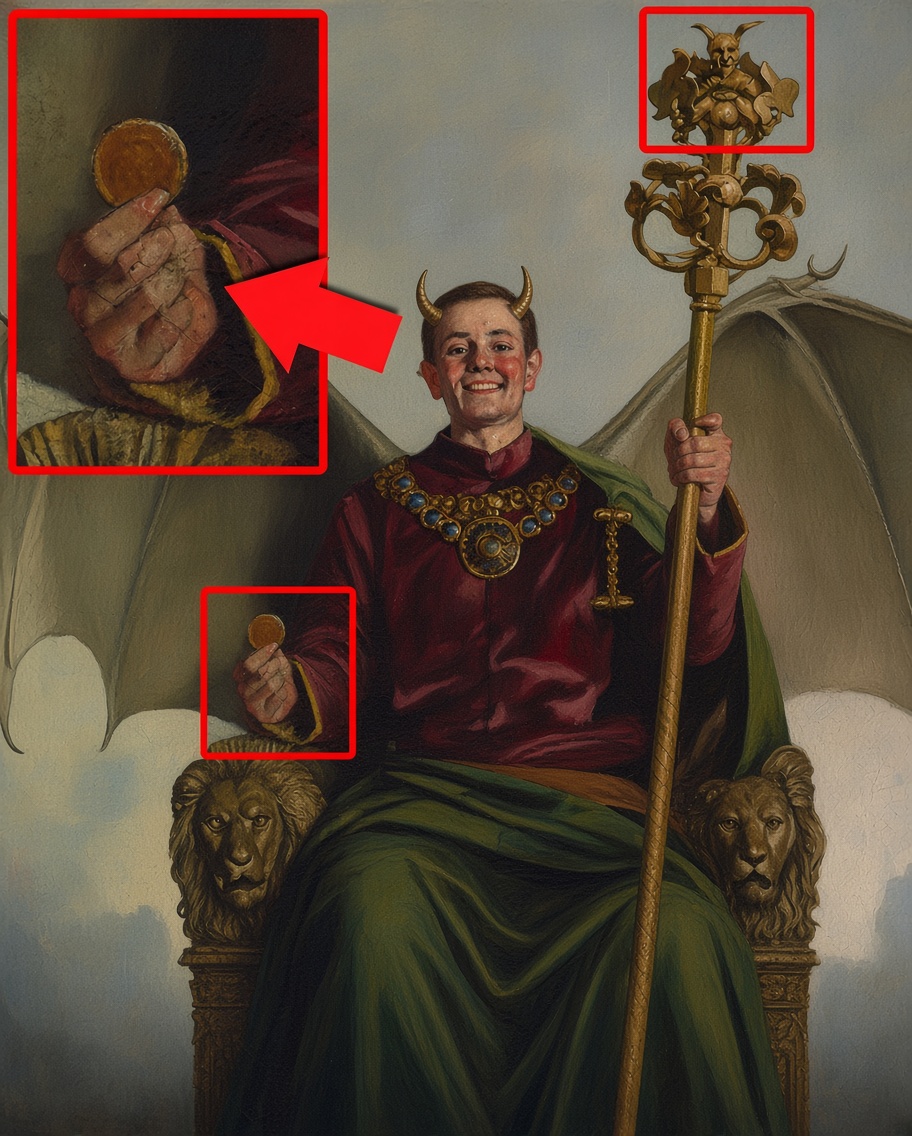
The throne itself is particularly striking. On either side are lion heads with snarling mouths, so lifelike that they seem ready to leap at the viewer. The lion has long been associated with strength, power, and royalty, and here it becomes a symbol of might.
But the detail that reveals his true nature is behind him. These are the wings. In Christian tradition, Satan is linked to Lucifer, the angel who rebelled against God and was cast down from heaven. The wings recall that original nature and serve as a visual reminder of the fall.
Even here, the artist does not try to make the image as frightening as possible. The wings look almost decorative, like another piece of ceremonial costume.
To the left of the throne are peacock feathers. In symbolic tradition, the peacock stood for vanity and pride, the first and gravest of the deadly sins. According to Christian theology, that very sin was enough to bring about Lucifer’s fall.
In one hand, Satan holds a long golden staff. It is a royal scepter, but it also resembles a bishop’s crosier, as if merging secular and spiritual authority in a single image.
In his other hand is an object that at first seems far less significant: a coin. Yet it becomes the key to the entire composition. Satan’s power here rests not only on fear or force. He holds what people themselves are willing to value enormously.
Now look at the lower part of the painting. At Satan’s feet lie scattered human skulls, and they are not random remains. Beside them are objects tied to social status and power: crowns, helmets, and other headwear.
Satan is not simply sitting on a throne. He towers over the remains of those who once tried to reach the top themselves. The skulls are more than a reminder that death is inevitable. They stand for fallen kings, warriors, and military commanders, people who lost their lives in pursuit of ambition.
There is a disturbing contrast between the illusion of vitality in the ruddy, smiling face on the throne and the deathly stillness at his feet. The skulls are silent witnesses that every bargain with this lord ends the same way.
The coins beside them are especially striking. They are scattered at the foot of the throne and gradually form a golden path leading straight to Satan. The eye follows it upward from one coin to the next until it reaches his hand, where he holds the last one.
The coin becomes a link between man and the devil. It is not just a symbol of wealth but a sign of choice, as if the artist were inviting the viewer to walk this path and take the final step toward what Satan promises.
In European painting, Satan was traditionally shown as the embodiment of horror and physical ugliness: horns, claws, fangs, animal-like features. Everything was meant to tell the viewer at once who stood before them. Such an image needed little explanation, since the devil looked alien, dangerous, and repulsive.
The time of this painting matters. Around 1900, the turn of the century, was an era of rapid industrial growth and profound spiritual crisis. Society was obsessed with material progress and the accumulation of capital.
Stasiak captured the spirit of his era. His Satan is not an archaic monster from medieval legend but a modern, pragmatic tempter who understands the psychology of an industrial age in which status and capital had become a new religion.
In traditional portrayals, Satan often arrives from outside as a destructive force set against humanity. Here, the devil already lives within the human world, in human form. He offers not horror but reward: wealth, power, high status.
That is exactly what makes the image so unsettling. If evil looks repulsive, it is easy to recognize. When it takes the form of greatness and success, it is much harder to resist.
On this reading, the painting is an allegory of power and wealth as temptation. It shows what appears to be a person’s path to the top. At the bottom are coins symbolizing earthly desires. A person follows them, chasing more money, more power, and more influence in order to rise above others, and at the end of that road waits Satan’s throne.
At its foot already lie those who followed the same path to the very end. Their skulls and crowns remind us that no one can hold power forever. A person can conquer lands, win a title, build a fortune, or become a ruler or commander. In the end, none of it can stand against death.
And still, Satan does not look like a monster. That may be the most disturbing detail of all. He does not frighten, he tempts. He is surrounded by the very things people have learned to value: gold, power, luxury, status, and recognition.
The faint smile on his face seems to say he does not even need to force anyone. He only has to offer what a person already desires, and they will take the step toward him willingly.
That is why the painting is called Lord of the World. Satan becomes its lord not by conquest but because people keep bringing him what they want most.
Not everyone reads it this way, and the painting has been interpreted in different ways. Some viewers see in it a straightforward religious horror image, a warning about damnation. The reading above treats it as something closer to a psychological portrait of humanity itself.
By that second reading, the artist created a brilliant illusion of meaning. As the viewer studies Lord of the World, they are, in a sense, looking into a mirror that reflects their own ambitions and hidden vices. It is not a distant fantasy about supernatural evil but a story about desires that live alongside every person.
The painting does not simply condemn greed or vanity. It leaves the viewer alone with an uncomfortable question: how powerful is the devil, really, if people willingly hand him the keys to their own fate?
Stasiak’s work erases the boundaries of time. The scenery may change, it suggests, but the mechanisms of human temptation do not.









