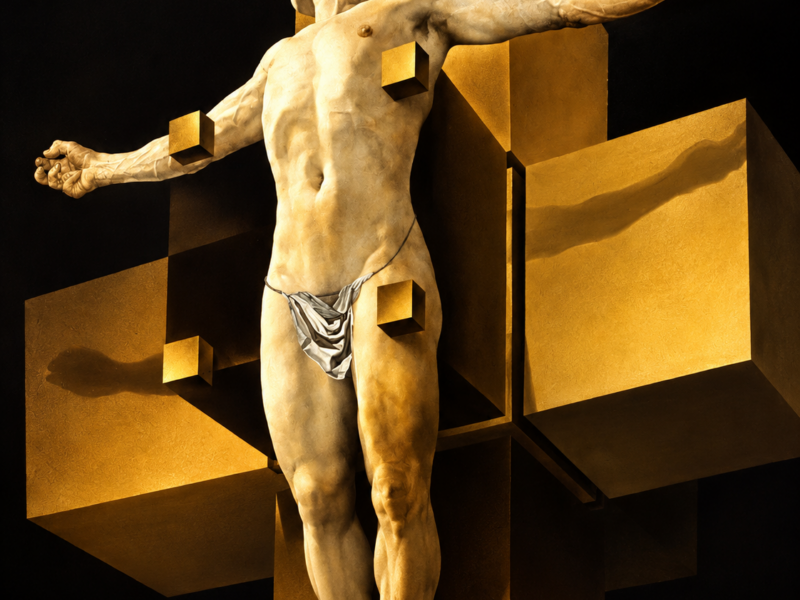
The Most Impossible Painting Ever
In 1954, Salvador Dalí presented a painting that no one quite knew how to describe. Not because it was abstract or incomprehensible, but quite the opposite.
The scene was perfectly clear: a crucifixion, Christ on the cross, and a female figure looking up from below. But something about that cross made no sense whatsoever.
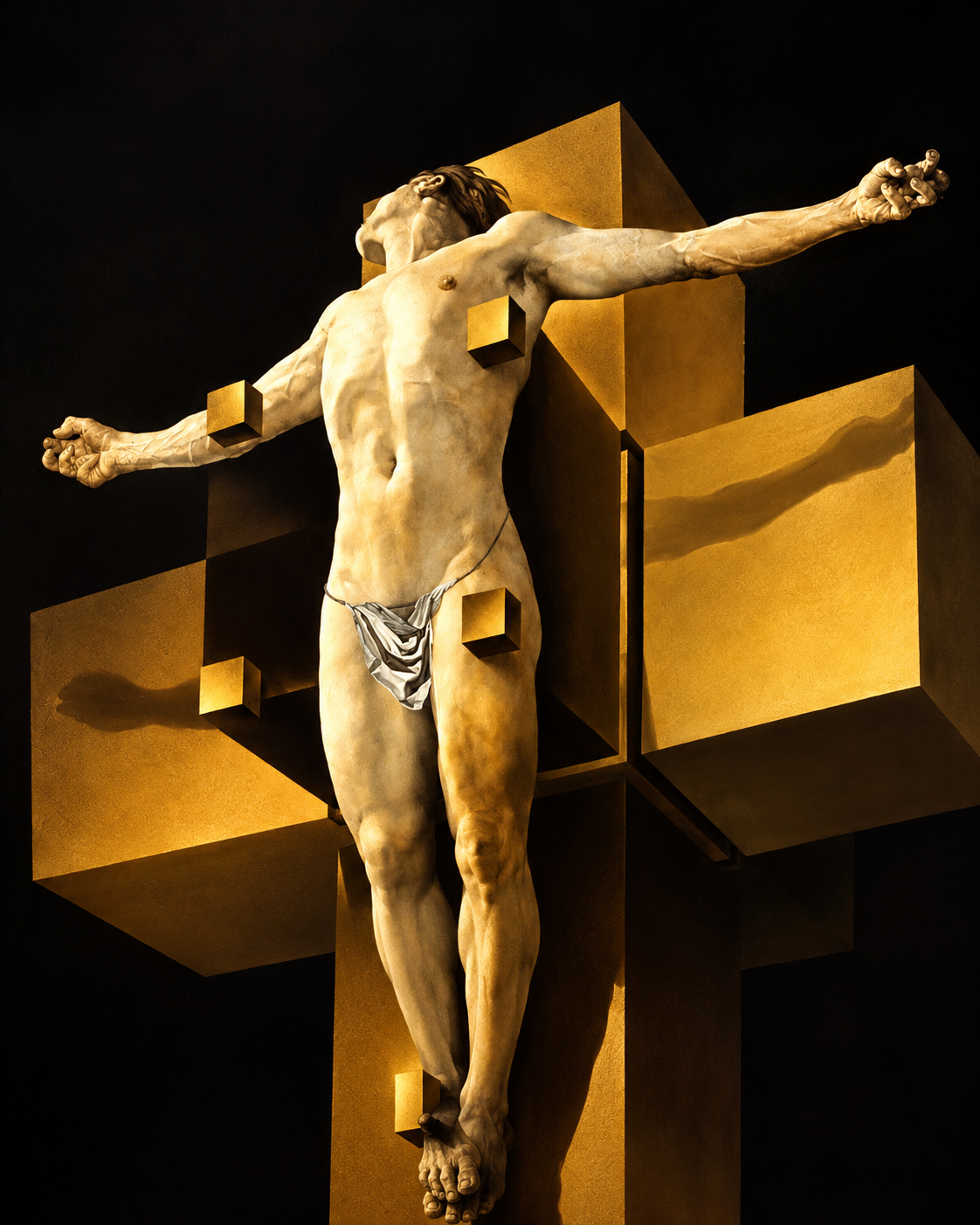
Dalí painted the cross as a geometric structure made up of eight perfect cubes, floating in the air in the middle of nowhere.
He spent four years on the work. Four years consulting with mathematicians, studying quantum physics and meeting with academics to make sure that what he painted was mathematically exact.
His aim was to show, with precision, something that exists in mathematical theory but that no human being has ever been able to see. It is the most famous crucifixion in the history of art, seen from a dimension we cannot access, literally.
The painting is called Crucifixion (Corpus Hypercubus). Dalí completed it in 1954, and today it is held at the Metropolitan Museum of Art in New York.
To understand why it is so extraordinary, we first need to understand what Christ is crucified on. As noted, it is not a cross at all. It is a hypercube.
We all know what a cube is: a shape with six faces, twelve edges and eight vertices. A perfectly regular form that exists in three dimensions.
Now take that cube and unfold it, opening it up like a cardboard box. The result is a cross, six squares connected to each other on the same plane.
A hypercube is the same idea, one dimension higher. Just as a cube exists in three dimensions, a hypercube exists in four. And just as an unfolded cube gives a cross of six squares, an unfolded hypercube gives a structure of eight cubes, exactly the one in the painting.
The problem is that human beings cannot see the fourth dimension. Our brains are simply not equipped for it.
So what Dalí painted, in the popular telling, is the three-dimensional shadow of an object that could only exist in a universe with four spatial dimensions. It is like someone living in a flat, two-dimensional world trying to imagine a cube. They could never see it. They could only see its shadow.
Purists might quibble with that comparison. An unfolded net, they would say, is not strictly the same thing as a shadow, though both are ways of squeezing a higher-dimensional object into a lower-dimensional picture. Either way, the effect on the viewer is the same: we are looking at something our eyes can only partly grasp.
By the time Dalí made this painting, he was already considered the most famous surrealist in the world. But his style had changed. Surrealism, with its obsession with dreams and the subconscious, no longer felt like enough.
In his later Antimatter Manifesto, from 1958, he wrote that during the surrealist period he had wanted to create the iconography of the interior world. Now he was fascinated by something completely different. His new father, he said, was no longer Freud but Heisenberg, the German physicist Werner Heisenberg, one of the fathers of quantum mechanics.
Dalí had discovered modern physics. What he found there did not seem to clash with his Catholic faith. It seemed exactly the opposite, a confirmation that reality was far larger and stranger than anything we could see.
He called it nuclear mysticism, a fusion of Catholicism, mathematics and science that would define the second half of his career. Corpus Hypercubus is often described as its purest expression.
Notice what is missing from the scene. There is no recognizable historical context. Christ is not in Jerusalem, and there is no crowd, as there usually is in paintings of the crucifixion.
All we see is a chessboard floor stretching toward an indefinite horizon. Above it, floating in space, hangs the structure of the hypercube.
Christ appears crucified on it without actually touching it. His body is perfect and muscular, with no sign of physical suffering. By painting him without nails or wounds, Dalí turns Jesus into a body that has transcended pain.
The intent, on this reading, is not to show the agony of the crucifixion, but the resurrection as a triumph over the physical laws of the universe.
The woman looking up is Gala, Dalí’s wife and lifelong muse. She stands where tradition would place Mary Magdalene, but she is not dressed in mourning. Her clothes are luxurious, because Dalí wanted her to represent the glory of humanity rather than its suffering.
Then there is the floor. Look carefully and you can make out five black squares on the chessboard that form the silhouette of a cross. It is a second cross hidden below, mirroring the one of the hypercube above, as if the same form existed in two different planes at once.
But what makes the painting truly remarkable is not only its visual complexity. It is the question it raises.
Dalí believed that science and religion were not opposites. The further physics went in exploring reality, he thought, the closer it came to what believers had called the divine for centuries. A universe with more dimensions than we can perceive, a reality that goes beyond what our senses can register.
The mathematician Thomas Banchoff, a professor at Brown University, collaborated with Dalí for almost a decade. When the artist showed him the painting, Banchoff immediately recognized the precision of the unfolded hypercube. In his view, it was not an artistic approximation but an exact representation.
That is what makes the work impossible in the most literal sense. Dalí painted, with mathematical precision, an object no human being can see.
The art critic Kelly Grovier has described the painting as having found a link between the spirituality of Christ’s salvation and the geometric and physical forces of matter. In his reading, it appears to bridge the divide between science and religion.
Not everyone would accept that bridge. A more skeptical viewer might see an artist borrowing the prestige of physics to dress up a traditional religious image, or find the pairing of quantum theory and Catholic mysticism more poetic than rigorous. Dalí’s admirers would answer that he never claimed to be doing laboratory science, only to be seeing the same reality from another angle.
The timing matters too. Dalí spent four years solving the mathematical and compositional problems of the painting, and he presented it in 1954, the same year CERN was founded in Geneva. He offered it to the world as his personal response to the atomic age.
It was an age in which humanity had learned to split the atom but still did not quite know what to do with that knowledge. And Dalí proposed something no one expected: that perhaps physics and faith were not describing different realities, but the same reality from different angles.
As he put it himself, “Scientists give me everything, even the immortality of the soul.”
Whether you read it as faith, physics, showmanship or all three, the painting still holds its ground. Seventy years on, a floating cross made of eight cubes keeps asking the same question: how much of reality can we actually see?









