The Most Disturbing Painting Has Not a Drop of Blood in It
There is a painting that has spent more than a century making people uncomfortable, and there isn’t a single drop of blood in it. There are no monsters, no corpses, and no violence at all, really. There are just two people and a locked iron gate standing between them.
Somehow, out of everything you’re about to see, this is the one that stays with people the longest. We’ll stand in front of it properly before the end. But first, a warning: some paintings only make sense once you’ve seen what they’re standing next to. So we start somewhere darker.
It’s around 1820, at a farmhouse outside Madrid. Inside lives a painter named Francisco Goya. He is in his 70s and completely deaf, and he has been for almost 30 years. He has survived a war and disease, and he has buried nearly everyone he ever loved.
Lately, he has been doing something strange. He is painting directly onto the walls of his house. Nobody asked him to. He never sells these paintings, never shows them to a soul, and never mentions them, not in a single letter.
In the room where he eats dinner alone every night, he paints a giant, wild-eyed god devouring his own child. The story comes from an old myth. Saturn was told his children would one day destroy him, so, one by one, he ate them.
But forget the myth and look at the eyes. That isn’t hunger, it’s fear. He knows exactly what he’s doing, he knows it’s monstrous, and he cannot stop.
Here’s the part that lingers. Goya never wanted anyone to see this. He died, and decades later, strangers peeled it off his wall and hung it in a museum. Looking at it means looking inside a lonely old man’s head without his permission.
Now for the most talked-about painting of 1782. When it appeared in London, crowds lined up to see it. A woman lies asleep, thrown back across her bed. A small demon sits on her chest, staring straight at you. Behind the curtain, a horse with white, blind eyes pushes its head into the room.
People called it shocking and indecent, and they bought thousands of copies anyway. But nobody knew the real story, because the real story is on the back.
Turn the canvas around and you’ll find a half-finished portrait of a young woman. Her name was Anna. The painter, Henry Fuseli, was in love with her and wanted to marry her. Her family said no, and she married another man.
Fuseli never recovered. He once wrote a letter describing a dream in which she belonged to him. Then he painted a sleeping woman with a demon on her chest, and hid Anna’s face on the back of the canvas.
Many historians believe the demon is Fuseli himself. If so, this was never a painting about a nightmare. It’s a painting about being one, about a man who couldn’t have someone, so he sat on her chest forever. Others caution that the portrait on the back proves nothing about the painting’s intent, and that the reading owes as much to romantic legend as to evidence.
This next one comes with fair warning: the story behind it is worse than the painting. In 1816, a French ship called the Medusa ran aground off the coast of Africa. There weren’t enough lifeboats, so the crew built a raft, loaded 147 people onto it, and cut the rope.
Thirteen days later, rescue finally arrived. Fifteen people were still alive. The survivors told the world what happened out there: the fighting, the madness, and the thing nobody wanted to say out loud. When the food ran out, the living ate the dead.
A young painter named Théodore Géricault heard the story and couldn’t let it go. He decided to paint it, enormous, the size of a wall. But he refused to imagine death. He wanted the real thing.
So he went to the hospital near his studio and borrowed pieces from the morgue: real severed heads, real arms, real legs. He kept them in his studio for weeks, painting them day after day as they rotted around him. Those practice studies still exist.
The big finished canvas hangs in the Louvre today, where millions admire it. Almost none of them know what was sitting in that studio.
Now travel to Rome in 1611. A young woman named Artemisia Gentileschi is one of the most gifted young painters in the city. Her private art teacher is a man named Agostino Tassi. One afternoon, he violates her trust in the worst possible way.
Her father takes it to court, and here is the part that should make your blood boil. To test whether she was telling the truth, the court tortured her. Not him. Her. Tassi was found guilty, and he walked free.
So Artemisia picked up her brush and painted Judith Beheading Holofernes. It’s an old Bible story, and plenty of artists had painted it before her. Their Judith always looks delicate and hesitant, turning away from the blood.
Artemisia’s Judith does not turn away. Her sleeves are rolled up, and she is working. Look closer, and Judith’s face looks a lot like Artemisia’s, while the man losing his head looks a lot like Tassi.
Historians still argue about whether she did that on purpose. Some see a deliberate act of revenge, while others see a coincidence of faces and a story read backward from her ordeal. Look at the painting and decide for yourself.
And now, the painting you came here for. You’ve just seen a god eating his child, a demon born of obsession, body parts rotting in a studio, and a woman painting her revenge. So how can a painting in which nothing violent happens at all be the most disturbing of them all?
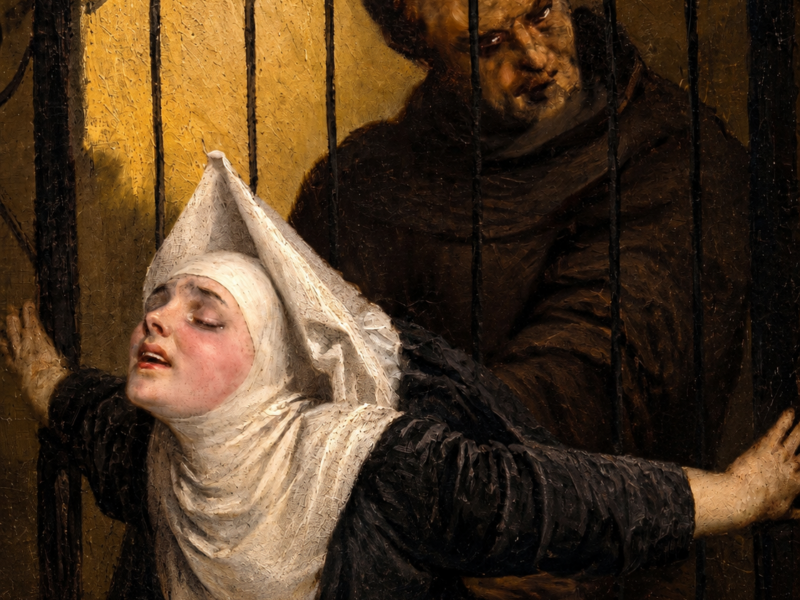
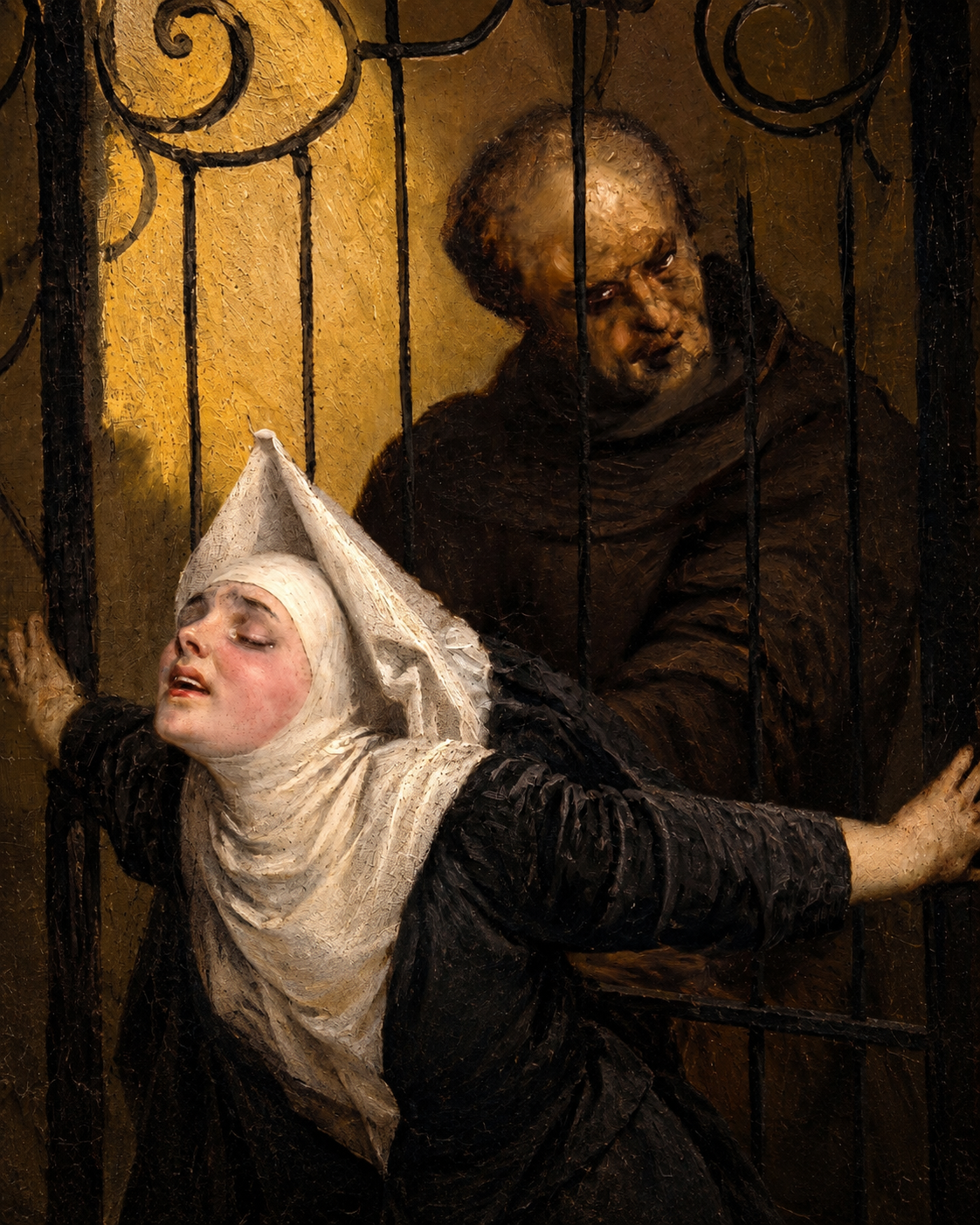
This is The Sin, painted in Germany in the 1880s by a man named Heinrich Lossow. Here’s the first surprise: Lossow was no outcast. His day job was caring for paintings in a royal gallery. He was a guardian of art, and in private, he painted this.
The scene is a convent. A heavy iron gate, built for one purpose only, keeps the world out and the nuns in. Pressed against those bars are a nun and a monk, two people who swore before God never to touch anyone like this.
Her robes are slipping, and his hands are reaching through. The gate is doing its job, keeping them apart. And somehow, it still works.
Lossow was a respectable man, trained at the academy in Munich and employed to look after other people’s masterpieces. So why would a man like that paint this? Because of a story the church had been trying to live down for almost 400 years.
Rome, October 1501. Inside the Vatican itself, the Pope’s own son, Cesare Borgia, throws a private party. Fifty courtesans are brought in for the night. They dance, first in their clothes, then without them.
Candles are set out on the floor and chestnuts are scattered between the flames. The women are made to crawl among them, collecting the chestnuts while the guests watch.
Then come the prizes: silk tunics and fine shoes for the men who could perform with the women the most. And watching all of it, according to the account, was the Pope himself.
Did that night really happen? Historians have fought over it for 500 years, because the story comes from a single source. But that source is the problem. It wasn’t written by an enemy of the church. It was the private diary of the Vatican’s own master of ceremonies, an insider. Defenders of the Borgias counter that one diary, however well placed its author, is thin ground for a story this lurid.
Now look at the painting again, because many believe this is the world Lossow was pointing at. Some go further and suggest the monk at the gate is Cesare Borgia himself, the man who hosted that party, painted in the robes of a man of God and taking one more thing that was never his to take. That identification is a theory, and no document confirms it.
Lossow could have painted the banquet, the candles, the crowd, an easy shock. He didn’t. He painted something smaller: two people, one gate, one broken vow.
A wild night in 1501 you can argue about. But this could be any convent, any century, any night. That’s the accusation, and the church understood it perfectly. It formally condemned him for it.
Every one of the other paintings we’ve covered hangs in a museum today, and you could go and stand in front of them tomorrow. But The Sin is gone. It vanished into private hands, and to this day, nobody on Earth can tell you where it hangs.









