The Mask Cast Then and Now in 2026: The Stars Who Exploded, the Ones Who Vanished, and the Faces We Sadly Lost
A shy bank clerk spends his days apologizing for taking up space.
Then he slips on a strange wooden mask, and a green-faced hurricane tears through the city.
The dancing, the cartoon-sized effects, and the laughter that shook movie theaters in 1994 were pure magic.
But the people behind that chaos were living very different stories.
Some became global stars, some built quiet and respected careers, and a few left this world far too soon.
So who are they now, and what happened after the green faded?
The Movie That Turned 1990s Comedy Inside Out
The Mask was more than a comedy.
It was a burst of 1990s movie magic where one timid man became a force of pure, joyful chaos.
Behind the wild effects were actors whose lives moved in very different directions.
Here is where the cast of The Mask stands in 2026, one character at a time.
Jim Carrey as Stanley Ipkiss: One Lonely Man, Two Personalities
Stanley Ipkiss became one of the defining comedy characters of the 1990s.
Jim Carrey made two completely different personalities feel like parts of the same lonely man.
Born in 1962, Carrey was 32 when The Mask premiered in 1994.
Stanley begins as a shy bank clerk who is ignored, embarrassed, and almost permanently apologizing for existing.
The mask changes that instantly, unleashing confidence, desire, and chaos on a cartoon scale.
What makes the performance unforgettable is that Carrey never loses the connection between the quiet man and the green-faced hurricane.
The wild physical comedy works because it feels like everything Stanley has suppressed finally exploding into public view.
The film arrived in the year that transformed Carrey into a major Hollywood star.
His career soon expanded far beyond broad comedy.
The Truman Show, Man on the Moon, and Eternal Sunshine of the Spotless Mind revealed an emotional and dramatic range that surprised many who had only seen the rubber-faced comedian.
Those performances proved that the sensitivity underneath Stanley was no accident.
It became an important part of Carrey’s screen identity.
In 2026, Jim Carrey is 64.
His career has moved through enormous fame, reinvention, and periods of greater distance from Hollywood.
Yet Stanley remains one of the roles that best captures his rare mix of vulnerability and explosive performance.
The character endures because Carrey made self-expression look hilarious and liberating.
Underneath all the noise, though, was someone who simply wanted to stop feeling invisible.
Peter Riegert as Lieutenant Mitch Kellaway: The Last Sane Man in Edge City
Lieutenant Mitch Kellaway works because Peter Riegert refuses to compete with the madness around him.
Born in 1947, Riegert was 47 when The Mask arrived.
He plays Kellaway as a weary detective trying to apply ordinary police logic to a situation that has abandoned ordinary rules.
His suspicion of Stanley gives the film a useful anchor.
While Carrey bends reality, Kellaway is trying to write reports, follow the evidence, and understand why every explanation seems more impossible than the last.
Riegert’s restraint makes that contrast funny without turning the detective into a fool.
He gives Kellaway enough competence and seriousness that the character feels like a real policeman trapped inside somebody else’s cartoon.
Riegert had already built a respected career long before 1994, with Animal House and Local Hero among his earlier work.
Afterward, he kept moving across film, television, theater, directing, and voice performance.
It was the kind of durable character actor career built on intelligence and understatement, not on one defining star persona.
In 2026, Peter Riegert is 79.
Kellaway is only one chapter in a much broader body of work, but it remains memorable because Riegert understood exactly what the movie needed from him.
Stillness.
The louder the world around him became, the more effective his skeptical reactions felt.
Lieutenant Kellaway endures because he gave the audience a human reference point, the face of reasonable disbelief watching Edge City lose its mind.
Peter Greene as Dorian Tyrell: The Darker Reflection
Dorian Tyrell is the darker reflection of Stanley Ipkiss.
Peter Greene gives him the kind of menace that exists long before the supernatural ever enters the story.
Born in 1965, Greene was 29 when The Mask premiered.
Dorian is ambitious, ruthless, and determined to rise beyond the criminal hierarchy surrounding him.
But what makes him truly effective is the restraint underneath that hunger.
Greene does not need constant shouting to make the character dangerous.
His stare, his posture, and his controlled delivery suggest someone already comfortable with intimidation.
When Dorian finally uses the mask himself, the contrast with Stanley becomes clear.
The same power that releases Stanley’s suppressed joy amplifies Dorian’s appetite for domination.
That role fit naturally with the intense screen identity Greene was developing during the 1990s.
He kept working across crime films, thrillers, and television, often playing unpredictable men whose danger came from an unsettling calm instead of obvious theatrics.
That quality made him one of those character actors audiences recognize immediately, even when the role is relatively compact.
In 2026, Peter Greene is 61.
Dorian remains one of the performances most closely tied to the darker side of the mask, because Greene never lets him become a merely cartoonish villain.
He gives him real resentment, ambition, and physical threat.
Dorian Tyrell endures because Greene made power look seductive before making it monstrous.
He is the perfect reminder that the mask does not create character so much as reveal what was already waiting underneath.
Amy Yasbeck as Peggy Brandt: When a Friendly Face Is the Real Disguise
Peggy Brandt initially feels like one of the few people willing to listen to Stanley.
That makes her betrayal far more important than her screen time might suggest.
Amy Yasbeck, born in 1962, was 32 when The Mask arrived.
Peggy is intelligent, approachable, and professionally curious, offering Stanley a moment of sympathy in a world where he is constantly ignored or pushed aside.
That is exactly why her decision to sell him out lands so sharply.
Yasbeck plays the character with enough warmth that the turn never feels obvious from the start.
In a film built around literal disguises, Peggy becomes another kind of mask, with friendliness covering self-interest.
Outside the movie, Yasbeck kept up a steady career across television and film, especially in comedy and supporting roles where her natural warmth shone.
Her life later carried a very different and deeply public chapter after the death of her husband, actor John Ritter.
She became connected to advocacy involving heart health and awareness, turning personal loss into work meant to help others understand similar medical risks.
In 2026, Amy Yasbeck is 64.
Peggy is a relatively small part of The Mask compared with Stanley, Tina, or Dorian, but the character serves an important emotional purpose.
Stanley has already learned to expect ridicule.
Betrayal is something different, and Yasbeck makes that disappointment feel grounded and believable.
Peggy Brandt endures because she reminds us that not every dangerous mask is green or magical.
Sometimes it looks exactly like trust.
Richard Jeni as Charlie Schumaker: The Funny Friend With a Heavy Secret
Charlie Schumaker represents the kind of confidence Stanley believes he is missing.
Richard Jeni gave that friendship a fast, restless comic energy.
Born in 1957, Jeni was 37 when The Mask premiered.
Charlie is louder, more socially comfortable, and far more willing to chase nightlife and women than Stanley, making him an immediate contrast to his timid friend.
He pushes Stanley toward a bolder life, though the confidence he shows is often more surface-level than truly deep.
Jeni played him with the speed of an experienced comedian, using timing and quick delivery to keep Charlie entertaining even when the character was not especially sensitive to Stanley’s insecurity.
That skill came from a career rooted firmly in stand-up.
Jeni remained best known as a gifted comedian with sharp timing, intelligence, and a strong television presence after The Mask.
His professional identity stretched far beyond this supporting film role, built on live performance and observational humor instead of conventional leading-man fame.
His private life, however, took a tragic turn.
Jeni struggled with severe clinical depression, and he died in 2007 at the age of 49.
That knowledge gives his comedy a more complicated emotional afterlife, especially for viewers who knew him mainly as someone associated with laughter.
Charlie Schumaker remains memorable because Jeni made him feel energetic and believable instead of just the confident friend.
Behind the role sits a much sadder real-life story, a reminder that the people who create effortless laughter on screen can be carrying struggles audiences never see.
Orestes Matacena as Nico: The Old Order of Edge City
Nico gives Edge City’s criminal world an established order before Dorian decides that order should belong to him.
Orestes Matacena, born in 1941, was 53 when The Mask premiered.
His age gives Nico the authority of a man who has spent years learning how power is maintained.
He is not impulsive the way Dorian is.
Nico represents control, hierarchy, and the expectation that fear will keep working because it always has.
That contrast makes Dorian’s ambition more meaningful.
The younger gangster is not simply committing crimes, because he is trying to replace an older system with himself at the center.
Matacena plays Nico with a stern, watchful quality that lets limited screen time carry real weight.
He does not need elaborate characterization, because the performance communicates status immediately.
Outside The Mask, Matacena continued across acting, writing, producing, and directing, giving his career a broader creative shape than screen performance alone.
That versatility suggests a professional life spent both in front of and behind the camera, not one defined by a single memorable mob role.
In 2026, Orestes Matacena is 85.
Nico remains important to the film because he gives Dorian something to rebel against and makes the criminal subplot feel like an existing world instead of a collection of random villains.
Nico endures because he represents old power, controlled, confident, and convinced that the structure protecting him will last forever.
That belief holds right up until someone hungrier decides the old rules no longer matter.
Tim Bagley as Irv: The Ordinary Man Staring at the Impossible
Irv appears only briefly, but Tim Bagley understands exactly what a scene like his needs.
It needs a completely ordinary reaction to something impossible.
Born in 1957, Bagley was 37 when The Mask premiered.
As one half of the auto-shop duo confronted by Stanley’s increasingly surreal behavior, Irv acts as a human measuring stick for the audience.
The more unbelievable the mask becomes, the funnier it is to watch normal people stand nearby, trying to understand what they have just witnessed.
Bagley’s strength lies in reaction, not spectacle.
A pause, a look, or a moment of disbelief can sell a joke just as effectively as the wild action happening in front of him.
That instinct became central to his later career.
Bagley built a long and respected life as a character actor, particularly in comedy, appearing across television, film, sitcoms, ensemble projects, and guest roles where dry intelligence and timing made smaller parts memorable.
He became one of those performers whose face audiences recognize from many different productions, even when they cannot place the name.
In 2026, Tim Bagley is 69.
Irv is far from the most important character in The Mask, but that is exactly why the performance shows the value of a strong supporting actor.
Someone has to react when reality collapses.
Bagley makes that reaction funny without pulling attention away from Jim Carrey.
Irv endures as one of the film’s small comic witnesses, the ordinary man looking at impossible chaos and silently asking the same question the audience is thinking.
Nancy Fish as Mrs. Peenman: The Landlady Who Never Lets Stanley Relax
Mrs. Peenman is one of the many reasons Stanley’s ordinary life feels exhausting before the mask ever appears.
Nancy Fish, born in 1938, was 56 when the film opened in 1994.
She plays Stanley’s landlady with the sharp irritation of someone who seems permanently ready to complain.
The character is small, but she contributes to an important pattern.
Stanley is dismissed at work, exploited by strangers, unlucky in romance, and unable even to go home without another reminder that someone is judging him.
Mrs. Peenman becomes part of the pressure surrounding his everyday existence.
Fish gives her a recognizable busybody energy without needing a large storyline, turning the hallway itself into another place where Stanley cannot quite relax.
Outside The Mask, Fish continued a long career in film and television across comedy, drama, and character parts.
Her distinctive screen presence made her well suited to roles where only a few scenes were needed to establish personality quickly.
In 2026, Nancy Fish is 88.
Her longevity gives Mrs. Peenman an interesting place within a cast that has followed many different paths since 1994.
The role remains memorable because it contributes to Stanley’s emotional setup without drawing attention to itself.
The mask feels liberating partly because his normal life contains so many small frustrations.
Mrs. Peenman endures because Fish turns everyday annoyance into something larger, one more voice telling a timid man that even in his own home, he is never completely free from somebody else’s expectations.
Denis Forest as Sweet Eddie: Danger That Arrives Smiling
Sweet Eddie adds an offbeat rhythm to Dorian’s crew.
Denis Forest makes the character memorable by refusing to play him exactly like the other henchmen.
Born in 1960, Forest was 34 when The Mask premiered.
Eddie lives inside a dangerous criminal world, yet his energy can be looser, stranger, and almost cheerful compared with the cold menace around him.
That variation matters.
Dorian’s gang would feel much flatter if every supporting villain behaved identically.
Freeze brings stillness, others bring physical intimidation, and Sweet Eddie contributes a more unpredictable comic edge that keeps the gang connected to the film’s larger tone.
Forest uses limited screen time effectively, suggesting someone who can appear foolish or amusing while still belonging to a genuinely violent environment.
Outside The Mask, he worked steadily across film and television, often in character roles that benefited from his distinctive appearance and adaptable screen presence.
His career, however, was cut tragically short.
Denis Forest died in 2002 at the age of 41.
That early death makes his surviving performances especially significant, because they preserve a career that never had the chance to grow old.
Sweet Eddie remains a small part of The Mask, but Forest gives him enough personality to keep him from disappearing into the background.
The character endures because he helps make Edge City feel unpredictable.
In this world, danger does not always look grim or serious.
Sometimes it arrives smiling, joking, and standing just close enough to remind you that the laughter can stop very quickly.
Blake Clark as Murray: Gruff Warmth Behind the Bar
Murray brings a little ordinary friendship into Stanley’s increasingly extraordinary life.
Blake Clark gives the role the kind of gruff warmth that makes a small character feel familiar.
Born in 1946, Clark was 48 when The Mask premiered.
As a bar owner, Murray exists in the everyday social world Stanley struggles to navigate before supernatural chaos takes over.
He is not central to the plot, but his presence reminds us that Stanley does have connections beyond work and his apartment.
Clark’s dry timing and distinctive voice give those brief scenes an easy, lived-in quality.
That combination became a recognizable part of his wider career.
He kept working extensively across film, television, and comedy, often playing fathers, veterans, blue-collar men, and characters whose rough surfaces concealed generous hearts.
His voice work also introduced him to younger audiences through animated films, broadening a career that had already included decades of live-action performance.
In 2026, Blake Clark is 80.
That longevity has made him one of those enduring character actors whose contributions add up across many projects, not one famous leading role.
Murray remains a small but useful part of The Mask because Clark makes him feel as though he existed before the movie began and would still be there after Stanley’s impossible adventure ended.
The character endures because ordinary friendship matters in a story built around transformation.
Murray is part of the normal world Stanley wants to belong to, proof that not every meaningful connection requires magic, spectacle, or a green face.
Nils Allen Stewart as Orlando: Danger Needs a Body
Orlando helps give Dorian’s organization a physical reality.
Nils Allen Stewart brings the kind of presence that comes from genuine experience in stunt and action performance.
Born in 1962, Stewart was 33 when The Mask premiered.
Orlando is one of the henchmen surrounding Dorian, and his role depends less on detailed dialogue than on size, movement, and intimidation.
In a film where supernatural comedy can become almost limitless, characters like Orlando matter because they remind the audience that Stanley is also colliding with a criminal world capable of real physical danger.
Stewart’s background gives that threat credibility.
After The Mask, he continued working as a stuntman, actor, and action performer across many productions, contributing to an area of filmmaking that viewers often experience without knowing the names behind it.
Stunt work demands precision, timing, physical control, and an understanding of how danger should look on camera while remaining carefully constructed behind the scenes.
That expertise shows in the way Stewart uses movement instead of dialogue to establish Orlando.
In 2026, Nils Allen Stewart is 64.
His career reflects the long professional life possible within Hollywood outside conventional stardom, where physical storytelling can stay valuable for decades.
Orlando endures less because of a personal storyline and more because Stewart helps give the film’s villains weight.
Dorian’s threats feel more believable when the people standing behind him look capable of carrying them out.
Even inside a movie built on cartoon logic, danger still needs a body.
Joely Fisher as Maggie: A Moment of Simple Kindness
Maggie provides a brief glimpse of warmth in Stanley’s ordinary life.
Joely Fisher makes that kindness feel meaningful precisely because the scene never needs to become a major subplot.
Born in 1967, Fisher was 27 when The Mask premiered.
As a waitress, Maggie belongs to the everyday world Stanley inhabits before the supernatural transformation takes over.
Her friendliness suggests something important about him.
Perhaps he is not quite as invisible or hopeless as he believes.
The character does not change the course of the story, but she offers a contrast to the rejection, humiliation, and frustration surrounding Stanley elsewhere.
Fisher brings an easy screen warmth that makes Maggie feel genuine instead of merely functional.
After The Mask, she continued a successful career across television, comedy, drama, and stage work.
She also came from an entertainment family while still building a professional identity of her own, an important distinction for someone entering an industry already tied to a recognizable family legacy.
In 2026, Joely Fisher is 59.
Her career extends far beyond this brief appearance, but Maggie remains a pleasant part of The Mask’s quieter texture.
The role works because the movie cannot be entirely chaos.
Stanley’s transformation only matters if viewers understand the ordinary world he is trying to escape and the connections he might have found without magic.
Maggie endures because Fisher makes kindness feel simple and unforced.
In a story obsessed with masks, performances, and exaggerated confidence, she briefly suggests that Stanley may not have needed to become someone else to deserve a little warmth.
Ben Stein as Dr. Arthur Neuman: The Voice of Reason in a World Without It
Dr. Arthur Neuman becomes funny by treating the impossible as though it belongs in an ordinary professional consultation.
Ben Stein’s famously dry delivery makes that contrast work perfectly.
Born in 1944, Stein was 50 when The Mask premiered.
Neuman tries to analyze Stanley’s strange condition using calm language and psychological explanation, creating one of the film’s most effective tonal contrasts.
Jim Carrey’s performance is built on movement, noise, and elastic physicality.
Stein barely needs to move at all.
That stillness becomes the joke.
The character also fits one of the movie’s broader ideas, that people are constantly trying to understand the hidden selves beneath social behavior, even when no rational explanation can fully account for what Stanley is experiencing.
Stein had already become recognizable through his famously monotone screen persona, with Ferris Bueller’s Day Off as an earlier example of how effectively he could turn flat delivery into comedy.
After The Mask, he remained a familiar public figure across acting, writing, television, political commentary, and broader pop culture.
That unusually varied career kept his voice and manner instantly recognizable, far beyond any single film role.
In 2026, Ben Stein is 82.
Dr. Neuman remains a relatively small part of The Mask, but the character shows how strong contrast can produce comedy without elaborate material.
Stein does not try to outperform Carrey.
He does the opposite.
Dr. Neuman endures because his calm makes the surrounding madness even louder, the perfect professional voice of reason trying to diagnose a world that has already abandoned reason entirely.
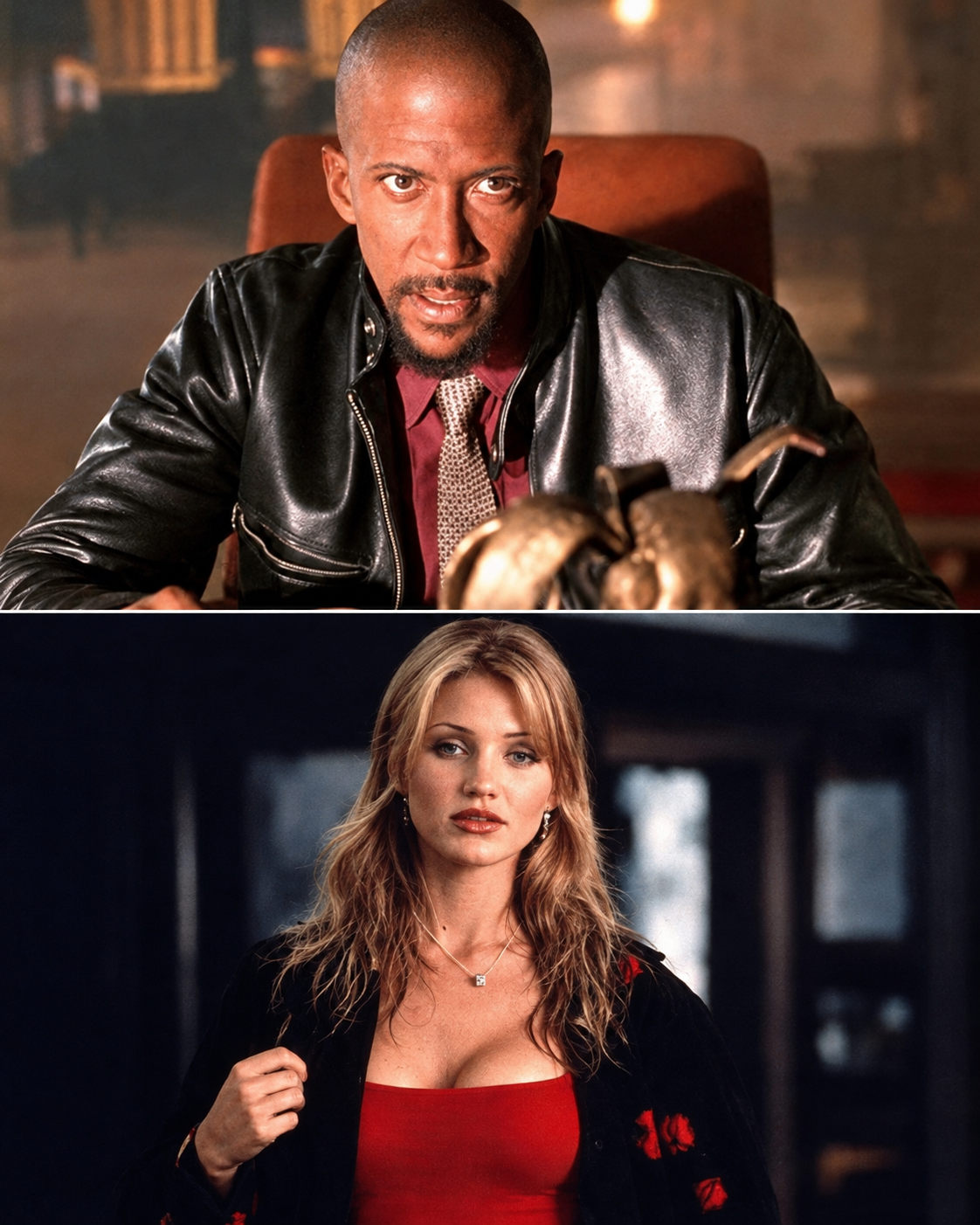
Reg E. Cathey as Freeze: The Quietest Man in the Room
Freeze barely needs dialogue to change the atmosphere around Dorian Tyrell.
Reg E. Cathey brings the role a quiet intensity that makes the criminal side of The Mask feel more dangerous.
Born in 1958, Cathey was 36 when the film premiered.
Freeze works because he does not compete with Dorian’s ambition or Carrey’s manic energy.
Instead, he provides stillness.
His presence suggests that real violence exists underneath the film’s comic surface, grounding the gangsters just enough that their threat never becomes entirely cartoonish.
Cathey’s voice, posture, and gaze give the character a sense of intelligence behind the intimidation, even with limited material.
That ability to bring depth to supporting roles later became one of the defining strengths of his career.
He earned major recognition through performances in The Wire and House of Cards, projects that gave him far richer opportunities to display authority, warmth, and emotional complexity.
Those later roles helped establish Cathey as one of television’s most admired character actors.
Reg E. Cathey died in 2018 at the age of 59.
His death came far too early, but by then he had built a body of work respected well beyond his appearance in The Mask.
Looking back, Freeze feels like an early example of the qualities that made Cathey so effective.
Economy, control, and the ability to make a small role feel heavier than the page might suggest.
Freeze endures because Cathey proves that menace does not always need noise.
Sometimes the quietest man in the room is the one audiences remember.
Cameron Diaz as Tina Carlyle: The Night a Star Was Born
Tina Carlyle was Cameron Diaz’s first film role.
It immediately announced a screen presence Hollywood would spend the next two decades building around.
Born in 1972, Diaz was only 22 when The Mask premiered.
Tina enters with glamour, but the character works because Diaz gives her enough warmth and vulnerability to exist beyond that first impression.
She is caught inside Dorian’s dangerous orbit while becoming increasingly drawn toward Stanley’s gentler nature, allowing the romantic side of the story to balance the film’s explosive comedy.
Her chemistry with Jim Carrey is especially important, because his performance operates at such an extreme level.
Diaz does not try to match that energy.
She provides contrast.
After The Mask, her career expanded rapidly.
Fairly soon came There’s Something About Mary, Charlie’s Angels, and Shrek, projects that show how easily she moved among comedy, romance, action, and animation.
She became one of Hollywood’s biggest stars of the late 1990s and 2000s before stepping back from acting for a significant period.
Even during that absence, her screen legacy stayed secure, because so many of her films had become major parts of popular culture.
In 2026, Cameron Diaz is 54.
Looking back, Tina Carlyle is remarkable not only as a memorable character, but as the beginning of an enormous career.
Diaz arrived in a major studio film with no previous movie résumé and immediately looked completely comfortable on screen.
Tina endures because that first entrance captured something audiences would recognize for years afterward.
Glamour balanced by humor, confidence softened by vulnerability, and the unmistakable feeling that a new star had just arrived.
The Mask Is Back in the Box, but the Energy Is Still Loose
The mask may be back in its box.
But its energy still feels impossible to contain.
Stanley, Tina, Dorian, Kellaway, and the rest helped create a film that mixed comedy, romance, danger, and pure cartoon madness into something unforgettable.
Some of the cast are still with us, while others left behind performances that now carry extra meaning.
Which transformation surprised you most?
Share your thoughts in the comments below, and tell us which Edge City character you still can’t shake.









